
Simulations of the response of the Mars ionosphere
- Slides: 27
Simulations of the response of the Mars ionosphere to solar flares and solar energetic particle events Paul Withers withers@bu. edu EGU meeting Vienna, Austria 2012. 04. 27 EGU 2012 -1449 XY 474
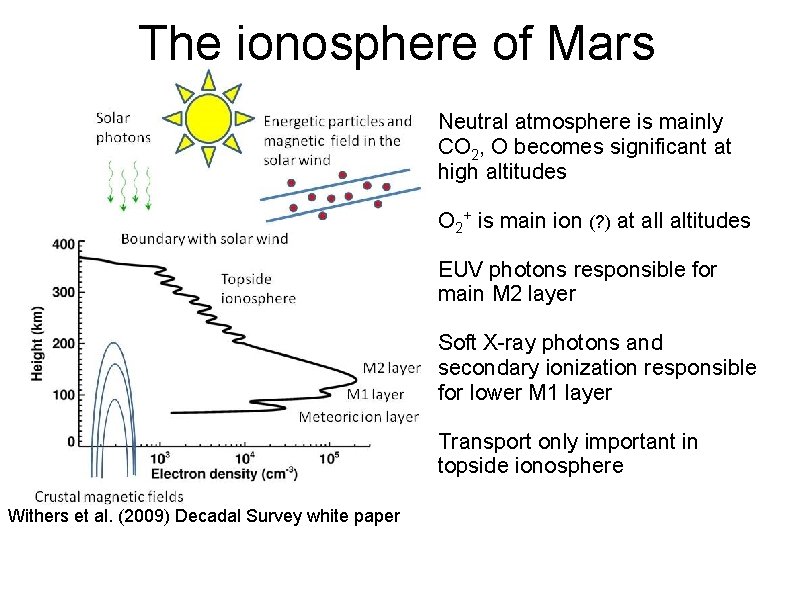
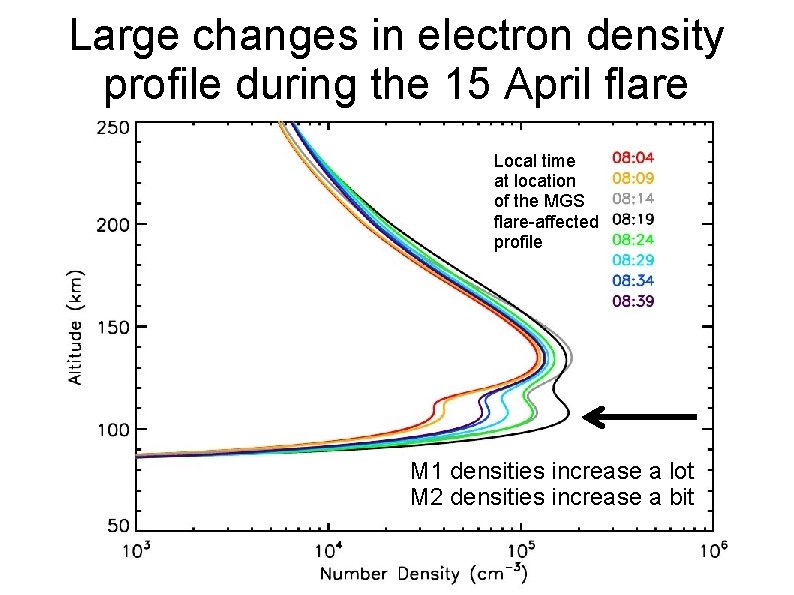
The ionosphere of Mars Neutral atmosphere is mainly CO 2, O becomes significant at high altitudes O 2+ is main ion (? ) at all altitudes EUV photons responsible for main M 2 layer Soft X-ray photons and secondary ionization responsible for lower M 1 layer Transport only important in topside ionosphere Withers et al. (2009) Decadal Survey white paper
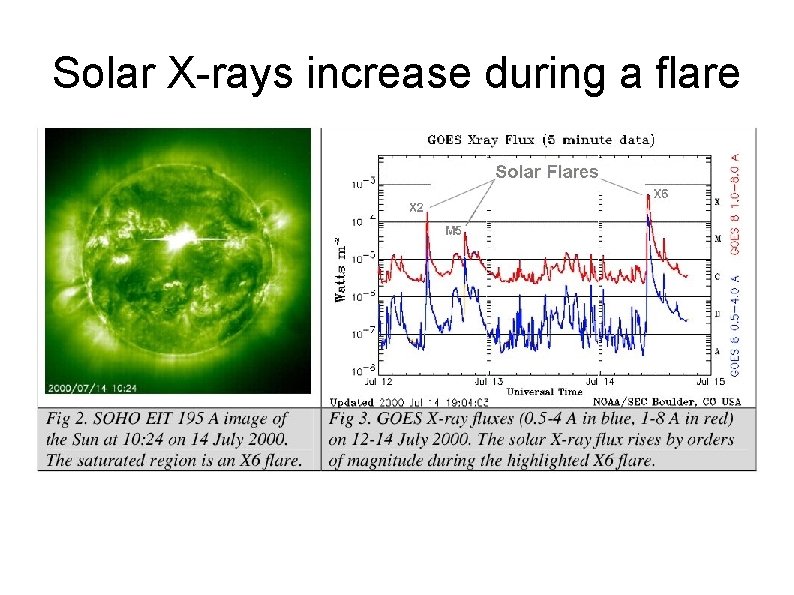
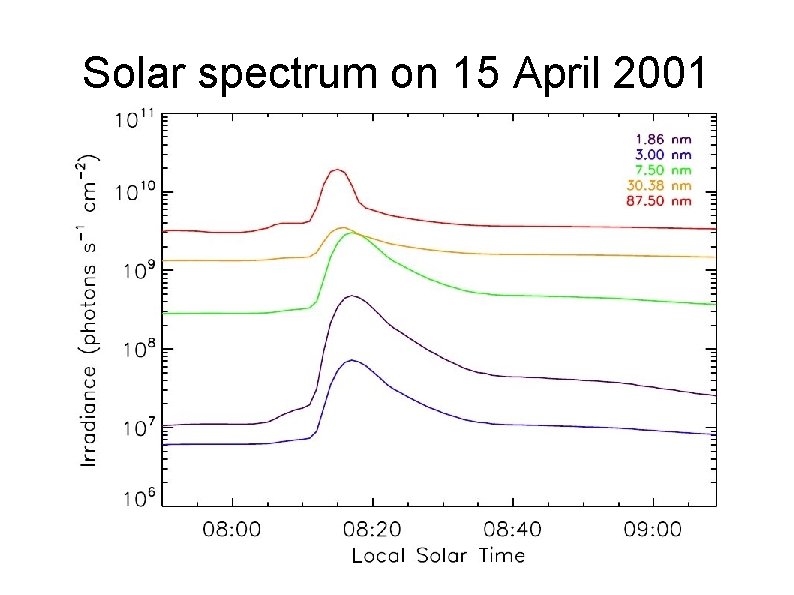
Solar X-rays increase during a flare
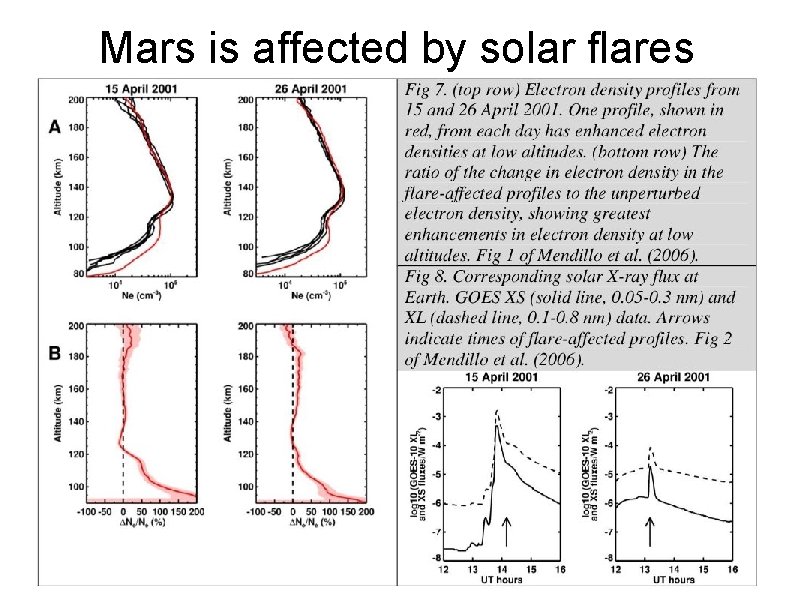
Mars is affected by solar flares
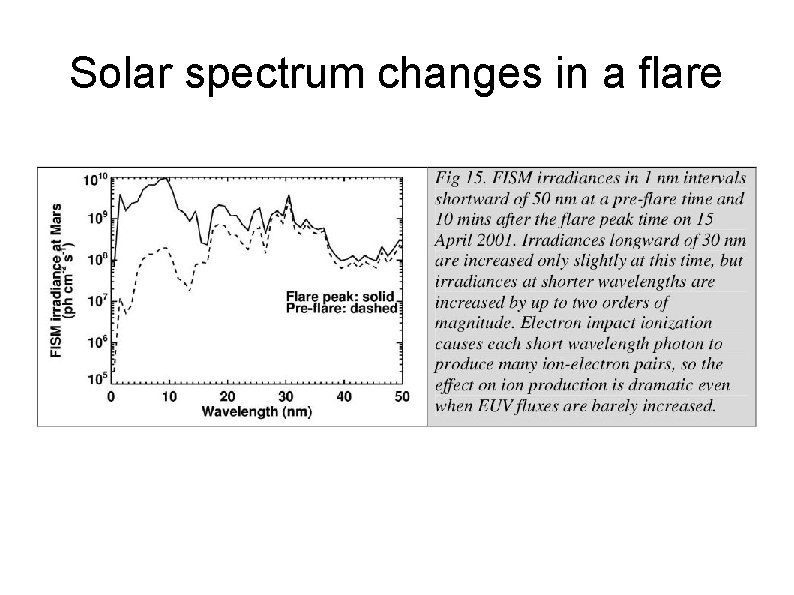
Solar spectrum changes in a flare
Solar spectrum on 15 April 2001
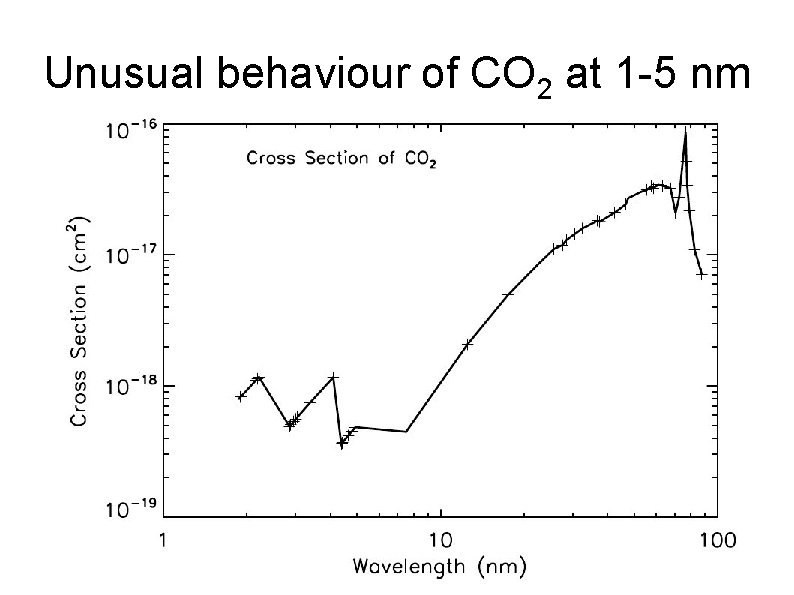
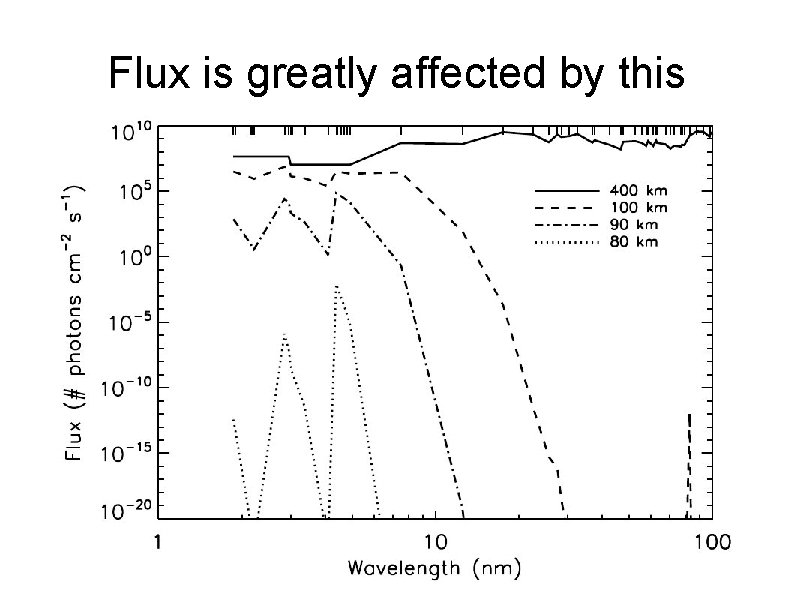
Unusual behaviour of CO 2 at 1 -5 nm
Flux is greatly affected by this
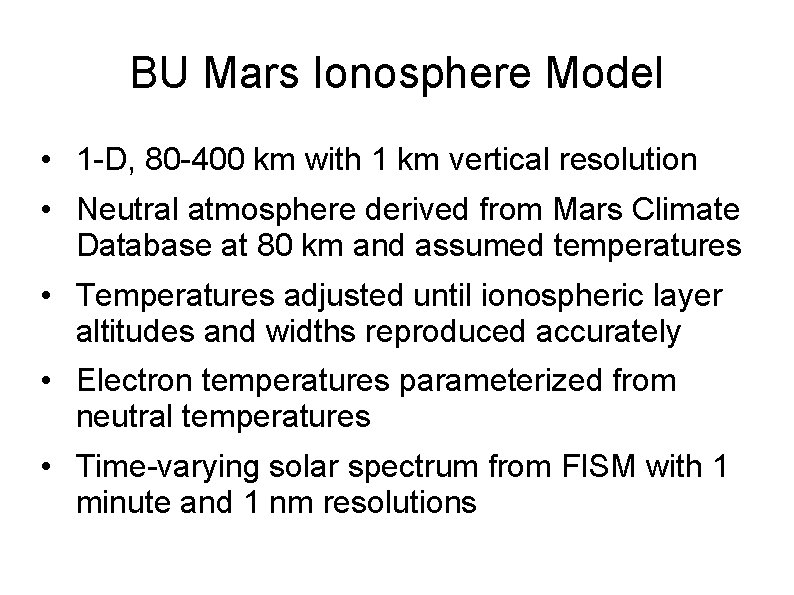
BU Mars Ionosphere Model • 1 -D, 80 -400 km with 1 km vertical resolution • Neutral atmosphere derived from Mars Climate Database at 80 km and assumed temperatures • Temperatures adjusted until ionospheric layer altitudes and widths reproduced accurately • Electron temperatures parameterized from neutral temperatures • Time-varying solar spectrum from FISM with 1 minute and 1 nm resolutions
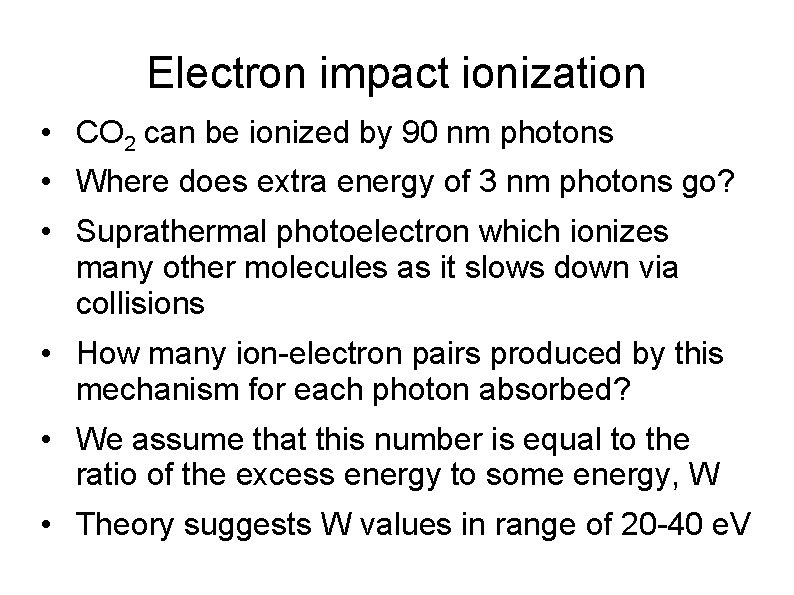
Electron impact ionization • CO 2 can be ionized by 90 nm photons • Where does extra energy of 3 nm photons go? • Suprathermal photoelectron which ionizes many other molecules as it slows down via collisions • How many ion-electron pairs produced by this mechanism for each photon absorbed? • We assume that this number is equal to the ratio of the excess energy to some energy, W • Theory suggests W values in range of 20 -40 e. V
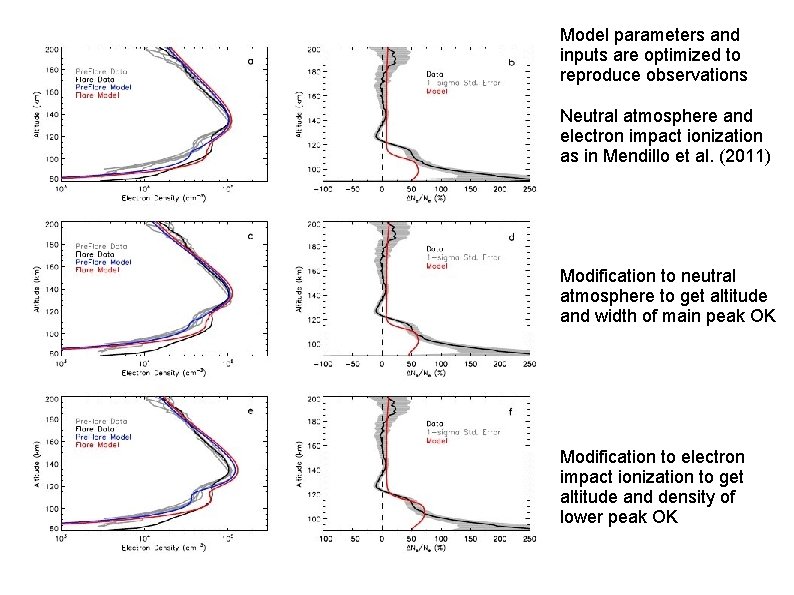
Model parameters and inputs are optimized to reproduce observations Neutral atmosphere and electron impact ionization as in Mendillo et al. (2011) Modification to neutral atmosphere to get altitude and width of main peak OK Modification to electron impact ionization to get altitude and density of lower peak OK
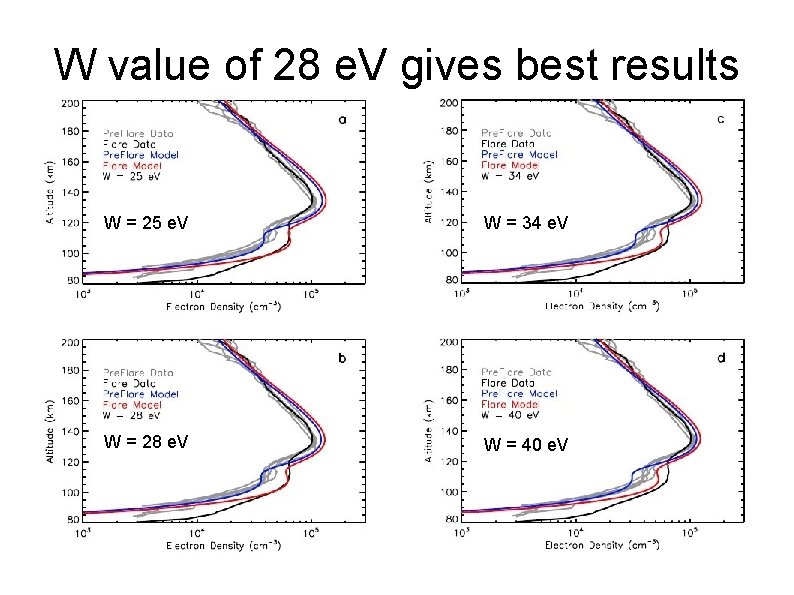
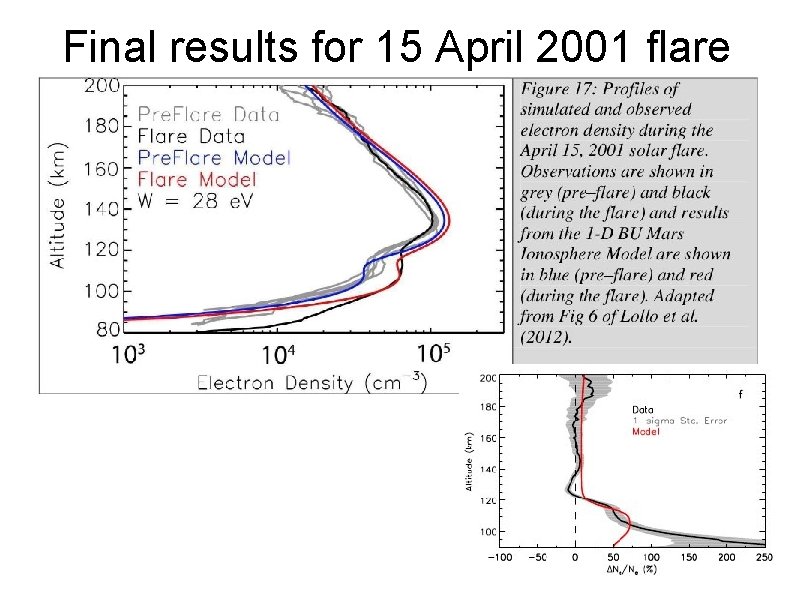
W value of 28 e. V gives best results W = 25 e. V W = 34 e. V W = 28 e. V W = 40 e. V
Final results for 15 April 2001 flare
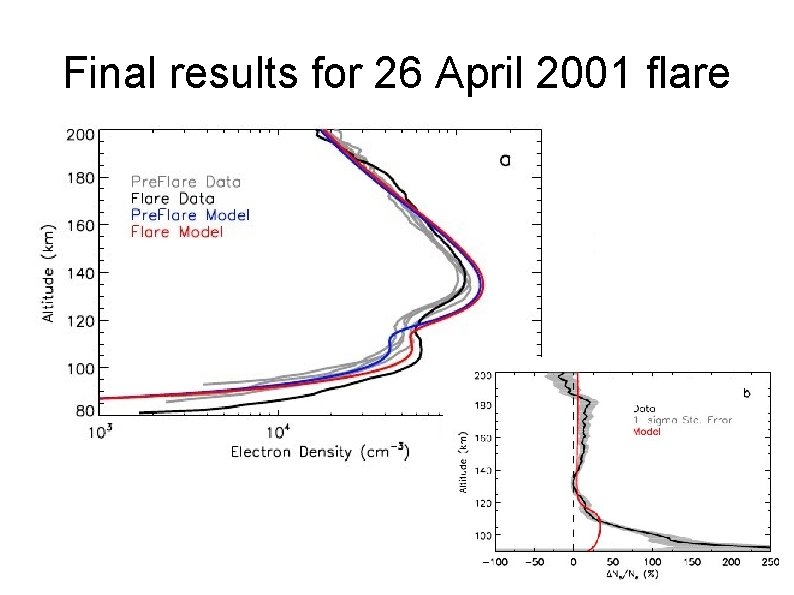
Final results for 26 April 2001 flare
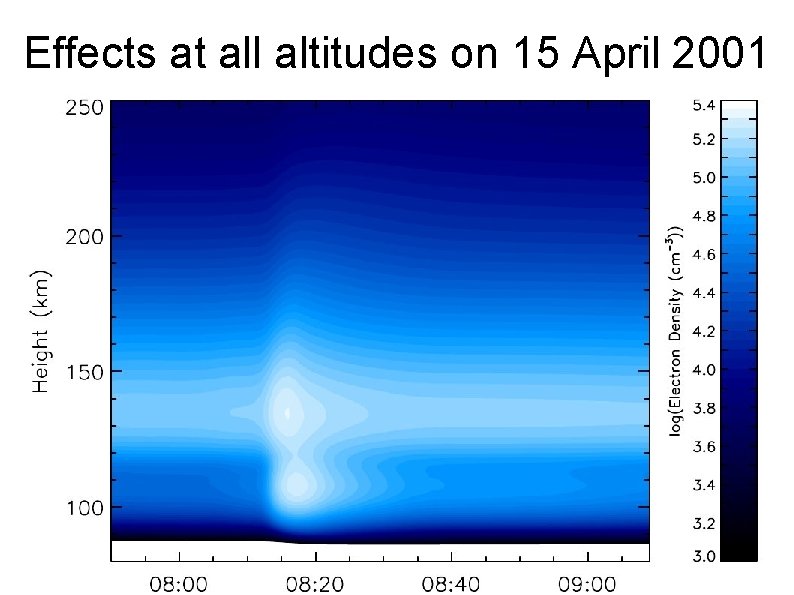
Large changes in electron density profile during the 15 April flare Local time at location of the MGS flare-affected profile M 1 densities increase a lot M 2 densities increase a bit
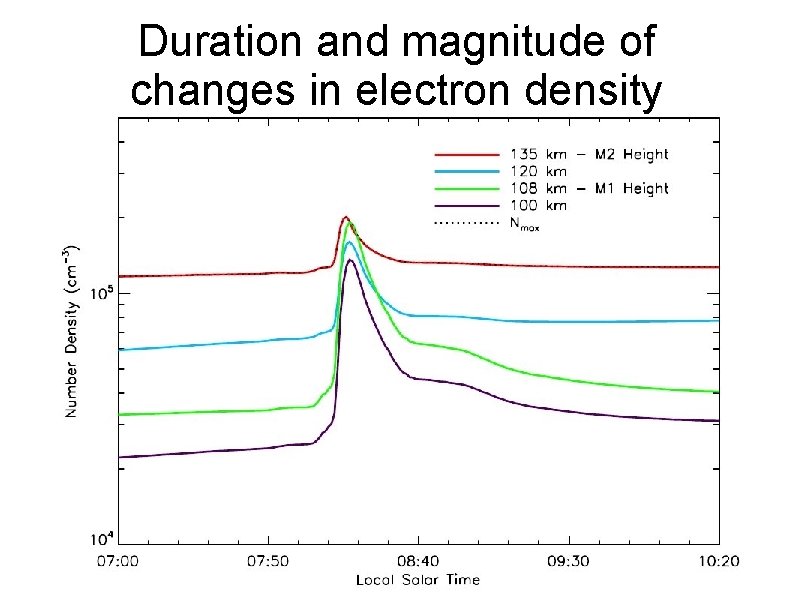
Duration and magnitude of changes in electron density
Effects at all altitudes on 15 April 2001
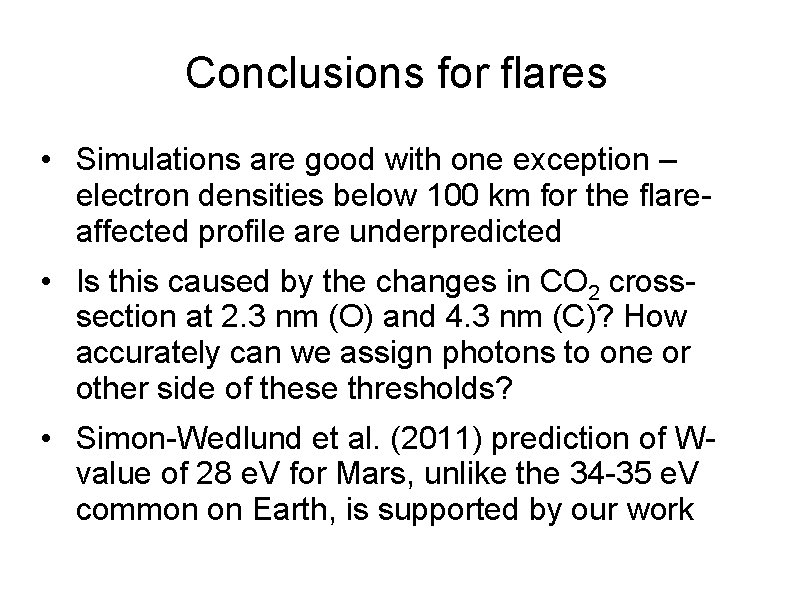
Conclusions for flares • Simulations are good with one exception – electron densities below 100 km for the flareaffected profile are underpredicted • Is this caused by the changes in CO 2 crosssection at 2. 3 nm (O) and 4. 3 nm (C)? How accurately can we assign photons to one or other side of these thresholds? • Simon-Wedlund et al. (2011) prediction of Wvalue of 28 e. V for Mars, unlike the 34 -35 e. V common on Earth, is supported by our work
In press at JGR Space Physics DOI: 10. 1029/2011 JA 017399
Effects of solar energetic particle (SEP) events • MARSIS data show that electron densities somewhere below the main peak are enhanced by some amount during SEP events • Does a model of the ionospheric effects of Sep events support this inferred association or not? • We simulate the ionosphere during a large SEP event (29 September 1989) to test if sufficient plasma is produced to affect MARSIS data
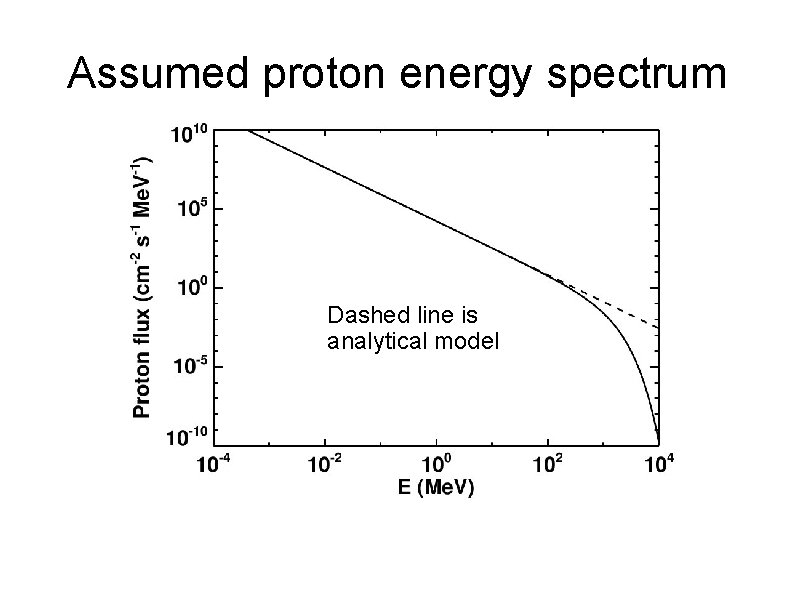
Assumed proton energy spectrum Dashed line is analytical model
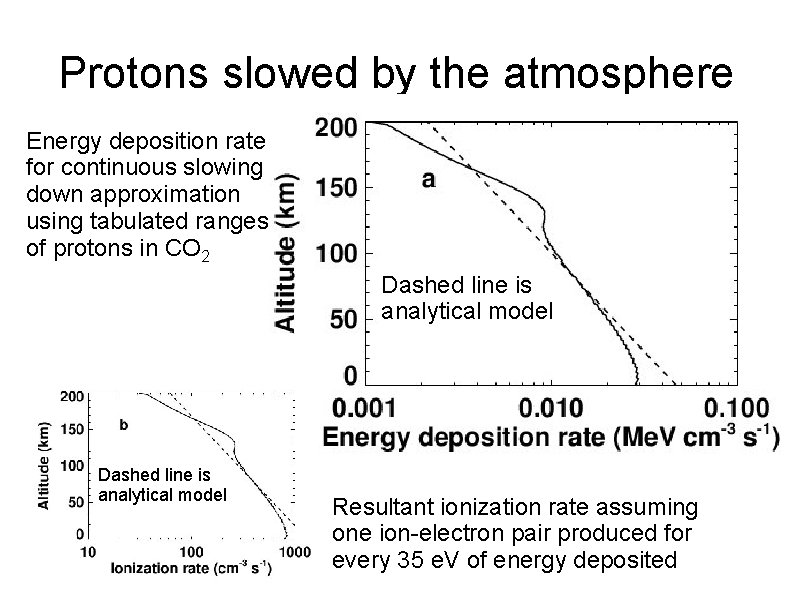
Protons slowed by the atmosphere Energy deposition rate for continuous slowing down approximation using tabulated ranges of protons in CO 2 Dashed line is analytical model Resultant ionization rate assuming one ion-electron pair produced for every 35 e. V of energy deposited
In press at JGR Space Physics DOI: 10. 1029/2011 JA 017455
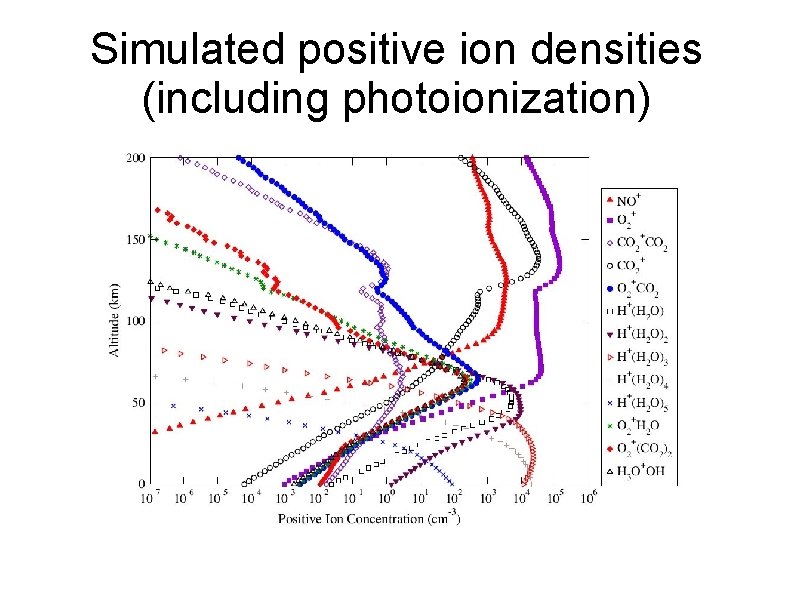
Simulated positive ion densities (including photoionization)
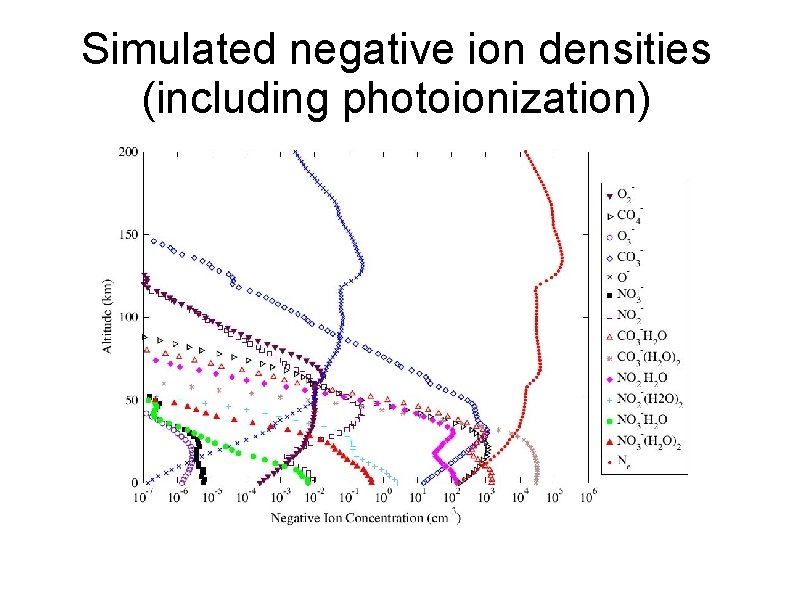
Simulated negative ion densities (including photoionization)
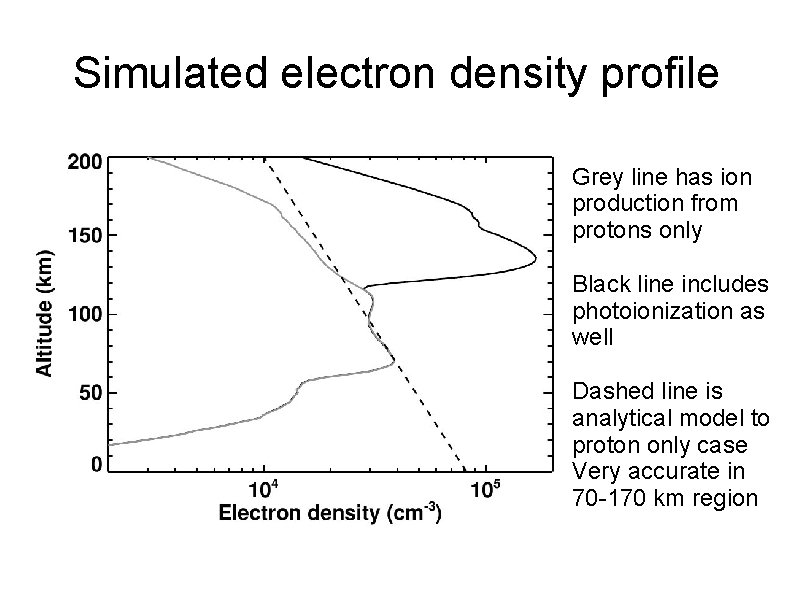
Simulated electron density profile Grey line has ion production from protons only Black line includes photoionization as well Dashed line is analytical model to proton only case Very accurate in 70 -170 km region
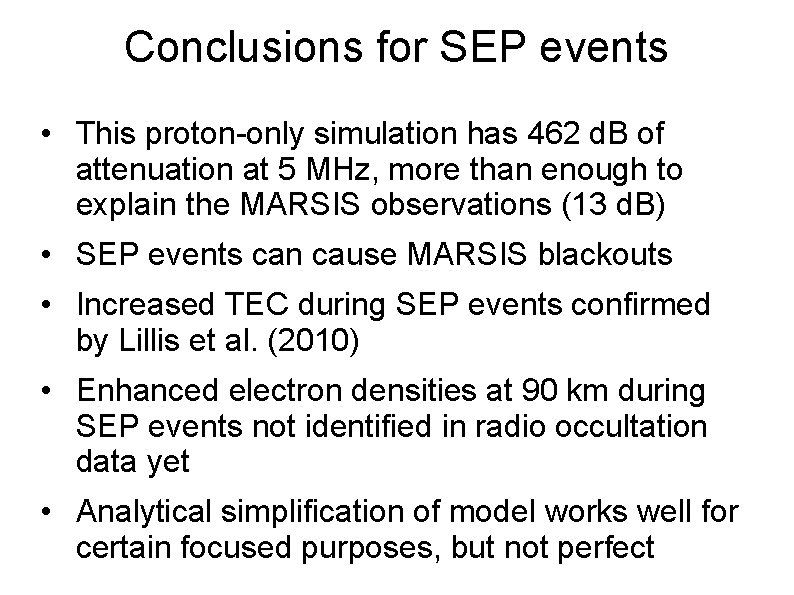
Conclusions for SEP events • This proton-only simulation has 462 d. B of attenuation at 5 MHz, more than enough to explain the MARSIS observations (13 d. B) • SEP events can cause MARSIS blackouts • Increased TEC during SEP events confirmed by Lillis et al. (2010) • Enhanced electron densities at 90 km during SEP events not identified in radio occultation data yet • Analytical simplification of model works well for certain focused purposes, but not perfect