
Simulations of Muon Cooling With an Inverse Cyclotron
- Slides: 12
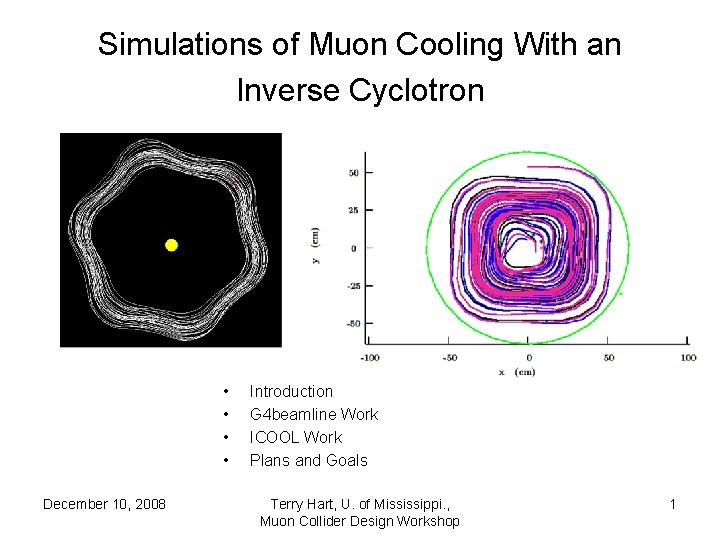
Simulations of Muon Cooling With an Inverse Cyclotron • • December 10, 2008 Introduction G 4 beamline Work ICOOL Work Plans and Goals Terry Hart, U. of Mississippi. , Muon Collider Design Workshop 1
Introduction • Started new appointment with U. of Mississippi – Don Summers is my boss – I’ll be working on • MICE • Mu. Cool • Inverse cyclotron simulation working with – Kevin Paul from Tech-X – Kevin Beard from JLab. ; Muons, Inc. – Bob Palmer from BNL December 10, 2008 Terry Hart, U. of Mississippi. , Muon Collider Design Workshop 2
Introduction • Inverse cyclotron intriguing scheme for 6 D muon cooling • Inverse Cyclotron Scheme – Muon beam injected into cyclotron – Lose energy through material interactions • material wedges surrounded by gas • Mid-plane foil relying on betatron oscillations – Focus beam with sectored (straight or spiral) magnetic field – Cooled muon beam coalesces at cyclotron center into one bunch – Muon bunch extracted perpendicular to cyclotron December 10, 2008 Terry Hart, U. of Mississippi. , Muon Collider Design Workshop 3
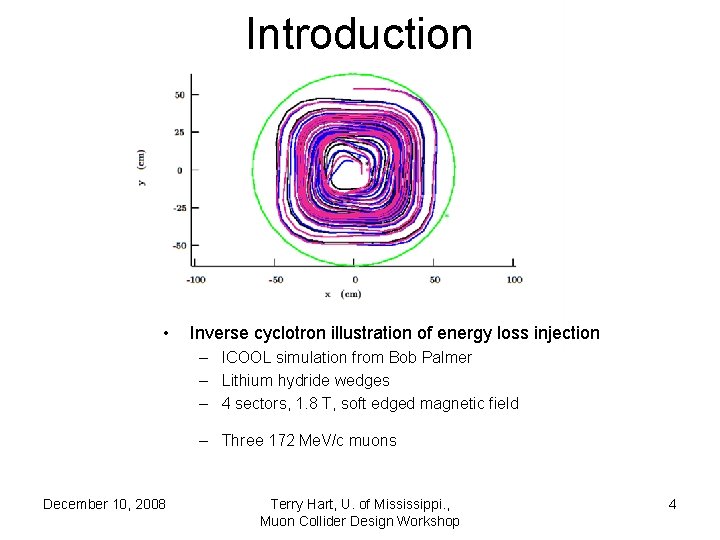
Introduction • Inverse cyclotron illustration of energy loss injection – ICOOL simulation from Bob Palmer – Lithium hydride wedges – 4 sectors, 1. 8 T, soft edged magnetic field – Three 172 Me. V/c muons December 10, 2008 Terry Hart, U. of Mississippi. , Muon Collider Design Workshop 4
Introduction • References – 6 D Muon Ionization Cooling with an Inverse Cyclotron from COOL 05; Summers, Bracker, Cremaldi, Godang, Palmer (2005) – Focusing Properties of Superconducting Cyclotron Magnets, NIM 121, Blosser and Johnson (1974) – Handbook of Accelerator Physics and Engineering, edited by Chao, Tigner – Introductory Nuclear Physics, Krane December 10, 2008 Terry Hart, U. of Mississippi. , Muon Collider Design Workshop 5
G 4 beamline Work • Don sent me program generating Bz of spiral sector cyclotron – – Number of sectors Spiral angle Bz, high, Bz, low Transition regions • Between sectors • Z bottle • G 4 beamline can import field from text file • I wanted to generate stable orbits from trial/error and calculation – No beam energy, angular spreads – No energy loss December 10, 2008 Terry Hart, U. of Mississippi. , Muon Collider Design Workshop 6
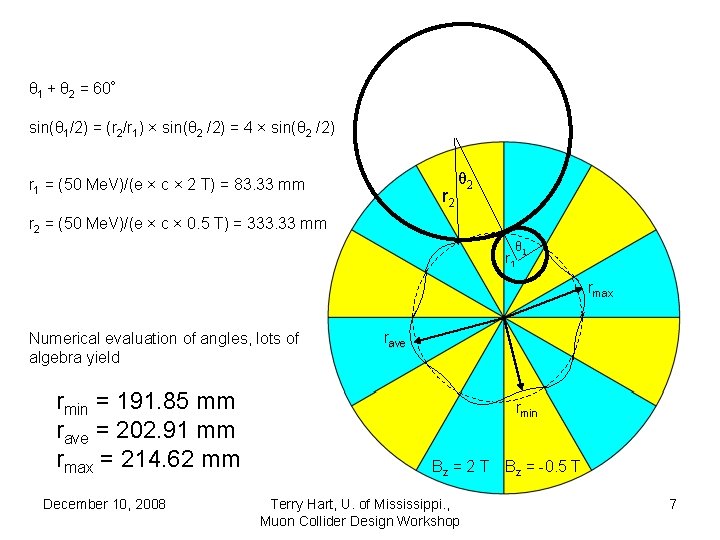
θ 1 + θ 2 = 60º sin(θ 1/2) = (r 2/r 1) × sin(θ 2 /2) = 4 × sin(θ 2 /2) r 1 = (50 Me. V)/(e × c × 2 T) = 83. 33 mm r 2 θ 2 r 2 = (50 Me. V)/(e × c × 0. 5 T) = 333. 33 mm r 1 θ 1 rmax Numerical evaluation of angles, lots of algebra yield rmin = 191. 85 mm rave = 202. 91 mm rmax = 214. 62 mm December 10, 2008 rave rmin Bz = 2 T Bz = -0. 5 T Terry Hart, U. of Mississippi. , Muon Collider Design Workshop 7
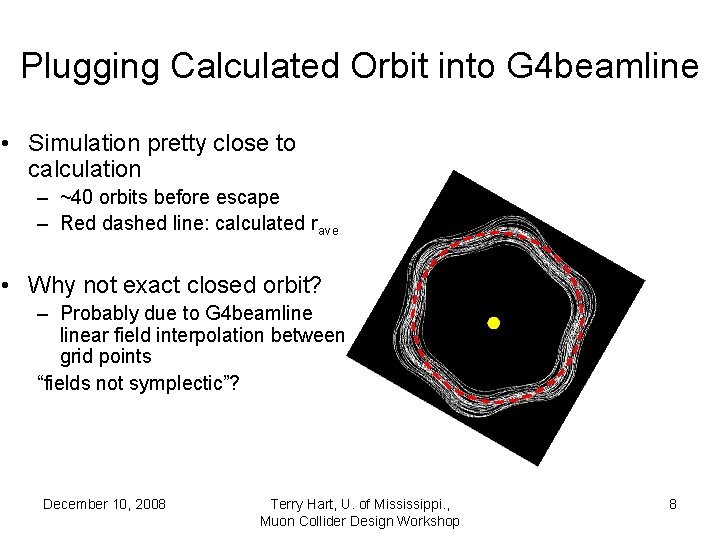
Plugging Calculated Orbit into G 4 beamline • Simulation pretty close to calculation – ~40 orbits before escape – Red dashed line: calculated rave • Why not exact closed orbit? – Probably due to G 4 beamlinear field interpolation between grid points “fields not symplectic”? December 10, 2008 Terry Hart, U. of Mississippi. , Muon Collider Design Workshop 8
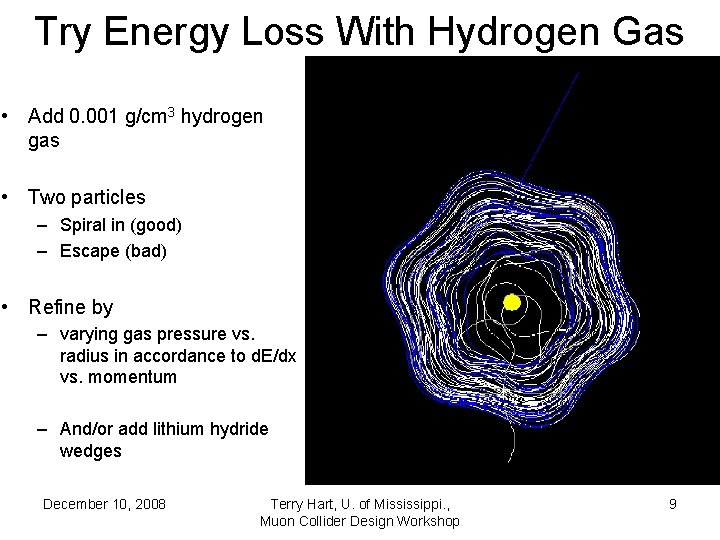
Try Energy Loss With Hydrogen Gas • Add 0. 001 g/cm 3 hydrogen gas • Two particles – Spiral in (good) – Escape (bad) • Refine by – varying gas pressure vs. radius in accordance to d. E/dx vs. momentum – And/or add lithium hydride wedges December 10, 2008 Terry Hart, U. of Mississippi. , Muon Collider Design Workshop 9
What’s Needed to Go On • Focusing in cyclotron plane needs azimuthal (Bx, By) fields – Much harder than Bz, but programs available • Use soft-edged fields instead of hard-edged fields • Energy loss – Hydrogen gas of varying densities – Lithium hydride wedges December 10, 2008 Terry Hart, U. of Mississippi. , Muon Collider Design Workshop 10
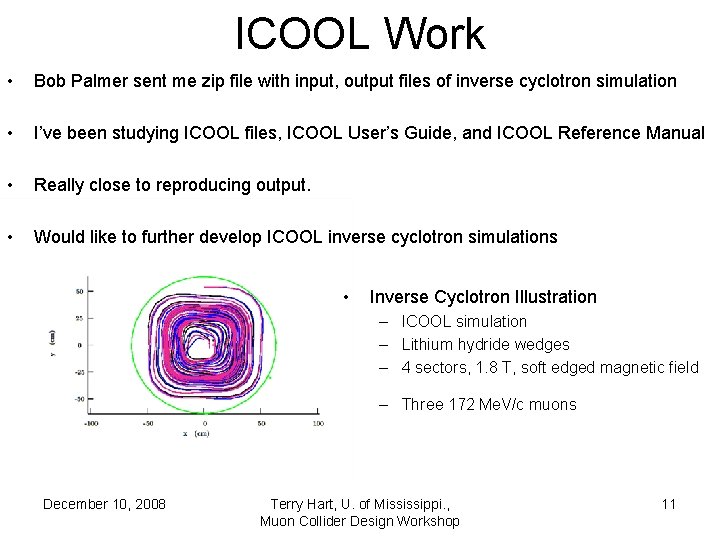
ICOOL Work • Bob Palmer sent me zip file with input, output files of inverse cyclotron simulation • I’ve been studying ICOOL files, ICOOL User’s Guide, and ICOOL Reference Manual • Really close to reproducing output. • Would like to further develop ICOOL inverse cyclotron simulations • Inverse Cyclotron Illustration – ICOOL simulation – Lithium hydride wedges – 4 sectors, 1. 8 T, soft edged magnetic field – Three 172 Me. V/c muons December 10, 2008 Terry Hart, U. of Mississippi. , Muon Collider Design Workshop 11
Plans and Goals • Continue learning more accelerator physics, G 4 beamline, ICOOL, … • Learn more about sector cyclotron magnetic field programs – Existing field in ICOOL simulations – TOSCA, TRIUMF CYCLOPS, … • Develop inverse cyclotron simulations with G 4 beamline and ICOOL • Find out what’s already known and developed so that I don’t do too much redundant studies • Keep working with Don, Kevin, Bob, Rick, and others on developing inverse cyclotron simulations for muon cooling December 10, 2008 Terry Hart, U. of Mississippi. , Muon Collider Design Workshop 12