
Simulations of an Electron Lens in IOTA Tommy
- Slides: 1
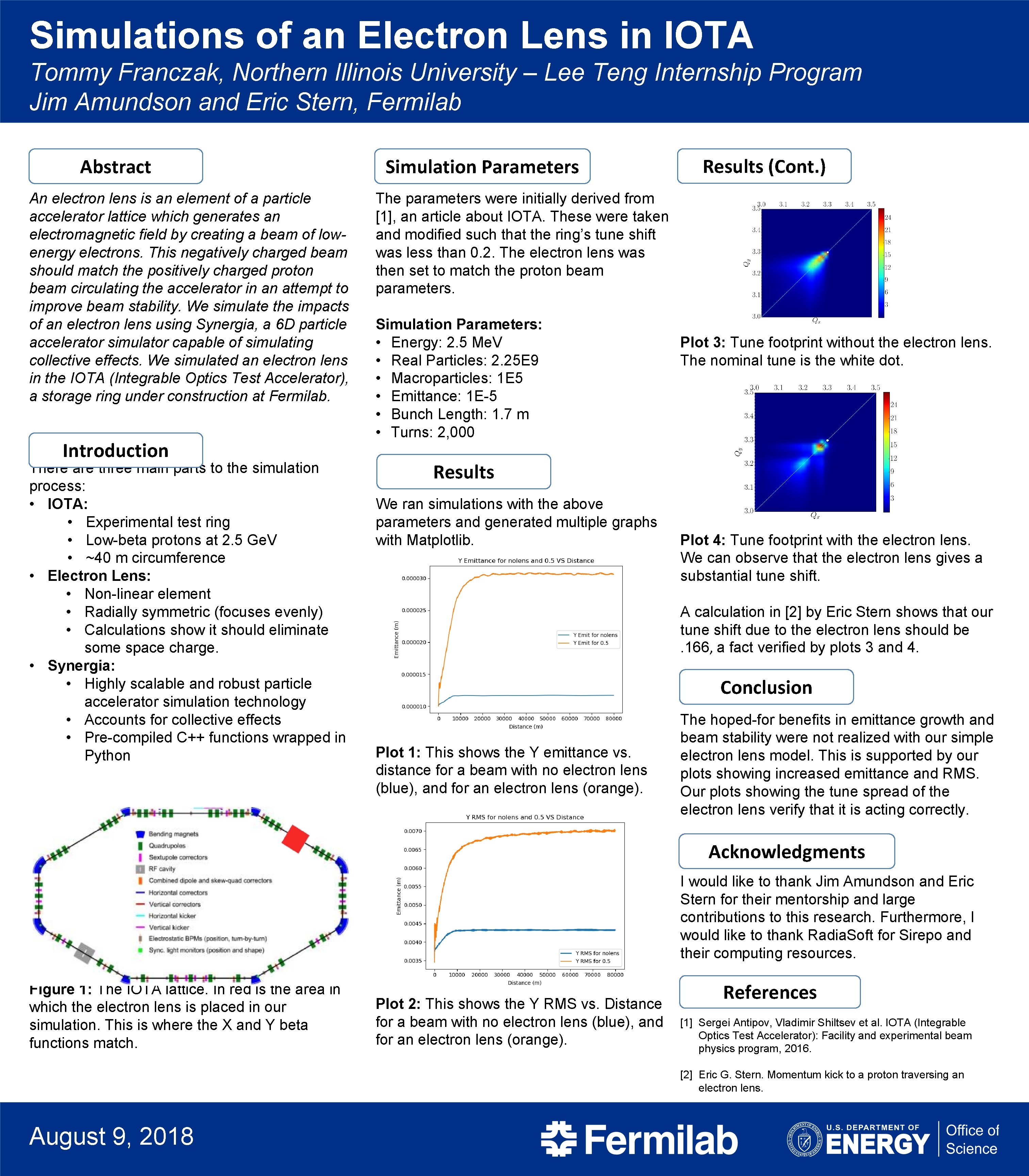
Simulations of an Electron Lens in IOTA Tommy Franczak, Northern Illinois University – Lee Teng Internship Program Jim Amundson and Eric Stern, Fermilab Hi Abstract An electron lens is an element of a particle accelerator lattice which generates an electromagnetic field by creating a beam of lowenergy electrons. This negatively charged beam should match the positively charged proton beam circulating the accelerator in an attempt to improve beam stability. We simulate the impacts of an electron lens using Synergia, a 6 D particle accelerator simulator capable of simulating collective effects. We simulated an electron lens in the IOTA (Integrable Optics Test Accelerator), a storage ring under construction at Fermilab. Introduction There are three main parts to the simulation process: • IOTA: • Experimental test ring • Low-beta protons at 2. 5 Ge. V • ~40 m circumference • Electron Lens: • Non-linear element • Radially symmetric (focuses evenly) • Calculations show it should eliminate some space charge. • Synergia: • Highly scalable and robust particle accelerator simulation technology • Accounts for collective effects • Pre-compiled C++ functions wrapped in Python Simulation Parameters Results (Cont. ) The parameters were initially derived from [1], an article about IOTA. These were taken and modified such that the ring’s tune shift was less than 0. 2. The electron lens was then set to match the proton beam parameters. Simulation Parameters: • Energy: 2. 5 Me. V • Real Particles: 2. 25 E 9 • Macroparticles: 1 E 5 • Emittance: 1 E-5 • Bunch Length: 1. 7 m • Turns: 2, 000 Plot 3: Tune footprint without the electron lens. The nominal tune is the white dot. Results We ran simulations with the above parameters and generated multiple graphs with Matplotlib. Plot 4: Tune footprint with the electron lens. We can observe that the electron lens gives a substantial tune shift. A calculation in [2] by Eric Stern shows that our tune shift due to the electron lens should be. 166, a fact verified by plots 3 and 4. Conclusion Plot 1: This shows the Y emittance vs. distance for a beam with no electron lens (blue), and for an electron lens (orange). The hoped-for benefits in emittance growth and beam stability were not realized with our simple electron lens model. This is supported by our plots showing increased emittance and RMS. Our plots showing the tune spread of the electron lens verify that it is acting correctly. Acknowledgments I would like to thank Jim Amundson and Eric Stern for their mentorship and large contributions to this research. Furthermore, I would like to thank Radia. Soft for Sirepo and their computing resources. Figure 1: The IOTA lattice. In red is the area in which the electron lens is placed in our simulation. This is where the X and Y beta functions match. Plot 2: This shows the Y RMS vs. Distance for a beam with no electron lens (blue), and for an electron lens (orange). References [1] Sergei Antipov, Vladimir Shiltsev et al. IOTA (Integrable Optics Test Accelerator): Facility and experimental beam physics program, 2016. [2] Eric G. Stern. Momentum kick to a proton traversing an electron lens. August 9, 2018