
simulations and results Munich 1972 Boulder 2040 stuff
simulations and results: Munich 1972 Boulder 2040: “stuff ion trapper‘s dreams are made of”
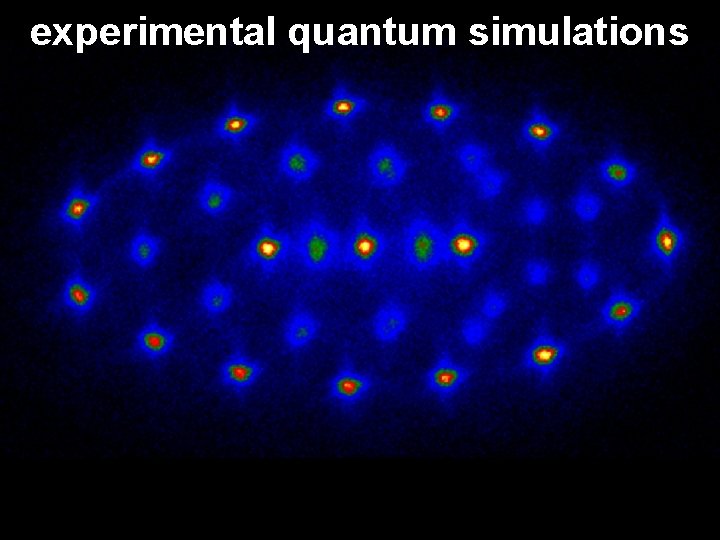
experimental quantum simulations
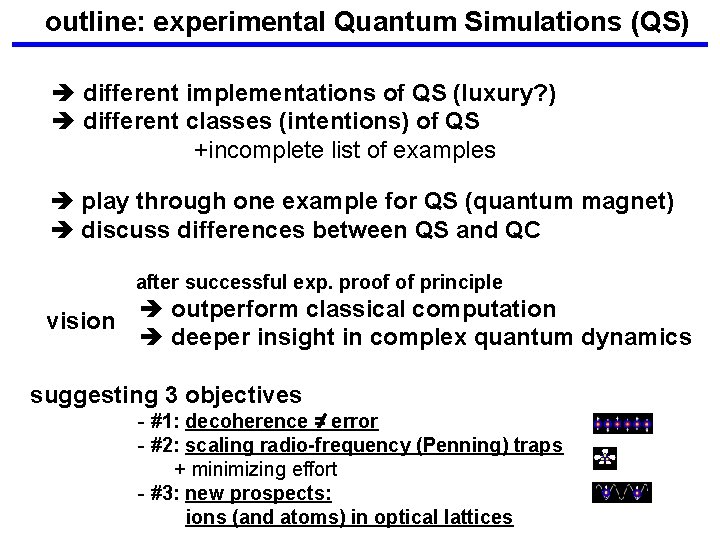
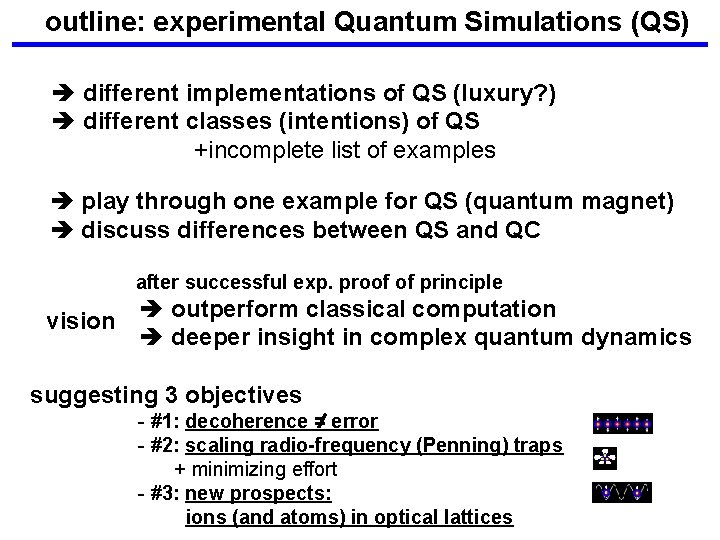
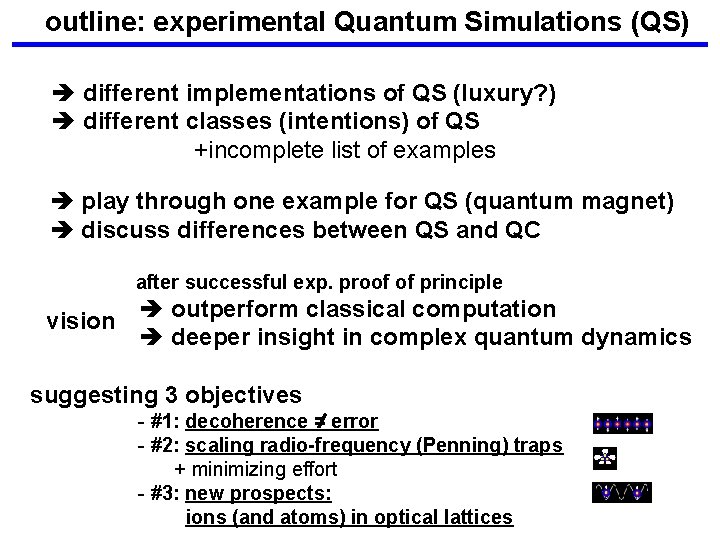
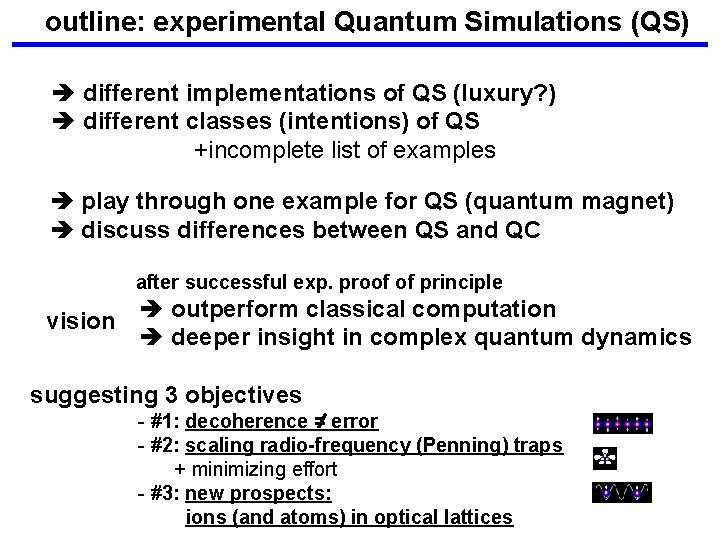
outline: experimental Quantum Simulations (QS) è different implementations of QS (luxury? ) è different classes (intentions) of QS +incomplete list of examples è play through one example for QS (quantum magnet) è discuss differences between QS and QC after successful exp. proof of principle vision è outperform classical computation è deeper insight in complex quantum dynamics suggesting 3 objectives - #1: decoherence = error - #2: scaling radio-frequency (Penning) traps + minimizing effort - #3: new prospects: ions (and atoms) in optical lattices
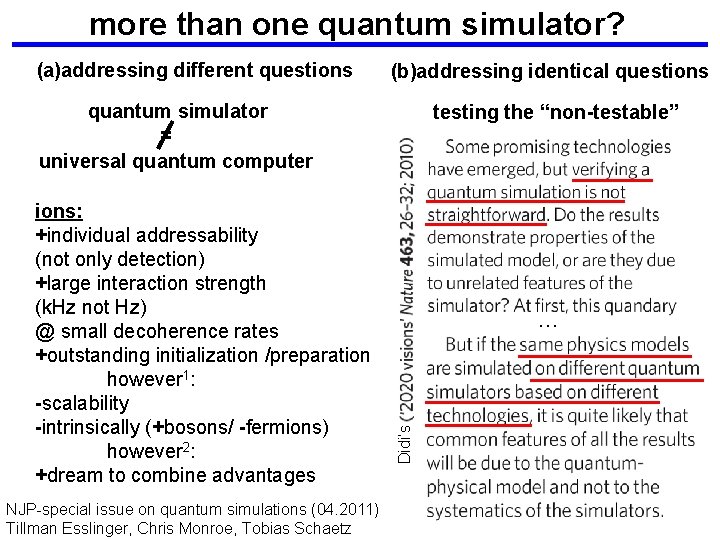
more than one quantum simulator? (a)addressing different questions (b)addressing identical questions quantum simulator = universal quantum computer NJP-special issue on quantum simulations (04. 2011) Tillman Esslinger, Chris Monroe, Tobias Schaetz … Didi’s ions: +individual addressability (not only detection) +large interaction strength (k. Hz not Hz) @ small decoherence rates +outstanding initialization /preparation however 1: -scalability -intrinsically (+bosons/ -fermions) however 2: +dream to combine advantages testing the “non-testable”
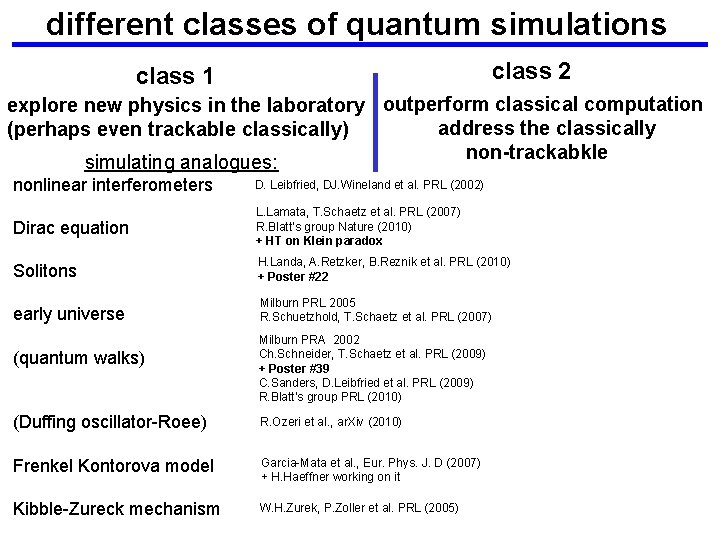
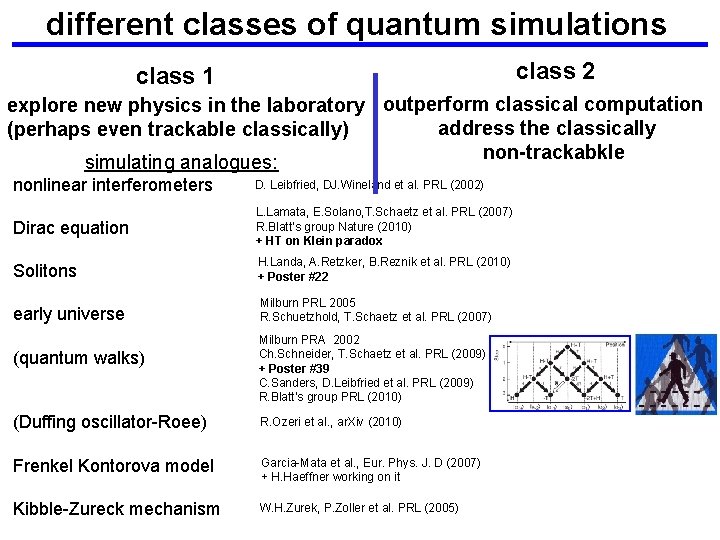
different classes of quantum simulations class 2 class 1 explore new physics in the laboratory outperform classical computation address the classically (perhaps even trackable classically) non-trackabkle simulating analogues: nonlinear interferometers D. Leibfried, DJ. Wineland et al. PRL (2002) Dirac equation L. Lamata, T. Schaetz et al. PRL (2007) R. Blatt’s group Nature (2010) + HT on Klein paradox Solitons H. Landa, A. Retzker, B. Reznik et al. PRL (2010) + Poster #22 early universe Milburn PRL 2005 R. Schuetzhold, T. Schaetz et al. PRL (2007) (quantum walks) Milburn PRA 2002 Ch. Schneider, T. Schaetz et al. PRL (2009) + Poster #39 C. Sanders, D. Leibfried et al. PRL (2009) R. Blatt’s group PRL (2010) (Duffing oscillator-Roee) R. Ozeri et al. , ar. Xiv (2010) Frenkel Kontorova model Garcia-Mata et al. , Eur. Phys. J. D (2007) + H. Haeffner working on it Kibble-Zureck mechanism W. H. Zurek, P. Zoller et al. PRL (2005)
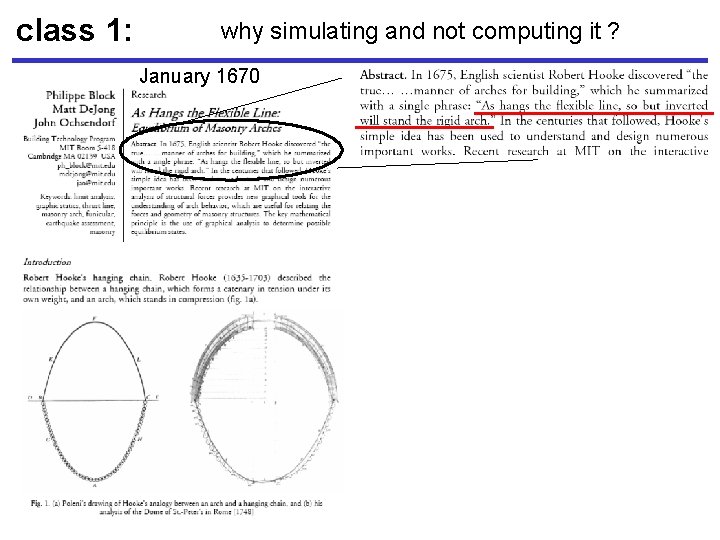
class 1: why simulating and not computing it ? January 1670
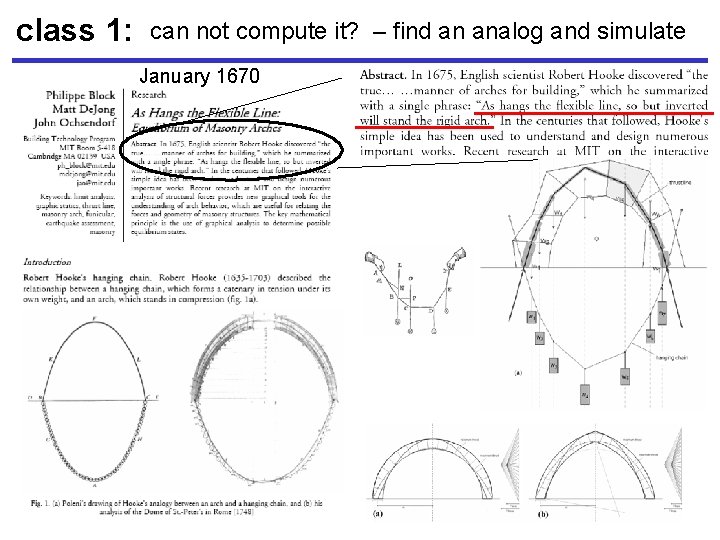
class 1: can not compute it? – find an analog and simulate January 1670
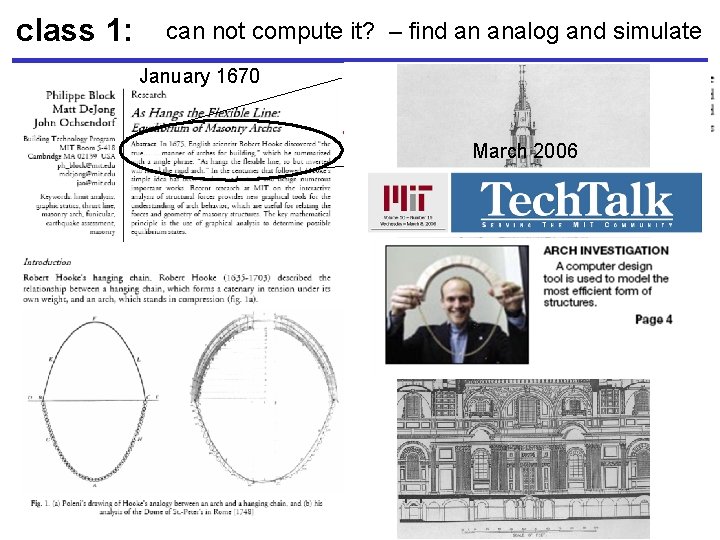
class 1: can not compute it? – find an analog and simulate January 1670 March 2006
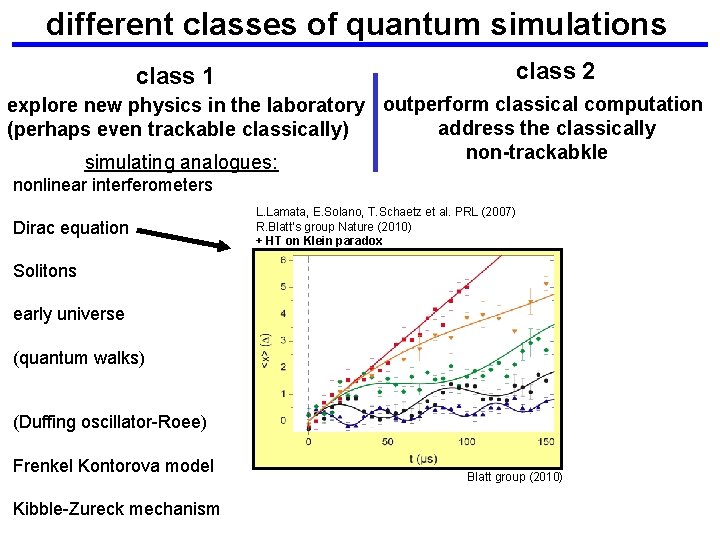
different classes of quantum simulations class 2 class 1 explore new physics in the laboratory outperform classical computation address the classically (perhaps even trackable classically) non-trackabkle simulating analogues: nonlinear interferometers D. Leibfried, DJ. Wineland et al. PRL (2002) Dirac equation L. Lamata, E. Solano, T. Schaetz et al. PRL (2007) R. Blatt’s group Nature (2010) + HT on Klein paradox Solitons H. Landa, A. Retzker et al. PRL (2010) + Poster #22 early universe Milburn PRL 2005 R. Schuetzhold, T. Schaetz et al. PRL (2007) (quantum walks) Milburn PRA 2002 Ch. Schneider, T. Schaetz et al. PRL (2009) + Poster #39 C. Sanders, D. Leibfried et al. PRL (2009) R. Blatt’s group PRL (2010) (Duffing oscillator-Roee) R. Ozeri et al. , ar. Xiv (2010) Frenkel Kontorova model Garcia-Mata et al. , Eur. Phys. J. D (2007) + H. Haeffner working on it Blatt group (2010) Kibble-Zureck mechanism W. H. Zurek, P. Zoller et al. PRL (2005)
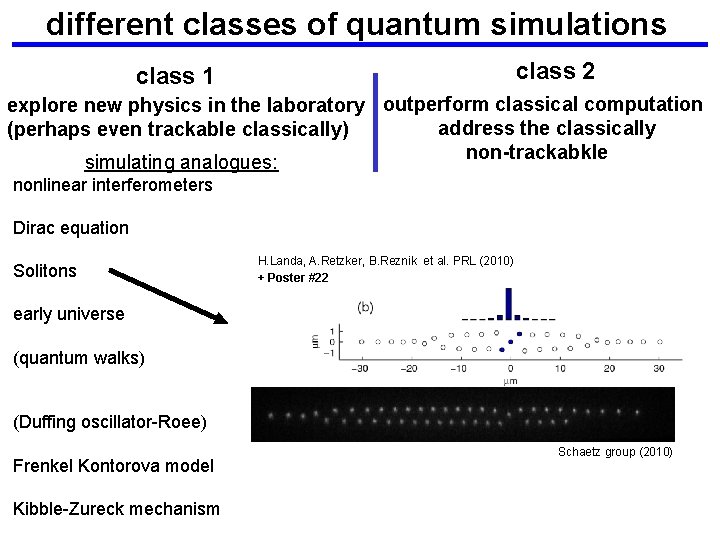
different classes of quantum simulations class 2 class 1 explore new physics in the laboratory outperform classical computation address the classically (perhaps even trackable classically) non-trackabkle simulating analogues: nonlinear interferometers D. Leibfried, DJ. Wineland et al. PRL (2002) Dirac equation L. Lamata, T. Schaetz et al. PRL (2007) R. Blatt’s group Nature (2010) + HT on Klein paradox Solitons H. Landa, A. Retzker, B. Reznik et al. PRL (2010) + Poster #22 early universe Milburn PRL 2005 R. Schuetzhold, T. Schaetz et al. PRL (2007) (quantum walks) Milburn PRA 2002 Ch. Schneider, T. Schaetz et al. PRL (2009) + Poster #39 C. Sanders, D. Leibfried et al. PRL (2009) R. Blatt’s group PRL (2010) (Duffing oscillator-Roee) R. Ozeri et al. , ar. Xiv (2010) Frenkel Kontorova model Garcia-Mata et al. , Eur. Phys. J. D (2007) + H. Haeffner working on it Kibble-Zureck mechanism W. H. Zurek, P. Zoller et al. PRL (2005) Schaetz group (2010)
different classes of quantum simulations class 2 class 1 explore new physics in the laboratory outperform classical computation address the classically (perhaps even trackable classically) non-trackabkle simulating analogues: nonlinear interferometers D. Leibfried, DJ. Wineland et al. PRL (2002) Dirac equation L. Lamata, E. Solano, T. Schaetz et al. PRL (2007) R. Blatt’s group Nature (2010) + HT on Klein paradox Solitons H. Landa, A. Retzker, B. Reznik et al. PRL (2010) + Poster #22 early universe Milburn PRL 2005 R. Schuetzhold, T. Schaetz et al. PRL (2007) (quantum walks) Milburn PRA 2002 Ch. Schneider, T. Schaetz et al. PRL (2009) + Poster #39 C. Sanders, D. Leibfried et al. PRL (2009) R. Blatt’s group PRL (2010) (Duffing oscillator-Roee) R. Ozeri et al. , ar. Xiv (2010) Frenkel Kontorova model Garcia-Mata et al. , Eur. Phys. J. D (2007) + H. Haeffner working on it Kibble-Zureck mechanism W. H. Zurek, P. Zoller et al. PRL (2005)
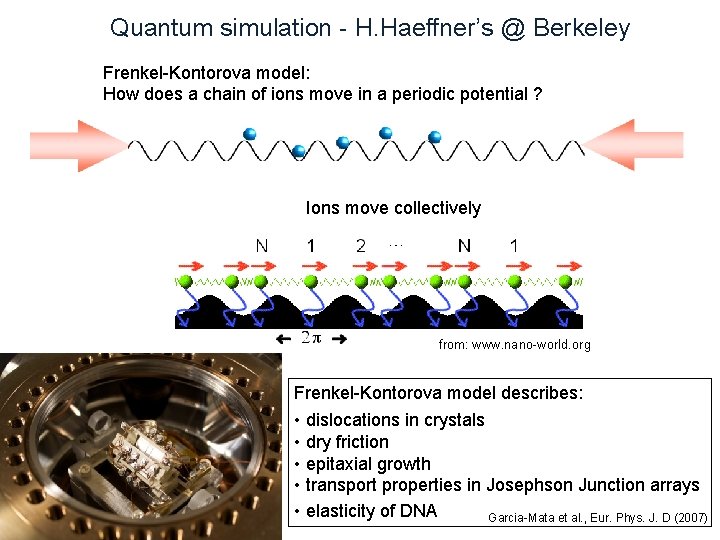
Quantum simulation - H. Haeffner’s @ Berkeley Frenkel-Kontorova model: How does a chain of ions move in a periodic potential ? Ions move collectively from: www. nano-world. org Frenkel-Kontorova model describes: • dislocations in crystals • dry friction • epitaxial growth • transport properties in Josephson Junction arrays • elasticity of DNA Garcia-Mata et al. , Eur. Phys. J. D (2007)
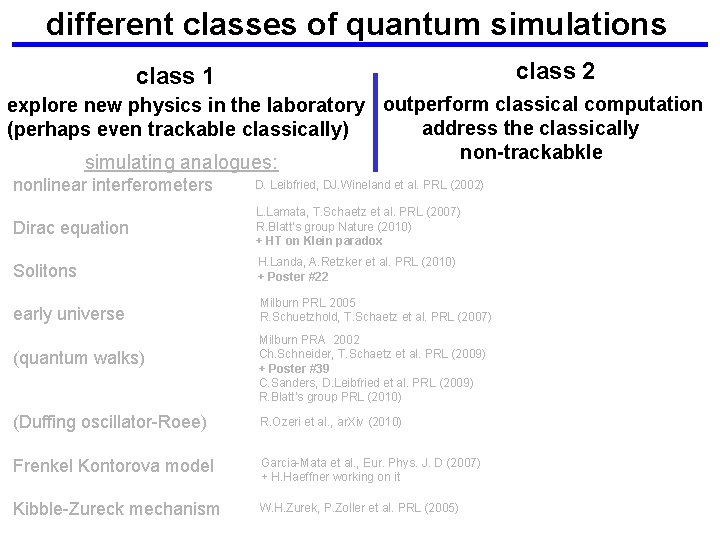
different classes of quantum simulations class 2 class 1 explore new physics in the laboratory outperform classical computation address the classically (perhaps even trackable classically) non-trackabkle simulating analogues: nonlinear interferometers D. Leibfried, DJ. Wineland et al. PRL (2002) Dirac equation L. Lamata, T. Schaetz et al. PRL (2007) R. Blatt’s group Nature (2010) + HT on Klein paradox Solitons H. Landa, A. Retzker et al. PRL (2010) + Poster #22 early universe Milburn PRL 2005 R. Schuetzhold, T. Schaetz et al. PRL (2007) (quantum walks) Milburn PRA 2002 Ch. Schneider, T. Schaetz et al. PRL (2009) + Poster #39 C. Sanders, D. Leibfried et al. PRL (2009) R. Blatt’s group PRL (2010) (Duffing oscillator-Roee) R. Ozeri et al. , ar. Xiv (2010) Frenkel Kontorova model Garcia-Mata et al. , Eur. Phys. J. D (2007) + H. Haeffner working on it Kibble-Zureck mechanism W. H. Zurek, P. Zoller et al. PRL (2005)
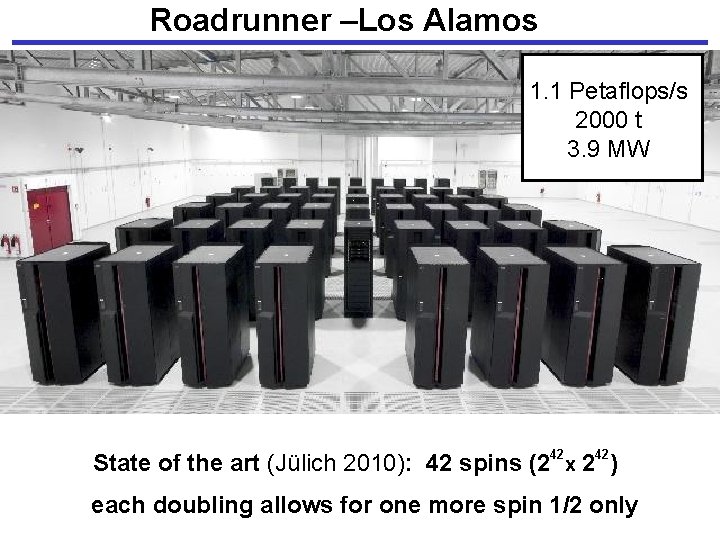
Roadrunner –Los Alamos 1. 1 Petaflops/s 2000 t 3. 9 MW State of the art (Jülich 2010): 42 spins (242 x 242) each doubling allows for one more spin 1/2 only
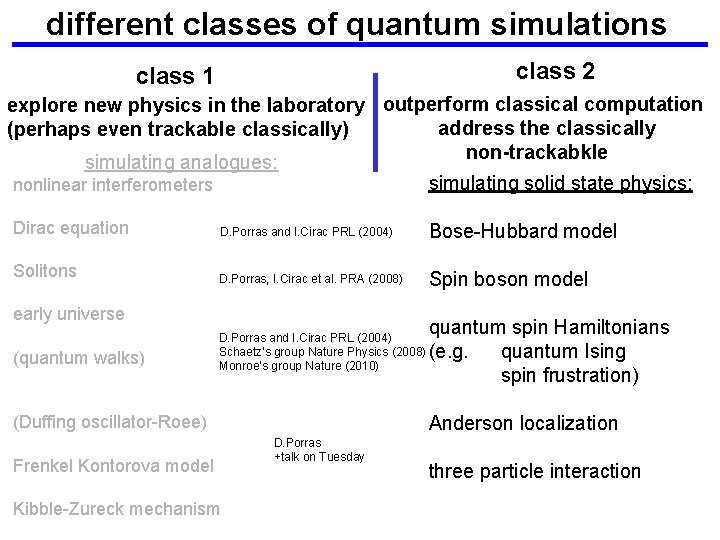
different classes of quantum simulations class 2 class 1 explore new physics in the laboratory outperform classical computation address the classically (perhaps even trackable classically) non-trackabkle simulating analogues: simulating solid state physics: nonlinear interferometers Dirac equation D. Porras and I. Cirac PRL (2004) Bose-Hubbard model Solitons D. Porras, I. Cirac et al. PRA (2008) Spin boson model D. Porras and I. Cirac PRL (2004) Schaetz’s group Nature Physics (2008) Monroe’s group Nature (2010) quantum spin Hamiltonians (e. g. quantum Ising spin frustration) early universe (quantum walks) Anderson localization (Duffing oscillator-Roee) Frenkel Kontorova model Kibble-Zureck mechanism D. Porras +talk on Tuesday three particle interaction
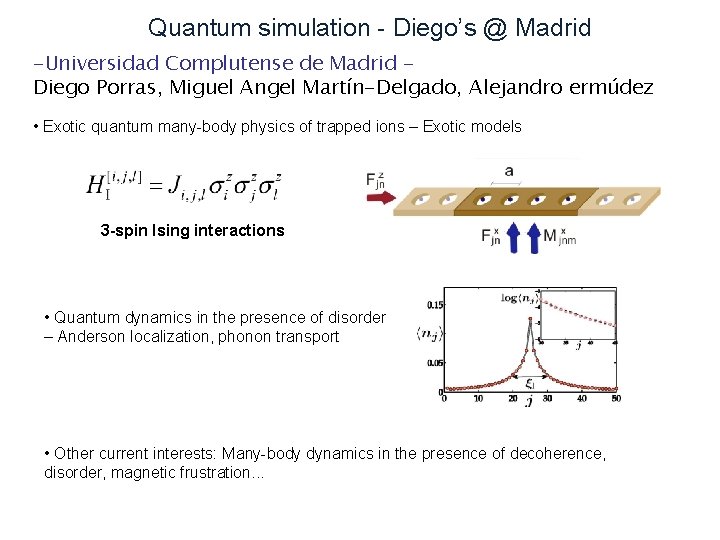
Quantum simulation - Diego’s @ Madrid -Universidad Complutense de Madrid Diego Porras, Miguel Angel Martín-Delgado, Alejandro ermúdez • Exotic quantum many-body physics of trapped ions – Exotic models 3 -spin Ising interactions • Quantum dynamics in the presence of disorder – Anderson localization, phonon transport • Other current interests: Many-body dynamics in the presence of decoherence, disorder, magnetic frustration. . .
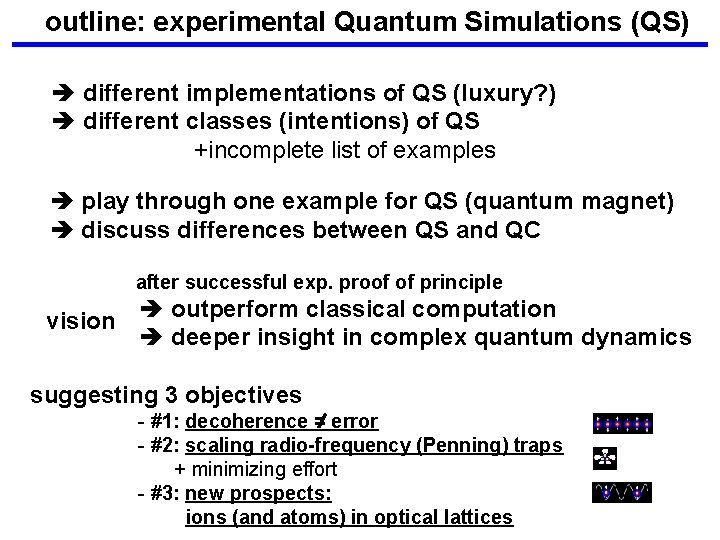
outline: experimental Quantum Simulations (QS) è different implementations of QS (luxury? ) è different classes (intentions) of QS +incomplete list of examples è play through one example for QS (quantum magnet) è discuss differences between QS and QC after successful exp. proof of principle vision è outperform classical computation è deeper insight in complex quantum dynamics suggesting 3 objectives - #1: decoherence = error - #2: scaling radio-frequency (Penning) traps + minimizing effort - #3: new prospects: ions (and atoms) in optical lattices
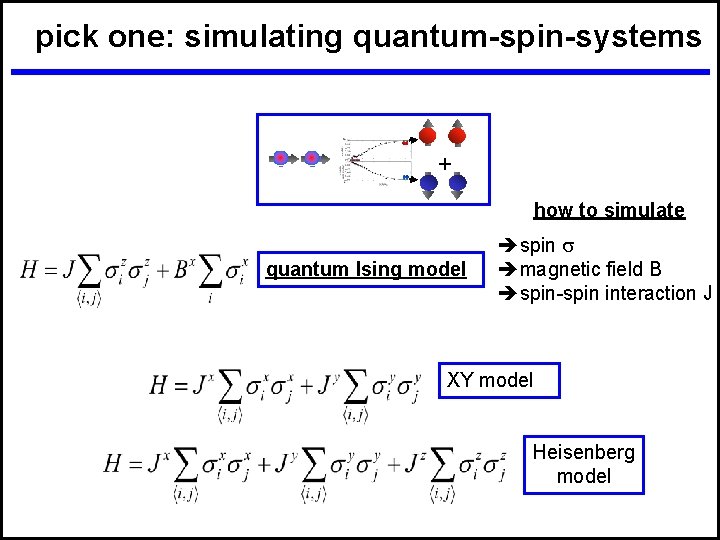
pick one: simulating quantum-spin-systems + how to simulate quantum Ising model èspin s èmagnetic field B èspin-spin interaction J XY model Heisenberg model
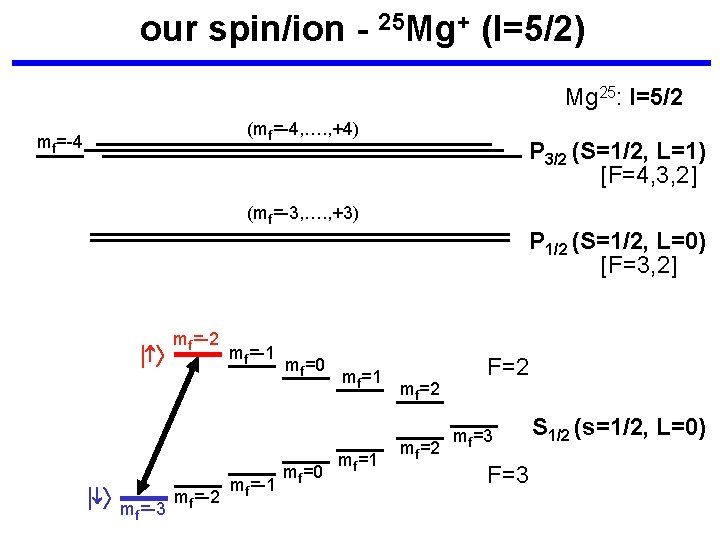
our spin/ion - 25 Mg+ (I=5/2) Mg 25: I=5/2 (mf=-4, …. , +4) mf=-4 P 3/2 (S=1/2, L=1) [F=4, 3, 2] (mf=-3, …. , +3) P 1/2 (S=1/2, L=0) [F=3, 2] mf=-3 mf=-2 mf=-1 mf=0 mf=1 mf=2 F=2 mf=3 F=3 S 1/2 (s=1/2, L=0)
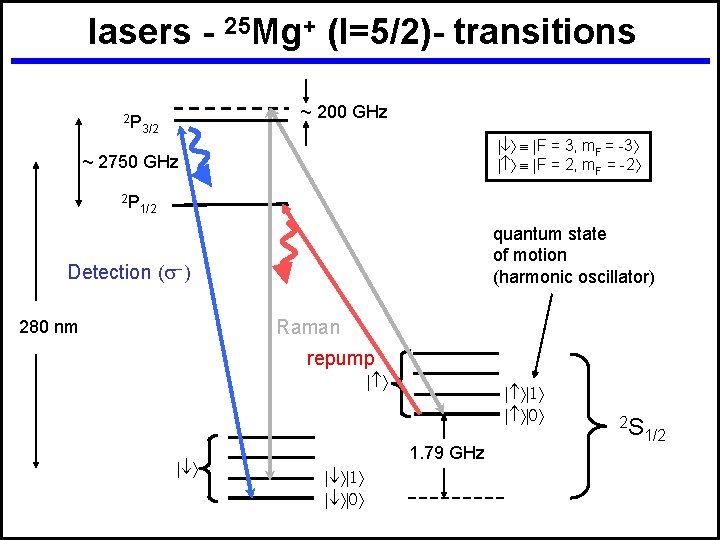
lasers - 25 Mg+ (I=5/2)- transitions 2 P ~ 200 GHz 3/2 F = 3, m. F = -3 F = 2, m. F = -2 ~ 2750 GHz 2 P 1/2 quantum state of motion (harmonic oscillator) Detection (s-) Raman 280 nm repump 1 0 1. 79 GHz 1 0 2 S 1/2
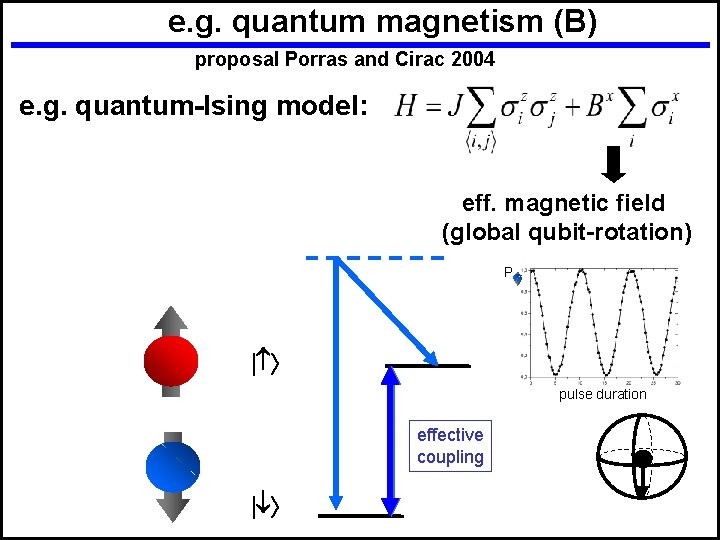
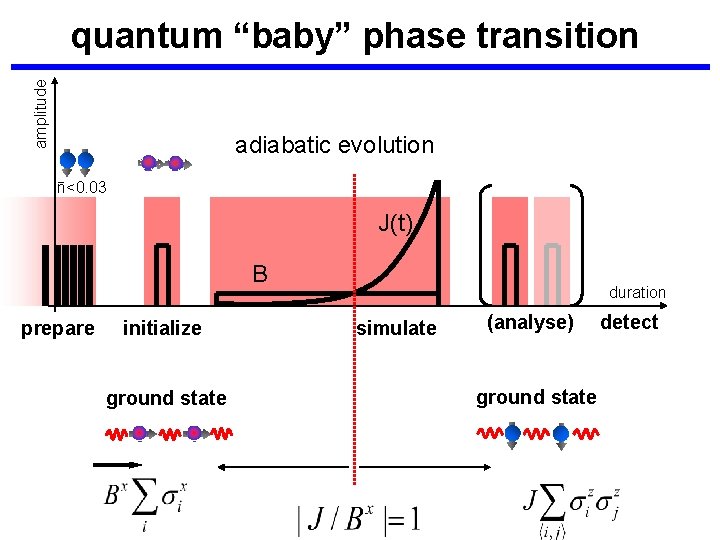
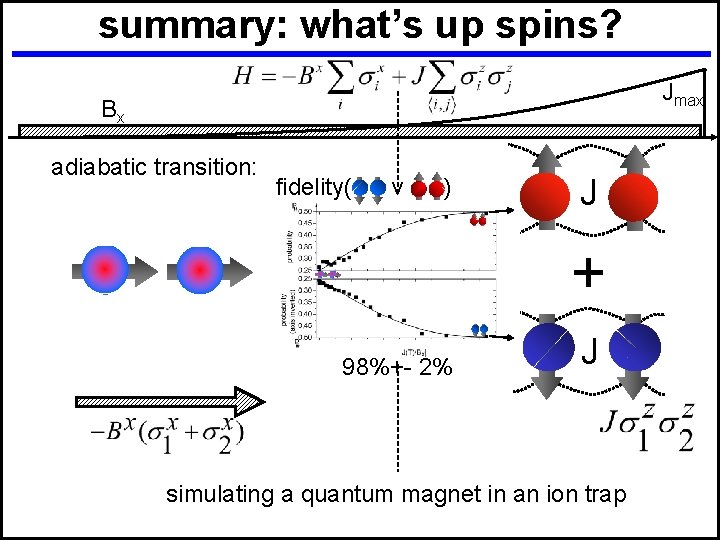
e. g. quantum magnetism (B) proposal Porras and Cirac 2004 e. g. quantum-Ising model: eff. magnetic field (global qubit-rotation) P pulse duration effective coupling Bx
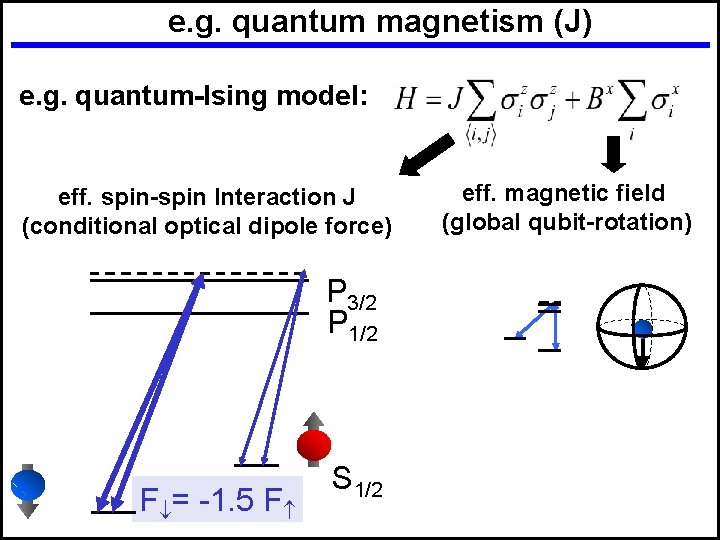
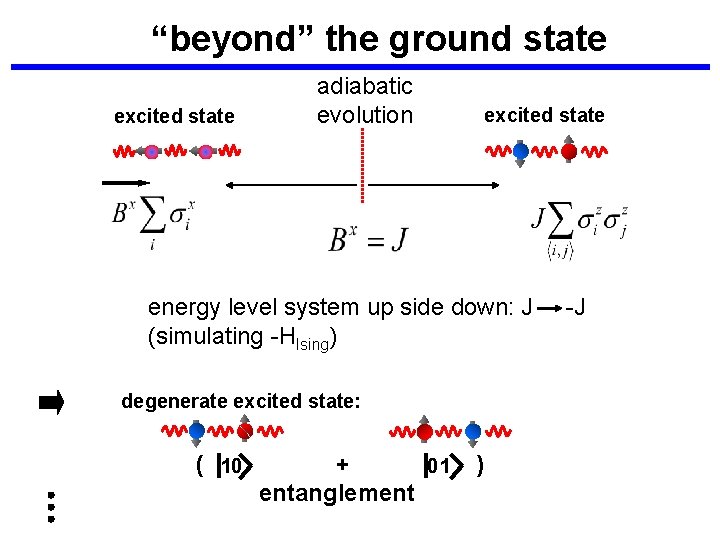
e. g. quantum magnetism (J) e. g. quantum-Ising model: eff. spin-spin Interaction J (conditional optical dipole force) eff. magnetic field (global qubit-rotation) P 3/2 P 1/2 F = -1. 5 F S 1/2 Bx
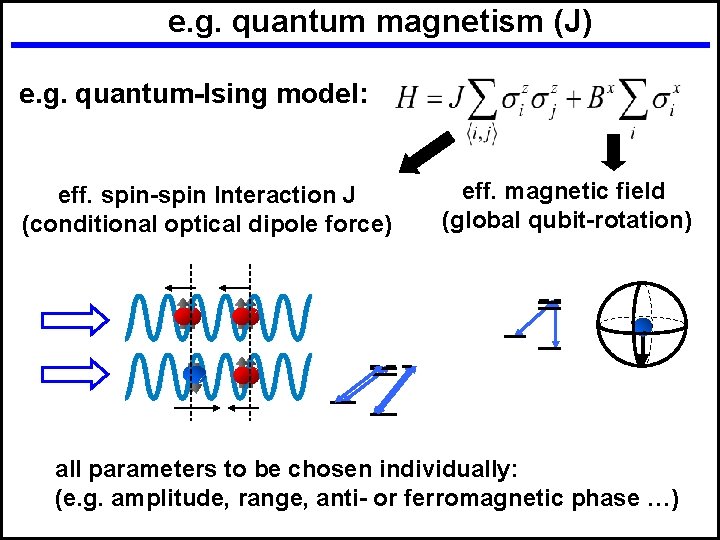
e. g. quantum magnetism (J) e. g. quantum-Ising model: eff. spin-spin Interaction J (conditional optical dipole force) eff. magnetic field (global qubit-rotation) all parameters to be chosen individually: Bx (e. g. amplitude, range, anti- or ferromagnetic phase …)
amplitude quantum “baby” phase transition adiabatic evolution + n<0. 03 J(t) B prepare initialize ground state duration simulate (analyse) ground state detect
summary: what’s up spins? Jmax Bx adiabatic transition: fidelity( v ) J Bx=|J(t)| + 98%+- 2% J simulating a quantum magnet in an ion trap
“beyond” the ground state excited state adiabatic evolution excited state energy level system up side down: J -J (simulating -HIsing) degenerate excited state: ( 10 + 01 entanglement )
Simplest case of spin frustration - C. Monroe’s AFM ? AFM J 12=J 13=J 23 > 0 ground state is entangled Bx=0 |Y = | +| +| +| symmetry breaking field Bx |Y 1 = | +| still entangled! P 0 P 1 P 2 P 3 Bx 0 |Y 2 = | +| still entangled! Frustration Entanglement P 0 P 1 K. Kim, et al. , Nature 465, 590 (2010)
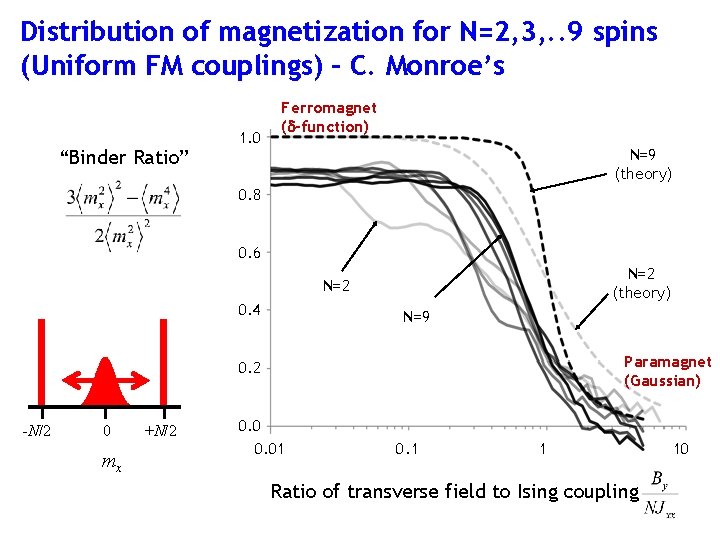
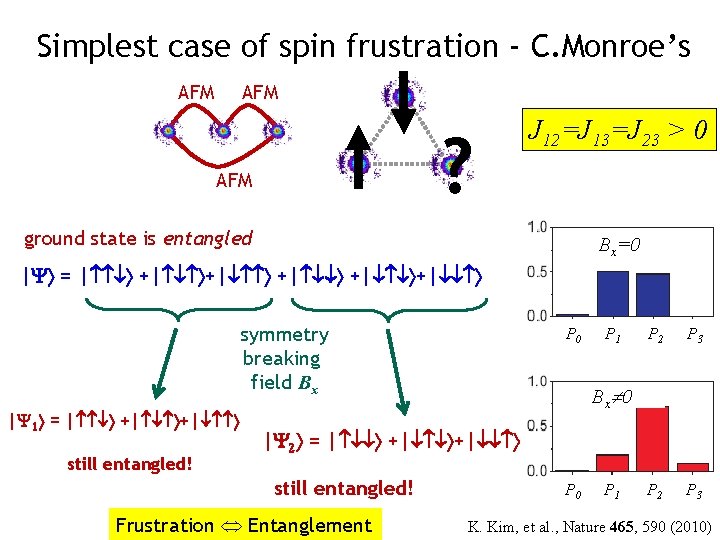
Distribution of magnetization for N=2, 3, . . 9 spins (Uniform FM couplings) – C. Monroe’s “Binder Ratio” 1. 0 Ferromagnet (d-function) N=9 (theory) 0. 8 0. 6 N=2 (theory) N=2 0. 4 N=9 Paramagnet (Gaussian) 0. 2 -N/2 0 mx +N/2 0. 01 0. 1 1 Ratio of transverse field to Ising coupling 10
outline: experimental Quantum Simulations (QS) è different implementations of QS (luxury? ) è different classes (intentions) of QS +incomplete list of examples è play through one example for QS (quantum magnet) è discuss differences between QS and QC after successful exp. proof of principle vision è outperform classical computation è deeper insight in complex quantum dynamics suggesting 3 objectives - #1: decoherence = error - #2: scaling radio-frequency (Penning) traps + minimizing effort - #3: new prospects: ions (and atoms) in optical lattices
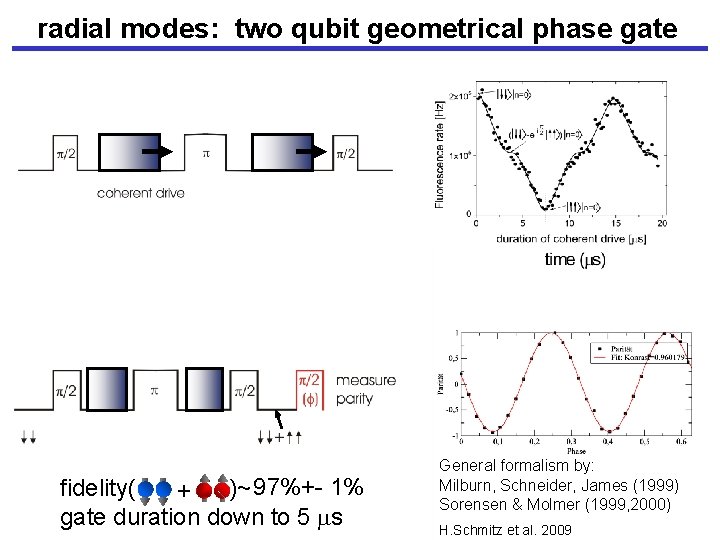
radial modes: two qubit geometrical phase gate time 39 ms 97%+- 1% fidelity( )~ + gate duration down to 5 ms General formalism by: Milburn, Schneider, James (1999) Sorensen & Molmer (1999, 2000) H. Schmitz et al. 2009
computing versus simulation • Techniques for minimizing noise in an quantum simulation (Poster) Q 28. 5 Di 16: 30 Uhr • Towards two-dimensional quantum simulations with trapped ions (Talk) Q 21. 1 Di 16: 30 Uhr
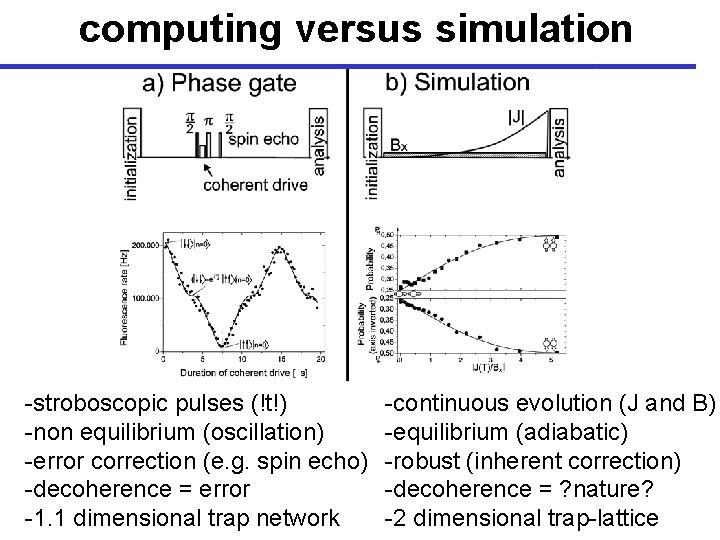
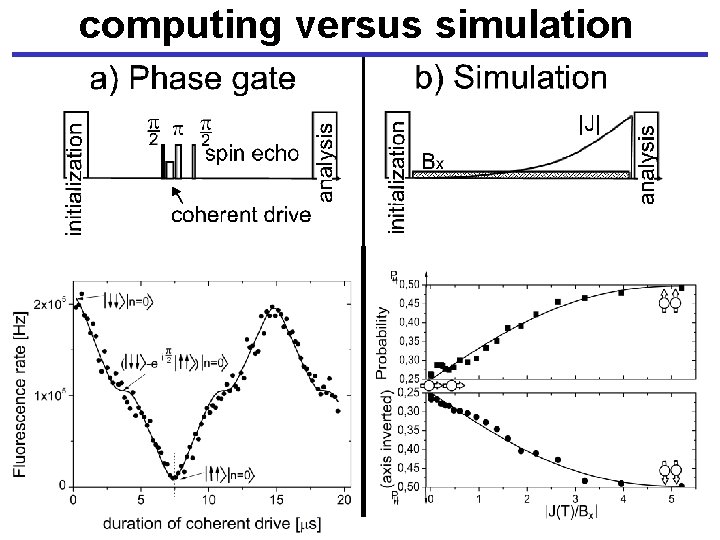
computing versus simulation -stroboscopic pulses (!t!) -non equilibrium (oscillation) -error correction (e. g. spin echo) -decoherence = error -1. 1 dimensional trap network -continuous evolution (J and B) -equilibrium (adiabatic) -robust (inherent correction) -decoherence = ? nature? -2 dimensional trap-lattice
outline: experimental Quantum Simulations (QS) è different implementations of QS (luxury? ) è different classes (intentions) of QS +incomplete list of examples è play through one example for QS (quantum magnet) è discuss differences between QS and QC after successful exp. proof of principle vision è outperform classical computation è deeper insight in complex quantum dynamics suggesting 3 objectives - #1: decoherence = error - #2: scaling radio-frequency (Penning) traps + minimizing effort - #3: new prospects: ions (and atoms) in optical lattices
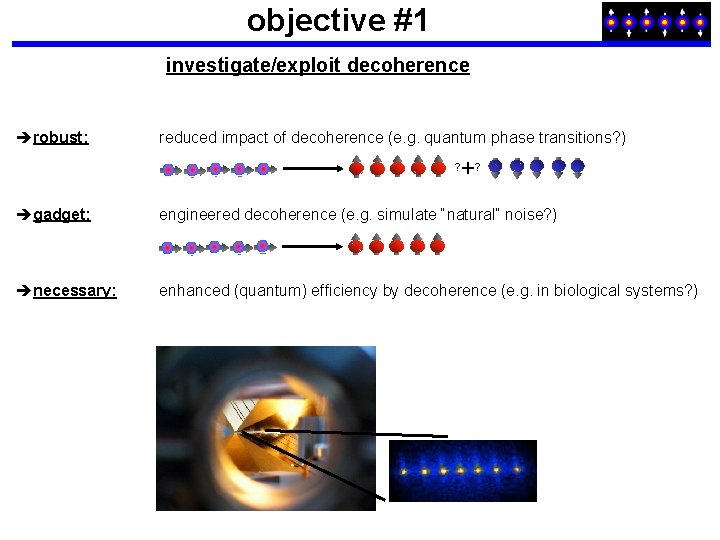
objective #1 investigate/exploit decoherence èrobust: reduced impact of decoherence (e. g. quantum phase transitions? ) ? +? ègadget: engineered decoherence (e. g. simulate “natural” noise? ) ènecessary: enhanced (quantum) efficiency by decoherence (e. g. in biological systems? )
outline: experimental Quantum Simulations (QS) è different implementations of QS (luxury? ) è different classes (intentions) of QS +incomplete list of examples è play through one example for QS (quantum magnet) è discuss differences between QS and QC after successful exp. proof of principle vision è outperform classical computation è deeper insight in complex quantum dynamics suggesting 3 objectives - #1: decoherence = error - #2: scaling radio-frequency (Penning) traps + minimizing effort - #3: new prospects: ions (and atoms) in optical lattices
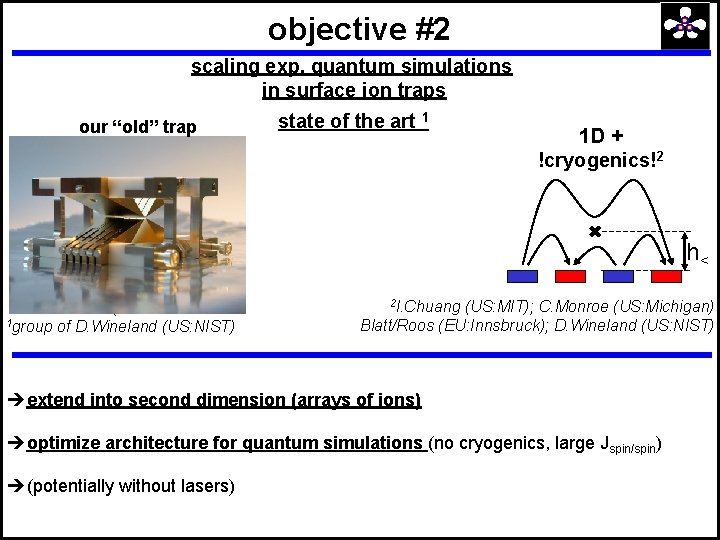
objective #2 scaling exp. quantum simulations in surface ion traps our “old” trap state of the art 1 1 D + !cryogenics!2 h< ~ rf 2 I. Chuang 1 group of D. Wineland (US: NIST) (US: MIT); C. Monroe (US: Michigan) Blatt/Roos (EU: Innsbruck); D. Wineland (US: NIST) èextend into second dimension (arrays of ions) èoptimize architecture for quantum simulations (no cryogenics, large Jspin/spin) è(potentially without lasers)
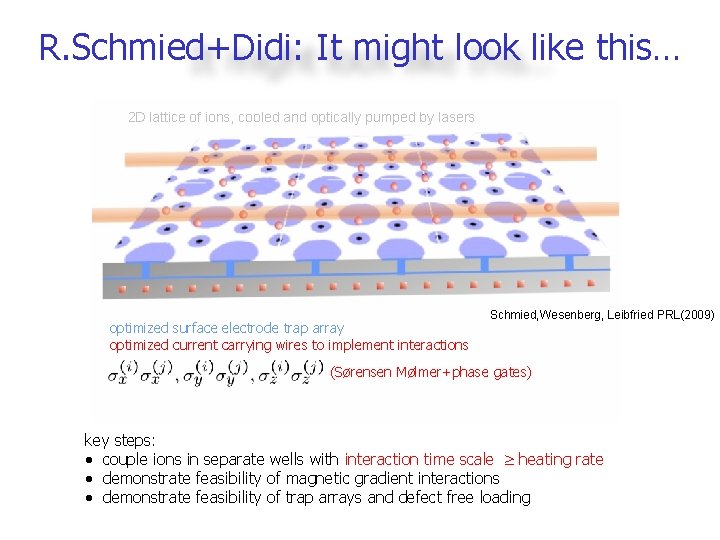
R. Schmied+Didi: It might look like this… 2 D lattice of ions, cooled and optically pumped by lasers optimized surface electrode trap array optimized current carrying wires to implement interactions Schmied, Wesenberg, Leibfried PRL(2009) (Sørensen Mølmer+phase gates) key steps: couple ions in separate wells with interaction time scale heating rate demonstrate feasibility of magnetic gradient interactions demonstrate feasibility of trap arrays and defect free loading
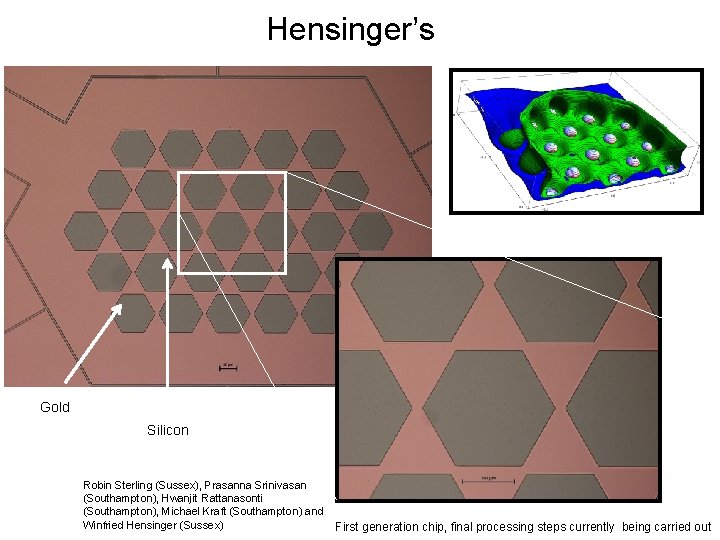
Hensinger’s Gold Silicon Robin Sterling (Sussex), Prasanna Srinivasan (Southampton), Hwanjit Rattanasonti (Southampton), Michael Kraft (Southampton) and Winfried Hensinger (Sussex) First generation chip, final processing steps currently being carried out
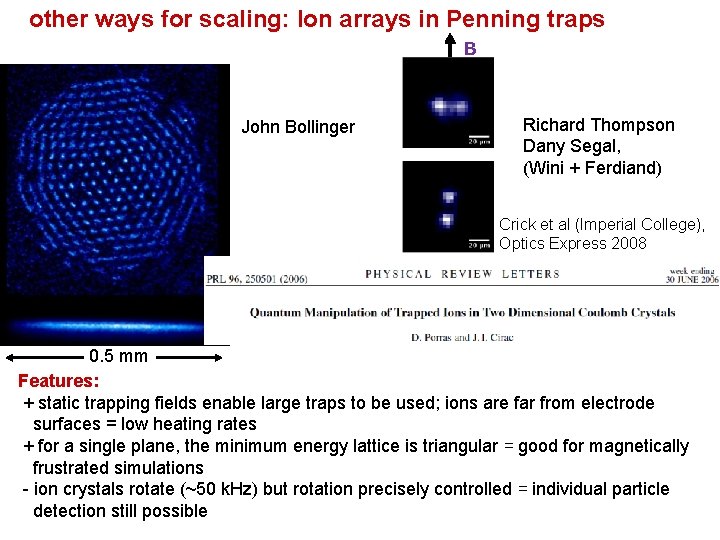
other ways for scaling: Ion arrays in Penning traps B John Bollinger Richard Thompson Dany Segal, (Wini + Ferdiand) Crick et al (Imperial College), Optics Express 2008 0. 5 mm Features: + static trapping fields enable large traps to be used; ions are far from electrode surfaces = low heating rates + for a single plane, the minimum energy lattice is triangular = good for magnetically frustrated simulations - ion crystals rotate (~50 k. Hz) but rotation precisely controlled = individual particle detection still possible
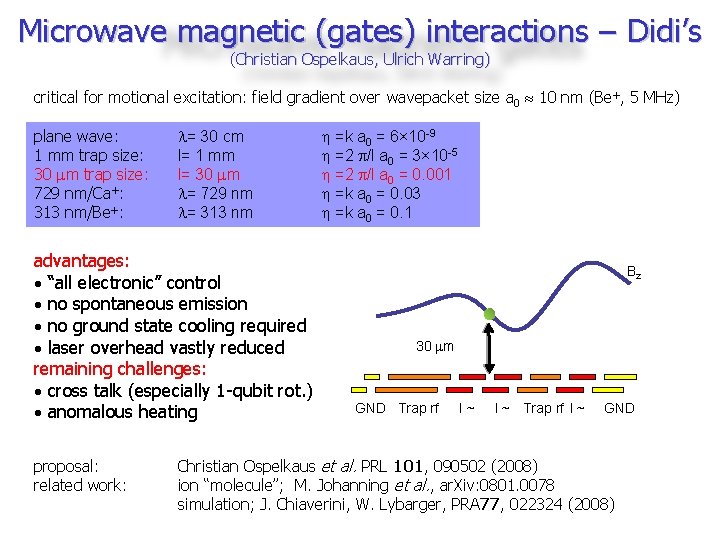
Microwave magnetic (gates) interactions – Didi’s (Christian Ospelkaus, Ulrich Warring) critical for motional excitation: field gradient over wavepacket size a 0 10 nm (Be+, 5 MHz) plane wave: 1 mm trap size: 30 mm trap size: 729 nm/Ca+: 313 nm/Be+: l= 30 cm l= 1 mm l= 30 mm l= 729 nm l= 313 nm advantages: “all electronic” control no spontaneous emission no ground state cooling required laser overhead vastly reduced remaining challenges: cross talk (especially 1 -qubit rot. ) anomalous heating proposal: related work: h =k a 0 = 6× 10 -9 h =2 p/l a 0 = 3× 10 -5 h =2 p/l a 0 = 0. 001 h =k a 0 = 0. 03 h =k a 0 = 0. 1 Bz 30 mm GND Trap rf I ~ GND Christian Ospelkaus et al. PRL 101, 090502 (2008) ion “molecule”; M. Johanning et al. , ar. Xiv: 0801. 0078 simulation; J. Chiaverini, W. Lybarger, PRA 77, 022324 (2008)
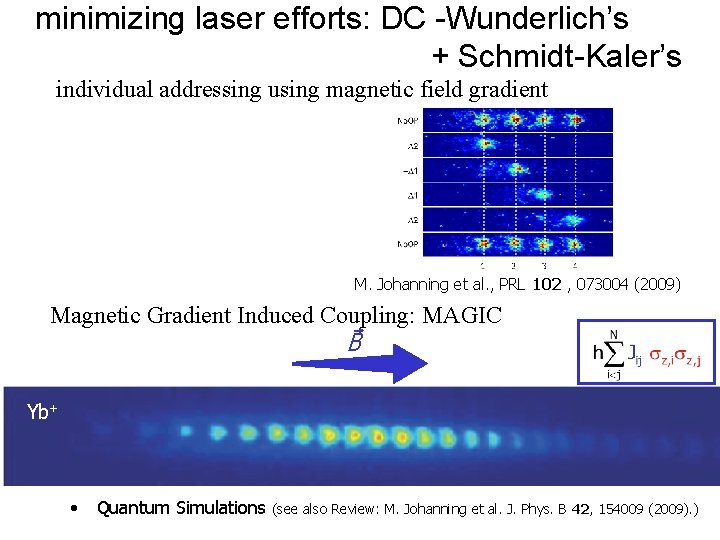
minimizing laser efforts: DC -Wunderlich’s + Schmidt-Kaler’s individual addressing using magnetic field gradient M. Johanning et al. , PRL 102 , 073004 (2009) Magnetic Gradient Induced Coupling: MAGIC B Yb+ • Quantum Simulations (see also Review: M. Johanning et al. J. Phys. B 42, 154009 (2009). )
outline: experimental Quantum Simulations (QS) è different implementations of QS (luxury? ) è different classes (intentions) of QS +incomplete list of examples è play through one example for QS (quantum magnet) è discuss differences between QS and QC after successful exp. proof of principle vision è outperform classical computation è deeper insight in complex quantum dynamics suggesting 3 objectives - #1: decoherence = error - #2: scaling radio-frequency (Penning) traps + minimizing effort - #3: new prospects: ions (and atoms) in optical lattices
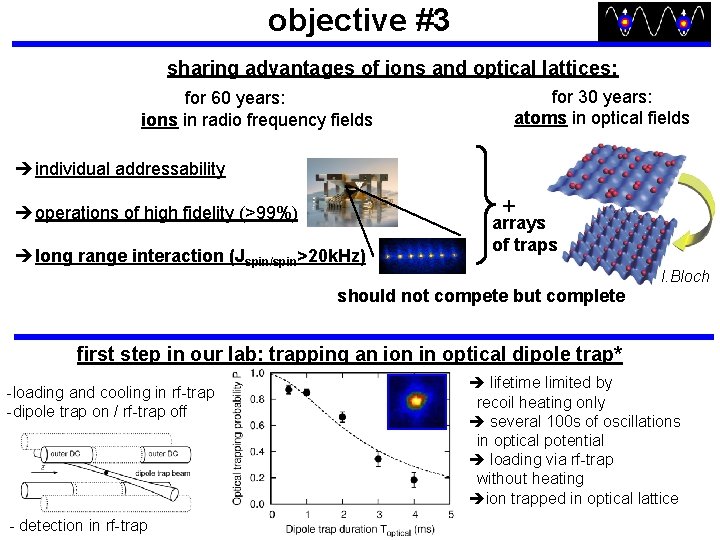
objective #3 sharing advantages of ions and optical lattices: for 60 years: ions in radio frequency fields for 30 years: atoms in optical fields èindividual addressability + èoperations of high fidelity (>99%) èlong range interaction (Jspin/spin>20 k. Hz) arrays of traps I. Bloch should not compete but complete first step in our lab: trapping an ion in optical dipole trap* -loading and cooling in rf-trap -dipole trap on / rf-trap off - detection in rf-trap è lifetime limited by recoil heating only è several 100 s of oscillations in optical potential è loading via rf-trap without heating èion trapped in optical lattice
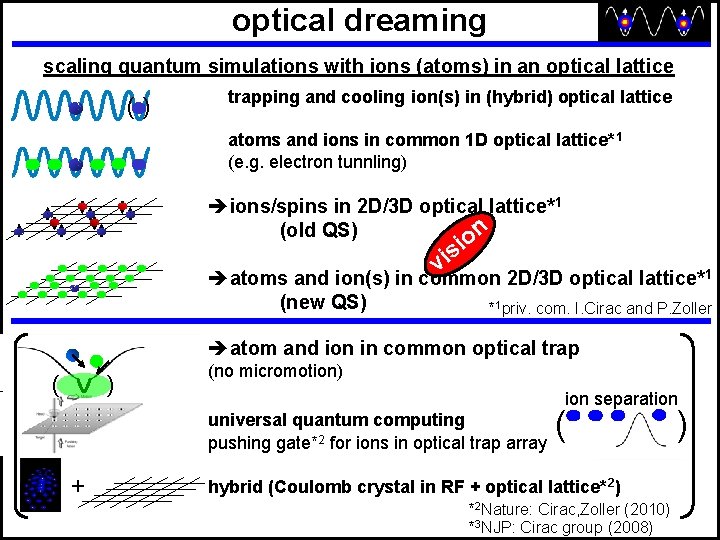
optical dreaming scaling quantum simulations with ions (atoms) in an optical lattice ( ) trapping and cooling ion(s) in (hybrid) optical lattice atoms and ions in common 1 D optical lattice*1 (e. g. electron tunnling) èions/spins in 2 D/3 D optical lattice*1 (old QS) on i s i v èatoms and ion(s) in common 2 D/3 D optical lattice*1 (new QS) *1 priv. com. I. Cirac and P. Zoller èatom and ion in common optical trap ( ) (no micromotion) universal quantum computing pushing gate*2 for ions in optical trap array + ion separation ( ) hybrid (Coulomb crystal in RF + optical lattice*2) *2 Nature: Cirac, Zoller (2010) *3 NJP: Cirac group (2008)
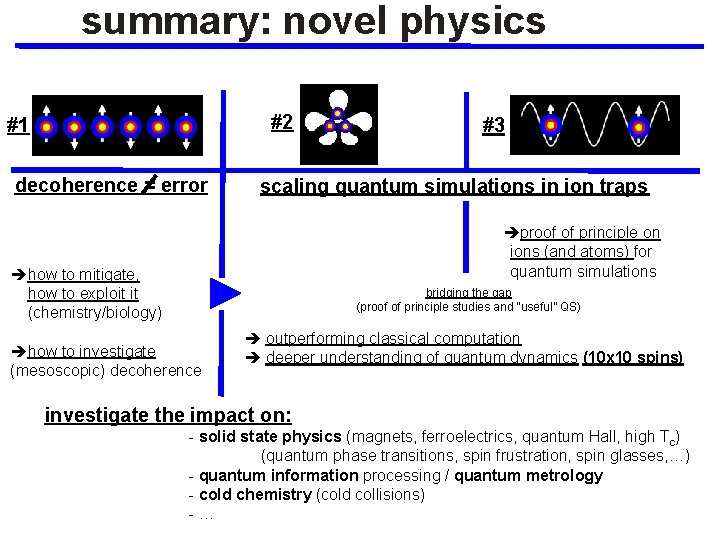
summary: novel physics #2 #1 decoherence = error #3 scaling quantum simulations in ion traps èproof of principle on ions (and atoms) for quantum simulations èhow to mitigate, how to exploit it (chemistry/biology) bridging the gap (proof of principle studies and “useful” QS) èhow to investigate (mesoscopic) decoherence è outperforming classical computation è deeper understanding of quantum dynamics (10 x 10 spins) investigate the impact on: - solid state physics (magnets, ferroelectrics, quantum Hall, high Tc) (quantum phase transitions, spin frustration, spin glasses, …) - quantum information processing / quantum metrology - cold chemistry (cold collisions) - …
Max-Planck Institute for Quantum Optics Garching Deutsche Forschungsgemeinschaft IMPRS-APS TIAMO Ph. Ds: Trapped Ions And MOlecules Steffen Kahra Günther Leschhorn GS: Tai Dou news from the 3. 8 fs beam line Ph. Ds: (Hector Schmitz) (Axel Friedenauer) QSim Christian Schneider Quantum Simulations Martin Enderlein GS: Thomas Huber (Robert Matjeschk) (Jan Glückert) (Lutz Pedersen) miac post doc position available
- Slides: 48