
SimulationBased Equivalence Checking Speaker Nansen Huang VLSI Design
Simulation-Based Equivalence Checking Speaker: Nansen Huang VLSI Design and Test Seminar (ELEC 7950001) March 9, 2016
Simulation-based equivalence checking �Problem statement �Importance of this problem �Various methods of equivalence checking �My method �Experiment �Results �Conclusion 2 Huang: ELEC 7950 -001 2016/3/9
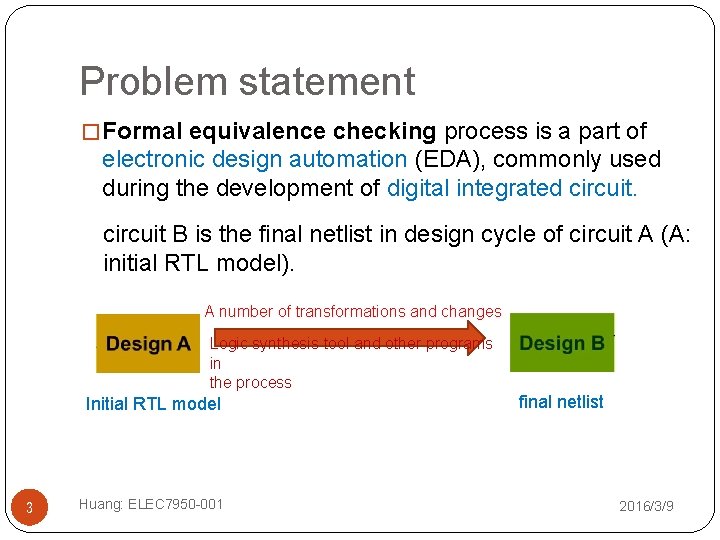
Problem statement � Formal equivalence checking process is a part of electronic design automation (EDA), commonly used during the development of digital integrated circuit B is the final netlist in design cycle of circuit A (A: initial RTL model). A number of transformations and changes Logic synthesis tool and other programs in the process Initial RTL model 3 Huang: ELEC 7950 -001 final netlist 2016/3/9
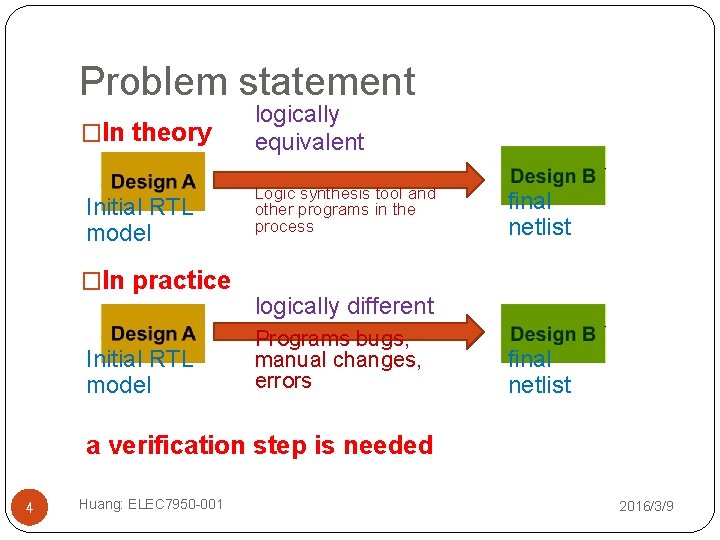
Problem statement �In theory Initial RTL model �In practice Initial RTL model logically equivalent Logic synthesis tool and other programs in the process final netlist logically different Programs bugs, manual changes, errors final netlist a verification step is needed 4 Huang: ELEC 7950 -001 2016/3/9
Importance of this problem � Historically, one way to check the equivalence was to 5 re-simulate, using the final netlist, and the test cases that were developed for verifying the correctness of the RTL. This process is called gate level logic simulation. � However, the problem with this is that the quality of the check is only as good as the quality of the test cases. Also, gate-level simulation of many test cases are notoriously slow to execute, which is a major problem as the size of digital designs continues to grow exponentially. � An alternative way to solve this is to formally prove that the RTL code and the netlist synthesized from it have exactly the same behavior in all (relevant) cases. This process is called formal equivalence checking and is a problem that is studied under the broader Huang: ELEC 7950 -001 2016/3/9 area of formal verification.
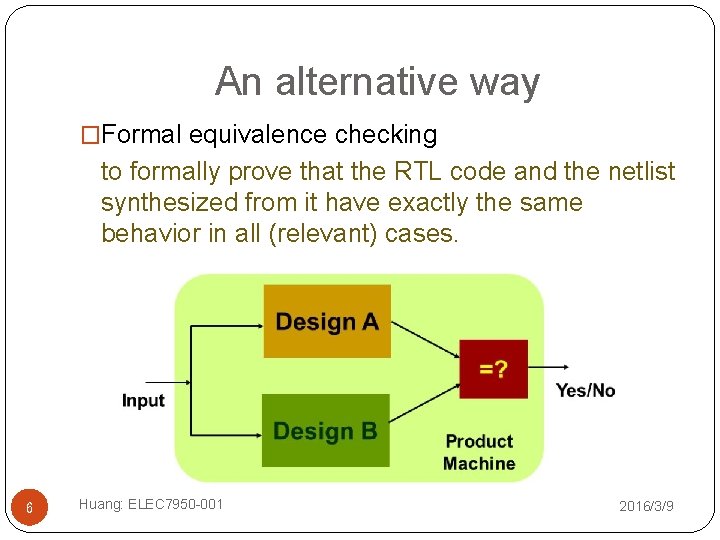
An alternative way �Formal equivalence checking to formally prove that the RTL code and the netlist synthesized from it have exactly the same behavior in all (relevant) cases. 6 Huang: ELEC 7950 -001 2016/3/9
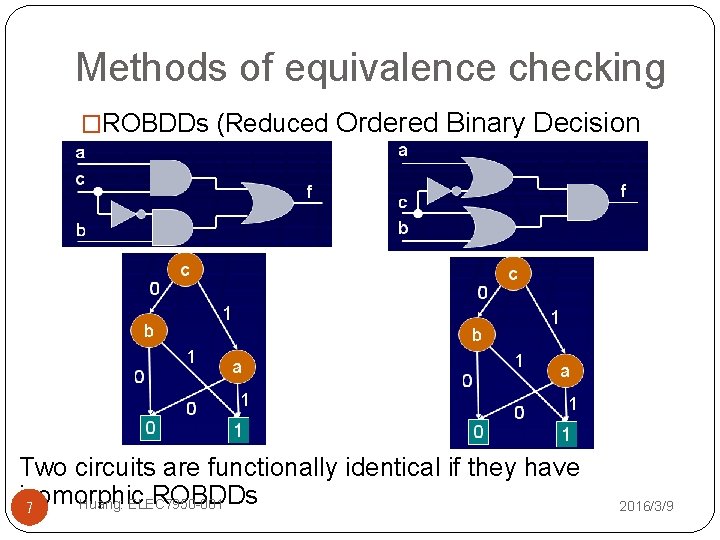
Methods of equivalence checking �ROBDDs (Reduced Ordered Binary Decision Diagram) Two circuits are functionally identical if they have isomorphic ROBDDs Huang: ELEC 7950 -001 7 2016/3/9
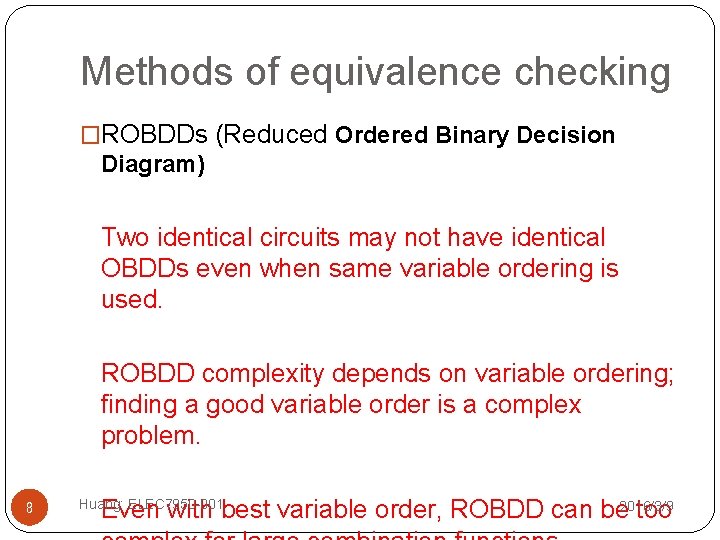
Methods of equivalence checking �ROBDDs (Reduced Ordered Binary Decision Diagram) Two identical circuits may not have identical OBDDs even when same variable ordering is used. ROBDD complexity depends on variable ordering; finding a good variable order is a complex problem. 8 Even with best variable order, ROBDD can be 2016/3/9 too Huang: ELEC 7950 -001
Methods of equivalence checking �Boolean satisfiability �Suppose we have circuits C 1 and C 2; C 2 is an 9 optimized version of C 1. �SAT means (F 1 and ¬F 2) or (¬F 1 and F 2) = true, where F 1 and F 2 are outputs of C 1 and C 2. �If we can find the input variable to satisfy the above formula, then C 1 and C 2 are not logically equivalent. However, SAT is proven to be an NPcomplete Huang: ELEC 7950 -001 2016/3/9 problem.
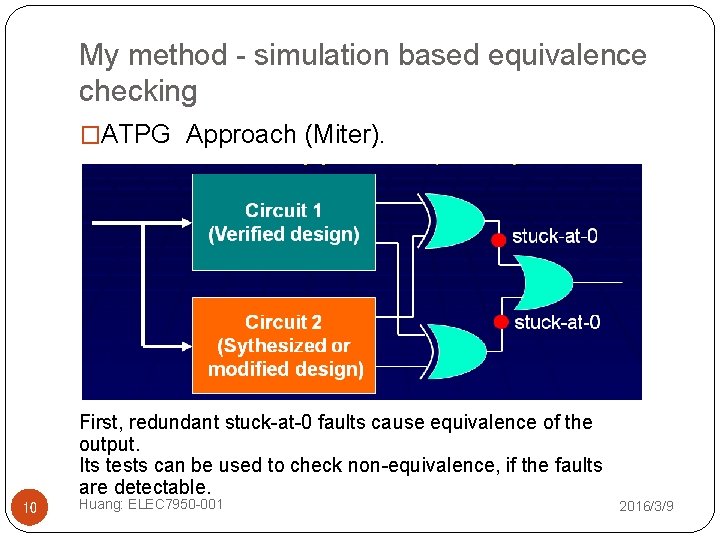
My method - simulation based equivalence checking �ATPG Approach (Miter). First, redundant stuck-at-0 faults cause equivalence of the output. Its tests can be used to check non-equivalence, if the faults are detectable. 10 Huang: ELEC 7950 -001 2016/3/9
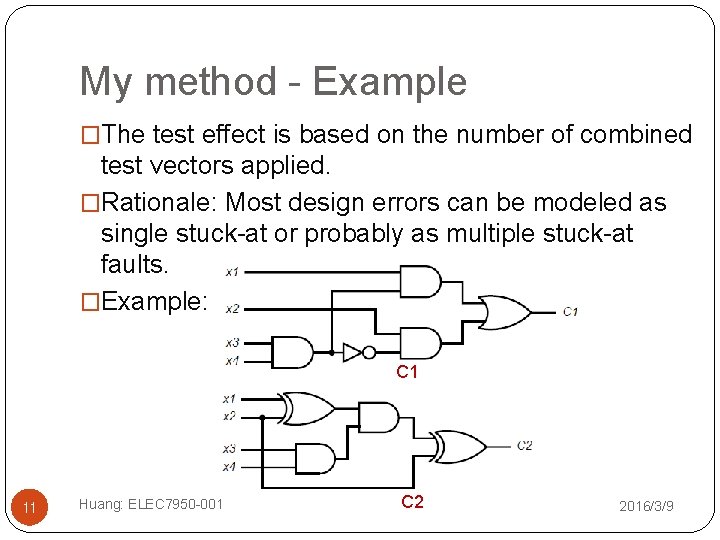
My method - Example �The test effect is based on the number of combined test vectors applied. �Rationale: Most design errors can be modeled as single stuck-at or probably as multiple stuck-at faults. �Example: C 1 11 Huang: ELEC 7950 -001 C 2 2016/3/9
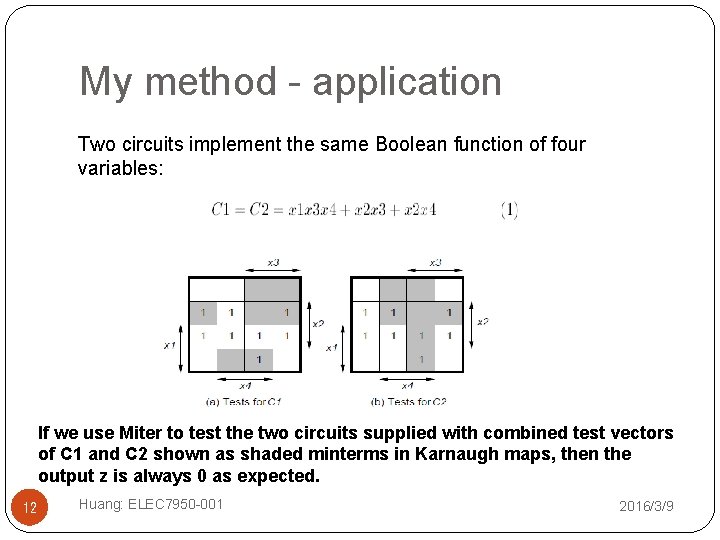
My method - application Two circuits implement the same Boolean function of four variables: If we use Miter to test the two circuits supplied with combined test vectors of C 1 and C 2 shown as shaded minterms in Karnaugh maps, then the output z is always 0 as expected. 12 Huang: ELEC 7950 -001 2016/3/9
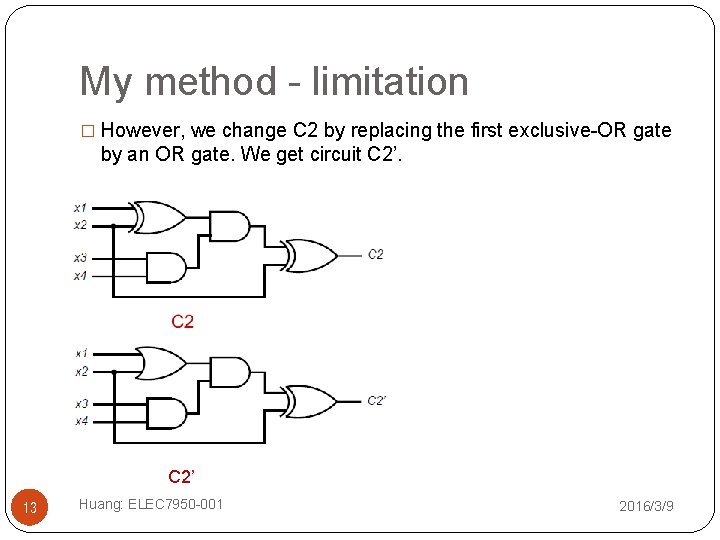
My method - limitation � However, we change C 2 by replacing the first exclusive-OR gate by an OR gate. We get circuit C 2’ 13 Huang: ELEC 7950 -001 2016/3/9
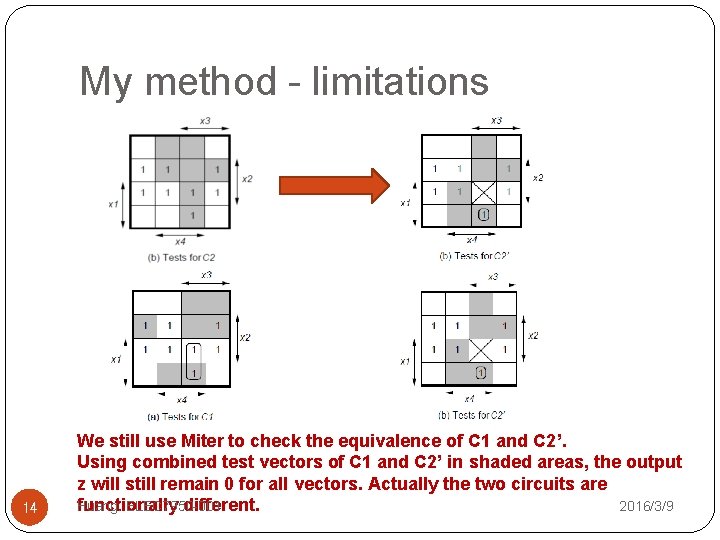
My method - limitations 14 We still use Miter to check the equivalence of C 1 and C 2’. Using combined test vectors of C 1 and C 2’ in shaded areas, the output z will still remain 0 for all vectors. Actually the two circuits are Huang: ELEC 7950 -001 functionally different. 2016/3/9
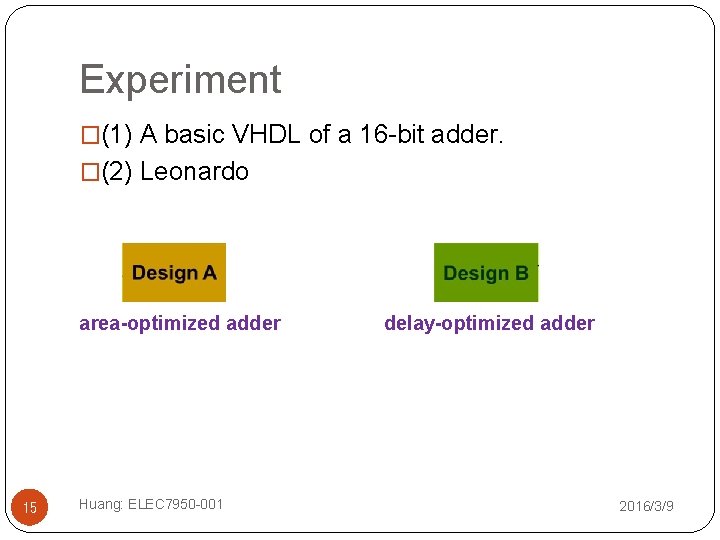
Experiment �(1) A basic VHDL of a 16 -bit adder. �(2) Leonardo area-optimized adder 15 Huang: ELEC 7950 -001 delay-optimized adder 2016/3/9
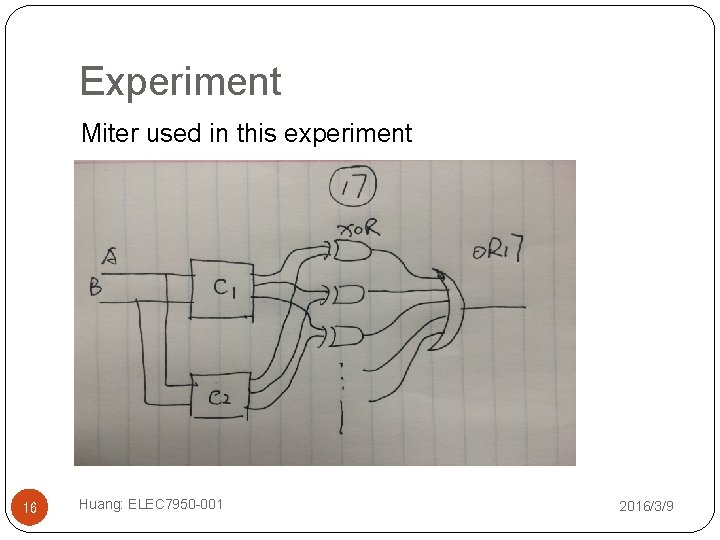
Experiment Miter used in this experiment 16 Huang: ELEC 7950 -001 2016/3/9
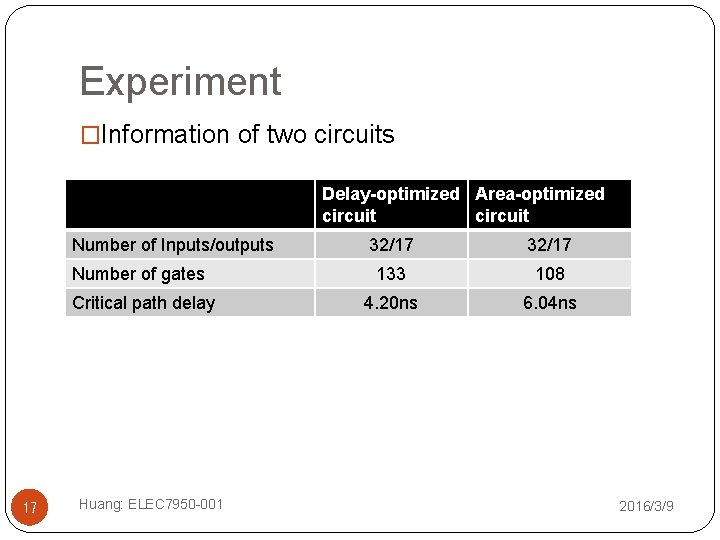
Experiment �Information of two circuits Delay-optimized Area-optimized circuit Number of Inputs/outputs 17 32/17 Number of gates 133 108 Critical path delay 4. 20 ns 6. 04 ns Huang: ELEC 7950 -001 2016/3/9
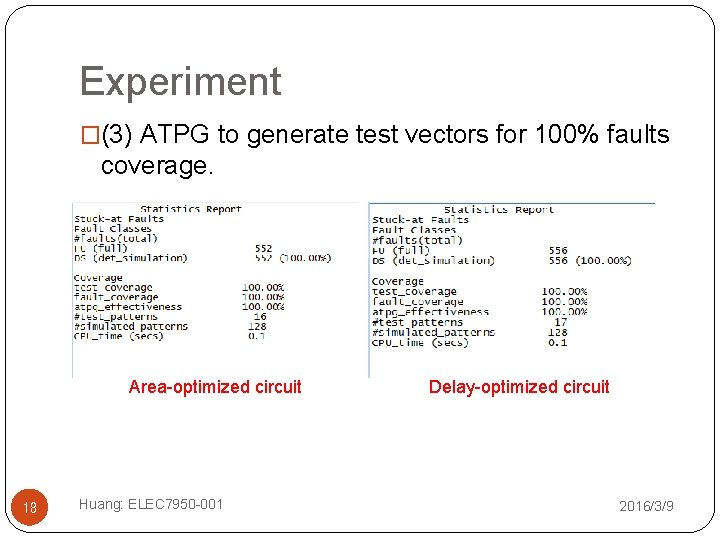
Experiment �(3) ATPG to generate test vectors for 100% faults coverage. Area-optimized circuit 18 Huang: ELEC 7950 -001 Delay-optimized circuit 2016/3/9
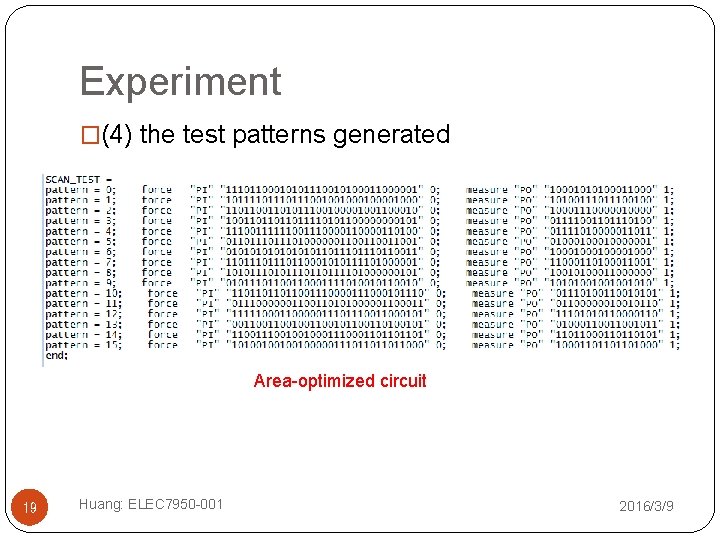
Experiment �(4) the test patterns generated Area-optimized circuit 19 Huang: ELEC 7950 -001 2016/3/9
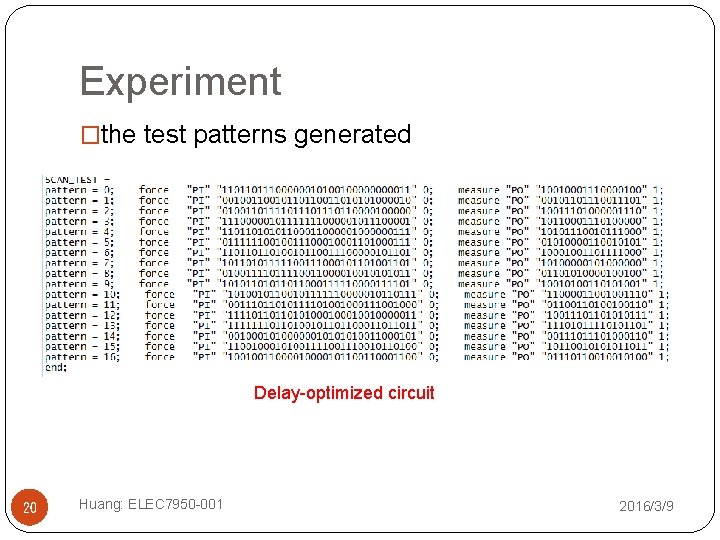
Experiment �the test patterns generated Delay-optimized circuit 20 Huang: ELEC 7950 -001 2016/3/9
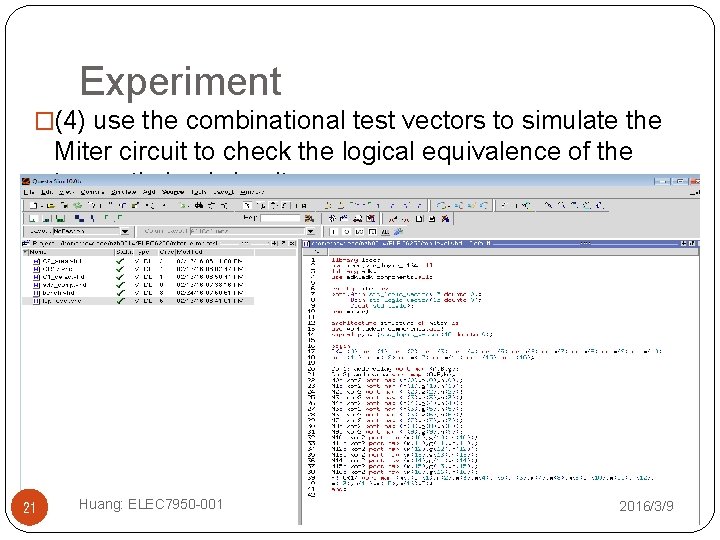
Experiment �(4) use the combinational test vectors to simulate the Miter circuit to check the logical equivalence of the two optimized circuits. 21 Huang: ELEC 7950 -001 2016/3/9

Experiment – simulation result 22 Huang: ELEC 7950 -001 2016/3/9
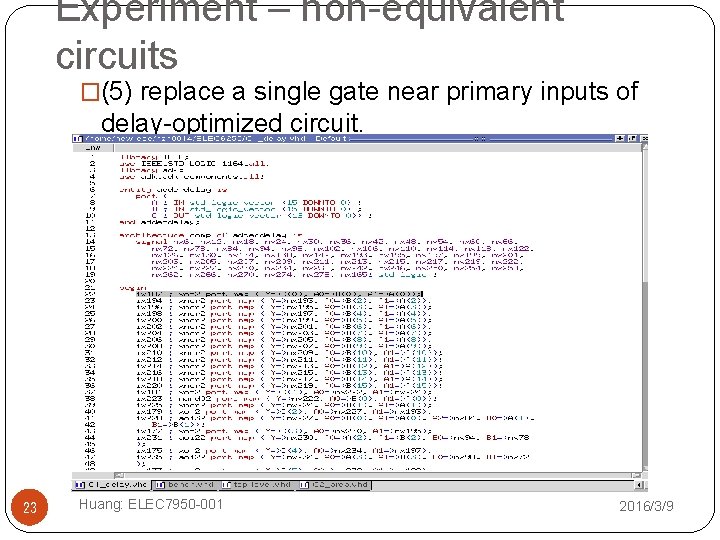
Experiment – non-equivalent circuits �(5) replace a single gate near primary inputs of delay-optimized circuit. 23 Huang: ELEC 7950 -001 2016/3/9
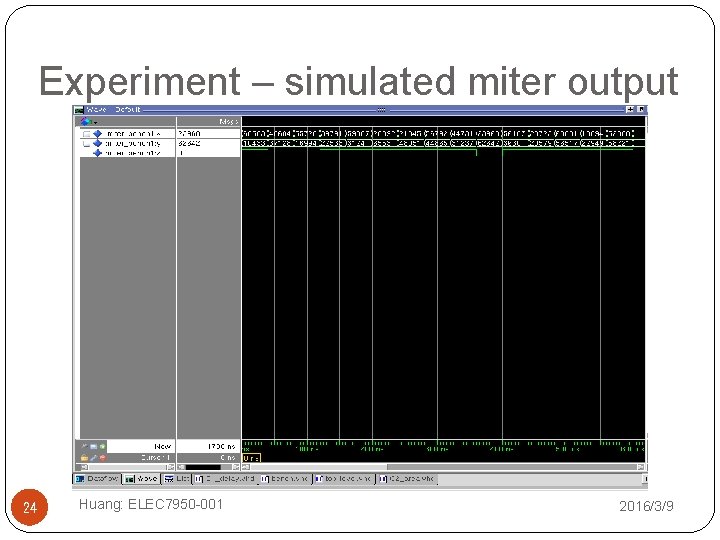
Experiment – simulated miter output 24 Huang: ELEC 7950 -001 2016/3/9
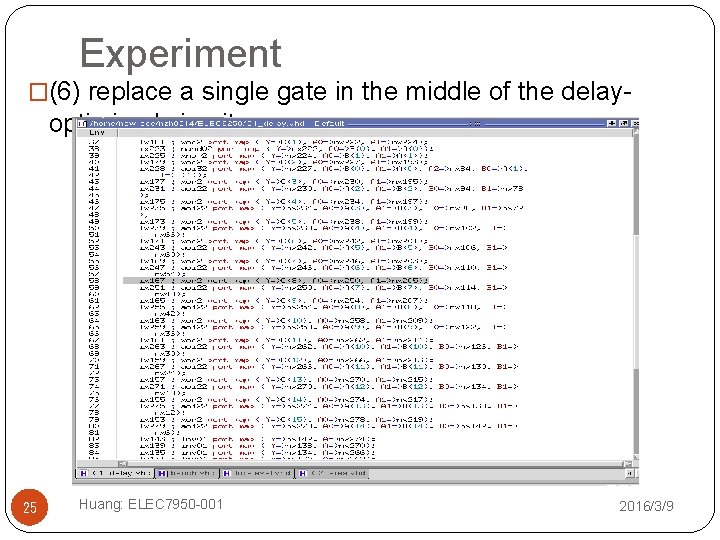
Experiment �(6) replace a single gate in the middle of the delay- optimized circuit. 25 Huang: ELEC 7950 -001 2016/3/9
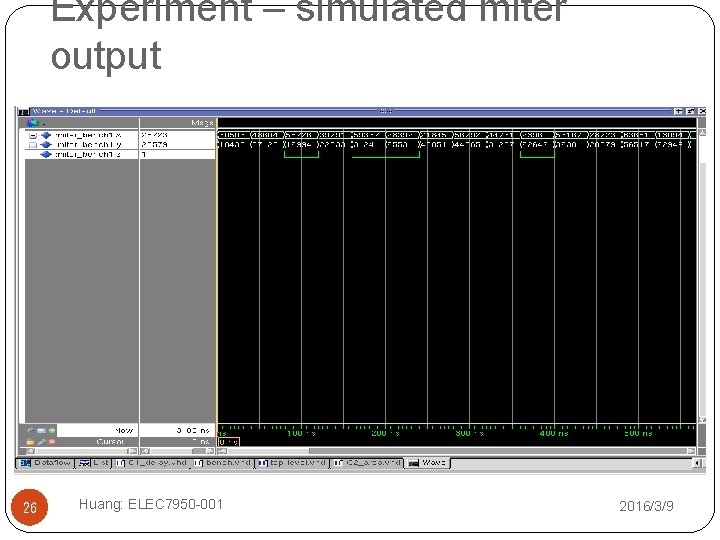
Experiment – simulated miter output 26 Huang: ELEC 7950 -001 2016/3/9
Conclusion �The simulation-based equivalence checking with ATPG vectors, often employed in the industry, mostly works. �But there are limitations as the example shows. �The method can be improved by using fault simulation of faults at primary inputs of the miter. �When simulation shows non-equivalence, fault simulation can be used to help identify design errors. 27 Huang: ELEC 7950 -001 2016/3/9
References � Equivalence Checking Problem: S. -Y. Hwang and K. 28 -T. Cheng, Formal Equivalence Checking and Design Debugging, Springer, 1998. � Formal Verification: E. M. Clarke, Jr. , O. Grumberg, and D. A. Peled, Model Checking, MIT Press, 1999. � ROBDD: R. E. Bryant, “Graph-Based Algorithms for Boolean Function Manipulation, ” IEEE Trans. Computers, vol. C-35, no. 8, pp. 677 -691, August 1986. � SAT: S. Eggersglüß and R. Drechsler, High Quality Test Pattern Generation and Boolean Satisfiability, Springer, 2012. � Miter Heuristic: V. D. Agrawal, “Choice of Tests for Logic Verification and Equivalence Checking and the Use of Fault Simulation, ” Proc. 13 th International Conf. VLSI Design, January 2000, pp. 306 -311. Huang: ELEC 7950 -001 2016/3/9
- Slides: 28