
SIMULATION STUDY OF THE MAGNETIZED ELECTRON BEAM S
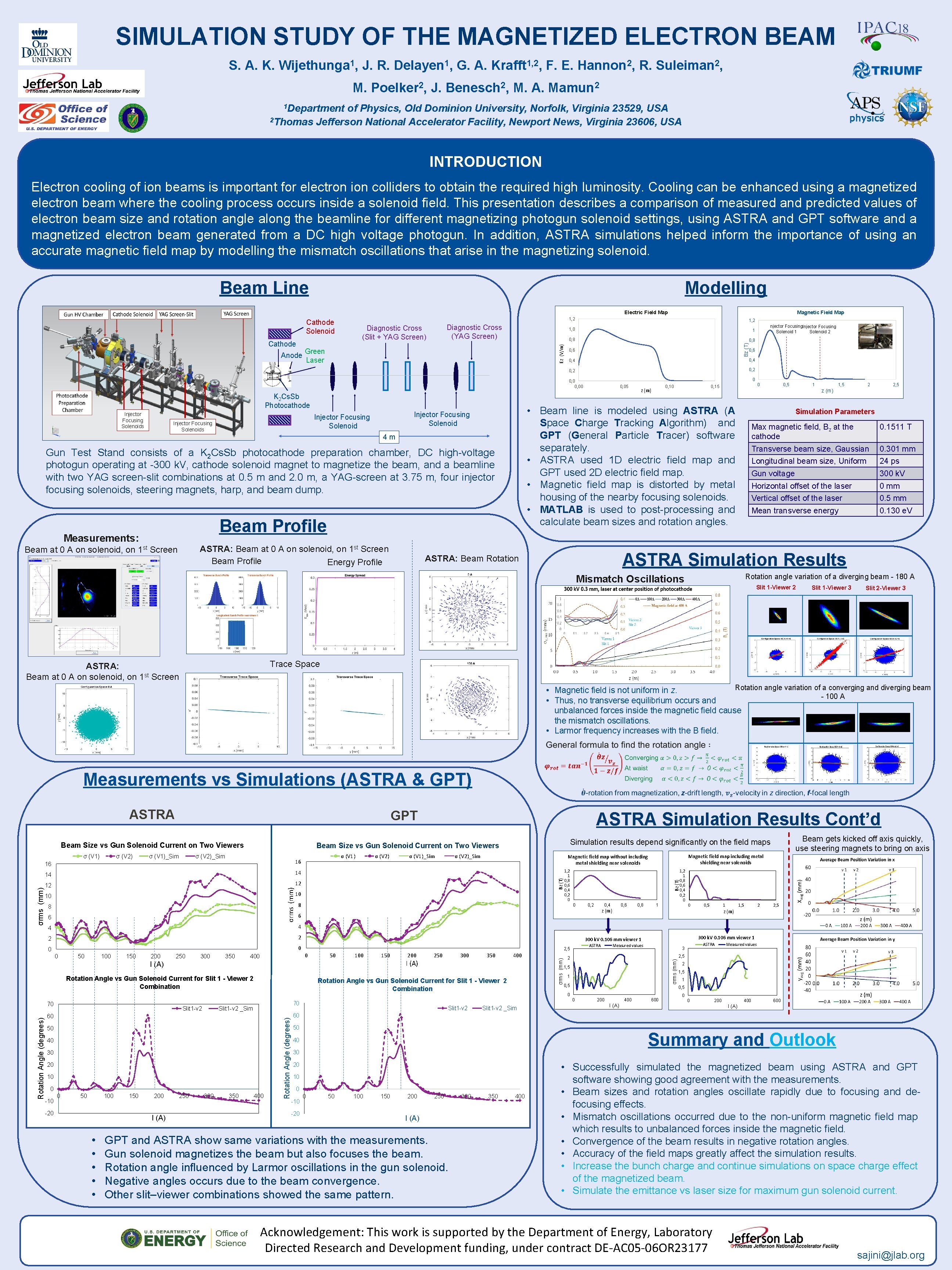
SIMULATION STUDY OF THE MAGNETIZED ELECTRON BEAM S. A. K. Wijethunga 1, J. R. Delayen 1, G. A. Krafft 1, 2, F. E. Hannon 2, R. Suleiman 2, M. Poelker 2, J. Benesch 2, M. A. Mamun 2 1 Department of Physics, Old Dominion University, Norfolk, Virginia 23529, USA 2 Thomas Jefferson National Accelerator Facility, Newport News, Virginia 23606, USA INTRODUCTION Electron cooling of ion beams is important for electron ion colliders to obtain the required high luminosity. Cooling can be enhanced using a magnetized electron beam where the cooling process occurs inside a solenoid field. This presentation describes a comparison of measured and predicted values of electron beam size and rotation angle along the beamline for different magnetizing photogun solenoid settings, using ASTRA and GPT software and a magnetized electron beam generated from a DC high voltage photogun. In addition, ASTRA simulations helped inform the importance of using an accurate magnetic field map by modelling the mismatch oscillations that arise in the magnetizing solenoid. Beam Line Modelling Electric Field Map Diagnostic Cross (YAG Screen) Diagnostic Cross (Slit + YAG Screen) Ez (V/m) Cathode Green Anode Laser 1, 2 1, 0 1 0, 8 Bz (T) Cathode Solenoid 0, 6 Injector Focusing Solenoids 0, 4 0, 2 0 Injector Focusing Solenoids 4 m Gun Test Stand consists of a K 2 Cs. Sb photocathode preparation chamber, DC high-voltage photogun operating at -300 k. V, cathode solenoid magnet to magnetize the beam, and a beamline with two YAG screen-slit combinations at 0. 5 m and 2. 0 m, a YAG-screen at 3. 75 m, four injector focusing solenoids, steering magnets, harp, and beam dump. Beam Profile Measurements: ASTRA: Beam at 0 A on solenoid, on 1 st Screen Beam Profile Energy Profile Beam at 0 A on solenoid, on 1 st Screen 0, 05 0, 10 z (m) 0 0, 15 0, 5 1 1, 5 2 2, 5 z (m) • Beam line is modeled using ASTRA (A Space Charge Tracking Algorithm) and GPT (General Particle Tracer) software separately. • ASTRA used 1 D electric field map and GPT used 2 D electric field map. • Magnetic field map is distorted by metal housing of the nearby focusing solenoids. • MATLAB is used to post-processing and calculate beam sizes and rotation angles. Injector Focusing Solenoid 1 Solenoid 2 0, 6 0, 4 0, 00 K 2 Cs. Sb Photocathode Magnetic Field Map Simulation Parameters Max magnetic field, Bz at the cathode 0. 1511 T Transverse beam size, Gaussian 0. 301 mm Longitudinal beam size, Uniform 24 ps Gun voltage 300 k. V Horizontal offset of the laser 0 mm Vertical offset of the laser 0. 5 mm Mean transverse energy 0. 130 e. V ASTRA Simulation Results ASTRA: Beam Rotation angle variation of a diverging beam - 180 A Mismatch Oscillations Slit 1 -Viewer 2 Slit 1 -Viewer 3 Slit 2 -Viewer 3 Trace Space ASTRA: Beam at 0 A on solenoid, on 1 st Screen Rotation angle variation of a converging and diverging beam • Magnetic field is not uniform in z. - 100 A • Thus, no transverse equilibrium occurs and unbalanced forces inside the magnetic field cause the mismatch oscillations. • Larmor frequency increases with the B field. Measurements vs Simulations (ASTRA & GPT) ASTRA GPT 16 16 14 14 12 12 10 8 6 2 0 0 150 200 250 300 350 50 100 150 40 30 20 10 0 0 50 100 -20 150 200 I (A) • • • 250 300 350 400 Rotation Angle (degrees) 50 -10 200 I (A) 250 300 350 400 0, 6 0, 8 1 0 Slit 1 -v 2 1 1, 5 2 2, 5 300 k. V 0. 106 mm viewer 1 Measured values ASTRA 3 Measured values 2, 5 1 0, 5 2 1, 5 1 0, 5 0 Slit 1 -v 2 _Sim 0, 5 z (m) 2 0 70 60 0, 4 ASTRA 2, 5 Rotation Angle vs Gun Solenoid Current for Slit 1 - Viewer 2 Combination Slit 1 -v 2 _Sim 0, 2 1 0, 8 0, 6 0, 4 0, 2 0 300 k. V 0. 106 mm viewer 1 Rotation Angle vs Gun Solenoid Current for Slit 1 - Viewer 2 Combination Slit 1 -v 2 1, 2 1 0, 8 0, 6 0, 4 0, 2 0 z (m) 0 400 Magnetic field map including metal shielding near solenoids Magnetic field map without including metal shielding near solenoids 0 I (A) 70 σ (V 2)_Sim 6 2 100 σ (V 1)_Sim 8 4 50 σ (V 2) 10 4 0 σ (V 1) σrms (mm) σ (V 2)_Sim Bz (T) σ (V 1)_Sim σrms (mm) σ (V 2) Beam Size vs Gun Solenoid Current on Two Viewers σrms (mm) σ (V 1) Beam gets kicked off axis quickly, use steering magnets to bring on axis Simulation results depend significantly on the field maps Bz (T) Beam Size vs Gun Solenoid Current on Two Viewers ASTRA Simulation Results Cont’d 200 400 I (A) 600 0 0 200 400 600 I (A) 60 50 Summary and Outlook 40 30 20 10 0 -10 -20 0 50 100 150 200 250 I (A) GPT and ASTRA show same variations with the measurements. Gun solenoid magnetizes the beam but also focuses the beam. Rotation angle influenced by Larmor oscillations in the gun solenoid. Negative angles occurs due to the beam convergence. Other slit–viewer combinations showed the same pattern. 300 350 400 • Successfully simulated the magnetized beam using ASTRA and GPT software showing good agreement with the measurements. • Beam sizes and rotation angles oscillate rapidly due to focusing and defocusing effects. • Mismatch oscillations occurred due to the non-uniform magnetic field map which results to unbalanced forces inside the magnetic field. • Convergence of the beam results in negative rotation angles. • Accuracy of the field maps greatly affect the simulation results. • Increase the bunch charge and continue simulations on space charge effect of the magnetized beam. • Simulate the emittance vs laser size for maximum gun solenoid current. Acknowledgement: This work is supported by the Department of Energy, Laboratory Directed Research and Development funding, under contract DE-AC 05 -06 OR 23177 sajini@jlab. org
- Slides: 1