
Simulation Study of Muon Scattering For Tomography Reconstruction
- Slides: 28
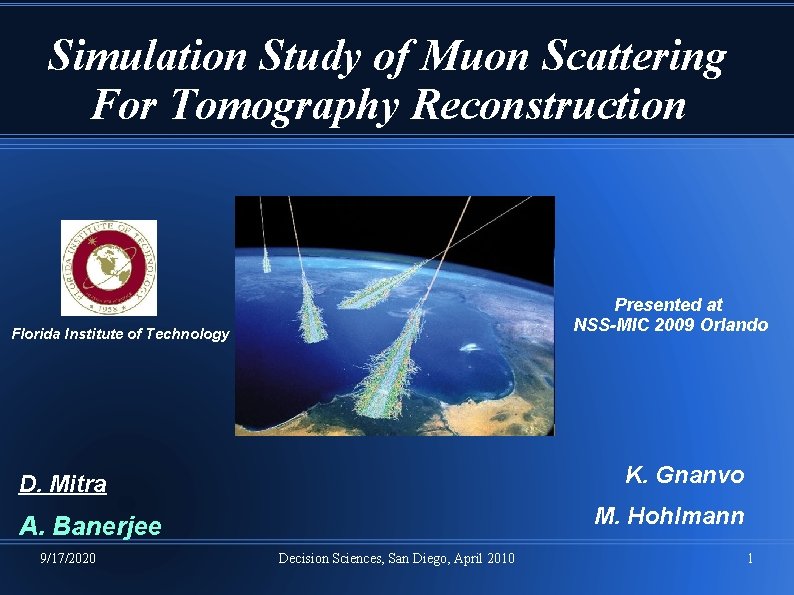
Simulation Study of Muon Scattering For Tomography Reconstruction Presented at NSS-MIC 2009 Orlando Florida Institute of Technology K. Gnanvo D. Mitra M. Hohlmann A. Banerjee 9/17/2020 Decision Sciences, San Diego, April 2010 1
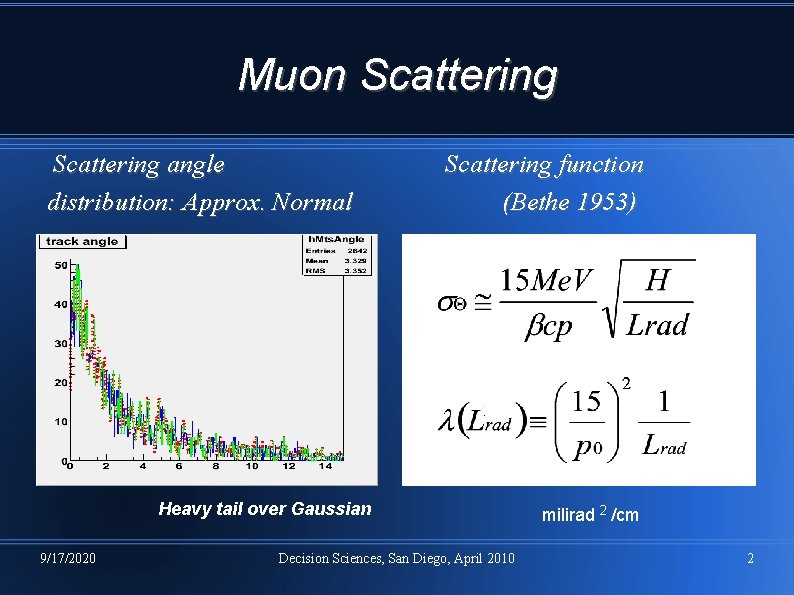
Muon Scattering angle distribution: Approx. Normal Scattering function (Bethe 1953) Heavy tail over Gaussian 9/17/2020 Decision Sciences, San Diego, April 2010 milirad 2 /cm 2
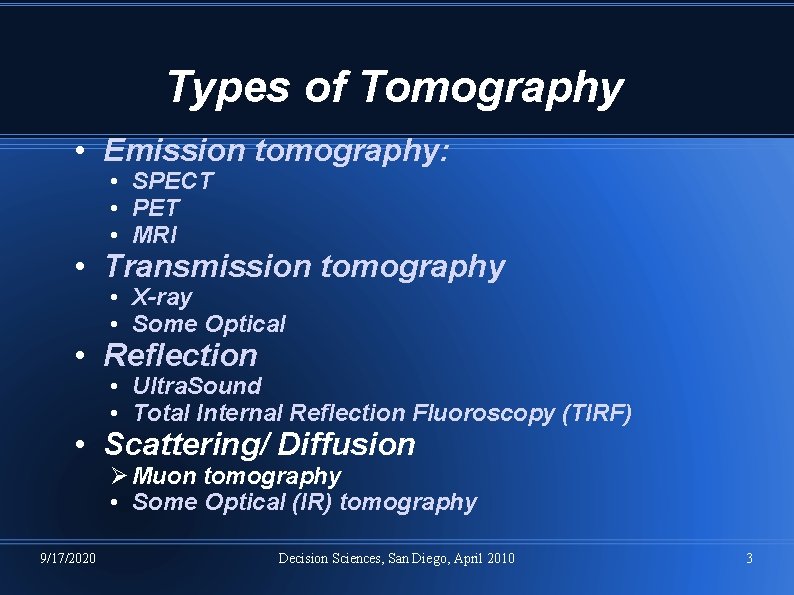
Types of Tomography • Emission tomography: • SPECT • PET • MRI • Transmission tomography • X-ray • Some Optical • Reflection • Ultra. Sound • Total Internal Reflection Fluoroscopy (TIRF) • Scattering/ Diffusion Ø Muon tomography • Some Optical (IR) tomography 9/17/2020 Decision Sciences, San Diego, April 2010 3
Experiment • GEANT 4 simulation with partial physics for scattering • Large array of Gas Electron Multiplier (GEM) detector is being built • IEEE NSS-MIC’ 09 Orlando Poster# N 13 -246 9/17/2020 Decision Sciences, San Diego, April 2010 4
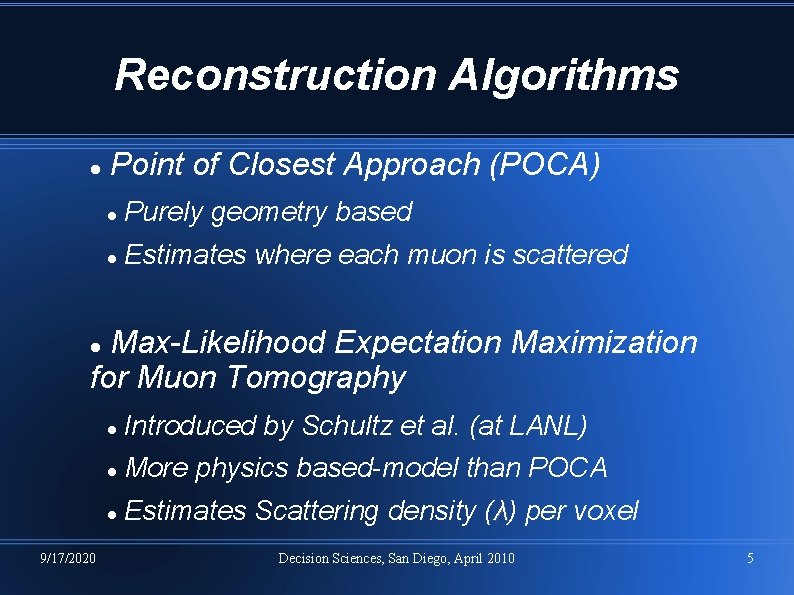
Reconstruction Algorithms Point of Closest Approach (POCA) Purely geometry based Estimates where each muon is scattered Max-Likelihood Expectation Maximization for Muon Tomography 9/17/2020 Introduced by Schultz et al. (at LANL) More physics based-model than POCA Estimates Scattering density (λ) per voxel Decision Sciences, San Diego, April 2010 5
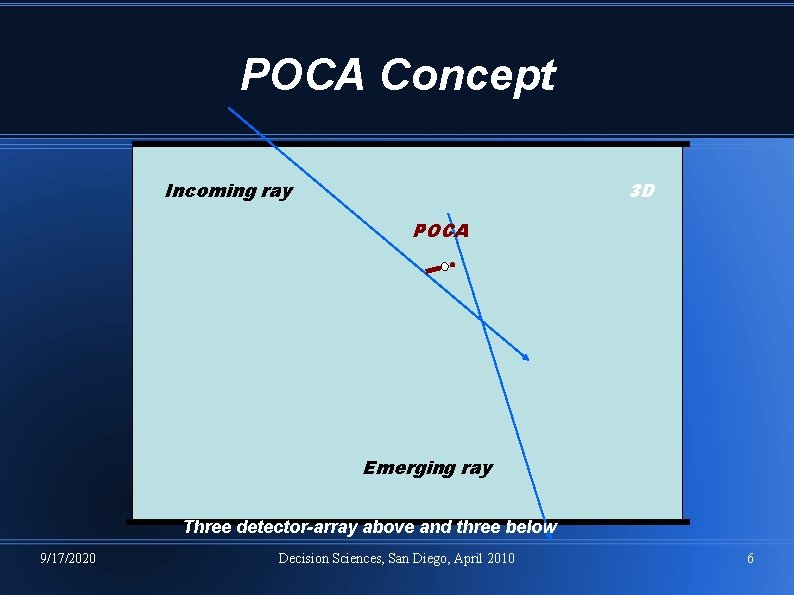
POCA Concept Incoming ray 3 D POCA Emerging ray Three detector-array above and three below 9/17/2020 Decision Sciences, San Diego, April 2010 6
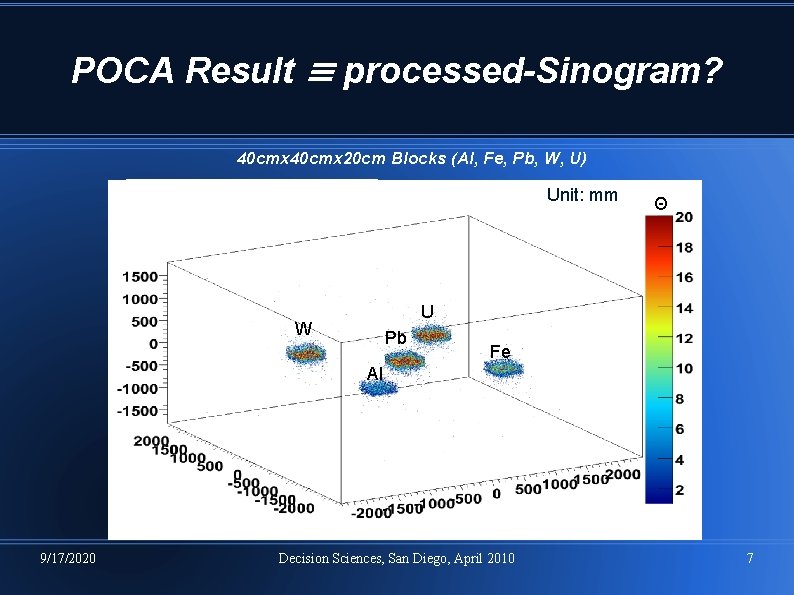
POCA Result ≡ processed-Sinogram? 40 cmx 20 cm Blocks (Al, Fe, Pb, W, U) Θ Unit: mm U W Pb Fe Al 9/17/2020 Decision Sciences, San Diego, April 2010 7
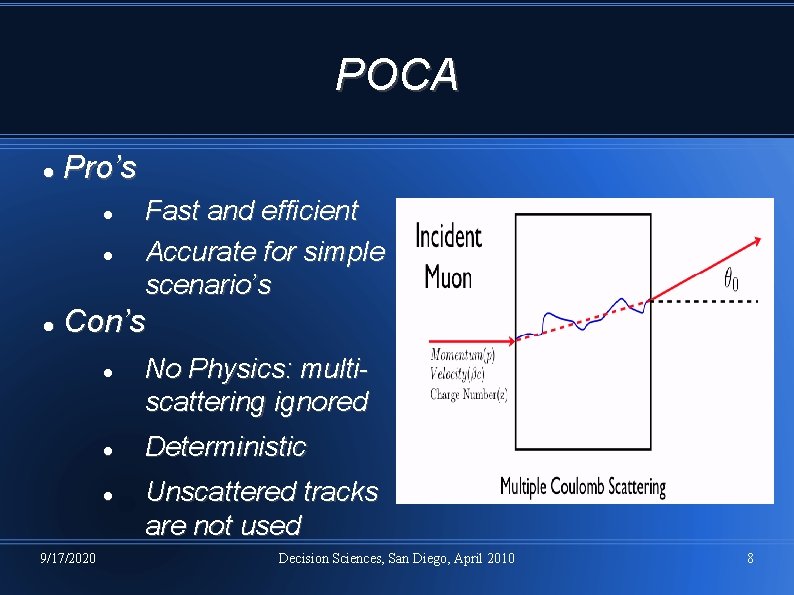
POCA Pro’s Fast and efficient Accurate for simple scenario’s Con’s 9/17/2020 No Physics: multiscattering ignored Deterministic Unscattered tracks are not used Decision Sciences, San Diego, April 2010 8
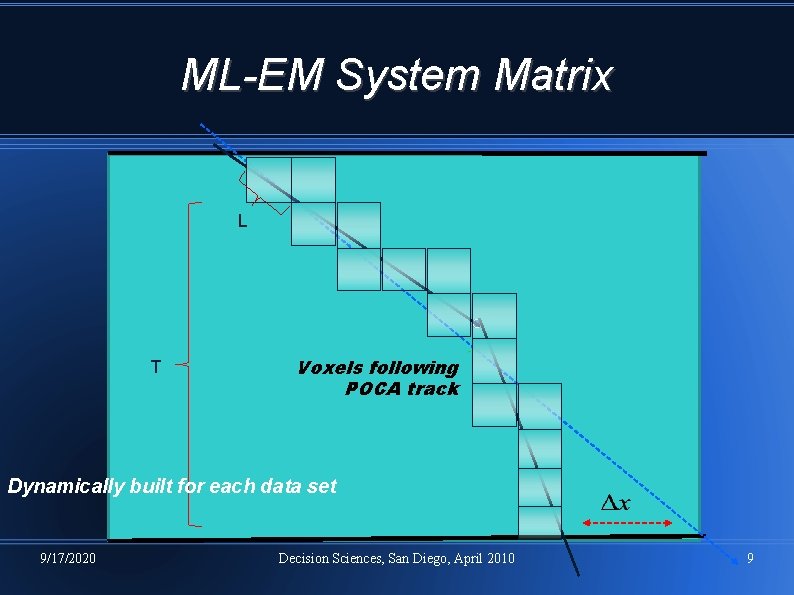
ML-EM System Matrix L T Voxels following POCA track Dynamically built for each data set 9/17/2020 Decision Sciences, San Diego, April 2010 9
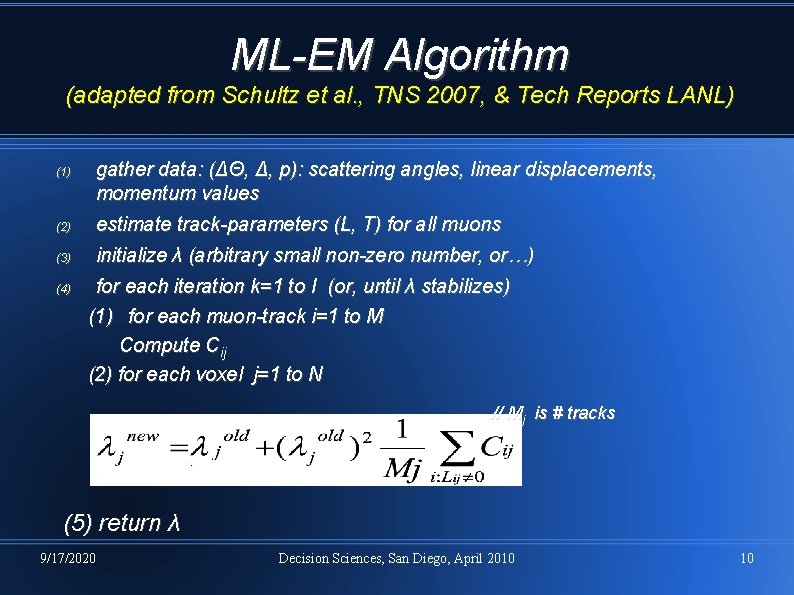
ML-EM Algorithm (adapted from Schultz et al. , TNS 2007, & Tech Reports LANL) (1) gather data: (ΔΘ, Δ, p): scattering angles, linear displacements, momentum values (2) estimate track-parameters (L, T) for all muons (3) initialize λ (arbitrary small non-zero number, or…) (4) for each iteration k=1 to I (or, until λ stabilizes) (1) for each muon-track i=1 to M Compute Cij (2) for each voxel j=1 to N // Mj is # tracks (5) return λ 9/17/2020 Decision Sciences, San Diego, April 2010 10
ML-EM Reconstruction [In ‘Next Generation Applied Intelligence’ (Springer Lecture Series in Computational Intelligence: 214), pp. 225 -231, June 2009. ] • Slow for complex scenario • Our implementation used some smart data structure for speed and better memory usage 9/17/2020 Decision Sciences, San Diego, April 2010 11
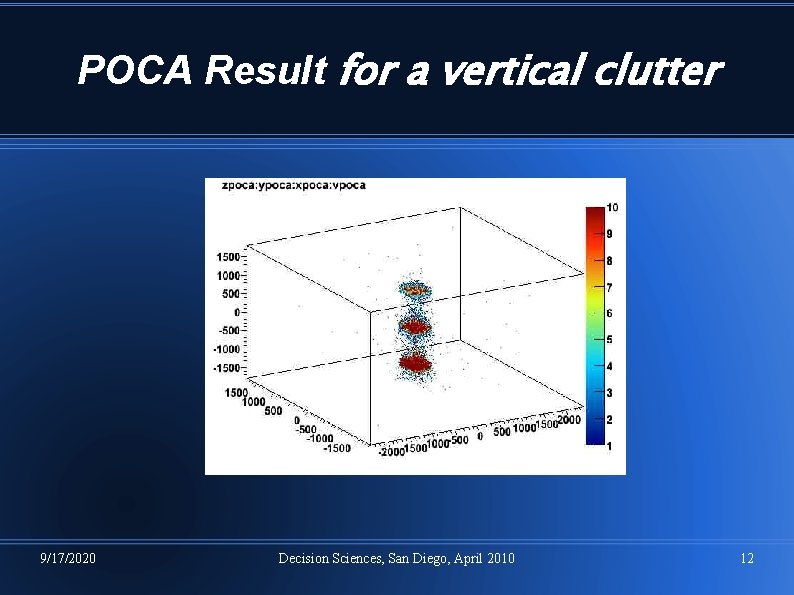
POCA Result for a vertical clutter 9/17/2020 Decision Sciences, San Diego, April 2010 12
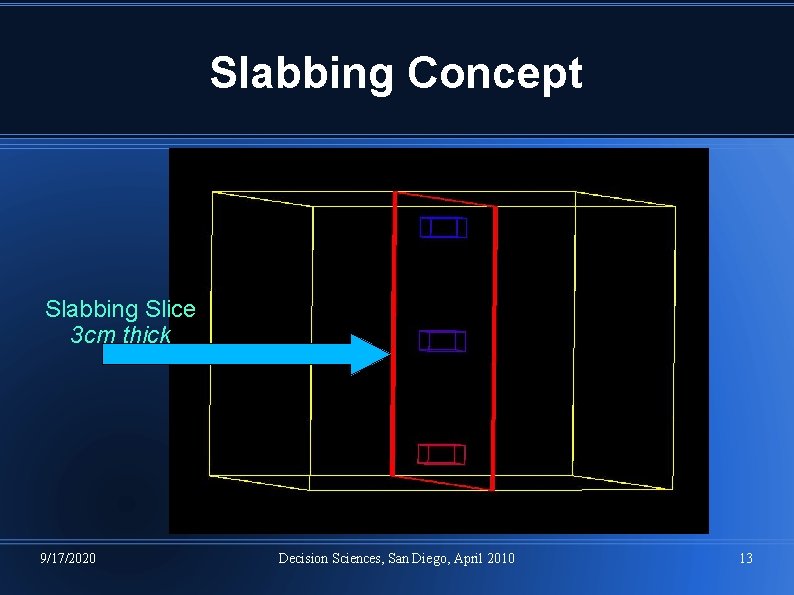
Slabbing Concept Slabbing Slice 3 cm thick 9/17/2020 Decision Sciences, San Diego, April 2010 13
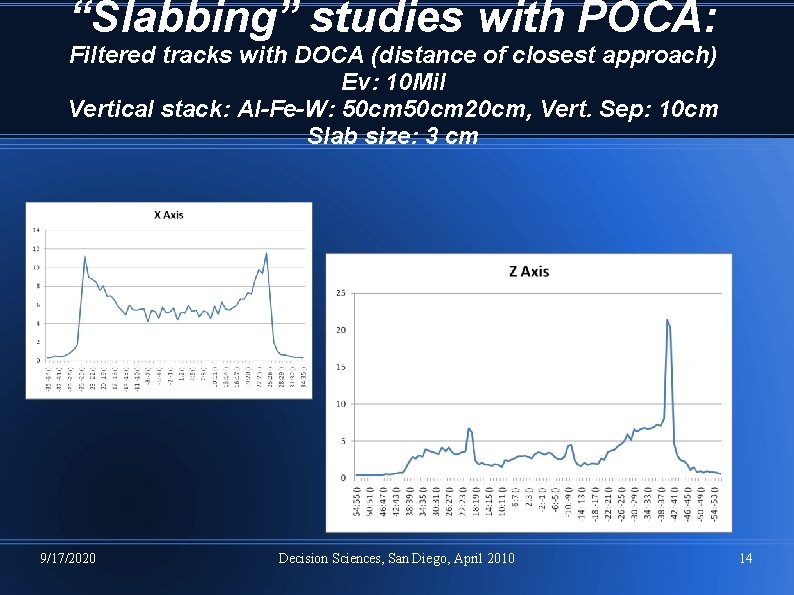
“Slabbing” studies with POCA: Filtered tracks with DOCA (distance of closest approach) Ev: 10 Mil Vertical stack: Al-Fe-W: 50 cm 20 cm, Vert. Sep: 10 cm Slab size: 3 cm 9/17/2020 Decision Sciences, San Diego, April 2010 14
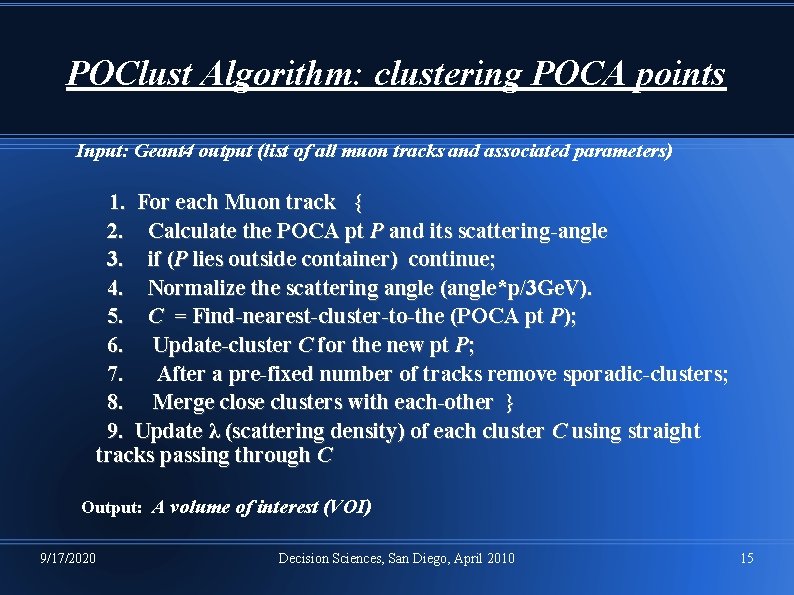
POClust Algorithm: clustering POCA points Input: Geant 4 output (list of all muon tracks and associated parameters) 1. For each Muon track { 2. Calculate the POCA pt P and its scattering-angle 3. if (P lies outside container) continue; 4. Normalize the scattering angle (angle*p/3 Ge. V). 5. C = Find-nearest-cluster-to-the (POCA pt P); 6. Update-cluster C for the new pt P; 7. After a pre-fixed number of tracks remove sporadic-clusters; 8. Merge close clusters with each-other } 9. Update λ (scattering density) of each cluster C using straight tracks passing through C Output: A volume of interest (VOI) 9/17/2020 Decision Sciences, San Diego, April 2010 15
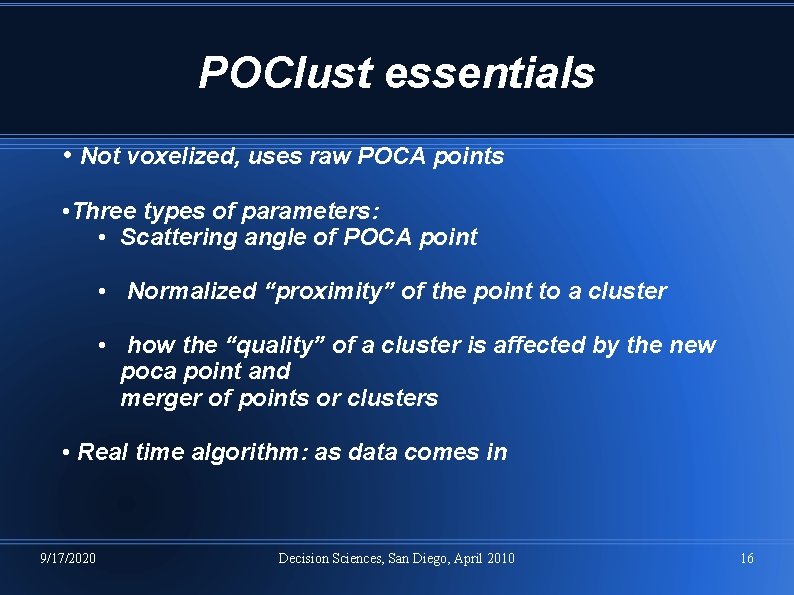
POClust essentials • Not voxelized, uses raw POCA points • Three types of parameters: • Scattering angle of POCA point • Normalized “proximity” of the point to a cluster • how the “quality” of a cluster is affected by the new poca point and merger of points or clusters • Real time algorithm: as data comes in 9/17/2020 Decision Sciences, San Diego, April 2010 16
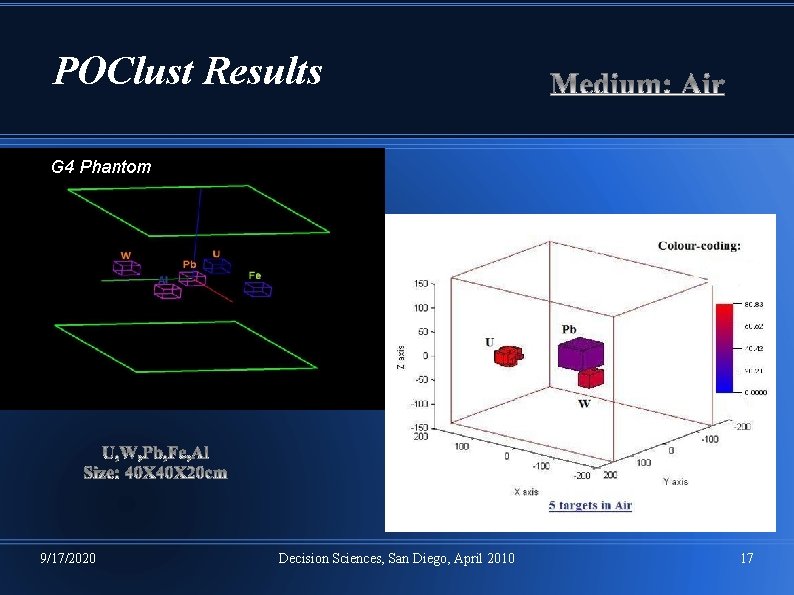
POClust Results G 4 Phantom 9/17/2020 Decision Sciences, San Diego, April 2010 17
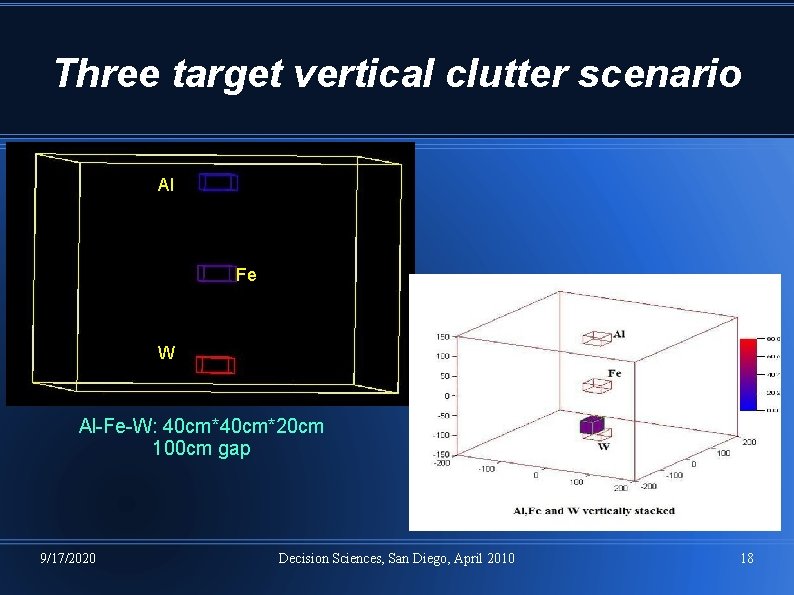
Three target vertical clutter scenario Al Fe W Al-Fe-W: 40 cm*20 cm 100 cm gap 9/17/2020 Decision Sciences, San Diego, April 2010 Fe Al W 18
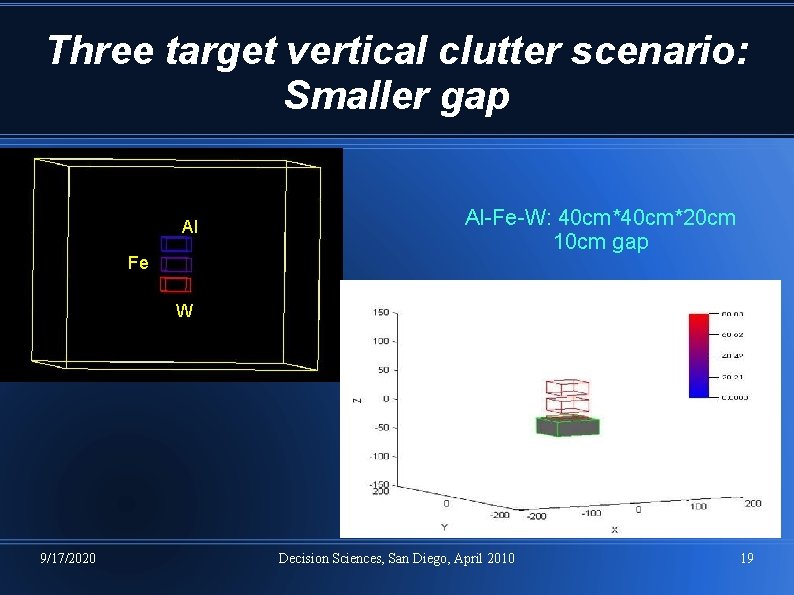
Three target vertical clutter scenario: Smaller gap Al Fe Al-Fe-W: 40 cm*20 cm 10 cm gap W 9/17/2020 Decision Sciences, San Diego, April 2010 19
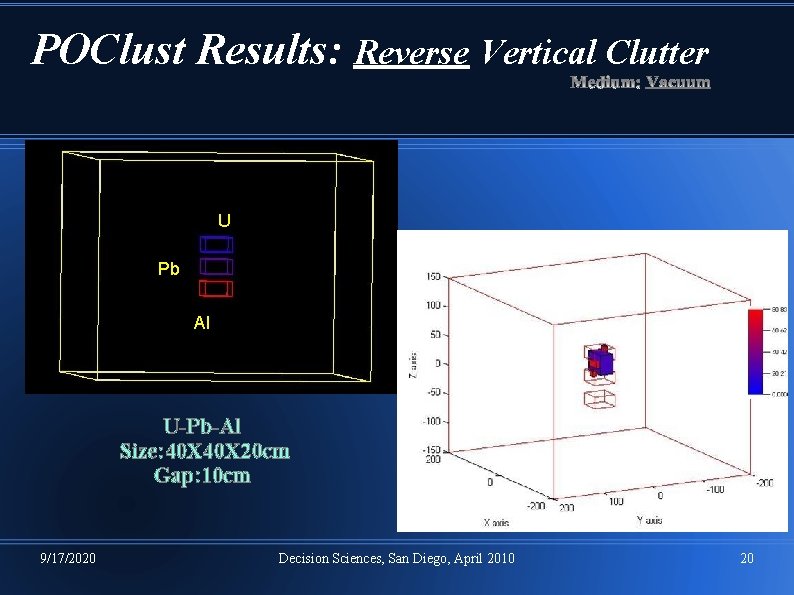
POClust Results: Reverse Vertical Clutter U Pb Al U-Pb-Al Size: 40 X 20 cm Gap: 10 cm 9/17/2020 Decision Sciences, San Diego, April 2010 20
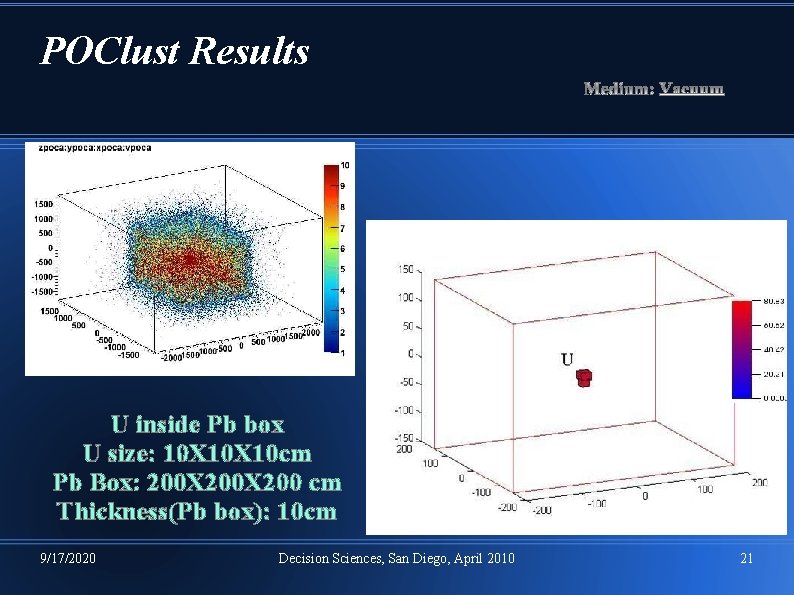
POClust Results U inside Pb box U size: 10 X 10 cm Pb Box: 200 X 200 cm Thickness(Pb box): 10 cm 9/17/2020 Decision Sciences, San Diego, April 2010 21
Why POClust & Not just POCA visualization? • Quantitate: ROC Analyses • Improve other Reconstruction algorithms with a Volume of Interest (VOI) or Regions of Interest (ROI) • Why any reconstruction at all? POCA visualization is very noisy in a complex realistic scenario 9/17/2020 Decision Sciences, San Diego, April 2010 22
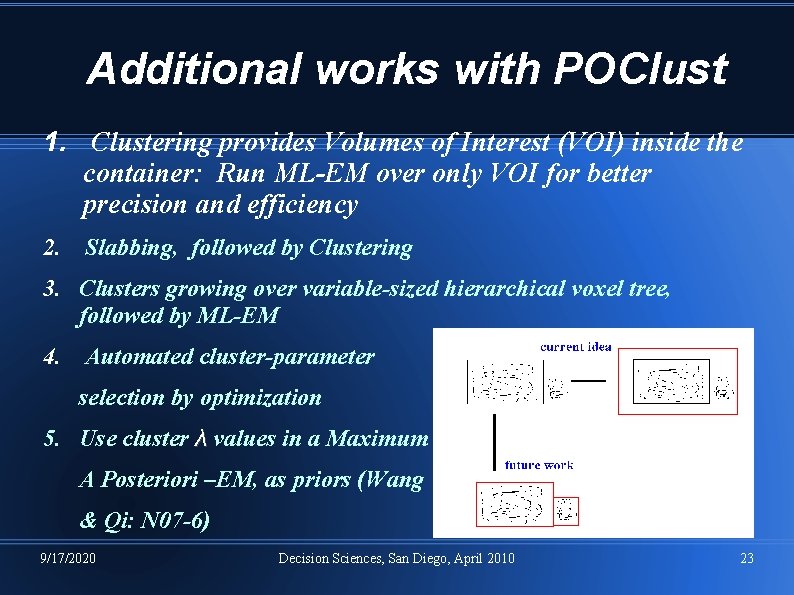
Additional works with POClust 1. Clustering provides Volumes of Interest (VOI) inside the container: Run ML-EM over only VOI for better precision and efficiency 2. Slabbing, followed by Clustering 3. Clusters growing over variable-sized hierarchical voxel tree, followed by ML-EM 4. Automated cluster-parameter selection by optimization 5. Use cluster λ values in a Maximum A Posteriori –EM, as priors (Wang & Qi: N 07 -6) 9/17/2020 Decision Sciences, San Diego, April 2010 23
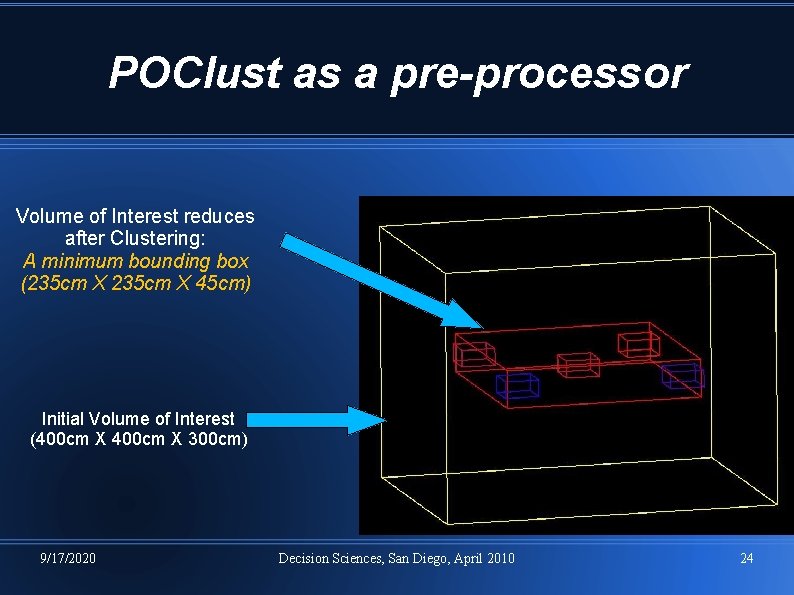
POClust as a pre-processor Volume of Interest reduces after Clustering: A minimum bounding box (235 cm X 45 cm) Initial Volume of Interest (400 cm X 300 cm) 9/17/2020 Decision Sciences, San Diego, April 2010 24
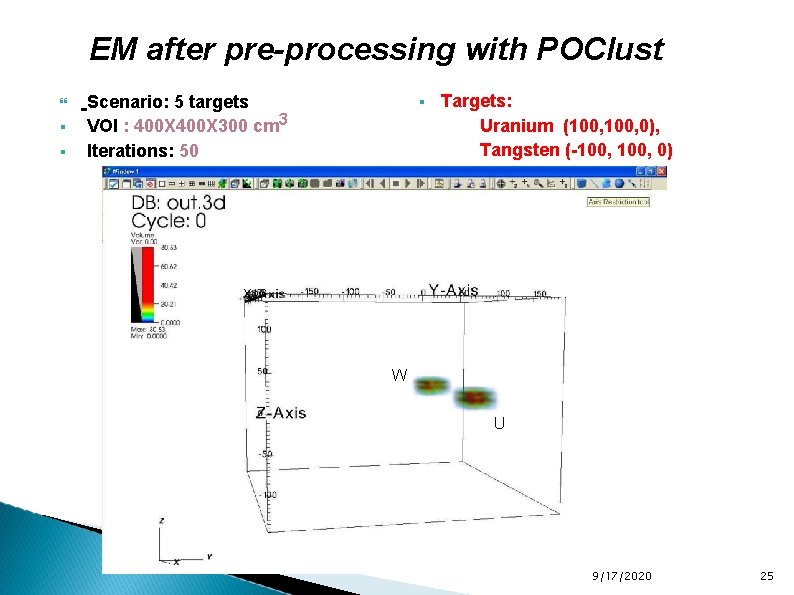
EM after pre-processing with POClust Scenario: 5 targets VOI : 400 X 300 cm 3 Iterations: 50 Targets: Uranium (100, 0), Tangsten (-100, 0) W U 9/17/2020 25
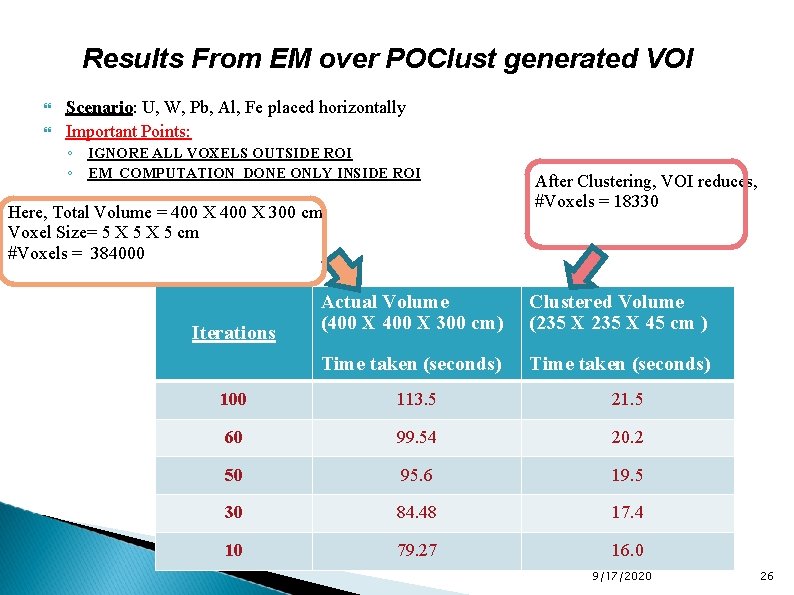
Results From EM over POClust generated VOI Scenario: U, W, Pb, Al, Fe placed horizontally Important Points: ◦ IGNORE ALL VOXELS OUTSIDE ROI ◦ EM COMPUTATION DONE ONLY INSIDE ROI Here, Total Volume = 400 X 300 cm Voxel Size= 5 X 5 cm #Voxels = 384000 Iterations After Clustering, VOI reduces, #Voxels = 18330 Actual Volume (400 X 300 cm) Clustered Volume (235 X 45 cm ) Time taken (seconds) 100 113. 5 21. 5 60 99. 54 20. 2 50 95. 6 19. 5 30 84. 48 17. 4 10 79. 27 16. 0 9/17/2020 26
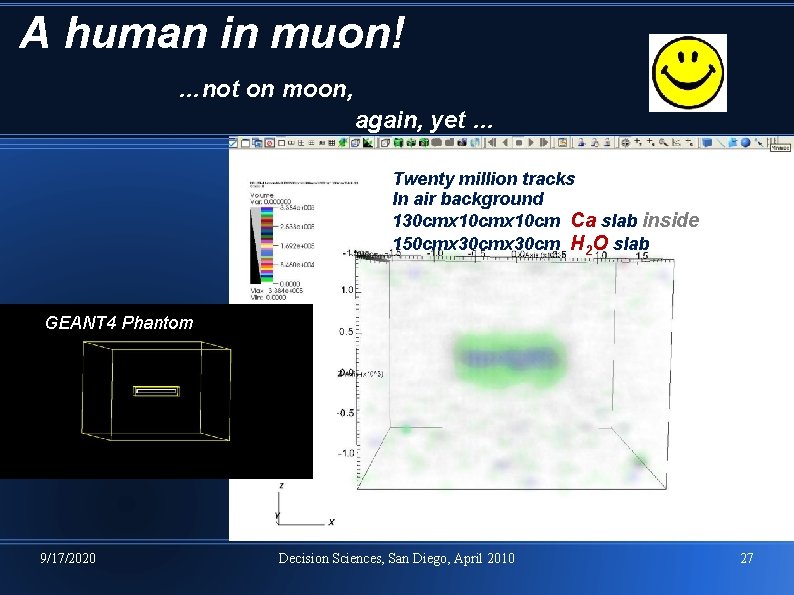
A human in muon! …not on moon, again, yet … Twenty million tracks In air background 130 cmx 10 cm Ca slab inside 150 cmx 30 cm H 2 O slab GEANT 4 Phantom 9/17/2020 Decision Sciences, San Diego, April 2010 27
Thanks! Acknowledgement: Department of Homeland Security National Science Foundation & many students at FIT Debasis Mitra dmitra@cs. fit. edu 9/17/2020 Decision Sciences, San Diego, April 2010 28