
Simulation of the pressure recovery time in a
![L[mm] L/D a x. Dt 40 6. 25 0. 161 1 60 9. 38](https://slidetodoc.com/presentation_image_h2/6accf816bc736e80a3dafc5e92552e5b/image-15.jpg "L[mm] L/D a x. Dt 40 6. 25 0. 161 1 60 9. 38")
- Slides: 22
Simulation of the pressure recovery time in a CLIC standard module Introduction Model Results Discussion Pedro Costa Pinto, 18 -06 -2008
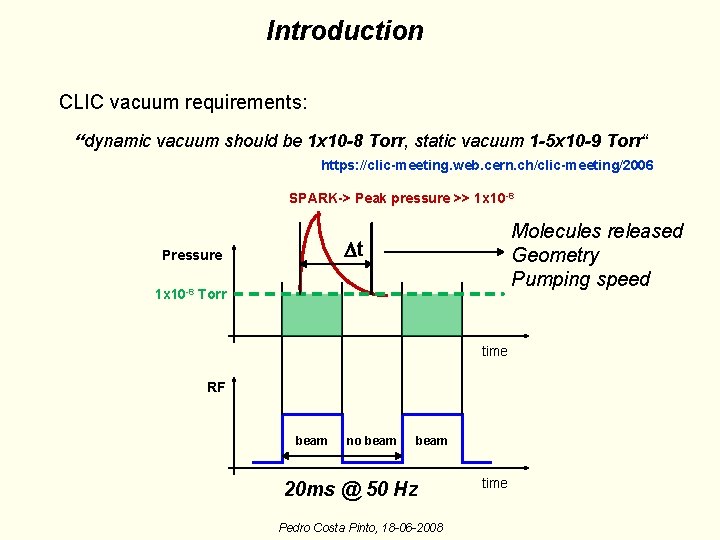
Introduction CLIC vacuum requirements: “dynamic vacuum should be 1 x 10 -8 Torr, static vacuum 1 -5 x 10 -9 Torr“ https: //clic-meeting. web. cern. ch/clic-meeting/2006 SPARK-> Peak pressure >> 1 x 10 -8 Molecules released Geometry Pumping speed Dt Pressure 1 x 10 -8 Torr time RF beam no beam 20 ms @ 50 Hz Pedro Costa Pinto, 18 -06 -2008 time
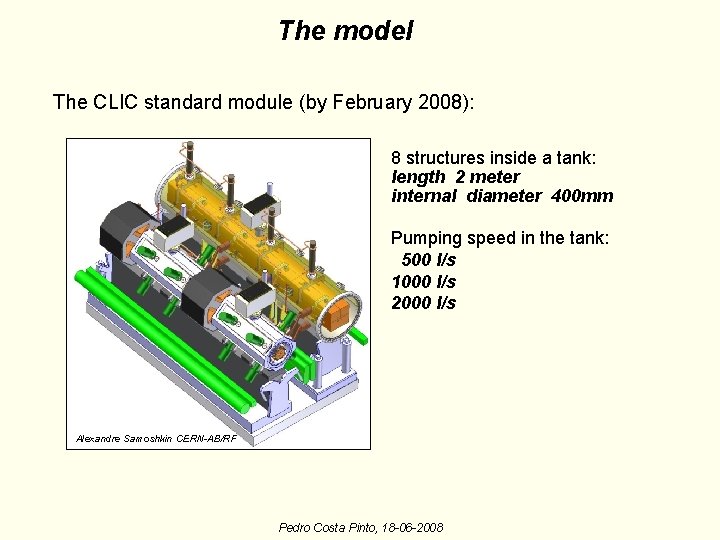
The model The CLIC standard module (by February 2008): 8 structures inside a tank: length 2 meter internal diameter 400 mm Pumping speed in the tank: 500 l/s 1000 l/s 2000 l/s Alexandre Samoshkin CERN-AB/RF Pedro Costa Pinto, 18 -06 -2008
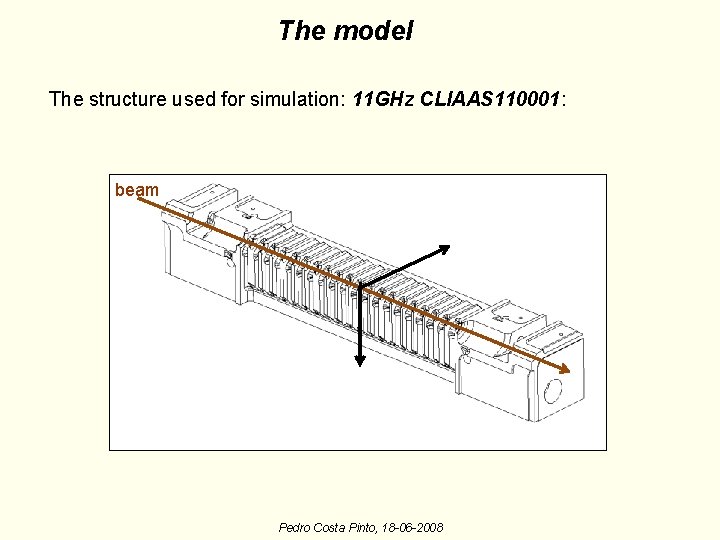
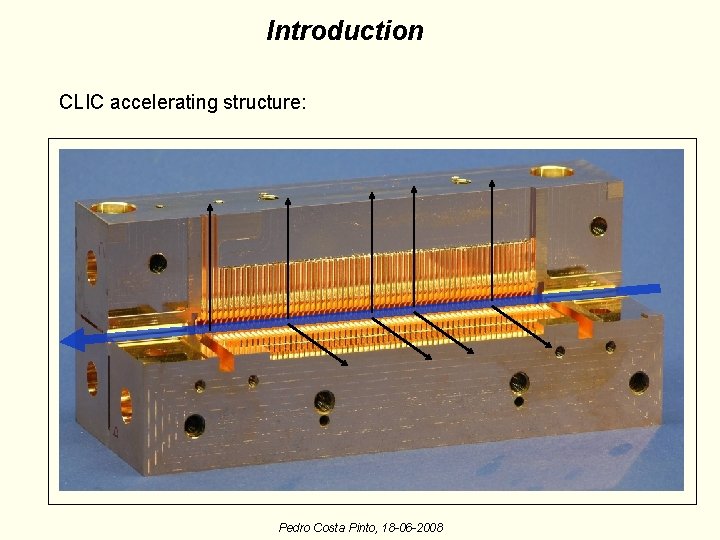
The model The structure used for simulation: 11 GHz CLIAAS 110001: beam Pedro Costa Pinto, 18 -06 -2008
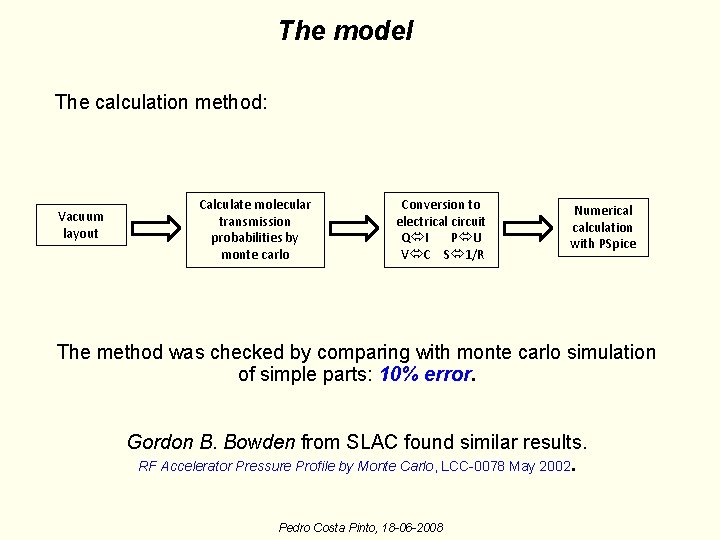
The model The calculation method: Vacuum layout Calculate molecular transmission probabilities by monte carlo Conversion to electrical circuit Q I P U V C S 1/R Numerical calculation with PSpice The method was checked by comparing with monte carlo simulation of simple parts: 10% error. Gordon B. Bowden from SLAC found similar results. RF Accelerator Pressure Profile by Monte Carlo, LCC-0078 May 2002. Pedro Costa Pinto, 18 -06 -2008
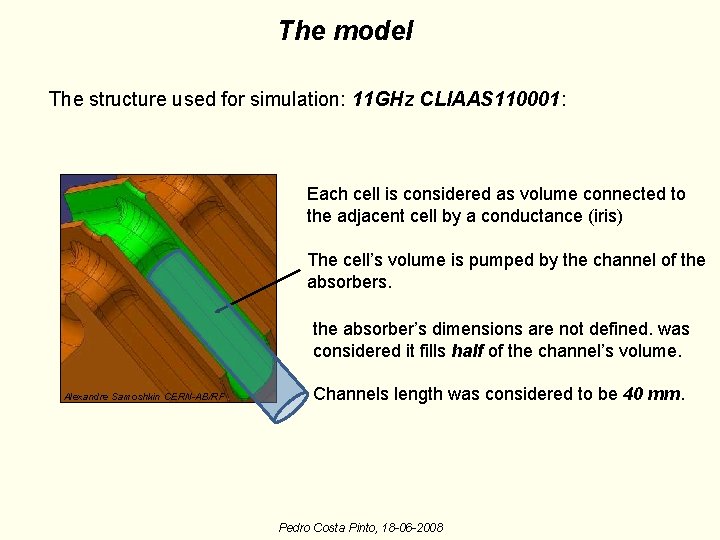
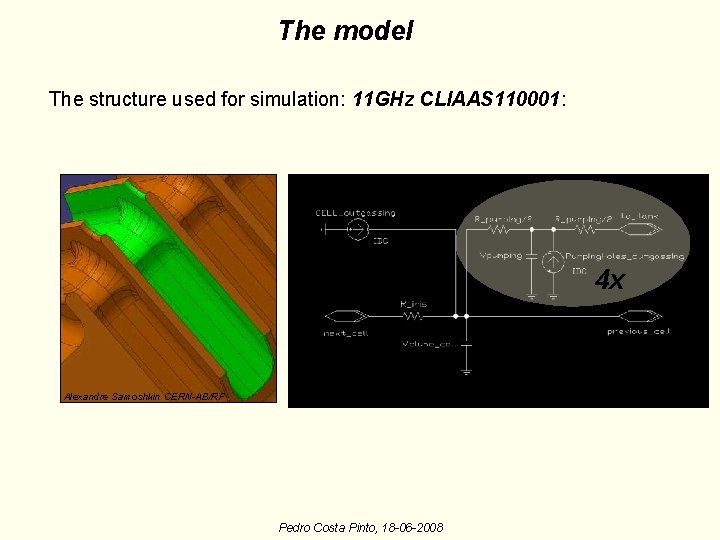
The model The structure used for simulation: 11 GHz CLIAAS 110001: Each cell is considered as volume connected to the adjacent cell by a conductance (iris) The cell’s volume is pumped by the channel of the absorbers. the absorber’s dimensions are not defined. was considered it fills half of the channel’s volume. Alexandre Samoshkin CERN-AB/RF Channels length was considered to be 40 mm. Pedro Costa Pinto, 18 -06 -2008
The model The structure used for simulation: 11 GHz CLIAAS 110001: 4 x Alexandre Samoshkin CERN-AB/RF Channels length was considered to be 40 mm. Pedro Costa Pinto, 18 -06 -2008
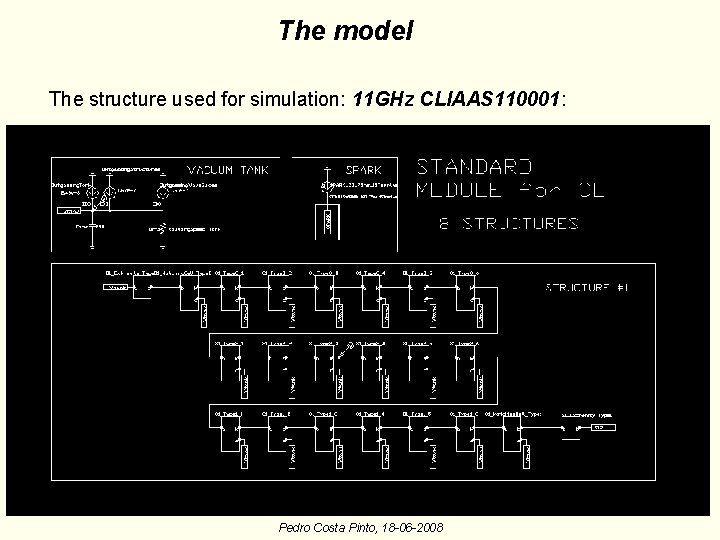
The model The structure used for simulation: 11 GHz CLIAAS 110001: Pedro Costa Pinto, 18 -06 -2008
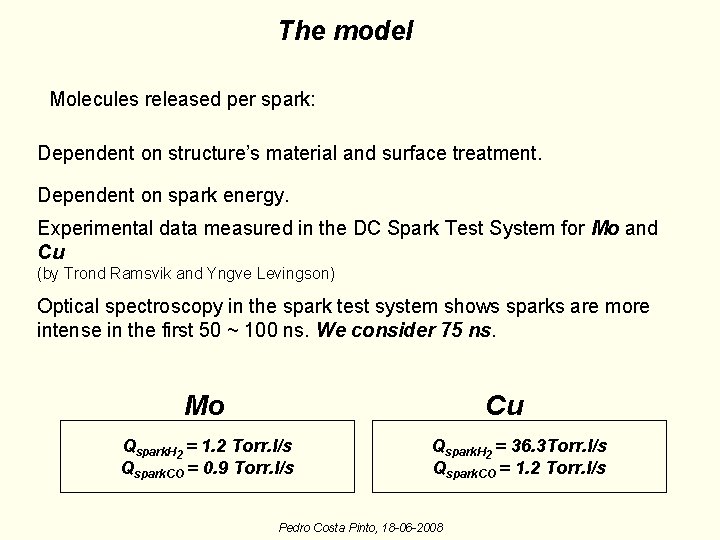
The model Molecules released per spark: Dependent on structure’s material and surface treatment. Dependent on spark energy. Experimental data measured in the DC Spark Test System for Mo and Cu (by Trond Ramsvik and Yngve Levingson) Optical spectroscopy in the spark test system shows sparks are more intense in the first 50 ~ 100 ns. We consider 75 ns. Mo Cu Qspark. H 2 = 1. 2 Torr. l/s Qspark. CO = 0. 9 Torr. l/s Qspark. H 2 = 36. 3 Torr. l/s Qspark. CO = 1. 2 Torr. l/s Pedro Costa Pinto, 18 -06 -2008
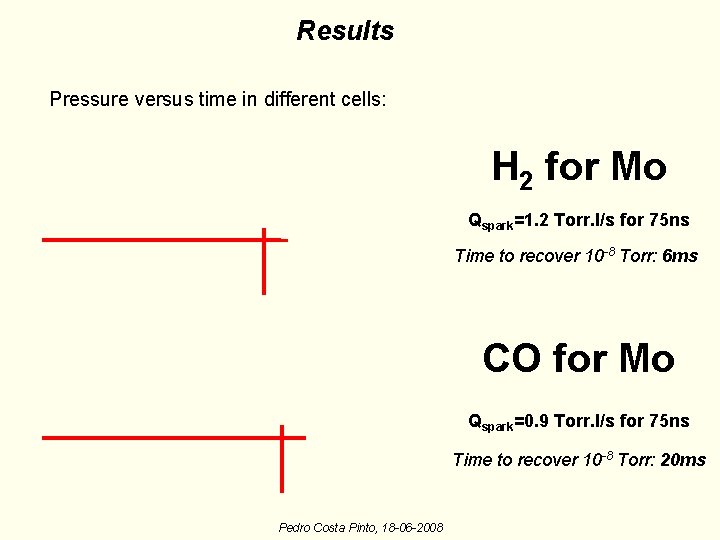
Results Pressure versus time in different cells: H 2 for Mo Qspark=1. 2 Torr. l/s for 75 ns Time to recover 10 -8 Torr: 6 ms CO for Mo Qspark=0. 9 Torr. l/s for 75 ns Time to recover 10 -8 Torr: 20 ms Pedro Costa Pinto, 18 -06 -2008
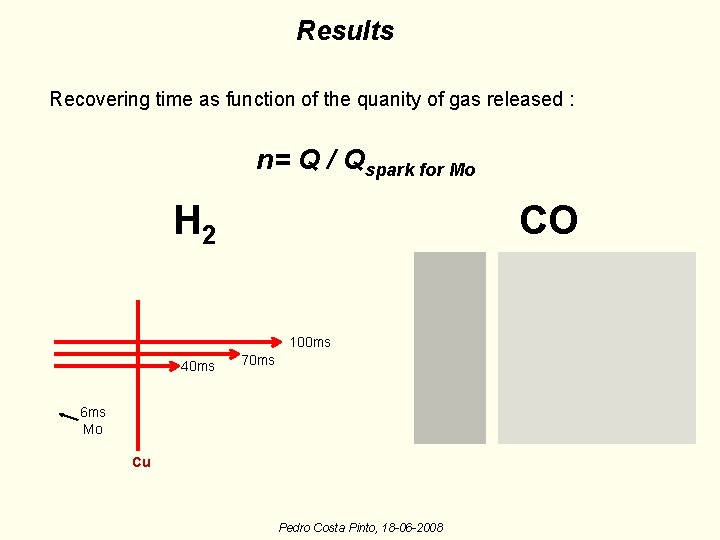
Results Recovering time as function of the quanity of gas released : n= Q / Qspark for Mo H 2 CO 100 ms 40 ms 70 ms 6 ms Mo Cu Pedro Costa Pinto, 18 -06 -2008
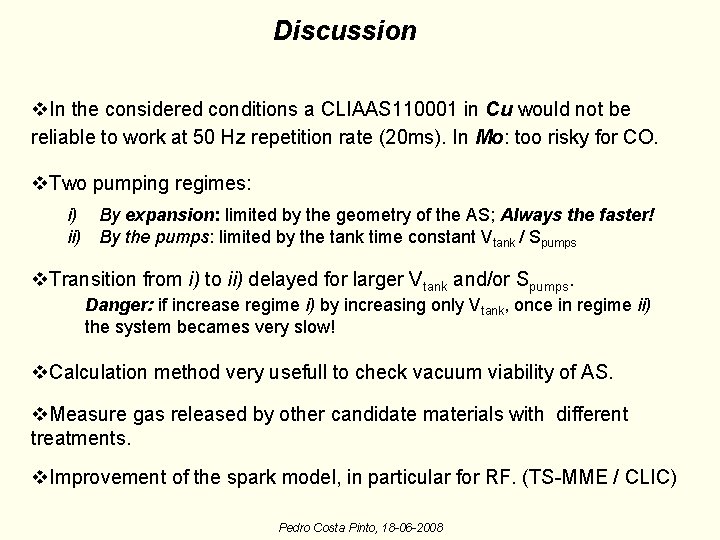
Discussion v. In the considered conditions a CLIAAS 110001 in Cu would not be reliable to work at 50 Hz repetition rate (20 ms). In Mo: too risky for CO. v. Two pumping regimes: i) By expansion: limited by the geometry of the AS; Always the faster! ii) By the pumps: limited by the tank time constant Vtank / Spumps v. Transition from i) to ii) delayed for larger Vtank and/or Spumps. Danger: if increase regime i) by increasing only Vtank, once in regime ii) the system becames very slow! v. Calculation method very usefull to check vacuum viability of AS. v. Measure gas released by other candidate materials with different treatments. v. Improvement of the spark model, in particular for RF. (TS-MME / CLIC) Pedro Costa Pinto, 18 -06 -2008
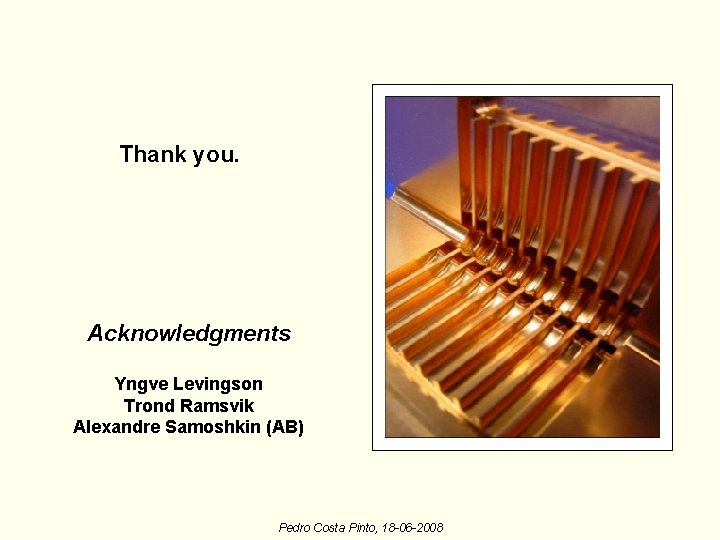
Thank you. Acknowledgments Yngve Levingson Trond Ramsvik Alexandre Samoshkin (AB) Pedro Costa Pinto, 18 -06 -2008
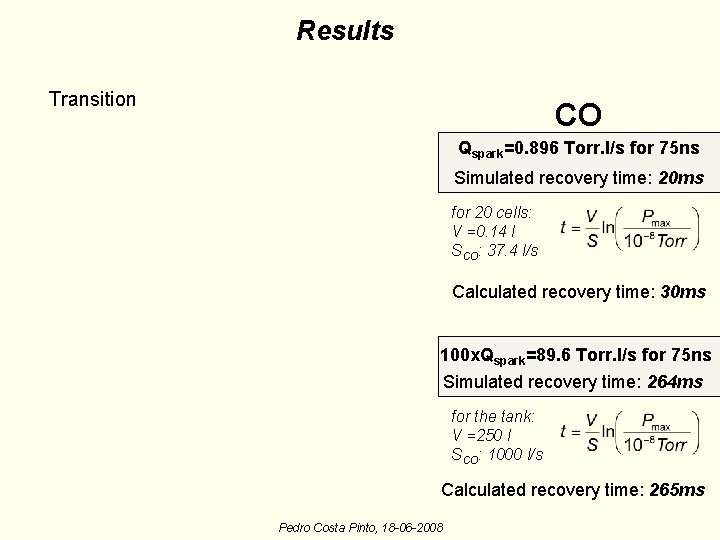
Results Transition CO Qspark=0. 896 Torr. l/s for 75 ns Simulated recovery time: 20 ms for 20 cells: V =0. 14 l SCO: 37. 4 l/s Calculated recovery time: 30 ms 100 x. Qspark=89. 6 Torr. l/s for 75 ns Simulated recovery time: 264 ms for the tank: V =250 l SCO: 1000 l/s Calculated recovery time: 265 ms Pedro Costa Pinto, 18 -06 -2008
L[mm] L/D a x. Dt 40 6. 25 0. 161 1 60 9. 38 0. 116 2. 1 80 12. 50 0. 090 3. 6 100 15. 62 0. 074 5. 4 Pedro Costa Pinto, 18 -06 -2008
Dynamic Vacuum in CLIC Standard Module Results Are the measured Qspark consistent with pressure bursts measured in CTF 2? Pressure reading: penning gauge every second… too slow. Pedro Costa Pinto, CLIC module working group meeting 11 -02 -2008.
Dynamic Vacuum in CLIC Standard Module Results Are the measured Qspark consistent with pressure bursts measured in CTF 2? Pressure reading: penning gauge every second… too slow. Pedro Costa Pinto, CLIC module working group meeting 11 -02 -2008.
Dynamic Vacuum in CLIC Standard Module Results Are the measured Qspark consistent with pressure bursts measured in CTF 2? Pressure reading: penning gauge every second… too slow. Pedro Costa Pinto, CLIC module working group meeting 11 -02 -2008.
Dynamic Vacuum in CLIC Standard Module Results Are the measured Qspark consistent with pressure bursts measured in CTF 2? Pressure reading: penning gauge every second… too slow. Thermal source of outgassing? RF sparks are different? Pedro Costa Pinto, CLIC module working group meeting 11 -02 -2008.
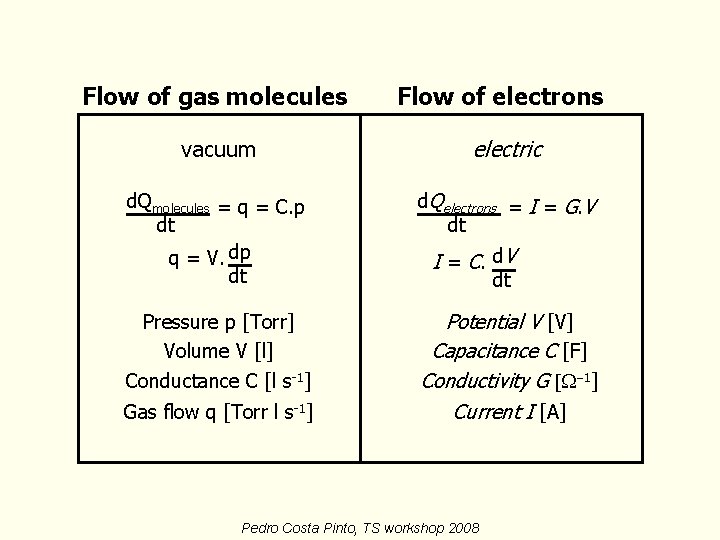
Flow of gas molecules Flow of electrons vacuum electric d. Qmolecules = q = C. p dt q = V. dp dt d. Qelectrons = I = G. V dt Pressure p [Torr] Volume V [l] Conductance C [l s-1] Potential V [V] Capacitance C [F] Conductivity G [W-1] Current I [A] Gas flow q [Torr l s-1] I = C. d. V dt Pedro Costa Pinto, TS workshop 2008
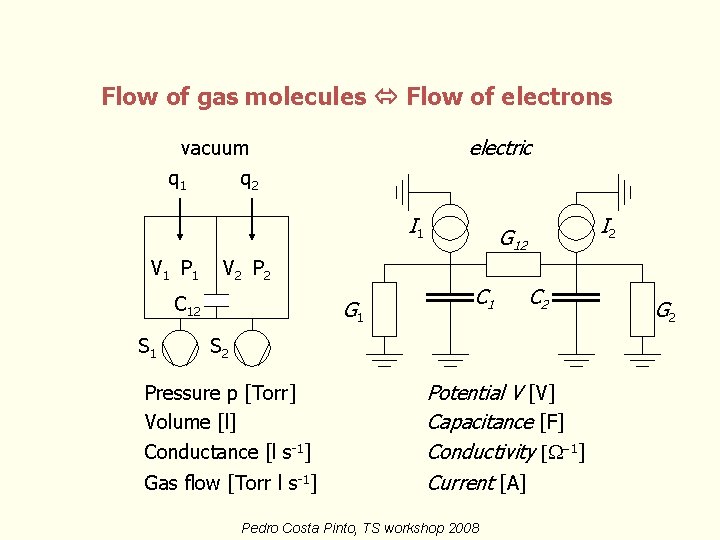
Flow of gas molecules Flow of electrons electric vacuum q 1 q 2 I 1 V 1 P 1 V 2 P 2 C 12 S 1 G 1 I 2 G 12 C 1 C 2 S 2 Pressure p [Torr] Volume [l] Conductance [l s-1] Gas flow [Torr l s-1] Potential V [V] Capacitance [F] Conductivity [W-1] Current [A] Pedro Costa Pinto, TS workshop 2008 G 2
Introduction CLIC accelerating structure: Pedro Costa Pinto, 18 -06 -2008