
Simulation of the acoustics of coupled rooms by
Simulation of the acoustics of coupled rooms by numerical resolution of a diffusion equation V. Valeau a, J. Picaut b, A. Sakout a, A. Billon a b LEPTAB, University of La Rochelle, France LCPC, Nantes, France 18 th International Congress on Acoustics Kyoto - 04/05/2004 a
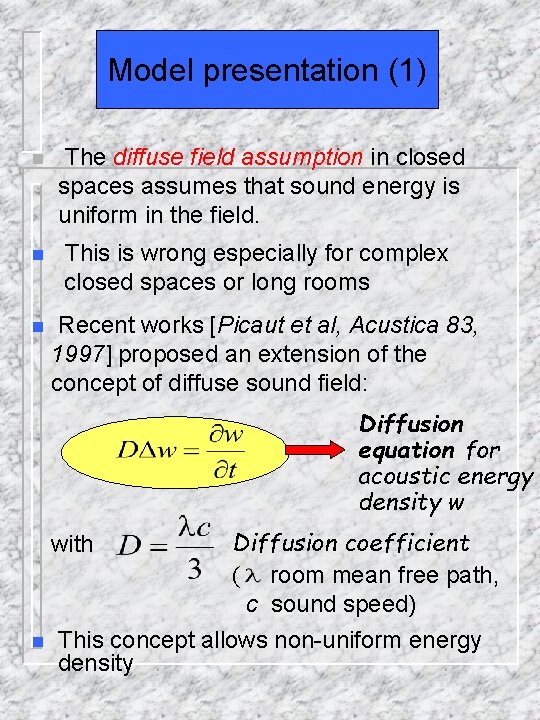
Model presentation (1) n The diffuse field assumption in closed spaces assumes that sound energy is uniform in the field. n This is wrong especially for complex closed spaces or long rooms n Recent works [Picaut et al, Acustica 83, 1997] proposed an extension of the concept of diffuse sound field: Diffusion equation for acoustic energy density w with n Diffusion coefficient ( room mean free path, c sound speed) This concept allows non-uniform energy density
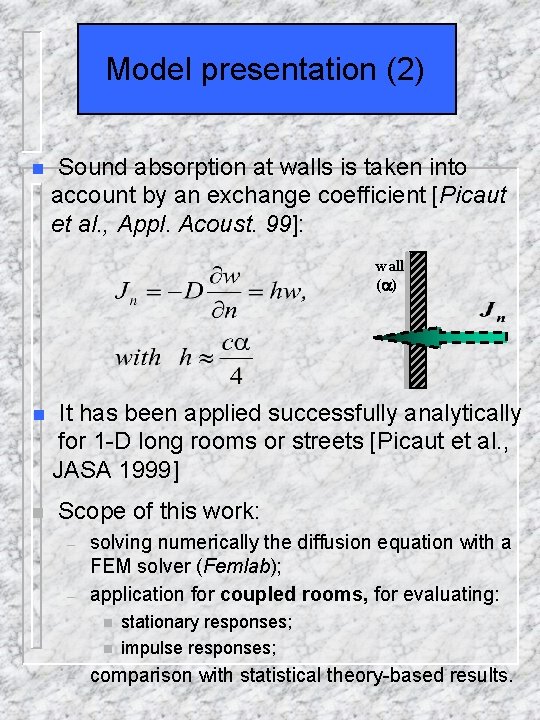
Model presentation (2) n Sound absorption at walls is taken into account by an exchange coefficient [Picaut et al. , Appl. Acoust. 99]: wall (a) n n It has been applied successfully analytically for 1 -D long rooms or streets [Picaut et al. , JASA 1999] Scope of this work: – – solving numerically the diffusion equation with a FEM solver (Femlab); application for coupled rooms, for evaluating: n n – stationary responses; impulse responses; comparison with statistical theory-based results.
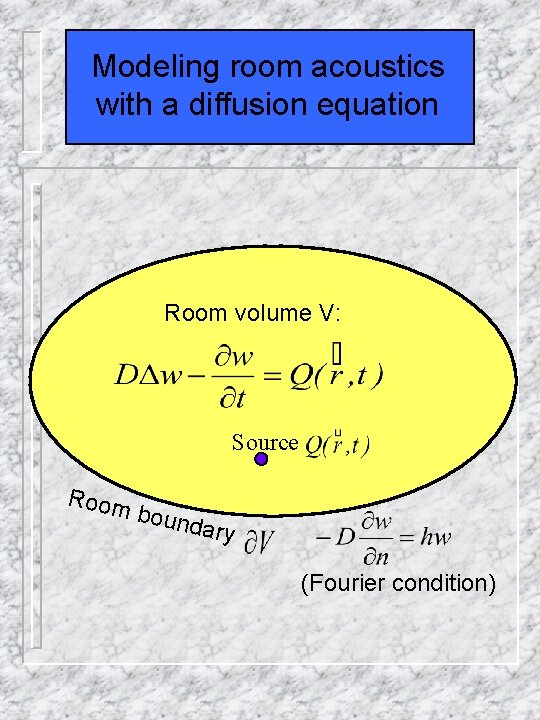
Modeling room acoustics with a diffusion equation Room volume V: Source Room boun dary (Fourier condition)
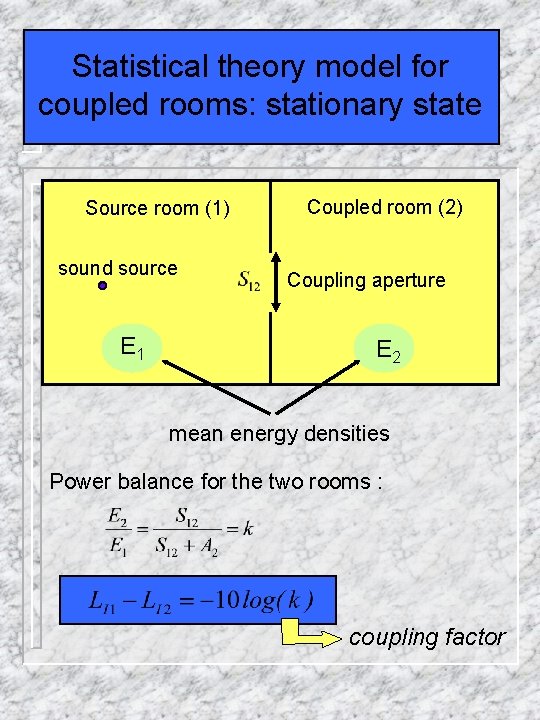
Statistical theory model for coupled rooms: stationary state Source room (1) sound source E 1 Coupled room (2) Coupling aperture E 2 mean energy densities Power balance for the two rooms : coupling factor
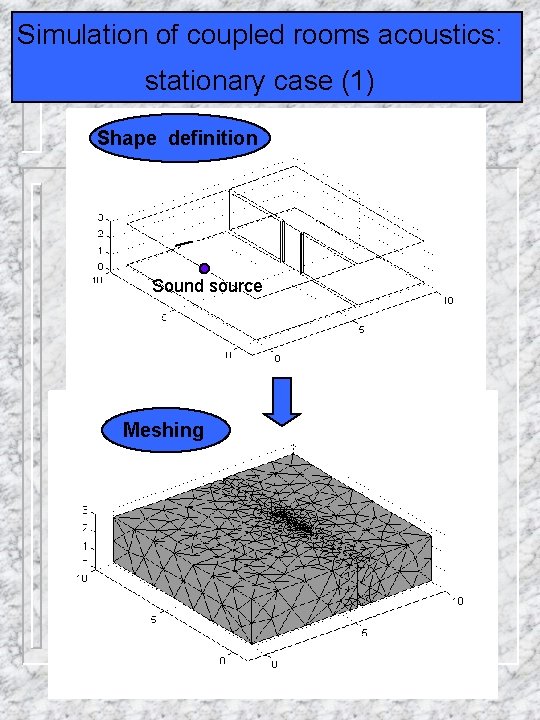
Simulation of coupled rooms acoustics: Stationary response for a 10*10 m room stationary case (1) Shape definition Sound source Meshing
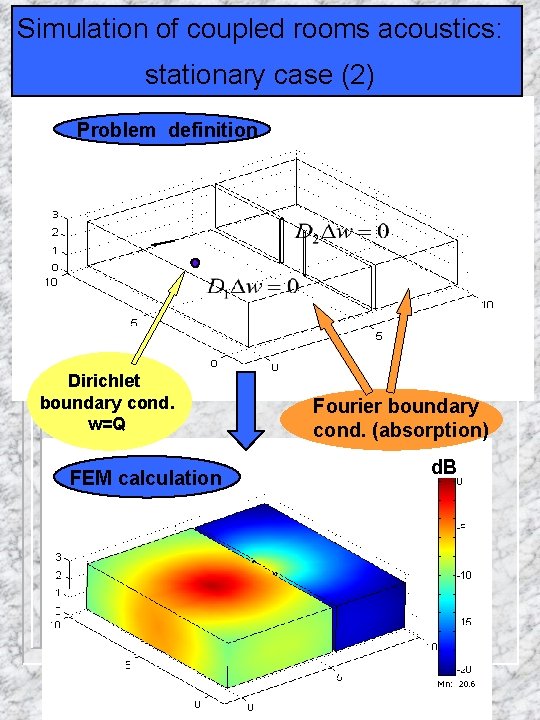
Simulation of coupled rooms acoustics: Stationary response for a 10*10 m room stationary case (2) Problem definition Dirichlet boundary cond. w=Q FEM calculation Fourier boundary cond. (absorption) d. B
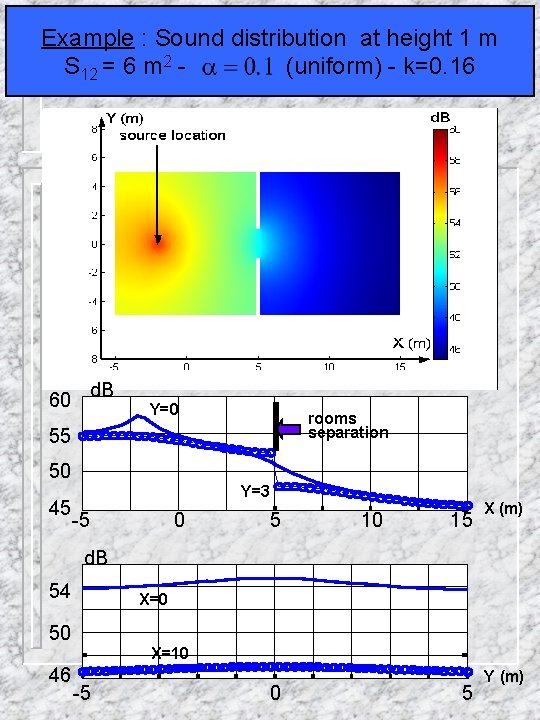
Example : Sound distribution at height 1 m 2 Stationary response for a 10*10 m room S 12 = 6 m (uniform) - k=0. 16 60 d. B Y=0 rooms separation 55 50 45 Y=3 -5 0 5 10 15 X (m) d. B 54 X=0 50 X=10 46 -5 0 5 Y (m)
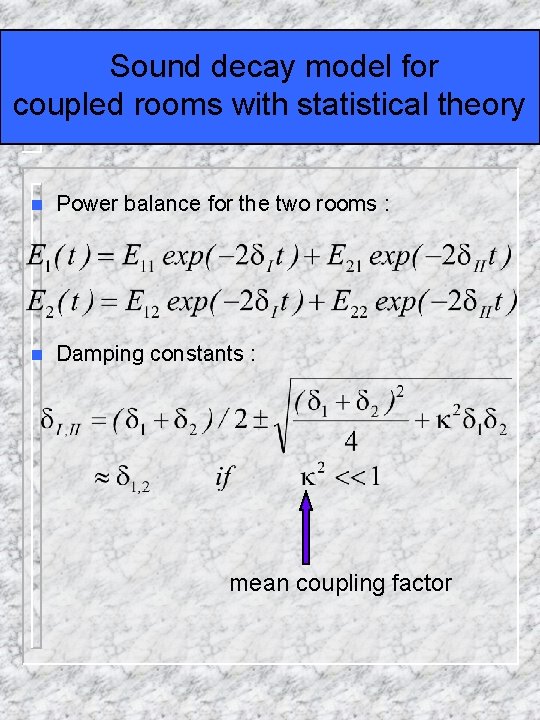
Sound decay model for coupled rooms with statistical theory n Power balance for the two rooms : n Damping constants : mean coupling factor
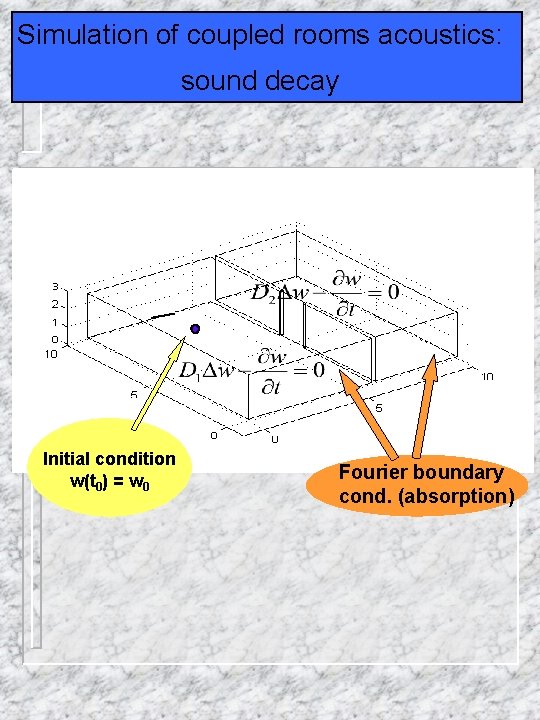
Simulation of coupled rooms acoustics: Stationary response for a 10*10 m room sound decay Initial condition w(t 0) = w 0 Fourier boundary cond. (absorption)
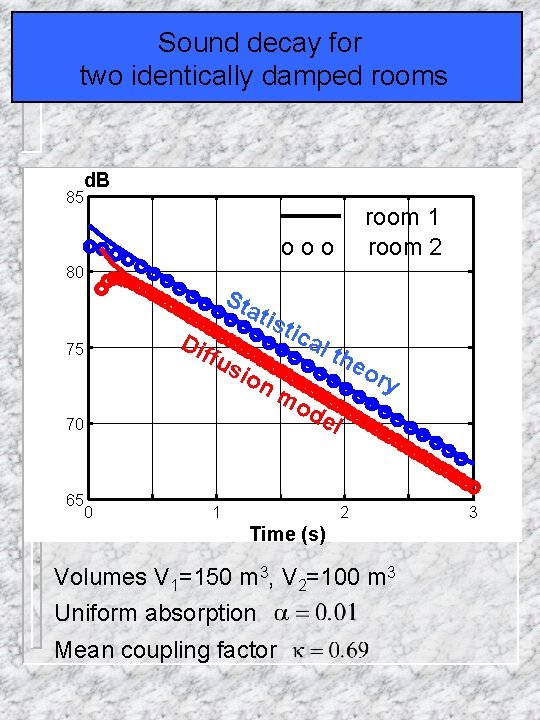
Sound decay for Stationary responsedamped for a 10*10 m two identically roomsroom d. B 85 room 1 room 2 ooo 80 75 Sta t Dif fus ion ica l th eo mo de ry l 70 65 0 ist 1 2 Time (s) Volumes V 1=150 m 3, V 2=100 m 3 Uniform absorption Mean coupling factor 3
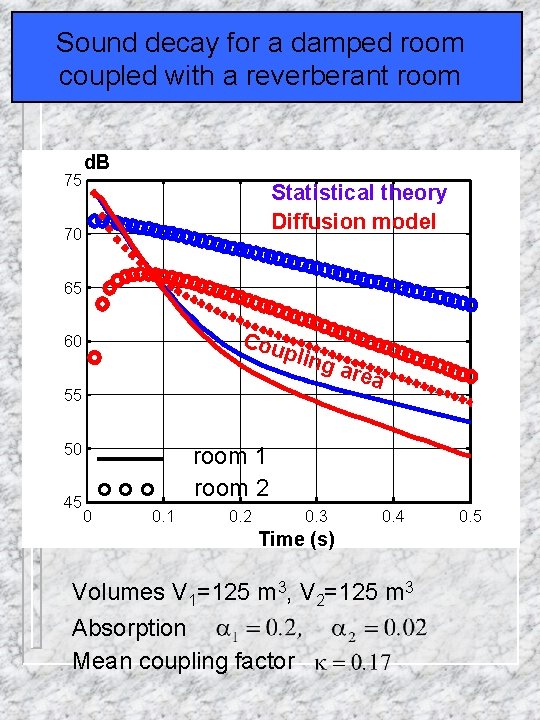
Sound decay for a damped room Stationary for a 10*10 m room coupledresponse with a reverberant room 75 d. B Statistical theory Diffusion model 70 65 Cou 60 plin g ar 55 50 45 0 ooo 0. 1 ea room 1 room 2 0. 3 0. 4 Time (s) Volumes V 1=125 m 3, V 2=125 m 3 Absorption Mean coupling factor 0. 5
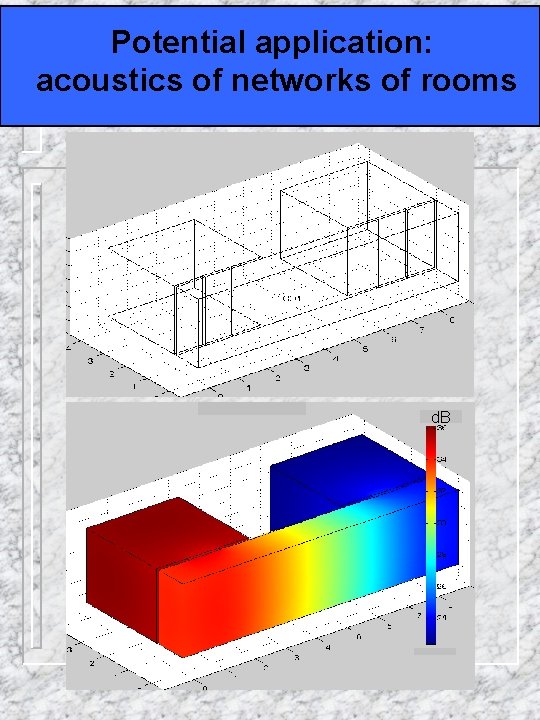
Potential application: acoustics of networks of rooms d. B
Conclusive remarks n Numerical solving of the diffusion equation with application to diffuse sound field calculation of coupled rooms, with a low computational cost. n Good agreement with statistical theory results n Advantages : provides fine description of spatial n variation of sound levels and decays. n low computational cost n provides results for arbitrary shapes n n Future work: n direct field contribution; n application to networks of rooms. n validation by comparisons with n measurements
- Slides: 14