
Simulation of Superconducting Qubits Using COMSOL Workshop on
Simulation of Superconducting Qubits Using COMSOL Workshop on Microwave Cavity Design for Axion Detection Nick Materise August 25, 2015 LLNL-PRES-676622 This work was performed under the auspices of the U. S. Department of Energy by Lawrence Livermore National Laboratory under contract DE-AC 52 -07 NA 27344. Lawrence Livermore National Security, LLC
Outline § § § Review of Cavity QED and Circuit QED COMSOL RF Modeling Noise Parametrization in COMSOL Connections to ADMX Models Summary Future Work LLNL-PRES-676622 2
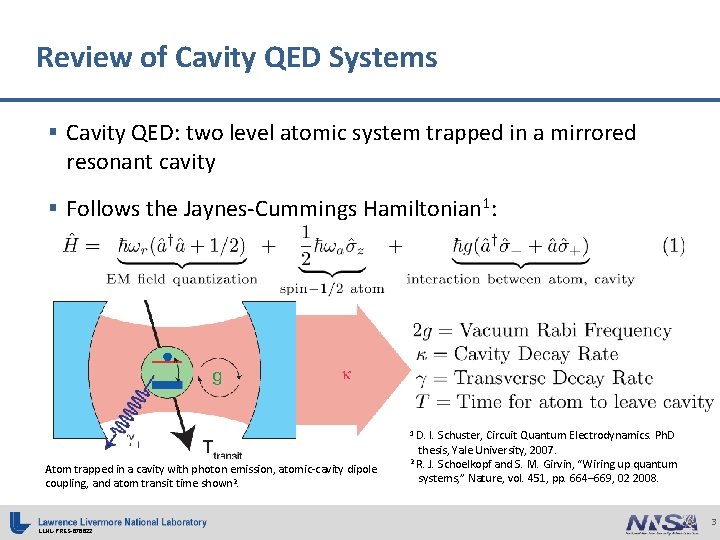
Review of Cavity QED Systems § Cavity QED: two level atomic system trapped in a mirrored resonant cavity § Follows the Jaynes-Cummings Hamiltonian 1: D. I. Schuster, Circuit Quantum Electrodynamics. Ph. D thesis, Yale University, 2007. 2 R. J. Schoelkopf and S. M. Girvin, “Wiring up quantum systems, ” Nature, vol. 451, pp. 664– 669, 02 2008. 1 Atom trapped in a cavity with photon emission, atomic-cavity dipole coupling, and atom transit time shown 2. LLNL-PRES-676622 3

Superconducting Qubits and Circuit QED § Circuit QED ~ Cavity QED — Harmonic Oscillator as a first circuit model approximation 1 — Add non-linear inductance with Josephson Junction, anharmonicity LC harmonic oscillator circuit § “Artificial Atom” or qubit replaces atom from Cavity QED — Two lowest energy levels form a two level system (TLS) — Qubit = TLS formed by Josephson Junction and other circuit elements 3 LLNL-PRES-676622 D. I. Schuster, Circuit Quantum Electrodynamics. Ph. D thesis, Yale University, 2007. 3 William D. Oliver and Paul B. Welander. Materials in superconducting quantum bits. MRS Bulletin, 38: 816– 825, 10 2013. 1 4
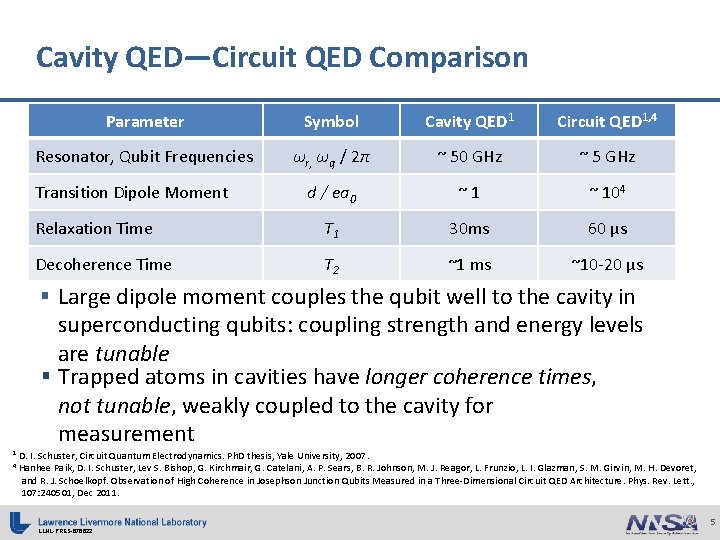
Cavity QED—Circuit QED Comparison Parameter Symbol Cavity QED 1 Circuit QED 1, 4 Resonator, Qubit Frequencies ωr, ωq / 2π ~ 50 GHz ~ 5 GHz d / ea 0 ~1 ~ 104 Relaxation Time T 1 30 ms 60 μs Decoherence Time T 2 ~1 ms ~10 -20 μs Transition Dipole Moment § Large dipole moment couples the qubit well to the cavity in superconducting qubits: coupling strength and energy levels are tunable § Trapped atoms in cavities have longer coherence times, not tunable, weakly coupled to the cavity for measurement 1 4 D. I. Schuster, Circuit Quantum Electrodynamics. Ph. D thesis, Yale University, 2007. Hanhee Paik, D. I. Schuster, Lev S. Bishop, G. Kirchmair, G. Catelani, A. P. Sears, B. R. Johnson, M. J. Reagor, L. Frunzio, L. I. Glazman, S. M. Girvin, M. H. Devoret, and R. J. Schoelkopf. Observation of High Coherence in Josephson Junction Qubits Measured in a Three-Dimensional Circuit QED Architecture. Phys. Rev. Lett. , 107: 240501, Dec 2011. LLNL-PRES-676622 5
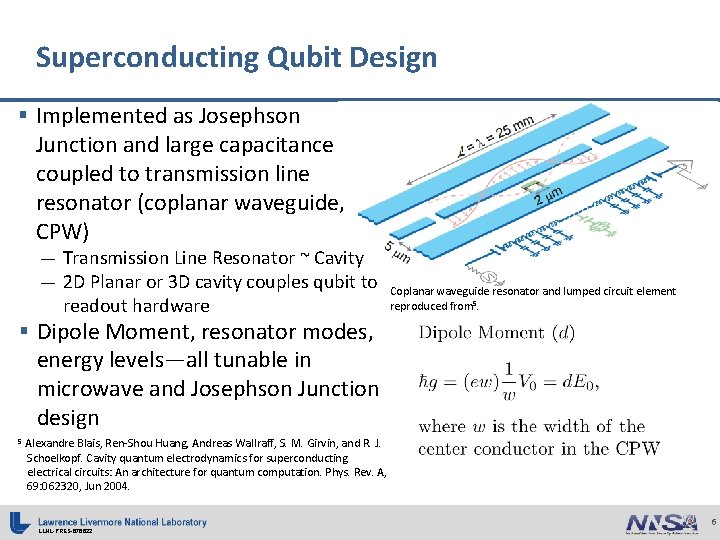
Superconducting Qubit Design § Implemented as Josephson Junction and large capacitance coupled to transmission line resonator (coplanar waveguide, CPW) — Transmission Line Resonator ~ Cavity — 2 D Planar or 3 D cavity couples qubit to readout hardware Coplanar waveguide resonator and lumped circuit element reproduced from 5. § Dipole Moment, resonator modes, energy levels—all tunable in microwave and Josephson Junction design 5 Alexandre Blais, Ren-Shou Huang, Andreas Wallraff, S. M. Girvin, and R. J. Schoelkopf. Cavity quantum electrodynamics for superconducting electrical circuits: An architecture for quantum computation. Phys. Rev. A, 69: 062320, Jun 2004. LLNL-PRES-676622 6
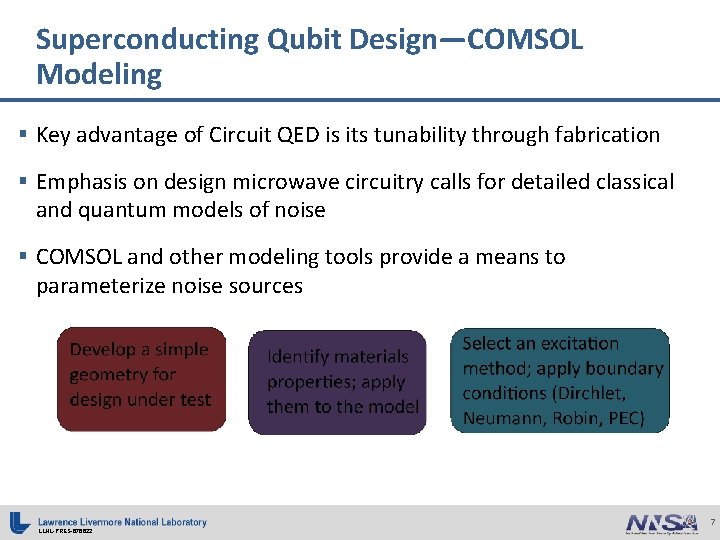
Superconducting Qubit Design—COMSOL Modeling § Key advantage of Circuit QED is its tunability through fabrication § Emphasis on design microwave circuitry calls for detailed classical and quantum models of noise § COMSOL and other modeling tools provide a means to parameterize noise sources LLNL-PRES-676622 7
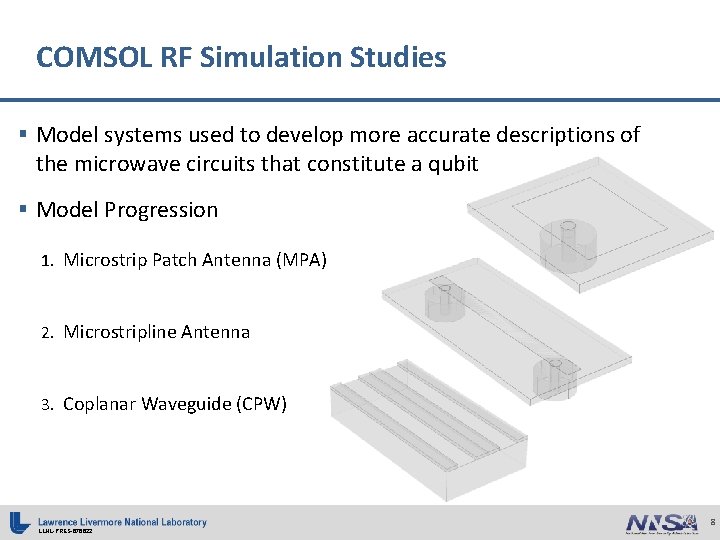
COMSOL RF Simulation Studies § Model systems used to develop more accurate descriptions of the microwave circuits that constitute a qubit § Model Progression 1. Microstrip Patch Antenna (MPA) 2. Microstripline Antenna 3. Coplanar Waveguide (CPW) LLNL-PRES-676622 8
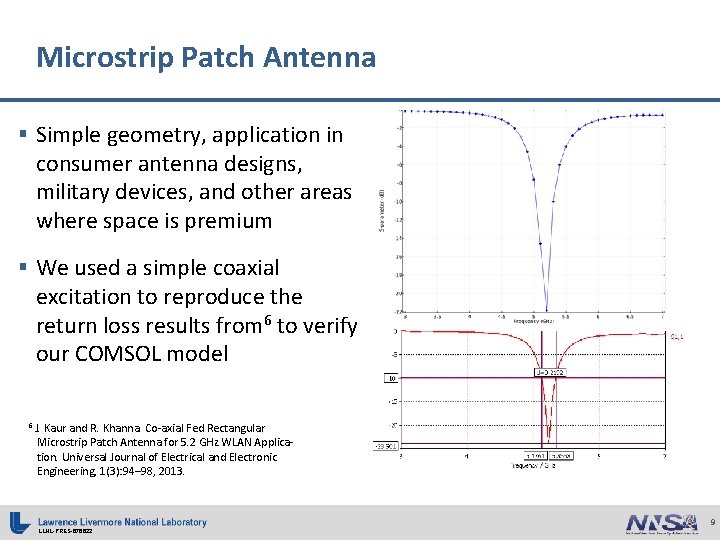
Microstrip Patch Antenna § Simple geometry, application in consumer antenna designs, military devices, and other areas where space is premium § We used a simple coaxial excitation to reproduce the return loss results from 6 to verify our COMSOL model 6 J. Kaur and R. Khanna. Co-axial Fed Rectangular Microstrip Patch Antenna for 5. 2 GHz WLAN Application. Universal Journal of Electrical and Electronic Engineering, 1(3): 94– 98, 2013. LLNL-PRES-676622 9
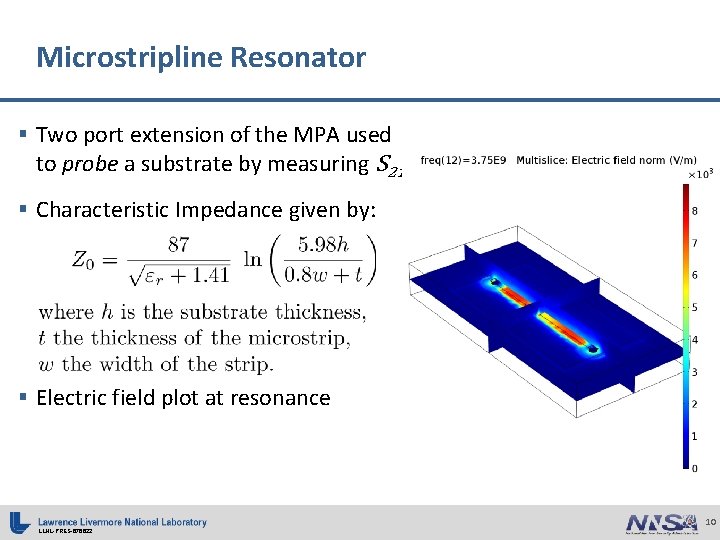
Microstripline Resonator § Two port extension of the MPA used to probe a substrate by measuring S 21 § Characteristic Impedance given by: § Electric field plot at resonance LLNL-PRES-676622 10
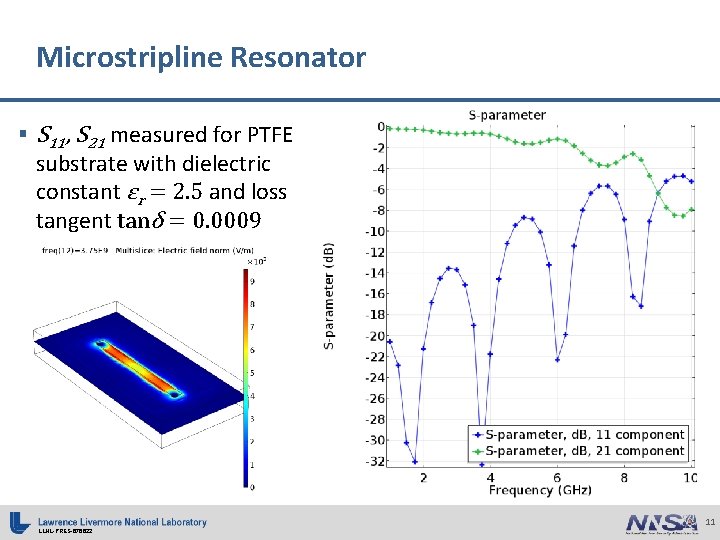
Microstripline Resonator § S 11, S 21 measured for PTFE substrate with dielectric constant εr = 2. 5 and loss tangent tanδ = 0. 0009 LLNL-PRES-676622 11
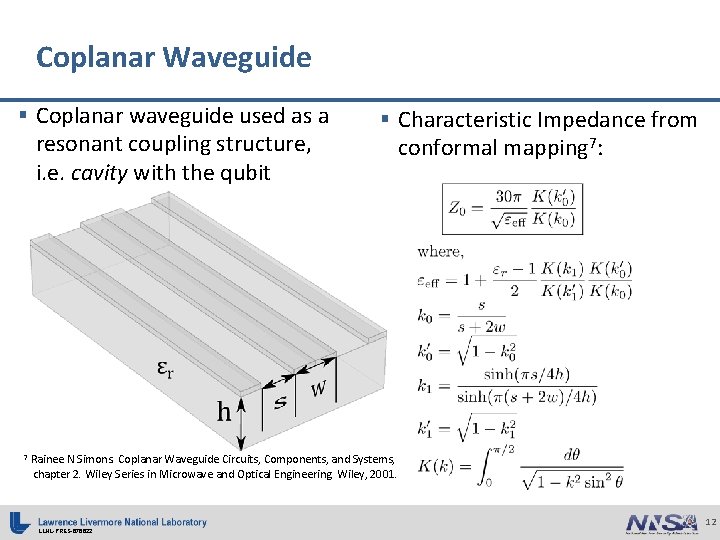
Coplanar Waveguide § Coplanar waveguide used as a resonant coupling structure, i. e. cavity with the qubit 7 § Characteristic Impedance from conformal mapping 7: Rainee N Simons. Coplanar Waveguide Circuits, Components, and Systems, chapter 2. Wiley Series in Microwave and Optical Engineering. Wiley, 2001. LLNL-PRES-676622 12
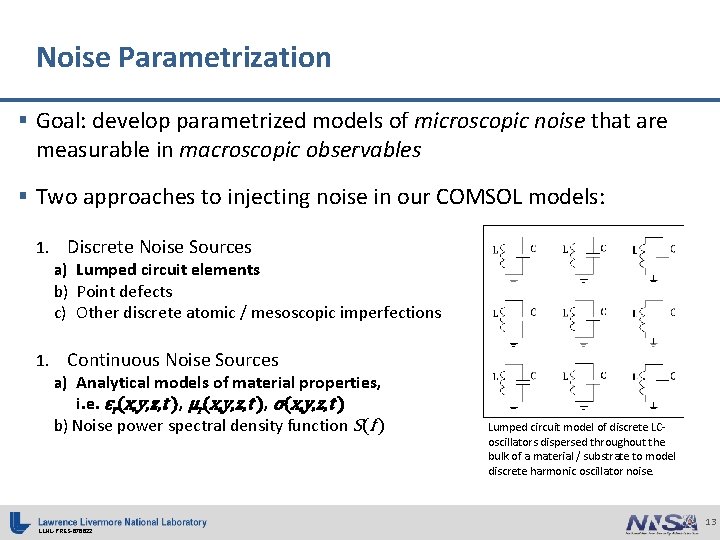
Noise Parametrization § Goal: develop parametrized models of microscopic noise that are measurable in macroscopic observables § Two approaches to injecting noise in our COMSOL models: 1. Discrete Noise Sources a) Lumped circuit elements b) Point defects c) Other discrete atomic / mesoscopic imperfections 1. Continuous Noise Sources a) Analytical models of material properties, i. e. εr(x, y, z, t ), μr(x, y, z, t ), σ(x, y, z, t ) b) Noise power spectral density function S(f ) LLNL-PRES-676622 Lumped circuit model of discrete LCoscillators dispersed throughout the bulk of a material / substrate to model discrete harmonic oscillator noise. 13
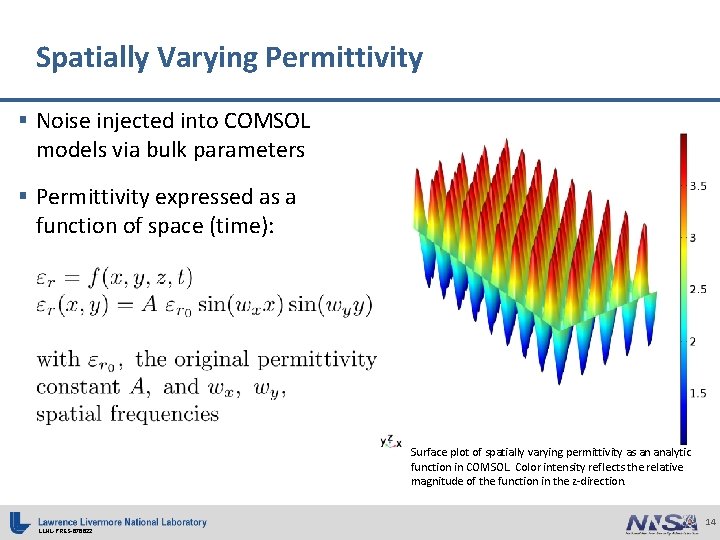
Spatially Varying Permittivity § Noise injected into COMSOL models via bulk parameters § Permittivity expressed as a function of space (time): Surface plot of spatially varying permittivity as an analytic function in COMSOL. Color intensity reflects the relative magnitude of the function in the z-direction. LLNL-PRES-676622 14
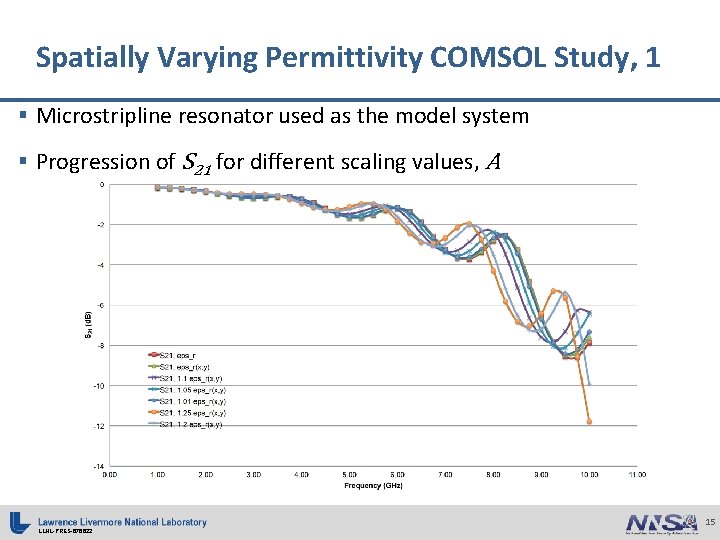
Spatially Varying Permittivity COMSOL Study, 1 § Microstripline resonator used as the model system § Progression of S 21 for different scaling values, A LLNL-PRES-676622 15
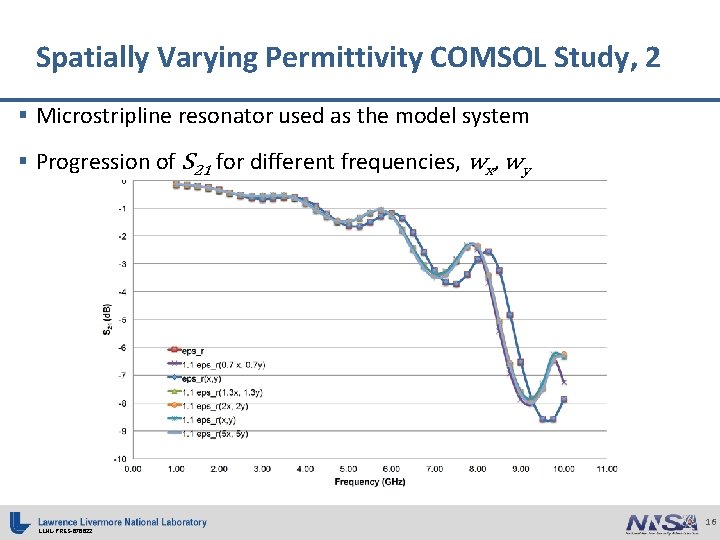
Spatially Varying Permittivity COMSOL Study, 2 § Microstripline resonator used as the model system § Progression of S 21 for different frequencies, wx, wy LLNL-PRES-676622 16
COMSOL Modeling—ADMX Contributions § Microwave cavity simulation: COMSOL Blog post by Bjorn Sjodin LLNL-PRES-676622 17
Summary § Circuit QED allows us to emulate Cavity QED systems in solid state devices, affording tunability and exploring new physics on chip § Qubits in the Circuit QED architecture require microwave engineering and involve microscopic noise sources § COMSOL allows for rapid design of RF circuits and flexible modeling of underlying physics in materials § Noise sources are conveniently modeled by discrete or continuous distributions § COMSOL models provide a means to test macroscopic manifestations of microscopic noise in subsequent experiments LLNL-PRES-676622 18
Future Work § Continue to develop more descriptive COMSOL models that incorporate bulk parameters with various dependencies § Simulate designs that more closely resemble those in existing superconducting qubits § Develop methods of modeling dissipation to predict relaxation and coherence times § Design and run experiment (s) to validate more comprehensive models LLNL-PRES-676622 19
Acknowledgements § Vince Lordi, Scott Nelson, Jonathan Dubois § Quantum Simulations Group § This work was funded by the LLNL Laboratory Directed Research and Development (LDRD) program, project number 15 -ERD-051. LLNL-PRES-676622 20

- Slides: 21