
Simulation of silver evaporation for a Knudsen Effusion

- Slides: 15
Simulation of silver evaporation for a Knudsen Effusion experiment under zero gravity 25. 09. 2019 | D. Henriquesa, M. Schulzb, H. Fritzeb, T. Markusa COMSOL Conference, Cambridge a. Mannheim University of Applied Sciences / Germany b. Clausthal University of Technology / Germany Hochschule Mannheim University of Applied Sciences
Content • Introduction • Method Knudsen Effusion • Results: Simulation vs. Experiment • Summary and Outlook Hochschule Mannheim University of Applied Sciences 2
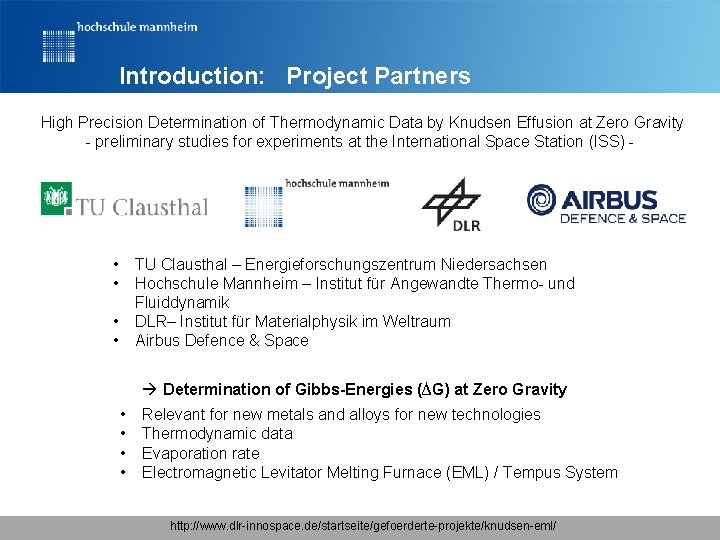
Introduction: Project Partners High Precision Determination of Thermodynamic Data by Knudsen Effusion at Zero Gravity - preliminary studies for experiments at the International Space Station (ISS) - • • TU Clausthal – Energieforschungszentrum Niedersachsen Hochschule Mannheim – Institut für Angewandte Thermo- und Fluiddynamik DLR– Institut für Materialphysik im Weltraum Airbus Defence & Space • • Determination of Gibbs-Energies (∆G) at Zero Gravity • • Relevant for new metals and alloys for new technologies Thermodynamic data Evaporation rate Electromagnetic Levitator Melting Furnace (EML) / Tempus System http: //www. dlr-innospace. de/startseite/gefoerderte-projekte/knudsen-eml/
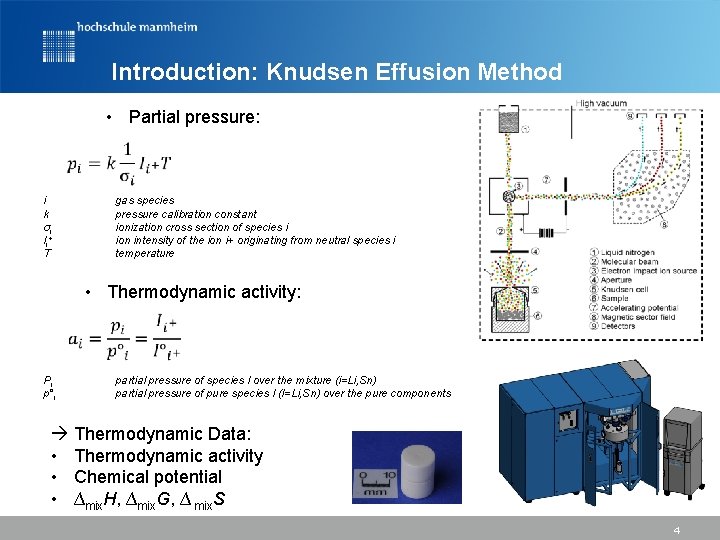
Introduction: Knudsen Effusion Method • Partial pressure: i k σi Ii+ T gas species pressure calibration constant ionization cross section of species i ion intensity of the ion i+ originating from neutral species i temperature • Thermodynamic activity: Pi p°i partial pressure of species I over the mixture (i=Li, Sn) partial pressure of pure species I (I=Li, Sn) over the pure components Thermodynamic Data: • Thermodynamic activity • Chemical potential • ∆mix. H, ∆mix. G, ∆ mix. S 4
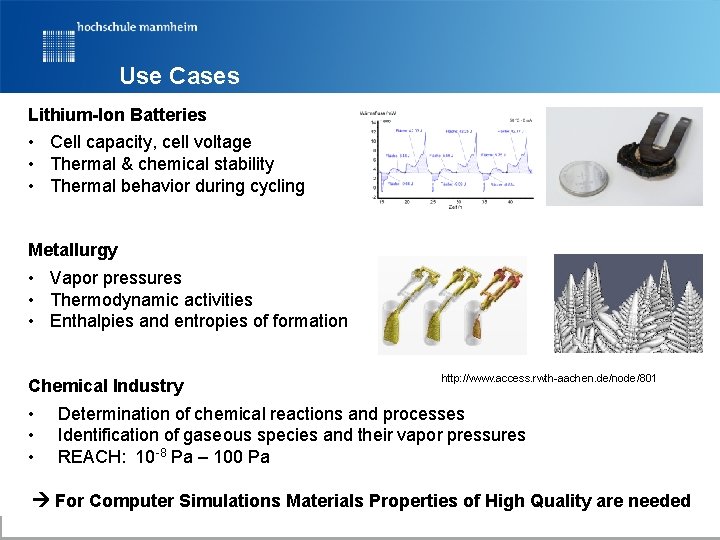
Use Cases Lithium-Ion Batteries • Cell capacity, cell voltage • Thermal & chemical stability • Thermal behavior during cycling Metallurgy • Vapor pressures • Thermodynamic activities • Enthalpies and entropies of formation Chemical Industry • • • http: //www. access. rwth-aachen. de/node/801 Determination of chemical reactions and processes Identification of gaseous species and their vapor pressures REACH: 10 -8 Pa – 100 Pa For Computer Simulations Materials Properties of High Quality are needed
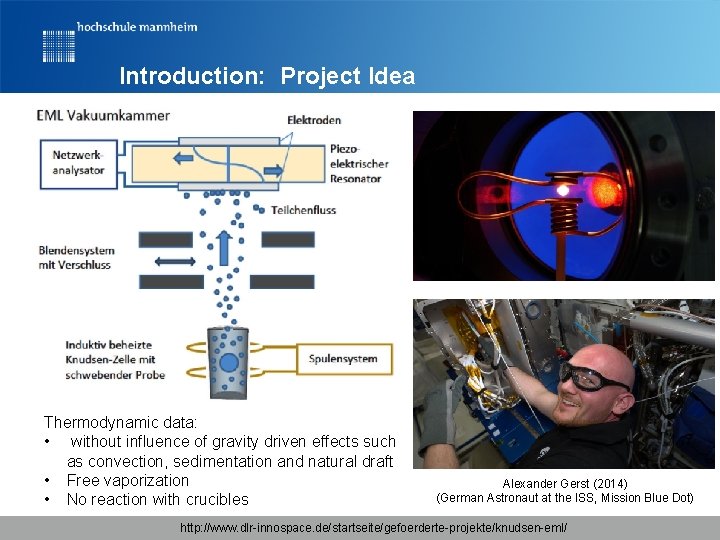
Introduction: Project Idea Thermodynamic data: • without influence of gravity driven effects such as convection, sedimentation and natural draft • Free vaporization • No reaction with crucibles Alexander Gerst (2014) (German Astronaut at the ISS, Mission Blue Dot) http: //www. dlr-innospace. de/startseite/gefoerderte-projekte/knudsen-eml/
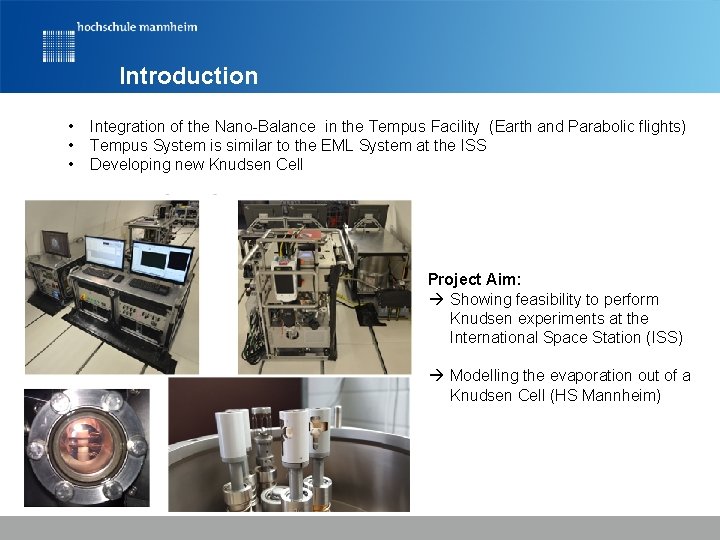
Introduction • • • Integration of the Nano-Balance in the Tempus Facility (Earth and Parabolic flights) Tempus System is similar to the EML System at the ISS Developing new Knudsen Cell Project Aim: Showing feasibility to perform Knudsen experiments at the International Space Station (ISS) Modelling the evaporation out of a Knudsen Cell (HS Mannheim)
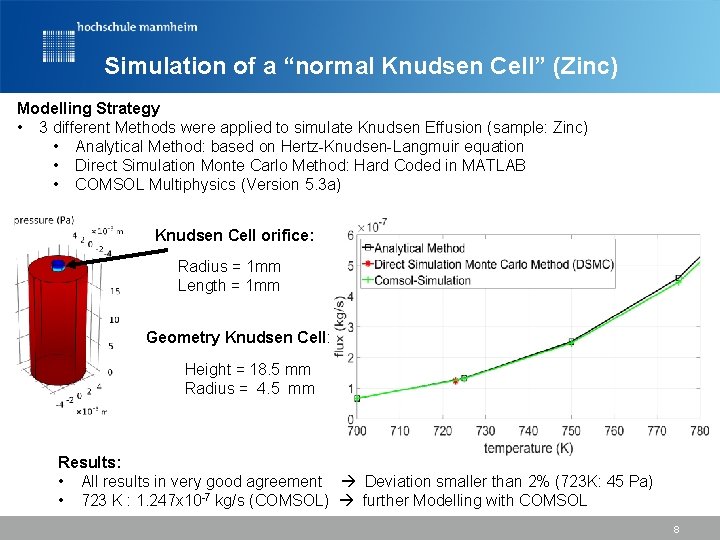
Simulation of a “normal Knudsen Cell” (Zinc) Modelling Strategy • 3 different Methods were applied to simulate Knudsen Effusion (sample: Zinc) • Analytical Method: based on Hertz-Knudsen-Langmuir equation • Direct Simulation Monte Carlo Method: Hard Coded in MATLAB • COMSOL Multiphysics (Version 5. 3 a) Knudsen Cell orifice: Radius = 1 mm Length = 1 mm Geometry Knudsen Cell: Height = 18. 5 mm Radius = 4. 5 mm Results: • All results in very good agreement Deviation smaller than 2% (723 K: 45 Pa) • 723 K : 1. 247 x 10 -7 kg/s (COMSOL) further Modelling with COMSOL 8
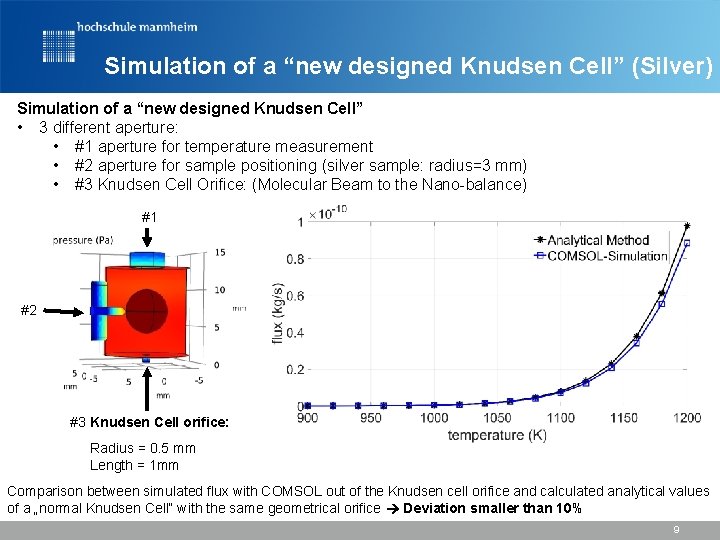
Simulation of a “new designed Knudsen Cell” (Silver) Simulation of a “new designed Knudsen Cell” • 3 different aperture: • #1 aperture for temperature measurement • #2 aperture for sample positioning (silver sample: radius=3 mm) • #3 Knudsen Cell Orifice: (Molecular Beam to the Nano-balance) #1 #2 #3 Knudsen Cell orifice: Radius = 0. 5 mm Length = 1 mm Comparison between simulated flux with COMSOL out of the Knudsen cell orifice and calculated analytical values of a „normal Knudsen Cell“ with the same geometrical orifice Deviation smaller than 10% 9
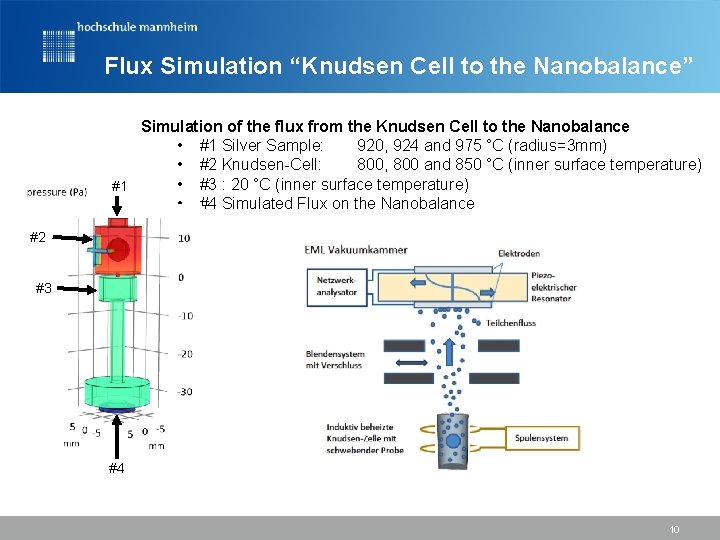
Flux Simulation “Knudsen Cell to the Nanobalance” Simulation of the flux from the Knudsen Cell to the Nanobalance • #1 Silver Sample: 920, 924 and 975 °C (radius=3 mm) • #2 Knudsen-Cell: 800, 800 and 850 °C (inner surface temperature) • #3 : 20 °C (inner surface temperature) #1 • #4 Simulated Flux on the Nanobalance #2 #3 #4 10
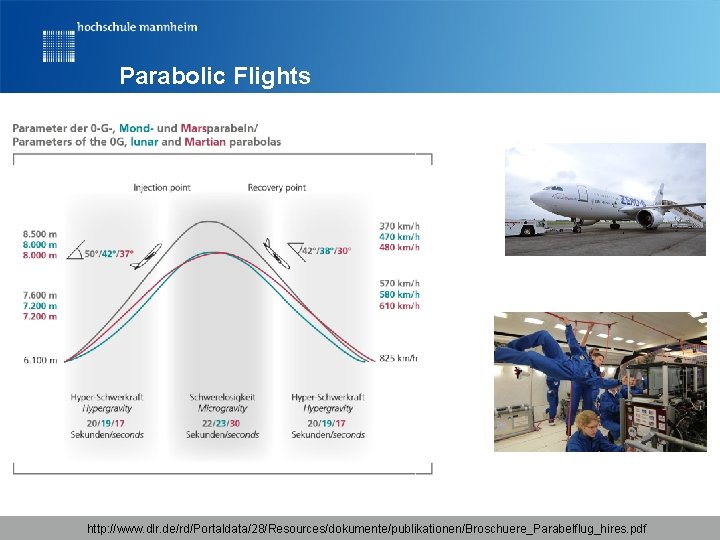
Parabolic Flights http: //www. dlr. de/rd/Portaldata/28/Resources/dokumente/publikationen/Broschuere_Parabelflug_hires. pdf
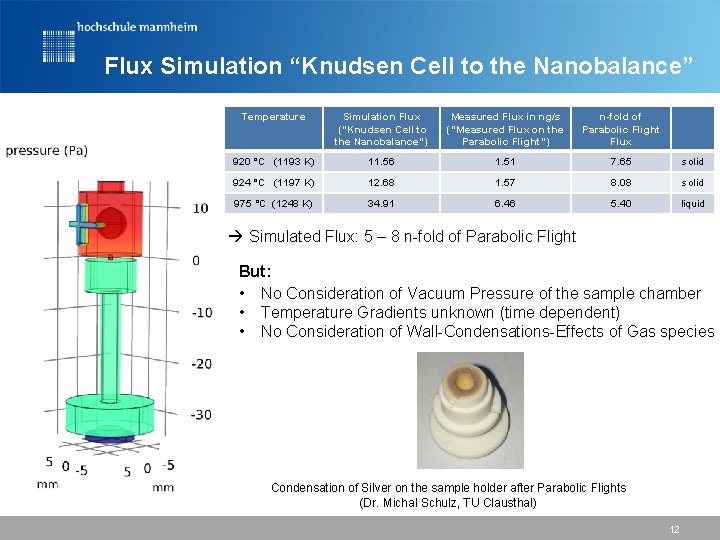
Flux Simulation “Knudsen Cell to the Nanobalance” Temperature Simulation Flux (“Knudsen Cell to the Nanobalance”) Measured Flux in ng/s (“Measured Flux on the Parabolic Flight”) n-fold of Parabolic Flight Flux 920 °C (1193 K) 11. 56 1. 51 7. 65 solid 924 °C (1197 K) 12. 68 1. 57 8. 08 solid 975 °C (1248 K) 34. 91 6. 46 5. 40 liquid Simulated Flux: 5 – 8 n-fold of Parabolic Flight But: • No Consideration of Vacuum Pressure of the sample chamber • Temperature Gradients unknown (time dependent) • No Consideration of Wall-Condensations-Effects of Gas species Condensation of Silver on the sample holder after Parabolic Flights (Dr. Michal Schulz, TU Clausthal) 12
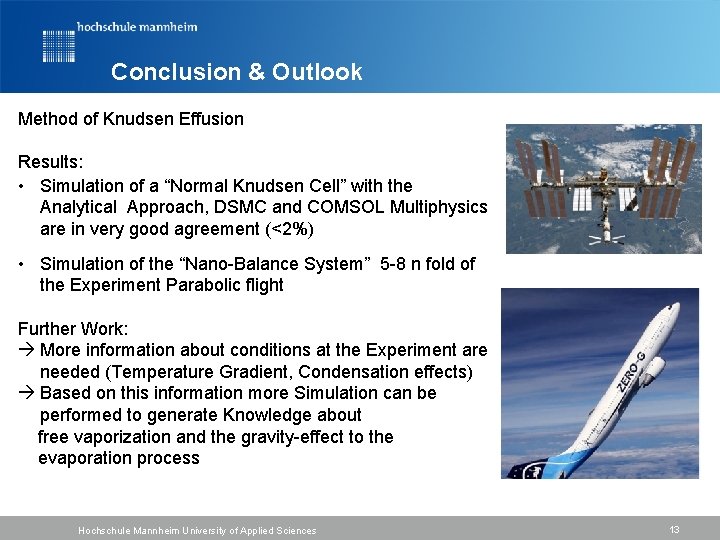
Conclusion & Outlook Method of Knudsen Effusion Results: • Simulation of a “Normal Knudsen Cell” with the Analytical Approach, DSMC and COMSOL Multiphysics are in very good agreement (<2%) • Simulation of the “Nano-Balance System” 5 -8 n fold of the Experiment Parabolic flight Further Work: More information about conditions at the Experiment are needed (Temperature Gradient, Condensation effects) Based on this information more Simulation can be performed to generate Knowledge about free vaporization and the gravity-effect to the evaporation process Hochschule Mannheim University of Applied Sciences 13
Acknowledgement Prof. Torsten Markus Jens Peter Matthäus Wittek Gert Thiel Maximilian Länge Uzair Tahir Christoph Huber Knudsen EML - Technology demonstrator for measuring evaporation rates of metals and alloys - High-precision determination of material constants under zero-g conditions - - Preparatory work for measurements on the International Space Station (ISS) - 14
Thank you for your attention !!! Hochschule Mannheim University of Applied Sciences