
Simulation of Signal Propagation in RPC for Atlas
![2. Simulation Method Stimulate source: ——Simulation signal A current signal Signal waveform: I[t]=(gap-v*t)*e^(a*v*t) Time](https://slidetodoc.com/presentation_image_h2/fc9d52b795d437568e6b60f7d4f1ac99/image-8.jpg "2. Simulation Method Stimulate source: ——Simulation signal A current signal Signal waveform: I[t]=(gap-v*t)*e^(a*v*t) Time")
- Slides: 20
Simulation of Signal Propagation in RPC for Atlas Phase II Upgrade Xiangyu Xie on behalf of ATLAS RPC Software Simulation Group(USTC, Roma II and INFN) At Third CLHCP, Nanjing University 2021/10/31 1
Outline • 1. Motivation • 2. Simulation method • 3. Results • 4. More functions • 5. Conclusion 2021/10/31 2
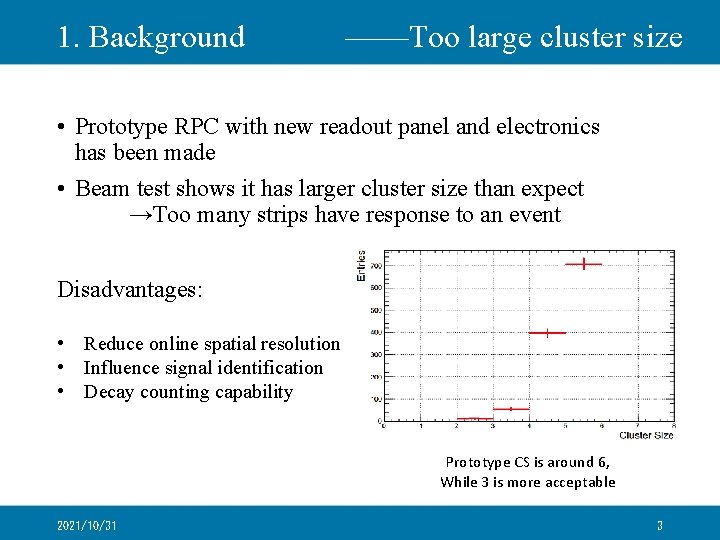
1. Background ——Too large cluster size • Prototype RPC with new readout panel and electronics has been made • Beam test shows it has larger cluster size than expect →Too many strips have response to an event Disadvantages: • Reduce online spatial resolution • Influence signal identification • Decay counting capability Prototype CS is around 6, While 3 is more acceptable 2021/10/31 3
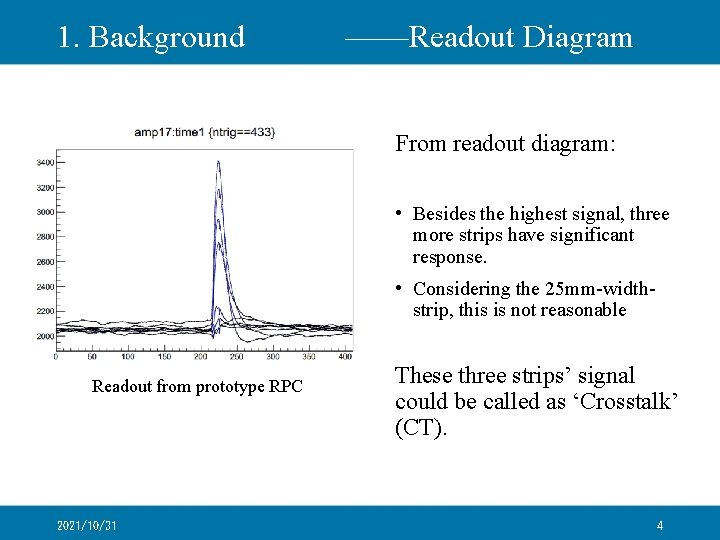
1. Background ——Readout Diagram From readout diagram: • Besides the highest signal, three more strips have significant response. • Considering the 25 mm-widthstrip, this is not reasonable Readout from prototype RPC 2021/10/31 These three strips’ signal could be called as ‘Crosstalk’ (CT). 4
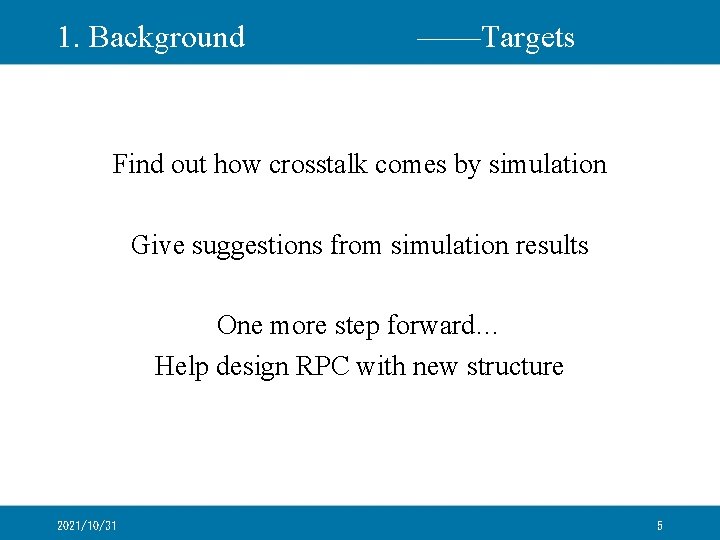
1. Background ——Targets Find out how crosstalk comes by simulation Give suggestions from simulation results One more step forward… Help design RPC with new structure 2021/10/31 5
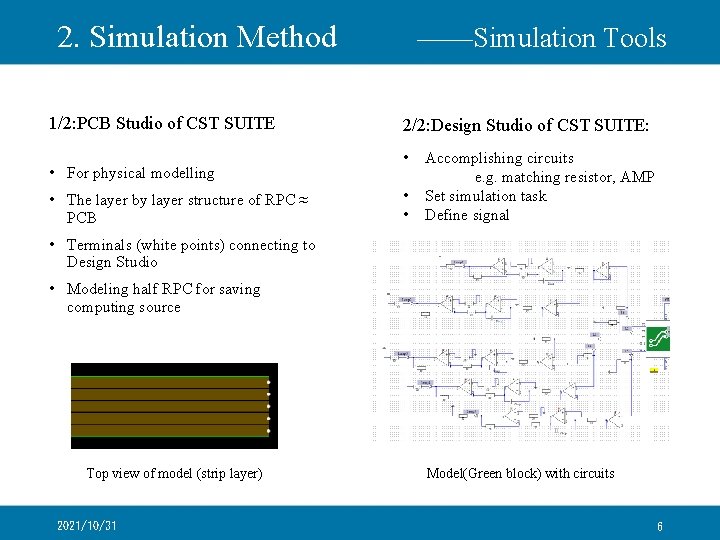
2. Simulation Method 1/2: PCB Studio of CST SUITE • For physical modelling • The layer by layer structure of RPC ≈ PCB ——Simulation Tools 2/2: Design Studio of CST SUITE: • • • Accomplishing circuits e. g. matching resistor, AMP Set simulation task Define signal • Terminals (white points) connecting to Design Studio • Modeling half RPC for saving computing source Top view of model (strip layer) 2021/10/31 Model(Green block) with circuits 6
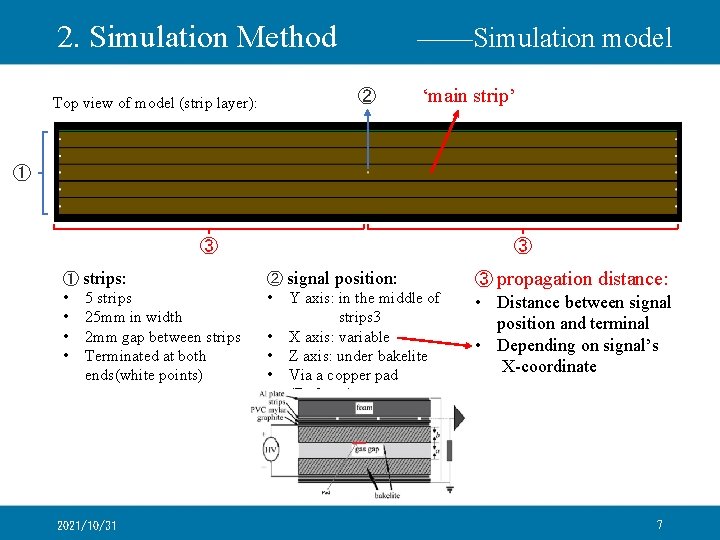
2. Simulation Method Top view of model (strip layer): ——Simulation model ② ‘main strip’ ① ③ ① strips: • 5 strips • 25 mm in width • 2 mm gap between strips • Terminated at both ends(white points) 2021/10/31 ③ ② signal position: • Y axis: in the middle of strips 3 • X axis: variable • Z axis: under bakelite • Via a copper pad (D=2 mm) ③ propagation distance: • Distance between signal position and terminal • Depending on signal’s X-coordinate 7
2. Simulation Method Stimulate source: ——Simulation signal A current signal Signal waveform: I[t]=(gap-v*t)*e^(a*v*t) Time of rise ≈ 4 ns Time of fall ≈ 1 ns (A simple assumption) PS. The strength of signal doesn’t matter. 2021/10/31 8
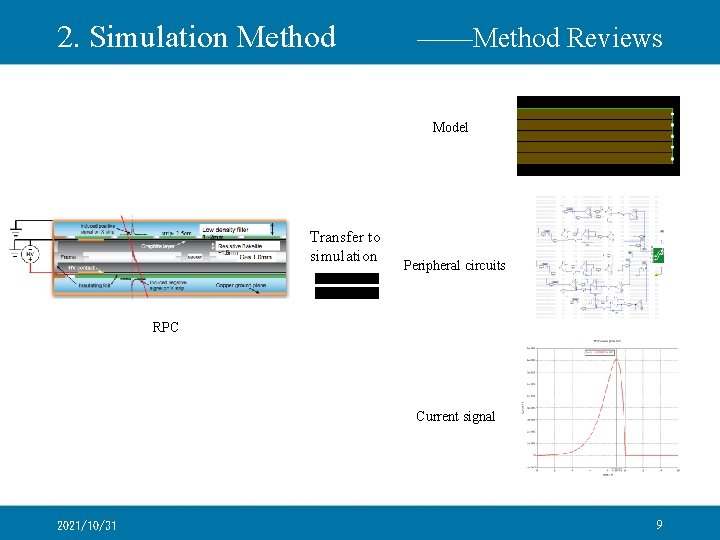
2. Simulation Method ——Method Reviews Model Transfer to simulation Peripheral circuits RPC Current signal 2021/10/31 9
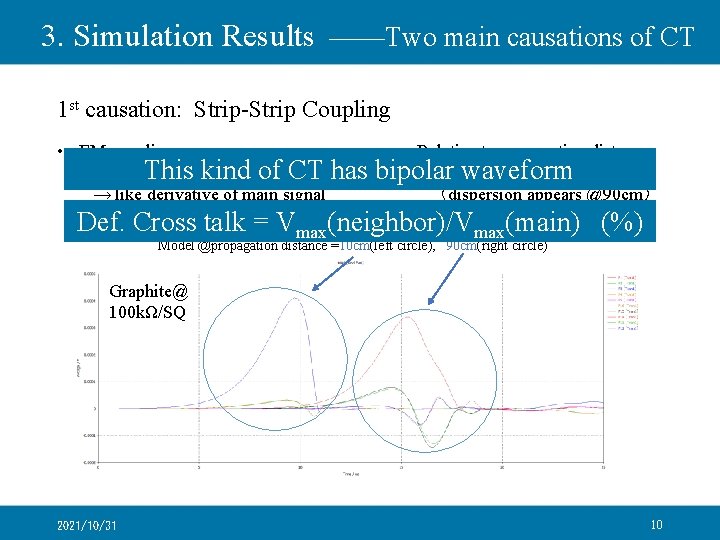
3. Simulation Results ——Two main causations of CT 1 st causation: Strip-Strip Coupling • EM coupling → CT has bipolar waveform This kind of CT has → like derivative of main signal • Relative to propagation distance → proportional relationship bipolar waveform (dispersion appears @90 cm) Def. Cross talk = voltage Vmaxreadout (neighbor)/V Five strips (by matching resistors) max(main) (%) Model @propagation distance =10 cm(left circle), 90 cm(right circle) Graphite@ 100 kΩ/SQ 2021/10/31 10
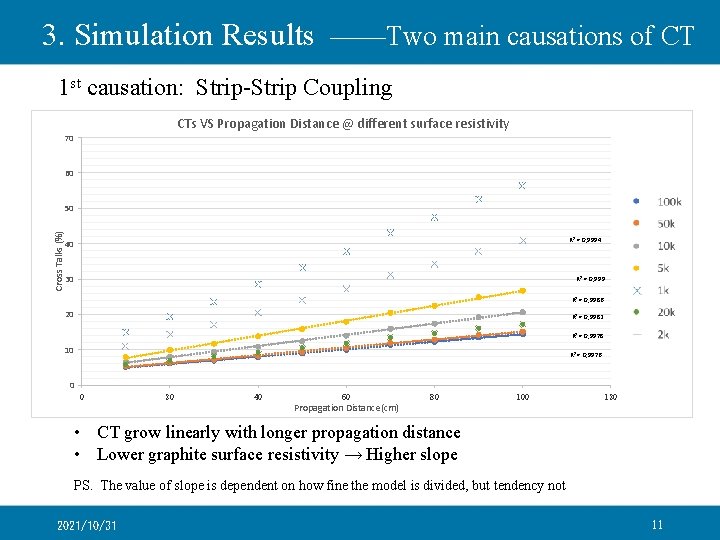
Cross Talks (%) 1 st causation: Strip-Strip Coupling R 2 = 0, 999 R 2 = 0, 9986 R 2 = 0, 9978 R 2 = 0, 9976 Propagation Distance(cm)
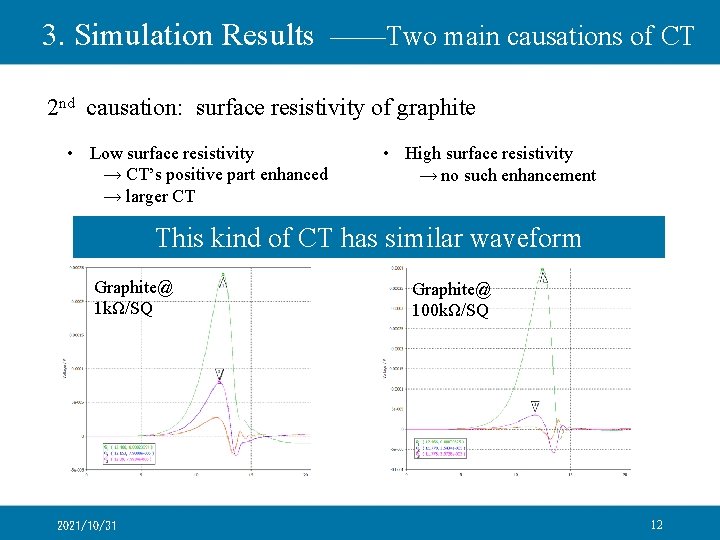
3. Simulation Results ——Two main causations of CT 2 nd causation: surface resistivity of graphite • Low surface resistivity → CT’s positive part enhanced → larger CT Direct voltage readout (of matching R) over time(ns) Graphite @ 1 kΩ/SQ, Propagation distance=50 cm • High surface resistivity → no such enhancement Direct voltage readout (of matching R) over time(ns) Graphite @ 100 kΩ/SQ, Propagation distance=50 cm This kind of CT has similar waveform Graphite@ 1 kΩ/SQ 2021/10/31 Graphite@ 100 kΩ/SQ 12
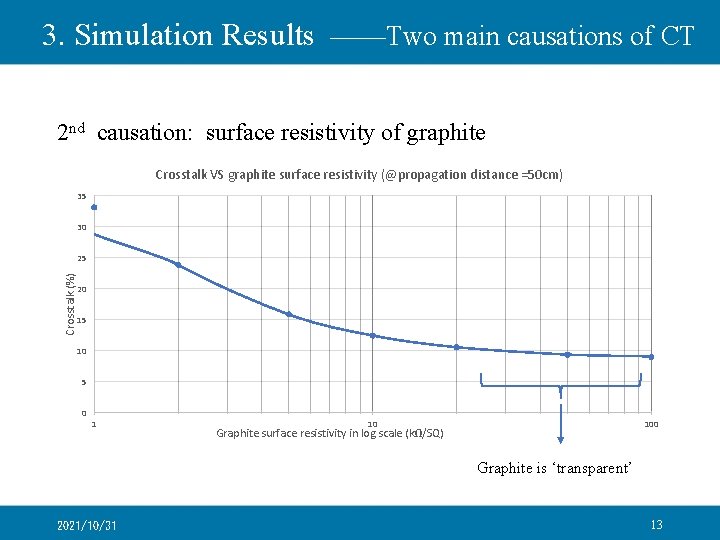
3. Simulation Results ——Two main causations of CT 2 nd causation: surface resistivity of graphite Crosstalk VS graphite surface resistivity (@propagation distance =50 cm) 35 30 Crosstalk (%) 25 20 15 10 5 0 1 10 100 Graphite surface resistivity in log scale (kΩ/SQ) Graphite is ‘transparent’ 2021/10/31 13
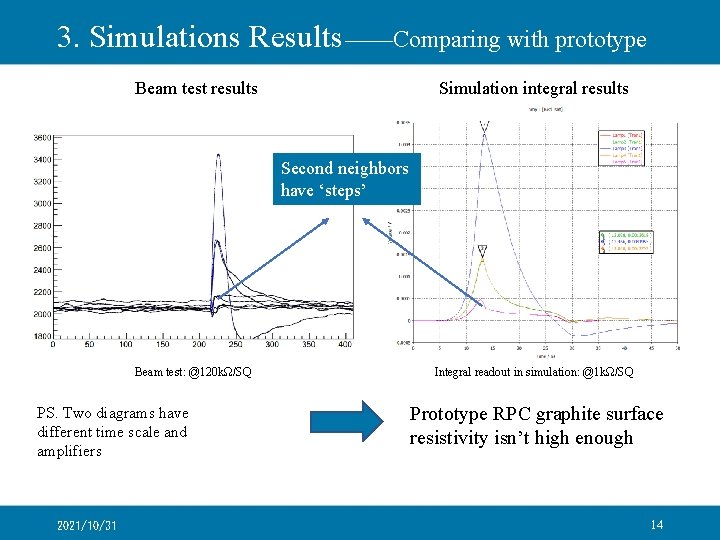
3. Simulations Results ——Comparing with prototype Beam test results Simulation integral results Second neighbors have ‘steps’ Beam test: @120 kΩ/SQ PS. Two diagrams have different time scale and amplifiers 2021/10/31 Integral readout in simulation: @1 kΩ/SQ Prototype RPC graphite surface resistivity isn’t high enough 14
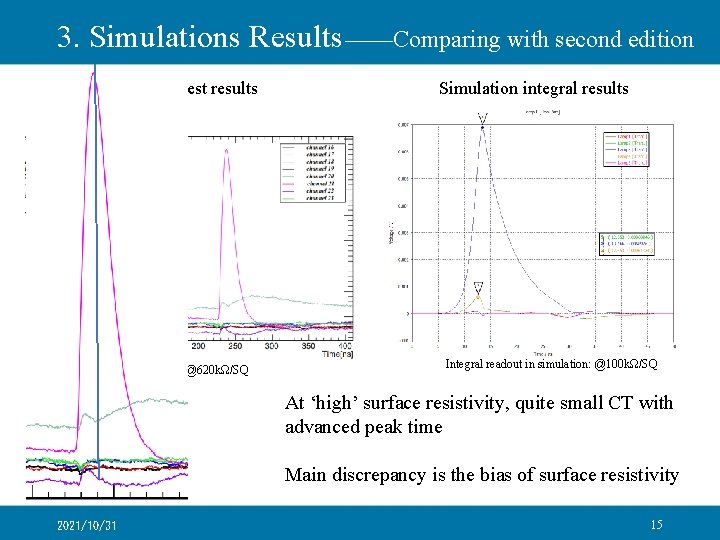
3. Simulations Results ——Comparing with second edition Beam test results Beam test: @620 kΩ/SQ Simulation integral results Integral readout in simulation: @100 kΩ/SQ At ‘high’ surface resistivity, quite small CT with advanced peak time Main discrepancy is the bias of surface resistivity 2021/10/31 15
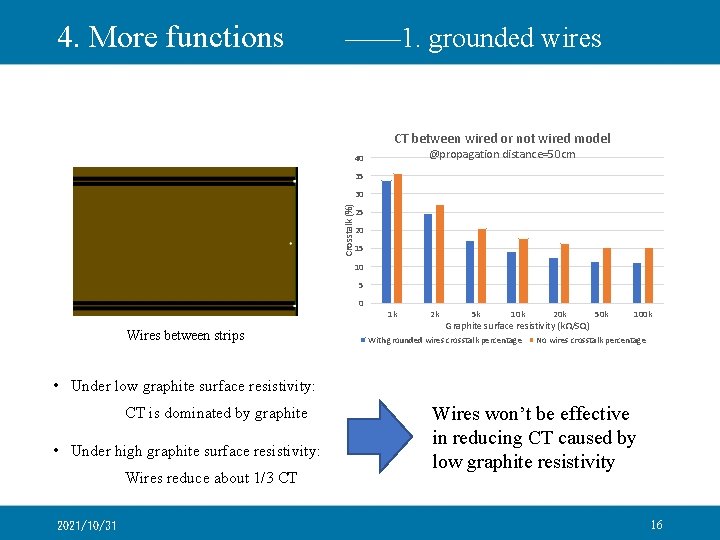
4. More functions —— 1. grounded wires CT between wired or not wired model @propagation distance=50 cm 40 35 Crosstalk (%) 30 25 20 15 10 5 0 Wires between strips 1 k 2 k 5 k 10 k 20 k Graphite surface resistivity (kΩ/SQ) With grounded wires crosstalk percentage 50 k 100 k No wires crosstalk percentage • Under low graphite surface resistivity: CT is dominated by graphite • Under high graphite surface resistivity: Wires reduce about 1/3 CT 2021/10/31 Wires won’t be effective in reducing CT caused by low graphite resistivity 16
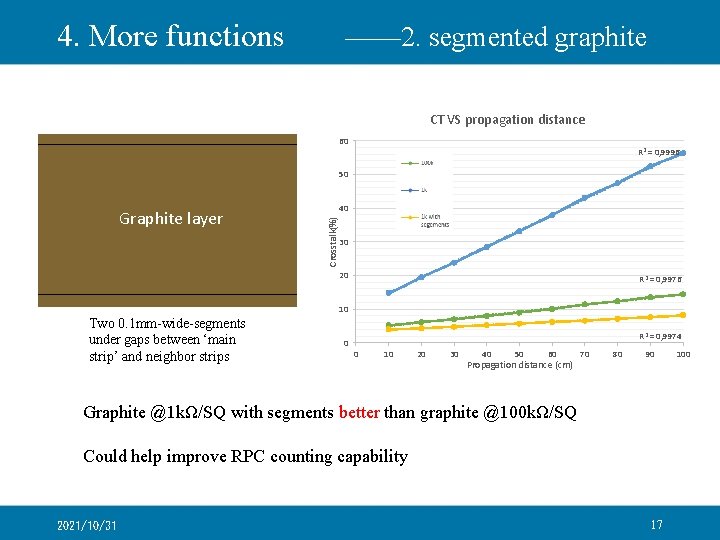
4. More functions —— 2. segmented graphite CT VS propagation distance 60 R 2 = 0, 9996 50 Crosstalk(%) Graphite layer 40 30 20 R 2 = 0, 9976 10 Two 0. 1 mm-wide-segments under gaps between ‘main strip’ and neighbor strips 0 R 2 = 0, 9974 0 10 20 30 40 50 60 Propagation distance (cm) 70 80 90 Graphite @1 kΩ/SQ with segments better than graphite @100 kΩ/SQ Could help improve RPC counting capability 2021/10/31 17 100
5. Conclusion • 1. Problem comes: Prototype RPC has large cluster size • 2. Results: • Set up a new method to simulate RPC • Two main causations of CT have been found and fit beam teats readouts • New design could be simulated by this method • 3. Future plan: • Improve model • Test existing applied material • Try new design RPC in USTC RPC lab. 2021/10/31 18
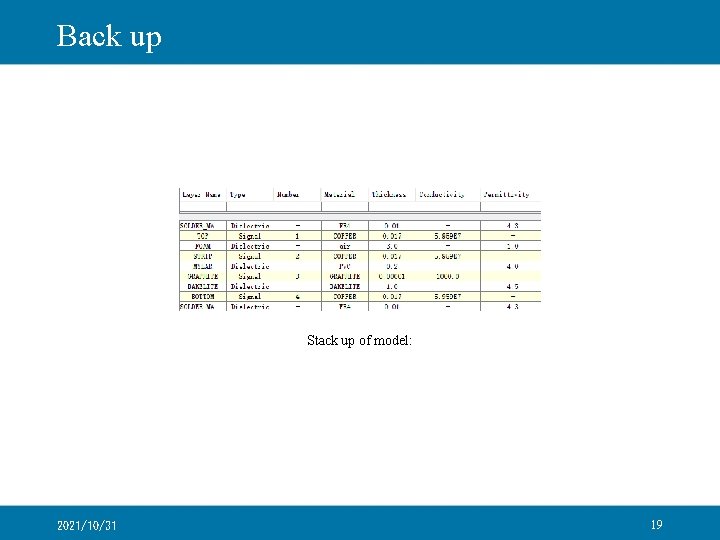
Back up Stack up of model: 2021/10/31 19
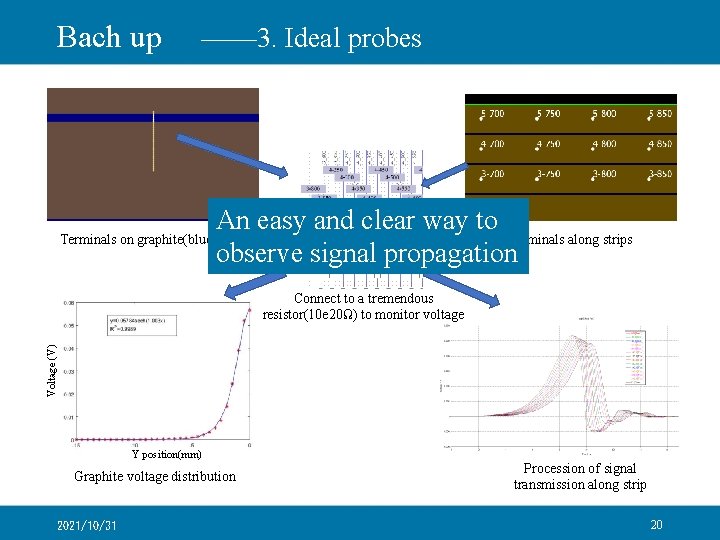
Bach up —— 3. Ideal probes An easy and clear way to Terminals along strips observe signal propagation Terminals on graphite(blue layer) Voltage (V) Connect to a tremendous resistor(10 e 20Ω) to monitor voltage Y position(mm) Graphite voltage distribution 2021/10/31 Procession of signal transmission along strip 20