
Simulation of RPC Performance for 511 ke V
![References [1] M. Couceiro et al. , RPC-PET: Status and Perspectives, NIM A 580](https://slidetodoc.com/presentation_image_h2/6b72a4f27877b5a84c146d04ccd694d5/image-2.jpg "References [1] M. Couceiro et al. , RPC-PET: Status and Perspectives, NIM A 580")
![RPC PET RPCs are attractive for Positron Emission Tomography (PET) because of their [1]](https://slidetodoc.com/presentation_image_h2/6b72a4f27877b5a84c146d04ccd694d5/image-3.jpg "RPC PET RPCs are attractive for Positron Emission Tomography (PET) because of their [1]")
![RPC PET RPCs are attractive for Positron Emission Tomography (PET) because of their [1]](https://slidetodoc.com/presentation_image_h2/6b72a4f27877b5a84c146d04ccd694d5/image-4.jpg "RPC PET RPCs are attractive for Positron Emission Tomography (PET) because of their [1]")
![RPC PET RPCs are attractive for Positron Emission Tomography (PET) because of their [1]](https://slidetodoc.com/presentation_image_h2/6b72a4f27877b5a84c146d04ccd694d5/image-5.jpg "RPC PET RPCs are attractive for Positron Emission Tomography (PET) because of their [1]")
![RPC PET RPCs are attractive for Positron Emission Tomography (PET) because of their [1]](https://slidetodoc.com/presentation_image_h2/6b72a4f27877b5a84c146d04ccd694d5/image-6.jpg "RPC PET RPCs are attractive for Positron Emission Tomography (PET) because of their [1]")
![1) FLUKA simulation of Photon Interactions Setup similar to the one described in [2]:](https://slidetodoc.com/presentation_image_h2/6b72a4f27877b5a84c146d04ccd694d5/image-10.jpg "1) FLUKA simulation of Photon Interactions Setup similar to the one described in [2]:")
![The Effective Townsend Coefficient within the Avalanche [4] The effective Townsend Coefficient ranges from](https://slidetodoc.com/presentation_image_h2/6b72a4f27877b5a84c146d04ccd694d5/image-24.jpg "The Effective Townsend Coefficient within the Avalanche [4] The effective Townsend Coefficient ranges from")
- Slides: 31
Simulation of RPC Performance for 511 ke. V photon detection Christian Lippmann*, Helmut Vincke* and Werner Riegler* *) CERN, Geneva, Switzerland Introduction RPC for PET Charge Deposit by 511 ke. V photons RPC Time Response Comparison to MIPs Space Charge Effect Reduction of the Multiplication with Avalanche Size Summary and Conclusions RPC 2007 - 15. 02. 2008 Christian Lippmann
References [1] M. Couceiro et al. , RPC-PET: Status and Perspectives, NIM A 580 (2007) 915 -918. [2] L. Lopes et al. , Accurate Timing of Gamma Rays with High-Rate Resistive Plate Chambers, NIM A 573 (2007) 4 -7. [3] D. Gonzales Diaz, Research and Developments on Timing RPCs, Doctoral Thesis, Santiago de Compostela, 2006. [4] C. Lippmann and W. Riegler, Space charge effects in Resistive Plate Chambers , NIM A 517 (2004) 54 -76. [5] A. Mangiarotti et al. , On the deterministic and stochastic solutions of Space Charge models and their impact on high resolution timing , Nucl. Phys. B Proc. Suppl. 158 (2006) 118 -122. [6] C. Lippmann and W. Riegler, Detailed Avalanche Simulations, NIM A 533 (2004) 11 -15. [7] W. Legler, Die Statistik der Elektronenlawinen in elektronegativen Gasen bei hohen Feldstärken und bei großer Gasverstärkung , Z. Naturforschg. 16 a (1961) 253 -261. RPC 2007 - 15. 02. 2008 Christian Lippmann
RPC PET RPCs are attractive for Positron Emission Tomography (PET) because of their [1] Cost effectiveness and Time resolution. 511 ke. V photons interact in the RPC material. Essentially the charge deposited by the Compton electrons is detected. RPC 2007 - 15. 02. 2008 Christian Lippmann
RPC PET RPCs are attractive for Positron Emission Tomography (PET) because of their [1] Cost effectiveness and Time resolution. 511 ke. V photons interact in the RPC material. Essentially the charge deposited by the Compton electrons is detected. Two observations can not be properly explained: RPC 2007 - 15. 02. 2008 Christian Lippmann
RPC PET RPCs are attractive for Positron Emission Tomography (PET) because of their [1] Cost effectiveness and Time resolution. 511 ke. V photons interact in the RPC material. Essentially the charge deposited by the Compton electrons is detected. Two observations can not be properly explained: 1. Time resolution is worse for photons as compared to particle beams [2]: ~ 90 ps for 511 ke. V photons (single gap RPC). ~ 50 ps for particle beams (single gap RPC). Possible Reason: The larger statistical variance of the primary charge that results from the photon interaction. RPC 2007 - 15. 02. 2008 Christian Lippmann
RPC PET RPCs are attractive for Positron Emission Tomography (PET) because of their [1] Cost effectiveness and Time resolution. 511 ke. V photons interact in the RPC material. Essentially the charge deposited by the Compton electrons is detected. Two observations can not be properly explained: 1. Time resolution is worse for photons as compared to particle beams [2]: ~ 90 ps for 511 ke. V photons (single gap RPC). ~ 50 ps for particle beams (single gap RPC) Possible Reason: The larger statistical variance of the primary charge that results from the photon interaction. 2. Time resolution with 511 ke. V photons essentially independent of HV (See e. g. Fig. 8. 24. In [3]). RPC 2007 - 15. 02. 2008 Christian Lippmann
A Simulation of RPC Performance A fast simulation procedure with the following input: 1. 2. Distibution of the number of primary electrons (N) in gas gap due to the photon interactions. RPC Time Response data: Threshold crossing times (mean and r. m. s. ) for given HV and number of primary electrons). RPC 2007 - 15. 02. 2008 Christian Lippmann
A Simulation of RPC Performance A fast simulation procedure with the following input: 1. 2. 1. Distibution of the number of primary electrons (N) in gas gap due to the photon interactions. RPC Time Response data: Threshold crossing times (mean and r. m. s. ) for given HV and number of primary electrons). The photon interaction (including secondaries) is simulated with FLUKA. Lowest particle transport threshold for Electrons and Photons: 1 ke. V. RPC 2007 - 15. 02. 2008 Christian Lippmann
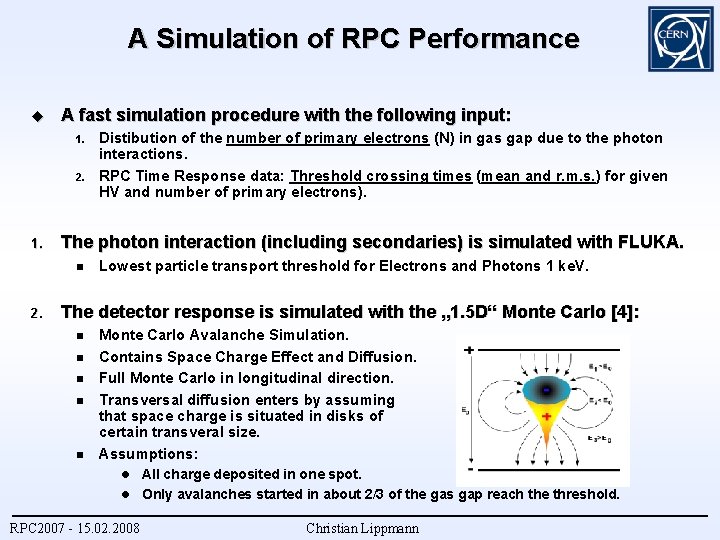
A Simulation of RPC Performance A fast simulation procedure with the following input: 1. 2. 1. The photon interaction (including secondaries) is simulated with FLUKA. 2. Distibution of the number of primary electrons (N) in gas gap due to the photon interactions. RPC Time Response data: Threshold crossing times (mean and r. m. s. ) for given HV and number of primary electrons). Lowest particle transport threshold for Electrons and Photons 1 ke. V. The detector response is simulated with the „ 1. 5 D“ Monte Carlo [4]: Monte Carlo Avalanche Simulation. Contains Space Charge Effect and Diffusion. Full Monte Carlo in longitudinal direction. Transversal diffusion enters by assuming that space charge is situated in disks of certain transveral size. Assumptions: All charge deposited in one spot. Only avalanches started in about 2/3 of the gas gap reach the threshold. RPC 2007 - 15. 02. 2008 Christian Lippmann
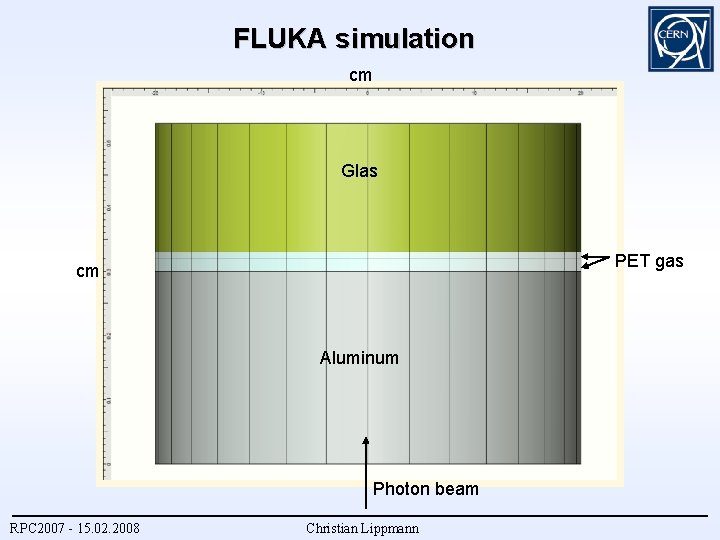
1) FLUKA simulation of Photon Interactions Setup similar to the one described in [2]: Aluminum 2 mm 511 ke. V Photon Glas 3 mm The gas gap of 0. 3 mm is divided into two volumes of 0. 2 mm and 0. 1 mm. The reason is that only avalanches started in about 2/3 of the gas gap reach the threshold. Gas mixture: C 2 F 4 H 2/ i-C 4 H 10/ SF 6 (85/5/10) Number of interest: Energy deposit spectrum in the two Gas volumes event by event. 0. 2+0. 1 mm RPC 2007 - 15. 02. 2008 Christian Lippmann
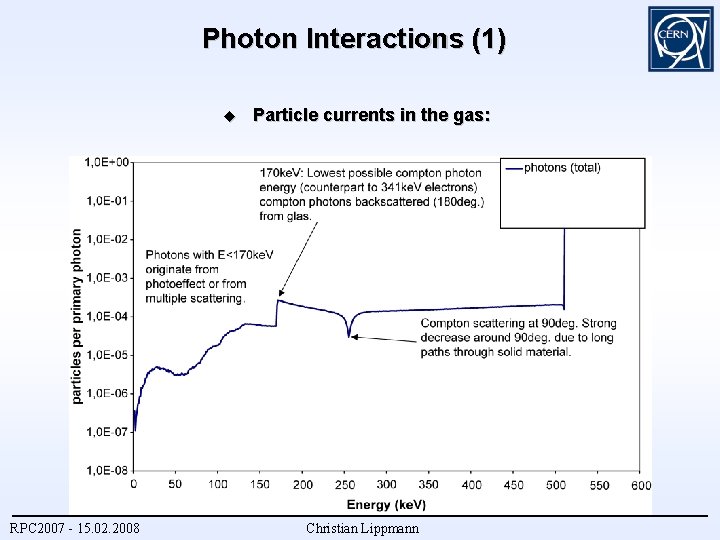
Photon Interactions (1) RPC 2007 - 15. 02. 2008 Particle currents in the gas: Christian Lippmann
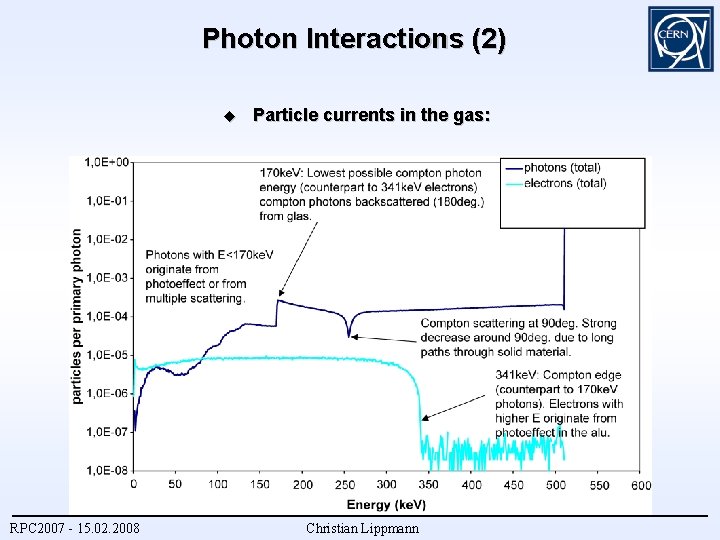
Photon Interactions (2) RPC 2007 - 15. 02. 2008 Particle currents in the gas: Christian Lippmann
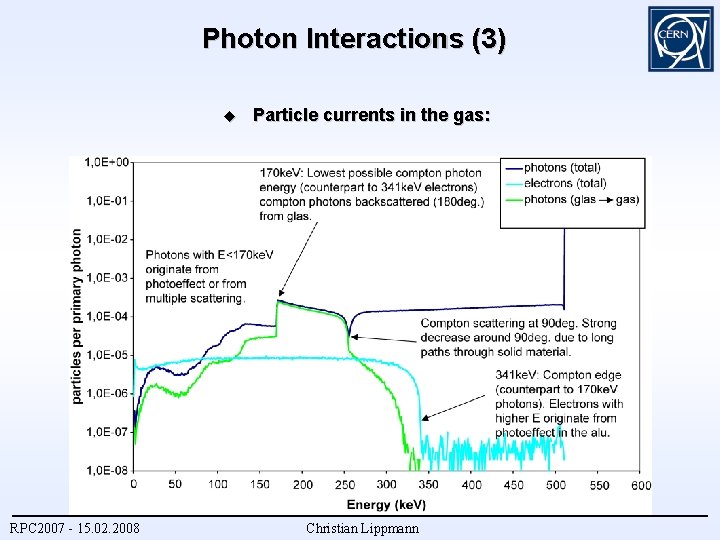
Photon Interactions (3) RPC 2007 - 15. 02. 2008 Particle currents in the gas: Christian Lippmann
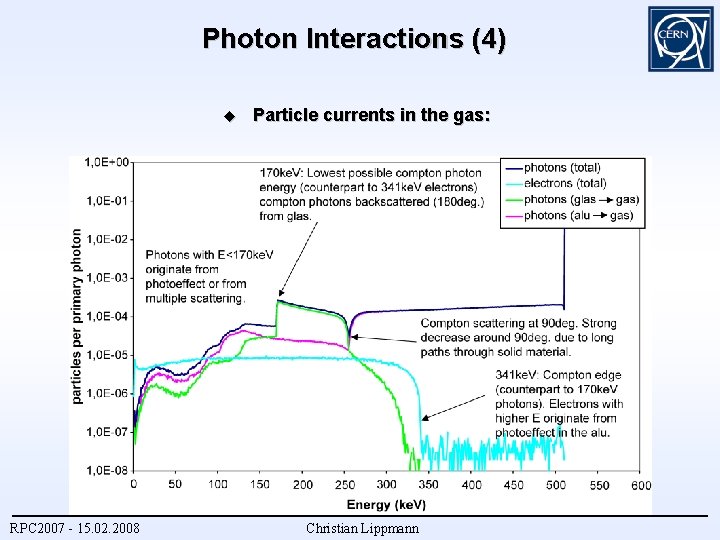
Photon Interactions (4) RPC 2007 - 15. 02. 2008 Particle currents in the gas: Christian Lippmann
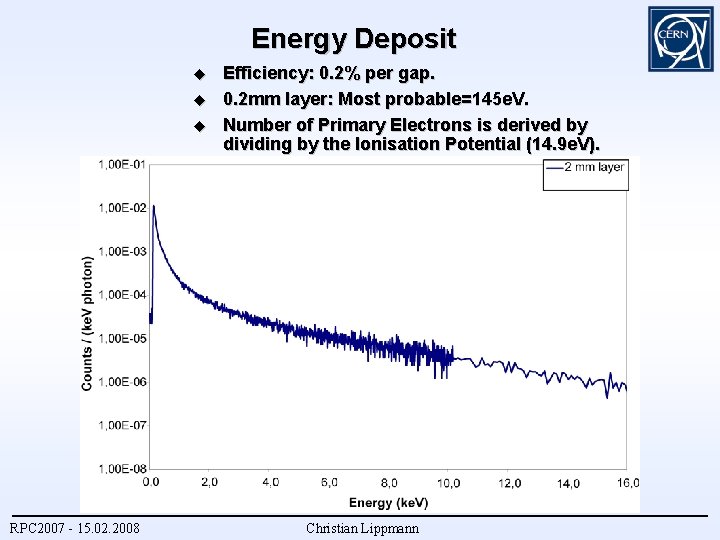
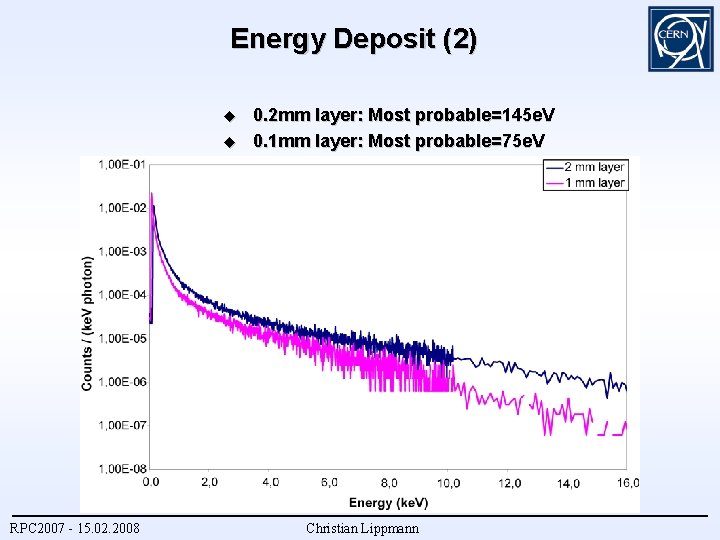
Energy Deposit RPC 2007 - 15. 02. 2008 Efficiency: 0. 2% per gap. 0. 2 mm layer: Most probable=145 e. V. Number of Primary Electrons is derived by dividing by the Ionisation Potential (14. 9 e. V). Christian Lippmann
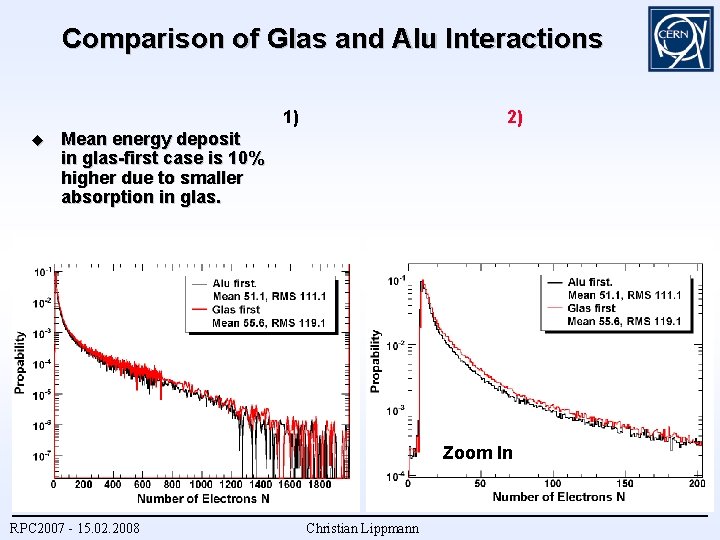
Comparison of Glas and Alu Interactions 1) 2) Mean energy deposit in glas-first case is 10% higher due to smaller absorption in glas. Zoom In RPC 2007 - 15. 02. 2008 Christian Lippmann
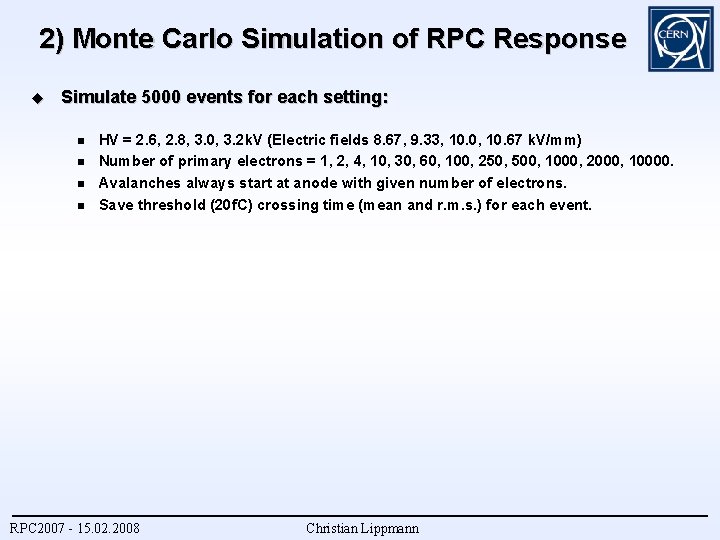
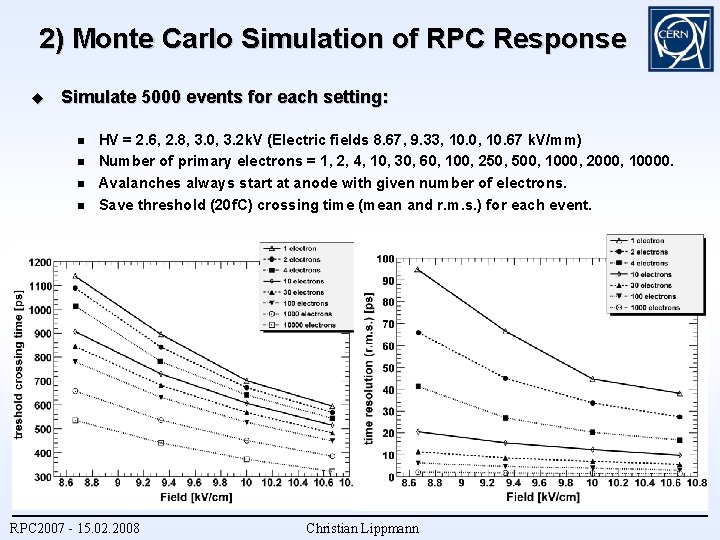
2) Monte Carlo Simulation of RPC Response Simulate 5000 events for each setting: HV = 2. 6, 2. 8, 3. 0, 3. 2 k. V (Electric fields 8. 67, 9. 33, 10. 0, 10. 67 k. V/mm) Number of primary electrons = 1, 2, 4, 10, 30, 60, 100, 250, 500, 1000, 2000, 10000. Avalanches always start at anode with given number of electrons. Save threshold (20 f. C) crossing time (mean and r. m. s. ) for each event. RPC 2007 - 15. 02. 2008 Christian Lippmann
2) Monte Carlo Simulation of RPC Response Simulate 5000 events for each setting: HV = 2. 6, 2. 8, 3. 0, 3. 2 k. V (Electric fields 8. 67, 9. 33, 10. 0, 10. 67 k. V/mm) Number of primary electrons = 1, 2, 4, 10, 30, 60, 100, 250, 500, 1000, 2000, 10000. Avalanches always start at anode with given number of electrons. Save threshold (20 f. C) crossing time (mean and r. m. s. ) for each event. RPC 2007 - 15. 02. 2008 Christian Lippmann
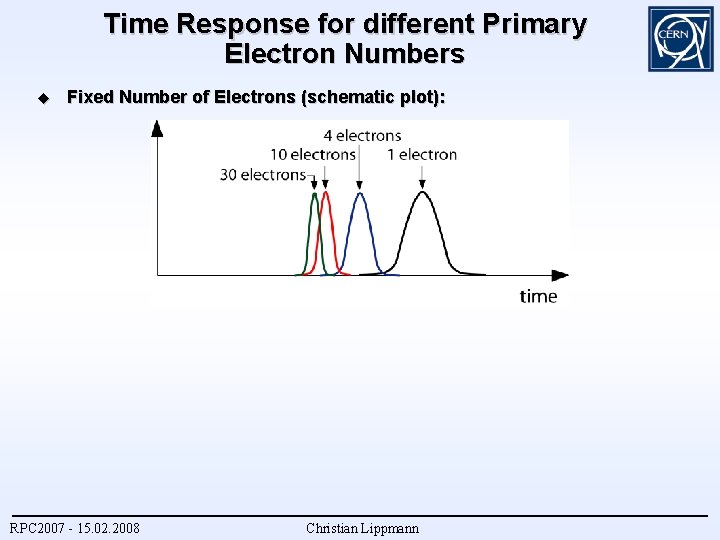
Time Response for different Primary Electron Numbers Fixed Number of Electrons (schematic plot): RPC 2007 - 15. 02. 2008 Christian Lippmann
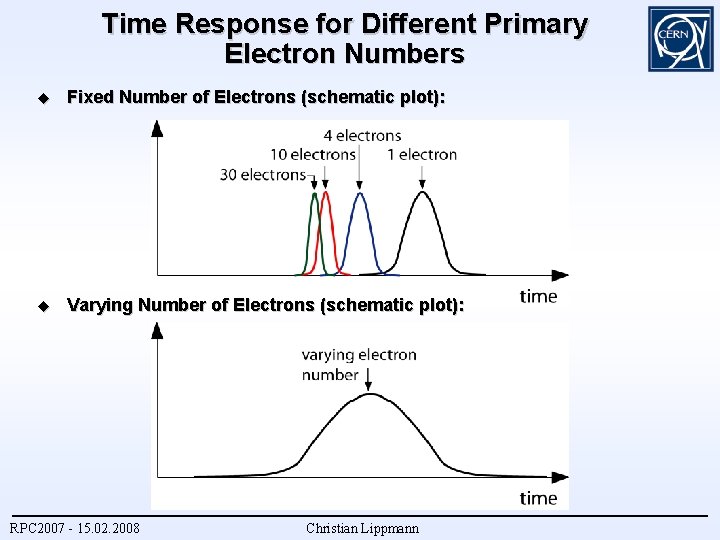
Time Response for Different Primary Electron Numbers Fixed Number of Electrons (schematic plot): Varying Number of Electrons (schematic plot): RPC 2007 - 15. 02. 2008 Christian Lippmann
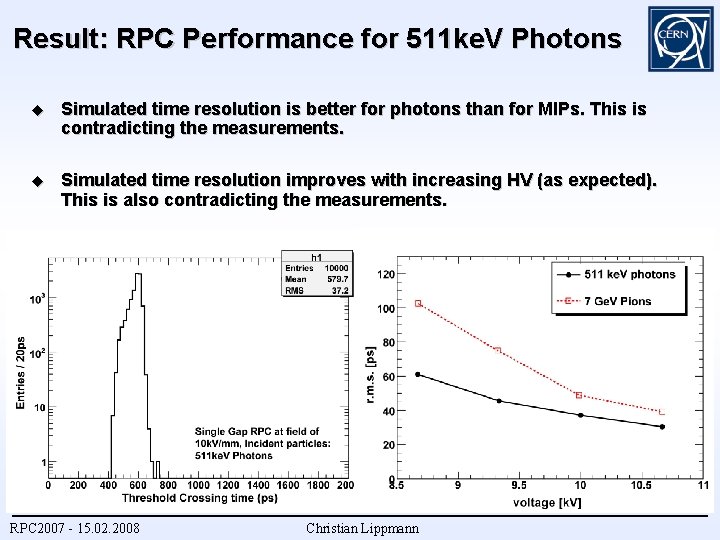
Result: RPC Performance for 511 ke. V Photons Simulated time resolution is better for photons than for MIPs. This is contradicting the measurements. Simulated time resolution improves with increasing HV (as expected). This is also contradicting the measurements. RPC 2007 - 15. 02. 2008 Christian Lippmann
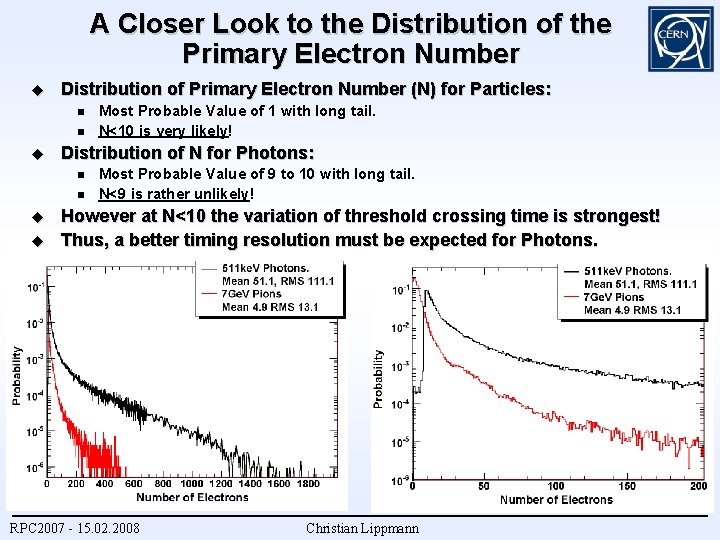
A Closer Look to the Distribution of the Primary Electron Number Distribution of Primary Electron Number (N) for Particles: Distribution of N for Photons: Most Probable Value of 1 with long tail. N<10 is very likely! Most Probable Value of 9 to 10 with long tail. N<9 is rather unlikely! However at N<10 the variation of threshold crossing time is strongest! Thus, a better timing resolution must be expected for Photons. RPC 2007 - 15. 02. 2008 Christian Lippmann
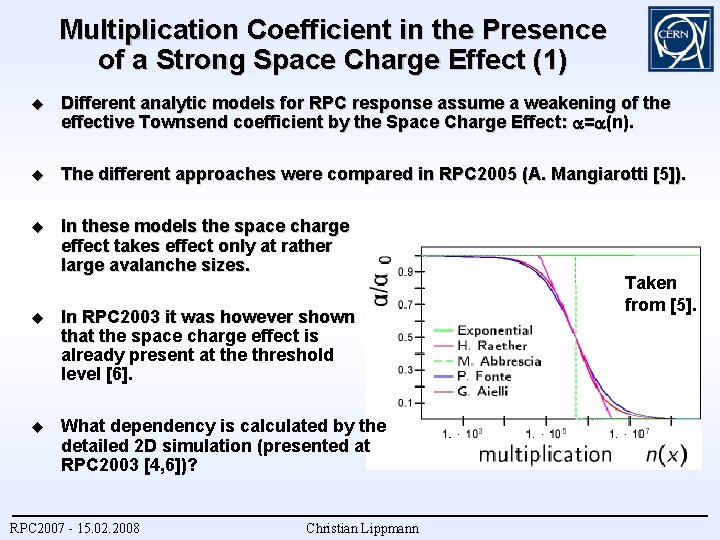
Multiplication Coefficient in the Presence of a Strong Space Charge Effect (1) Different analytic models for RPC response assume a weakening of the effective Townsend coefficient by the Space Charge Effect: = (n). The different approaches were compared in RPC 2005 (A. Mangiarotti [5]). In these models the space charge effect takes effect only at rather large avalanche sizes. In RPC 2003 it was however shown that the space charge effect is already present at the threshold level [6]. What dependency is calculated by the detailed 2 D simulation (presented at RPC 2003 [4, 6])? RPC 2007 - 15. 02. 2008 Christian Lippmann Taken from [5].
The Effective Townsend Coefficient within the Avalanche [4] The effective Townsend Coefficient ranges from +3000/cm to – 6000/cm! RPC 2007 - 15. 02. 2008 Christian Lippmann 2 D simulation
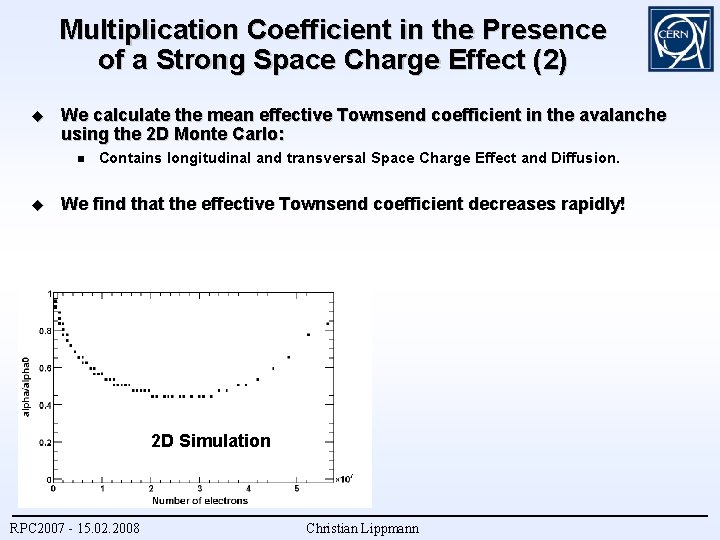
Multiplication Coefficient in the Presence of a Strong Space Charge Effect (2) We calculate the mean effective Townsend coefficient in the avalanche using the 2 D Monte Carlo: Contains longitudinal and transversal Space Charge Effect and Diffusion. We find that the effective Townsend coefficient decreases rapidly! 2 D Simulation RPC 2007 - 15. 02. 2008 Christian Lippmann
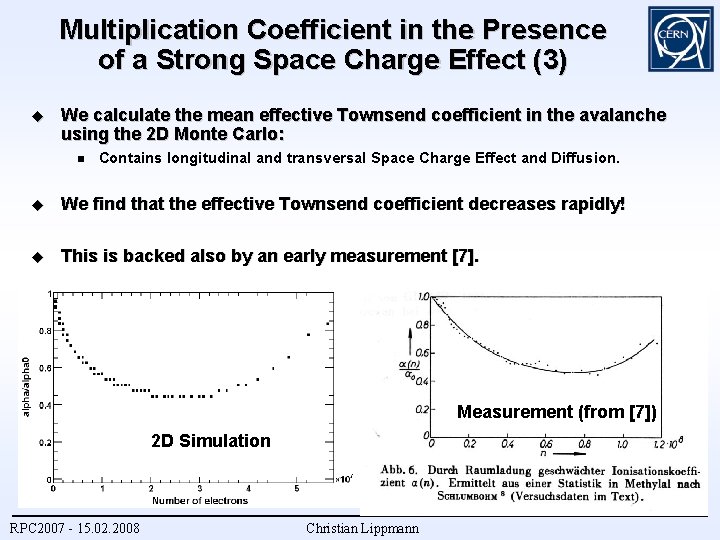
Multiplication Coefficient in the Presence of a Strong Space Charge Effect (3) We calculate the mean effective Townsend coefficient in the avalanche using the 2 D Monte Carlo: Contains longitudinal and transversal Space Charge Effect and Diffusion. We find that the effective Townsend coefficient decreases rapidly! This is backed also by an early measurement [7]. Measurement (from [7]) 2 D Simulation RPC 2007 - 15. 02. 2008 Christian Lippmann
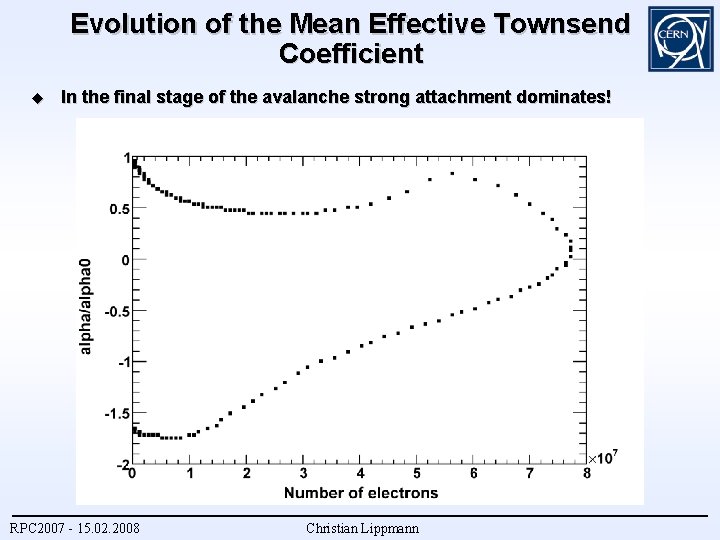
Evolution of the Mean Effective Townsend Coefficient In the final stage of the avalanche strong attachment dominates! RPC 2007 - 15. 02. 2008 Christian Lippmann
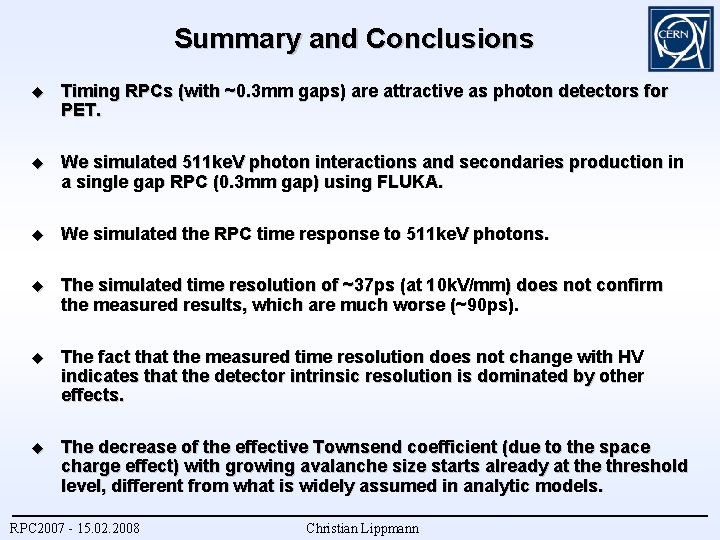
Summary and Conclusions Timing RPCs (with ~0. 3 mm gaps) are attractive as photon detectors for PET. We simulated 511 ke. V photon interactions and secondaries production in a single gap RPC (0. 3 mm gap) using FLUKA. We simulated the RPC time response to 511 ke. V photons. The simulated time resolution of ~37 ps (at 10 k. V/mm) does not confirm the measured results, which are much worse (~90 ps). The fact that the measured time resolution does not change with HV indicates that the detector intrinsic resolution is dominated by other effects. The decrease of the effective Townsend coefficient (due to the space charge effect) with growing avalanche size starts already at the threshold level, different from what is widely assumed in analytic models. RPC 2007 - 15. 02. 2008 Christian Lippmann
FLUKA simulation cm Glas PET gas cm Aluminum Photon beam RPC 2007 - 15. 02. 2008 Christian Lippmann
Energy Deposit (2) RPC 2007 - 15. 02. 2008 0. 2 mm layer: Most probable=145 e. V 0. 1 mm layer: Most probable=75 e. V Christian Lippmann
Slide Added after the workshop (on March 14, 2008) After discussions at the workshop it turns out that the following statements should be added: The plot on slide 23 has log scale on the X axis. The plots on slides 25/26 have linear scale. This makes them hard to compare. . In the conclusions (slide 28) we should thus conclude: The development of the effective Townsend coefficient (due to the space charge effect) with growing avalanche size differs from what is widely assumed in analytic models, becoming strongly negative in the final stage of an avalanche. RPC 2007 - 15. 02. 2008 Christian Lippmann