
Simulation of Oxygen Ion Ordering as a Result

- Slides: 9
Simulation of Oxygen Ion Ordering as a Result of Temperature Change Andrew Wilson & Ashley Predith 18. 337 Spring May 13, 2002
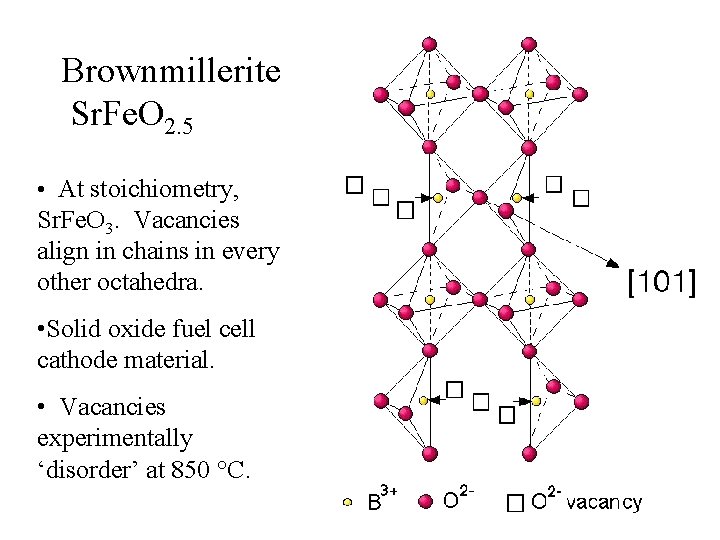
Brownmillerite Sr. Fe. O 2. 5 • At stoichiometry, Sr. Fe. O 3. Vacancies align in chains in every other octahedra. • Solid oxide fuel cell cathode material. • Vacancies experimentally ‘disorder’ at 850 °C.
Goal Model the oxygen vacancy order-disorder and calculate the temperature at which the vacancies disorder in Sr. Fe. O 2. 5.
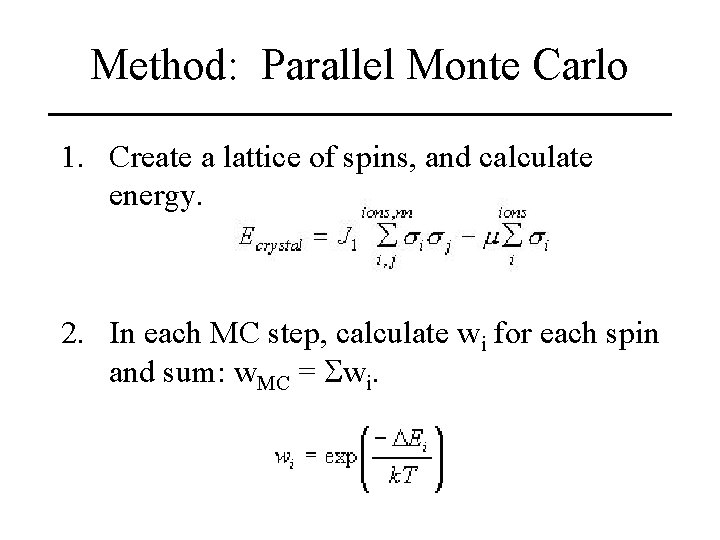
Method: Parallel Monte Carlo 1. Create a lattice of spins, and calculate energy. 2. In each MC step, calculate wi for each spin and sum: w. MC = wi.
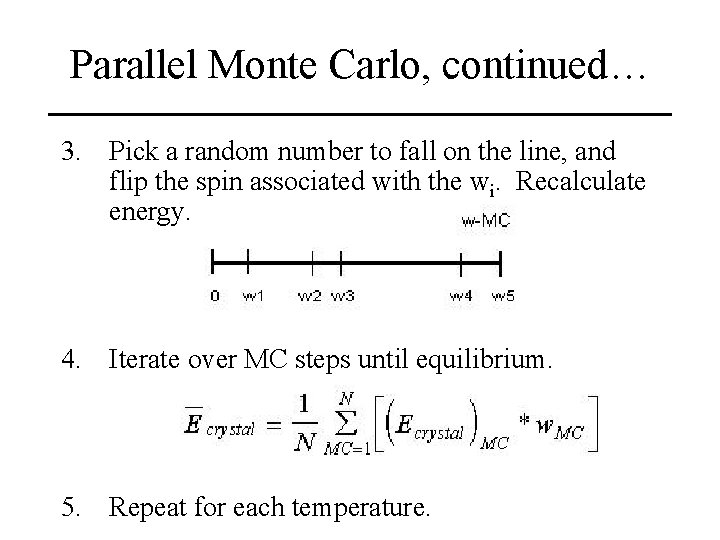
Parallel Monte Carlo, continued… 3. Pick a random number to fall on the line, and flip the spin associated with the wi. Recalculate energy. 4. Iterate over MC steps until equilibrium. 5. Repeat for each temperature.
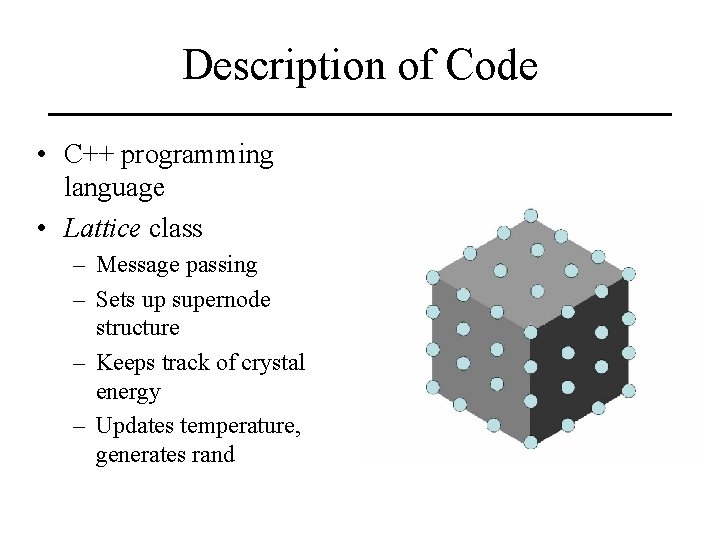
Description of Code • C++ programming language • Lattice class – Message passing – Sets up supernode structure – Keeps track of crystal energy – Updates temperature, generates rand
Description of Code, continued… • Material class – Defines atomic orientation – Calculates energy when flipping spin • Computation time between serial and parallel is about the same. Speed up is due to the structure being entirely in distributed memory instead of writing it to disk.
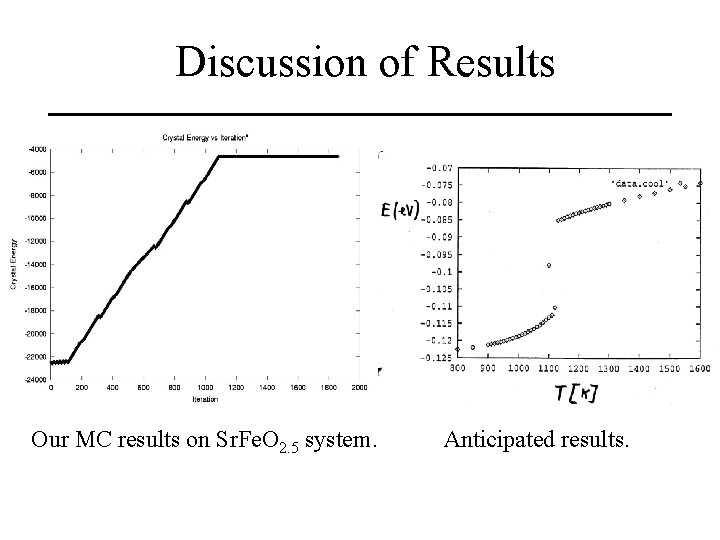
Discussion of Results Our MC results on Sr. Fe. O 2. 5 system. Anticipated results.
Problems and Solutions • Problem: Equilibrium energy does not change when temperature changes. The energy expression for our system is not accurate. • Solution: Add in terms to the energy expression to account for second, third, and fourth nearest neighbors. Determine J 1, J 2, J 3, and J 4 from a cluster expansion of many calculated structures with the same parent structure.