
Simulation of Missiles with Grid Fins using an
- Slides: 31
Simulation of Missiles with Grid Fins using an Unstructured Navier-Stokes solver coupled to a Semi-Experimental DLR Institute of Aerodynamics and Flow Technology 1
Outline · · · Scope of the problem Lattice wing modelling Semi-empirical theory Solver Results for a missile Conclusion DLR Institute of Aerodynamics and Flow Technology 2
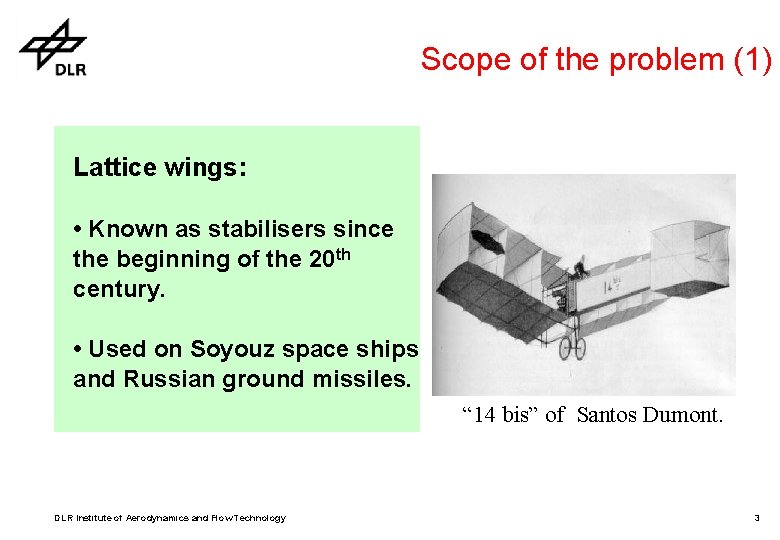
Scope of the problem (1) Lattice wings: • Known as stabilisers since the beginning of the 20 th century. • Used on Soyouz space ships and Russian ground missiles. “ 14 bis” of Santos Dumont. DLR Institute of Aerodynamics and Flow Technology 3
Scope of the problem (2) Lattice wings Attractive for missile applications: · Lifting capabilities; · Small hinge moments; · Excellent supersonic control characteristics. DLR Institute of Aerodynamics and Flow Technology 4
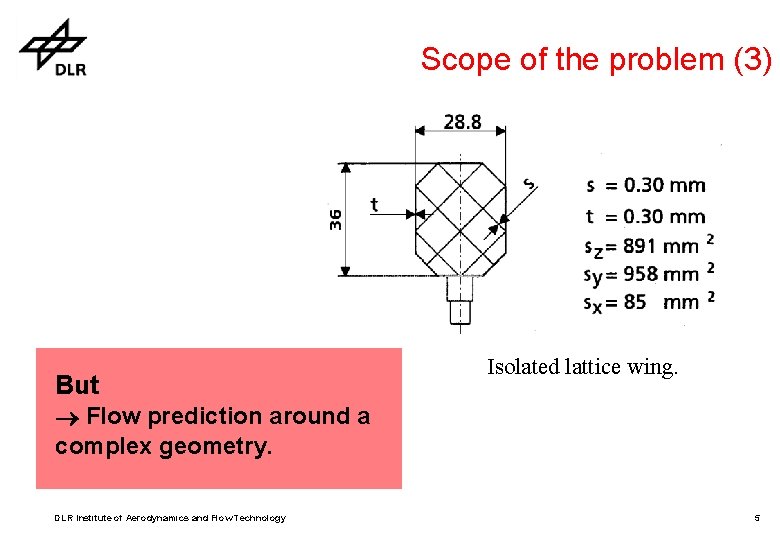
Scope of the problem (3) But Isolated lattice wing. Flow prediction around a complex geometry. DLR Institute of Aerodynamics and Flow Technology 5
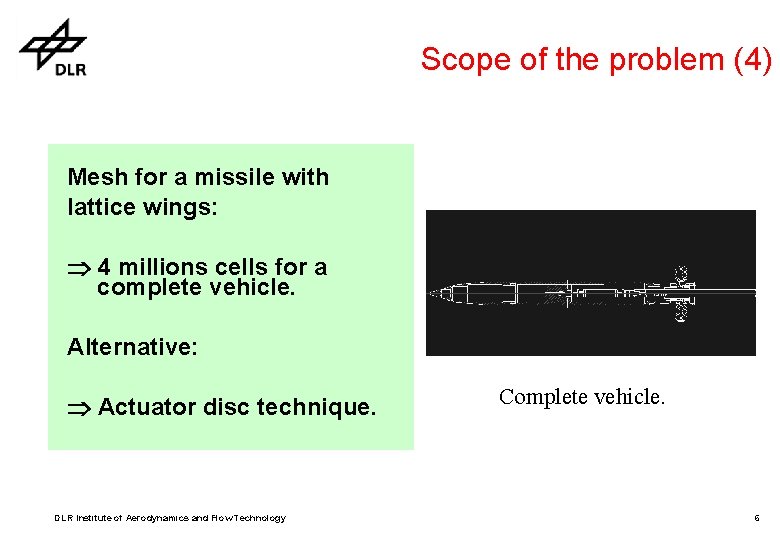
Scope of the problem (4) Mesh for a missile with lattice wings: 4 millions cells for a complete vehicle. Alternative: Actuator disc technique. DLR Institute of Aerodynamics and Flow Technology Complete vehicle. 6
Scope of the problem (5) Objective: • To predict the performances in term of forces and moments for lattice wings, To reduce the computational cost due to the complex geometry of the grid fin. DLR Institute of Aerodynamics and Flow Technology 7
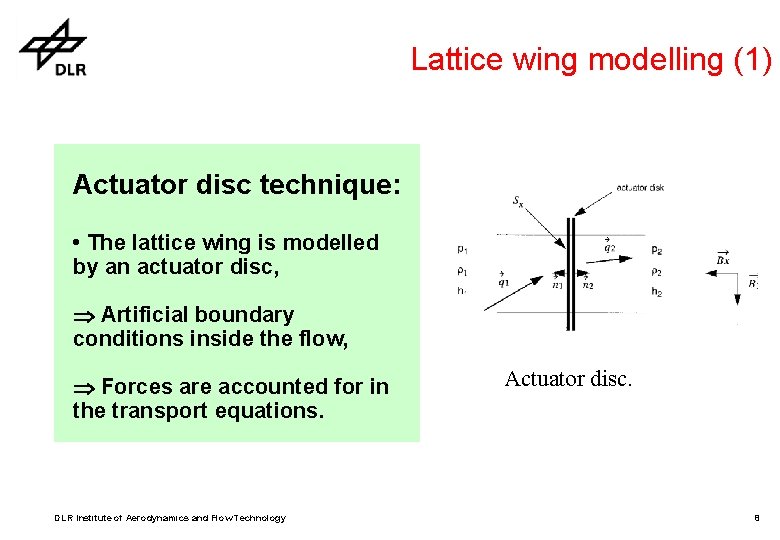
Lattice wing modelling (1) Actuator disc technique: • The lattice wing is modelled by an actuator disc, Artificial boundary conditions inside the flow, Forces are accounted for in the transport equations. DLR Institute of Aerodynamics and Flow Technology Actuator disc. 8
Lattice wing modelling (2) Forces: • In a previous study they were interpolated from an experimental database, Failure when the flow conditions were out of the database range. DLR Institute of Aerodynamics and Flow Technology 9
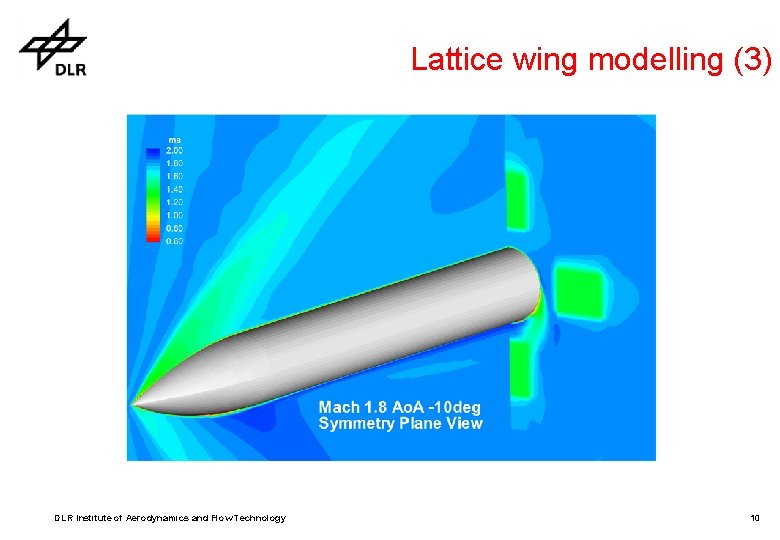
Lattice wing modelling (3) DLR Institute of Aerodynamics and Flow Technology 10
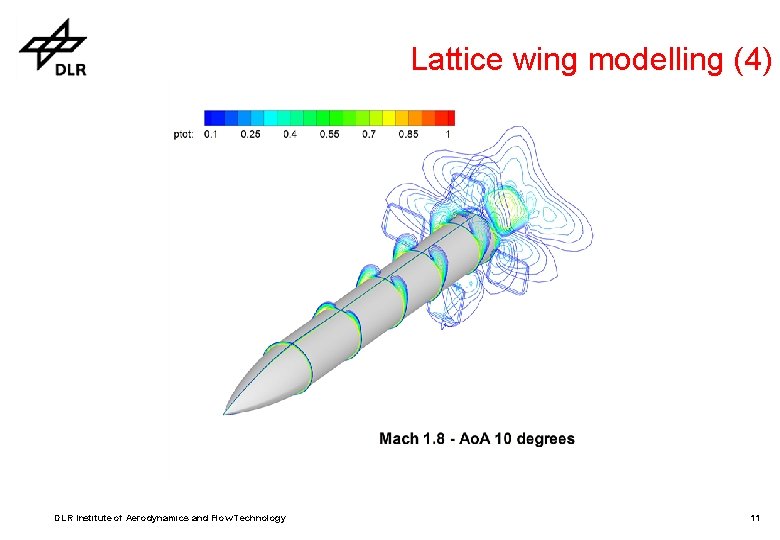
Lattice wing modelling (4) DLR Institute of Aerodynamics and Flow Technology 11
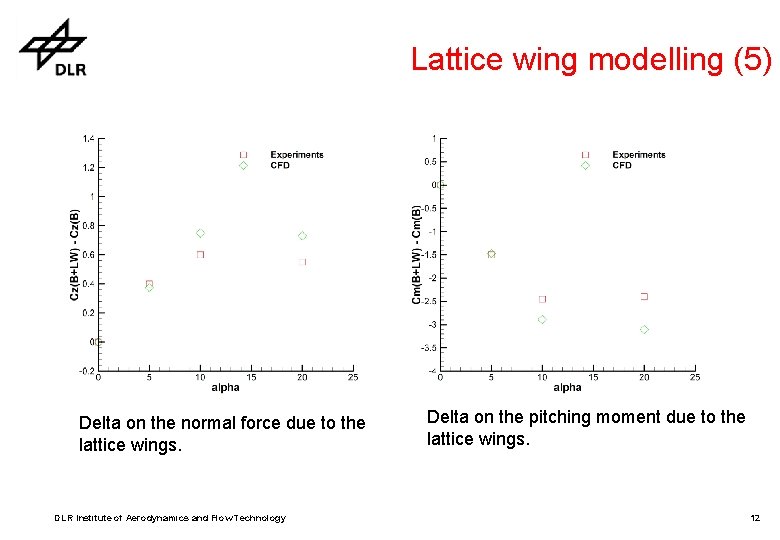
Lattice wing modelling (5) Delta on the normal force due to the lattice wings. DLR Institute of Aerodynamics and Flow Technology Delta on the pitching moment due to the lattice wings. 12
Lattice wing modelling (6) Forces: • Here, the forces are computed using the semiempirical theory for lattice wing, The goal is to extend the tool capacities in terms of Mach number, angle of attack and yawing angle. DLR Institute of Aerodynamics and Flow Technology 13
Semi-empirical theory (1) Methodology: • Development of a semi-empirical method for design and optimisation of isolated grid fins. Main aspects: • Based on the semi-empirical theory for lattice wings. • Used three different models for subsonic, transonic and supersonic flows. • Computation of the forces in function of flow and geometry parameters. DLR Institute of Aerodynamics and Flow Technology 14
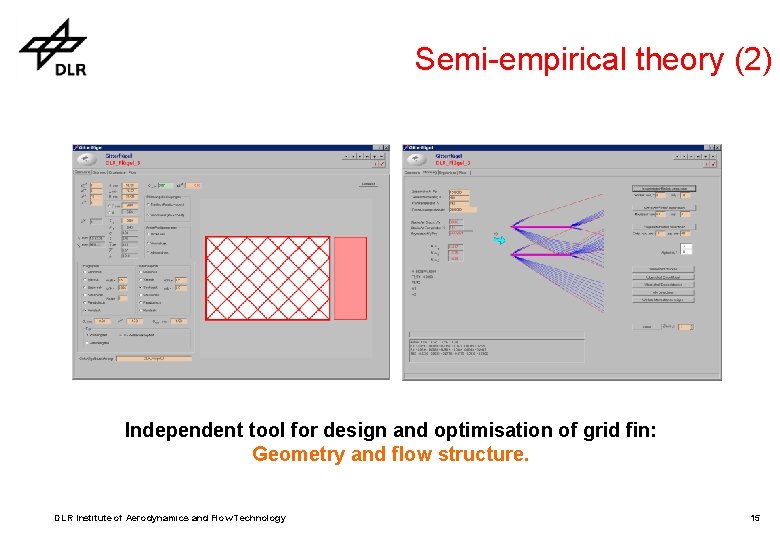
Semi-empirical theory (2) Independent tool for design and optimisation of grid fin: Geometry and flow structure. DLR Institute of Aerodynamics and Flow Technology 15
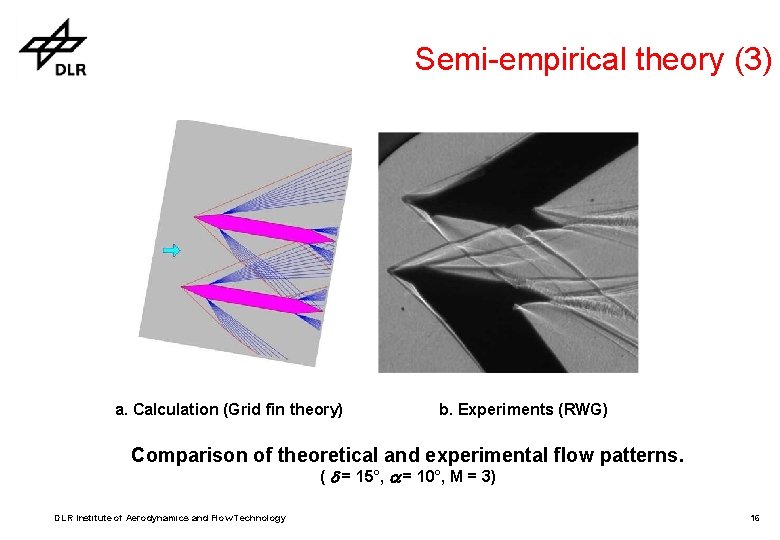
Semi-empirical theory (3) a. Calculation (Grid fin theory) b. Experiments (RWG) Comparison of theoretical and experimental flow patterns. ( d = 15°, a = 10°, M = 3) DLR Institute of Aerodynamics and Flow Technology 16
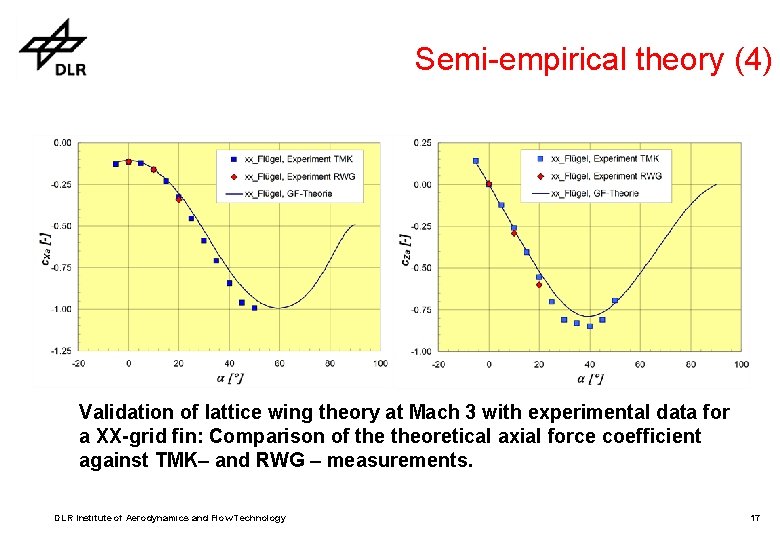
Semi-empirical theory (4) Validation of lattice wing theory at Mach 3 with experimental data for a XX-grid fin: Comparison of theoretical axial force coefficient against TMK– and RWG – measurements. DLR Institute of Aerodynamics and Flow Technology 17
Solver (1) TAU solver: · 3 D finite volume Navier-Stokes solver for structured and unstructured grids. · Accurate to the second order in space. · Computations performed using the AUSM-DV scheme. DLR Institute of Aerodynamics and Flow Technology 18
Solver (2) Coupling with the semi-empirical module: · This module, based on lattice wing theory, computes the force coefficients using semiempirical relations. · Called at each iteration step and each point during the calculation as a function of flow conditions and grid fin geometry (several geometries are available). DLR Institute of Aerodynamics and Flow Technology 19
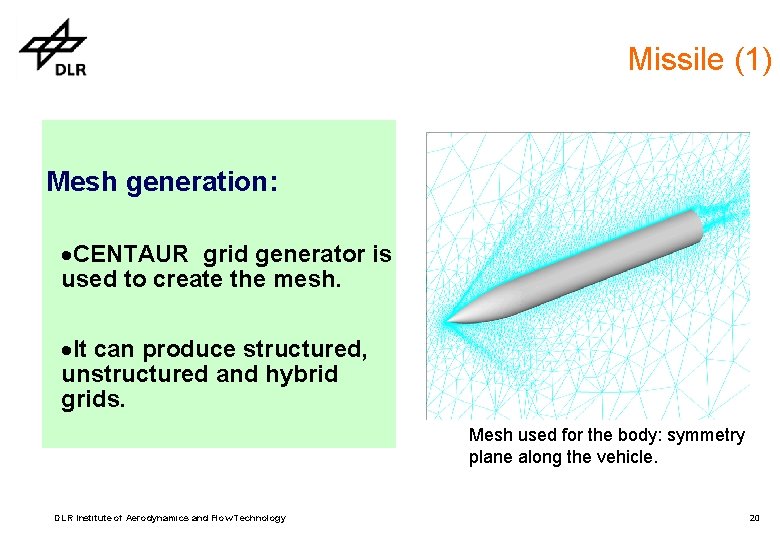
Missile (1) Mesh generation: ·CENTAUR grid generator is used to create the mesh. ·It can produce structured, unstructured and hybrid grids. Mesh used for the body: symmetry plane along the vehicle. DLR Institute of Aerodynamics and Flow Technology 20
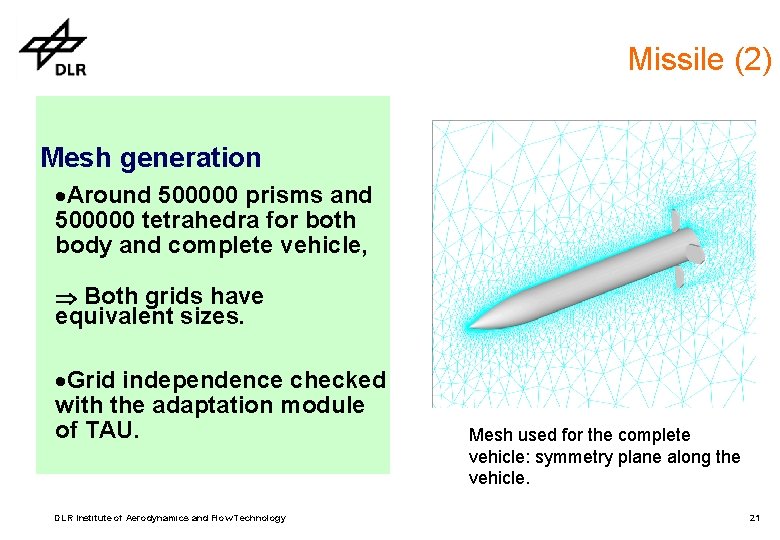
Missile (2) Mesh generation ·Around 500000 prisms and 500000 tetrahedra for both body and complete vehicle, Both grids have equivalent sizes. ·Grid independence checked with the adaptation module of TAU. DLR Institute of Aerodynamics and Flow Technology Mesh used for the complete vehicle: symmetry plane along the vehicle. 21
Missile (3) Computations ·Both body alone and complete vehicle with grid fins have been computed, The body alone will be used as reference. ·Computed cases: - Mach 1. 8 to 4 (Reynolds from 1. 8 106 to 3. 3 106). - From 0 to 20 degrees angle of attack. DLR Institute of Aerodynamics and Flow Technology 22
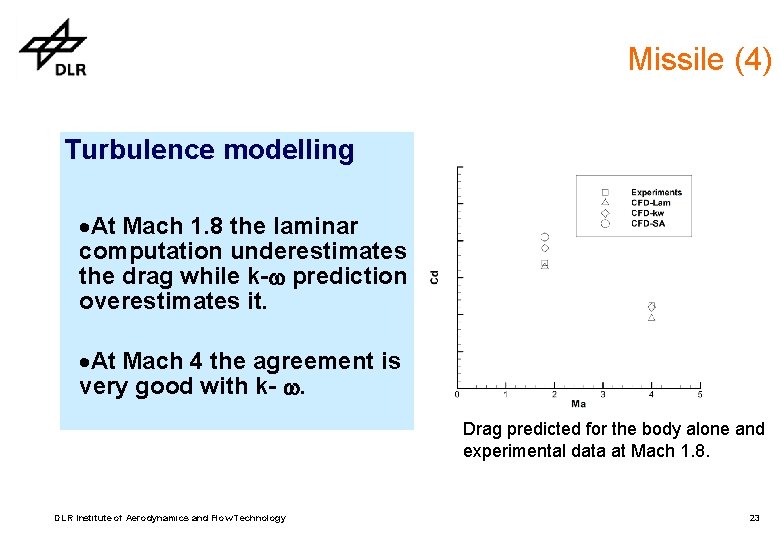
Missile (4) Turbulence modelling ·At Mach 1. 8 the laminar computation underestimates the drag while k-w prediction overestimates it. ·At Mach 4 the agreement is very good with k- w. Drag predicted for the body alone and experimental data at Mach 1. 8. DLR Institute of Aerodynamics and Flow Technology 23
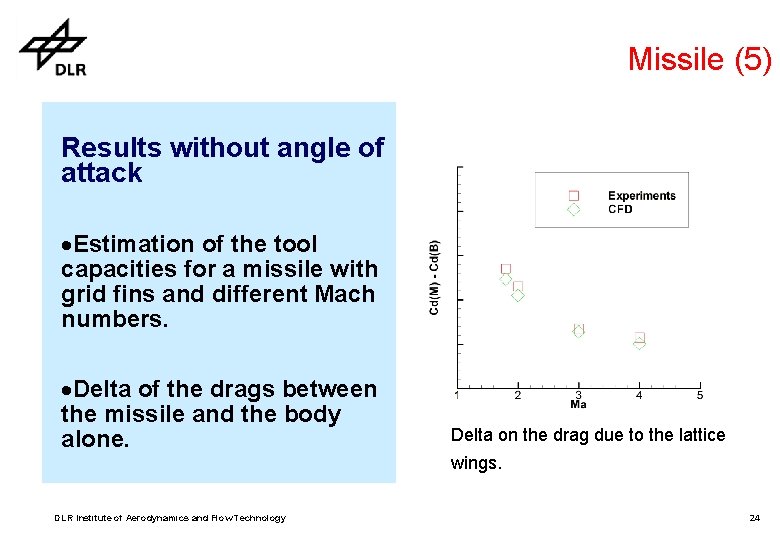
Missile (5) Results without angle of attack ·Estimation of the tool capacities for a missile with grid fins and different Mach numbers. ·Delta of the drags between the missile and the body alone. Delta on the drag due to the lattice wings. DLR Institute of Aerodynamics and Flow Technology 24
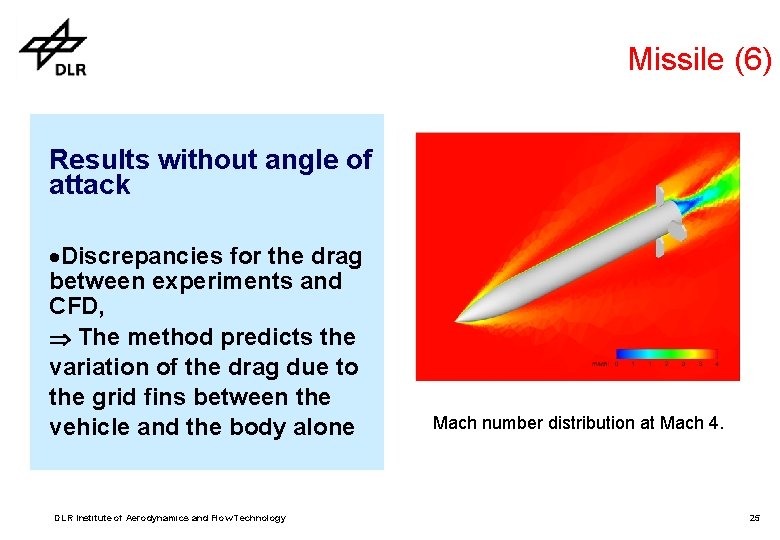
Missile (6) Results without angle of attack ·Discrepancies for the drag between experiments and CFD, The method predicts the variation of the drag due to the grid fins between the vehicle and the body alone DLR Institute of Aerodynamics and Flow Technology Mach number distribution at Mach 4. 25
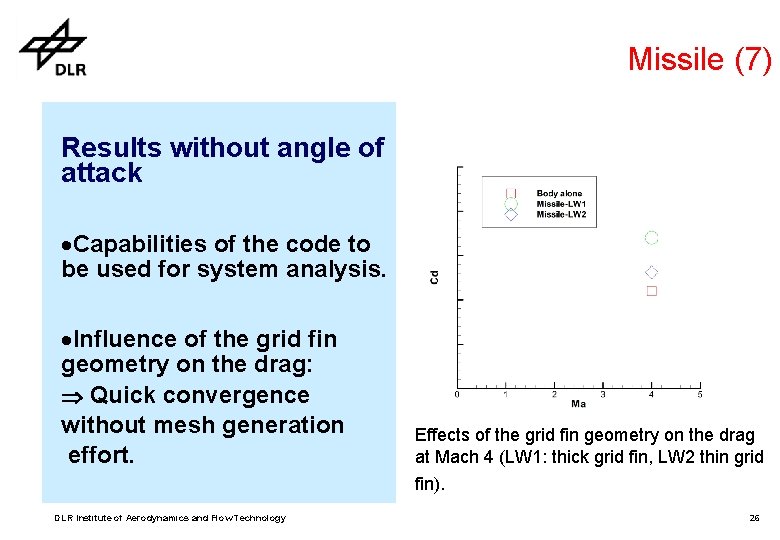
Missile (7) Results without angle of attack ·Capabilities of the code to be used for system analysis. ·Influence of the grid fin geometry on the drag: Quick convergence without mesh generation effort. Effects of the grid fin geometry on the drag at Mach 4 (LW 1: thick grid fin, LW 2 thin grid fin). DLR Institute of Aerodynamics and Flow Technology 26
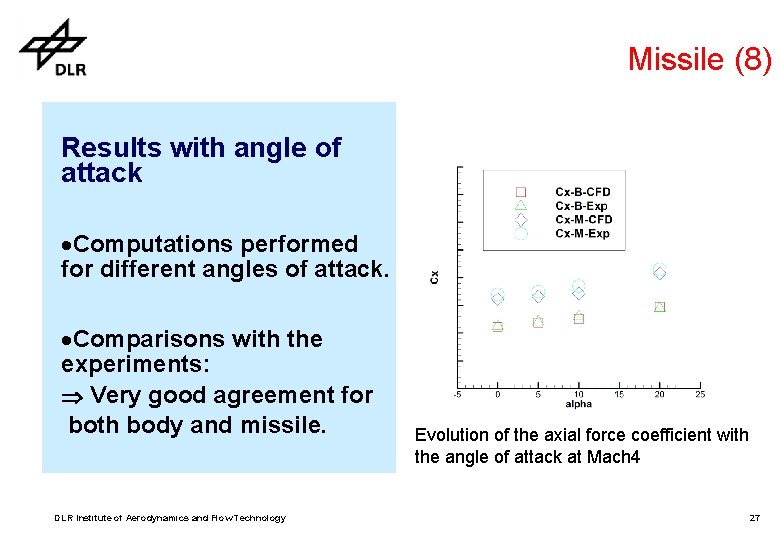
Missile (8) Results with angle of attack ·Computations performed for different angles of attack. ·Comparisons with the experiments: Very good agreement for both body and missile. DLR Institute of Aerodynamics and Flow Technology Evolution of the axial force coefficient with the angle of attack at Mach 4 27
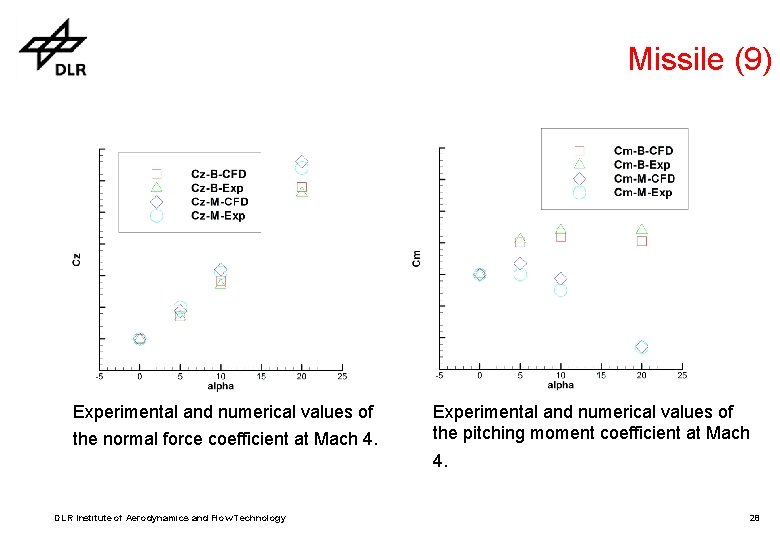
Missile (9) Experimental and numerical values of the normal force coefficient at Mach 4. Experimental and numerical values of the pitching moment coefficient at Mach 4. DLR Institute of Aerodynamics and Flow Technology 28
Missile (10) Comments ·Good agreement with the experiments with and without angle of attack with a discrepancy smaller than 10 %. ·Savings in computational cost and mesh generation effort: a factor of 6 for the first geometry. A second geometry can be investigated for a very low additional cost. DLR Institute of Aerodynamics and Flow Technology 29
Conclusions (1) ·The coupling with the semi-empirical theory avoids the dependency on the validity range of an experimental database. ·The code is able to predict the trends of the force and moment coefficient evolution with the Mach number and the angle of attack. Comparisons with the experiments indicate that the discrepancies do not exceed 10 %. DLR Institute of Aerodynamics and Flow Technology 30
Conclusions (2) ·Using the actuator disc technique the problem of the high computational cost due to the presence of the grid fins can be avoided. ·For a low additional cost another geometry can be investigated, Usefulness of the tool which can be used for design and system analysis DLR Institute of Aerodynamics and Flow Technology 31