
Simulation of Microchannel Flows by Lattice Boltzmann Method

Simulation of Micro-channel Flows by Lattice Boltzmann Method LIM Chee Yen, and C. Shu National University of Singapore 1
Introduction • 1. Lattice Boltzmann Method • 2. Micro flow Simulation • 3. Results and Discussions • 4. Conclusions 2
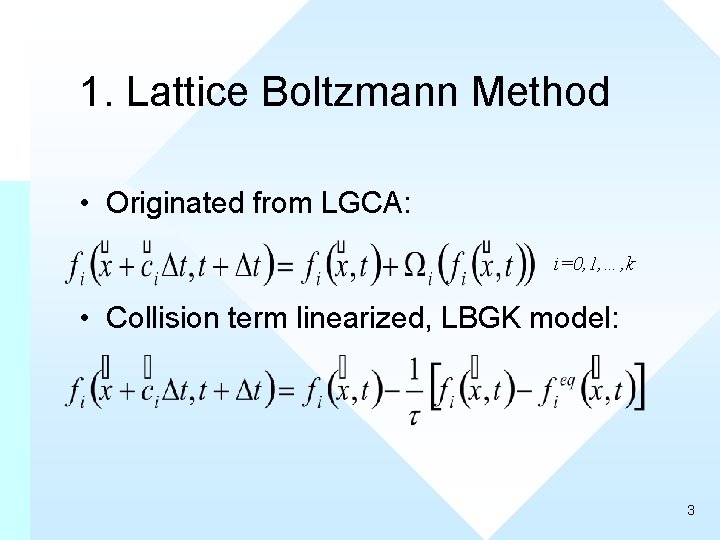
1. Lattice Boltzmann Method • Originated from LGCA: i=0, 1, …, k • Collision term linearized, LBGK model: 3
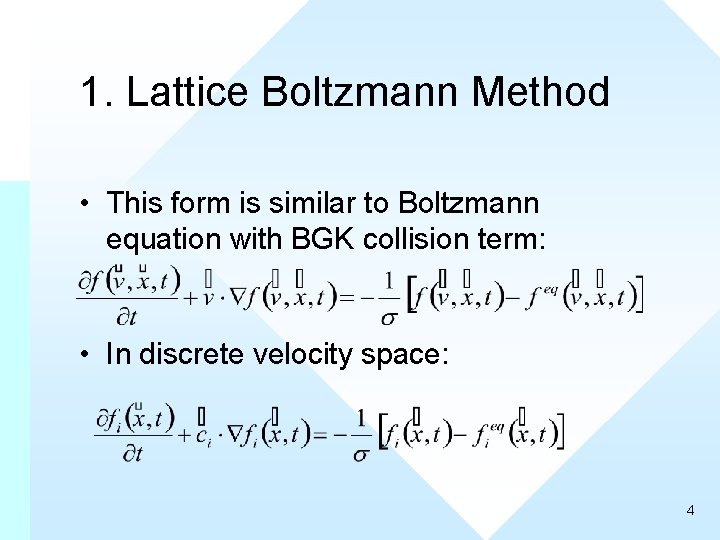
1. Lattice Boltzmann Method • This form is similar to Boltzmann equation with BGK collision term: • In discrete velocity space: 4

1. Lattice Boltzmann Method • Applying upwind scheme together with Lattice velocity , we have • This is exactly standard LBM form is we set. 5
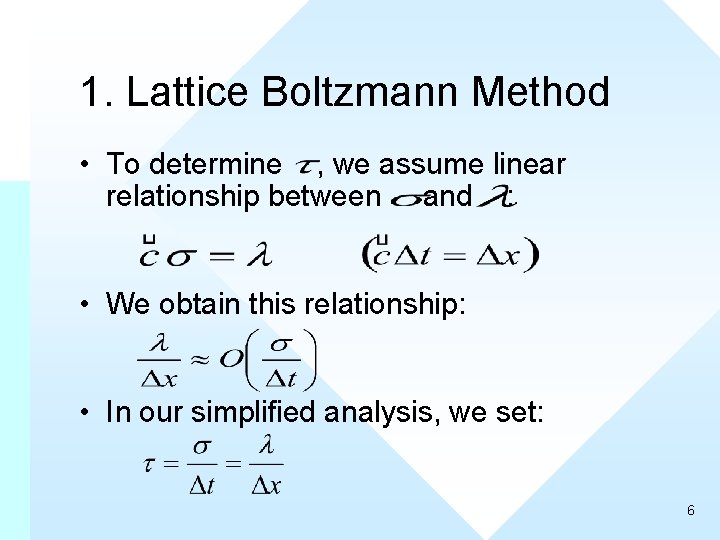
1. Lattice Boltzmann Method • To determine , we assume linear relationship between and : • We obtain this relationship: • In our simplified analysis, we set: 6
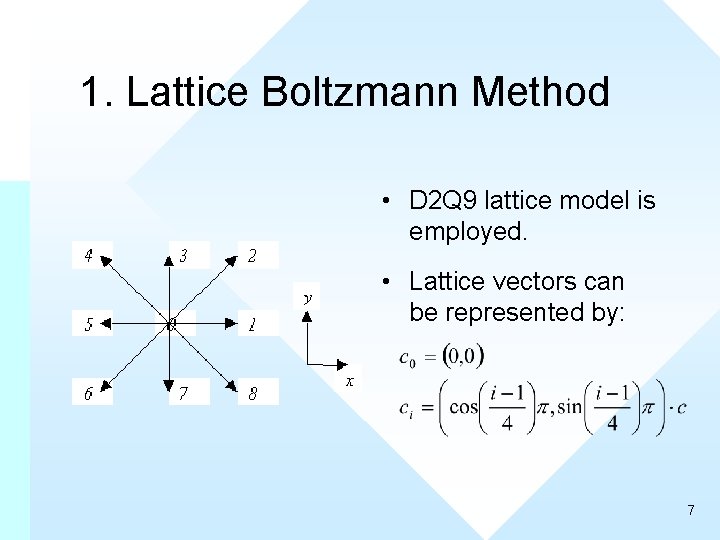
1. Lattice Boltzmann Method • D 2 Q 9 lattice model is employed. • Lattice vectors can be represented by: 7
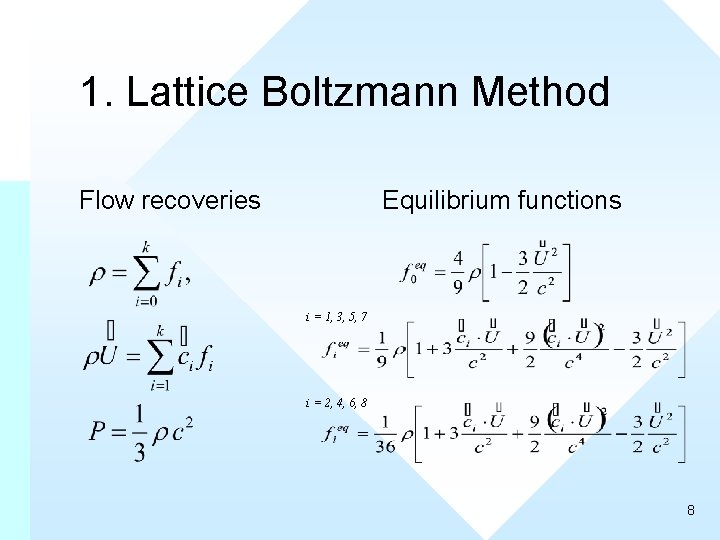
1. Lattice Boltzmann Method Flow recoveries Equilibrium functions i = 1, 3, 5, 7 i = 2, 4, 6, 8 8
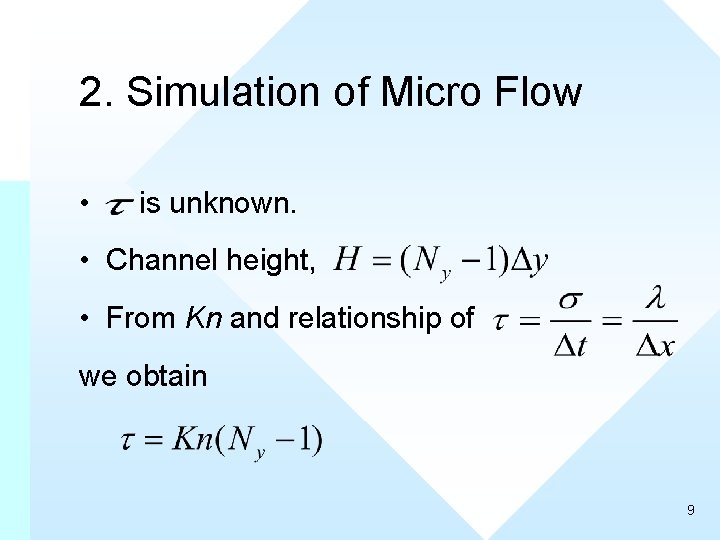
2. Simulation of Micro Flow • is unknown. • Channel height, • From Kn and relationship of we obtain 9
2. 1. Boundary Conditions • Equilibrium functions at openings • Specular bounce back at solid walls. 10
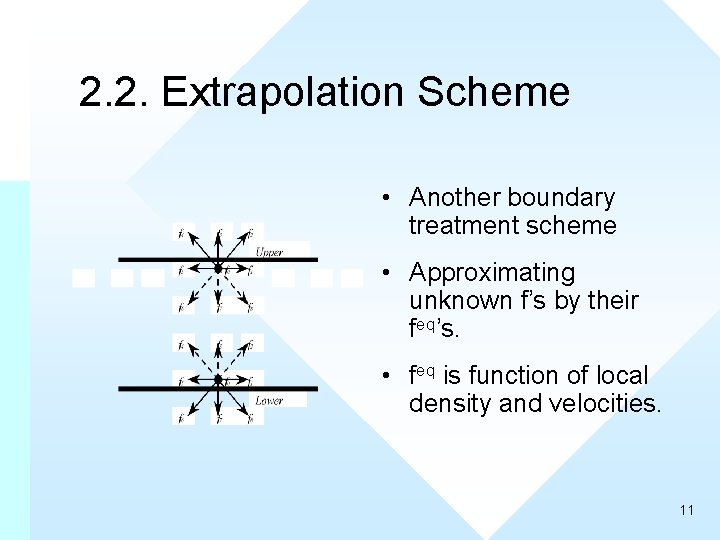
2. 2. Extrapolation Scheme • Another boundary treatment scheme • Approximating unknown f’s by their feq’s. • feq is function of local density and velocities. 11
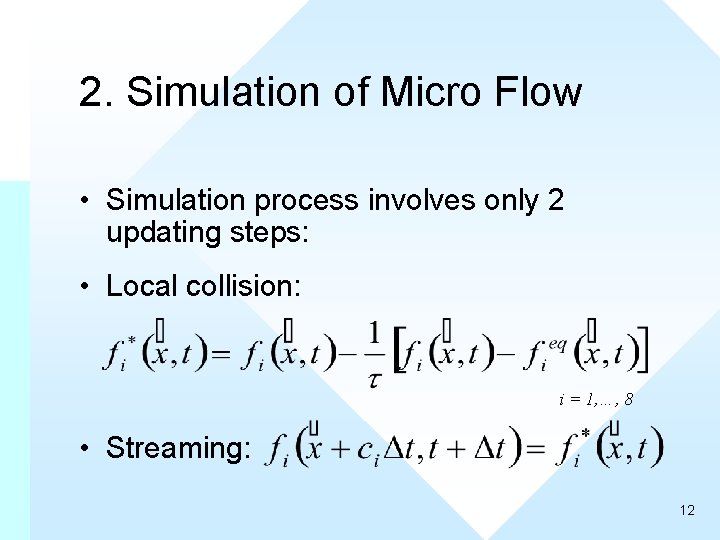
2. Simulation of Micro Flow • Simulation process involves only 2 updating steps: • Local collision: i = 1, …, 8 • Streaming: 12

3. Results and Discussions • Qualitative analyses: General profiles of flow properties. • Quantitative analyses – pressure and velocity distributions. • Normalising, P* = P / Pout, P*’ = P* P*linear , u* = u / umax 13
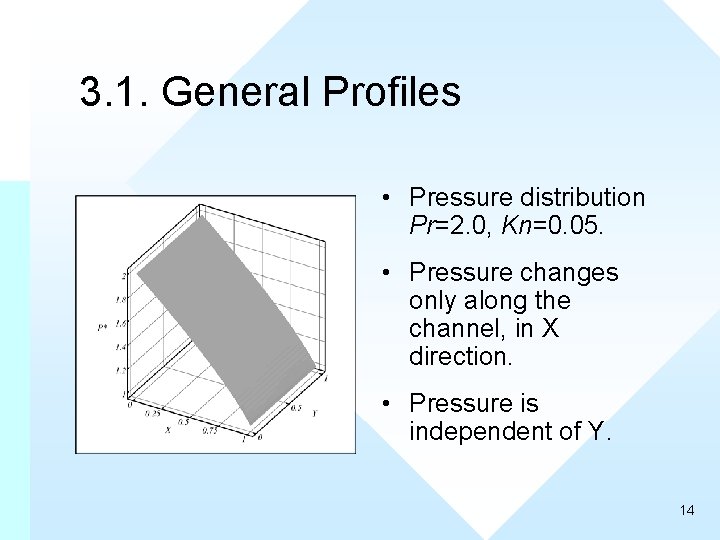
3. 1. General Profiles • Pressure distribution Pr=2. 0, Kn=0. 05. • Pressure changes only along the channel, in X direction. • Pressure is independent of Y. 14
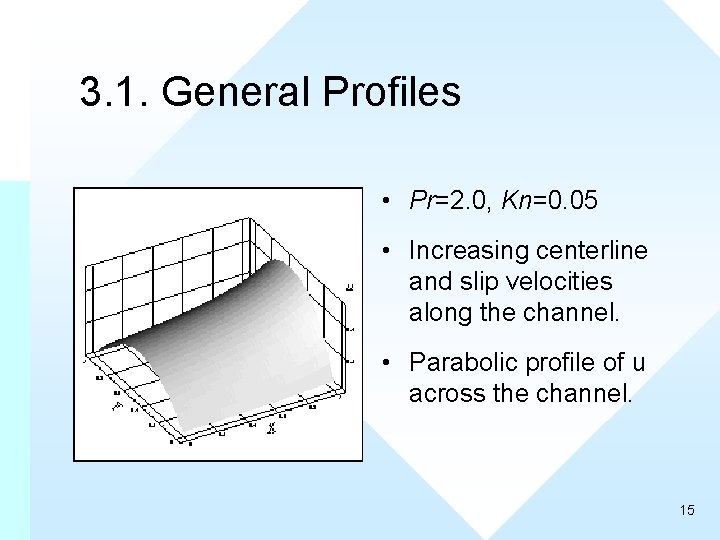
3. 1. General Profiles • Pr=2. 0, Kn=0. 05 • Increasing centerline and slip velocities along the channel. • Parabolic profile of u across the channel. 15
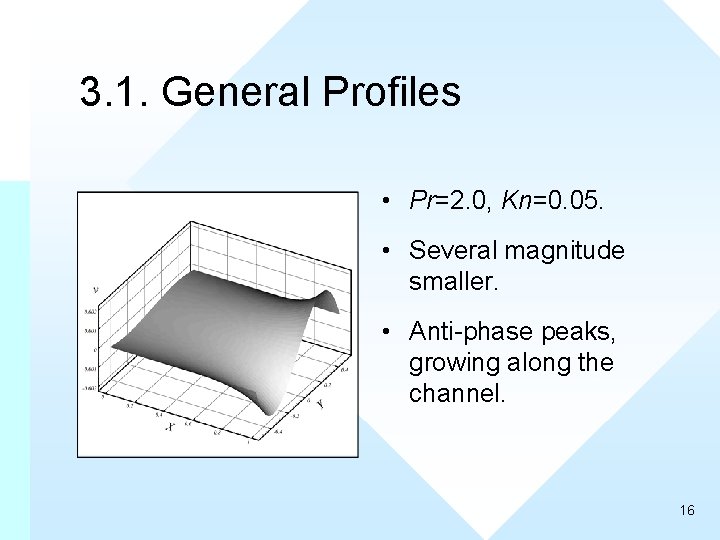
3. 1. General Profiles • Pr=2. 0, Kn=0. 05. • Several magnitude smaller. • Anti-phase peaks, growing along the channel. 16
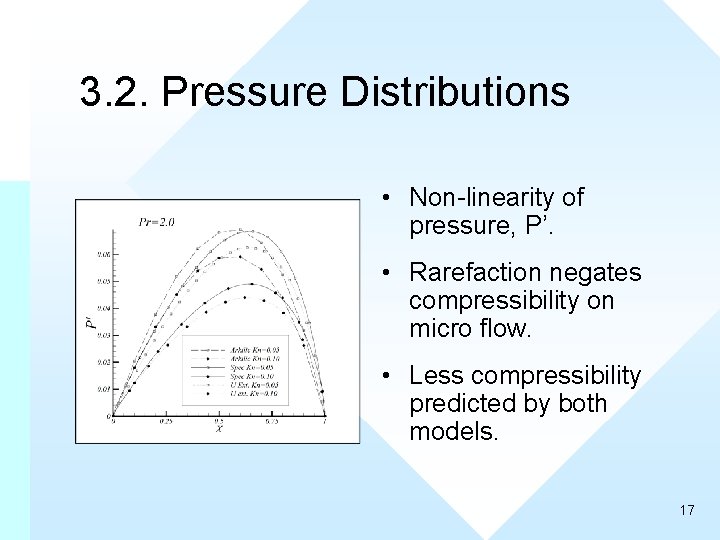
3. 2. Pressure Distributions • Non-linearity of pressure, P’. • Rarefaction negates compressibility on micro flow. • Less compressibility predicted by both models. 17
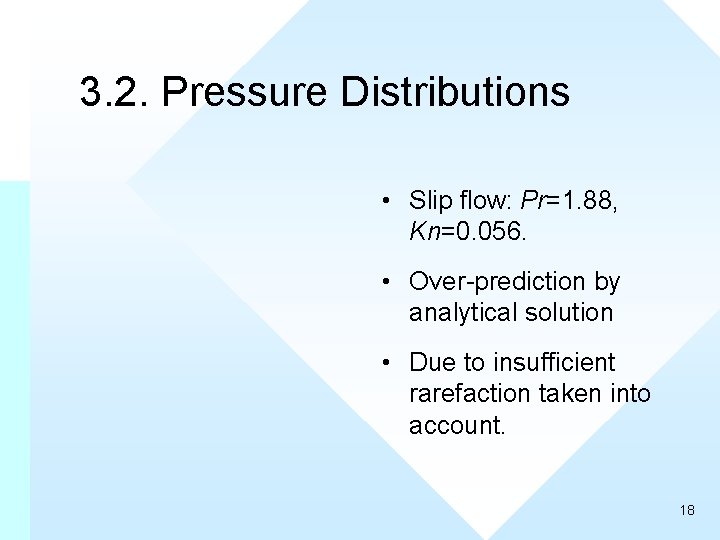
3. 2. Pressure Distributions • Slip flow: Pr=1. 88, Kn=0. 056. • Over-prediction by analytical solution • Due to insufficient rarefaction taken into account. 18
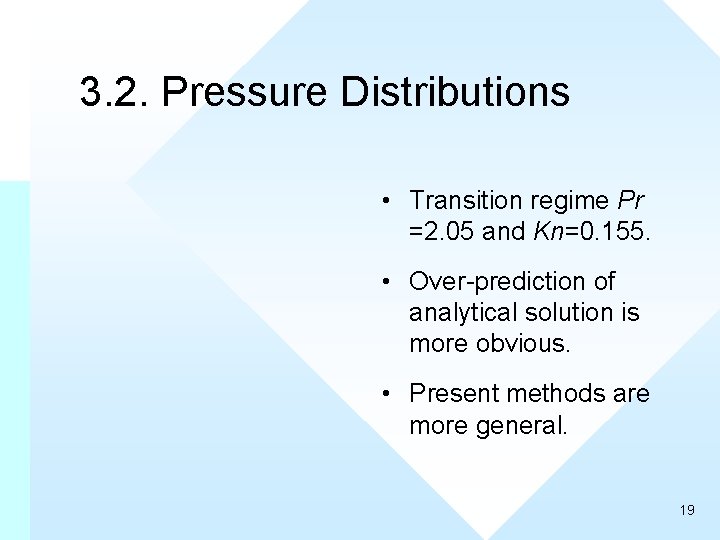
3. 2. Pressure Distributions • Transition regime Pr =2. 05 and Kn=0. 155. • Over-prediction of analytical solution is more obvious. • Present methods are more general. 19
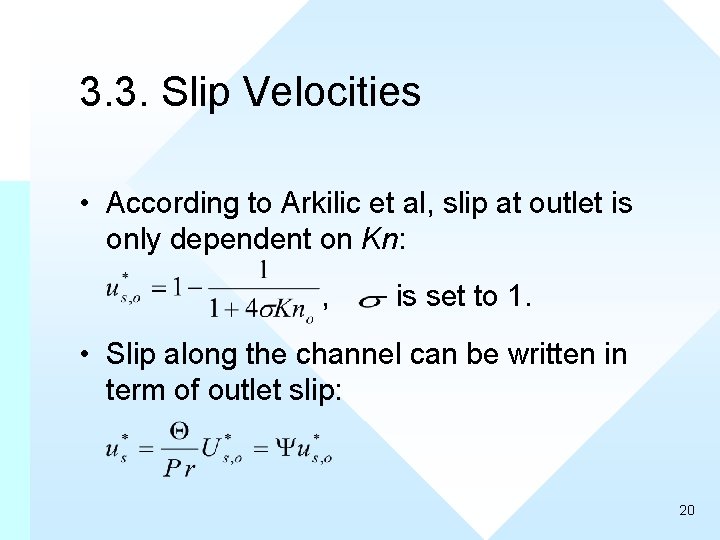
3. 3. Slip Velocities • According to Arkilic et al, slip at outlet is only dependent on Kn: , is set to 1. • Slip along the channel can be written in term of outlet slip: 20
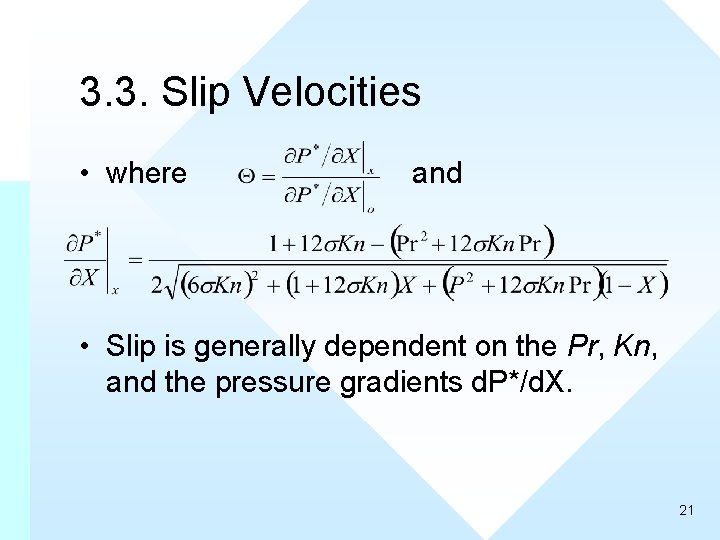
3. 3. Slip Velocities • where and • Slip is generally dependent on the Pr, Kn, and the pressure gradients d. P*/d. X. 21
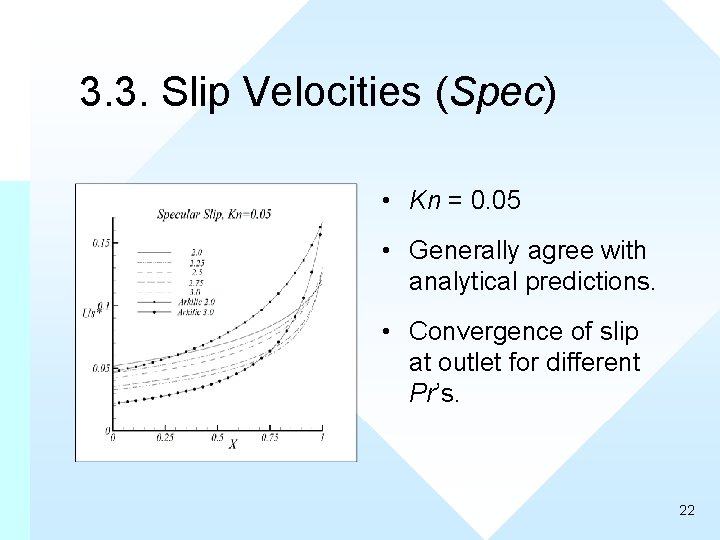
3. 3. Slip Velocities (Spec) • Kn = 0. 05 • Generally agree with analytical predictions. • Convergence of slip at outlet for different Pr’s. 22
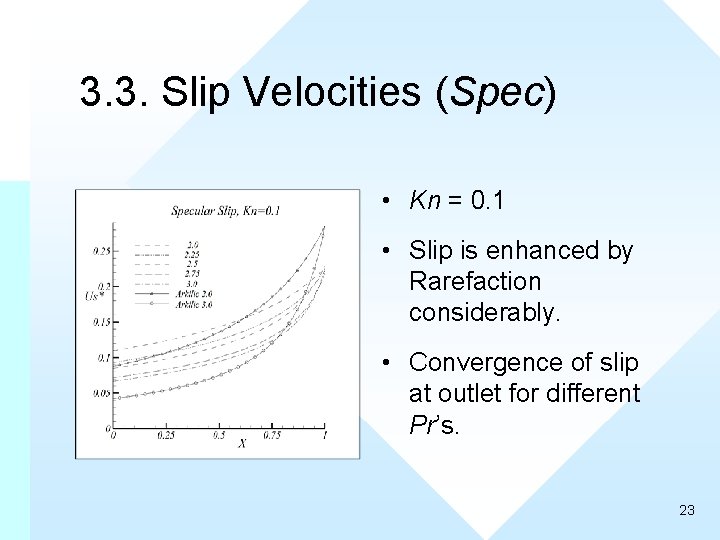
3. 3. Slip Velocities (Spec) • Kn = 0. 1 • Slip is enhanced by Rarefaction considerably. • Convergence of slip at outlet for different Pr’s. 23
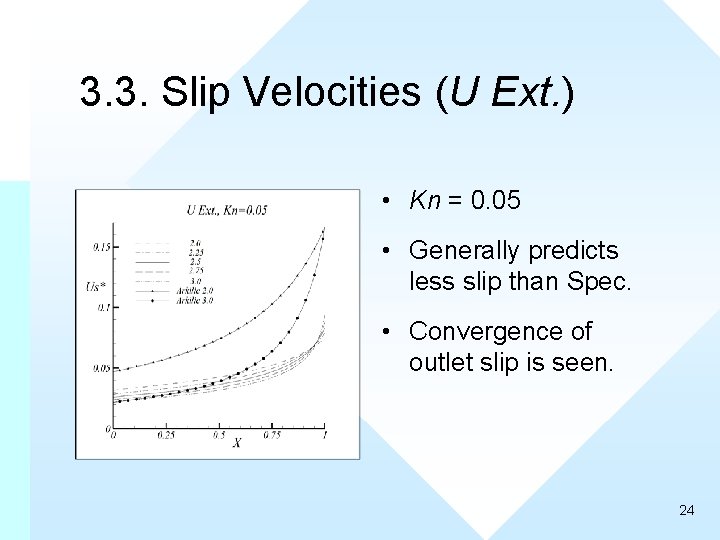
3. 3. Slip Velocities (U Ext. ) • Kn = 0. 05 • Generally predicts less slip than Spec. • Convergence of outlet slip is seen. 24
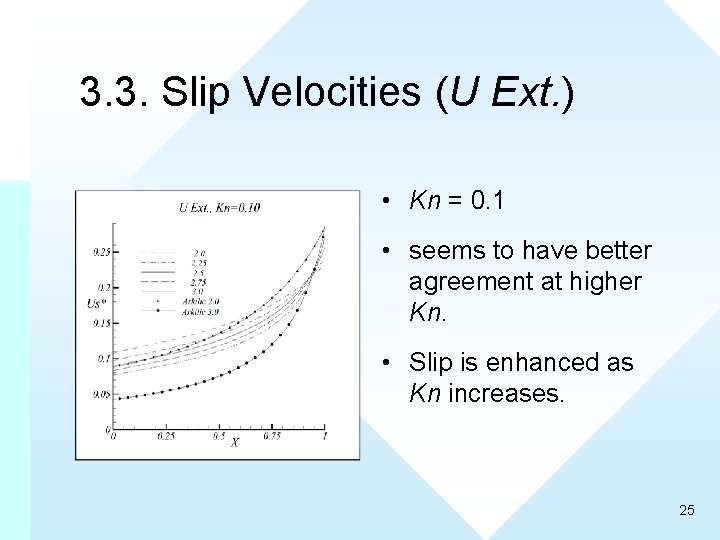
3. 3. Slip Velocities (U Ext. ) • Kn = 0. 1 • seems to have better agreement at higher Kn. • Slip is enhanced as Kn increases. 25
4. Closure • Discuss the origin of LBM and its derivation from Boltzmann equation. • Present an efficient LBM scheme for simulation of micro flows. • Verify our numerical results by comparisons to experimental and analytical work. 26
4. Closure Pressure distribution Slip velocities • Negation of compressibility by rarefaction. • Slip is function of u*s, o, Pr, and d. P*/d. X. • Insufficient consideration of rarefaction in N-S analytical solution. • Convergence of outlet slip for different Pr’s. • Kn enhances slip. 27
- Slides: 27