
Simulation of Dam Breaking Phenomena in Accordance with
Simulation of Dam Breaking Phenomena in Accordance with Dimensional Analysis by Dual. SPHysics Research Directors: Presented by: Mohammad Meiabadi Professor Vincent Demers Professor Louis Dufresne Montréal, June 30 2020 4 th follow up meeting
Outline • Dimensional Analysis and Similitude • Similarity and Scaling Laws • Simulation of Dam-Breaking by Dual. SPHysics • Validation by Experimental Results 2
Dimensional Analysis Solutions of some real flow problems depend heavily on experimental data. • To save time and money, tests are performed on a geometrically scaled model, not on the full-scale prototype. • Experimentation on model must be properly scaled so that results are meaningful for the full-scale prototype. • Thus, a technique called dimensional analysis is needed. 3
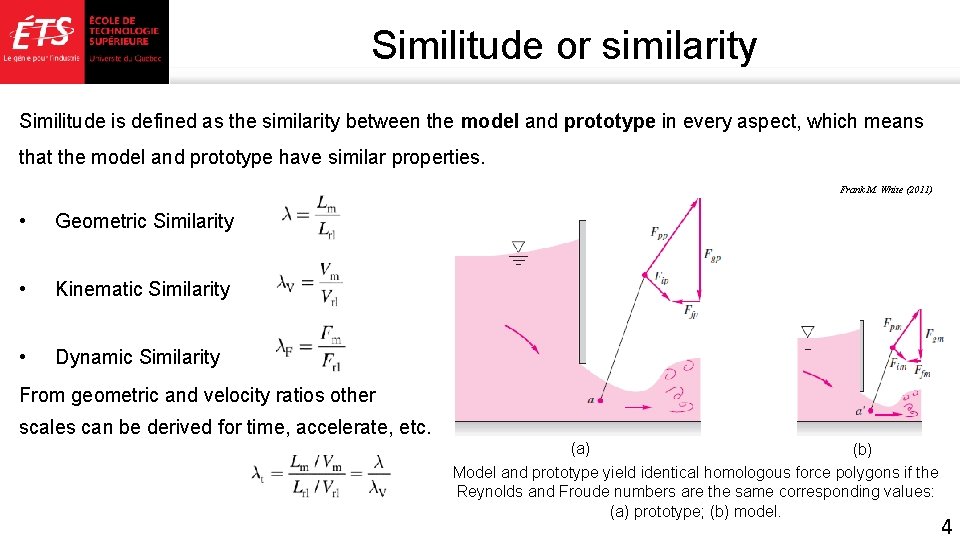
Similitude or similarity Similitude is defined as the similarity between the model and prototype in every aspect, which means that the model and prototype have similar properties. Frank M. White (2011) • Geometric Similarity • Kinematic Similarity • Dynamic Similarity From geometric and velocity ratios other scales can be derived for time, accelerate, etc. (a) (b) Model and prototype yield identical homologous force polygons if the Reynolds and Froude numbers are the same corresponding values: (a) prototype; (b) model. 4
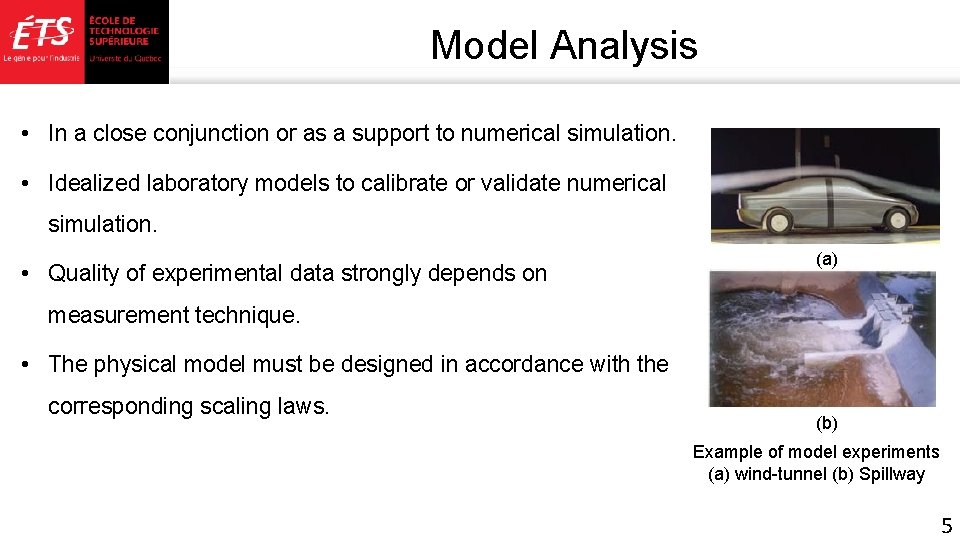
Model Analysis • In a close conjunction or as a support to numerical simulation. • Idealized laboratory models to calibrate or validate numerical simulation. • Quality of experimental data strongly depends on (a) measurement technique. • The physical model must be designed in accordance with the corresponding scaling laws. (b) Example of model experiments (a) wind-tunnel (b) Spillway 5
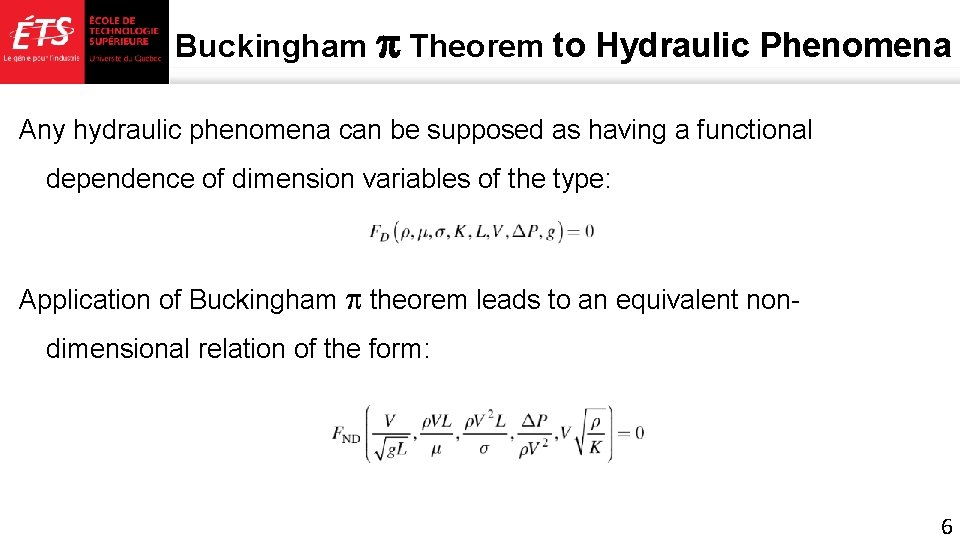
Buckingham Theorem to Hydraulic Phenomena Any hydraulic phenomena can be supposed as having a functional dependence of dimension variables of the type: Application of Buckingham theorem leads to an equivalent nondimensional relation of the form: 6
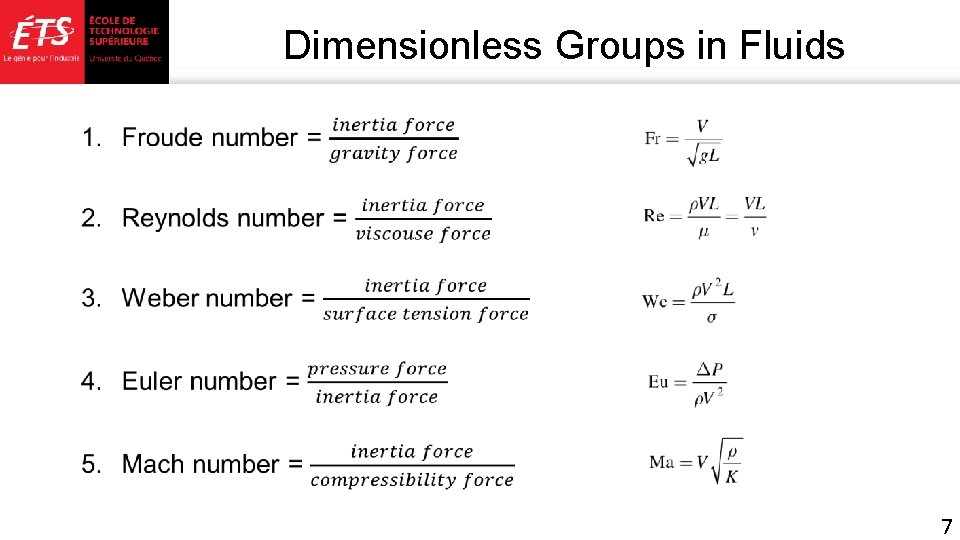
Dimensionless Groups in Fluids 7
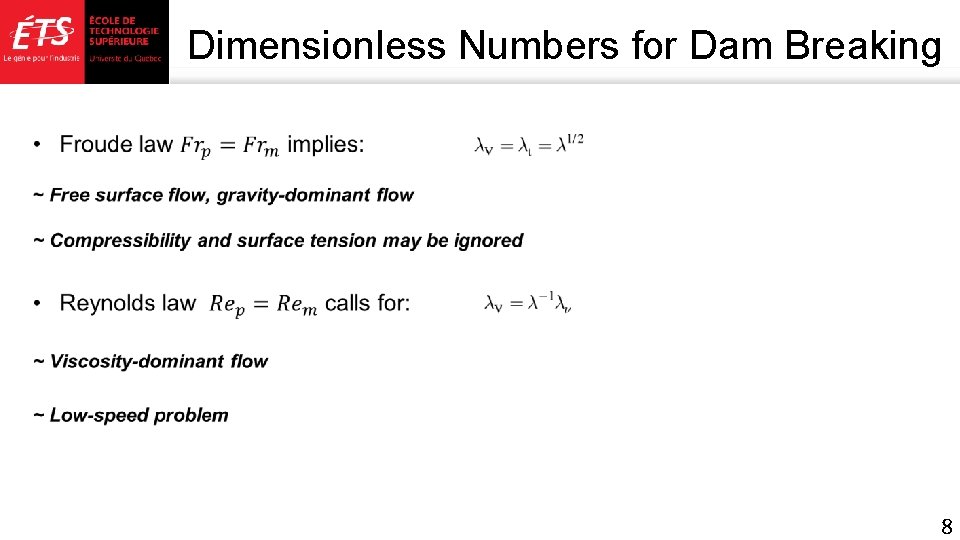
Dimensionless Numbers for Dam Breaking 8
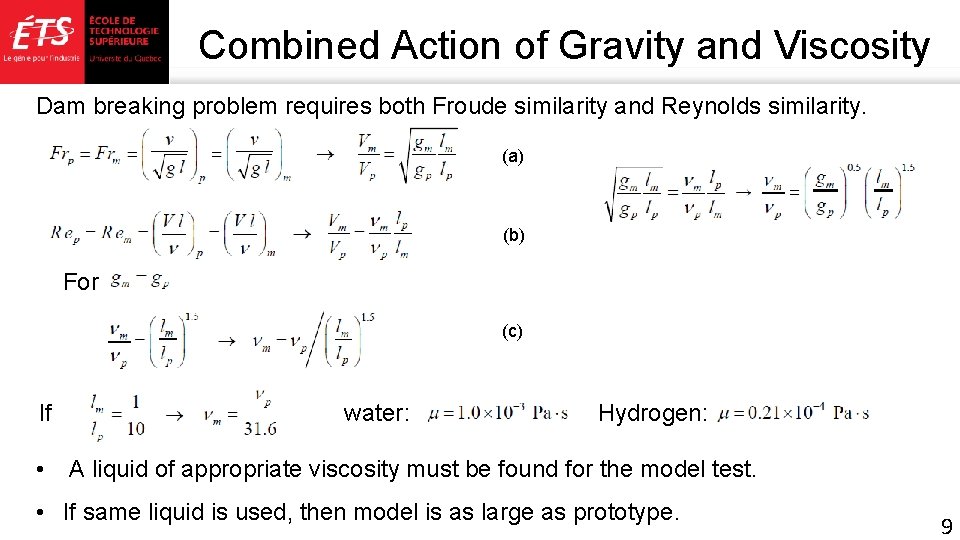
Combined Action of Gravity and Viscosity Dam breaking problem requires both Froude similarity and Reynolds similarity. (a) (b) For (c) If • water: Hydrogen: A liquid of appropriate viscosity must be found for the model test. • If same liquid is used, then model is as large as prototype. 9
Dam-Breaking Numerical Model • A liquid of appropriate viscosity cannot be found for the dam breaking test. • It is not usually possible to have a model as large as prototype. • It is impossible to keep Froude and Reynolds numbers in the model equal to those in prototype. • A choice between the Froude and Reynolds numbers should be made in experimental model. Physical model can be replaced by NUMERICAL MODEL in order to satisfy both Froude law and Reynolds laws in the tests. 10
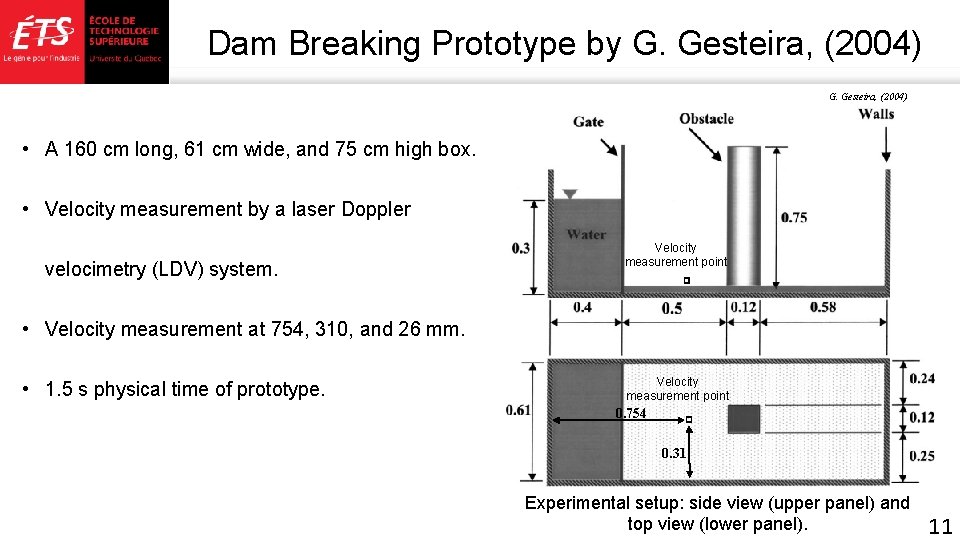
Dam Breaking Prototype by G. Gesteira, (2004) • A 160 cm long, 61 cm wide, and 75 cm high box. • Velocity measurement by a laser Doppler velocimetry (LDV) system. Velocity measurement point • Velocity measurement at 754, 310, and 26 mm. • 1. 5 s physical time of prototype. Velocity measurement point 0. 754 0. 31 Experimental setup: side view (upper panel) and top view (lower panel). 11
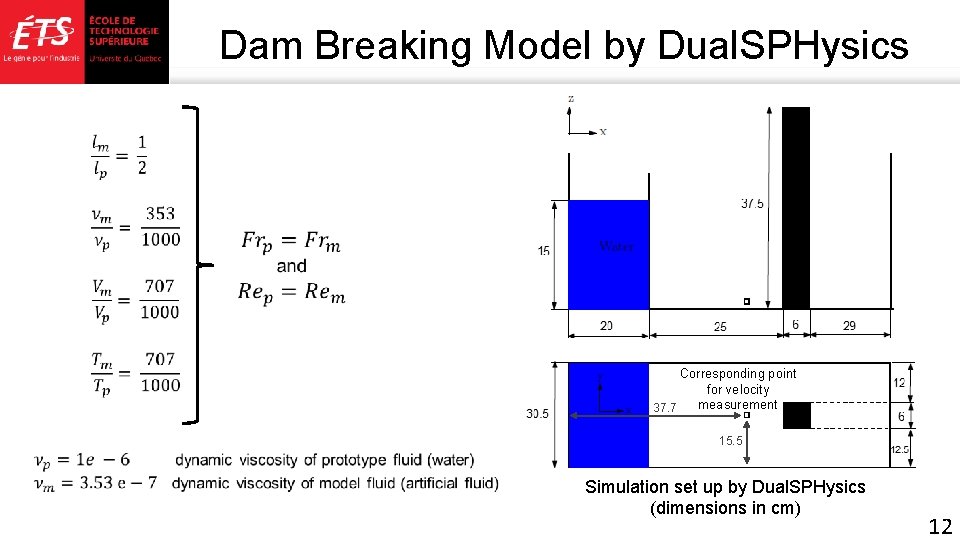
Dam Breaking Model by Dual. SPHysics Corresponding point for velocity measurement 37. 7 15. 5 Simulation set up by Dual. SPHysics (dimensions in cm) 12
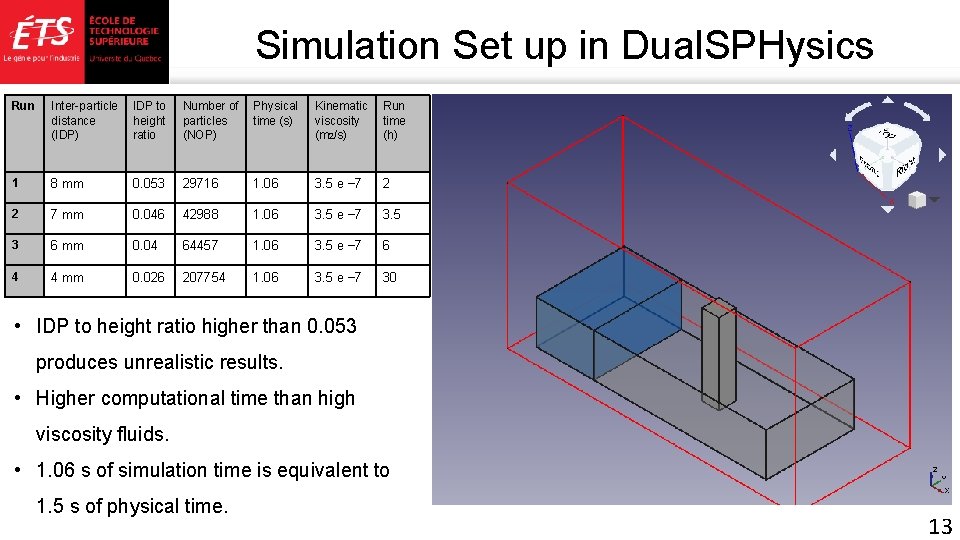
Simulation Set up in Dual. SPHysics Run Inter-particle distance (IDP) IDP to height ratio Number of particles (NOP) Physical time (s) Kinematic viscosity (m 2/s) Run time (h) 1 8 mm 0. 053 29716 1. 06 3. 5 e − 7 2 2 7 mm 0. 046 42988 1. 06 3. 5 e − 7 3. 5 3 6 mm 0. 04 64457 1. 06 3. 5 e − 7 6 4 4 mm 0. 026 207754 1. 06 3. 5 e − 7 30 • IDP to height ratio higher than 0. 053 produces unrealistic results. • Higher computational time than high viscosity fluids. • 1. 06 s of simulation time is equivalent to 1. 5 s of physical time. 13
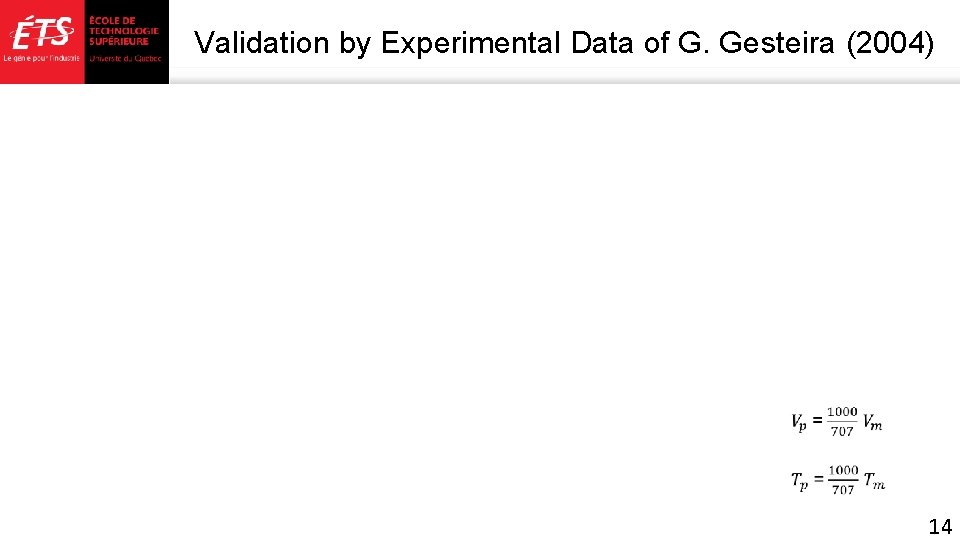
Validation by Experimental Data of G. Gesteira (2004) 14
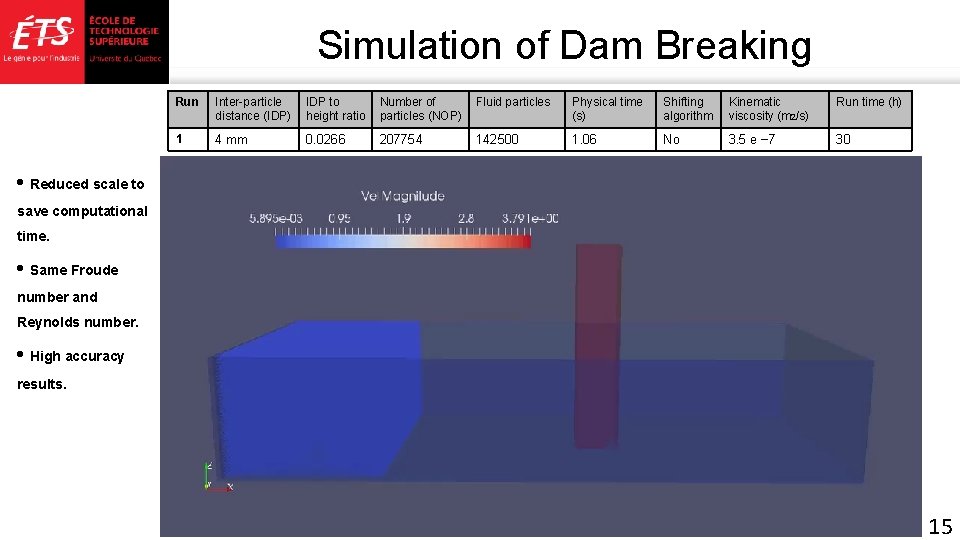
Simulation of Dam Breaking Run Inter-particle distance (IDP) IDP to height ratio Number of particles (NOP) Fluid particles Physical time (s) Shifting algorithm Kinematic viscosity (m 2/s) Run time (h) 1 4 mm 0. 0266 207754 142500 1. 06 No 3. 5 e − 7 30 • Reduced scale to save computational time. • Same Froude number and Reynolds number. • High accuracy results. 15
- Slides: 15