
Simulation of Compressible Cava Simulation of Cavitating Flows
Simulation of Compressible Cava. Simulation of Cavitating Flows Using a Novel Stochastic Field Formulation , FSM Franco Magagnato Andreas G. Claas KIT, FSM KIT, IKET 8 th International Symposium on Cavitation CAV 2012 August 13 -16, 2012, Singapore 1 KIT. The cooperation of Forschungszentrum Karlsruhe Gmb. H and Universität Karlsruhe
Outline of the presentation Motivation for compressible cavitation The novel Stochastic Field Method Homogenous equilibrium cavitation model of Okuda/Ikohagi Numerical method used in SPARC First results for a cavitating diffusor Conclusions and outlook 2 KIT. The cooperation of Forschungszentrum Karlsruhe Gmb. H and Universität Karlsruhe
Compressible cavitation Cavitation is often modeled with incompressible methods, but inside the bubble very low speed of sounds occurs. In incompressible simulation the speed of sound is infinite. Compressible cavitation is more appropriate but also more difficult to simulate numerically. Turbulence is usually modeled with RANS, here we use LES. The turbulence-two-phase flow interaction is often neglected. We propose a novel method based on the Eulerian Stochastic Field Theory. 3 KIT. The cooperation of Forschungszentrum Karlsruhe Gmb. H and Universität Karlsruhe
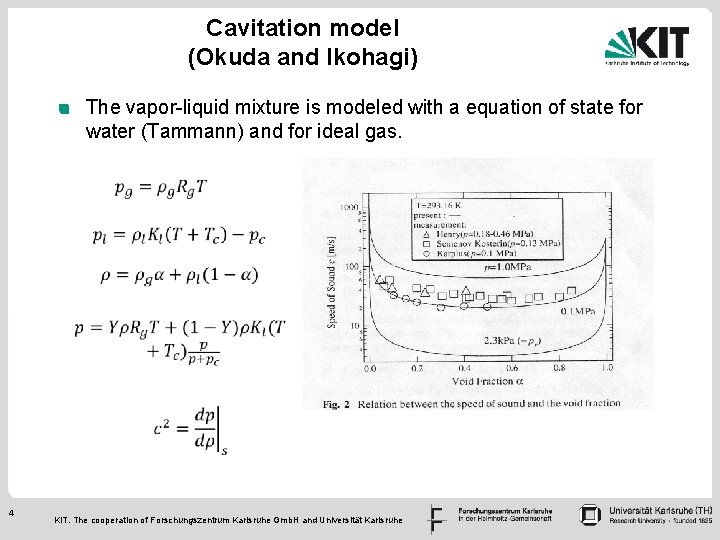
Cavitation model (Okuda and Ikohagi) The vapor-liquid mixture is modeled with a equation of state for water (Tammann) and for ideal gas. 4 KIT. The cooperation of Forschungszentrum Karlsruhe Gmb. H and Universität Karlsruhe
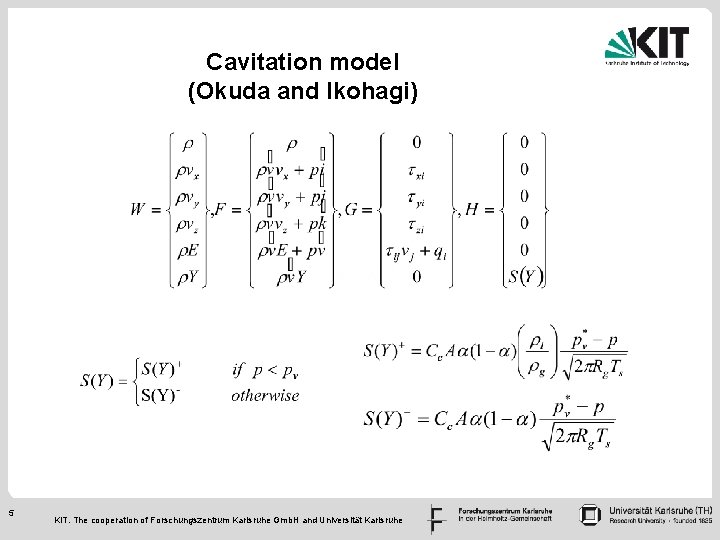
Cavitation model (Okuda and Ikohagi) 5 KIT. The cooperation of Forschungszentrum Karlsruhe Gmb. H and Universität Karlsruhe
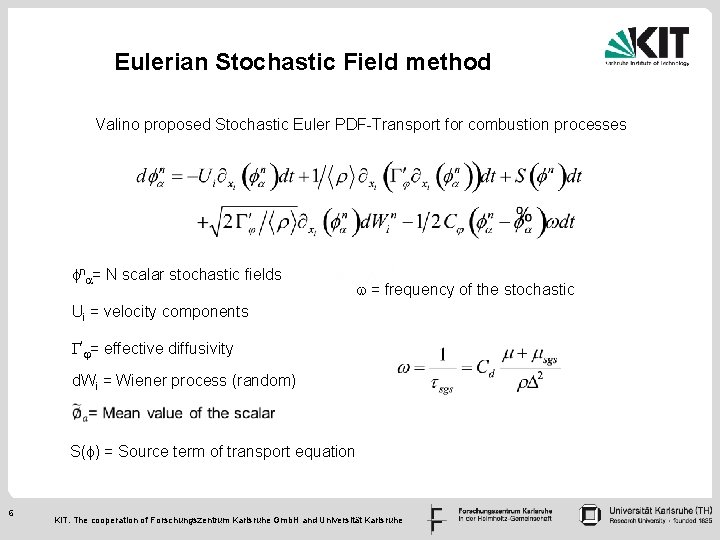
Eulerian Stochastic Field method Valino proposed Stochastic Euler PDF-Transport for combustion processes fna= N scalar stochastic fields w = frequency of the stochastic Ui = velocity components G‘j= effective diffusivity d. Wi = Wiener process (random) S(f) = Source term of transport equation 6 KIT. The cooperation of Forschungszentrum Karlsruhe Gmb. H and Universität Karlsruhe
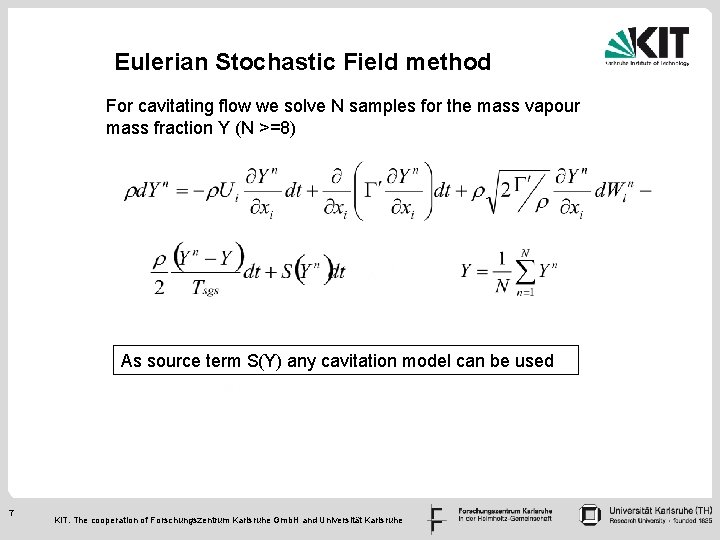
Eulerian Stochastic Field method For cavitating flow we solve N samples for the mass vapour mass fraction Y (N >=8) As source term S(Y) any cavitation model can be used 7 KIT. The cooperation of Forschungszentrum Karlsruhe Gmb. H and Universität Karlsruhe
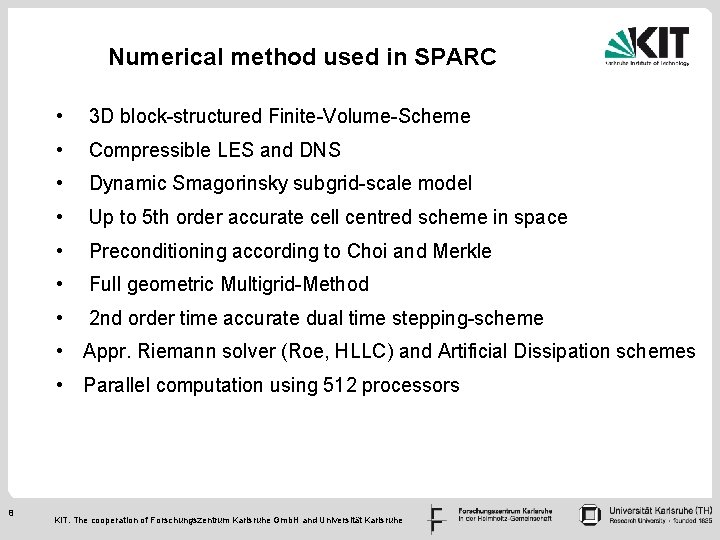
Numerical method used in SPARC • 3 D block-structured Finite-Volume-Scheme • Compressible LES and DNS • Dynamic Smagorinsky subgrid-scale model • Up to 5 th order accurate cell centred scheme in space • Preconditioning according to Choi and Merkle • Full geometric Multigrid-Method • 2 nd order time accurate dual time stepping-scheme • Appr. Riemann solver (Roe, HLLC) and Artificial Dissipation schemes • Parallel computation using 512 processors 8 KIT. The cooperation of Forschungszentrum Karlsruhe Gmb. H and Universität Karlsruhe
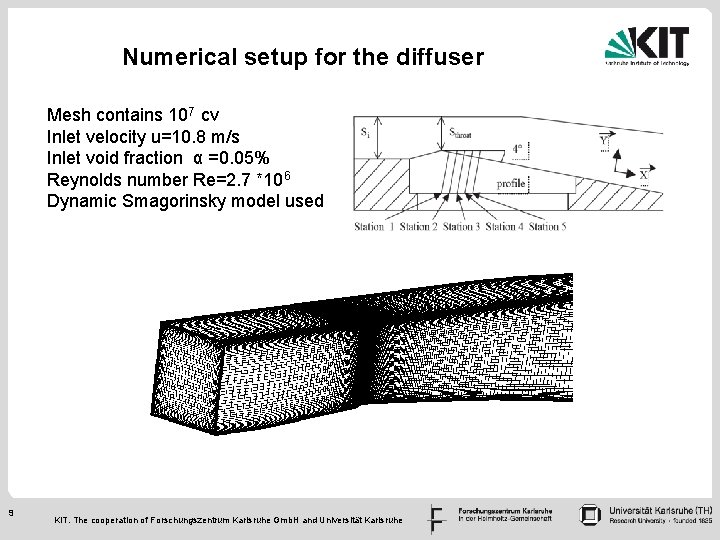
Numerical setup for the diffuser Mesh contains 107 cv Inlet velocity u=10. 8 m/s Inlet void fraction α =0. 05% Reynolds number Re=2. 7 *106 Dynamic Smagorinsky model used 9 KIT. The cooperation of Forschungszentrum Karlsruhe Gmb. H and Universität Karlsruhe
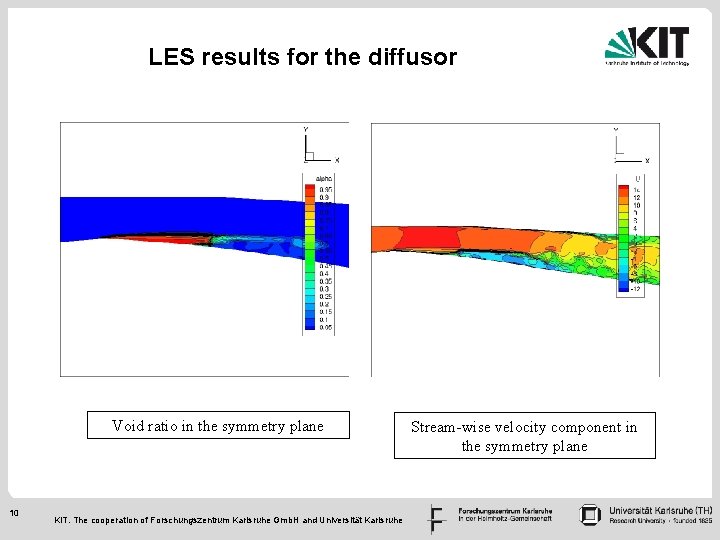
LES results for the diffusor Void ratio in the symmetry plane 10 KIT. The cooperation of Forschungszentrum Karlsruhe Gmb. H and Universität Karlsruhe Stream-wise velocity component in the symmetry plane
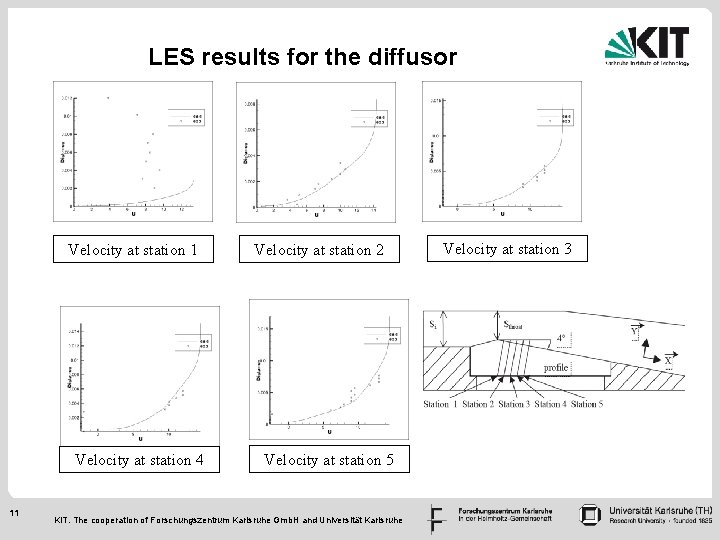
LES results for the diffusor Velocity at station 1 Velocity at station 4 11 Velocity at station 2 Velocity at station 5 KIT. The cooperation of Forschungszentrum Karlsruhe Gmb. H and Universität Karlsruhe Velocity at station 3
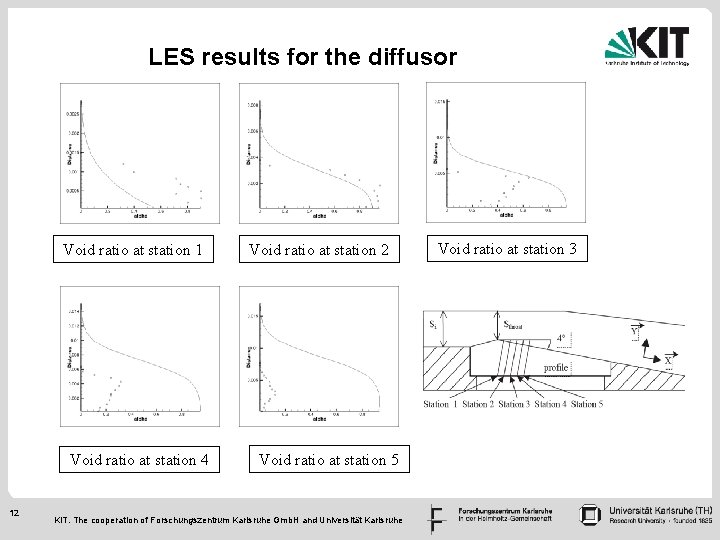
LES results for the diffusor Void ratio at station 1 Void ratio at station 4 12 Void ratio at station 5 KIT. The cooperation of Forschungszentrum Karlsruhe Gmb. H and Universität Karlsruhe Void ratio at station 3
Conclusions A novel Eulerian Stochastic Field formulation has been proposed for the turbulence-two-phase flow interaction. Eight additional transport equations are sufficient for reliable simulation It can be combined with many cavitation models. A first 3 D validation case for cavitating flow shows encouraging agreement with the experiment (Concalves et al. ) Additional 3 D LES are underway for calibrating the constants in the Eulerian SFM. 13 KIT. The cooperation of Forschungszentrum Karlsruhe Gmb. H and Universität Karlsruhe
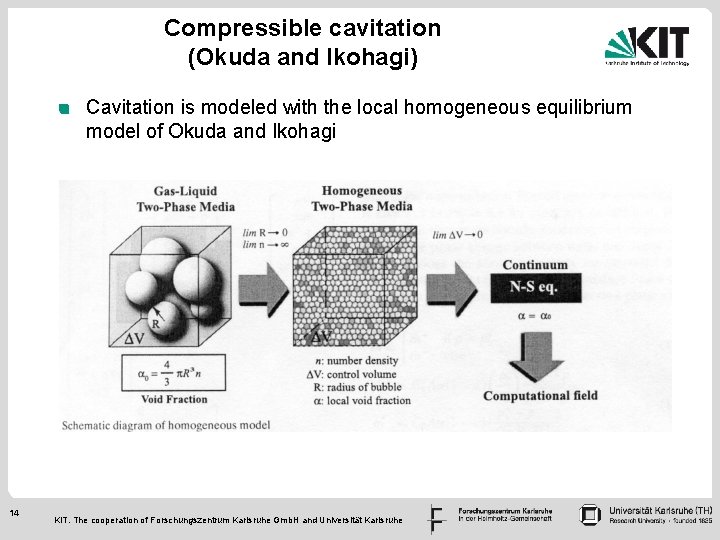
Compressible cavitation (Okuda and Ikohagi) Cavitation is modeled with the local homogeneous equilibrium model of Okuda and Ikohagi 14 KIT. The cooperation of Forschungszentrum Karlsruhe Gmb. H and Universität Karlsruhe
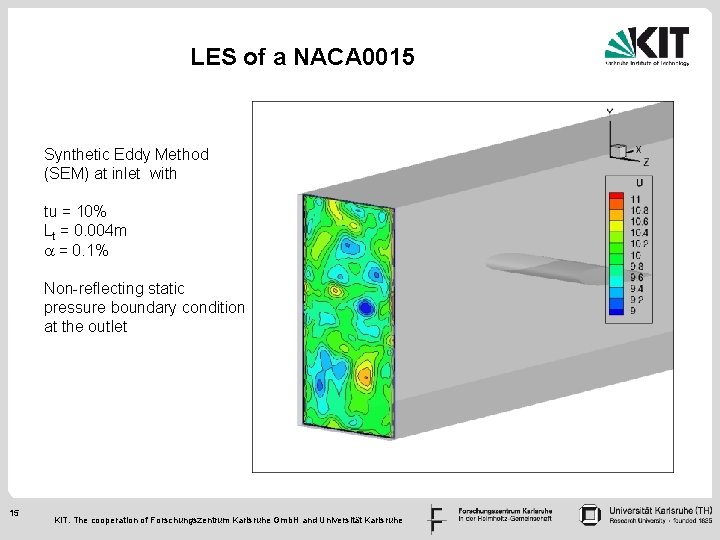
LES of a NACA 0015 Synthetic Eddy Method (SEM) at inlet with tu = 10% Lt = 0. 004 m a = 0. 1% Non-reflecting static pressure boundary condition at the outlet 15 KIT. The cooperation of Forschungszentrum Karlsruhe Gmb. H and Universität Karlsruhe
- Slides: 15