
Simulation of beam loading for CLIC accelerating structures
Simulation of beam loading for CLIC accelerating structures Oleksiy Kononenko, CERN
Contents • • Introduction Unloaded gradient calculation scheme Beam loading model and simulation Conclusions

Introduction: E-field in T 24 structure Considering T 18, T 24 CLIC structures
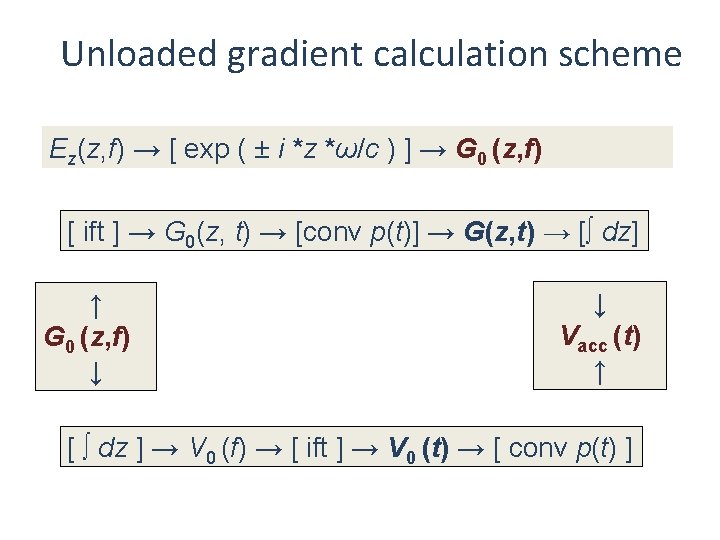
Unloaded gradient calculation scheme Ez(z, f) → [ exp ( ± i *z *ω/c ) ] → G 0 (z, f) [ ift ] → G 0(z, t) → [conv p(t)] → G(z, t) → [∫ dz] ↑ G 0 (z, f) ↓ ↓ Vacc (t) ↑ [ ∫ dz ] → V 0 (f) → [ ift ] → V 0 (t) → [ conv p(t) ]
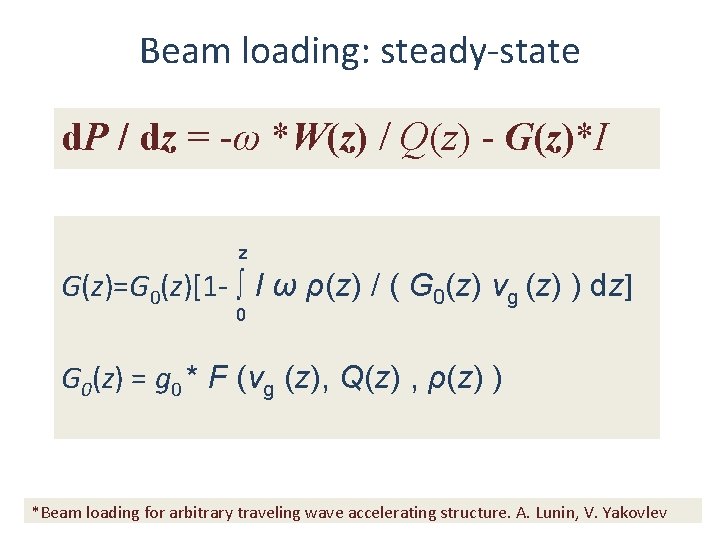
Beam loading: steady-state d. P / dz = -ω *W(z) / Q(z) - G(z)*I z G(z)=G 0(z)[1 - ∫ I ω ρ(z) / ( G 0(z) vg (z) ) dz] 0 G 0(z) = g 0 * F (vg (z), Q(z) , ρ(z) ) *Beam loading for arbitrary traveling wave accelerating structure. A. Lunin, V. Yakovlev
Beam loading: steady-state
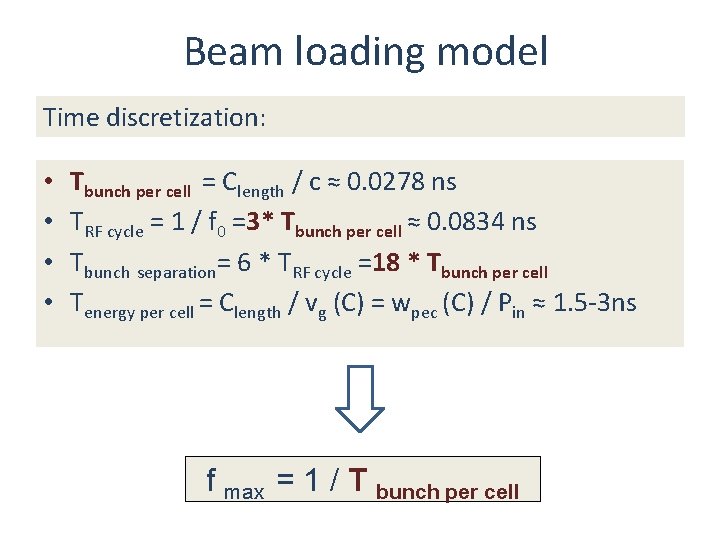
Beam loading model Time discretization: • • Tbunch per cell = Clength / c ≈ 0. 0278 ns TRF cycle = 1 / f 0 =3* Tbunch per cell ≈ 0. 0834 ns Tbunch separation= 6 * TRF cycle =18 * Tbunch per cell Tenergy per cell = Clength / vg (C) = wpec (C) / Pin ≈ 1. 5 -3 ns f max = 1 / T bunch per cell
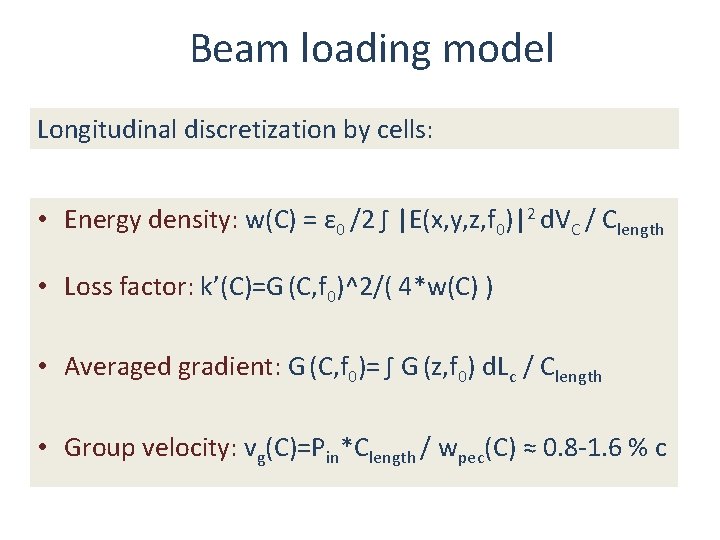
Beam loading model Longitudinal discretization by cells: • Energy density: w(C) = ε 0 /2 ∫ |E(x, y, z, f 0)|2 d. VC / Clength • Loss factor: k’(C)=G (C, f 0)^2/( 4*w(C) ) • Averaged gradient: G (C, f 0)= ∫ G (z, f 0) d. Lc / Clength • Group velocity: vg(C)=Pin*Clength / wpec(C) ≈ 0. 8 -1. 6 % c
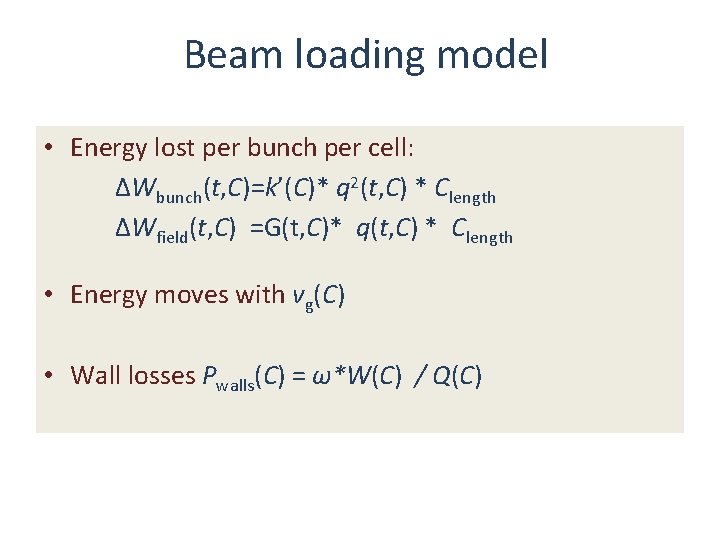
Beam loading model • Energy lost per bunch per cell: ΔWbunch(t, C)=k’(C)* q 2(t, C) * Clength ΔWfield(t, C) =G(t, C)* q(t, C) * Clength • Energy moves with vg(C) • Wall losses Pwalls(C) = ω*W(C) / Q(C)
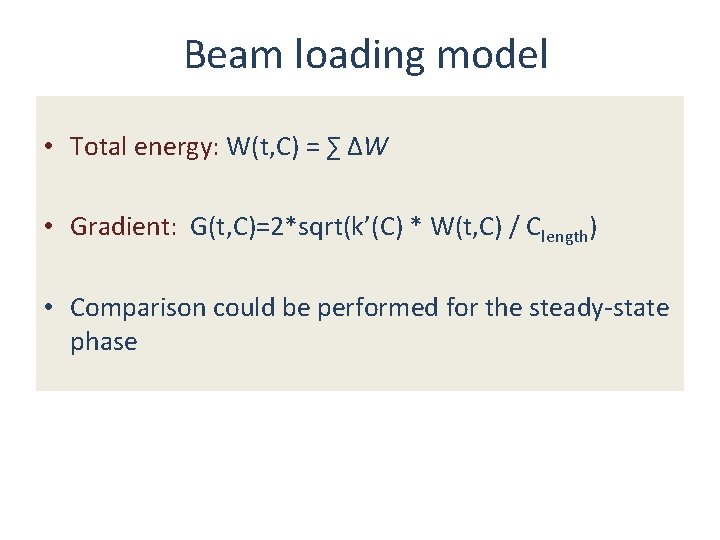
Beam loading model • Total energy: W(t, C) = ∑ ΔW • Gradient: G(t, C)=2*sqrt(k’(C) * W(t, C) / Clength) • Comparison could be performed for the steady-state phase

Beam loading simulation
Rectangular pulse
Accelerating voltage in T 24

Ramped pulse
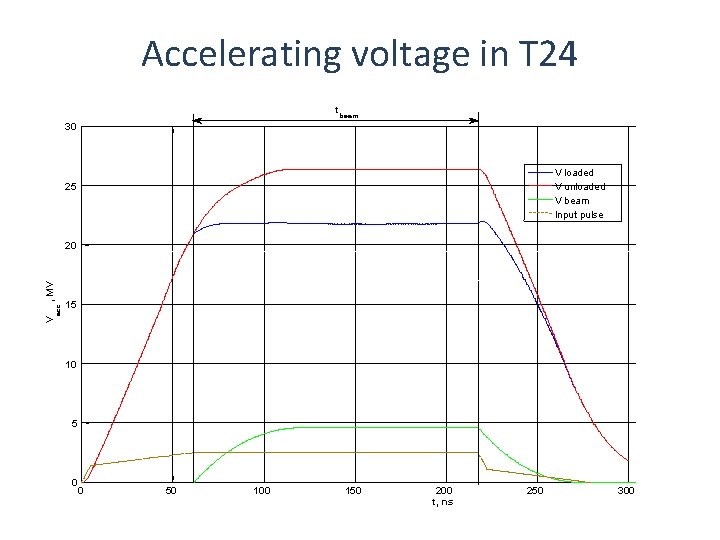
Accelerating voltage in T 24 t beam 30 V loaded V unloaded V beam Input pulse 25 15 V acc , MV 20 10 5 0 0 50 100 150 200 t, ns 250 300 35
Conclusions 1. Beam loading model is developed and simulations are carried out. 2. Comparison with the steady state case is performed. 3. Optimization of the pulse shape is necessary 4. More detailed beam loading calculations are needed

Thank you for the attention!
- Slides: 17