
SIMULATION OF A SINGLESERVER QUEUEING SYSTEM Will show
- Slides: 21
SIMULATION OF A SINGLE-SERVER QUEUEING SYSTEM • Will show to simulate a specific version of the single-server queuing system • Though simple, it contains many features found in all simulation models
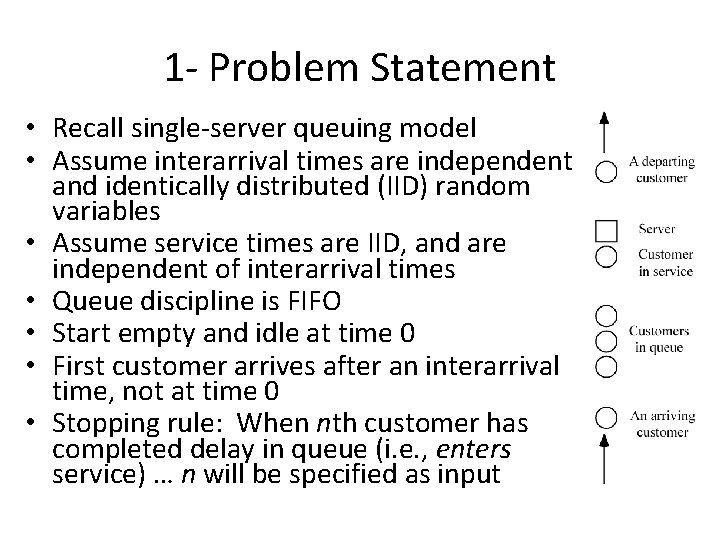
1 - Problem Statement • Recall single-server queuing model • Assume interarrival times are independent and identically distributed (IID) random variables • Assume service times are IID, and are independent of interarrival times • Queue discipline is FIFO • Start empty and idle at time 0 • First customer arrives after an interarrival time, not at time 0 • Stopping rule: When nth customer has completed delay in queue (i. e. , enters service) … n will be specified as input
1 - Problem Statement (cont’d. ) • Quantities to be estimated – Expected average delay in queue (excluding service time) of the n customers completing their delays • Why “expected? ” – Expected average number of customers in queue (excluding any in service) • A continuous-time average • Area under Q(t) = queue length at time t, divided by T(n) = time simulation ends … see book for justification and details – Expected utilization (proportion of time busy) of the server • Another continuous-time average • Area under B(t) = server-busy function (1 if busy, 0 if idle at time t), divided by T(n) … justification and details in book – Many others are possible (maxima, minima, time or number in system, proportions, quantiles, variances …)
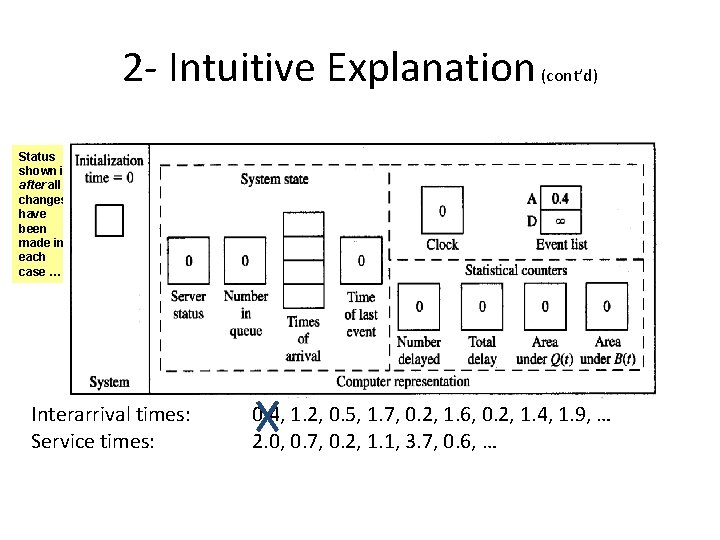
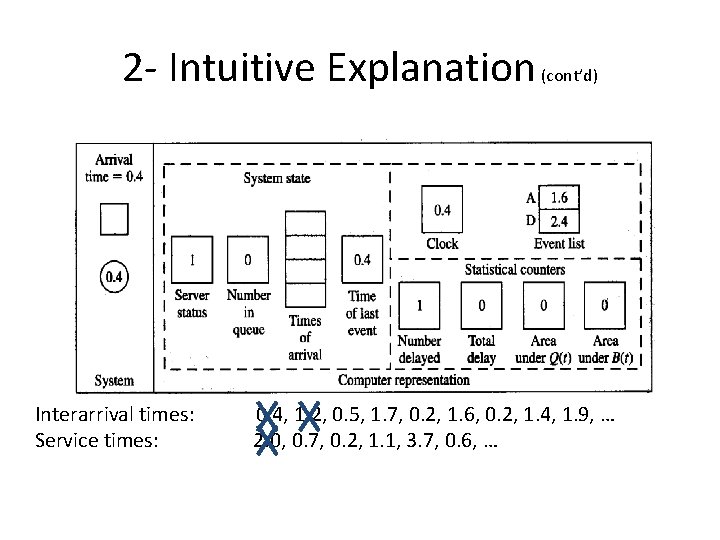
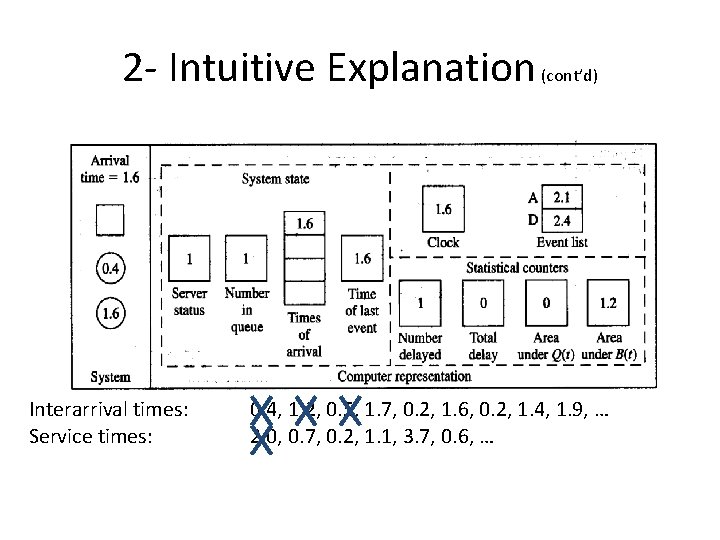
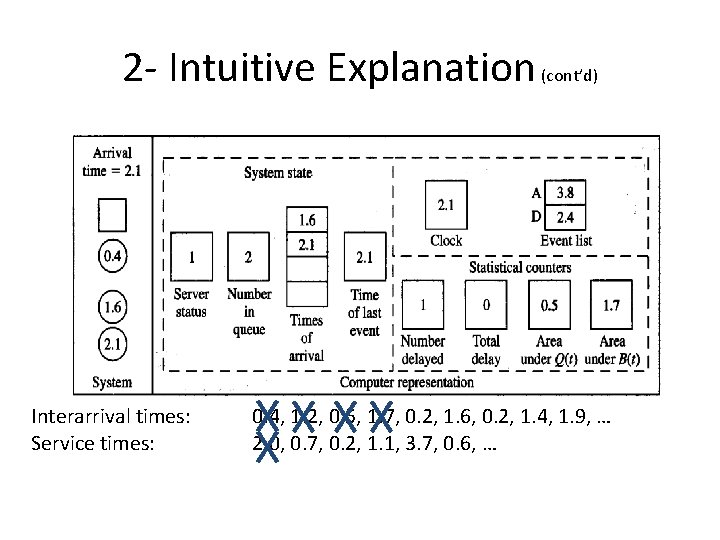
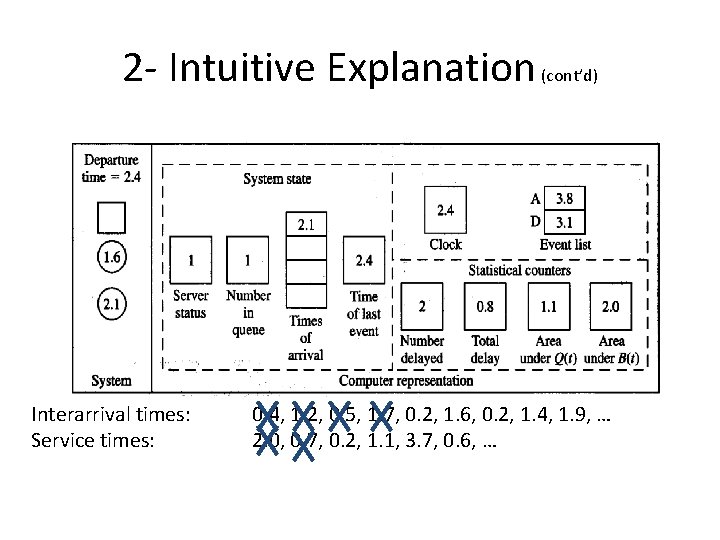
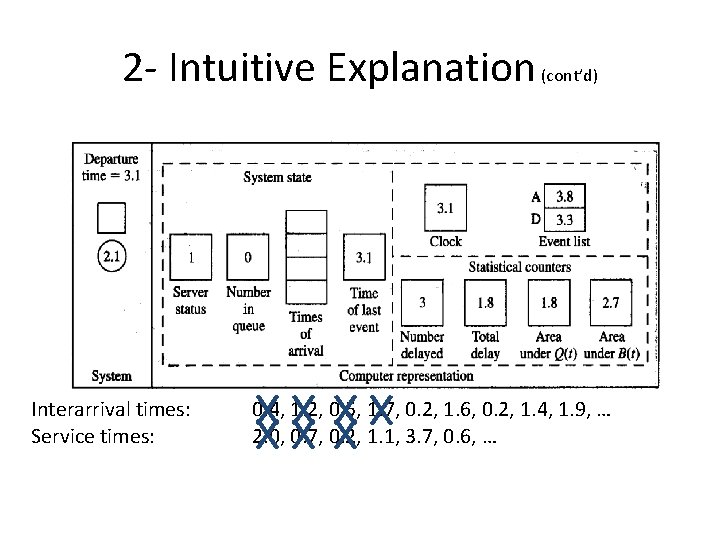
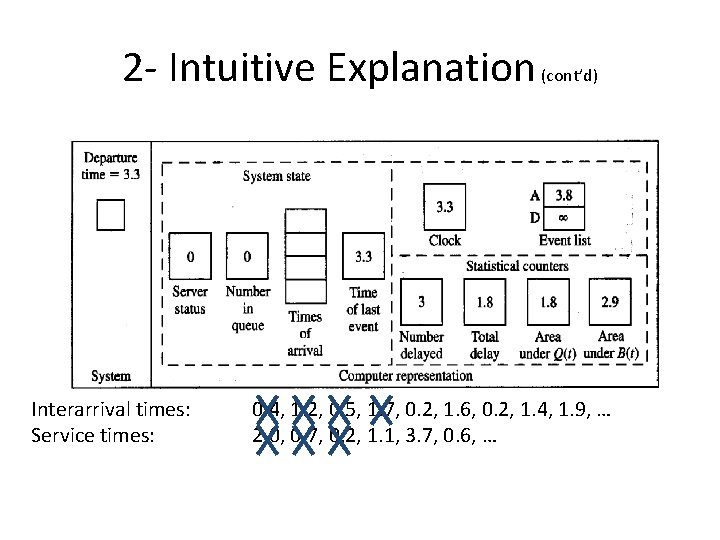
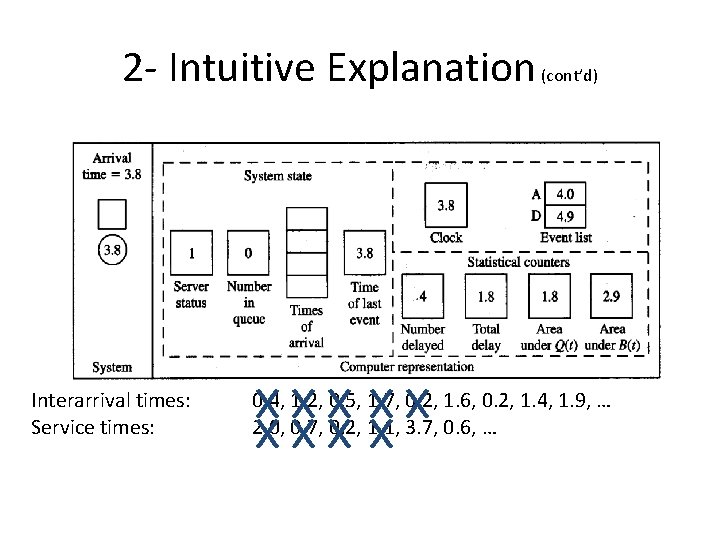
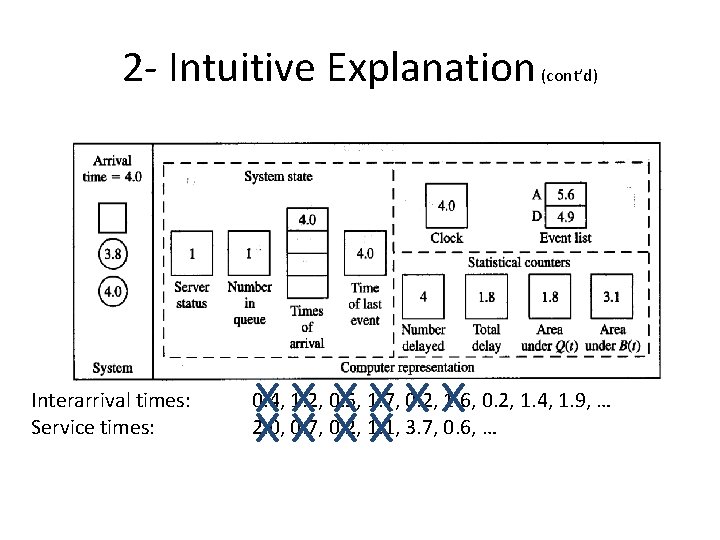
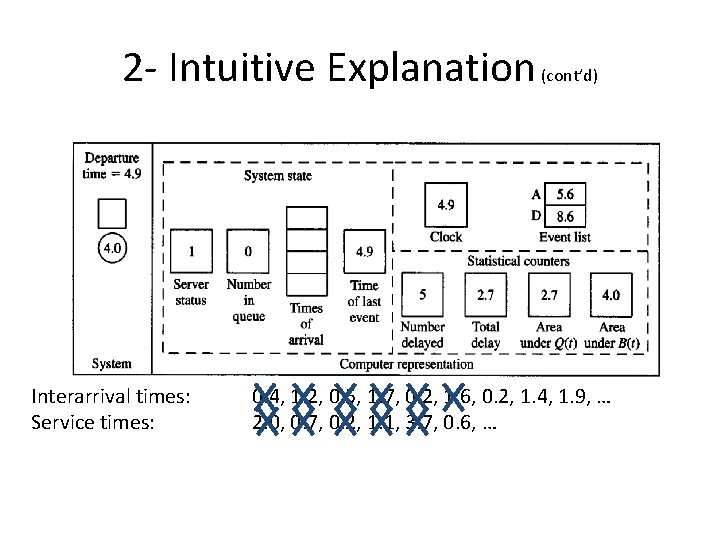
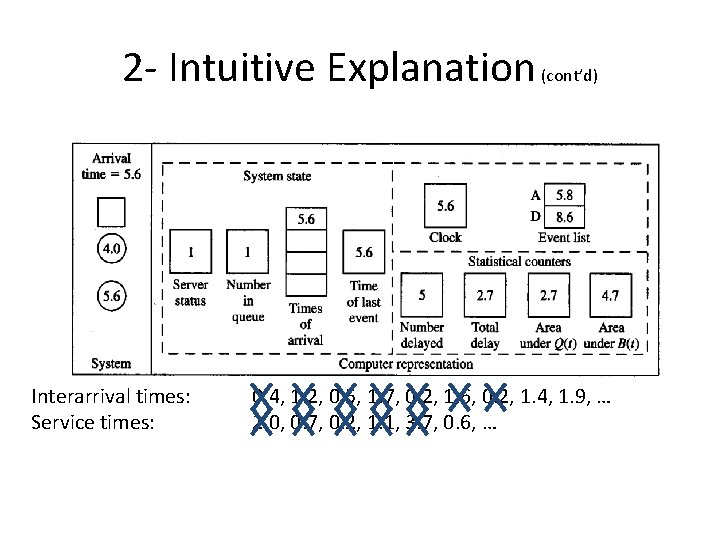
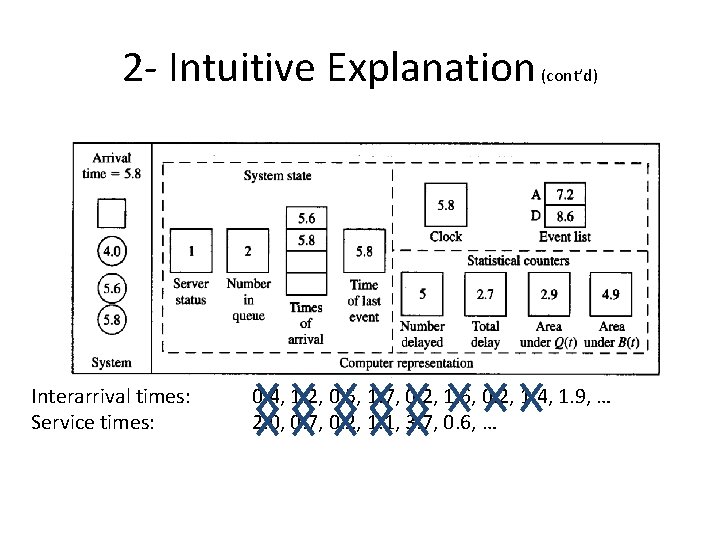
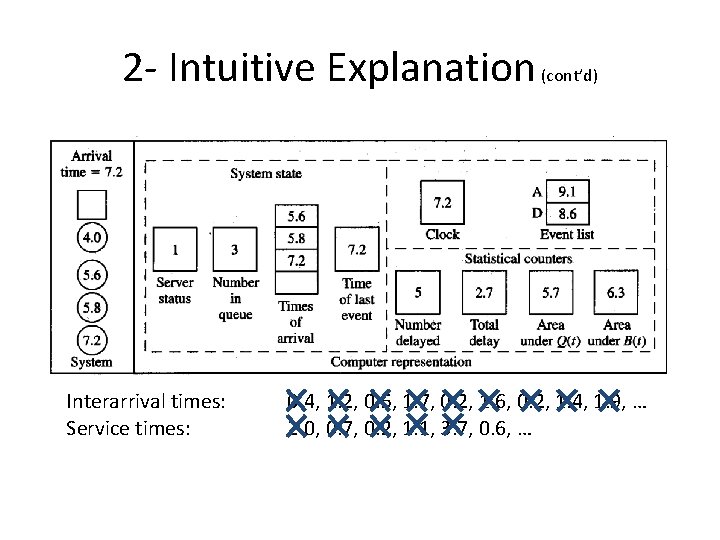
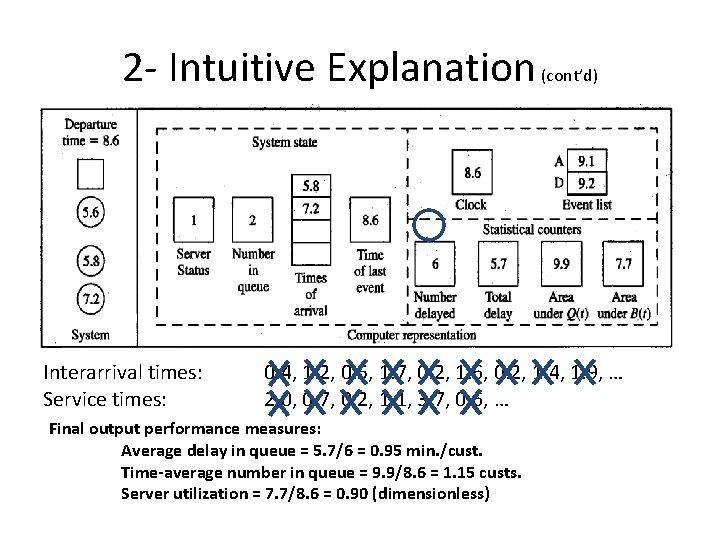
2 - Intuitive Explanation • Given (for now) interarrival times (all times are in minutes): 0. 4, 1. 2, 0. 5, 1. 7, 0. 2, 1. 6, 0. 2, 1. 4, 1. 9, … • Given service times: 2. 0, 0. 7, 0. 2, 1. 1, 3. 7, 0. 6, … • n = 6 delays in queue desired • “Hand” simulation: – Display system, state variables, clock, event list, statistical counters … all after execution of each event – Use above lists of interarrival, service times to “drive” simulation – Stop when number of delays hits n = 6, compute output performance measures
2 - Intuitive Explanation (cont’d) Status shown is after all changes have been made in each case … Interarrival times: Service times: 0. 4, 1. 2, 0. 5, 1. 7, 0. 2, 1. 6, 0. 2, 1. 4, 1. 9, … 2. 0, 0. 7, 0. 2, 1. 1, 3. 7, 0. 6, …
2 - Intuitive Explanation (cont’d) Interarrival times: Service times: 0. 4, 1. 2, 0. 5, 1. 7, 0. 2, 1. 6, 0. 2, 1. 4, 1. 9, … 2. 0, 0. 7, 0. 2, 1. 1, 3. 7, 0. 6, …
2 - Intuitive Explanation (cont’d) Interarrival times: Service times: 0. 4, 1. 2, 0. 5, 1. 7, 0. 2, 1. 6, 0. 2, 1. 4, 1. 9, … 2. 0, 0. 7, 0. 2, 1. 1, 3. 7, 0. 6, …
2 - Intuitive Explanation (cont’d) Interarrival times: Service times: 0. 4, 1. 2, 0. 5, 1. 7, 0. 2, 1. 6, 0. 2, 1. 4, 1. 9, … 2. 0, 0. 7, 0. 2, 1. 1, 3. 7, 0. 6, …
2 - Intuitive Explanation (cont’d) Interarrival times: Service times: 0. 4, 1. 2, 0. 5, 1. 7, 0. 2, 1. 6, 0. 2, 1. 4, 1. 9, … 2. 0, 0. 7, 0. 2, 1. 1, 3. 7, 0. 6, …
2 - Intuitive Explanation (cont’d) Interarrival times: Service times: 0. 4, 1. 2, 0. 5, 1. 7, 0. 2, 1. 6, 0. 2, 1. 4, 1. 9, … 2. 0, 0. 7, 0. 2, 1. 1, 3. 7, 0. 6, …
2 - Intuitive Explanation (cont’d) Interarrival times: Service times: 0. 4, 1. 2, 0. 5, 1. 7, 0. 2, 1. 6, 0. 2, 1. 4, 1. 9, … 2. 0, 0. 7, 0. 2, 1. 1, 3. 7, 0. 6, …
2 - Intuitive Explanation (cont’d) Interarrival times: Service times: 0. 4, 1. 2, 0. 5, 1. 7, 0. 2, 1. 6, 0. 2, 1. 4, 1. 9, … 2. 0, 0. 7, 0. 2, 1. 1, 3. 7, 0. 6, …
2 - Intuitive Explanation (cont’d) Interarrival times: Service times: 0. 4, 1. 2, 0. 5, 1. 7, 0. 2, 1. 6, 0. 2, 1. 4, 1. 9, … 2. 0, 0. 7, 0. 2, 1. 1, 3. 7, 0. 6, …
2 - Intuitive Explanation (cont’d) Interarrival times: Service times: 0. 4, 1. 2, 0. 5, 1. 7, 0. 2, 1. 6, 0. 2, 1. 4, 1. 9, … 2. 0, 0. 7, 0. 2, 1. 1, 3. 7, 0. 6, …
2 - Intuitive Explanation (cont’d) Interarrival times: Service times: 0. 4, 1. 2, 0. 5, 1. 7, 0. 2, 1. 6, 0. 2, 1. 4, 1. 9, … 2. 0, 0. 7, 0. 2, 1. 1, 3. 7, 0. 6, …
2 - Intuitive Explanation (cont’d) Interarrival times: Service times: 0. 4, 1. 2, 0. 5, 1. 7, 0. 2, 1. 6, 0. 2, 1. 4, 1. 9, … 2. 0, 0. 7, 0. 2, 1. 1, 3. 7, 0. 6, …
2 - Intuitive Explanation (cont’d) Interarrival times: Service times: 0. 4, 1. 2, 0. 5, 1. 7, 0. 2, 1. 6, 0. 2, 1. 4, 1. 9, … 2. 0, 0. 7, 0. 2, 1. 1, 3. 7, 0. 6, …
2 - Intuitive Explanation (cont’d) Interarrival times: Service times: 0. 4, 1. 2, 0. 5, 1. 7, 0. 2, 1. 6, 0. 2, 1. 4, 1. 9, … 2. 0, 0. 7, 0. 2, 1. 1, 3. 7, 0. 6, … Final output performance measures: Average delay in queue = 5. 7/6 = 0. 95 min. /cust. Time-average number in queue = 9. 9/8. 6 = 1. 15 custs. Server utilization = 7. 7/8. 6 = 0. 90 (dimensionless)
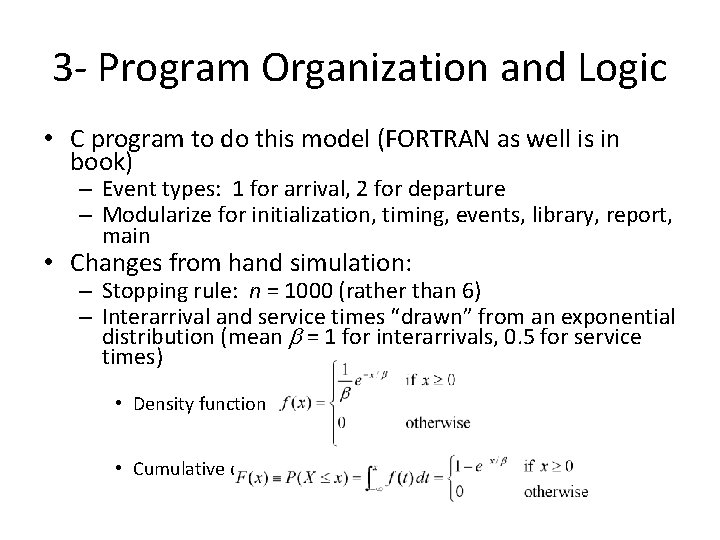
3 - Program Organization and Logic • C program to do this model (FORTRAN as well is in book) – Event types: 1 for arrival, 2 for departure – Modularize for initialization, timing, events, library, report, main • Changes from hand simulation: – Stopping rule: n = 1000 (rather than 6) – Interarrival and service times “drawn” from an exponential distribution (mean b = 1 for interarrivals, 0. 5 for service times) • Density function • Cumulative distribution function
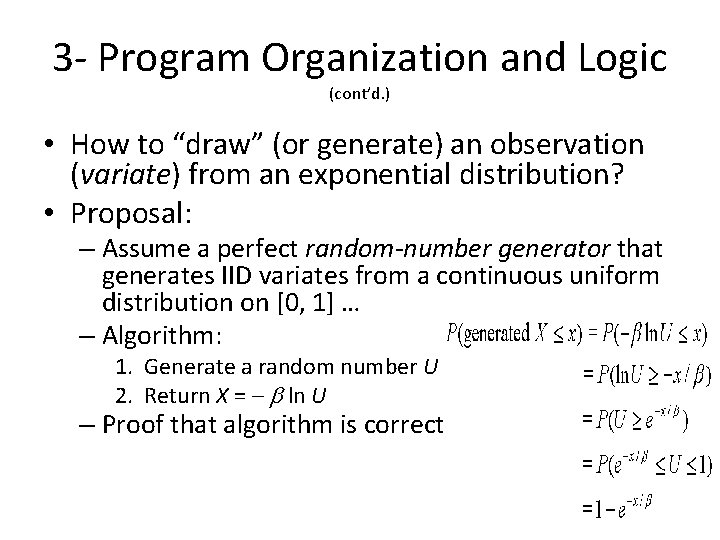
3 - Program Organization and Logic (cont’d. ) • How to “draw” (or generate) an observation (variate) from an exponential distribution? • Proposal: – Assume a perfect random-number generator that generates IID variates from a continuous uniform distribution on [0, 1] … – Algorithm: 1. Generate a random number U 2. Return X = – b ln U – Proof that algorithm is correct:
ALTERNATIVE APPROACHES TO MODELING AND CODING SIMULATIONS • Parallel and distributed simulation – Various kinds of parallel and distributed architectures – Break up a simulation model in some way, run the different parts simultaneously on different parallel processors – Different ways to break up model • By support functions – random-number generation, variate generation, event-list management, event routines, etc. • Decompose the model itself; assign different parts of model to different processors – message-passing to maintain synchronization, or forget synchronization and do “rollbacks” if necessary … “virtual time” • Web-based simulation – Central simulation engine, submit “jobs” over the web – Wide-scope parallel/distributed simulation