
Simulation Methods for Fire Suppression Process inside Engine
![Volumetric Concentration v = fh / [fh + (1 - fh) (Mh/Ma)] where, fh](https://slidetodoc.com/presentation_image_h2/83318d173277a14cb446cd020a1e80aa/image-15.jpg "Volumetric Concentration v = fh / [fh + (1 - fh) (Mh/Ma)] where, fh")

- Slides: 24
Simulation Methods for Fire Suppression Process inside Engine Core and APU Compartments The Fourth Triennial International Aircraft Fire and Cabin Safety Research Conference Lisbon Conference Center, Portugal November 15 -18, 2004 Jaesoo Lee Boeing Commercial Airplanes Group Seattle, Washington, 98124 -2207, USA J. Lee 11 -17 -04
Acknowledgment • FAA Tech Center: D. Ingerson: Nacelle Fire Simulator Test Data • Boeing: C. Roseburg: Thermodynamic Properties of Agents A. Nazir: Hflowx Modification D. Lackas, J. Petkus: Certification Test Data M. Dunn: Engine Cooling Airflow Data D. Dummeyer: APU Fire. X Test Data M. Grueneis, R. Moody, B. Hsiao: Mesh Generation J. Lee 11 -17 -04
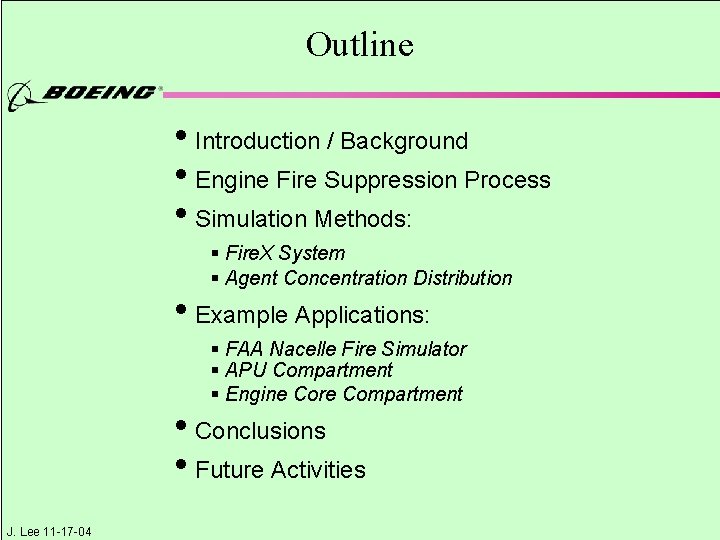
Outline • Introduction / Background • Engine Fire Suppression Process • Simulation Methods: § Fire. X System § Agent Concentration Distribution • Example Applications: § FAA Nacelle Fire Simulator § APU Compartment § Engine Core Compartment • Conclusions • Future Activities J. Lee 11 -17 -04
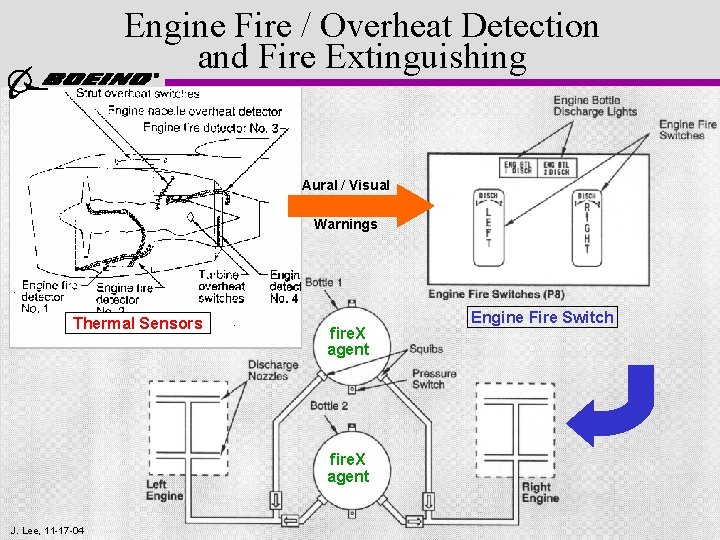
Engine Fire / Overheat Detection and Fire Extinguishing Aural / Visual Warnings Thermal Sensors fire. X agent J. Lee, 11 -17 -04 Engine Fire Switch
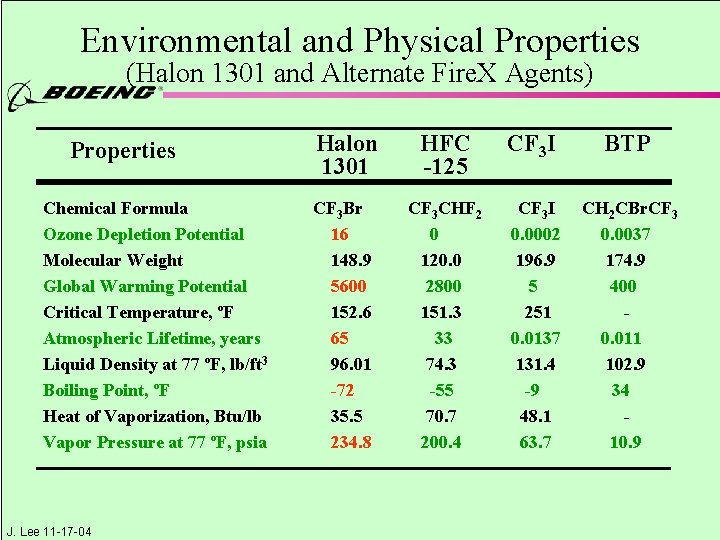
Environmental and Physical Properties (Halon 1301 and Alternate Fire. X Agents) Properties Chemical Formula Ozone Depletion Potential Molecular Weight Global Warming Potential Critical Temperature, ºF Atmospheric Lifetime, years Liquid Density at 77 ºF, lb/ft 3 Boiling Point, ºF Heat of Vaporization, Btu/lb Vapor Pressure at 77 ºF, psia J. Lee 11 -17 -04 Halon 1301 HFC -125 CF 3 I BTP CF 3 Br 16 148. 9 5600 152. 6 65 96. 01 -72 35. 5 234. 8 CF 3 CHF 2 0 120. 0 2800 151. 3 33 74. 3 -55 70. 7 200. 4 CF 3 I 0. 0002 196. 9 5 251 0. 0137 131. 4 -9 48. 1 63. 7 CH 2 CBr. CF 3 0. 0037 174. 9 400 0. 011 102. 9 34 10. 9
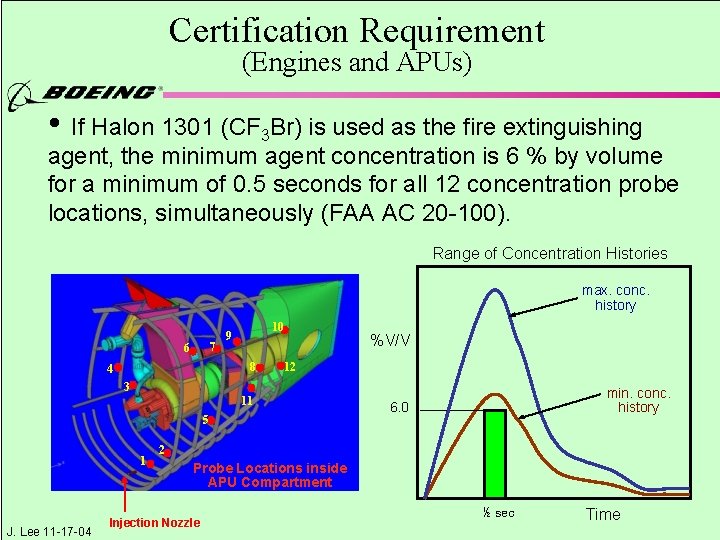
Certification Requirement (Engines and APUs) • If Halon 1301 (CF 3 Br) is used as the fire extinguishing agent, the minimum agent concentration is 6 % by volume for a minimum of 0. 5 seconds for all 12 concentration probe locations, simultaneously (FAA AC 20 -100). Range of Concentration Histories max. conc. history 7 6 10 9 8 4 %V/V 12 3 11 5 1 J. Lee 11 -17 -04 min. conc. history 6. 0 2 Probe Locations inside APU Compartment Injection Nozzle ½ sec Time
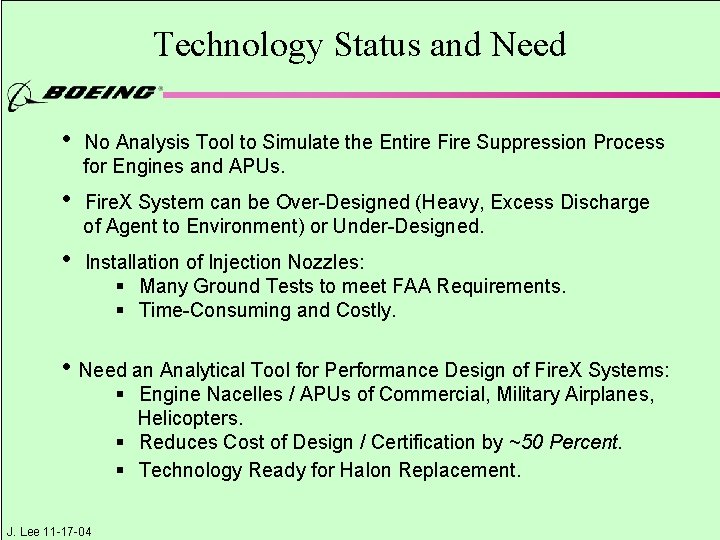
Technology Status and Need • No Analysis Tool to Simulate the Entire Fire Suppression Process for Engines and APUs. • Fire. X System can be Over-Designed (Heavy, Excess Discharge of Agent to Environment) or Under-Designed. • Installation of Injection Nozzles: § Many Ground Tests to meet FAA Requirements. § Time-Consuming and Costly. • Need an Analytical Tool for Performance Design of Fire. X Systems: § Engine Nacelles / APUs of Commercial, Military Airplanes, Helicopters. § Reduces Cost of Design / Certification by ~50 Percent. § Technology Ready for Halon Replacement. J. Lee 11 -17 -04
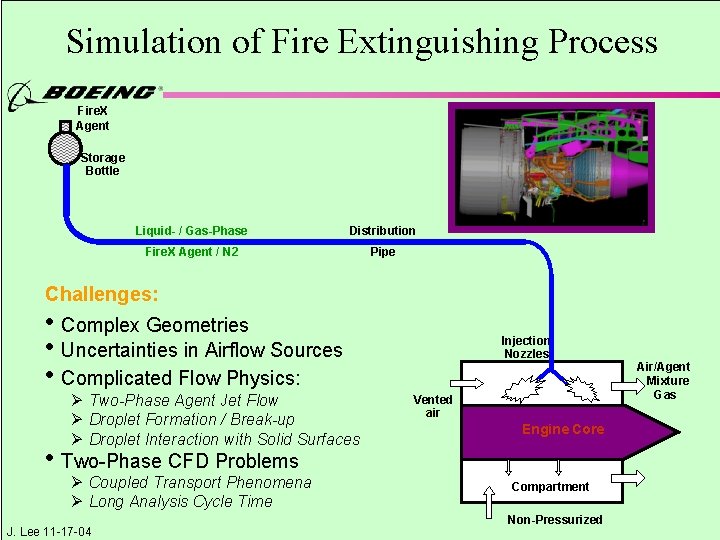
Simulation of Fire Extinguishing Process Fire. X Agent Storage Bottle Liquid- / Gas-Phase Distribution Fire. X Agent / N 2 Pipe Challenges: • Complex Geometries • Uncertainties in Airflow Sources • Complicated Flow Physics: Ø Two-Phase Agent Jet Flow Ø Droplet Formation / Break-up Ø Droplet Interaction with Solid Surfaces Injection Nozzles Vented air Engine Core • Two-Phase CFD Problems Ø Coupled Transport Phenomena Ø Long Analysis Cycle Time J. Lee 11 -17 -04 Compartment Non-Pressurized Air/Agent Mixture Gas
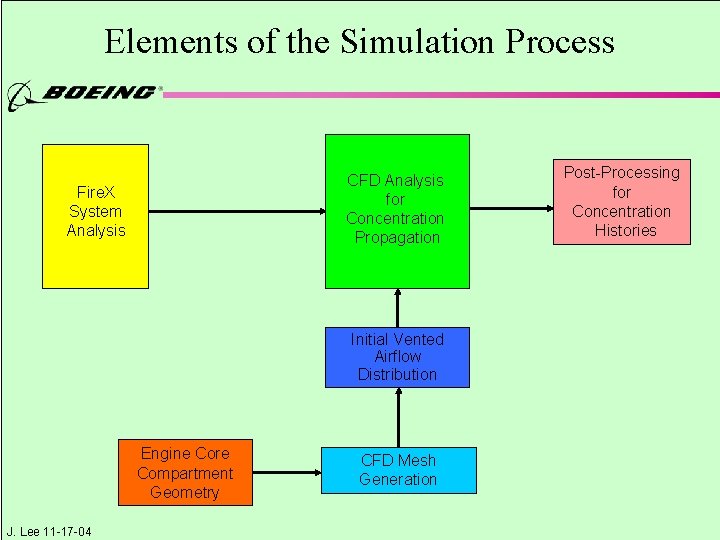
Elements of the Simulation Process CFD Analysis for Concentration Propagation Fire. X System Analysis Initial Vented Airflow Distribution Engine Core Compartment Geometry J. Lee 11 -17 -04 CFD Mesh Generation Post-Processing for Concentration Histories
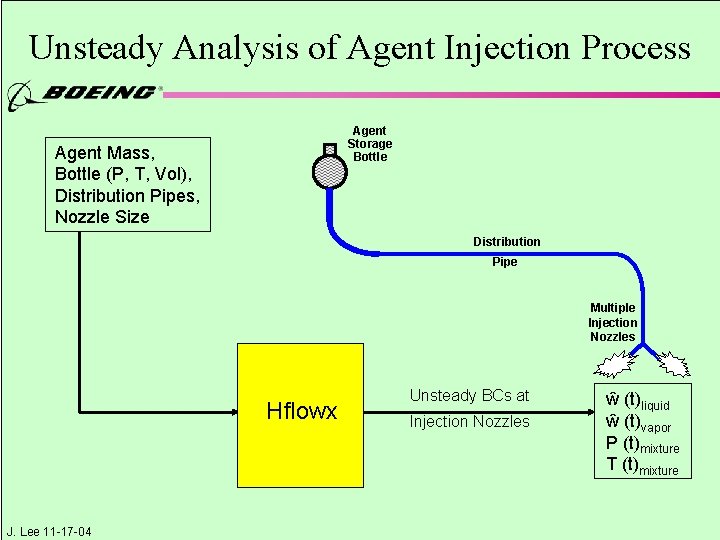
Unsteady Analysis of Agent Injection Process Agent Storage Bottle Agent Mass, Bottle (P, T, Vol), Distribution Pipes, Nozzle Size Distribution Pipe Multiple Injection Nozzles Hflowx J. Lee 11 -17 -04 Unsteady BCs at Injection Nozzles ŵ (t)liquid ŵ (t)vapor P (t)mixture T (t)mixture
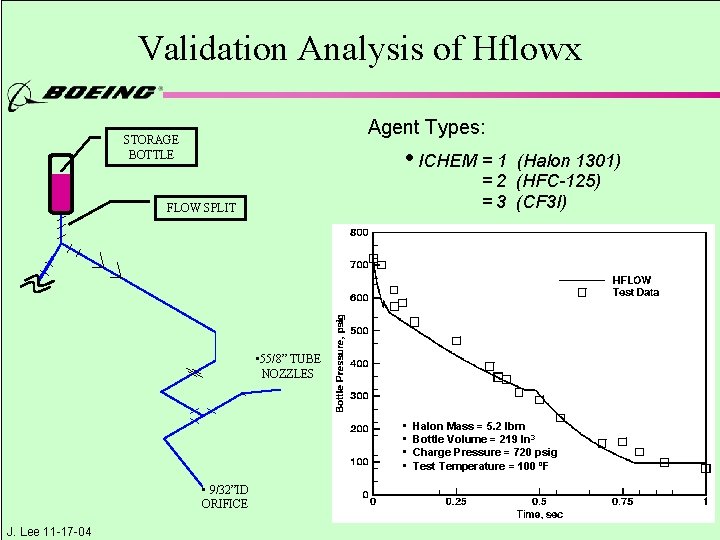
Validation Analysis of Hflowx Agent Types: STORAGE BOTTLE • ICHEM = 1 (Halon 1301) = 2 (HFC-125) = 3 (CF 3 I) FLOW SPLIT • 55/8” TUBE NOZZLES • • • 9/32”ID ORIFICE J. Lee 11 -17 -04 Halon Mass = 5. 2 lbm Bottle Volume = 219 In 3 Charge Pressure = 720 psig Test Temperature = 100 ºF
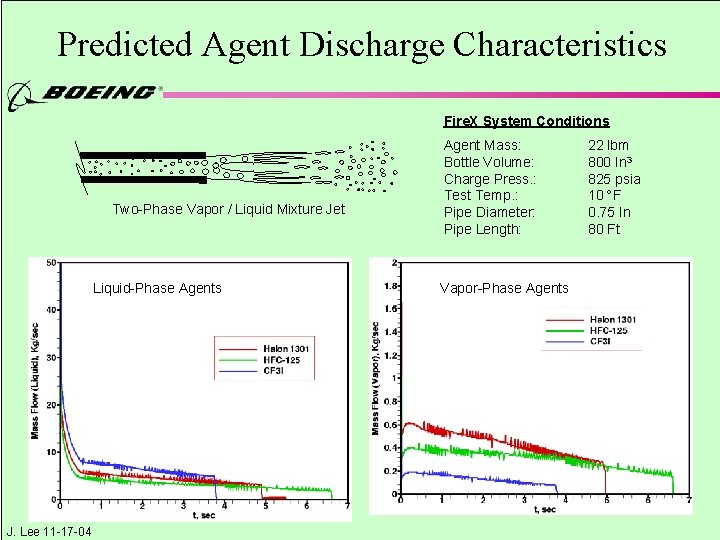
Predicted Agent Discharge Characteristics Fire. X System Conditions Two-Phase Vapor / Liquid Mixture Jet Liquid-Phase Agents J. Lee 11 -17 -04 Agent Mass: Bottle Volume: Charge Press. : Test Temp. : Pipe Diameter: Pipe Length: Vapor-Phase Agents 22 lbm 800 In 3 825 psia 10 F 0. 75 In 80 Ft
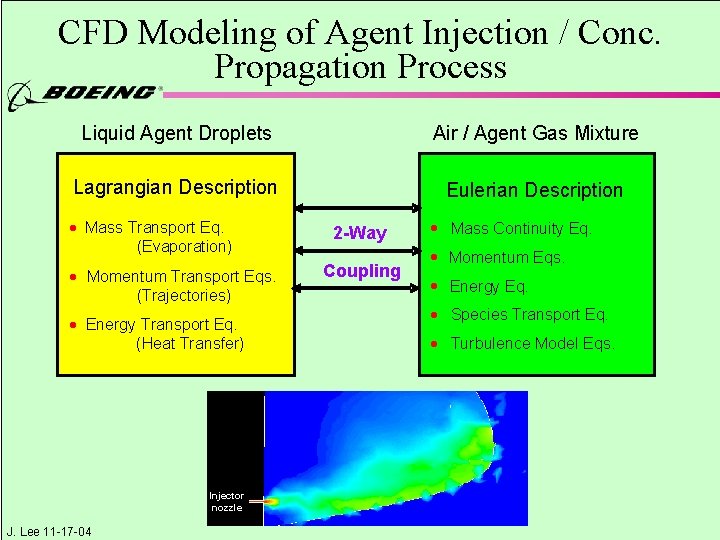
CFD Modeling of Agent Injection / Conc. Propagation Process Liquid Agent Droplets Air / Agent Gas Mixture Lagrangian Description Eulerian Description • Mass Transport Eq. (Evaporation) • Momentum Transport Eqs. (Trajectories) • Energy Transport Eq. (Heat Transfer) Injector nozzle J. Lee 11 -17 -04 2 -Way Coupling • • • Mass Continuity Eq. Momentum Eqs. Energy Eq. Species Conservation Transport Eq. Species Turbulence Model Eqs.
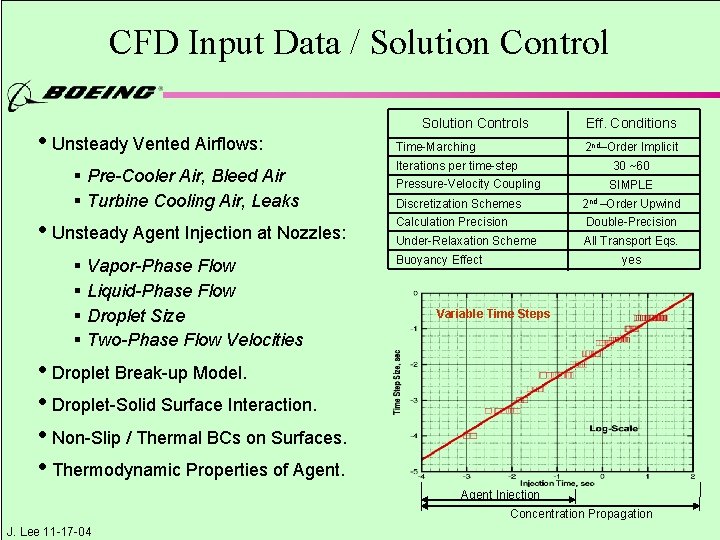
CFD Input Data / Solution Control • Unsteady Vented Airflows: § Pre-Cooler Air, Bleed Air § Turbine Cooling Air, Leaks • Unsteady Agent Injection at Nozzles: § Vapor-Phase Flow § Liquid-Phase Flow § Droplet Size § Two-Phase Flow Velocities Solution Controls Time-Marching Eff. Conditions 2 nd–Order Implicit Iterations per time-step Pressure-Velocity Coupling 30 ~60 SIMPLE Discretization Schemes 2 nd –Order Upwind Calculation Precision Double-Precision Under-Relaxation Scheme All Transport Eqs. Buoyancy Effect yes Variable Time Steps • Droplet Break-up Model. • Droplet-Solid Surface Interaction. • Non-Slip / Thermal BCs on Surfaces. • Thermodynamic Properties of Agent Injection Concentration Propagation J. Lee 11 -17 -04
Volumetric Concentration v = fh / [fh + (1 - fh) (Mh/Ma)] where, fh = Predicted Mass Fraction of Agent Mh = Mol. Weight of Agent Vapor Ma = Mol. Weight of Air v = Volumetric Concentration v, %V/V time, sec J. Lee 11 -17 -04
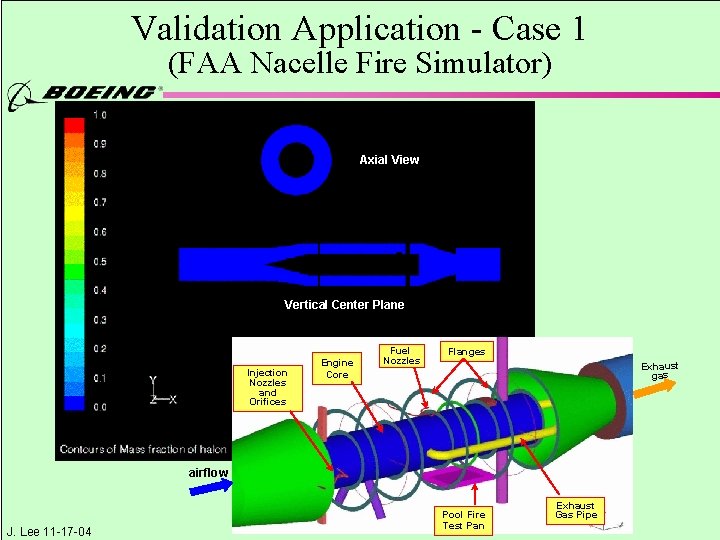
Validation Application - Case 1 (FAA Nacelle Fire Simulator) Axial View Vertical Center Plane Injection Nozzles and Orifices Engine Core Fuel Nozzles Flanges Exhaust gas airflow J. Lee 11 -17 -04 Pool Fire Test Pan Exhaust Gas Pipe
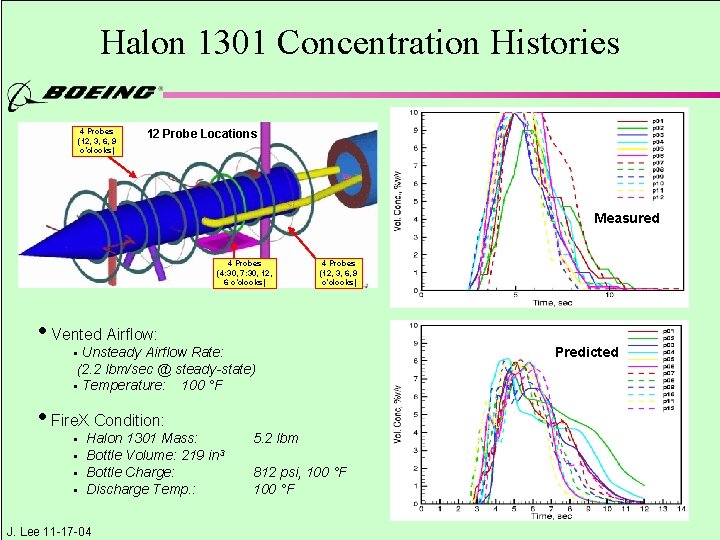
Halon 1301 Concentration Histories 4 Probes (12, 3, 6, 9 o’clocks) 12 Probe Locations Measured 4 Probes (4: 30, 7: 30, 12, 6 o’clocks) 4 Probes (12, 3, 6, 9 o’clocks) • Vented Airflow: Unsteady Airflow Rate: (2. 2 lbm/sec @ steady-state) § Temperature: 100 °F § • Fire. X Condition: § § Halon 1301 Mass: Bottle Volume: 219 in 3 Bottle Charge: Discharge Temp. : J. Lee 11 -17 -04 5. 2 lbm 812 psi, 100 °F Predicted
Validation Application - Case 2 (APU Compartment) Initial Airflow Pattern Surface Mesh Side View Top View t = 0. 30 sec after injection J. Lee 11 -17 -04
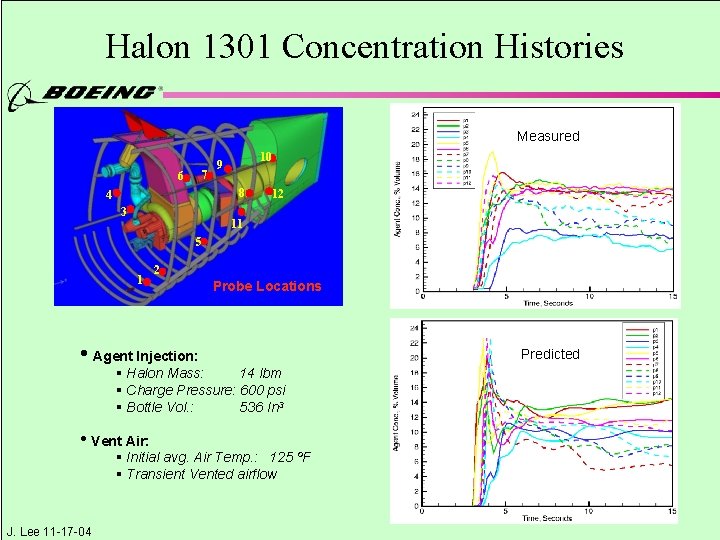
Halon 1301 Concentration Histories Measured 7 6 10 9 8 4 3 12 11 5 1 2 Probe Locations • Agent Injection: § Halon Mass: 14 lbm § Charge Pressure: 600 psi § Bottle Vol. : 536 In 3 • Vent Air: § Initial avg. Air Temp. : 125 ºF § Transient Vented airflow J. Lee 11 -17 -04 Predicted
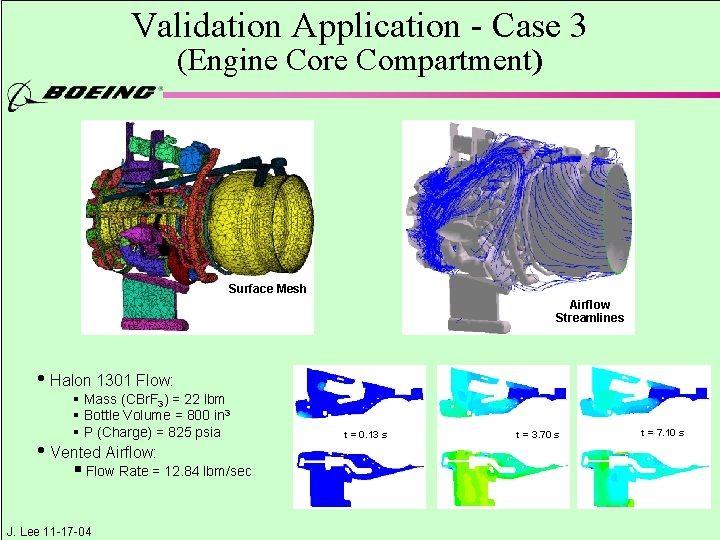
Validation Application - Case 3 (Engine Core Compartment) Surface Mesh Airflow Streamlines • Halon 1301 Flow: § Mass (CBr. F 3) = 22 lbm § Bottle Volume = 800 in 3 § P (Charge) = 825 psia • Vented Airflow: § Flow Rate = 12. 84 lbm/sec J. Lee 11 -17 -04 t = 0. 13 s t = 3. 70 s t = 7. 10 s
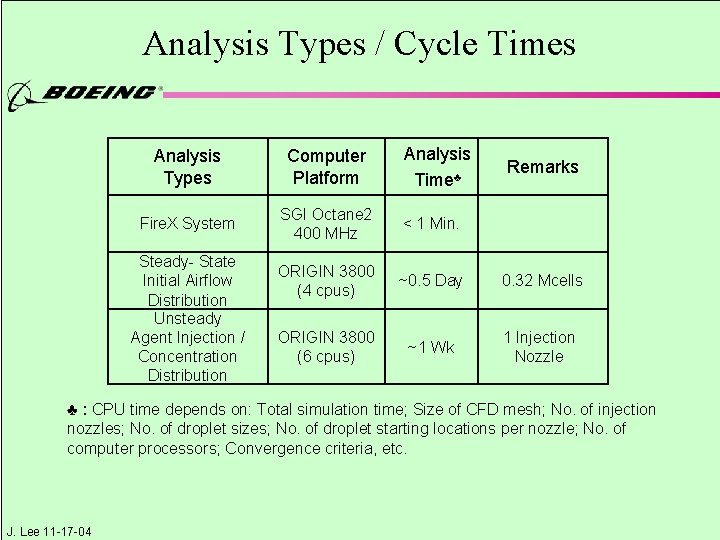
Analysis Types / Cycle Times Analysis Time♣ Analysis Types Computer Platform Fire. X System SGI Octane 2 400 MHz < 1 Min. ORIGIN 3800 (4 cpus) ~0. 5 Day 0. 32 Mcells ORIGIN 3800 (6 cpus) ~1 Wk 1 Injection Nozzle Steady- State Initial Airflow Distribution Unsteady Agent Injection / Concentration Distribution Remarks ♣ : CPU time depends on: Total simulation time; Size of CFD mesh; No. of injection nozzles; No. of droplet sizes; No. of droplet starting locations per nozzle; No. of computer processors; Convergence criteria, etc. J. Lee 11 -17 -04
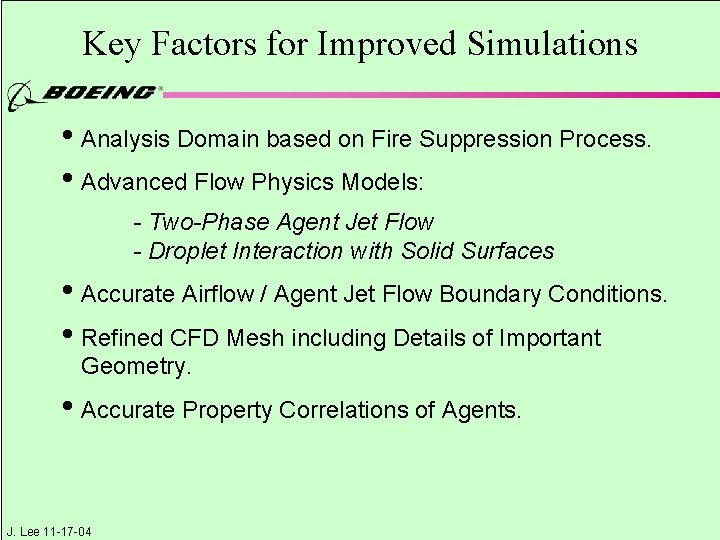
Key Factors for Improved Simulations • Analysis Domain based on Fire Suppression Process. • Advanced Flow Physics Models: - Two-Phase Agent Jet Flow - Droplet Interaction with Solid Surfaces • Accurate Airflow / Agent Jet Flow Boundary Conditions. • Refined CFD Mesh including Details of Important Geometry. • Accurate Property Correlations of Agents. J. Lee 11 -17 -04
Conclusions • Simulation Methods for Fire Suppression Process inside Aircraft Propulsion Systems have been Developed. • The Capabilities of the Methods have been Demonstrated by Simulating the Fire. X Tests of Engines and APUs. • Predicted Concentration Histories are well Correlated with Measured Data. • The Simulation Methods need to be Improved for More Accurate Prediction of Concentration Histories. J. Lee 11 -17 -04
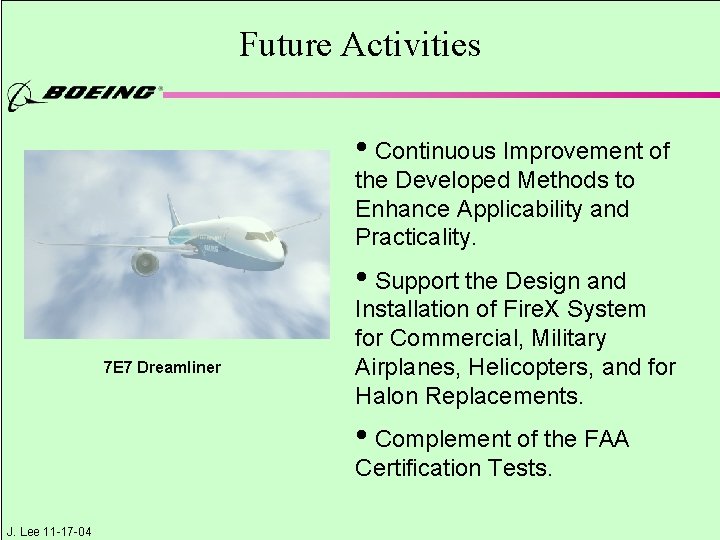
Future Activities • Continuous Improvement of the Developed Methods to Enhance Applicability and Practicality. • Support the Design and 7 E 7 Dreamliner Installation of Fire. X System for Commercial, Military Airplanes, Helicopters, and for Halon Replacements. • Complement of the FAA Certification Tests. J. Lee 11 -17 -04