
Simulation in ALICE Andreas Morsch For the ALICE

- Slides: 16
Simulation in ALICE Andreas Morsch For the ALICE Offline Project 2003 Conference for Computing in High Energy and Nuclear Physics Andreas Morsch, CERN EP/AIP CHEP 2003
Topics ● ALICE Simulation Strategy ● Simulation in the Ali. Root Framework ● Virtual MC ● Event Generator Interfaces Andreas Morsch, CERN EP/AIP CHEP 2003
ALICE Simulation Strategy (1) ● ● Coherent simulation framework for detector and physics performance studies in the Ali. Root Framework based on ROOT – Physics simulation – Detailed detector response simulation – Fast simulation Use of Transport MC transparent to the user – Virtual MC Interface ● Maximum reuse of user code ● One single development line (in C++) Andreas Morsch, CERN EP/AIP CHEP 2003
ALICE Simulation Strategy (2) ● ● Event Generator Interface tailored to the needs of the Heavy Ion Physics Community – Soft Uncorrelated Background ⊕ Correlations ⊕ Hard Processes – Maximum of flexibility and user configuration capabilities Monte Carlo Truth – Full history from primary particles (partons) to hits available after simulation. Andreas Morsch, CERN EP/AIP CHEP 2003
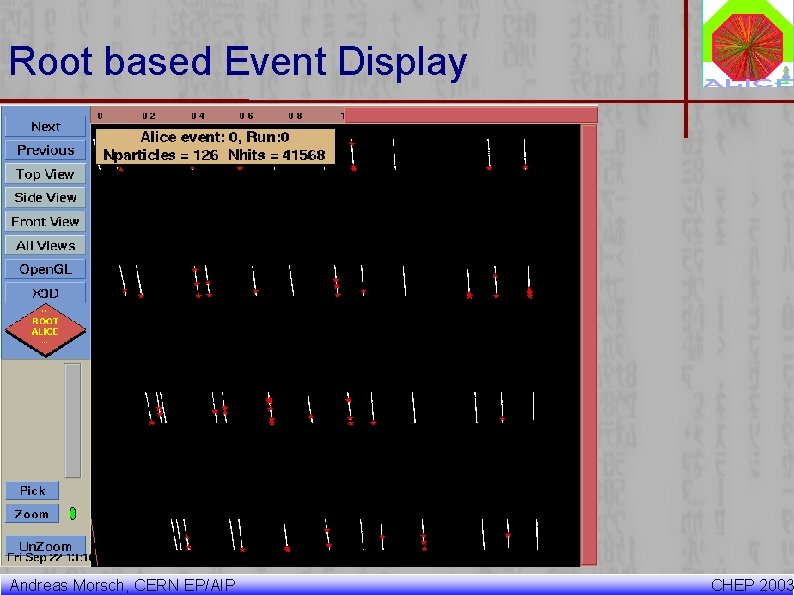
Root based Event Display Andreas Morsch, CERN EP/AIP CHEP 2003
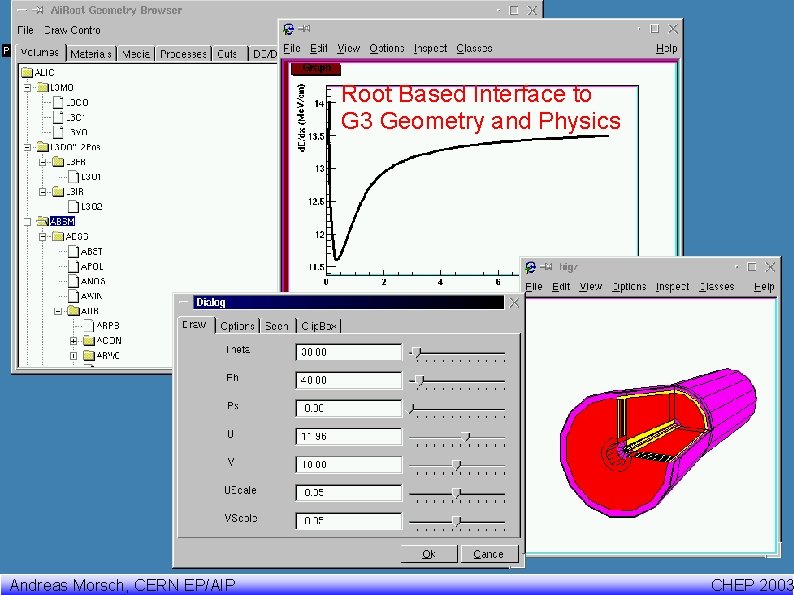
Root Based Interface to G 3 Geometry and Physics Andreas Morsch, CERN EP/AIP CHEP 2003
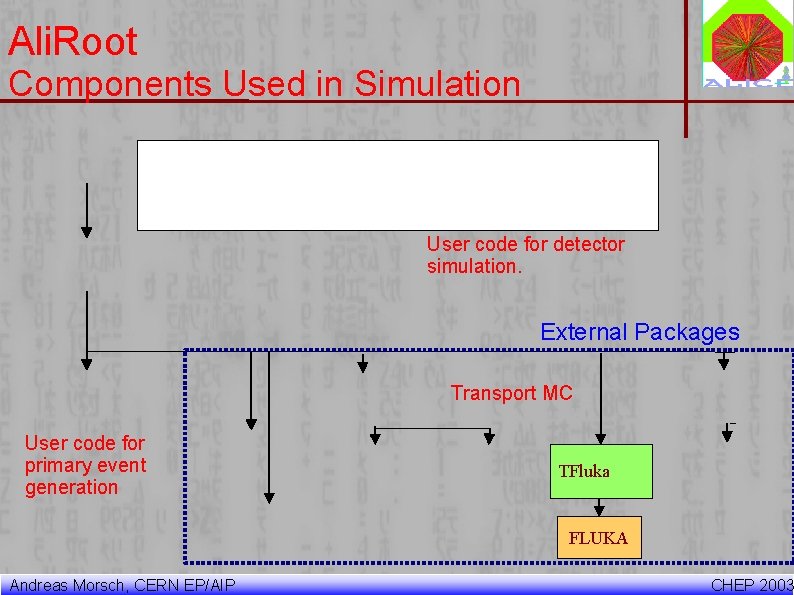
Ali. Root Components Used in Simulation User code for detector simulation. External Packages Transport MC User code for primary event generation TFluka FLUKA Andreas Morsch, CERN EP/AIP CHEP 2003
Virtual Monte Carlo (VMC) See presentation by Ivana Hrivnacova See presentation by Andrei Gheata Andreas Morsch, CERN EP/AIP CHEP 2003
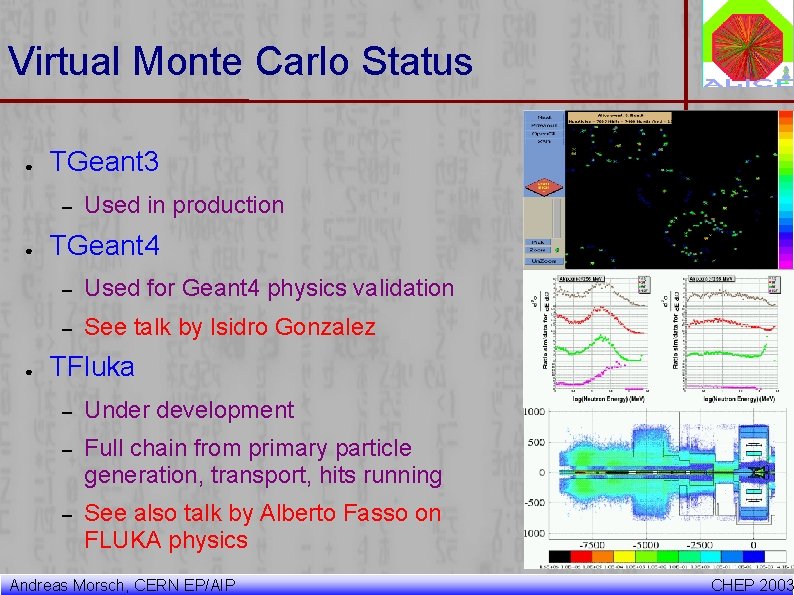
Virtual Monte Carlo Status ● TGeant 3 – ● ● Used in production TGeant 4 – Used for Geant 4 physics validation – See talk by Isidro Gonzalez TFluka – Under development – Full chain from primary particle generation, transport, hits running – See also talk by Alberto Fasso on FLUKA physics Andreas Morsch, CERN EP/AIP CHEP 2003
Simulation of Heavy Ion Collisions ● ● Shortcomings of existing generators – None of the existing generators do give detailed account of the expected multiplicities, pt and rapidity dependence at LHC energies – Most of the hard probes (heavy flavor, jets. . . ) are not properly reproduced by existing generators. – Existing generators do not provide for event topologies like momentum correlations, azimuthal flow etc. The small cross-section of hard processes would demand prohibitively long runs to simulate a number of events that is commensurable with the expected number of detected events in the experiment Andreas Morsch, CERN EP/AIP CHEP 2003
The ALICE Approach ● ● ● The simulation framework provides an interface to external generators, like HIJING. A parameterised “signal free” underlying event with multiplicity as a parameter is provided. Rare signals can be generated using – External generators like PYTHIA – Libraries of parameterised pt and rapidity distributions The framework provides a tool to assemble events from different signal generators – On the primary particle level (cocktail) – On the digit level (merging) After-Burners are used to introduce particle correlations. Andreas Morsch, CERN EP/AIP CHEP 2003
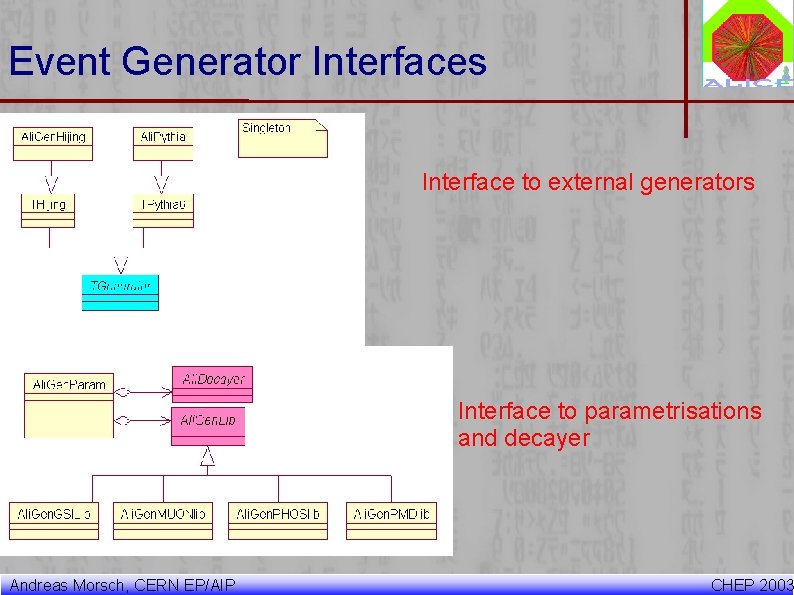
Event Generator Interfaces Interface to external generators Interface to parametrisations and decayer Andreas Morsch, CERN EP/AIP CHEP 2003
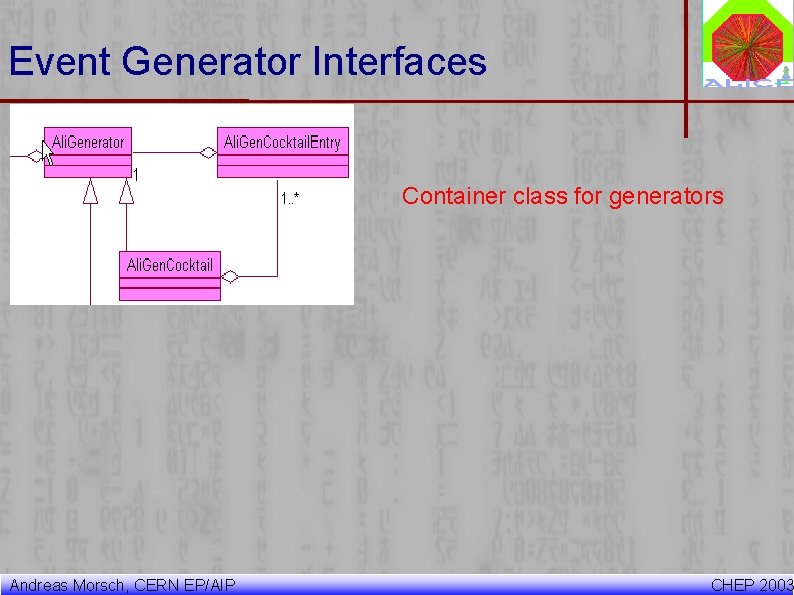
Event Generator Interfaces Container class for generators Andreas Morsch, CERN EP/AIP CHEP 2003
Afterburner Processors ● ● Introduction of correlations in otherwise uncorrelated events – 2 particle correlations – Flow – Assembling of new events Design of classes involved in event generation (Ali. Run, Ali. Stack, Ali. Generator) supports requirements for Afterburner – Example: Several objects of type Ali. Stack containing the input events can be connected to the Afterburner (of type Ali. Generator) to fill a stack connected to Ali. Run (output event) Andreas Morsch, CERN EP/AIP CHEP 2003
Fast Simulation ● As many approaches as subdetectors. ● Two main applications in ALICE: – Very fast simulation ● – Smearing of track parameters from paramterisation obtained from slow simulation Combined slow and fast simulation ● Detailed simulation of inner detector system (vertexing) and fast simulation of TPC response (momentum resolution) Andreas Morsch, CERN EP/AIP CHEP 2003
Conclusions ● ● The ALICE Offline Project has developed a coherent simulation framework for detector and physics performance studies in the Ali. Root Framework based on ROOT The main simulation components are – – Virtual MC Interface ● TGeant 3 (production) ● TGeant 4 (physics validation) ● TFluka (implementation ongoing) Event generator interfaces tailored to the needs of the heavy ion community Andreas Morsch, CERN EP/AIP CHEP 2003