
Simulation Codes in Accelerator Physics the n source
- Slides: 17
Simulation Codes in Accelerator Physics (the n source example) V. Daniel Elvira Fermilab October 19 th, 2000 V. Daniel Elvira 1
Outline • The neutrino source/muon collider studies • Technical computing challenges • Software: simulation packages • Computational resources • Conclusions October 19 th, 2000 V. Daniel Elvira 2
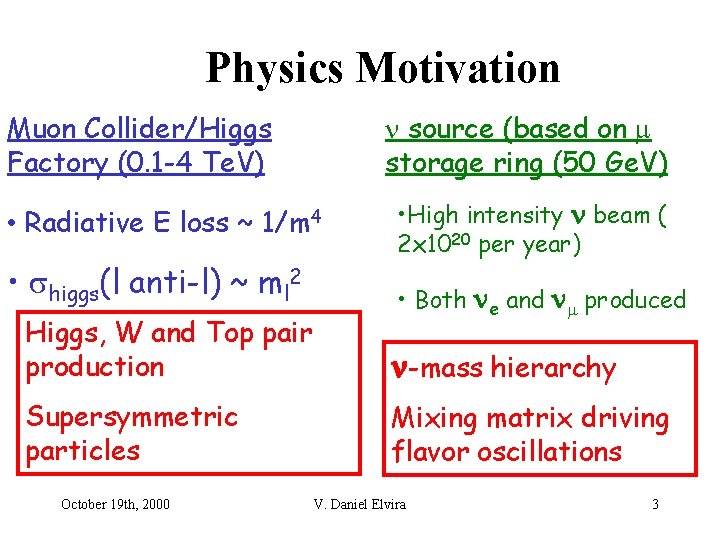
Physics Motivation Muon Collider/Higgs Factory (0. 1 -4 Te. V) n source (based on m storage ring (50 Ge. V) • Radiative E loss ~ 1/m 4 • shiggs(l anti-l) ~ ml 2 • High intensity n beam ( 2 x 10²⁰ per year) • Both ne and nm produced Higgs, W and Top pair production n-mass hierarchy Supersymmetric particles Mixing matrix driving flavor oscillations October 19 th, 2000 V. Daniel Elvira 3
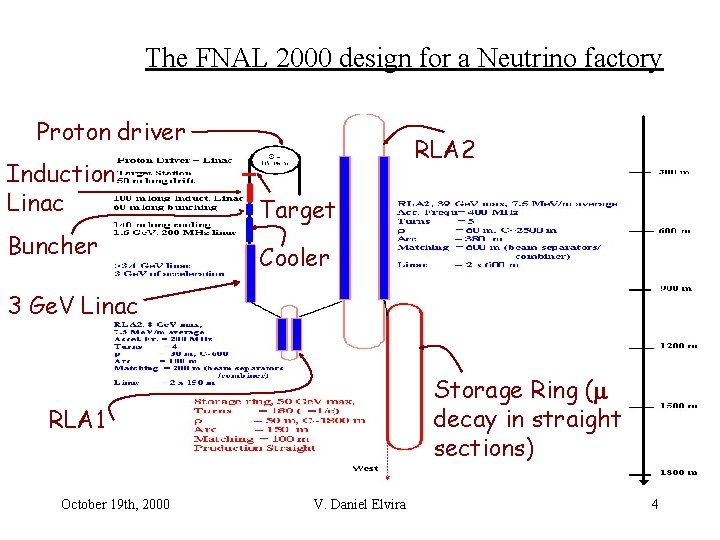
The FNAL 2000 design for a Neutrino factory Proton driver RLA 2 Induction Linac Target Buncher Cooler 3 Ge. V Linac Storage Ring (m decay in straight sections) RLA 1 October 19 th, 2000 V. Daniel Elvira 4
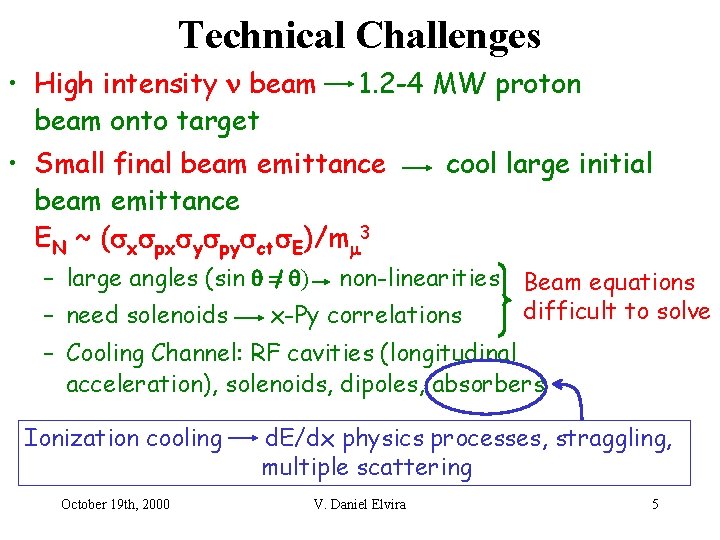
Technical Challenges • High intensity n beam onto target 1. 2 -4 MW proton • Small final beam emittance EN ~ (sxspxsyspyscts. E)/mm 3 cool large initial – large angles (sin q = q) – need solenoids non-linearities Beam equations difficult to solve x-Py correlations – Cooling Channel: RF cavities (longitudinal acceleration), solenoids, dipoles, absorbers Ionization cooling October 19 th, 2000 d. E/dx physics processes, straggling, multiple scattering V. Daniel Elvira 5
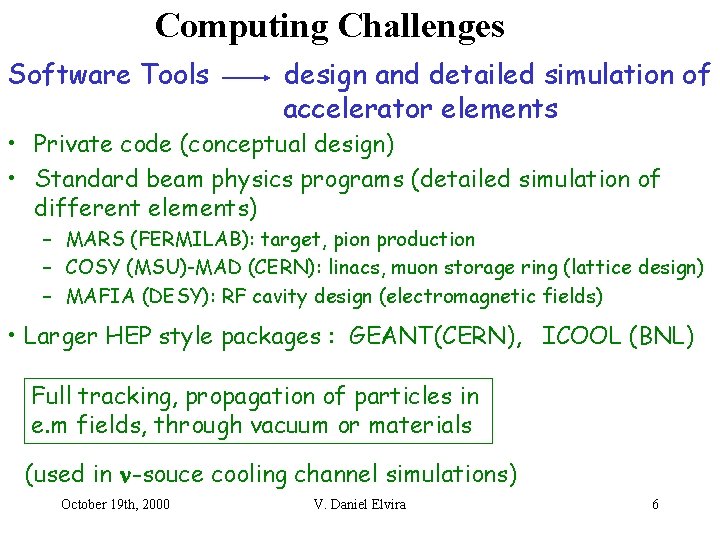
Computing Challenges Software Tools design and detailed simulation of accelerator elements • Private code (conceptual design) • Standard beam physics programs (detailed simulation of different elements) – MARS (FERMILAB): target, pion production – COSY (MSU)-MAD (CERN): linacs, muon storage ring (lattice design) – MAFIA (DESY): RF cavity design (electromagnetic fields) • Larger HEP style packages : GEANT(CERN), ICOOL (BNL) Full tracking, propagation of particles in e. m fields, through vacuum or materials (used in n-souce cooling channel simulations) October 19 th, 2000 V. Daniel Elvira 6
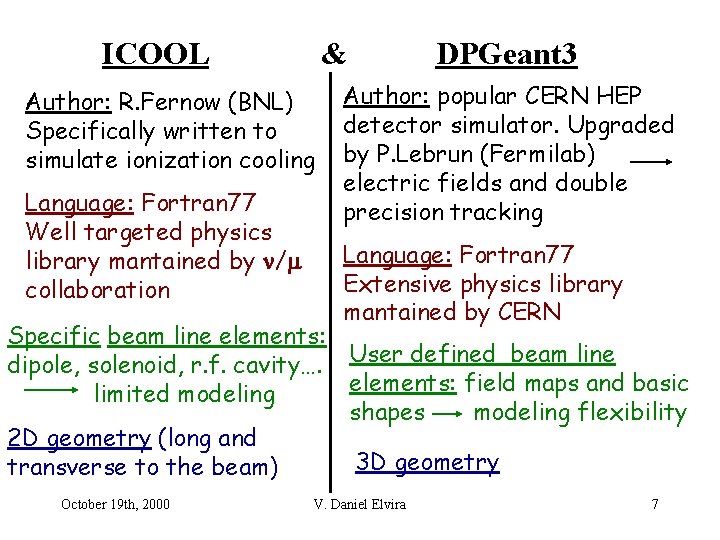
ICOOL & Author: R. Fernow (BNL) Specifically written to simulate ionization cooling Language: Fortran 77 Well targeted physics library mantained by n/m collaboration DPGeant 3 Author: popular CERN HEP detector simulator. Upgraded by P. Lebrun (Fermilab) electric fields and double precision tracking Language: Fortran 77 Extensive physics library mantained by CERN Specific beam line elements: dipole, solenoid, r. f. cavity…. User defined beam line elements: field maps and basic limited modeling shapes modeling flexibility 2 D geometry (long and 3 D geometry transverse to the beam) October 19 th, 2000 V. Daniel Elvira 7
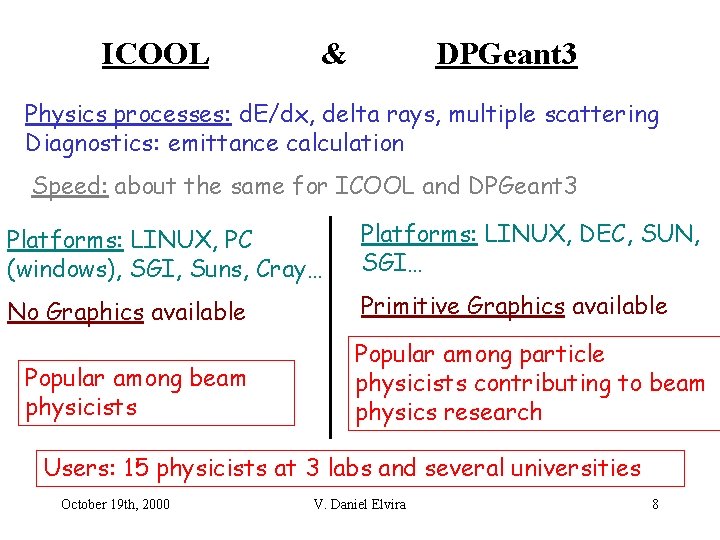
ICOOL & DPGeant 3 Physics processes: d. E/dx, delta rays, multiple scattering Diagnostics: emittance calculation Speed: about the same for ICOOL and DPGeant 3 Platforms: LINUX, PC (windows), SGI, Suns, Cray… Platforms: LINUX, DEC, SUN, SGI… No Graphics available Primitive Graphics available Popular among beam physicists Popular among particle physicists contributing to beam physics research Users: 15 physicists at 3 labs and several universities October 19 th, 2000 V. Daniel Elvira 8
Hardware Resources • Conceptual designs (desktop/laptop machines adequate) Thousands of particles ~ minutes/hours • Optimization (multi-parameter space) Small farm required ~ hours • Space Charge Studies more will be needed (farms of tightly coupled systems) October 19 th, 2000 V. Daniel Elvira 9
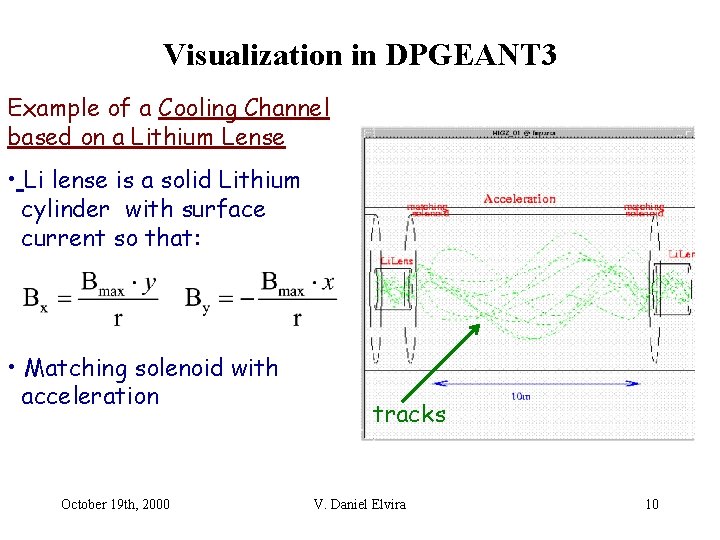
Visualization in DPGEANT 3 Example of a Cooling Channel based on a Lithium Lense • Li lense is a solid Lithium cylinder with surface current so that: • Matching solenoid with acceleration October 19 th, 2000 tracks V. Daniel Elvira 10
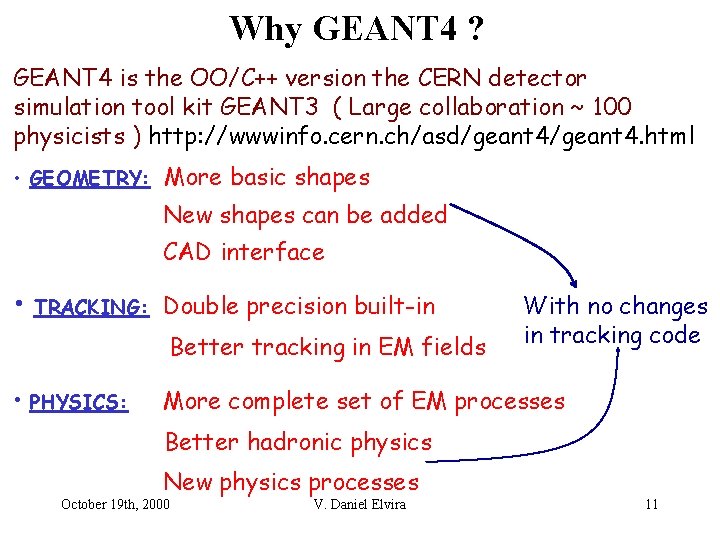
Why GEANT 4 ? GEANT 4 is the OO/C++ version the CERN detector simulation tool kit GEANT 3 ( Large collaboration ~ 100 physicists ) http: //wwwinfo. cern. ch/asd/geant 4. html • GEOMETRY: More basic shapes New shapes can be added CAD interface • TRACKING: Double precision built-in Better tracking in EM fields • PHYSICS: With no changes in tracking code More complete set of EM processes Better hadronic physics New physics processes October 19 th, 2000 V. Daniel Elvira 11
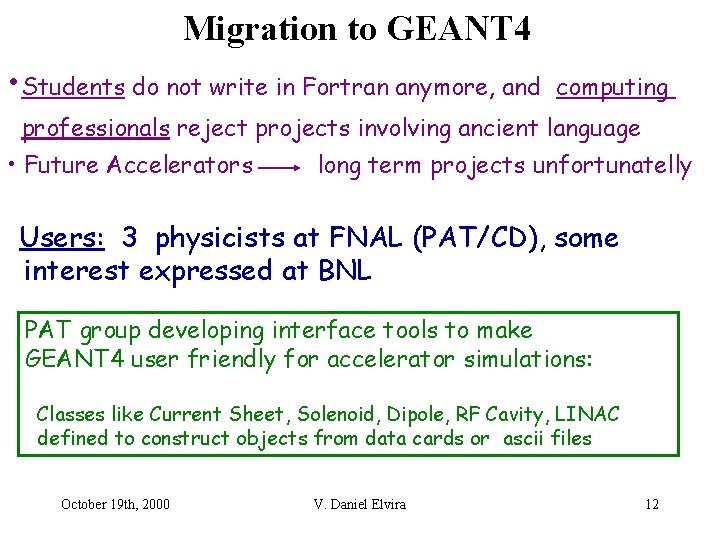
Migration to GEANT 4 • Students do not write in Fortran anymore, and computing professionals reject projects involving ancient language • Future Accelerators long term projects unfortunatelly Users: 3 physicists at FNAL (PAT/CD), some interest expressed at BNL PAT group developing interface tools to make GEANT 4 user friendly for accelerator simulations: Classes like Current Sheet, Solenoid, Dipole, RF Cavity, LINAC defined to construct objects from data cards or ascii files October 19 th, 2000 V. Daniel Elvira 12
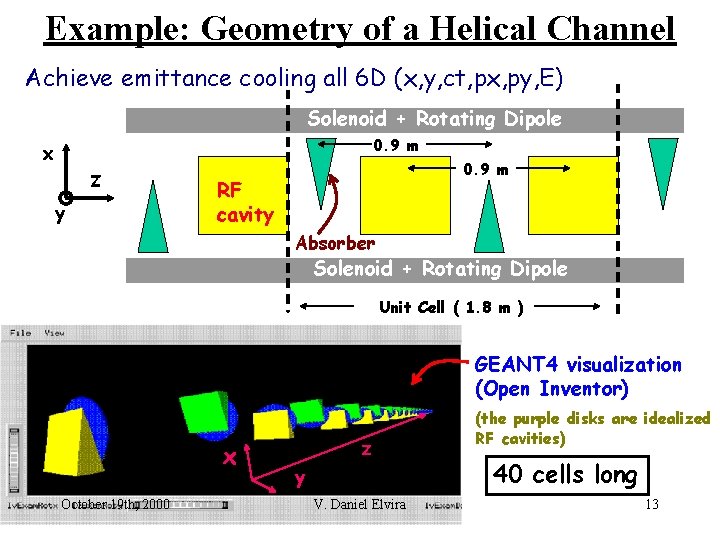
Example: Geometry of a Helical Channel Achieve emittance cooling all 6 D (x, y, ct, px, py, E) Solenoid + Rotating Dipole 0. 9 m x Z y 0. 9 m RF cavity Absorber Solenoid + Rotating Dipole Unit Cell ( 1. 8 m ) GEANT 4 visualization (Open Inventor) x October 19 th, 2000 z y V. Daniel Elvira (the purple disks are idealized RF cavities) 40 cells long 13
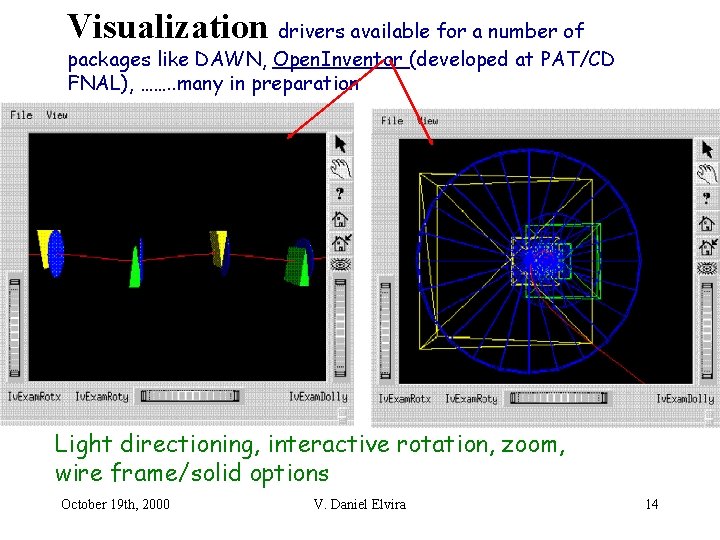
Visualization drivers available for a number of packages like DAWN, Open. Inventor (developed at PAT/CD FNAL), ……. . many in preparation Light directioning, interactive rotation, zoom, wire frame/solid options October 19 th, 2000 V. Daniel Elvira 14
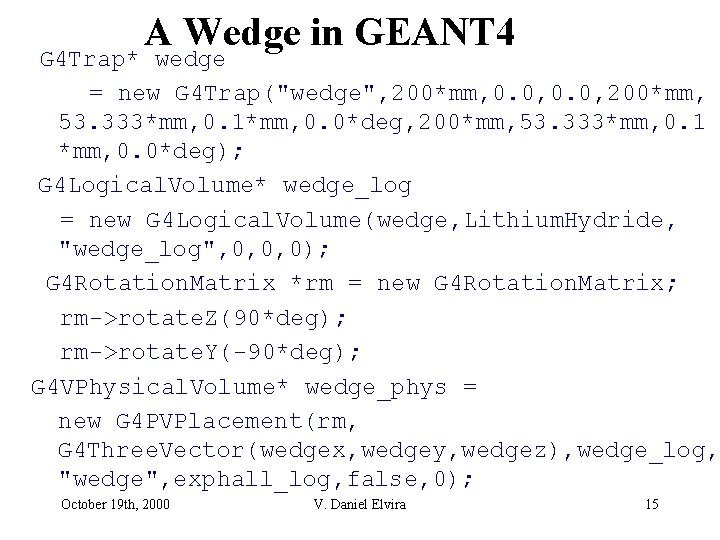
A Wedge in GEANT 4 G 4 Trap* wedge = new G 4 Trap("wedge", 200*mm, 0. 0, 200*mm, 53. 333*mm, 0. 1*mm, 0. 0*deg, 200*mm, 53. 333*mm, 0. 1 *mm, 0. 0*deg); G 4 Logical. Volume* wedge_log = new G 4 Logical. Volume(wedge, Lithium. Hydride, "wedge_log", 0, 0, 0); G 4 Rotation. Matrix *rm = new G 4 Rotation. Matrix; rm->rotate. Z(90*deg); rm->rotate. Y(-90*deg); G 4 VPhysical. Volume* wedge_phys = new G 4 PVPlacement(rm, G 4 Three. Vector(wedgex, wedgey, wedgez), wedge_log, "wedge", exphall_log, false, 0); October 19 th, 2000 V. Daniel Elvira 15
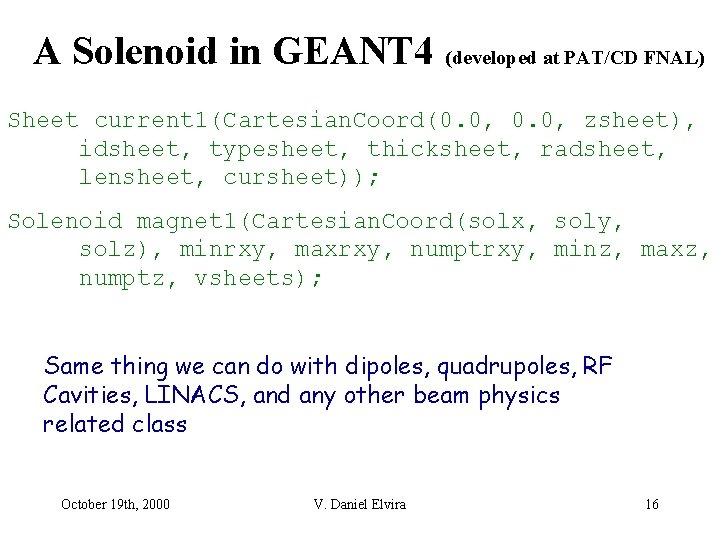
A Solenoid in GEANT 4 (developed at PAT/CD FNAL) Sheet current 1(Cartesian. Coord(0. 0, zsheet), idsheet, typesheet, thicksheet, radsheet, lensheet, cursheet)); Solenoid magnet 1(Cartesian. Coord(solx, soly, solz), minrxy, maxrxy, numptrxy, minz, maxz, numptz, vsheets); Same thing we can do with dipoles, quadrupoles, RF Cavities, LINACS, and any other beam physics related class October 19 th, 2000 V. Daniel Elvira 16
Conclusions • Future accelerators problems complex technological • Demand for HEP style multidisciplinary packages (beam, particle, plasma physics) • In PAT/CD FERMILAB we are moving toward OO/C++ options (like GEANT 4) and developing beam physics related classes to help the user October 19 th, 2000 V. Daniel Elvira 17