
Simulation and Complexity how they might relate Bruce
Simulation and Complexity - how they might relate Bruce Edmonds Centre for Policy Modelling Manchester Metropolitan University Business School Simulation and Complexity - how they might relate, Oxford 2003, http: //cfpm. org/~bruce slide-1
Outline of Talk 1. A Simple Model of Modelling 2. What Really Happens 3. Consequences of Modelling Complex Phenomena 4. Constraining Our Models 5. Giving Our Models Meaning 6. Example Simulations Simulation and Complexity - how they might relate, Oxford 2003, http: //cfpm. org/~bruce slide-2 (Outline)
Some ‘Problems’ • Models that are plausible but with little relation to reality, used as conceptual or formal exploration but then projected upon reality • Types of models are confused in terms of use and judgement • Programming is much more accessible than doing mathematics - everyone can build a model and discover something Simulation and Complexity - how they might relate, Oxford 2003, http: //cfpm. org/~bruce slide-3
1. A Simple Model of Modelling Simulation and Complexity - how they might relate, Oxford 2003, http: //cfpm. org/~bruce slide-4
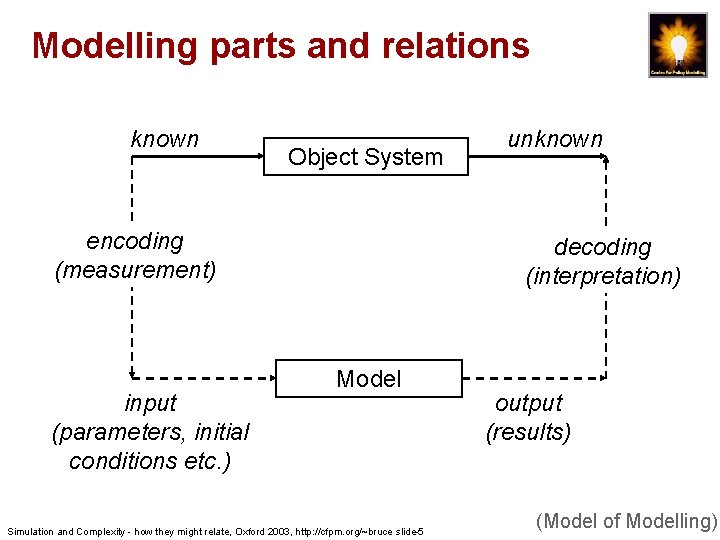
Modelling parts and relations known Object System encoding (measurement) input (parameters, initial conditions etc. ) unknown decoding (interpretation) Model Simulation and Complexity - how they might relate, Oxford 2003, http: //cfpm. org/~bruce slide-5 output (results) (Model of Modelling)
Some uses of simulation models • • Entertainment Art Illustration Mathematics Mediation Design Science – I. e. helping to understand phenomena Simulation and Complexity - how they might relate, Oxford 2003, http: //cfpm. org/~bruce slide-6
Some ‘scientific’ uses of modelling • Prediction – Provide information about a current unknown by inference from known information • Explanation – Provide an explanation why and how an outcome resulted from some conditions • Analogy – Provide a framework for (or a way of) thinking about a poorly understood or complex system Simulation and Complexity - how they might relate, Oxford 2003, http: //cfpm. org/~bruce slide-7 (Model of Modelling)
Some criteria for judging models • Soundness of design – w. r. t. knowledge of how the object works – w. r. t. tradition in a field • Accuracy (lack of error) • Simplicity (ease in communication, construction, comprehension etc. ) • Generality (when you can safely use it) • Sensitivity (relates to goals and object) • Plausibility (of design, process and results) • Cost (time, space etc. ) Simulation and Complexity - how they might relate, Oxford 2003, http: //cfpm. org/~bruce slide-8 (Model of Modelling)
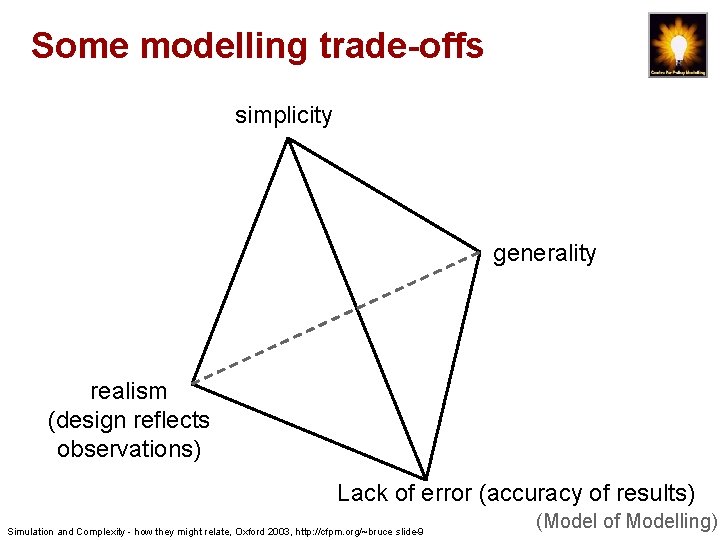
Some modelling trade-offs simplicity generality realism (design reflects observations) Lack of error (accuracy of results) Simulation and Complexity - how they might relate, Oxford 2003, http: //cfpm. org/~bruce slide-9 (Model of Modelling)
2. What Really Happens (even in the ‘hard’ sciences) Simulation and Complexity - how they might relate, Oxford 2003, http: //cfpm. org/~bruce slide-10
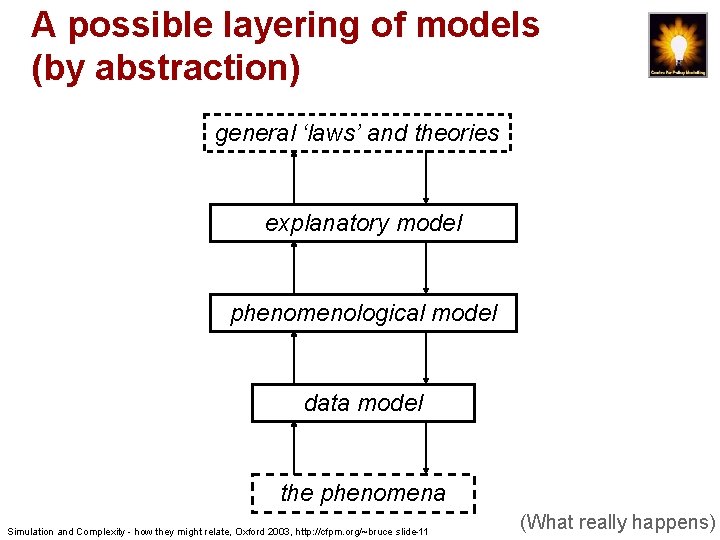
A possible layering of models (by abstraction) general ‘laws’ and theories explanatory model phenomenological model data model the phenomena Simulation and Complexity - how they might relate, Oxford 2003, http: //cfpm. org/~bruce slide-11 (What really happens)
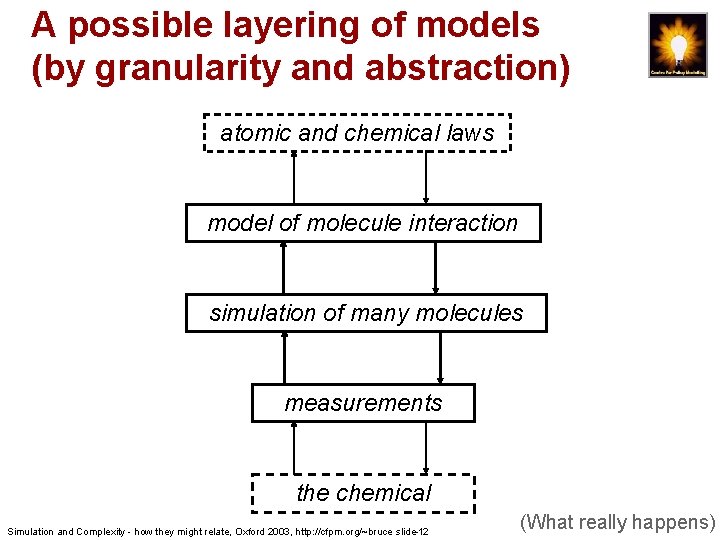
A possible layering of models (by granularity and abstraction) atomic and chemical laws model of molecule interaction simulation of many molecules measurements the chemical Simulation and Complexity - how they might relate, Oxford 2003, http: //cfpm. org/~bruce slide-12 (What really happens)
Multiple models • Parallel models – e. g. different models gained by different approaches and simplifications, whose results are compared (e. g. Lasers) • Context-specific models – e. g. quantum models in micro-world and relativistic models in macro-world • Clusters of models – e. g. use of analogical models alongside formal models in atomic physics Simulation and Complexity - how they might relate, Oxford 2003, http: //cfpm. org/~bruce slide-13 (What really happens)

3. Consequences of modelling complex phenomena Simulation and Complexity - how they might relate, Oxford 2003, http: //cfpm. org/~bruce slide-14
More complex models • Formal models that are too complex for analytic inference to be feasible – simulation models • Complexity and chaos means that the detailed interactions of parts can make a significant difference to results – compound models • What is required is not aggregate results but the detail of processes as they occur – detailed descriptive models Simulation and Complexity - how they might relate, Oxford 2003, http: //cfpm. org/~bruce slide-15 (consequences of complexity)
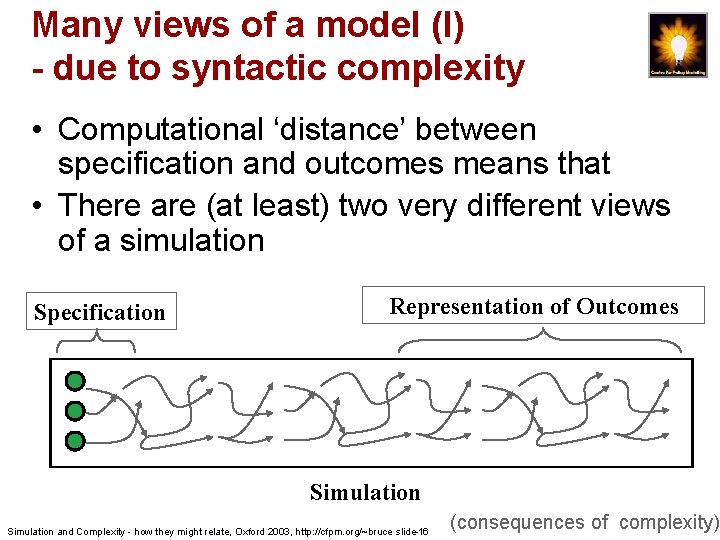
Many views of a model (I) - due to syntactic complexity • Computational ‘distance’ between specification and outcomes means that • There are (at least) two very different views of a simulation Specification Representation of Outcomes Simulation and Complexity - how they might relate, Oxford 2003, http: //cfpm. org/~bruce slide-16 (consequences of complexity)
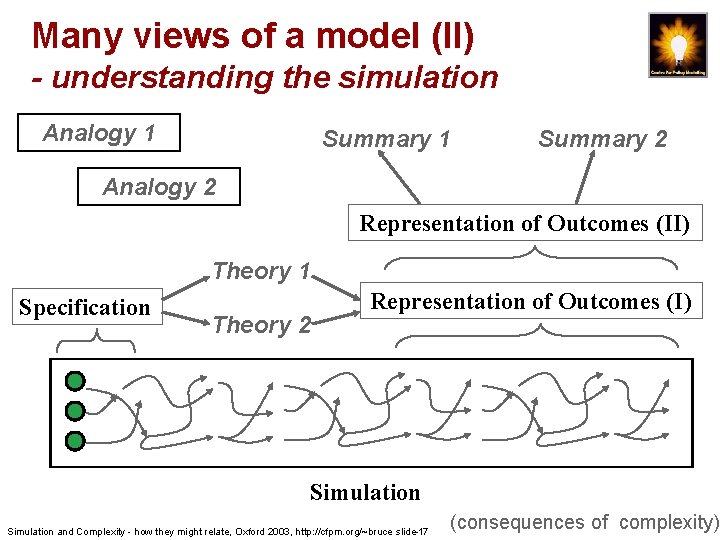
Many views of a model (II) - understanding the simulation Analogy 1 Summary 2 Analogy 2 Representation of Outcomes (II) Theory 1 Specification Theory 2 Representation of Outcomes (I) Simulation and Complexity - how they might relate, Oxford 2003, http: //cfpm. org/~bruce slide-17 (consequences of complexity)
Models are less general • Each model is of more limited applicability (e. g. a model of this kind of social influence in this situation) • Each model abstracts less from the phenomena (it is more descriptive in nature) • Different models for different purposes (rather than using a single model for all) Simulation and Complexity - how they might relate, Oxford 2003, http: //cfpm. org/~bruce slide-18 (consequences of complexity)
Many more models • • • Models at different levels of abstraction Models at different levels of granularity Parallel models to check results Models derived from different ‘views’ Complementary models covering different situations or contexts • Descriptive models of different instances • Analogical models • Different summaries of collections Simulation and Complexity - how they might relate, Oxford 2003, http: //cfpm. org/~bruce slide-19 (consequences of complexity)
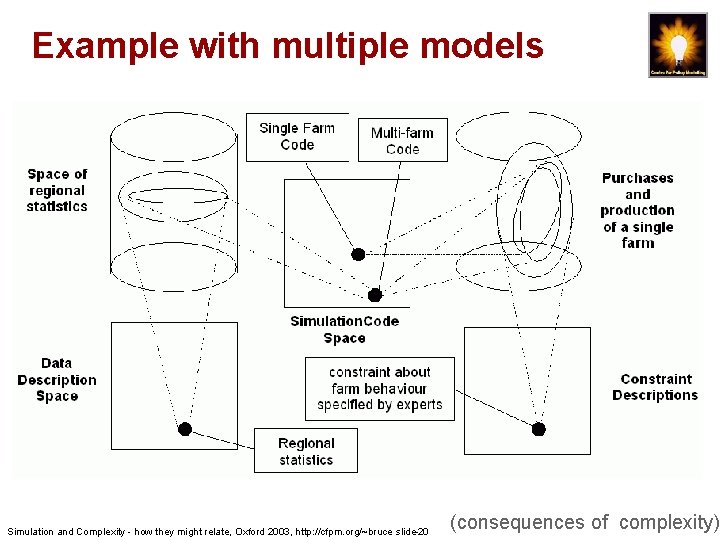
Example with multiple models Simulation and Complexity - how they might relate, Oxford 2003, http: //cfpm. org/~bruce slide-20 (consequences of complexity)
4. Constraining Our Models Simulation and Complexity - how they might relate, Oxford 2003, http: //cfpm. org/~bruce slide-21
A priori constraints on models • By what is feasible in terms of cost and time: ‘simplicity’ (e. g. computer simulation) • By the traditions of academic fields (e. g. utility optimising equilibrium models) • By already validated theoretical frameworks (e. g. atomic interaction, Newtonian physics) • By expert and stakeholder opinion • Observation of phenomena (including anecdotal evidence) Simulation and Complexity - how they might relate, Oxford 2003, http: //cfpm. org/~bruce slide-22 (constraining models)
Post hoc constraints • Accuracy in terms of low error • Consistency and coherence with other models and observations • Of: – Aggregate outcomes – Unfolding of simulation process (detail over time) – Behaviour of component parts (detail over model structure) Simulation and Complexity - how they might relate, Oxford 2003, http: //cfpm. org/~bruce slide-23 (constraining models)
Constraints on scope • Each layer of the abstraction modelling layer will only be able to safely abstract to a limited extent • Obligation to sketch out the conditions of applicability of simulation models • Abstracting out of the original context risks loosing the meaning of the model • Danger of the use of a model as an interactive analogy due to ‘theoretical spectacles’ effect Simulation and Complexity - how they might relate, Oxford 2003, http: //cfpm. org/~bruce slide-24 (constraining models)
5. Giving Our Models Meaning Simulation and Complexity - how they might relate, Oxford 2003, http: //cfpm. org/~bruce slide-25
Context • It is impossible to include all relevant causes in any one model (causal spread) • Constant or irrelevant factors can be omitted as long as the conditions under which the model works can be reliably recognised later so it can be applied • Set of all excluded factors can be abstracted to a (modelling) context • Meaning is bootstrapped from reference inside a specific (real) context Simulation and Complexity - how they might relate, Oxford 2003, http: //cfpm. org/~bruce slide-26 (Meaning)
Semantic complexity • The difficulty of interpreting a rich meaningful domain and descriptions into an impoverished formal model • Establishment of symbol meaning by: – Importing symbols from natural language – Use of symbols in context – Cycle of interaction and learning about symbols Simulation and Complexity - how they might relate, Oxford 2003, http: //cfpm. org/~bruce slide-27 (Meaning)
The token processing view • That an off-line computation can be viewed as a manipulation of tokens meaningful to humans (by its design) • This contrasts with mapping to world via data models (and measurement) • Model needs to be embedded in interaction with participants in adaptive cycles • All simulation models are somewhat in both ‘worlds’ Simulation and Complexity - how they might relate, Oxford 2003, http: //cfpm. org/~bruce slide-28 (Meaning)
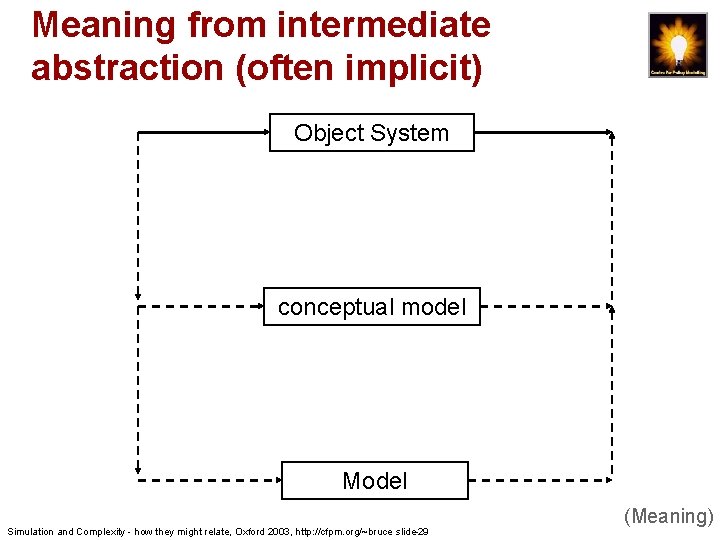
Meaning from intermediate abstraction (often implicit) Object System conceptual model Model Simulation and Complexity - how they might relate, Oxford 2003, http: //cfpm. org/~bruce slide-29 (Meaning)
6. Example Simulations Simulation and Complexity - how they might relate, Oxford 2003, http: //cfpm. org/~bruce slide-30
Example 1: a model of social influence and water demand • Investigate the possible impact of social influence between households on patterns of water consumption • Design and detailed behaviour from simulation validated against expert and stakeholder opinion at each stage • Some of the inputs are real data • Characteristics of resulting aggregate time series validated against similar real data Simulation and Complexity - how they might relate, Oxford 2003, http: //cfpm. org/~bruce slide-31 (Examples)
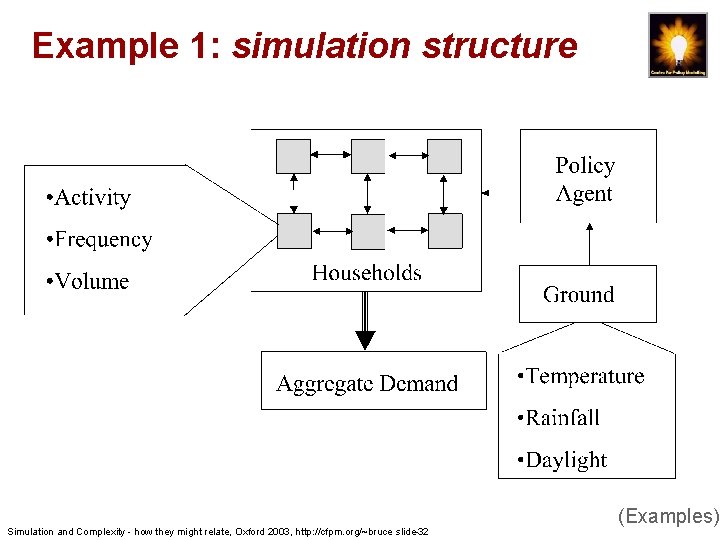
Example 1: simulation structure Simulation and Complexity - how they might relate, Oxford 2003, http: //cfpm. org/~bruce slide-32 (Examples)
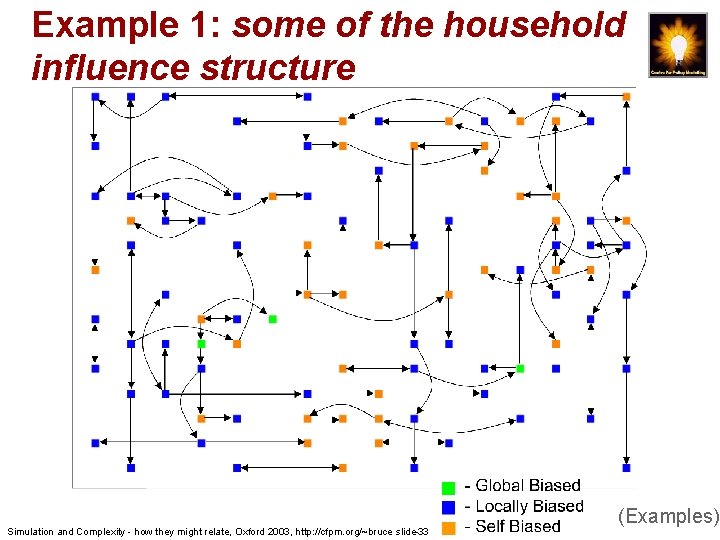
Example 1: some of the household influence structure Simulation and Complexity - how they might relate, Oxford 2003, http: //cfpm. org/~bruce slide-33 (Examples)
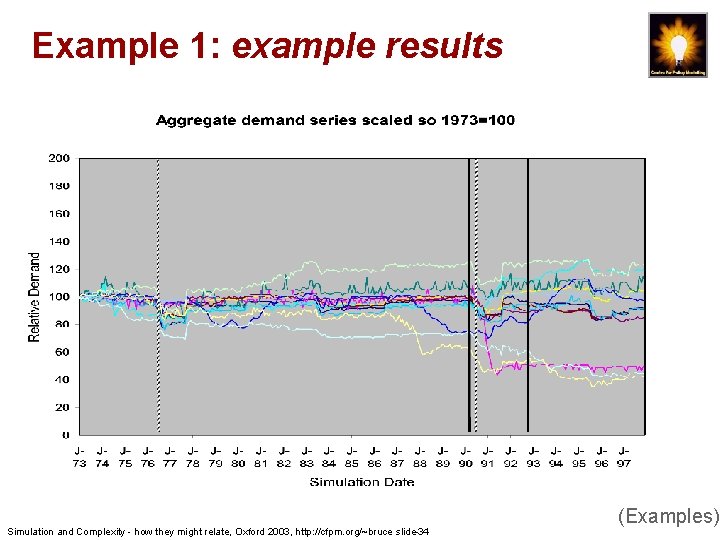
Example 1: example results Simulation and Complexity - how they might relate, Oxford 2003, http: //cfpm. org/~bruce slide-34 (Examples)
Example 1: Conclusions • The use of a concrete descriptive simulation model allowed the detailed criticism and, hence, improvement of the model • The inclusion of social influence resulted in aggregate water demand patterns with many of the characteristics of observed demand patterns • The model established how it was possible that processes of mutual social influence could result in widely differing patterns of consumption that were self-reinforcing Simulation and Complexity - how they might relate, Oxford 2003, http: //cfpm. org/~bruce slide-35 (Examples)
Example 2: integrating domain expertise and aggregate data • Meta-model (or abstract framework) relating a class of consumer preference models to aggregate price and demand time series • Within this marketing practitioner sets, focus brand, key characteristics, values of characteristic for brands (market context) • Within context practitioner investigates the relationship between particular consumer preference models and aggregate results Simulation and Complexity - how they might relate, Oxford 2003, http: //cfpm. org/~bruce slide-36 (Examples)
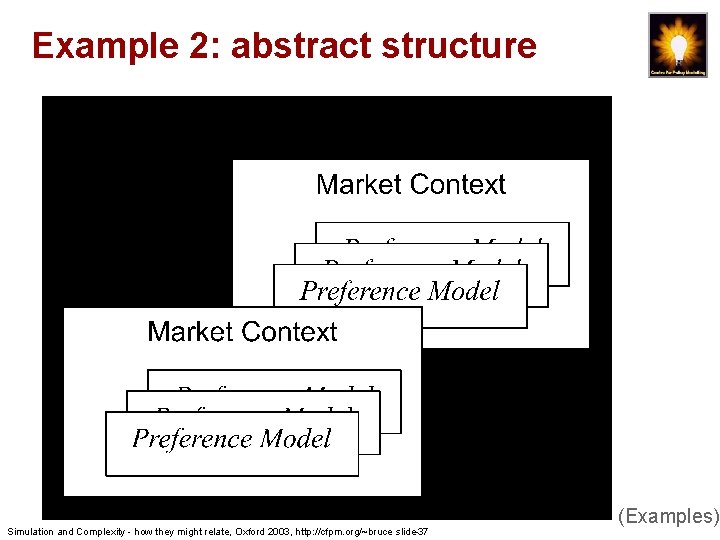
Example 2: abstract structure Simulation and Complexity - how they might relate, Oxford 2003, http: //cfpm. org/~bruce slide-37 (Examples)
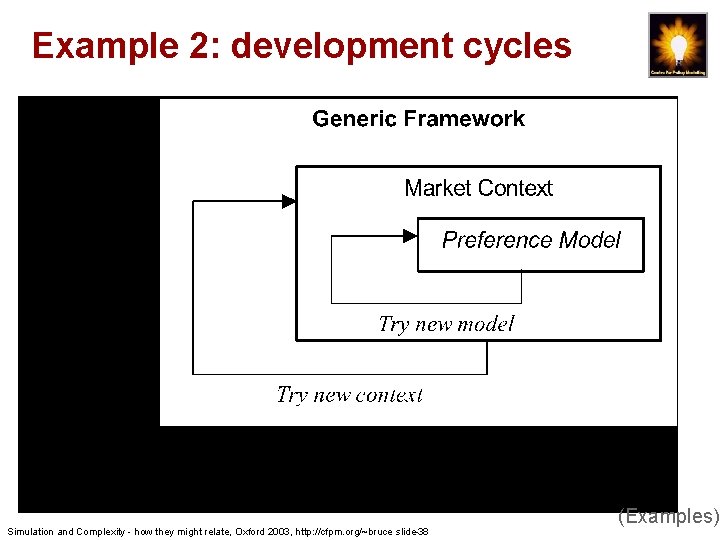
Example 2: development cycles Simulation and Complexity - how they might relate, Oxford 2003, http: //cfpm. org/~bruce slide-38 (Examples)
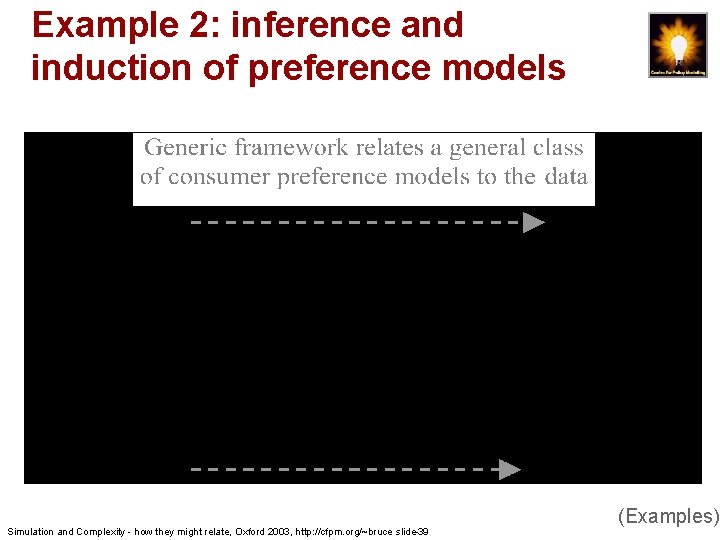
Example 2: inference and induction of preference models Simulation and Complexity - how they might relate, Oxford 2003, http: //cfpm. org/~bruce slide-39 (Examples)
Example 2: practitioner or expert specifies: • A list of labels for each of the brands to be considered • A list of labels for each of the relevant product characteristics that are judged to be used by consumers to distinguish between these brands • For each product: – For each characteristic: • A number representing the perceived intensity of that characteristic associated with that brand Simulation and Complexity - how they might relate, Oxford 2003, http: //cfpm. org/~bruce slide-40 (Examples)
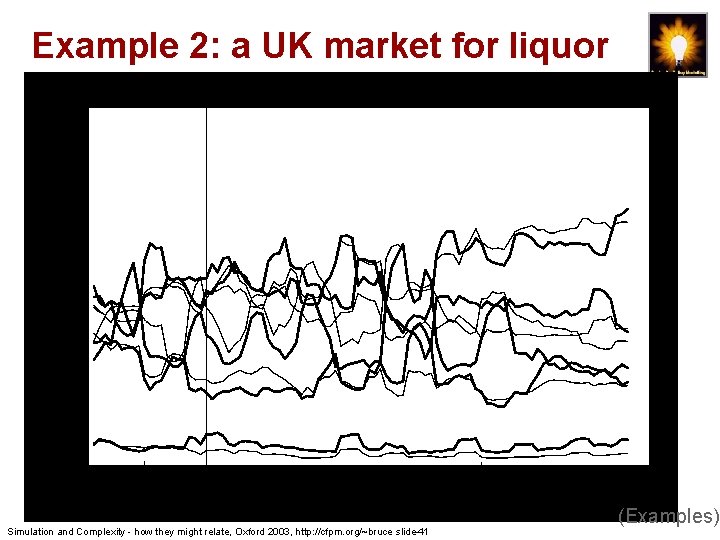
Example 2: a UK market for liquor Simulation and Complexity - how they might relate, Oxford 2003, http: //cfpm. org/~bruce slide-41 (Examples)
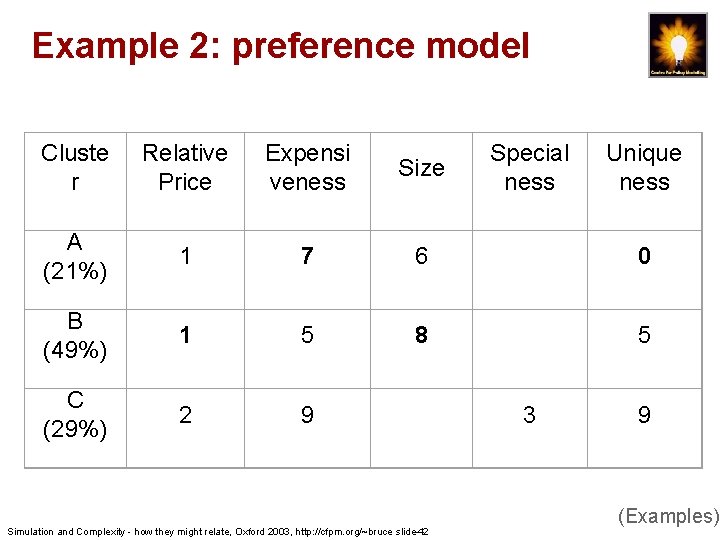
Example 2: preference model Cluste r Relative Price Expensi veness Size A (21%) 1 7 6 0 B (49%) 1 5 8 5 C (29%) 2 9 Simulation and Complexity - how they might relate, Oxford 2003, http: //cfpm. org/~bruce slide-42 Special ness 3 Unique ness 9 (Examples)
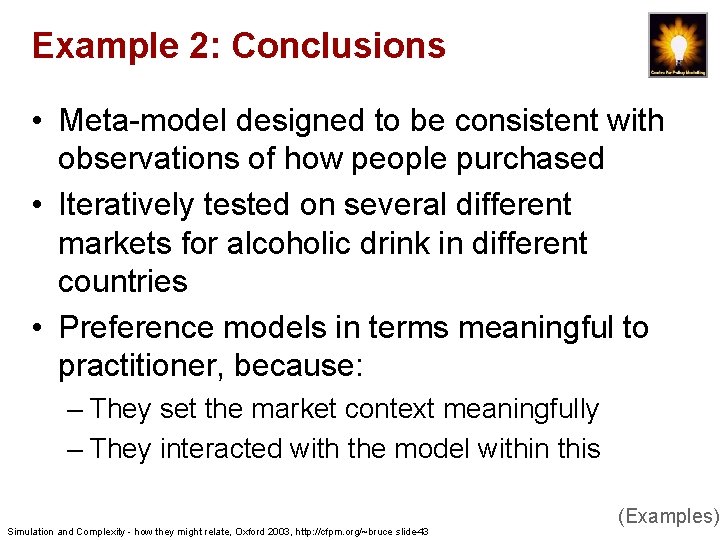
Example 2: Conclusions • Meta-model designed to be consistent with observations of how people purchased • Iteratively tested on several different markets for alcoholic drink in different countries • Preference models in terms meaningful to practitioner, because: – They set the market context meaningfully – They interacted with the model within this Simulation and Complexity - how they might relate, Oxford 2003, http: //cfpm. org/~bruce slide-43 (Examples)
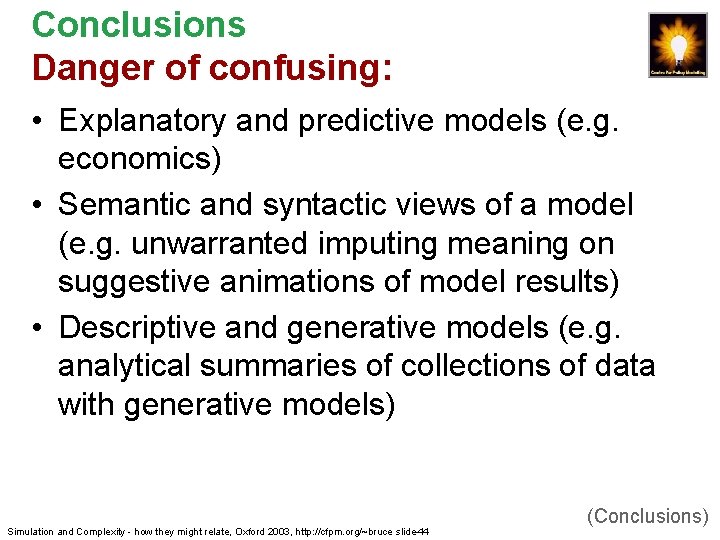
Conclusions Danger of confusing: • Explanatory and predictive models (e. g. economics) • Semantic and syntactic views of a model (e. g. unwarranted imputing meaning on suggestive animations of model results) • Descriptive and generative models (e. g. analytical summaries of collections of data with generative models) Simulation and Complexity - how they might relate, Oxford 2003, http: //cfpm. org/~bruce slide-44 (Conclusions)
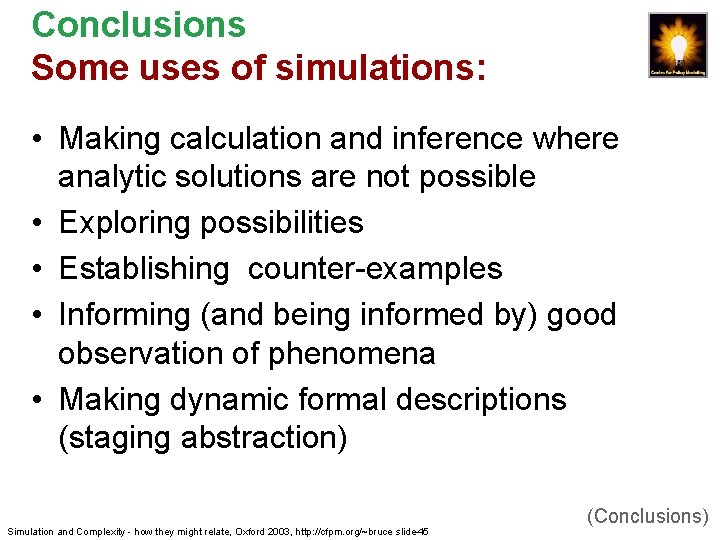
Conclusions Some uses of simulations: • Making calculation and inference where analytic solutions are not possible • Exploring possibilities • Establishing counter-examples • Informing (and being informed by) good observation of phenomena • Making dynamic formal descriptions (staging abstraction) Simulation and Complexity - how they might relate, Oxford 2003, http: //cfpm. org/~bruce slide-45 (Conclusions)
“Model 2 Model” workshop • Considering how simulation models might be related to each other • Particularly with respect to modelling social phenomena • To be held at CNRS, Marseilles, 31 st March and 1 st April 2003 • Deadline for submissions is past but attendance is free, (but tell us you are coming, there may even be free meals) http: //cfpm. org/m 2 m Simulation and Complexity - how they might relate, Oxford 2003, http: //cfpm. org/~bruce slide-46
The End Bruce Edmonds bruce. edmonds. name Centre for Policy Modelling cfpm. org Simulation and Complexity - how they might relate, Oxford 2003, http: //cfpm. org/~bruce slide-47
- Slides: 47