
Simulation and Analysis of Single Mode Semiconductor Laser
- Slides: 10
Simulation and Analysis of Single Mode Semiconductor Laser Course Project for EE 8114 Electrical Engineering Dept. Ryerson University Grace FENG
Outline of My Work Background Research on Fiber over Radio Close Study on the Simulink Based Semiconductor Laser Diode Model Repeat the Simulation Results from the Previous Work Build Simulation Functions to Analyze the Optical Response of the Laser Diode
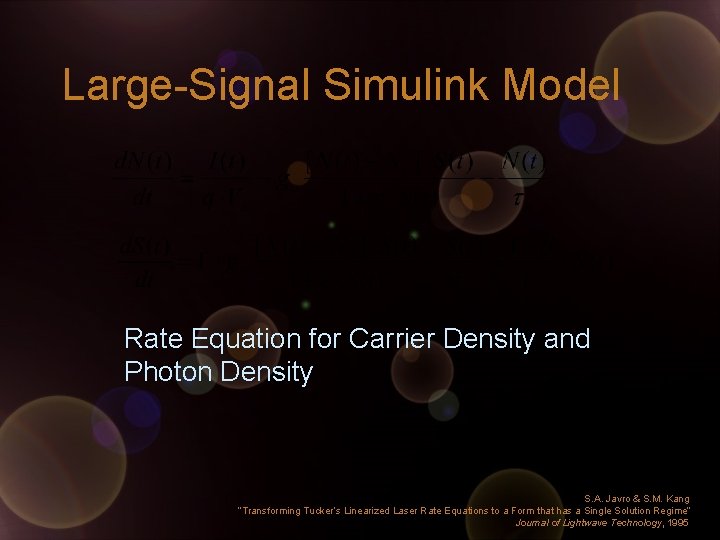
Large-Signal Simulink Model Rate Equation for Carrier Density and Photon Density S. A. Javro & S. M. Kang “Transforming Tucker’s Linearized Laser Rate Equations to a Form that has a Single Solution Regime” Journal of Lightwave Technology, 1995
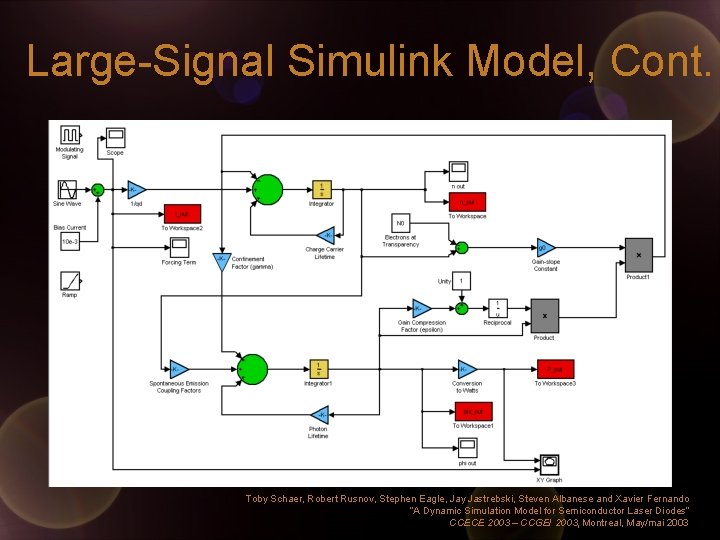
Large-Signal Simulink Model, Cont. Toby Schaer, Robert Rusnov, Stephen Eagle, Jay Jastrebski, Steven Albanese and Xavier Fernando “A Dynamic Simulation Model for Semiconductor Laser Diodes” CCECE 2003 – CCGEI 2003, Montreal, May/mai 2003
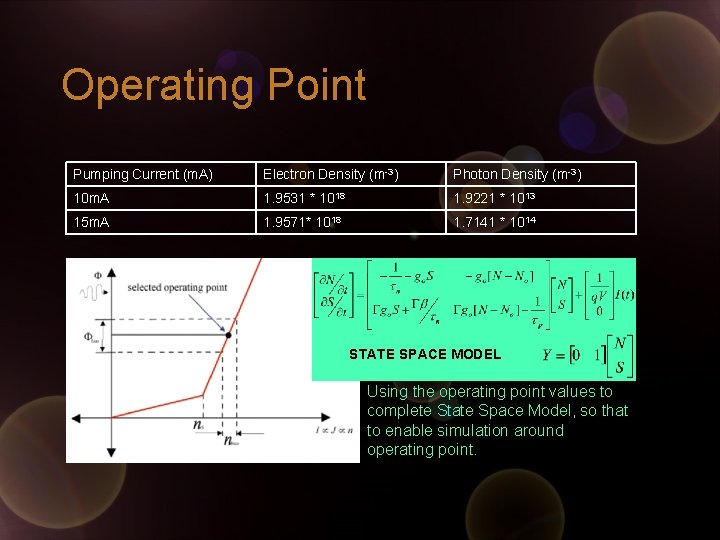
Operating Point Pumping Current (m. A) Electron Density (m-3) Photon Density (m-3) 10 m. A 1. 9531 * 1018 1. 9221 * 1013 15 m. A 1. 9571* 1018 1. 7141 * 1014 STATE SPACE MODEL Using the operating point values to complete State Space Model, so that to enable simulation around operating point.
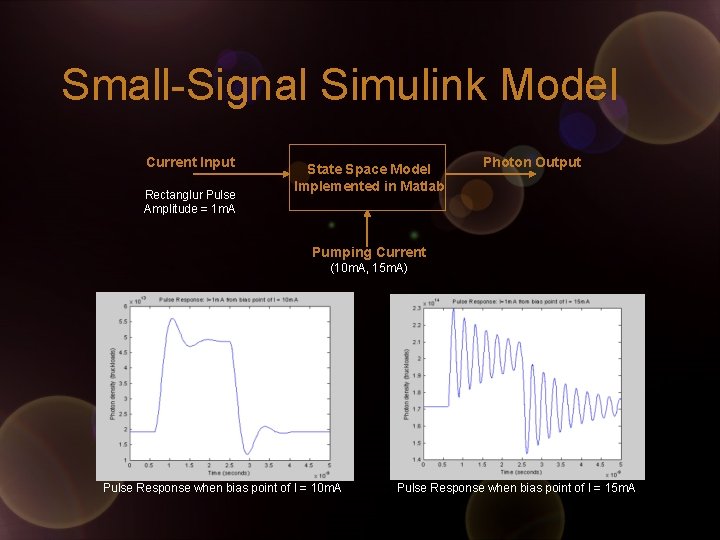
Small-Signal Simulink Model Current Input Rectanglur Pulse Amplitude = 1 m. A State Space Model Implemented in Matlab Photon Output Pumping Current (10 m. A, 15 m. A) Pulse Response when bias point of I = 10 m. A Pulse Response when bias point of I = 15 m. A
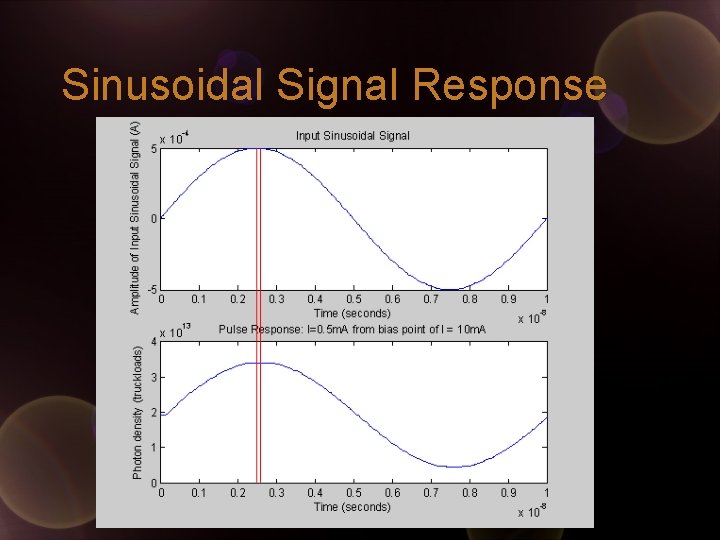
Sinusoidal Signal Response
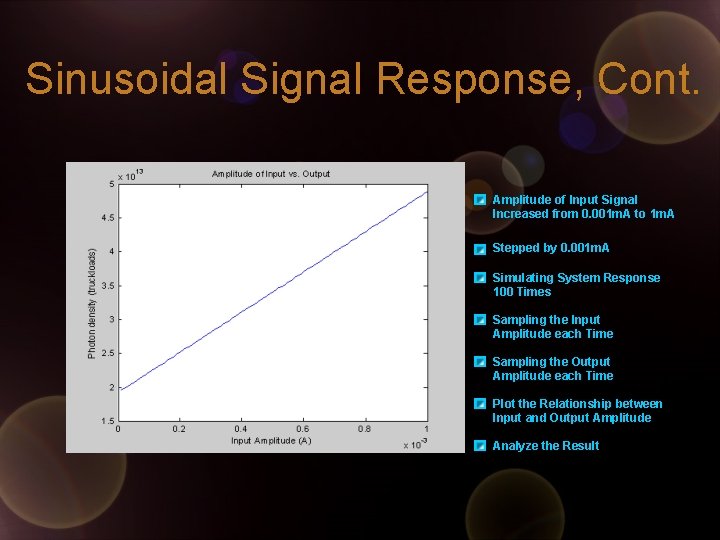
Sinusoidal Signal Response, Cont. Amplitude of Input Signal Increased from 0. 001 m. A to 1 m. A Stepped by 0. 001 m. A Simulating System Response 100 Times Sampling the Input Amplitude each Time Sampling the Output Amplitude each Time Plot the Relationship between Input and Output Amplitude Analyze the Result
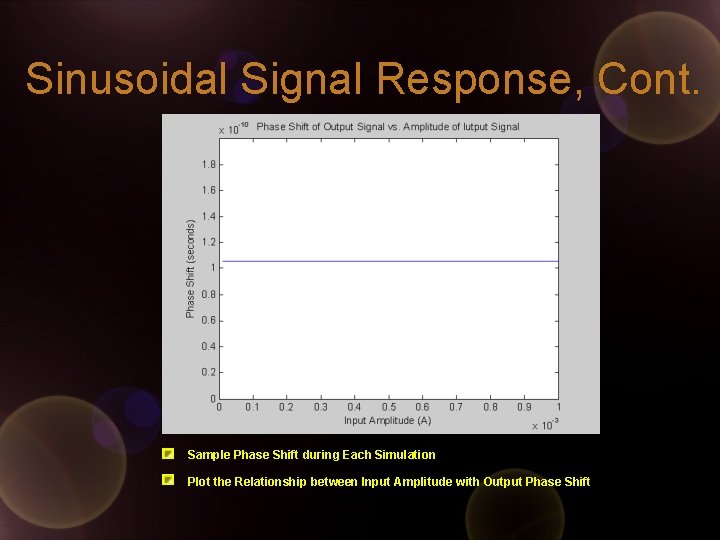
Sinusoidal Signal Response, Cont. Sample Phase Shift during Each Simulation Plot the Relationship between Input Amplitude with Output Phase Shift
Conclusion Small Input Eletronic Signal around Operating Point of a Laser Diode could Lead to Linear Optical Response in Terms of Amplitude Phase Shift in Optical Response around Operating Point Does Not Respond to Any Changes in Input Electronic Signal