
Simulation and analysis of hurricanedriven extreme wave climate
- Slides: 1
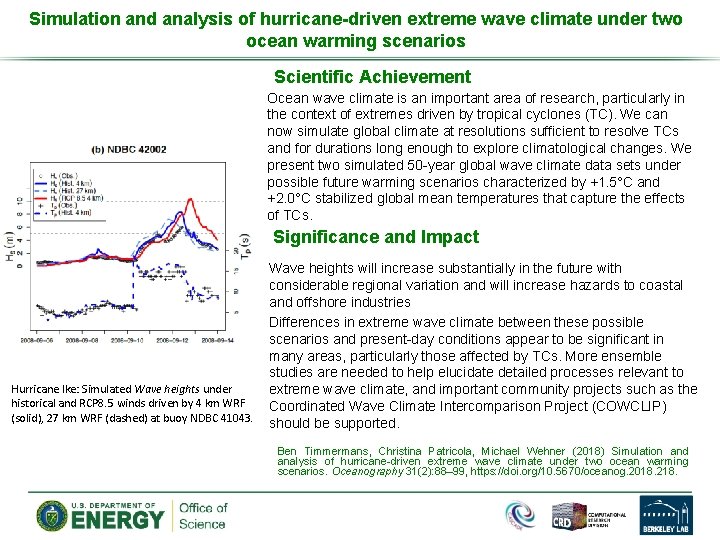
Simulation and analysis of hurricane-driven extreme wave climate under two ocean warming scenarios Scientific Achievement Ocean wave climate is an important area of research, particularly in the context of extremes driven by tropical cyclones (TC). We can now simulate global climate at resolutions sufficient to resolve TCs and for durations long enough to explore climatological changes. We present two simulated 50 -year global wave climate data sets under possible future warming scenarios characterized by +1. 5°C and +2. 0°C stabilized global mean temperatures that capture the effects of TCs. Significance and Impact Hurricane Ike: Simulated Wave heights under historical and RCP 8. 5 winds driven by 4 km WRF (solid), 27 km WRF (dashed) at buoy NDBC 41043. Wave heights will increase substantially in the future with considerable regional variation and will increase hazards to coastal and offshore industries Differences in extreme wave climate between these possible scenarios and present-day conditions appear to be significant in many areas, particularly those affected by TCs. More ensemble studies are needed to help elucidate detailed processes relevant to extreme wave climate, and important community projects such as the Coordinated Wave Climate Intercomparison Project (COWCLIP) should be supported. Ben Timmermans, Christina Patricola, Michael Wehner (2018) Simulation and analysis of hurricane-driven extreme wave climate under two ocean warming scenarios. Oceanography 31(2): 88– 99, https: //doi. org/10. 5670/oceanog. 2018. 218.