
Simulating the Silicon Detector Tracking and PFA Studies
- Slides: 18
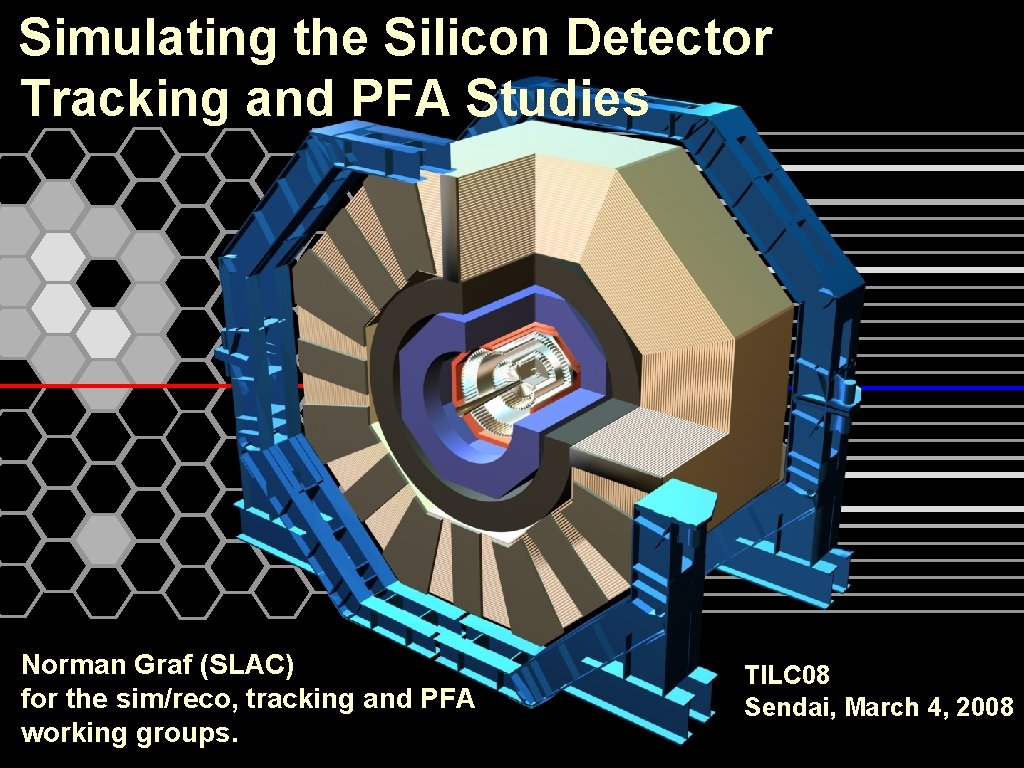
Simulating the Silicon Detector Tracking and PFA Studies Norman Graf (SLAC) for the sim/reco, tracking and PFA working groups. TILC 08 Sendai, March 4, 2008
Outline • The goals • Tracking infrastructure, status & plans • Status & plans of PFA implementations • Si. D Detector Optimization using PFA • See talk by Marcel Stanitzki later today for PANDORA • Outlook
The goals • Study the physics performance of the silicon detector, particularly the benchmark channels • See talk by P. Burrows for Si. D overview. • Optimize the detector design quantitatively • Make informed, rational technology choices • To do these with confidence, we need: • Highly efficient, excellent resolution tracking • a robust, high-performance PFA. • Rule of thumb: dijet mass resolution ~ 3 to 4 Ge. V.
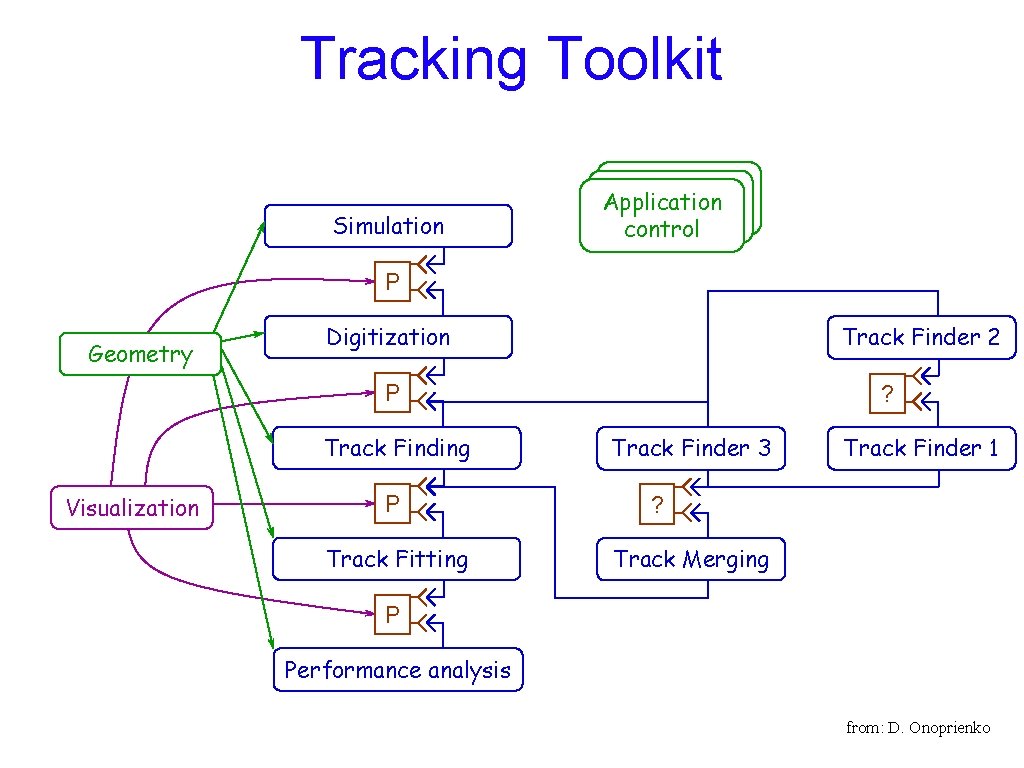
Tracking Toolkit Simulation Application control P Geometry Digitization Track Finder 2 P Track Finding Visualization P Track Fitting ? Track Finder 3 Track Finder 1 ? Track Merging P Performance analysis from: D. Onoprienko
Tracking • Full Simulation and benchmarking of design • Full planar geometry description and virtual segmentation • Hit generation and digitization Sim. Tracker. Hit • Pattern recognition code almost complete • Number of different approaches • outside-in, inside-out, calorimeter assisted, … • Full Kalman filter available • Need to bring all together into one user-friendly package. • See talk by M. Demarteau in tomorrow’s Si. D parallel session.
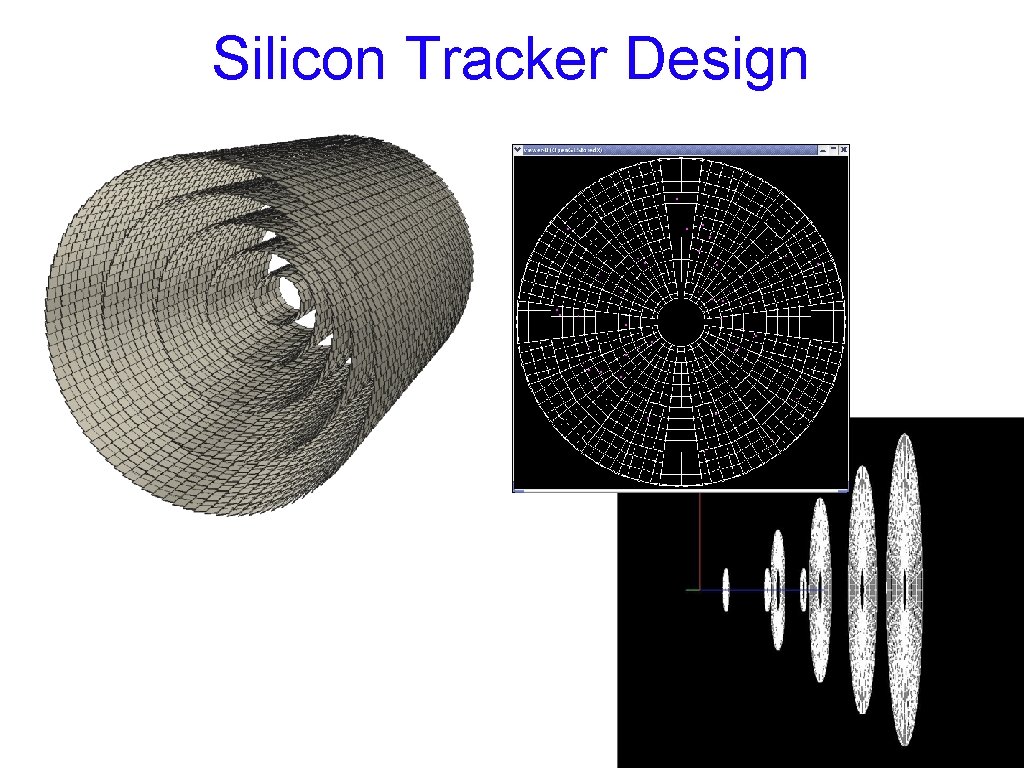
Silicon Tracker Design
List of existing Si. D PFAs • Steve Magill: Track following + E/p clustering • Lei Xia: Density-based clustering. • NIU/NICADD group: Directed tree clustering • Mat Charles: Non. Trivial. PFA & Recluster. DTree However, most PFA developers are working part time on – split between other tasks (Ba. Bar, ATLAS, ILC Test Beam, …)
Side note on manpower • Important not to forget that there are other people working on modules, infrastructure, benchmarking, tools, etc: • Ron Cassell (tools, PFA testing) • Dima Onoprienko (looking into PFA/tracking interface) • Ray Cowan, Lawrence Bronk (testing/benchmarking PFA output) • Ray Cowan, Marcel Stanitzky (Pandora. PFA) • Qingmin Zhang (photon-finding) • . . . and more besides (apologies!)
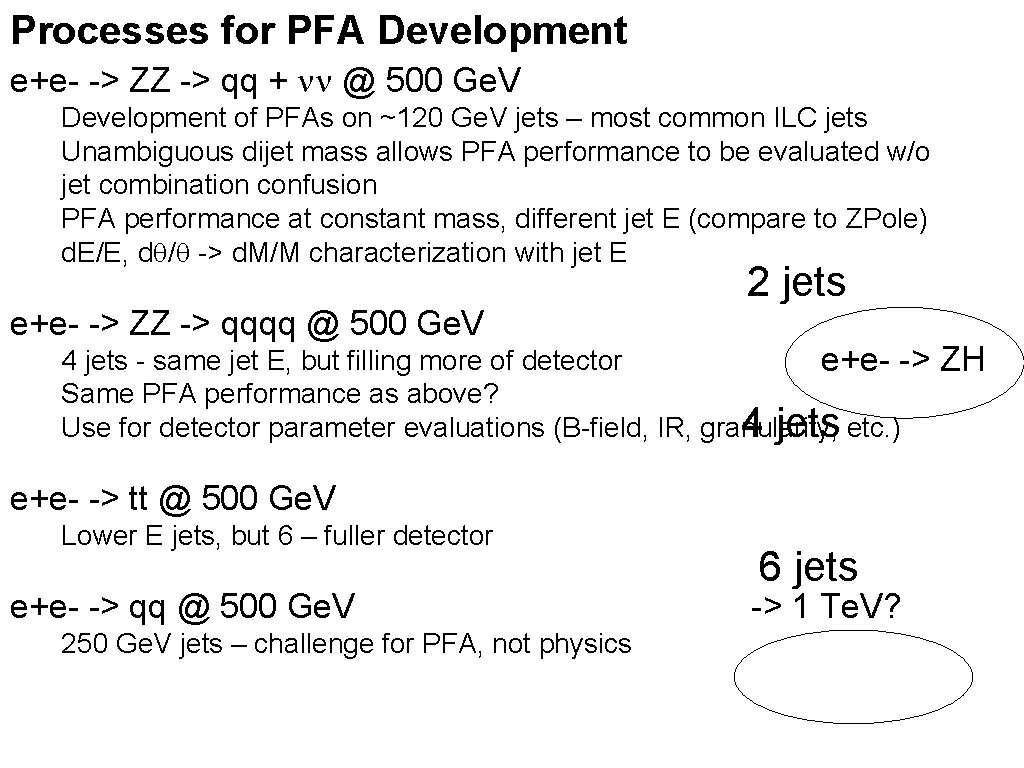
Processes for PFA Development e+e- -> ZZ -> qq + @ 500 Ge. V Development of PFAs on ~120 Ge. V jets – most common ILC jets Unambiguous dijet mass allows PFA performance to be evaluated w/o jet combination confusion PFA performance at constant mass, different jet E (compare to ZPole) d. E/E, d / -> d. M/M characterization with jet E e+e- -> ZZ -> qqqq @ 500 Ge. V 2 jets 4 jets - same jet E, but filling more of detector e+e- -> Same PFA performance as above? Use for detector parameter evaluations (B-field, IR, granularity, 4 jets etc. ) e+e- -> tt @ 500 Ge. V Lower E jets, but 6 – fuller detector e+e- -> qq @ 500 Ge. V 250 Ge. V jets – challenge for PFA, not physics 6 jets -> 1 Te. V? ZH
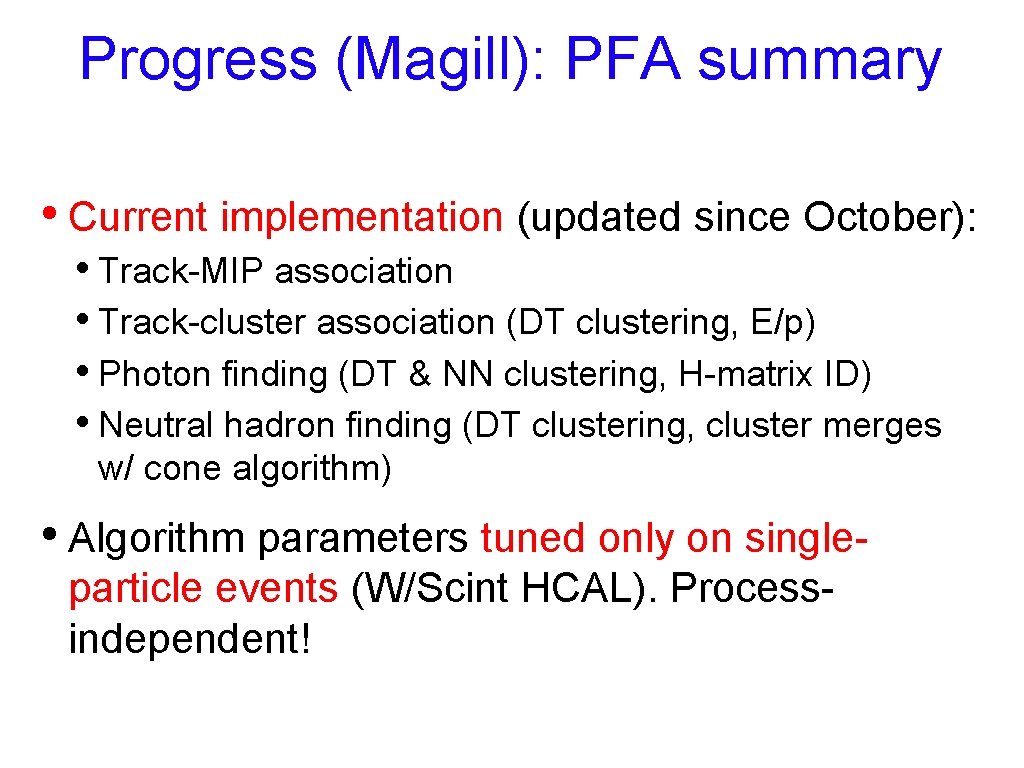
Progress (Magill): PFA summary • Current implementation (updated since October): • Track-MIP association • Track-cluster association (DT clustering, E/p) • Photon finding (DT & NN clustering, H-matrix ID) • Neutral hadron finding (DT clustering, cluster merges w/ cone algorithm) • Algorithm parameters tuned only on singleparticle events (W/Scint HCAL). Processindependent!
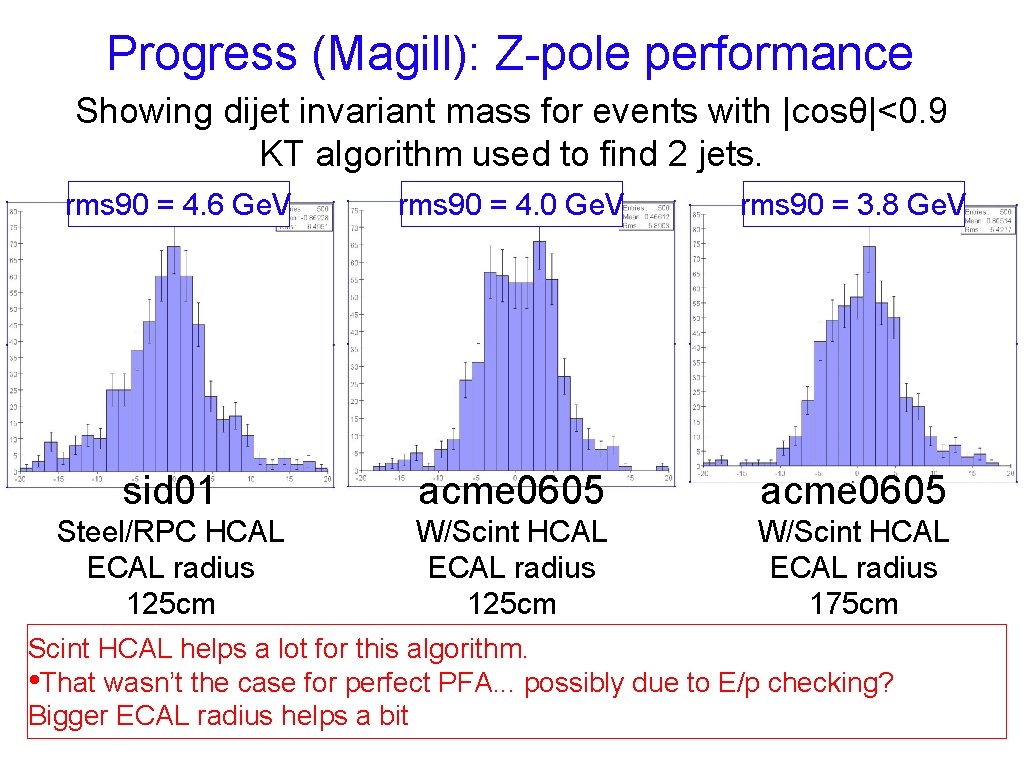
Progress (Magill): Z-pole performance Showing dijet invariant mass for events with |cosθ|<0. 9 KT algorithm used to find 2 jets. rms 90 = 4. 6 Ge. V rms 90 = 4. 0 Ge. V rms 90 = 3. 8 Ge. V sid 01 acme 0605 Steel/RPC HCAL ECAL radius 125 cm W/Scint HCAL ECAL radius 175 cm Scint HCAL helps a lot for this algorithm. • That wasn’t the case for perfect PFA. . . possibly due to E/p checking? Bigger ECAL radius helps a bit
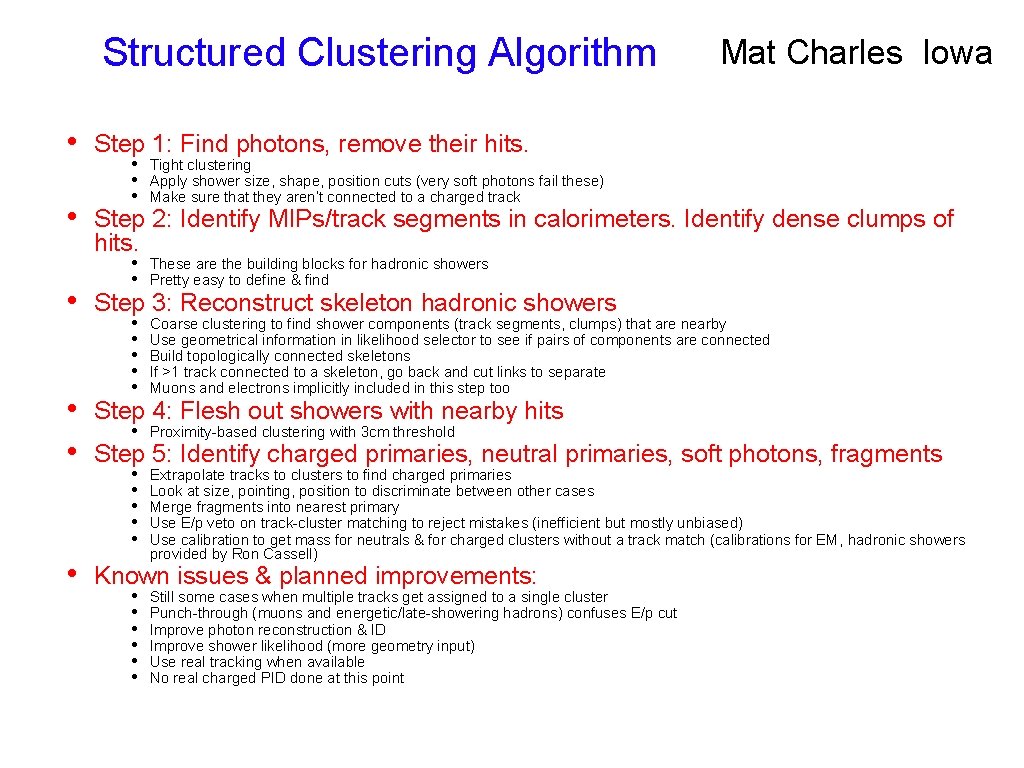
Structured Clustering Algorithm Mat Charles Iowa • Step 1: Find photons, remove their hits. • Step 2: Identify MIPs/track segments in calorimeters. Identify dense clumps of hits. • • • Tight clustering Apply shower size, shape, position cuts (very soft photons fail these) Make sure that they aren’t connected to a charged track • • These are the building blocks for hadronic showers Pretty easy to define & find • • • Coarse clustering to find shower components (track segments, clumps) that are nearby Use geometrical information in likelihood selector to see if pairs of components are connected Build topologically connected skeletons If >1 track connected to a skeleton, go back and cut links to separate Muons and electrons implicitly included in this step too • Proximity-based clustering with 3 cm threshold • • • Extrapolate tracks to clusters to find charged primaries Look at size, pointing, position to discriminate between other cases Merge fragments into nearest primary Use E/p veto on track-cluster matching to reject mistakes (inefficient but mostly unbiased) Use calibration to get mass for neutrals & for charged clusters without a track match (calibrations for EM, hadronic showers provided by Ron Cassell) • Step 3: Reconstruct skeleton hadronic showers • • Step 4: Flesh out showers with nearby hits • Known issues & planned improvements: Step 5: Identify charged primaries, neutral primaries, soft photons, fragments • • • Still some cases when multiple tracks get assigned to a single cluster Punch-through (muons and energetic/late-showering hadrons) confuses E/p cut Improve photon reconstruction & ID Improve shower likelihood (more geometry input) Use real tracking when available No real charged PID done at this point
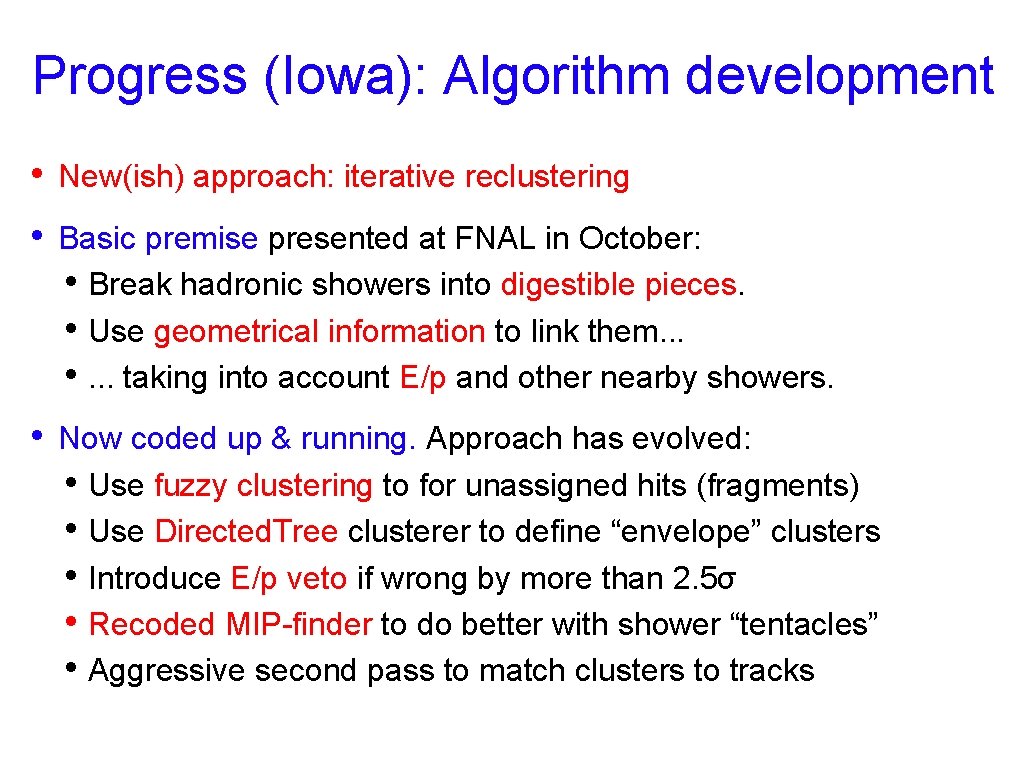
Progress (Iowa): Algorithm development • New(ish) approach: iterative reclustering • Basic premise presented at FNAL in October: • Break hadronic showers into digestible pieces. • Use geometrical information to link them. . . • . . . taking into account E/p and other nearby showers. • Now coded up & running. Approach has evolved: • Use fuzzy clustering to for unassigned hits (fragments) • Use Directed. Tree clusterer to define “envelope” clusters • Introduce E/p veto if wrong by more than 2. 5σ • Recoded MIP-finder to do better with shower “tentacles” • Aggressive second pass to match clusters to tracks
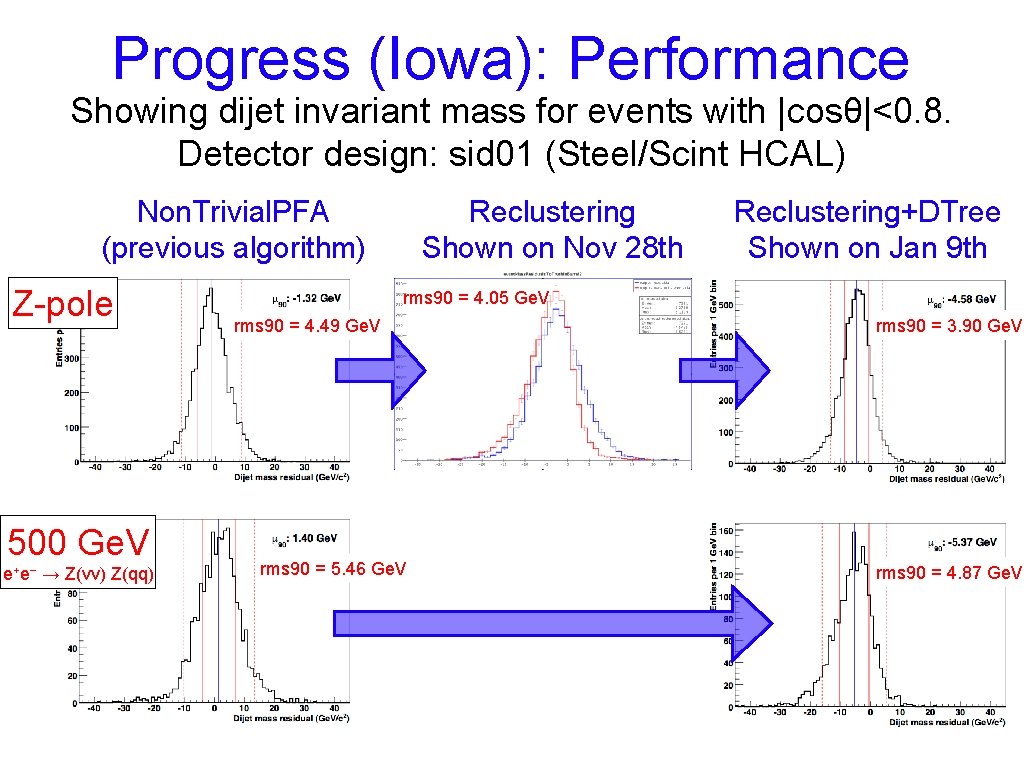
Progress (Iowa): Performance Showing dijet invariant mass for events with |cosθ|<0. 8. Detector design: sid 01 (Steel/Scint HCAL) Non. Trivial. PFA (previous algorithm) Z-pole 500 Ge. V e+e− → Z(vv) Z(qq) Reclustering Shown on Nov 28 th Reclustering+DTree Shown on Jan 9 th rms 90 = 4. 05 Ge. V rms 90 = 4. 49 Ge. V rms 90 = 5. 46 Ge. V rms 90 = 3. 90 Ge. V rms 90 = 4. 87 Ge. V
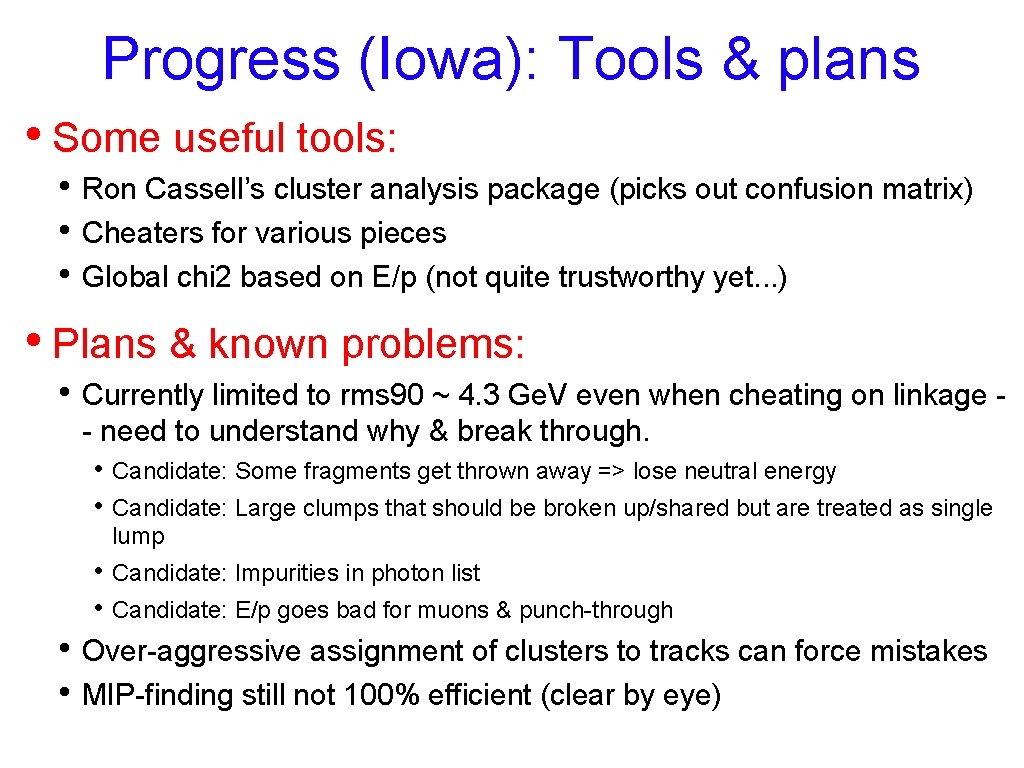
Progress (Iowa): Tools & plans • Some useful tools: • Ron Cassell’s cluster analysis package (picks out confusion matrix) • Cheaters for various pieces • Global chi 2 based on E/p (not quite trustworthy yet. . . ) • Plans & known problems: • Currently limited to rms 90 ~ 4. 3 Ge. V even when cheating on linkage - need to understand why & break through. • Candidate: Some fragments get thrown away => lose neutral energy • Candidate: Large clumps that should be broken up/shared but are treated as single lump • • • Candidate: Impurities in photon list • Candidate: E/p goes bad for muons & punch-through Over-aggressive assignment of clusters to tracks can force mistakes MIP-finding still not 100% efficient (clear by eye)
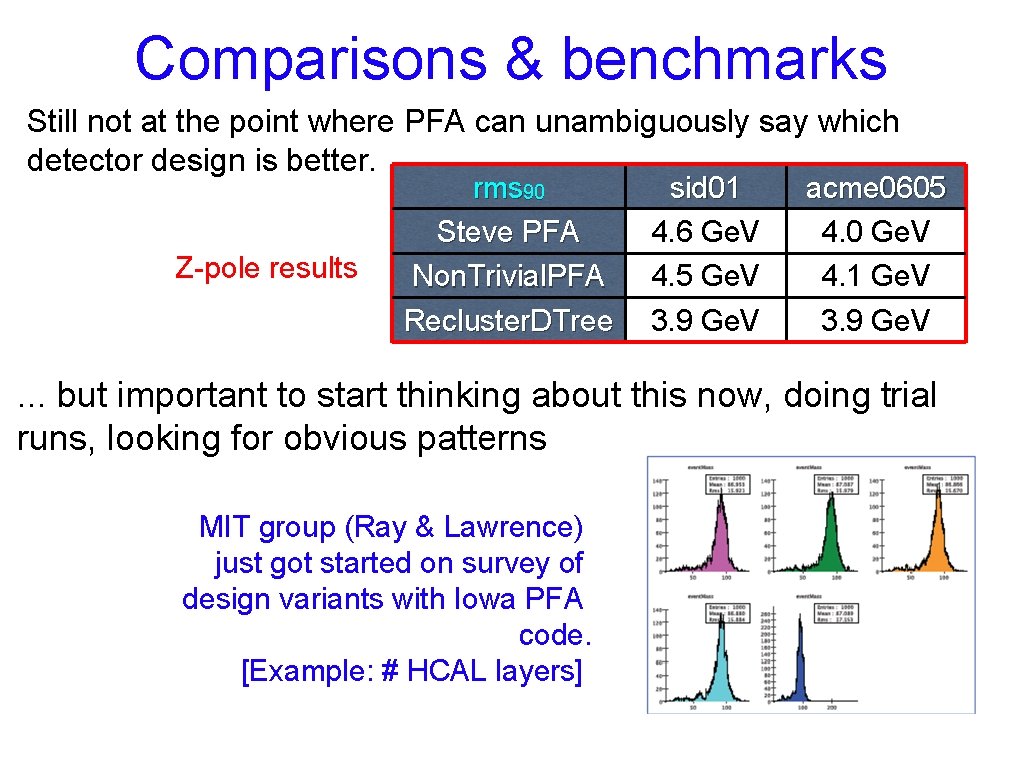
Comparisons & benchmarks Still not at the point where PFA can unambiguously say which detector design is better. Z-pole results rms 90 Steve PFA Non. Trivial. PFA Recluster. DTree sid 01 4. 6 Ge. V 4. 5 Ge. V 3. 9 Ge. V acme 0605 4. 0 Ge. V 4. 1 Ge. V 3. 9 Ge. V . . . but important to start thinking about this now, doing trial runs, looking for obvious patterns MIT group (Ray & Lawrence) just got started on survey of design variants with Iowa PFA code. [Example: # HCAL layers]
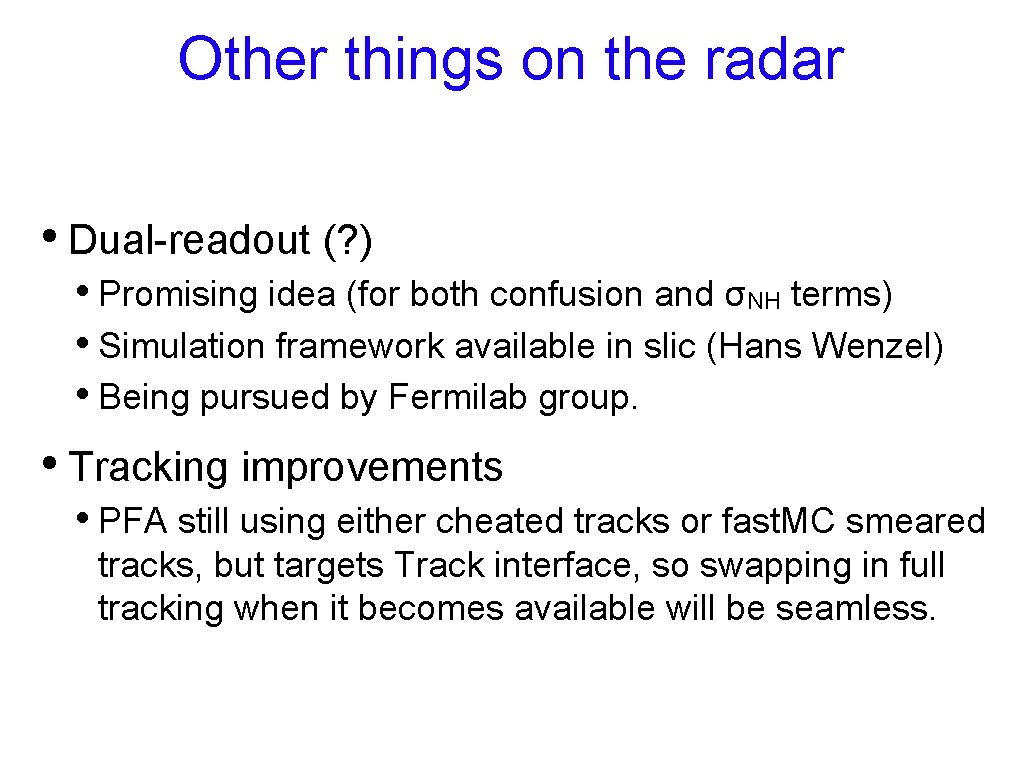
Other things on the radar • Dual-readout (? ) • Promising idea (for both confusion and σNH terms) • Simulation framework available in slic (Hans Wenzel) • Being pursued by Fermilab group. • Tracking improvements • PFA still using either cheated tracks or fast. MC smeared tracks, but targets Track interface, so swapping in full tracking when it becomes available will be seamless.
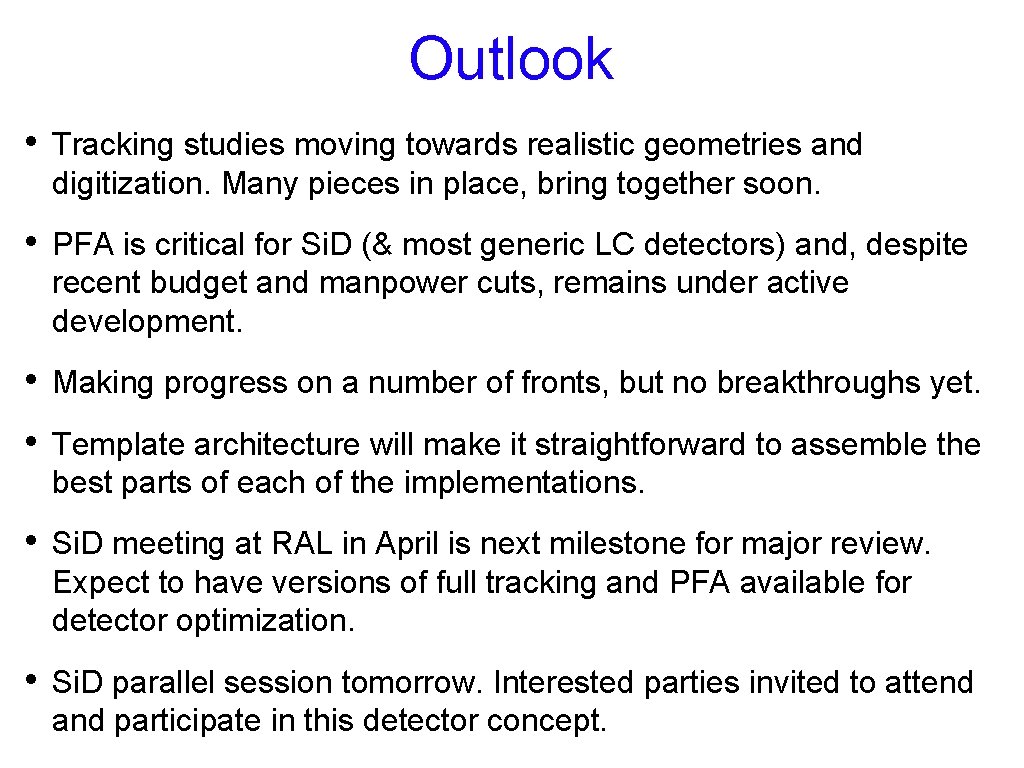
Outlook • Tracking studies moving towards realistic geometries and digitization. Many pieces in place, bring together soon. • PFA is critical for Si. D (& most generic LC detectors) and, despite recent budget and manpower cuts, remains under active development. • Making progress on a number of fronts, but no breakthroughs yet. • Template architecture will make it straightforward to assemble the best parts of each of the implementations. • Si. D meeting at RAL in April is next milestone for major review. Expect to have versions of full tracking and PFA available for detector optimization. • Si. D parallel session tomorrow. Interested parties invited to attend and participate in this detector concept.