
Simulating the Light Distribution in Sodium Iodide Detectors
Simulating the Light Distribution in Sodium Iodide Detectors Lisi Goodlett Dr. Ingo Wiedenhöver
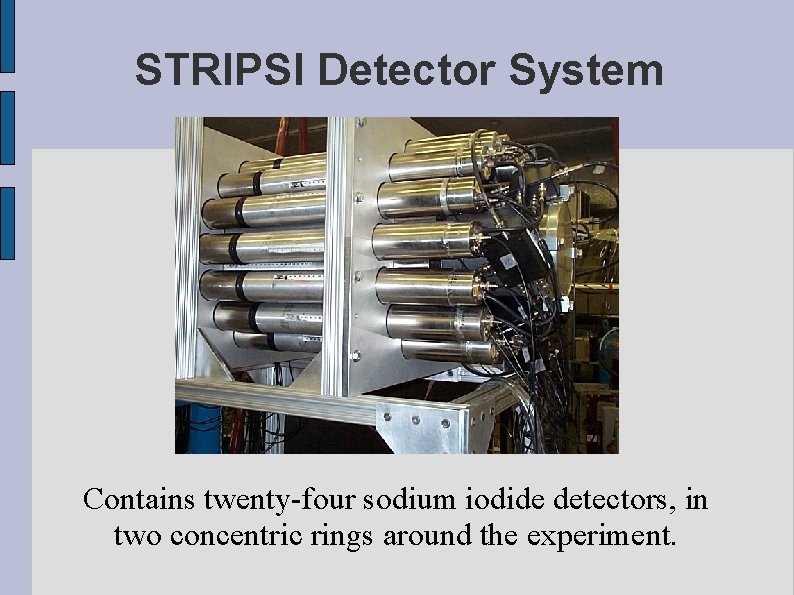
STRIPSI Detector System Contains twenty-four sodium iodide detectors, in two concentric rings around the experiment.
Sodium Iodide Detectors Used to detect gamma rays Composed of a sodium iodide crystal Windows at either end Photomultiplier tubes affixed to each window
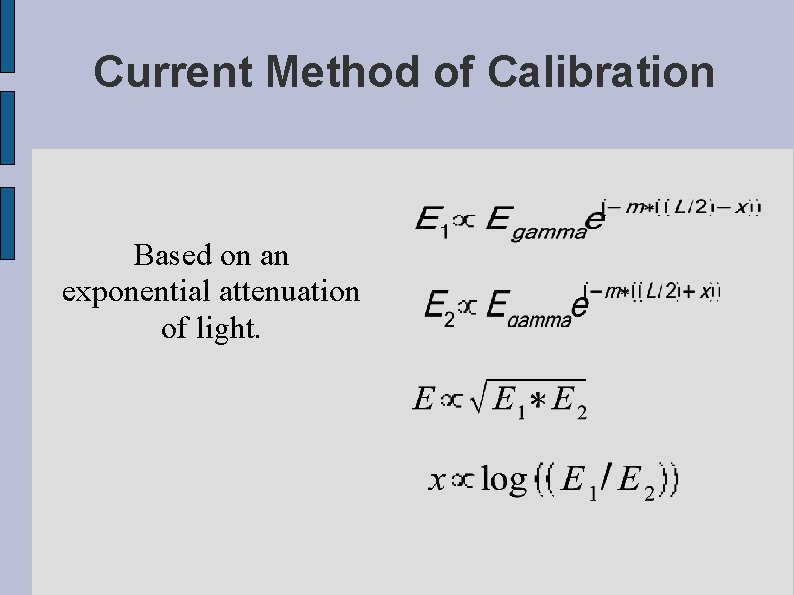
Current Method of Calibration Based on an exponential attenuation of light.
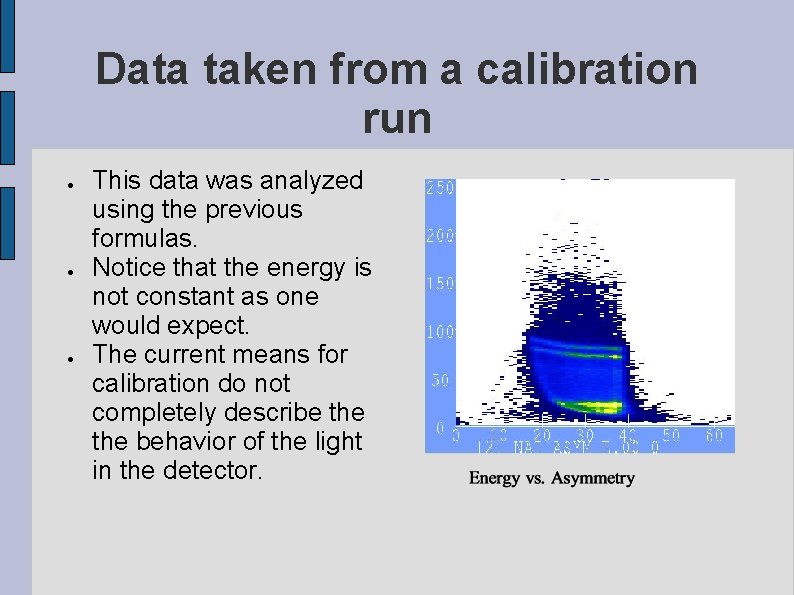
Data taken from a calibration run ● ● ● This data was analyzed using the previous formulas. Notice that the energy is not constant as one would expect. The current means for calibration do not completely describe the behavior of the light in the detector.
Objective Computationally simulate the light distribution within the sodium iodide detector.
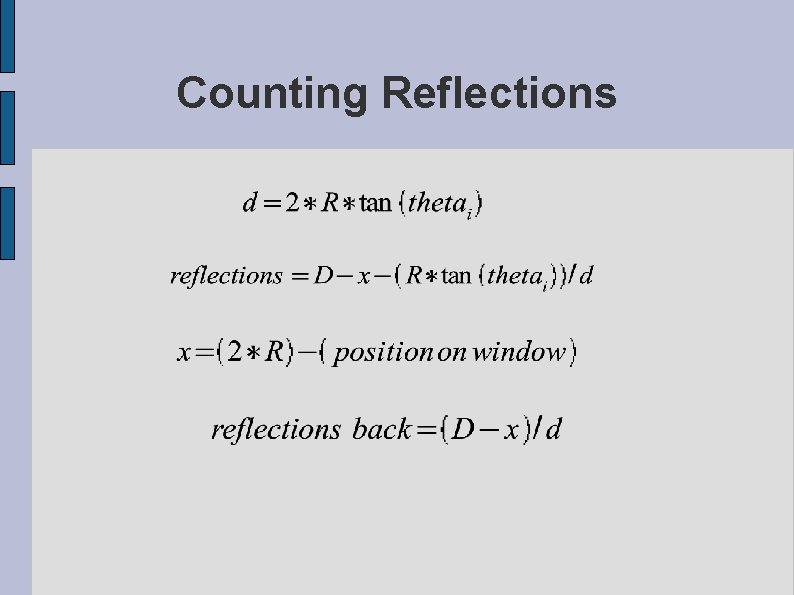
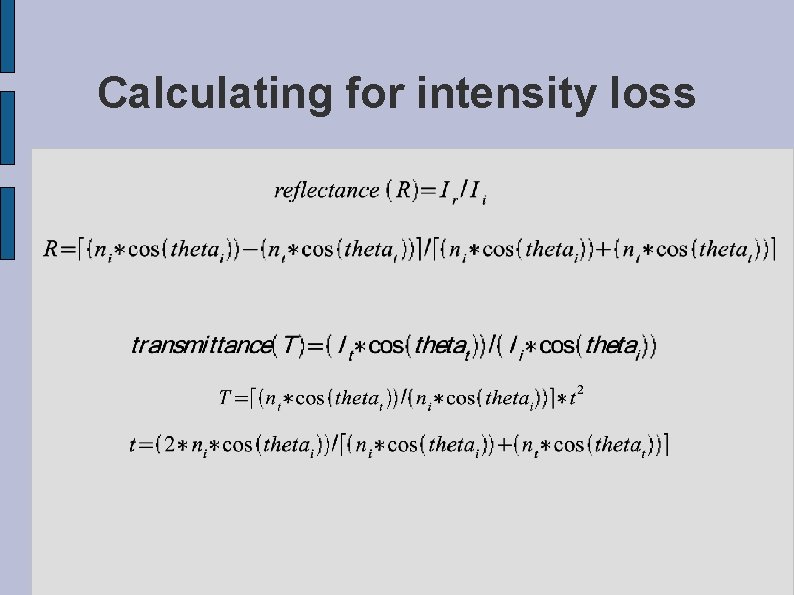
Basic Assumptions ● ● ● Attenuation of light can be described through intensity losses due to reflections within the cavity walls. About half of the scintillation photons produced propogate to either end of the crystal. Amount of light detected at either end can be calculated by varying the point of interaction and integrating over possible angles.
A few Uncertainties: ● ● Our detectors were given to us (third or fourth hand), and had been specially made. In consequence, we do not know all of the materials used to make the detectors.
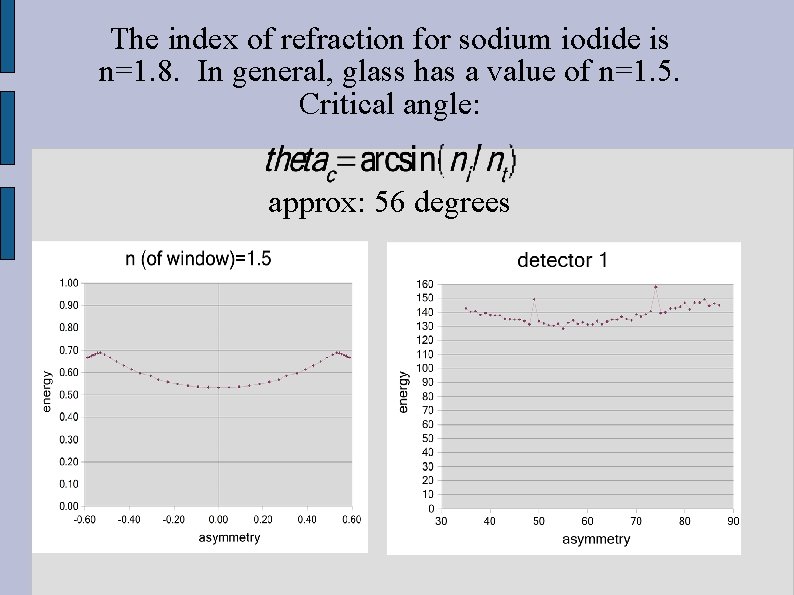
The index of refraction for sodium iodide is n=1. 8. In general, glass has a value of n=1. 5. Critical angle: approx: 56 degrees
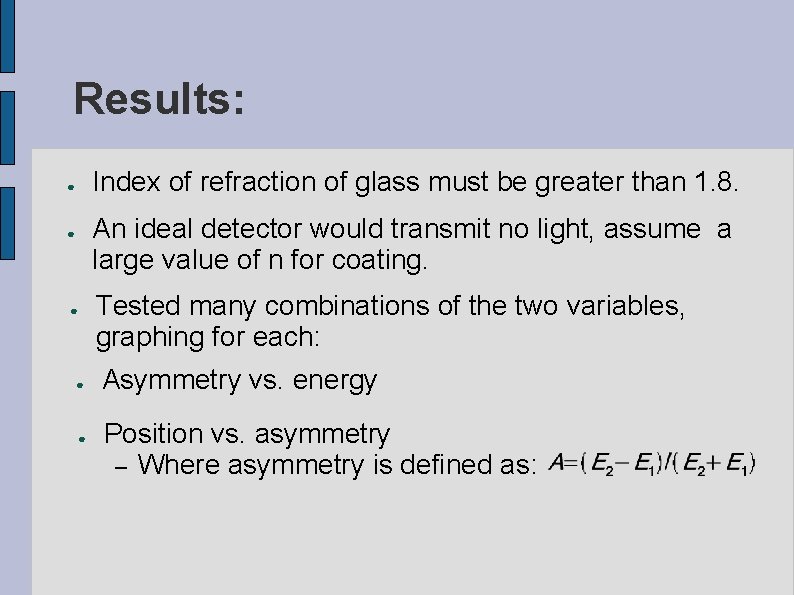
Results: Index of refraction of glass must be greater than 1. 8. ● An ideal detector would transmit no light, assume a large value of n for coating. ● Tested many combinations of the two variables, graphing for each: ● ● ● Asymmetry vs. energy Position vs. asymmetry – Where asymmetry is defined as:
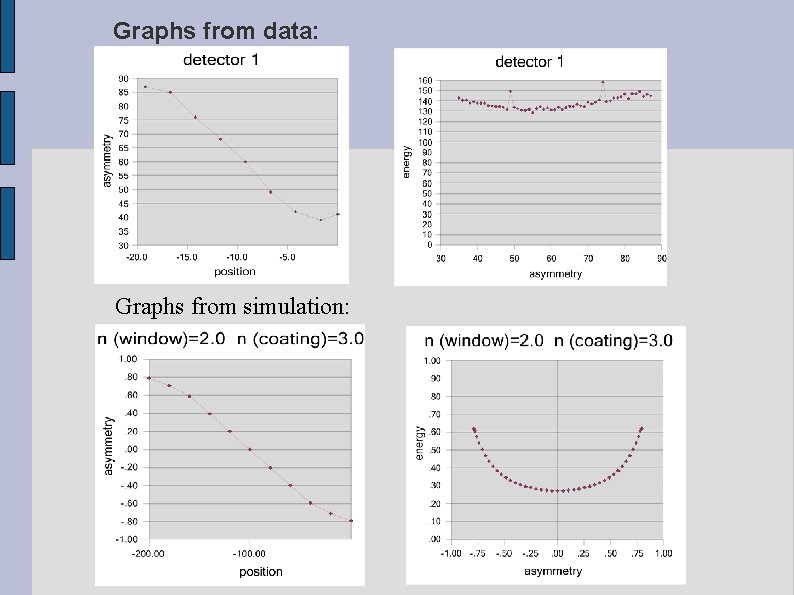
Graphs from data: Graphs from simulation:
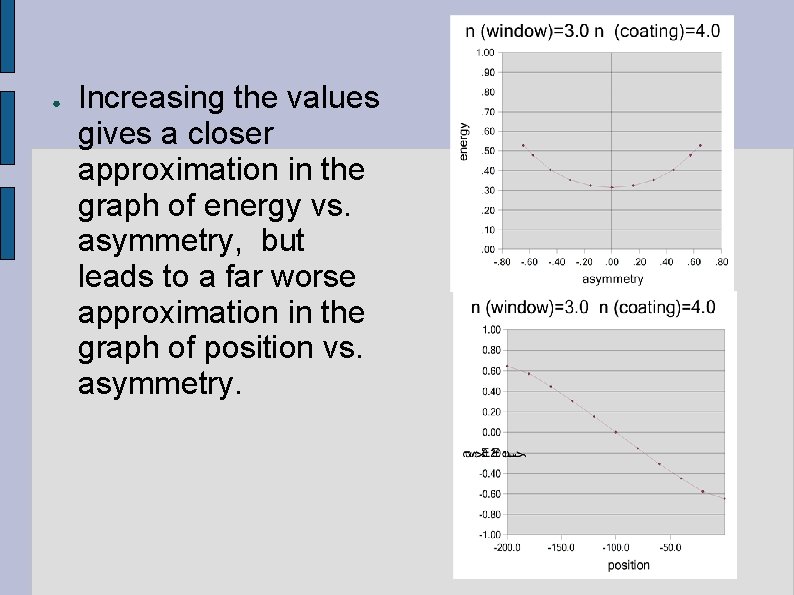
● Increasing the values gives a closer approximation in the graph of energy vs. asymmetry, but leads to a far worse approximation in the graph of position vs. asymmetry.
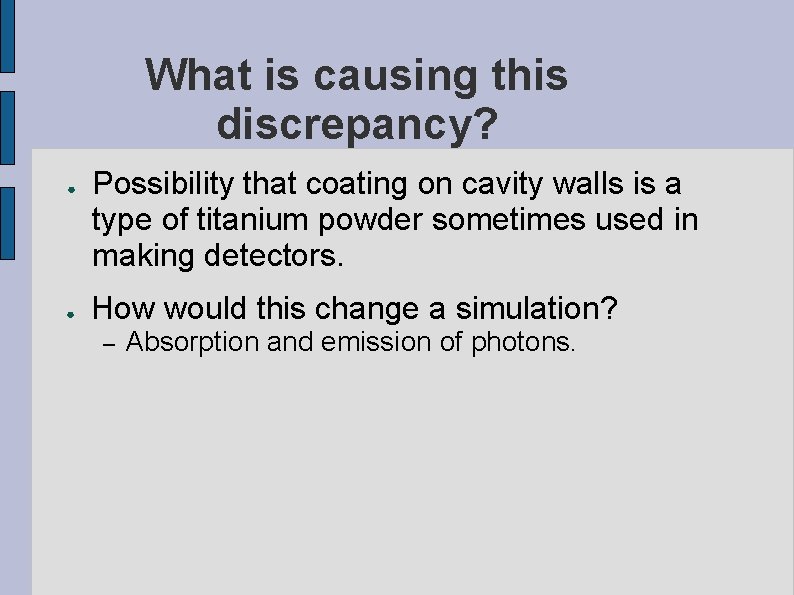
What is causing this discrepancy? ● ● Possibility that coating on cavity walls is a type of titanium powder sometimes used in making detectors. How would this change a simulation? – Absorption and emission of photons.

Work in progress. . . ● ● I have since begun incorporating absorption into my current program. I will continue this work into the fall and hope to find my results improved.

Counting Reflections
Calculating for intensity loss
- Slides: 17