
Simulating Switchgrass Production in Diverse Environments Jim R
- Slides: 1
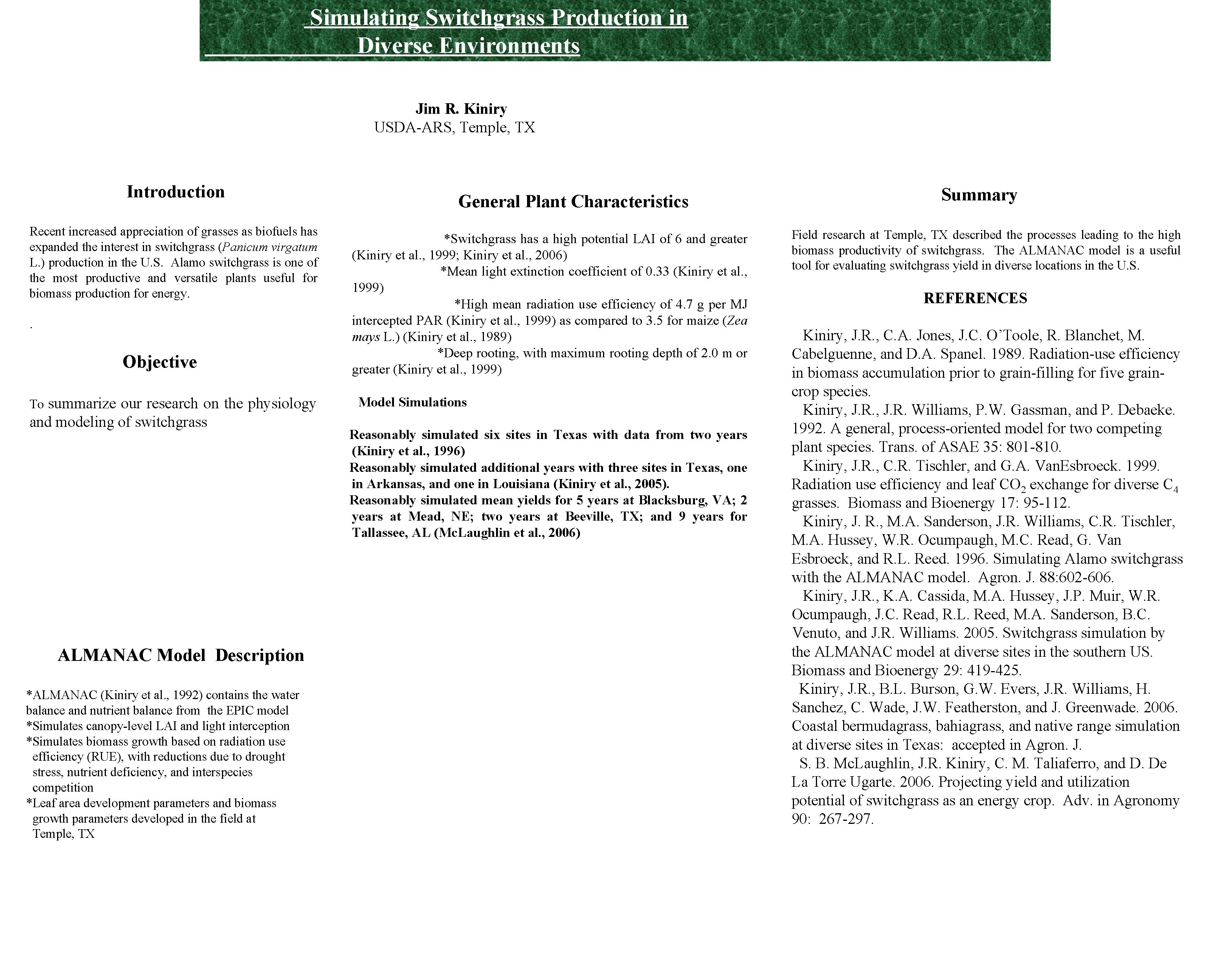
Simulating Switchgrass Production in Diverse Environments Jim R. Kiniry USDA-ARS, Temple, TX Introduction Recent increased appreciation of grasses as biofuels has expanded the interest in switchgrass (Panicum virgatum L. ) production in the U. S. Alamo switchgrass is one of the most productive and versatile plants useful for biomass production for energy. . Objective summarize our research on the physiology and modeling of switchgrass To ALMANAC Model Description *ALMANAC (Kiniry et al. , 1992) contains the water balance and nutrient balance from the EPIC model *Simulates canopy-level LAI and light interception *Simulates biomass growth based on radiation use efficiency (RUE), with reductions due to drought stress, nutrient deficiency, and interspecies competition *Leaf area development parameters and biomass growth parameters developed in the field at Temple, TX General Plant Characteristics *Switchgrass has a high potential LAI of 6 and greater (Kiniry et al. , 1999; Kiniry et al. , 2006) *Mean light extinction coefficient of 0. 33 (Kiniry et al. , 1999) *High mean radiation use efficiency of 4. 7 g per MJ intercepted PAR (Kiniry et al. , 1999) as compared to 3. 5 for maize (Zea mays L. ) (Kiniry et al. , 1989) *Deep rooting, with maximum rooting depth of 2. 0 m or greater (Kiniry et al. , 1999) Model Simulations Reasonably simulated six sites in Texas with data from two years (Kiniry et al. , 1996) Reasonably simulated additional years with three sites in Texas, one in Arkansas, and one in Louisiana (Kiniry et al. , 2005). Reasonably simulated mean yields for 5 years at Blacksburg, VA; 2 years at Mead, NE; two years at Beeville, TX; and 9 years for Tallassee, AL (Mc. Laughlin et al. , 2006) Summary Field research at Temple, TX described the processes leading to the high biomass productivity of switchgrass. The ALMANAC model is a useful tool for evaluating switchgrass yield in diverse locations in the U. S. REFERENCES Kiniry, J. R. , C. A. Jones, J. C. O’Toole, R. Blanchet, M. Cabelguenne, and D. A. Spanel. 1989. Radiation-use efficiency in biomass accumulation prior to grain-filling for five graincrop species. Kiniry, J. R. Williams, P. W. Gassman, and P. Debaeke. 1992. A general, process-oriented model for two competing plant species. Trans. of ASAE 35: 801 -810. Kiniry, J. R. , C. R. Tischler, and G. A. Van. Esbroeck. 1999. Radiation use efficiency and leaf CO 2 exchange for diverse C 4 grasses. Biomass and Bioenergy 17: 95 -112. Kiniry, J. R. , M. A. Sanderson, J. R. Williams, C. R. Tischler, M. A. Hussey, W. R. Ocumpaugh, M. C. Read, G. Van Esbroeck, and R. L. Reed. 1996. Simulating Alamo switchgrass with the ALMANAC model. Agron. J. 88: 602 -606. Kiniry, J. R. , K. A. Cassida, M. A. Hussey, J. P. Muir, W. R. Ocumpaugh, J. C. Read, R. L. Reed, M. A. Sanderson, B. C. Venuto, and J. R. Williams. 2005. Switchgrass simulation by the ALMANAC model at diverse sites in the southern US. Biomass and Bioenergy 29: 419 -425. Kiniry, J. R. , B. L. Burson, G. W. Evers, J. R. Williams, H. Sanchez, C. Wade, J. W. Featherston, and J. Greenwade. 2006. Coastal bermudagrass, bahiagrass, and native range simulation at diverse sites in Texas: accepted in Agron. J. S. B. Mc. Laughlin, J. R. Kiniry, C. M. Taliaferro, and D. De La Torre Ugarte. 2006. Projecting yield and utilization potential of switchgrass as an energy crop. Adv. in Agronomy 90: 267 -297.