
Simulating quantum chemistry on a classical computer Garnet
- Slides: 35
Simulating quantum chemistry on a classical computer Garnet Kin-Lic Chan California Institute of Technology
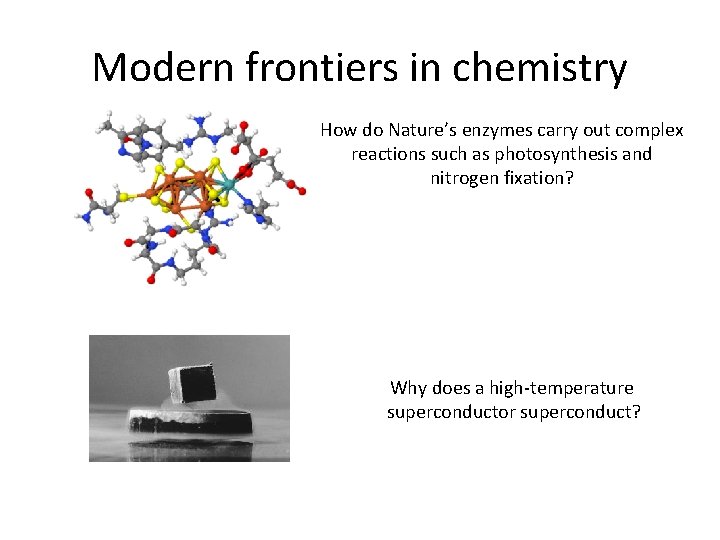
Modern frontiers in chemistry How do Nature’s enzymes carry out complex reactions such as photosynthesis and nitrogen fixation? Why does a high-temperature superconductor superconduct?
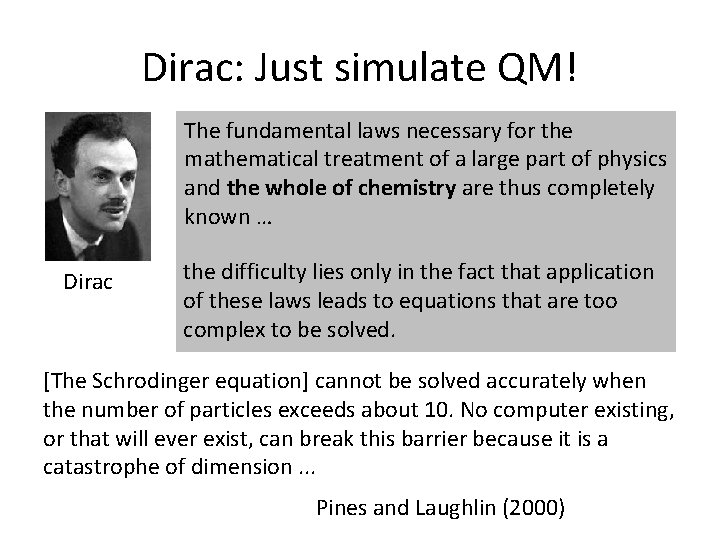
Dirac: Just simulate QM! The fundamental laws necessary for the mathematical treatment of a large part of physics and the whole of chemistry are thus completely known … Dirac the difficulty lies only in the fact that application of these laws leads to equations that are too complex to be solved. [The Schrodinger equation] cannot be solved accurately when the number of particles exceeds about 10. No computer existing, or that will ever exist, can break this barrier because it is a catastrophe of dimension. . . Pines and Laughlin (2000)
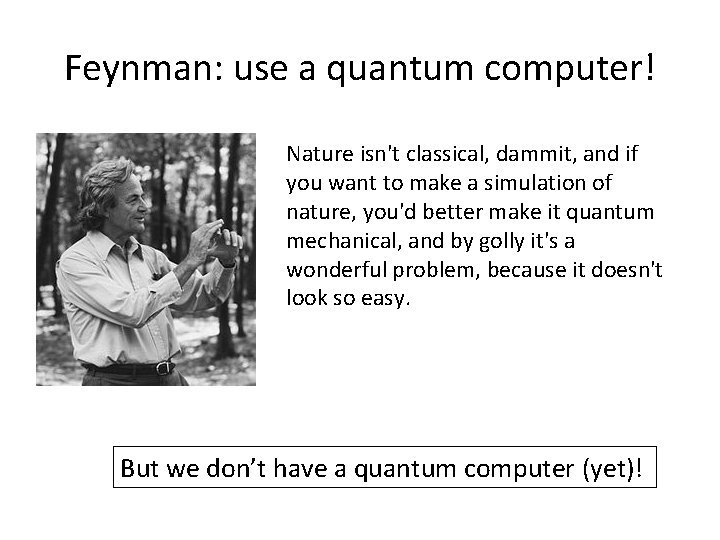
Feynman: use a quantum computer! Nature isn't classical, dammit, and if you want to make a simulation of nature, you'd better make it quantum mechanical, and by golly it's a wonderful problem, because it doesn't look so easy. But we don’t have a quantum computer (yet)!
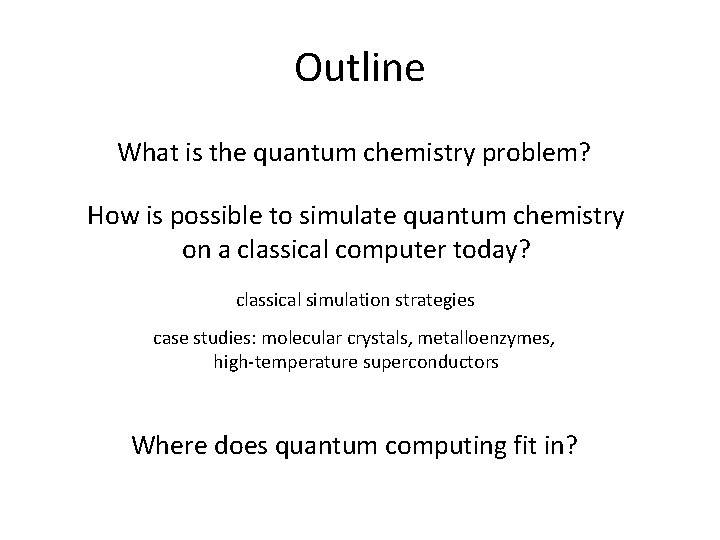
Outline What is the quantum chemistry problem? How is possible to simulate quantum chemistry on a classical computer today? classical simulation strategies case studies: molecular crystals, metalloenzymes, high-temperature superconductors Where does quantum computing fit in?
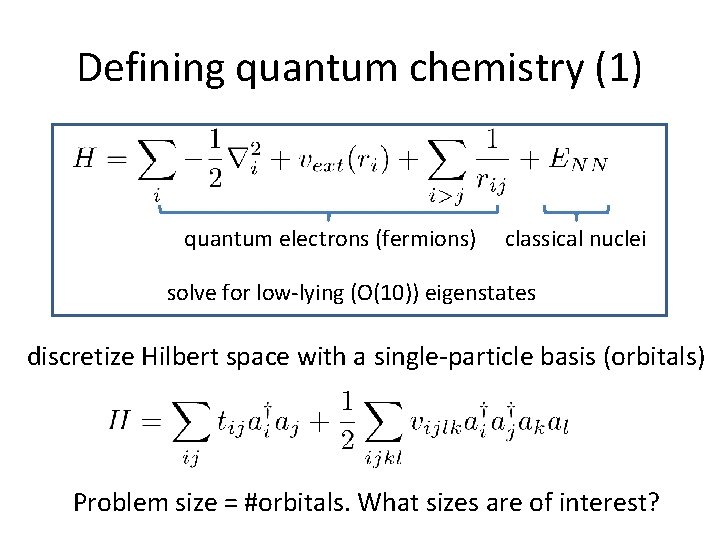
Defining quantum chemistry (1) quantum electrons (fermions) classical nuclei solve for low-lying (O(10)) eigenstates discretize Hilbert space with a single-particle basis (orbitals) Problem size = #orbitals. What sizes are of interest?
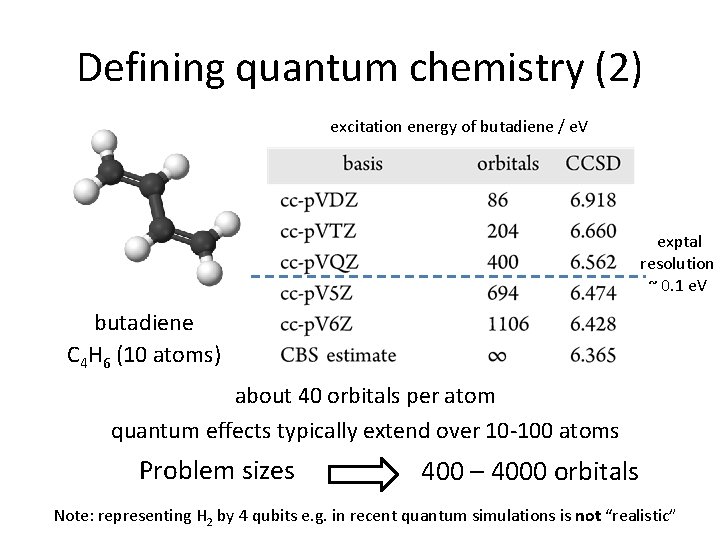
Defining quantum chemistry (2) excitation energy of butadiene / e. V exptal resolution ~ 0. 1 e. V butadiene C 4 H 6 (10 atoms) about 40 orbitals per atom quantum effects typically extend over 10 -100 atoms Problem sizes 400 – 4000 orbitals Note: representing H 2 by 4 qubits e. g. in recent quantum simulations is not “realistic”
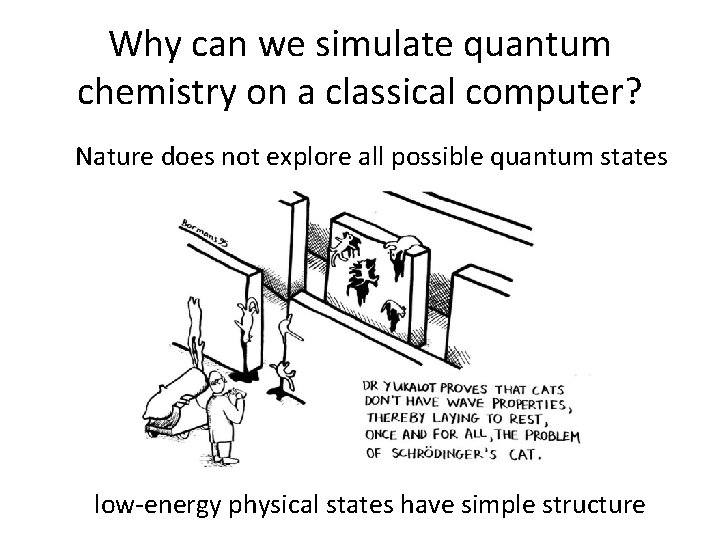
Why can we simulate quantum chemistry on a classical computer? Nature does not explore all possible quantum states low-energy physical states have simple structure
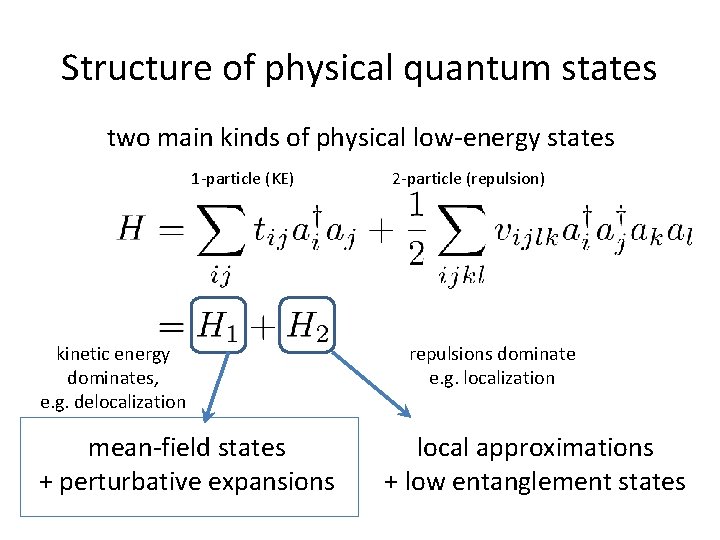
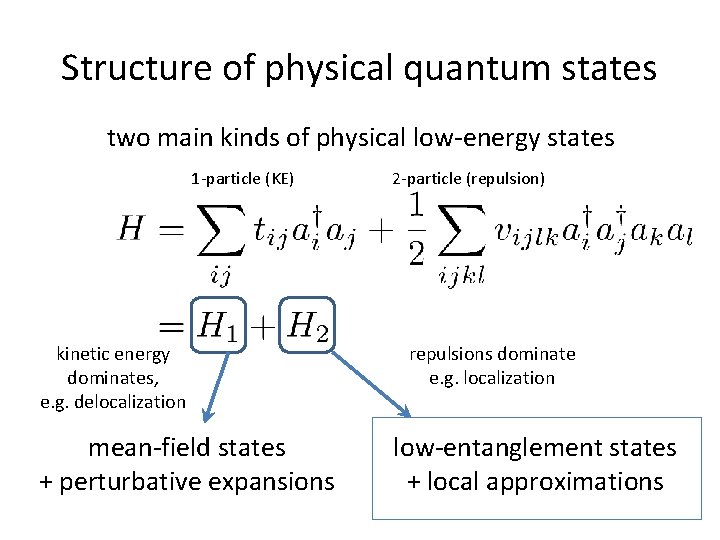
Structure of physical quantum states two main kinds of physical low-energy states 1 -particle (KE) kinetic energy dominates, e. g. delocalization mean-field states + perturbative expansions 2 -particle (repulsion) repulsions dominate e. g. localization local approximations + low entanglement states
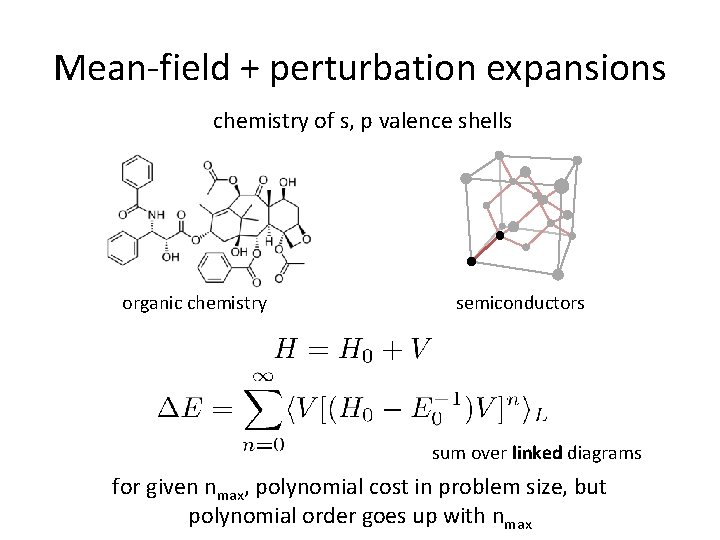
Mean-field + perturbation expansions chemistry of s, p valence shells organic chemistry semiconductors sum over linked diagrams for given nmax, polynomial cost in problem size, but polynomial order goes up with nmax
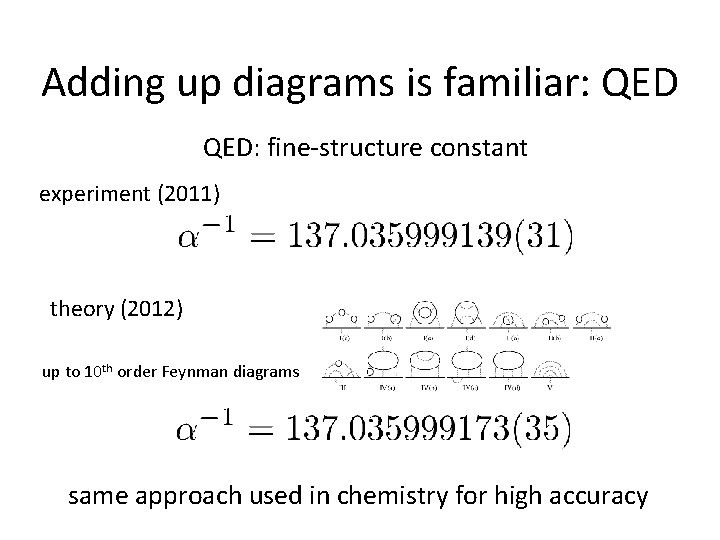
Adding up diagrams is familiar: QED: fine-structure constant experiment (2011) theory (2012) up to 10 th order Feynman diagrams same approach used in chemistry for high accuracy
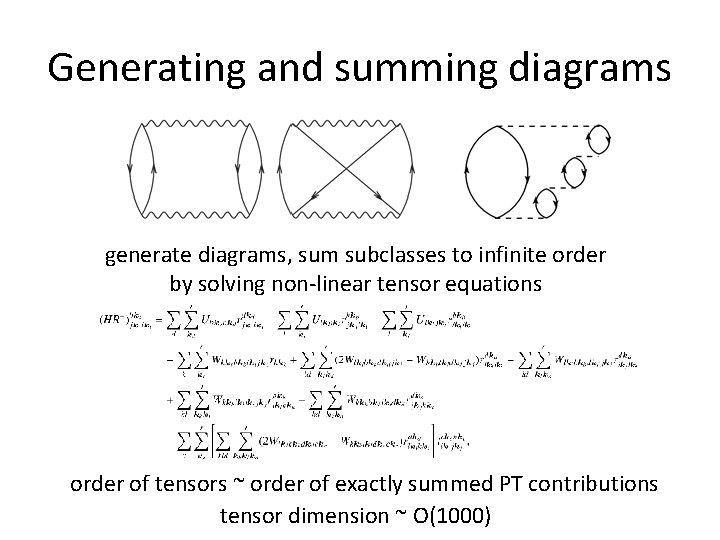
Generating and summing diagrams generate diagrams, sum subclasses to infinite order by solving non-linear tensor equations order of tensors ~ order of exactly summed PT contributions tensor dimension ~ O(1000)
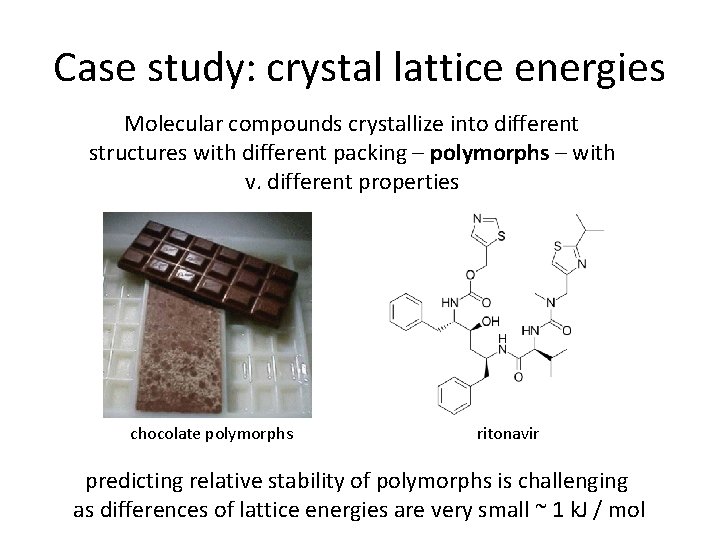
Case study: crystal lattice energies Molecular compounds crystallize into different structures with different packing – polymorphs – with v. different properties chocolate polymorphs ritonavir predicting relative stability of polymorphs is challenging as differences of lattice energies are very small ~ 1 k. J / mol
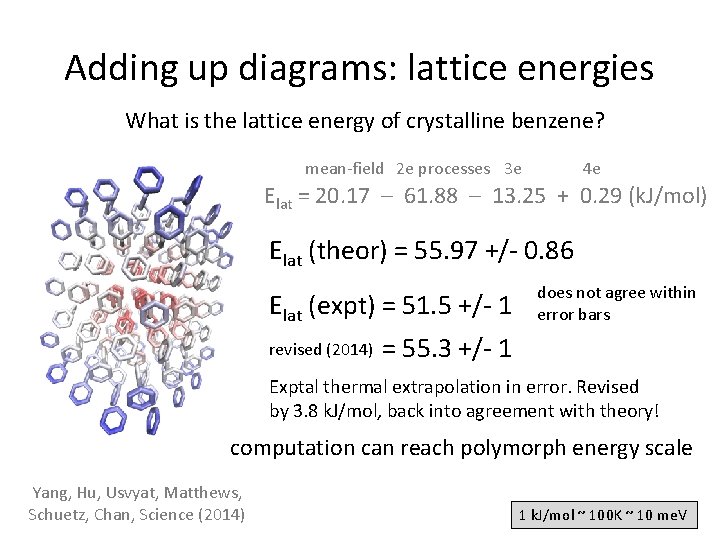
Adding up diagrams: lattice energies What is the lattice energy of crystalline benzene? mean-field 2 e processes 3 e 4 e Elat = 20. 17 – 61. 88 – 13. 25 + 0. 29 (k. J/mol) Elat (theor) = 55. 97 +/- 0. 86 Elat (expt) = 51. 5 +/- 1 revised (2014) does not agree within error bars = 55. 3 +/- 1 Exptal thermal extrapolation in error. Revised by 3. 8 k. J/mol, back into agreement with theory! computation can reach polymorph energy scale Yang, Hu, Usvyat, Matthews, Schuetz, Chan, Science (2014) 1 k. J/mol ~ 100 K ~ 10 me. V
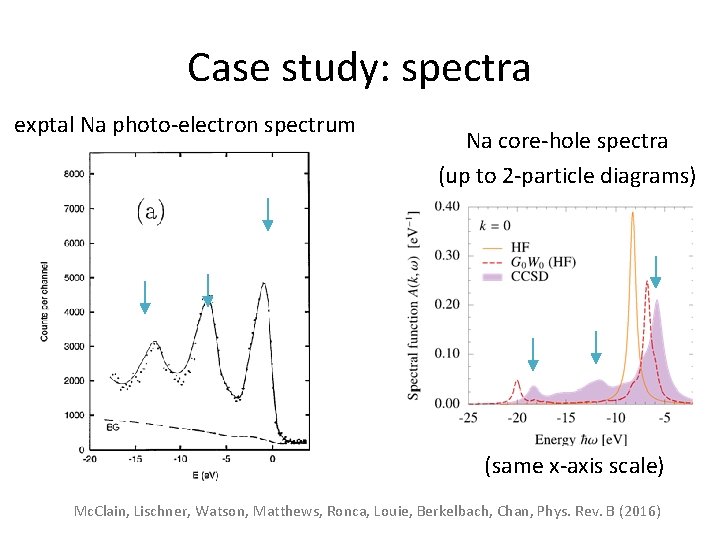
Case study: spectra exptal Na photo-electron spectrum Na core-hole spectra (up to 2 -particle diagrams) (same x-axis scale) Mc. Clain, Lischner, Watson, Matthews, Ronca, Louie, Berkelbach, Chan, Phys. Rev. B (2016)
Structure of physical quantum states two main kinds of physical low-energy states 1 -particle (KE) kinetic energy dominates, e. g. delocalization mean-field states + perturbative expansions 2 -particle (repulsion) repulsions dominate e. g. localization low-entanglement states + local approximations
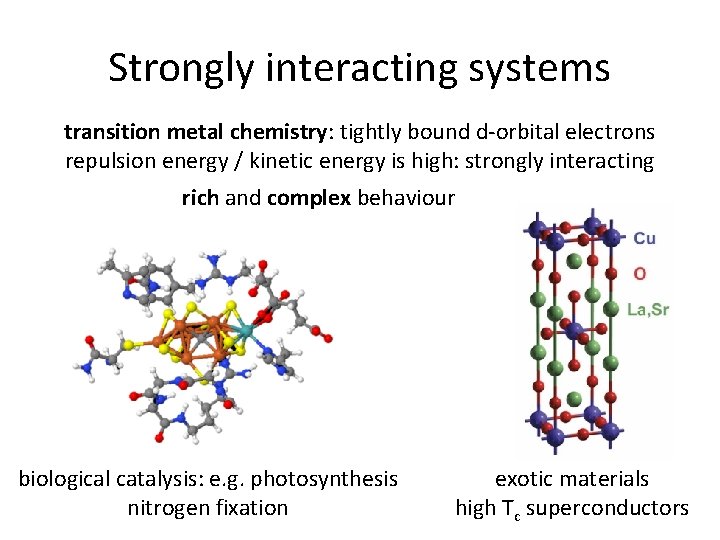
Strongly interacting systems transition metal chemistry: tightly bound d-orbital electrons repulsion energy / kinetic energy is high: strongly interacting rich and complex behaviour biological catalysis: e. g. photosynthesis nitrogen fixation exotic materials high Tc superconductors
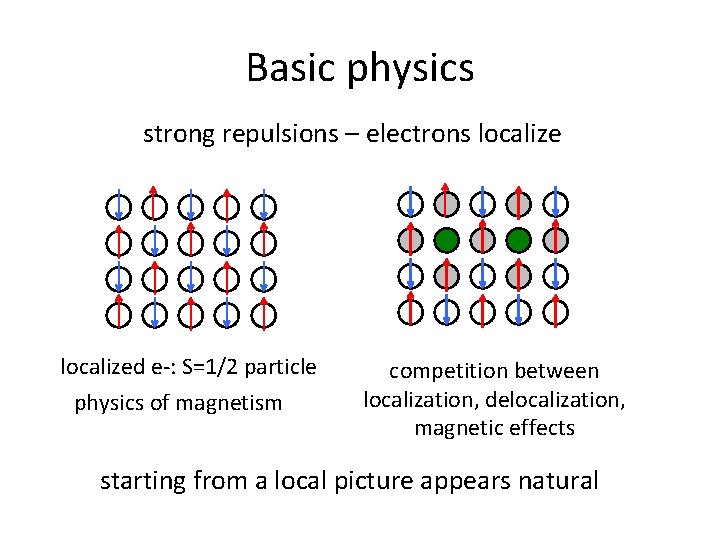
Basic physics strong repulsions – electrons localized e-: S=1/2 particle physics of magnetism competition between localization, delocalization, magnetic effects starting from a local picture appears natural
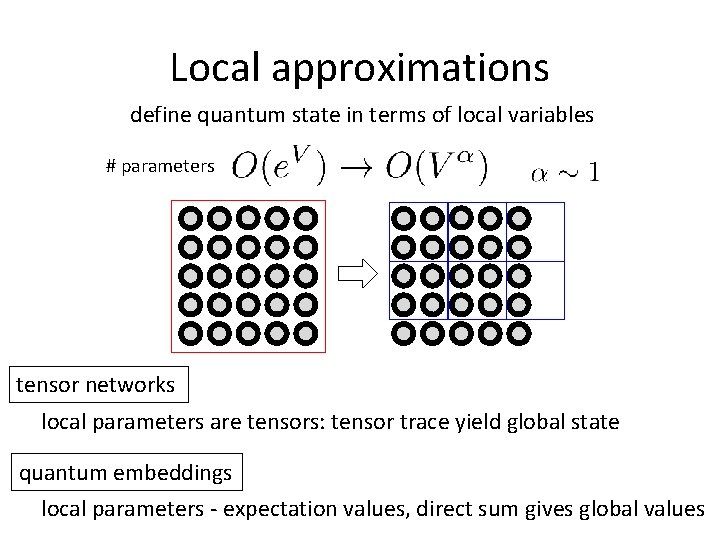
Local approximations define quantum state in terms of local variables # parameters tensor networks local parameters are tensors: tensor trace yield global state quantum embeddings local parameters - expectation values, direct sum gives global values
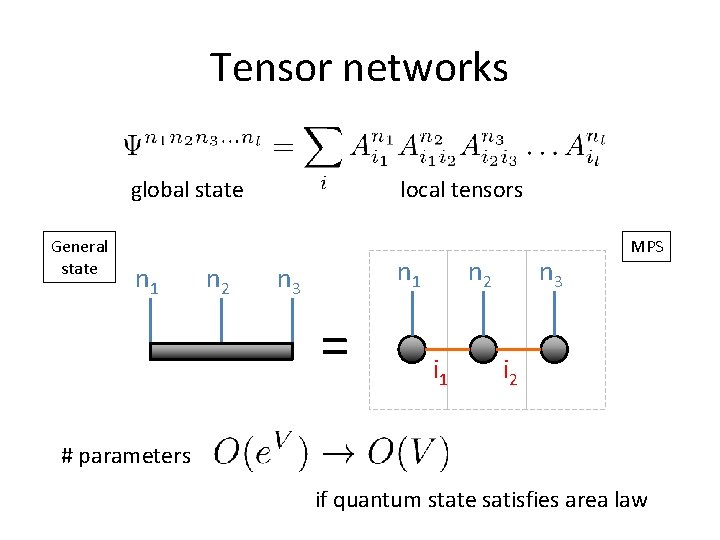
Tensor networks global state General state n 1 n 2 local tensors n 1 n 3 = n 2 i 1 n 3 MPS i 2 # parameters if quantum state satisfies area law
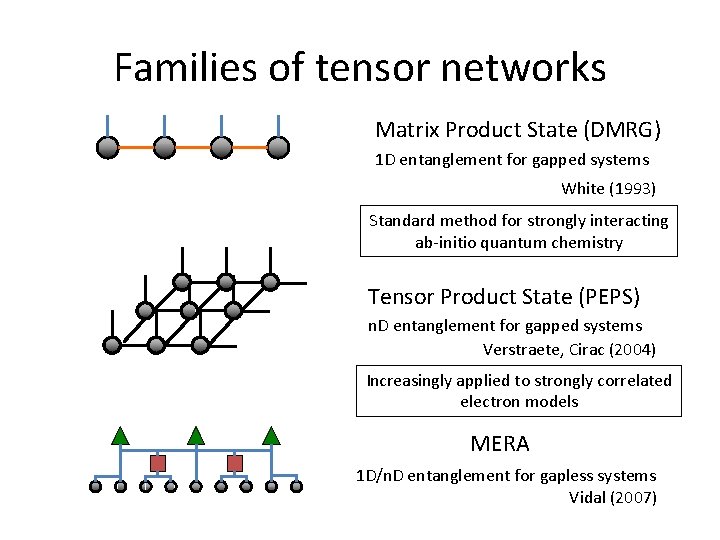
Families of tensor networks Matrix Product State (DMRG) 1 D entanglement for gapped systems White (1993) Standard method for strongly interacting ab-initio quantum chemistry Tensor Product State (PEPS) n. D entanglement for gapped systems Verstraete, Cirac (2004) Increasingly applied to strongly correlated electron models MERA 1 D/n. D entanglement for gapless systems Vidal (2007)
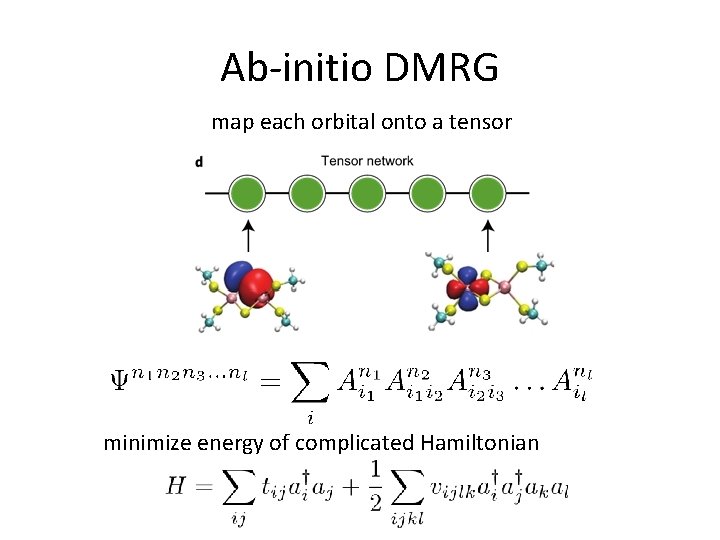
Ab-initio DMRG map each orbital onto a tensor minimize energy of complicated Hamiltonian
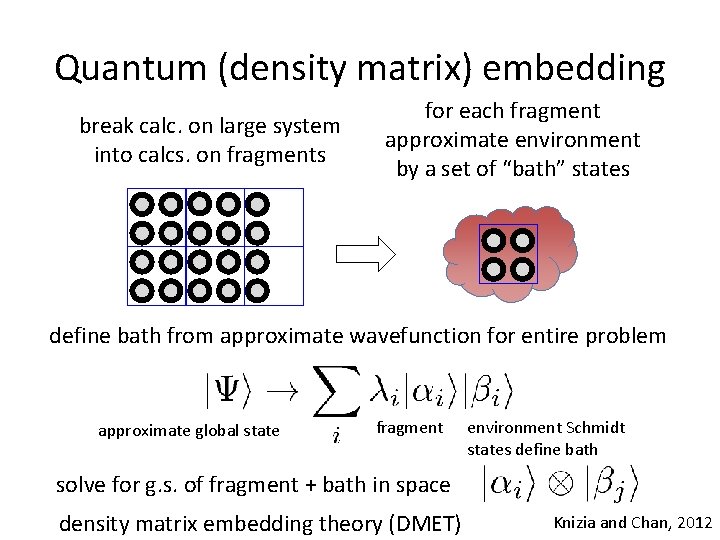
Quantum (density matrix) embedding break calc. on large system into calcs. on fragments for each fragment approximate environment by a set of “bath” states define bath from approximate wavefunction for entire problem approximate global state fragment environment Schmidt states define bath solve for g. s. of fragment + bath in space density matrix embedding theory (DMET) Knizia and Chan, 2012
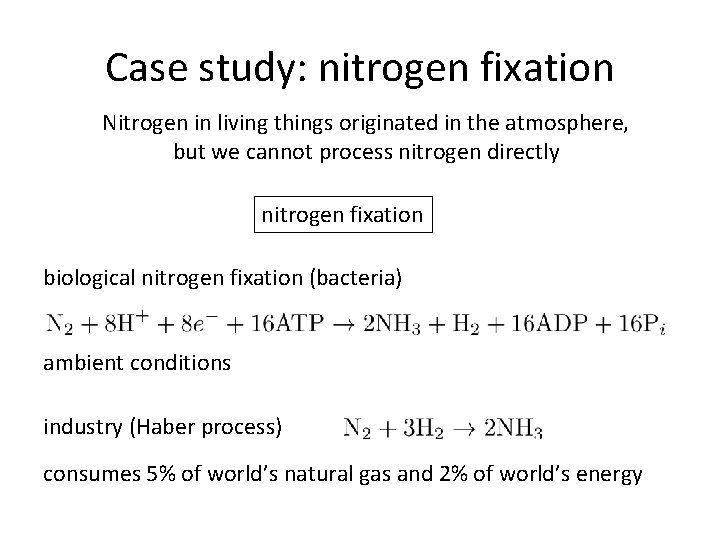
Case study: nitrogen fixation Nitrogen in living things originated in the atmosphere, but we cannot process nitrogen directly nitrogen fixation biological nitrogen fixation (bacteria) ambient conditions industry (Haber process) consumes 5% of world’s natural gas and 2% of world’s energy
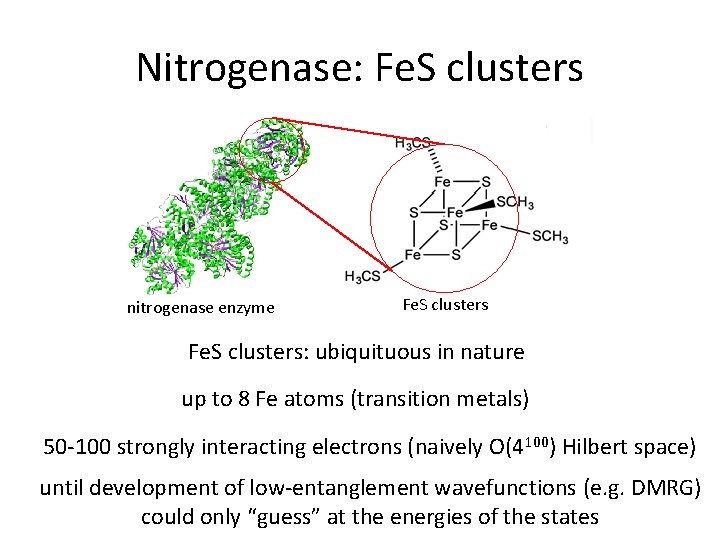
Nitrogenase: Fe. S clusters nitrogenase enzyme Fe. S clusters: ubiquituous in nature up to 8 Fe atoms (transition metals) 50 -100 strongly interacting electrons (naively O(4100) Hilbert space) until development of low-entanglement wavefunctions (e. g. DMRG) could only “guess” at the energies of the states
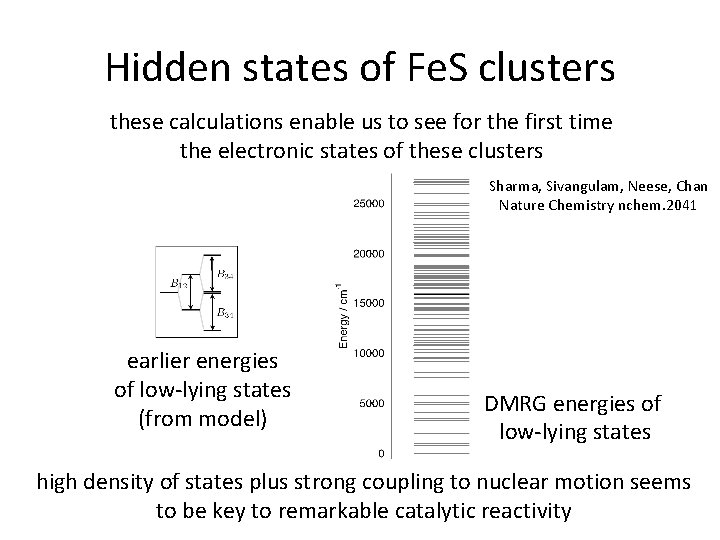
Hidden states of Fe. S clusters these calculations enable us to see for the first time the electronic states of these clusters Sharma, Sivangulam, Neese, Chan Nature Chemistry nchem. 2041 earlier energies of low-lying states (from model) DMRG energies of low-lying states high density of states plus strong coupling to nuclear motion seems to be key to remarkable catalytic reactivity
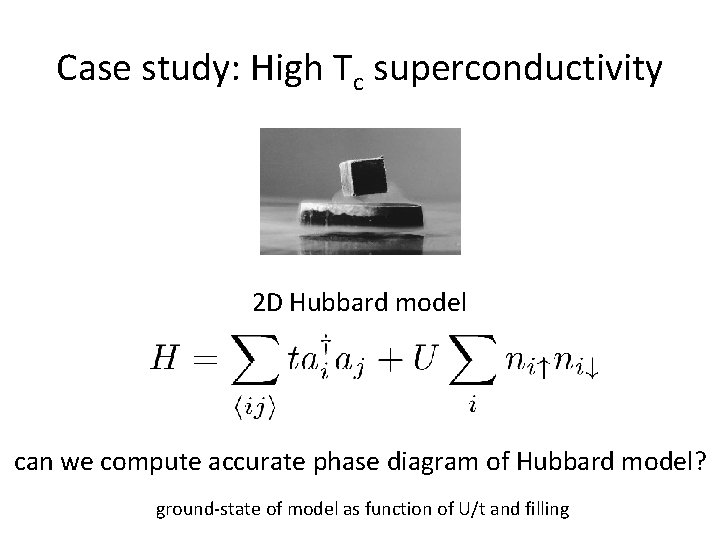
Case study: High Tc superconductivity 2 D Hubbard model can we compute accurate phase diagram of Hubbard model? ground-state of model as function of U/t and filling
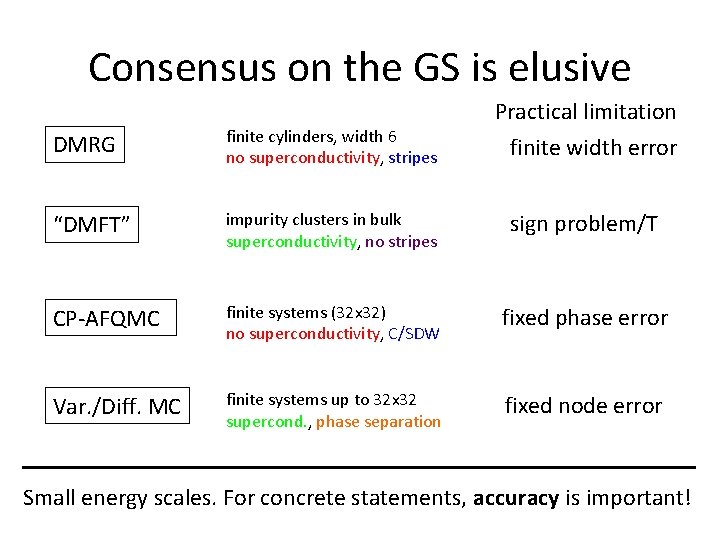
Consensus on the GS is elusive Practical limitation DMRG finite cylinders, width 6 no superconductivity, stripes “DMFT” impurity clusters in bulk superconductivity, no stripes sign problem/T CP-AFQMC finite systems (32 x 32) no superconductivity, C/SDW fixed phase error Var. /Diff. MC finite systems up to 32 x 32 supercond. , phase separation fixed node error finite width error Small energy scales. For concrete statements, accuracy is important!
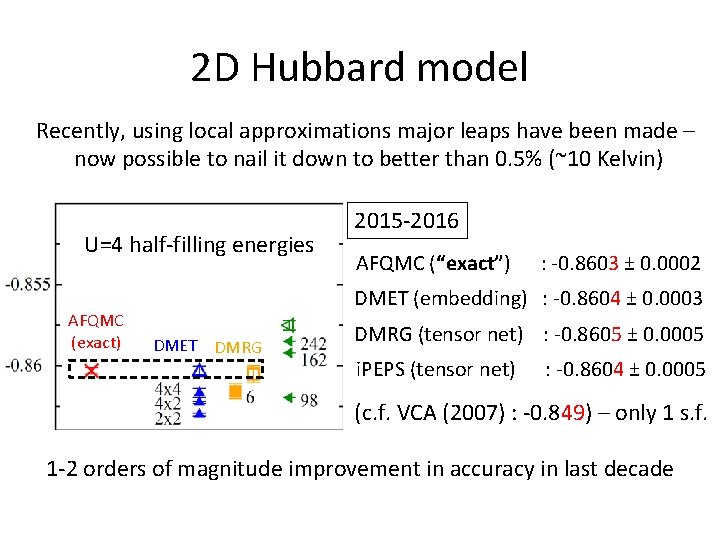
2 D Hubbard model Recently, using local approximations major leaps have been made – now possible to nail it down to better than 0. 5% (~10 Kelvin) U=4 half-filling energies AFQMC (exact) 2015 -2016 AFQMC (“exact”) : -0. 8603 ± 0. 0002 DMET (embedding) : -0. 8604 ± 0. 0003 DMET DMRG (tensor net) : -0. 8605 ± 0. 0005 i. PEPS (tensor net) : -0. 8604 ± 0. 0005 (c. f. VCA (2007) : -0. 849) – only 1 s. f. 1 -2 orders of magnitude improvement in accuracy in last decade
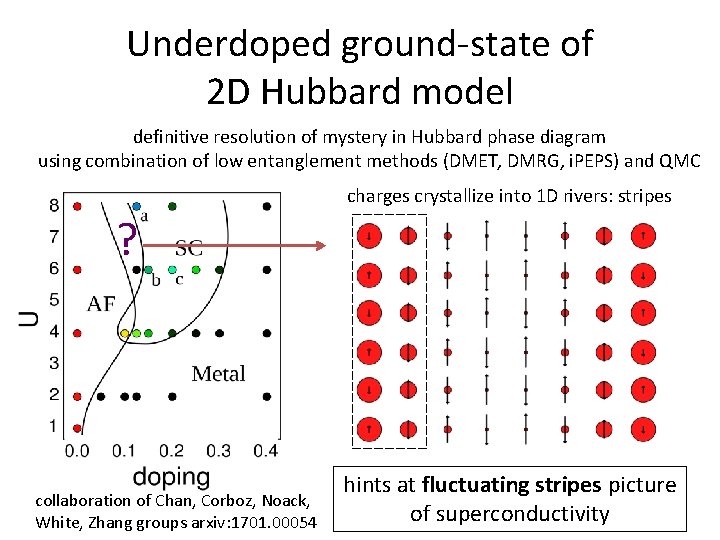
Underdoped ground-state of 2 D Hubbard model definitive resolution of mystery in Hubbard phase diagram using combination of low entanglement methods (DMET, DMRG, i. PEPS) and QMC charges crystallize into 1 D rivers: stripes ? collaboration of Chan, Corboz, Noack, White, Zhang groups arxiv: 1701. 00054 hints at fluctuating stripes picture of superconductivity
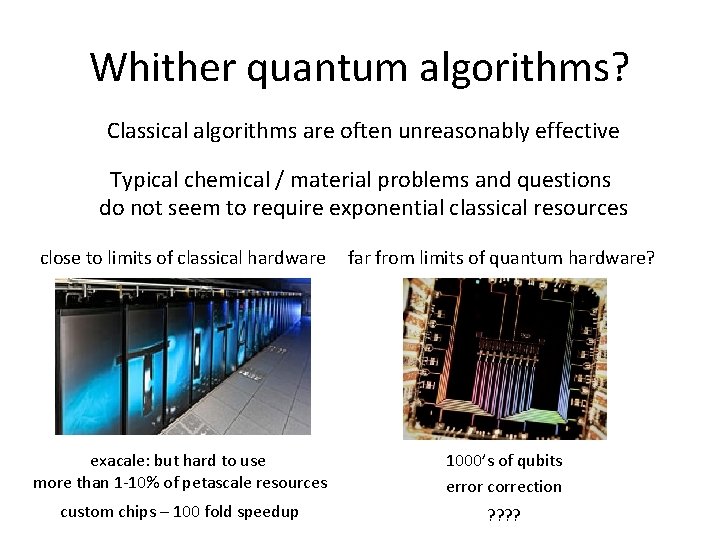
Whither quantum algorithms? Classical algorithms are often unreasonably effective Typical chemical / material problems and questions do not seem to require exponential classical resources close to limits of classical hardware far from limits of quantum hardware? exacale: but hard to use more than 1 -10% of petascale resources 1000’s of qubits error correction custom chips – 100 fold speedup ? ?
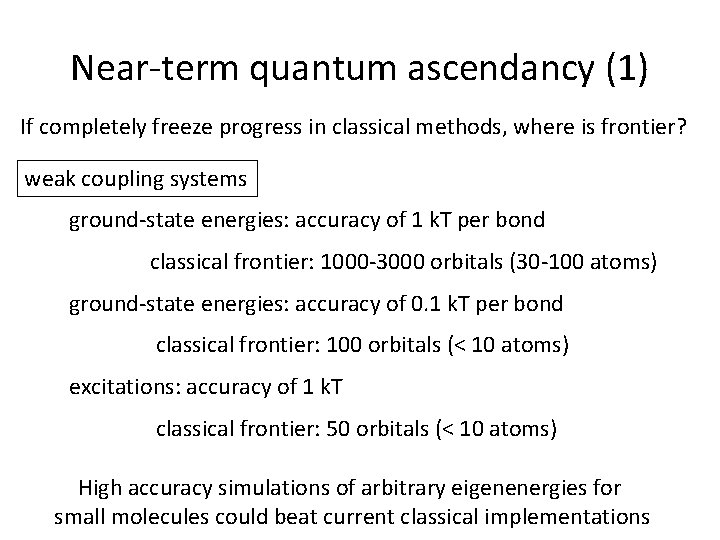
Near-term quantum ascendancy (1) If completely freeze progress in classical methods, where is frontier? weak coupling systems ground-state energies: accuracy of 1 k. T per bond classical frontier: 1000 -3000 orbitals (30 -100 atoms) ground-state energies: accuracy of 0. 1 k. T per bond classical frontier: 100 orbitals (< 10 atoms) excitations: accuracy of 1 k. T classical frontier: 50 orbitals (< 10 atoms) High accuracy simulations of arbitrary eigenenergies for small molecules could beat current classical implementations
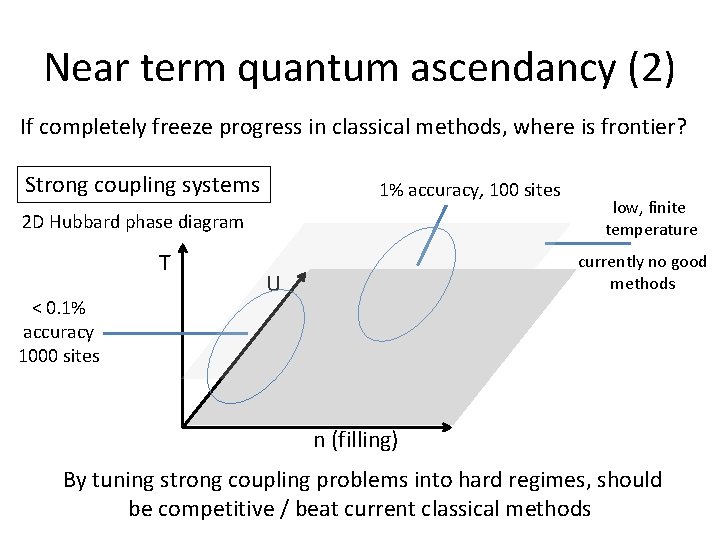
Near term quantum ascendancy (2) If completely freeze progress in classical methods, where is frontier? Strong coupling systems 1% accuracy, 100 sites 2 D Hubbard phase diagram T < 0. 1% accuracy 1000 sites low, finite temperature currently no good methods U n (filling) By tuning strong coupling problems into hard regimes, should be competitive / beat current classical methods
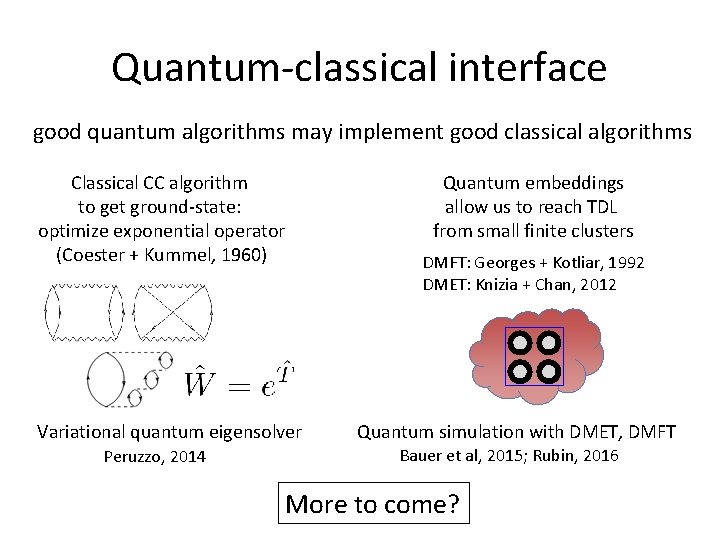
Quantum-classical interface good quantum algorithms may implement good classical algorithms Classical CC algorithm to get ground-state: optimize exponential operator (Coester + Kummel, 1960) Variational quantum eigensolver Peruzzo, 2014 Quantum embeddings allow us to reach TDL from small finite clusters DMFT: Georges + Kotliar, 1992 DMET: Knizia + Chan, 2012 Quantum simulation with DMET, DMFT Bauer et al, 2015; Rubin, 2016 More to come?
Conclusions Using physical structures of quantum states can simulate frontier chemistry and materials science problems on classical computers No evidence that we need exponential classical resources By tuning into appropriate regimes, should see quantum computing crossover Funding from: DOE, NSF, Simons Foundation