
Simulating Atmospheric Strehl Trex Enterprises Mentor Ben Wheeler
Simulating Atmospheric Strehl Trex Enterprises Mentor: Ben Wheeler Ryan Nora Summer 2005
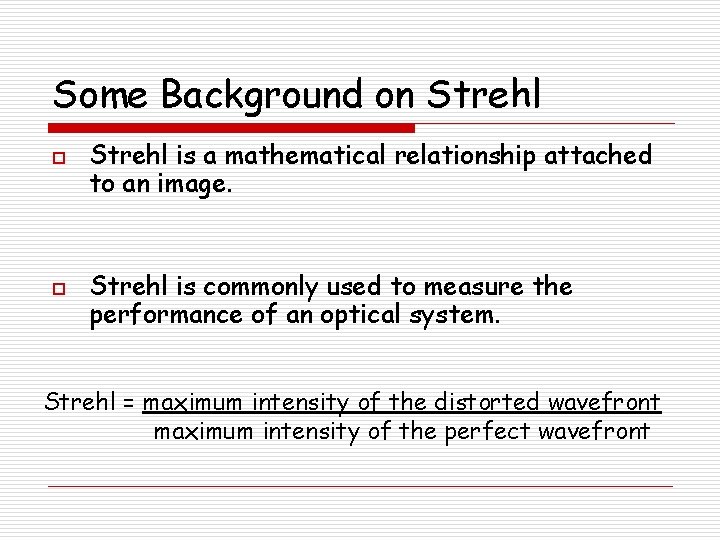
Some Background on Strehl o o Strehl is a mathematical relationship attached to an image. Strehl is commonly used to measure the performance of an optical system. Strehl = maximum intensity of the distorted wavefront maximum intensity of the perfect wavefront
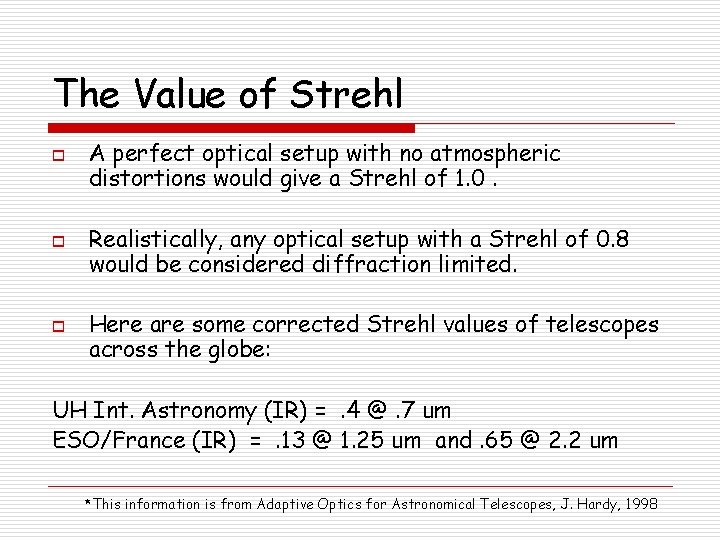
The Value of Strehl o o o A perfect optical setup with no atmospheric distortions would give a Strehl of 1. 0. Realistically, any optical setup with a Strehl of 0. 8 would be considered diffraction limited. Here are some corrected Strehl values of telescopes across the globe: UH Int. Astronomy (IR) =. 4 @. 7 um ESO/France (IR) =. 13 @ 1. 25 um and. 65 @ 2. 2 um *This information is from Adaptive Optics for Astronomical Telescopes, J. Hardy, 1998
The Project o o o To simulate atmospheric distortions in a wavefront and calculate its Strehl. Modeled after the AEOS telescope. Broken into two simulations to calculate Strehl.
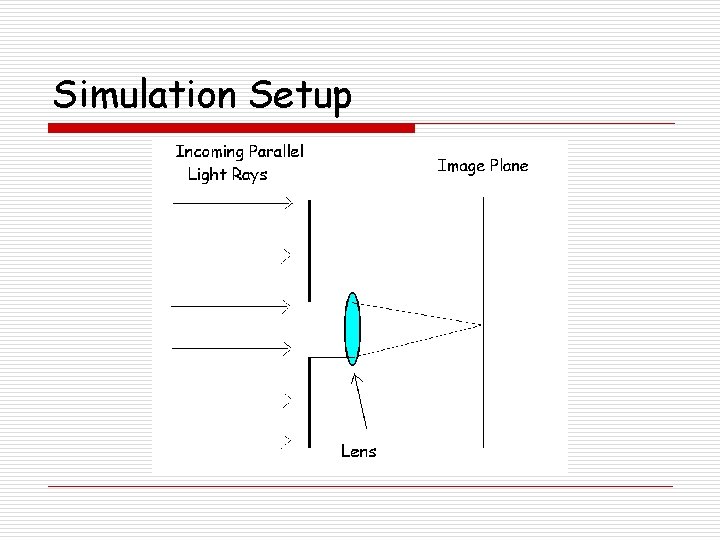
Simulation Setup

Energy Distribution Background Airy Disk Intensity Plot
Ideal System Important Steps in calculating the energy distribution of the ideal system: o o o Define the amount of light entering the system Find which frequencies are present Convert amplitude to intensity
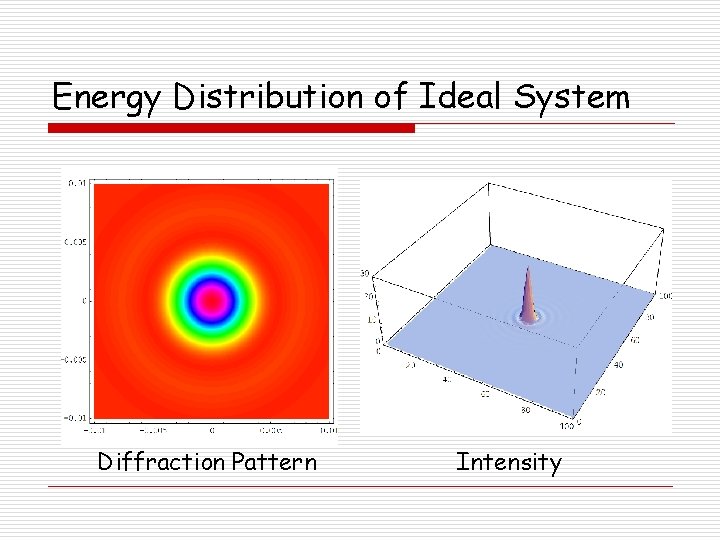
Energy Distribution of Ideal System Diffraction Pattern Intensity
Distorted System Important Steps in calculating the energy distribution of the distorted system: o o Define the amount of light entering the system Generate distorted wavefront Find which frequencies are present Convert amplitude to intensity
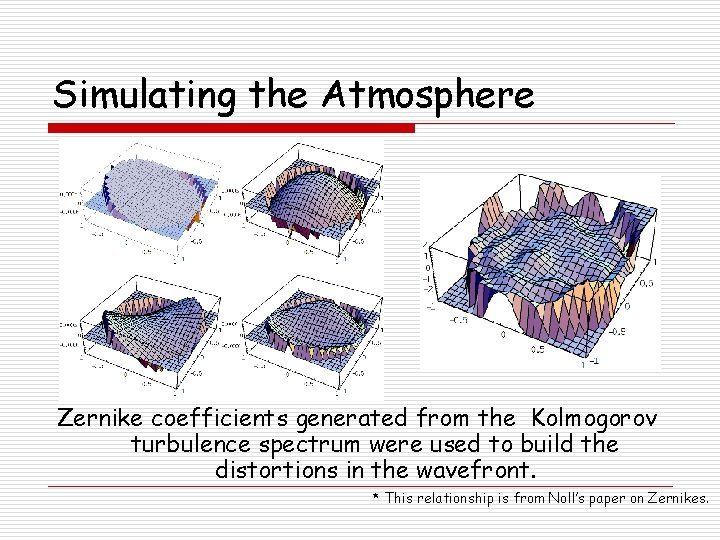
Simulating the Atmosphere Zernike coefficients generated from the Kolmogorov turbulence spectrum were used to build the distortions in the wavefront. * This relationship is from Noll’s paper on Zernikes.
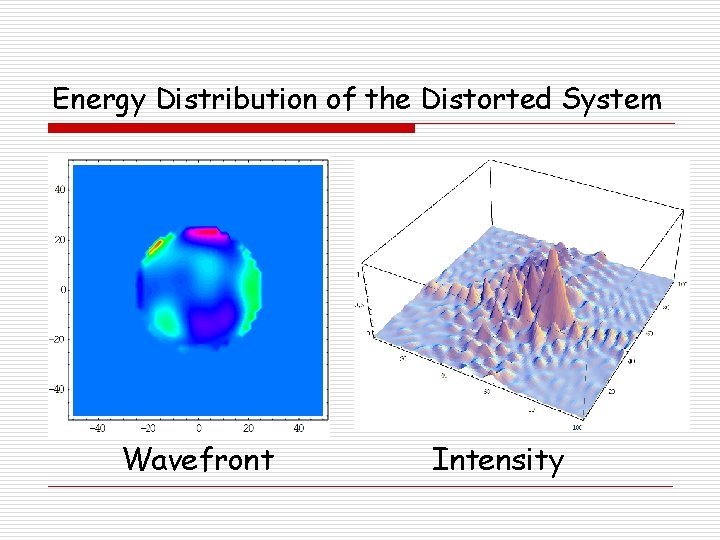
Energy Distribution of the Distorted System Wavefront Intensity
Calculating Strehl = maximum intensity of the distorted wavefront maximum intensity of the perfect wavefront By creating the aberrations in the simulated wave front similar to what the atmosphere distorts waves in real life, I have calculated an atmospheric Strehl of: ~ 0. 03
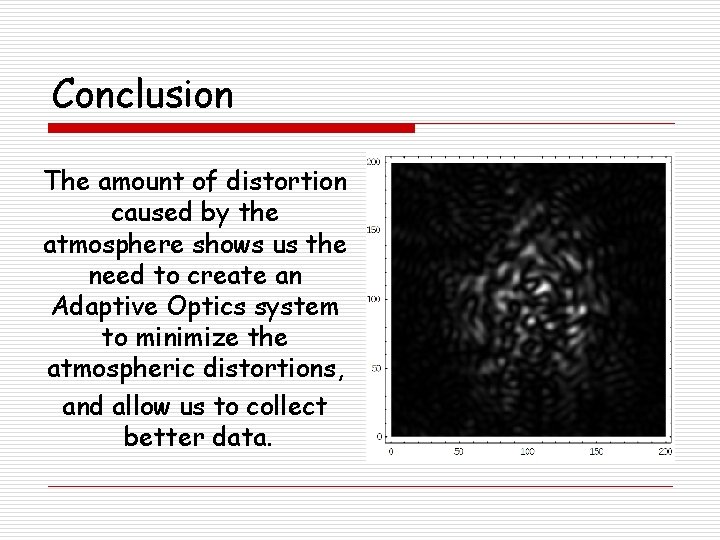
Conclusion The amount of distortion caused by the atmosphere shows us the need to create an Adaptive Optics system to minimize the atmospheric distortions, and allow us to collect better data.
Many Mahalos to: Center for Adaptive Trex Enterprises Ben Wheeler Dr. Mike Flannigan Optics Malika Bell Maui Community College Lisa Hunter Mark Hoffman Liz Espinoza Wallette Pellegrino This project is supported by the National Science Foundation Science and Technology Center for Adaptive Optics, managed by the University of California at Santa Cruz under cooperative agreement No. AST - 9876783.

- Slides: 15