
Simplifying Radical Expressions For a radical expression to

- Slides: 9
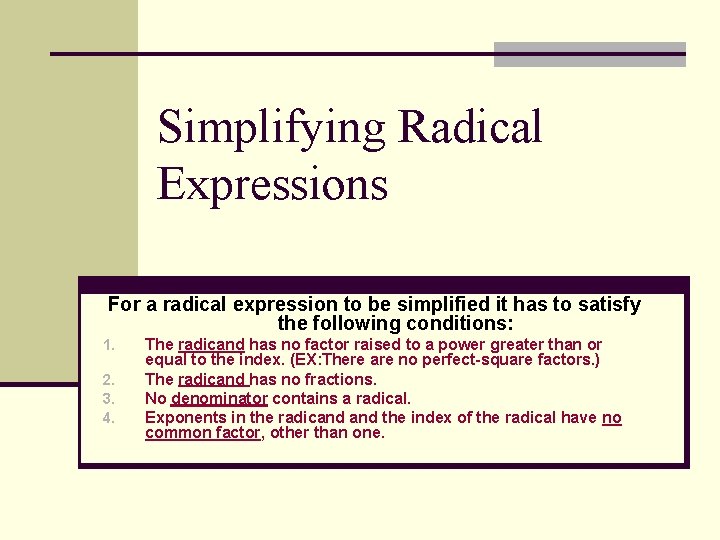
Simplifying Radical Expressions For a radical expression to be simplified it has to satisfy the following conditions: 1. 2. 3. 4. The radicand has no factor raised to a power greater than or equal to the index. (EX: There are no perfect-square factors. ) The radicand has no fractions. No denominator contains a radical. Exponents in the radicand the index of the radical have no common factor, other than one.
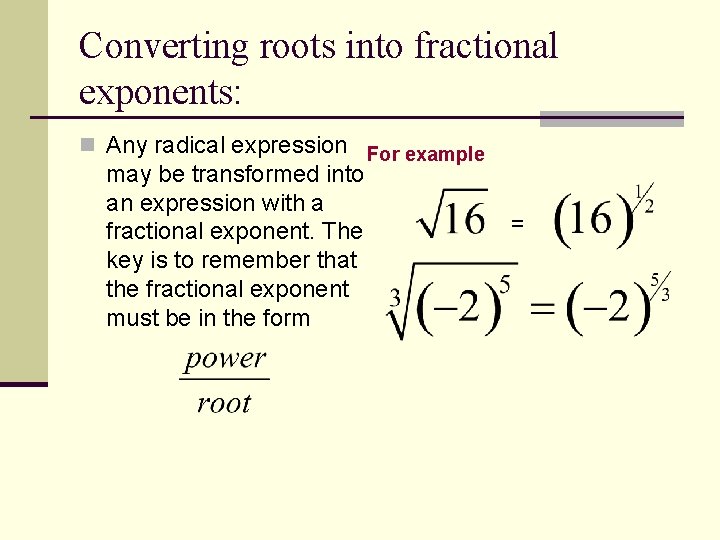
Converting roots into fractional exponents: n Any radical expression For example may be transformed into an expression with a fractional exponent. The key is to remember that the fractional exponent must be in the form =
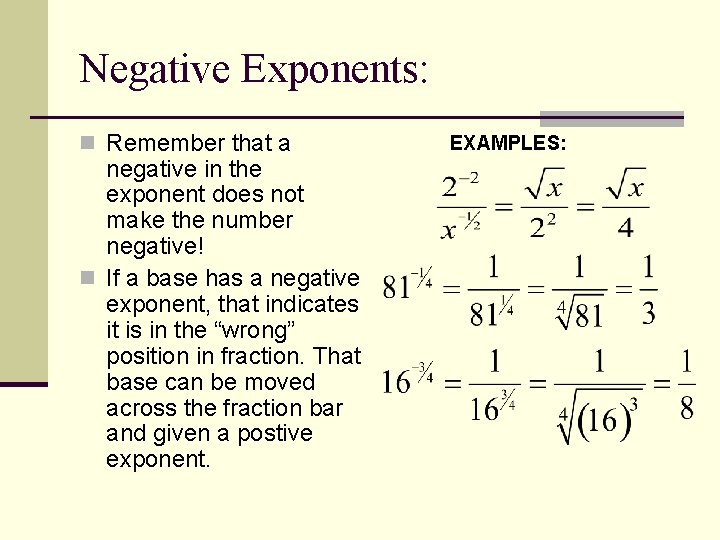
Negative Exponents: n Remember that a negative in the exponent does not make the number negative! n If a base has a negative exponent, that indicates it is in the “wrong” position in fraction. That base can be moved across the fraction bar and given a postive exponent. EXAMPLES:
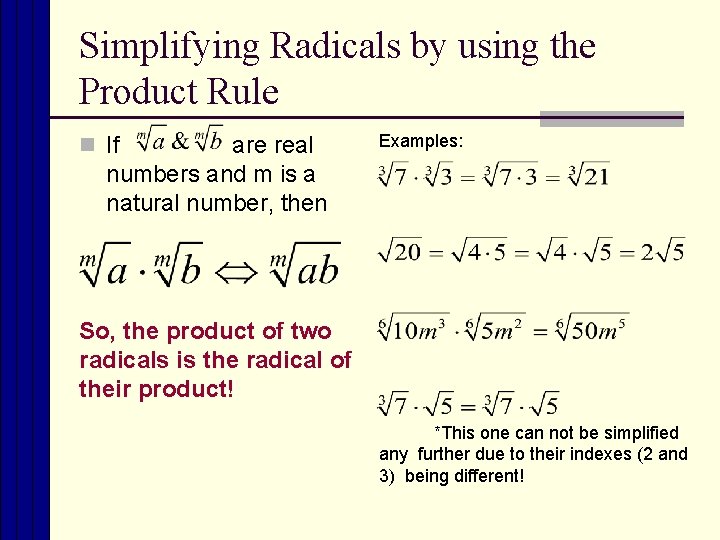
Simplifying Radicals by using the Product Rule n If are real numbers and m is a natural number, then Examples: So, the product of two radicals is the radical of their product! *This one can not be simplified any further due to their indexes (2 and 3) being different!
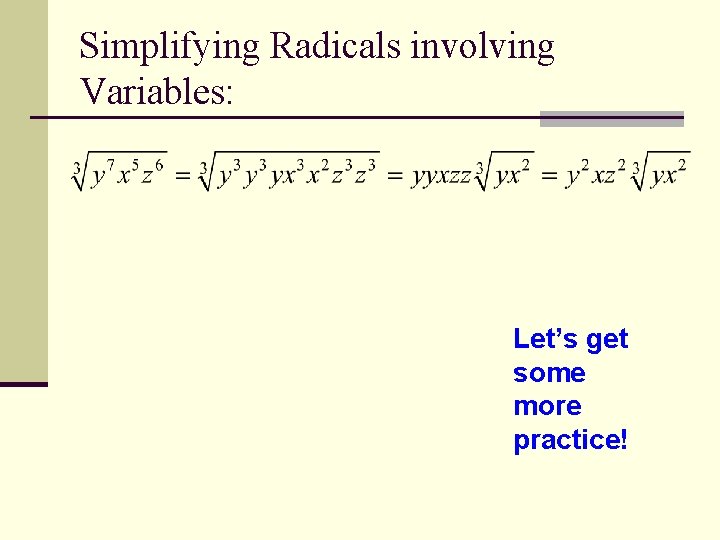
Simplifying Radicals involving Variables: Let’s get some more practice!
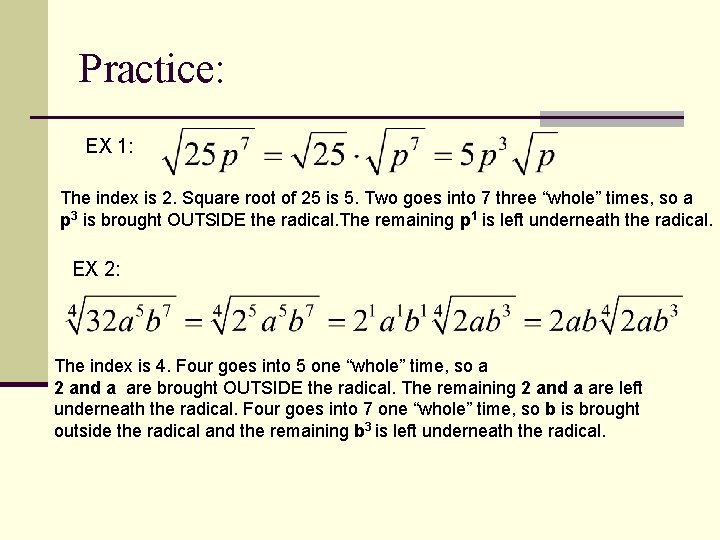
Practice: EX 1: The index is 2. Square root of 25 is 5. Two goes into 7 three “whole” times, so a p 3 is brought OUTSIDE the radical. The remaining p 1 is left underneath the radical. EX 2: The index is 4. Four goes into 5 one “whole” time, so a 2 and a are brought OUTSIDE the radical. The remaining 2 and a are left underneath the radical. Four goes into 7 one “whole” time, so b is brought outside the radical and the remaining b 3 is left underneath the radical.
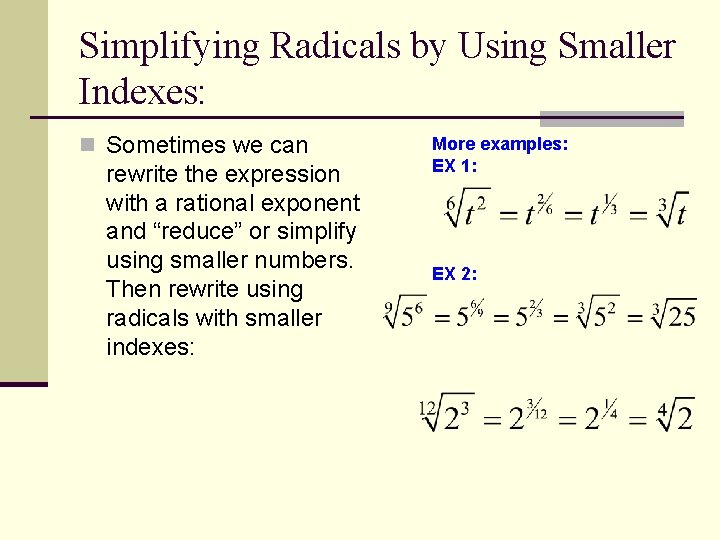
Simplifying Radicals by Using Smaller Indexes: n Sometimes we can rewrite the expression with a rational exponent and “reduce” or simplify using smaller numbers. Then rewrite using radicals with smaller indexes: More examples: EX 1: EX 2:
Multiplying Radicals with Difference Indexes: n Sometimes radicals can be MADE to have the same index by rewriting first as rational exponents and getting a common denominator. Then, these rational exponents may be rewritten as radicals with the same index in order to be multiplied.
Applications of Radicals: n There are many applications of radicals. However, one of the most widely used applications is the use of the Pythagorean Formula. n You will also be using the Quadratic Formula later in this course!