
Simplified fabrication of doubly reentrant structures Manuel Garcia
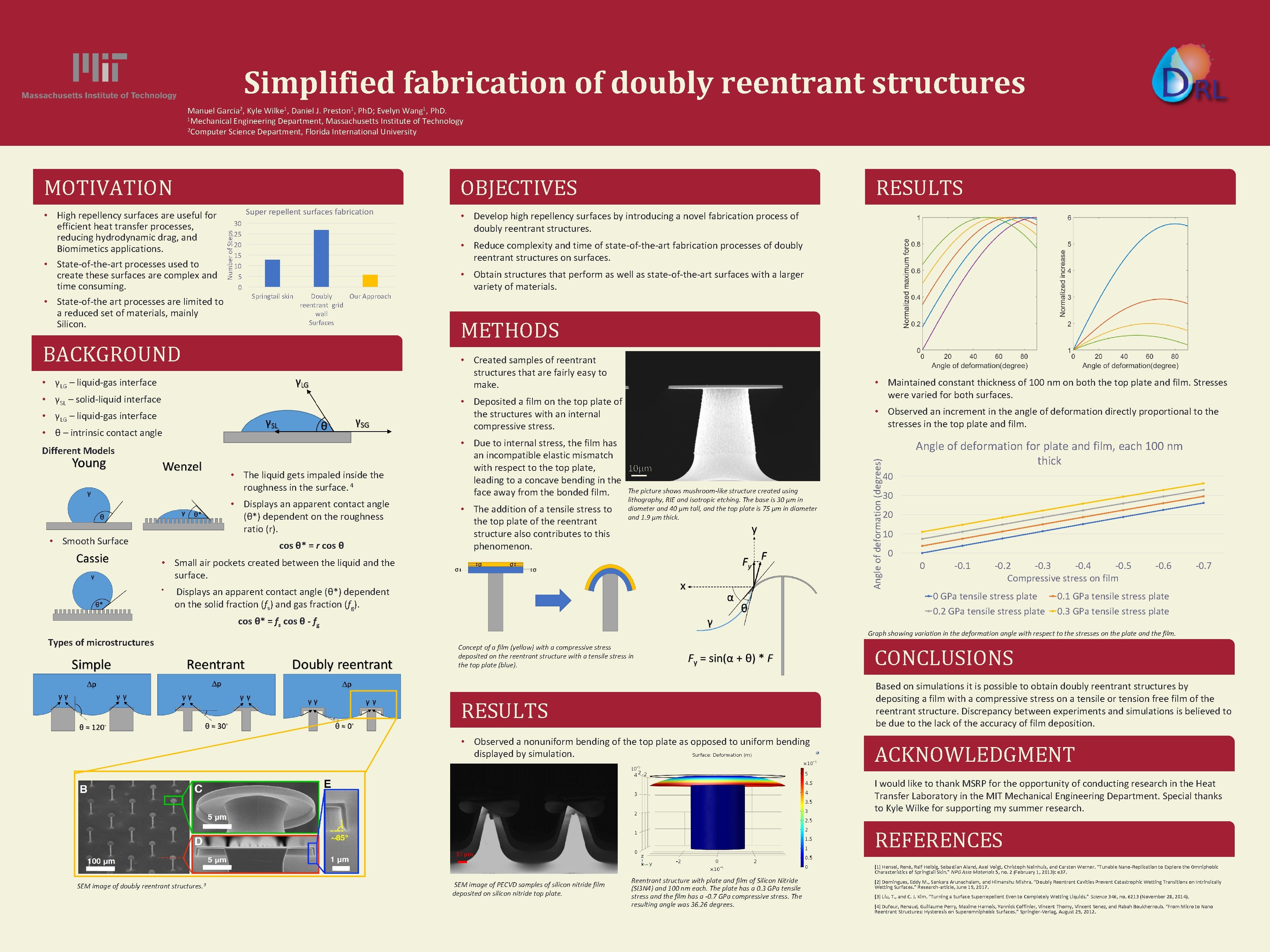
Simplified fabrication of doubly reentrant structures Manuel Garcia 2, Kyle Wilke 1, Daniel J. Preston 1, Ph. D; Evelyn Wang 1, Ph. D. 1 Mechanical Engineering Department, Massachusetts Institute of Technology 2 Computer Science Department, Florida International University MOTIVATION RESULTS OBJECTIVES Super repellent surfaces fabrication 30 25 20 15 10 5 0 • Develop high repellency surfaces by introducing a novel fabrication process of doubly reentrant structures. • Reduce complexity and time of state-of-the-art fabrication processes of doubly reentrant structures on surfaces. Springtail skin Doubly Our Approach reentrant grid wall Surfaces BACKGROUND • Obtain structures that perform as well as state-of-the-art surfaces with a larger variety of materials. METHODS • Created samples of reentrant structures that are fairly easy to make. • γLG – liquid-gas interface • γSL – solid-liquid interface • Maintained constant thickness of 100 nm on both the top plate and film. Stresses were varied for both surfaces. • Deposited a film on the top plate of the structures with an internal compressive stress. • γLG – liquid-gas interface • θ – intrinsic contact angle Different Models • The liquid gets impaled inside the roughness in the surface. 4 • Displays an apparent contact angle (θ*) dependent on the roughness ratio (r). • Smooth Surface cos θ* = r cos θ • Due to internal stress, the film has an incompatible elastic mismatch with respect to the top plate, leading to a concave bending in the face away from the bonded film. • The addition of a tensile stress to the top plate of the reentrant structure also contributes to this phenomenon. • Observed an increment in the angle of deformation directly proportional to the stresses in the top plate and film. Angle of deformation for plate and film, each 100 nm thick 40 The picture shows mushroom-like structure created using lithography, RIE and isotropic etching. The base is 30 μm in diameter and 40 μm tall, and the top plate is 75 μm in diameter and 1. 9 μm thick. 30 20 10 • Small air pockets created between the liquid and the surface. • Angle of deformation (degrees) Number of Steps • High repellency surfaces are useful for efficient heat transfer processes, reducing hydrodynamic drag, and Biomimetics applications. • State-of-the-art processes used to create these surfaces are complex and time consuming. • State-of-the art processes are limited to a reduced set of materials, mainly Silicon. Displays an apparent contact angle (θ*) dependent on the solid fraction (fs) and gas fraction (fg). 0 0 -0. 1 -0. 2 -0. 3 -0. 4 -0. 5 Compressive stress on film 0 GPa tensile stress plate 0. 2 GPa tensile stress plate cos θ* = fs cos θ - fg -0. 6 -0. 7 0. 1 GPa tensile stress plate 0. 3 GPa tensile stress plate Graph showing variation in the deformation angle with respect to the stresses on the plate and the film. Types of microstructures Concept of a film (yellow) with a compressive stress deposited on the reentrant structure with a tensile stress in the top plate (blue). CONCLUSIONS Based on simulations it is possible to obtain doubly reentrant structures by depositing a film with a compressive stress on a tensile or tension free film of the reentrant structure. Discrepancy between experiments and simulations is believed to be due to the lack of the accuracy of film deposition. RESULTS • Observed a nonuniform bending of the top plate as opposed to uniform bending displayed by simulation. ACKNOWLEDGMENT I would like to thank MSRP for the opportunity of conducting research in the Heat Transfer Laboratory in the MIT Mechanical Engineering Department. Special thanks to Kyle Wilke for supporting my summer research. REFERENCES 10 μm [1] Hensel, René, Ralf Helbig, Sebastian Aland, Axel Voigt, Christoph Neinhuis, and Carsten Werner. “Tunable Nano-Replication to Explore the Omniphobic Characteristics of Springtail Skin. ” NPG Asia Materials 5, no. 2 (February 1, 2013): e 37. SEM image of doubly reentrant structures. 3 SEM image of PECVD samples of silicon nitride film deposited on silicon nitride top plate. Reentrant structure with plate and film of Silicon Nitride (SI 3 N 4) and 100 nm each. The plate has a 0. 3 GPa tensile stress and the film has a -0. 7 GPa compressive stress. The resulting angle was 36. 26 degrees. [2] Domingues, Eddy M. , Sankara Arunachalam, and Himanshu Mishra. “Doubly Reentrant Cavities Prevent Catastrophic Wetting Transitions on Intrinsically Wetting Surfaces. ” Research-article, June 19, 2017. [3] Liu, T. , and C. J. Kim. “Turning a Surface Superrepellent Even to Completely Wetting Liquids. ” Science 346, no. 6213 (November 28, 2014). [4] Dufour, Renaud, Guillaume Perry, Maxime Harnois, Yannick Coffinier, Vincent Thomy, Vincent Senez, and Rabah Boukherroub. “From Micro to Nano Reentrant Structures: Hysteresis on Superomniphobic Surfaces. ” Springler-Verlag, August 29, 2012.
- Slides: 1