
Simplex PMD Glen Kramer Chair IEEE P 802
- Slides: 13
Simplex PMD Glen Kramer Chair, IEEE P 802. 3 av “ 10 GEPON” Task Force glen. kramer@teknovus. com July 16, 2007 IEEE 802. 3 Plenary Session, San Francisco, CA 1
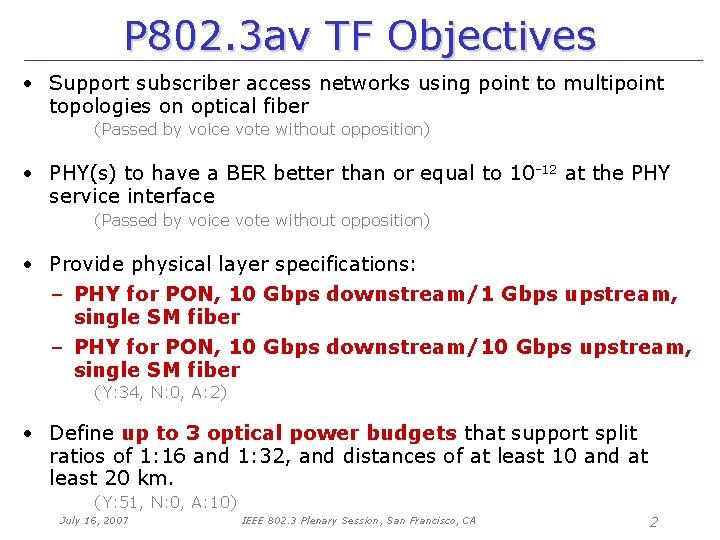
P 802. 3 av TF Objectives • Support subscriber access networks using point to multipoint topologies on optical fiber (Passed by voice vote without opposition) • PHY(s) to have a BER better than or equal to 10 -12 at the PHY service interface (Passed by voice vote without opposition) • Provide physical layer specifications: – PHY for PON, 10 Gbps downstream/1 Gbps upstream, single SM fiber – PHY for PON, 10 Gbps downstream/10 Gbps upstream, single SM fiber (Y: 34, N: 0, A: 2) • Define up to 3 optical power budgets that support split ratios of 1: 16 and 1: 32, and distances of at least 10 and at least 20 km. (Y: 51, N: 0, A: 10) July 16, 2007 IEEE 802. 3 Plenary Session, San Francisco, CA 2
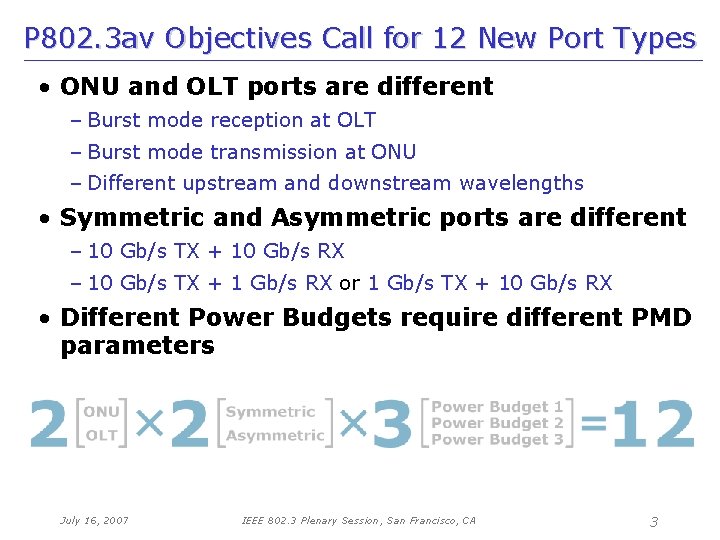
P 802. 3 av Objectives Call for 12 New Port Types • ONU and OLT ports are different – Burst mode reception at OLT – Burst mode transmission at ONU – Different upstream and downstream wavelengths • Symmetric and Asymmetric ports are different – 10 Gb/s TX + 10 Gb/s RX – 10 Gb/s TX + 1 Gb/s RX or 1 Gb/s TX + 10 Gb/s RX • Different Power Budgets require different PMD parameters July 16, 2007 IEEE 802. 3 Plenary Session, San Francisco, CA 3
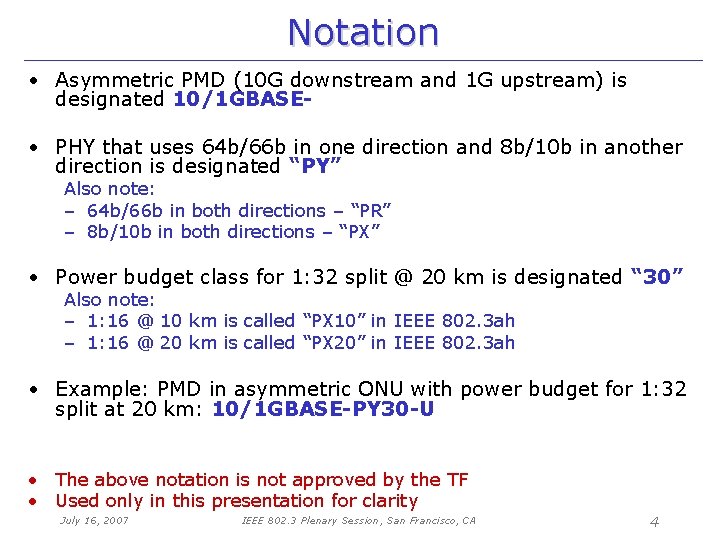
Notation • Asymmetric PMD (10 G downstream and 1 G upstream) is designated 10/1 GBASE • PHY that uses 64 b/66 b in one direction and 8 b/10 b in another direction is designated “PY” Also note: – 64 b/66 b in both directions – “PR” – 8 b/10 b in both directions – “PX” • Power budget class for 1: 32 split @ 20 km is designated “ 30” Also note: – 1: 16 @ 10 km is called “PX 10” in IEEE 802. 3 ah – 1: 16 @ 20 km is called “PX 20” in IEEE 802. 3 ah • Example: PMD in asymmetric ONU with power budget for 1: 32 split at 20 km: 10/1 GBASE-PY 30 -U • The above notation is not approved by the TF • Used only in this presentation for clarity July 16, 2007 IEEE 802. 3 Plenary Session, San Francisco, CA 4
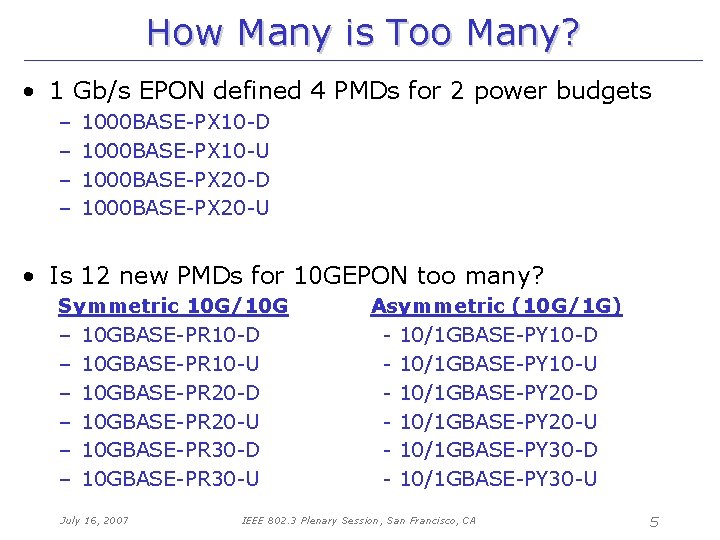
How Many is Too Many? • 1 Gb/s EPON defined 4 PMDs for 2 power budgets – – 1000 BASE-PX 10 -D 1000 BASE-PX 10 -U 1000 BASE-PX 20 -D 1000 BASE-PX 20 -U • Is 12 new PMDs for 10 GEPON too many? Symmetric 10 G/10 G – 10 GBASE-PR 10 -D – 10 GBASE-PR 10 -U – 10 GBASE-PR 20 -D – 10 GBASE-PR 20 -U – 10 GBASE-PR 30 -D – 10 GBASE-PR 30 -U July 16, 2007 Asymmetric (10 G/1 G) - 10/1 GBASE-PY 10 -D - 10/1 GBASE-PY 10 -U - 10/1 GBASE-PY 20 -D - 10/1 GBASE-PY 20 -U - 10/1 GBASE-PY 30 -D - 10/1 GBASE-PY 30 -U IEEE 802. 3 Plenary Session, San Francisco, CA 5
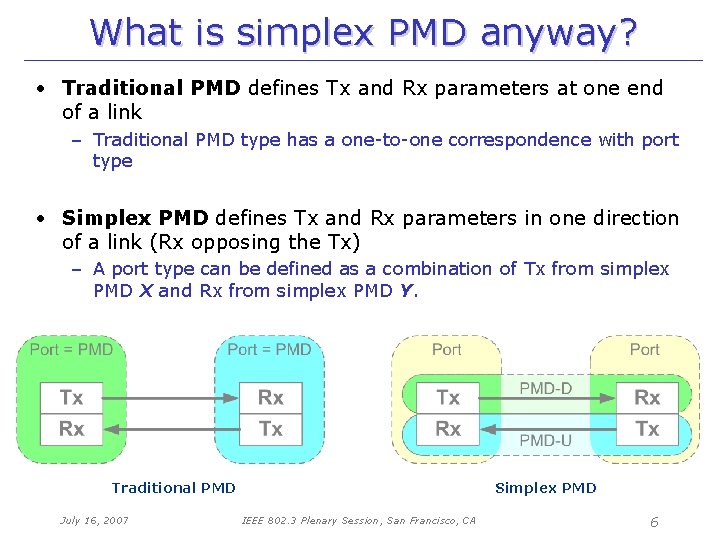
What is simplex PMD anyway? • Traditional PMD defines Tx and Rx parameters at one end of a link – Traditional PMD type has a one-to-one correspondence with port type • Simplex PMD defines Tx and Rx parameters in one direction of a link (Rx opposing the Tx) – A port type can be defined as a combination of Tx from simplex PMD X and Rx from simplex PMD Y. Traditional PMD July 16, 2007 Simplex PMD IEEE 802. 3 Plenary Session, San Francisco, CA 6
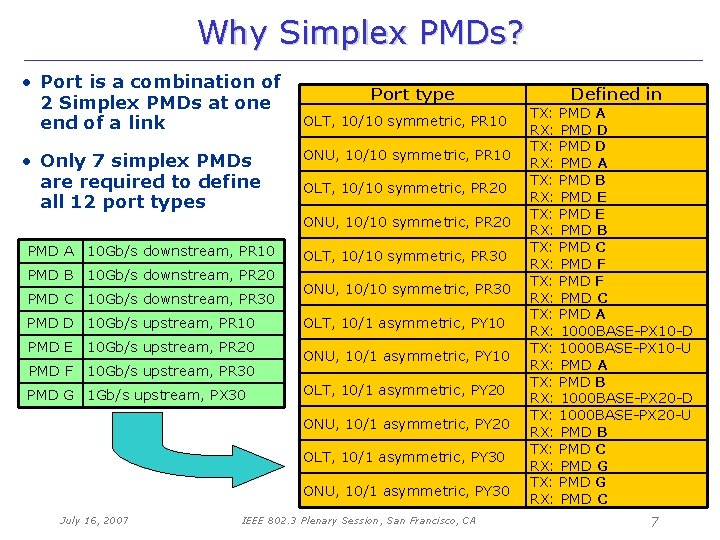
Why Simplex PMDs? • Port is a combination of 2 Simplex PMDs at one end of a link • Only 7 simplex PMDs are required to define all 12 port types Port type OLT, 10/10 symmetric, PR 10 ONU, 10/10 symmetric, PR 10 OLT, 10/10 symmetric, PR 20 ONU, 10/10 symmetric, PR 20 PMD A 10 Gb/s downstream, PR 10 PMD B 10 Gb/s downstream, PR 20 PMD C 10 Gb/s downstream, PR 30 PMD D 10 Gb/s upstream, PR 10 PMD E 10 Gb/s upstream, PR 20 PMD F 10 Gb/s upstream, PR 30 PMD G 1 Gb/s upstream, PX 30 OLT, 10/10 symmetric, PR 30 ONU, 10/10 symmetric, PR 30 OLT, 10/1 asymmetric, PY 10 ONU, 10/1 asymmetric, PY 10 OLT, 10/1 asymmetric, PY 20 ONU, 10/1 asymmetric, PY 20 OLT, 10/1 asymmetric, PY 30 ONU, 10/1 asymmetric, PY 30 July 16, 2007 IEEE 802. 3 Plenary Session, San Francisco, CA Defined in TX: PMD A RX: PMD D TX: PMD D RX: PMD A TX: PMD B RX: PMD E TX: PMD E RX: PMD B TX: PMD C RX: PMD F TX: PMD F RX: PMD C TX: PMD A RX: 1000 BASE-PX 10 -D TX: 1000 BASE-PX 10 -U RX: PMD A TX: PMD B RX: 1000 BASE-PX 20 -D TX: 1000 BASE-PX 20 -U RX: PMD B TX: PMD C RX: PMD G TX: PMD G RX: PMD C 7
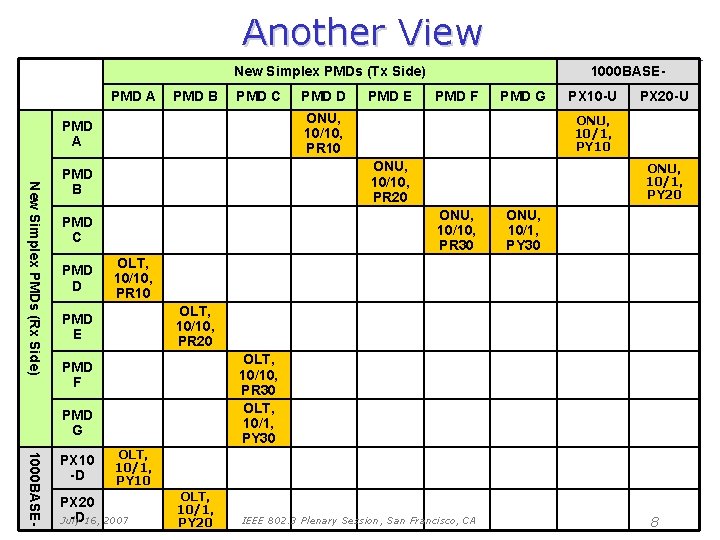
Another View New Simplex PMDs (Tx Side) PMD A PMD B PMD C PMD F PMD G PX 20 -U New Simplex PMDs (Rx Side) ONU, 10/1, PY 20 ONU, 10/10, PR 30 PMD C PX 10 -U ONU, 10/1, PY 10 ONU, 10/10, PR 20 PMD B ONU, 10/1, PY 30 OLT, 10/10, PR 10 OLT, 10/10, PR 20 PMD E OLT, 10/10, PR 30 OLT, 10/1, PY 30 PMD F PMD G 1000 BASE- PX 10 -D PMD E ONU, 10/10, PR 10 PMD A PMD D 1000 BASE- OLT, 10/1, PY 10 PX 20 -D 16, 2007 July OLT, 10/1, PY 20 IEEE 802. 3 Plenary Session, San Francisco, CA 8
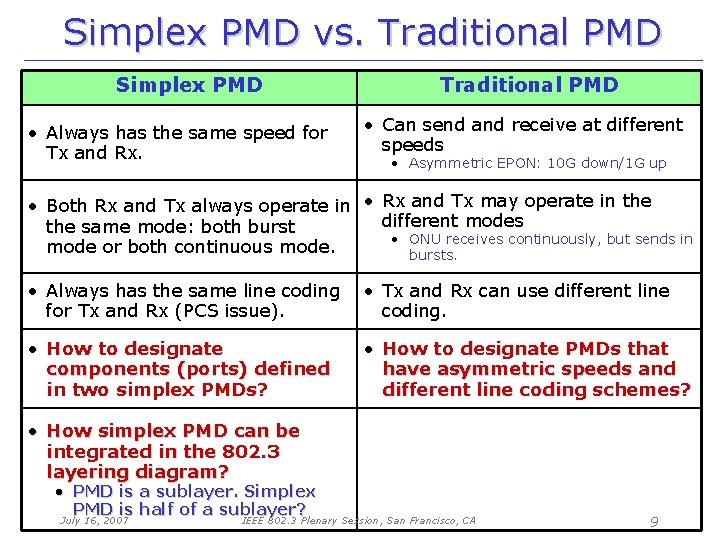
Simplex PMD vs. Traditional PMD Simplex PMD • Always has the same speed for Tx and Rx. Traditional PMD • Can send and receive at different speeds • Asymmetric EPON: 10 G down/1 G up • Both Rx and Tx always operate in • Rx and Tx may operate in the different modes the same mode: both burst • ONU receives continuously, but sends in mode or both continuous mode. bursts. • Always has the same line coding for Tx and Rx (PCS issue). • Tx and Rx can use different line coding. • How to designate components (ports) defined in two simplex PMDs? • How to designate PMDs that have asymmetric speeds and different line coding schemes? • How simplex PMD can be integrated in the 802. 3 layering diagram? • PMD is a sublayer. Simplex PMD is half of a sublayer? July 16, 2007 IEEE 802. 3 Plenary Session, San Francisco, CA 9
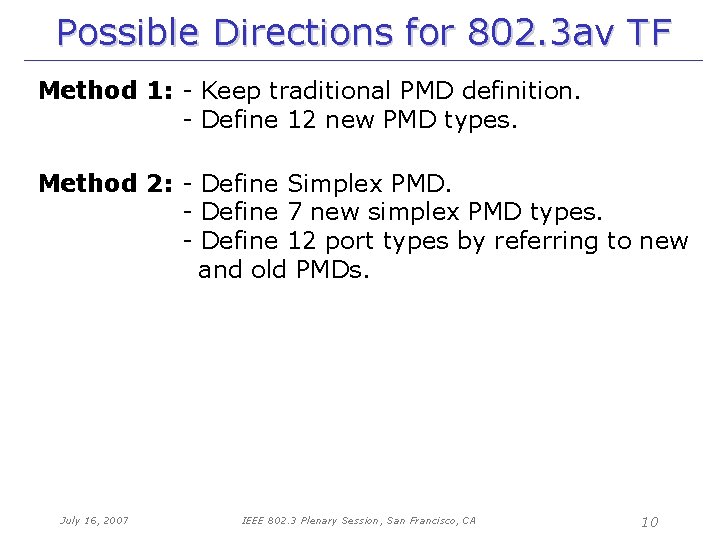
Possible Directions for 802. 3 av TF Method 1: - Keep traditional PMD definition. - Define 12 new PMD types. Method 2: - Define Simplex PMD. - Define 7 new simplex PMD types. - Define 12 port types by referring to new and old PMDs. July 16, 2007 IEEE 802. 3 Plenary Session, San Francisco, CA 10
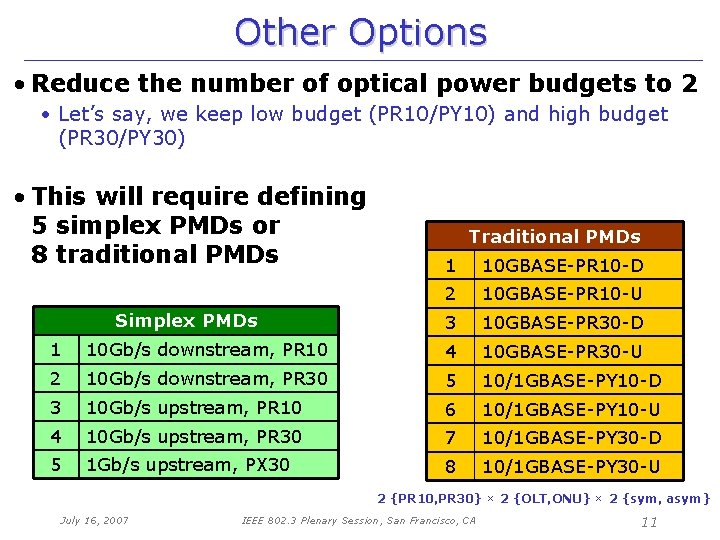
Other Options • Reduce the number of optical power budgets to 2 • Let’s say, we keep low budget (PR 10/PY 10) and high budget (PR 30/PY 30) • This will require defining 5 simplex PMDs or 8 traditional PMDs Simplex PMDs Traditional PMDs 1 10 GBASE-PR 10 -D 2 10 GBASE-PR 10 -U 3 10 GBASE-PR 30 -D 1 10 Gb/s downstream, PR 10 4 10 GBASE-PR 30 -U 2 10 Gb/s downstream, PR 30 5 10/1 GBASE-PY 10 -D 3 10 Gb/s upstream, PR 10 6 10/1 GBASE-PY 10 -U 4 10 Gb/s upstream, PR 30 7 10/1 GBASE-PY 30 -D 5 1 Gb/s upstream, PX 30 8 10/1 GBASE-PY 30 -U 2 {PR 10, PR 30} × 2 {OLT, ONU} × 2 {sym, asym} July 16, 2007 IEEE 802. 3 Plenary Session, San Francisco, CA 11
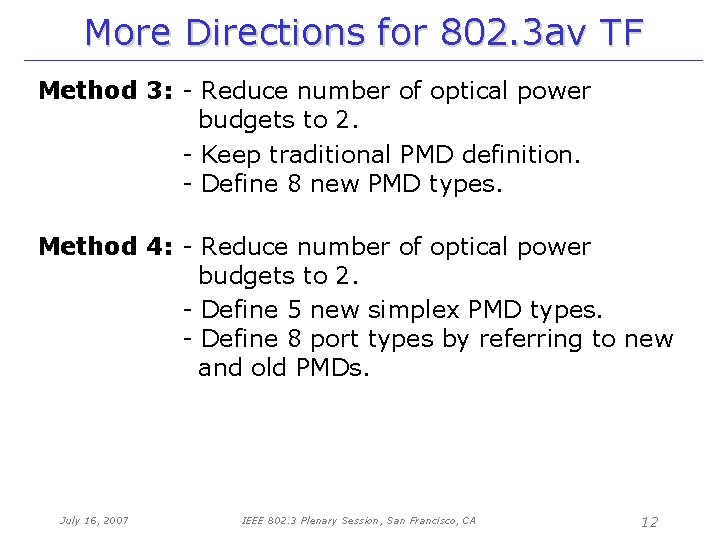
More Directions for 802. 3 av TF Method 3: - Reduce number of optical power budgets to 2. - Keep traditional PMD definition. - Define 8 new PMD types. Method 4: - Reduce number of optical power budgets to 2. - Define 5 new simplex PMD types. - Define 8 port types by referring to new and old PMDs. July 16, 2007 IEEE 802. 3 Plenary Session, San Francisco, CA 12
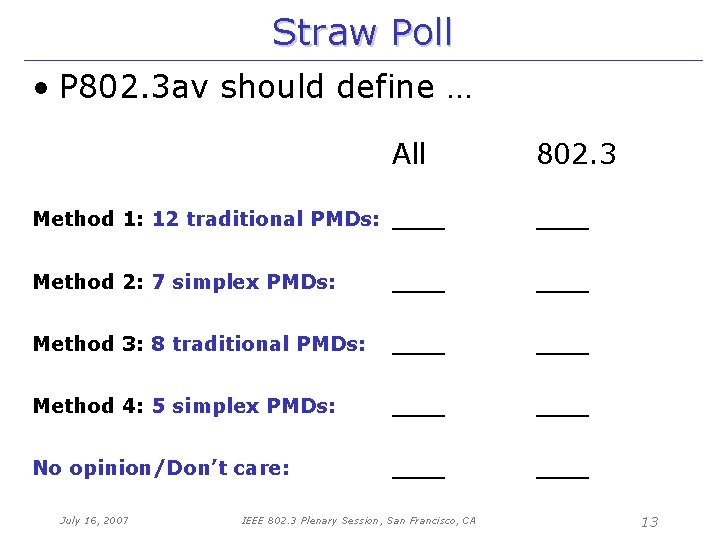
Straw Poll • P 802. 3 av should define … All 802. 3 Method 1: 12 traditional PMDs: ___ Method 2: 7 simplex PMDs: ___ Method 3: 8 traditional PMDs: ___ Method 4: 5 simplex PMDs: ___ No opinion/Don’t care: ___ July 16, 2007 IEEE 802. 3 Plenary Session, San Francisco, CA 13