
Simple vs Compound Mark Hierarchical Marking Menus Shengdong
![Limitations – Error Rate Breadth/depth/speed/accuracy trade-off [Kurtenbach and Buxton, 1993] Compass 4 11](https://slidetodoc.com/presentation_image/136b4e2309f8fb85f86821eeb5bd828a/image-11.jpg "Limitations – Error Rate Breadth/depth/speed/accuracy trade-off [Kurtenbach and Buxton, 1993] Compass 4 11")
![Limitations – Error Rate Breadth/depth/speed/accuracy trade-off [Kurtenbach and Buxton, 1993] Compass 4 -4 12](https://slidetodoc.com/presentation_image/136b4e2309f8fb85f86821eeb5bd828a/image-12.jpg "Limitations – Error Rate Breadth/depth/speed/accuracy trade-off [Kurtenbach and Buxton, 1993] Compass 4 -4 12")
![Limitations – Error Rate Breadth/depth/speed/accuracy trade-off [Kurtenbach and Buxton, 1993] Compass 8 13](https://slidetodoc.com/presentation_image/136b4e2309f8fb85f86821eeb5bd828a/image-13.jpg "Limitations – Error Rate Breadth/depth/speed/accuracy trade-off [Kurtenbach and Buxton, 1993] Compass 8 13")
![Limitations – Error Rate Breadth/depth/speed/accuracy trade-off [Kurtenbach and Buxton, 1993] Compass 8 -2 14](https://slidetodoc.com/presentation_image/136b4e2309f8fb85f86821eeb5bd828a/image-14.jpg "Limitations – Error Rate Breadth/depth/speed/accuracy trade-off [Kurtenbach and Buxton, 1993] Compass 8 -2 14")
- Slides: 54
Simple vs. Compound Mark Hierarchical Marking Menus Shengdong Zhao, Ravin Balakrishnan
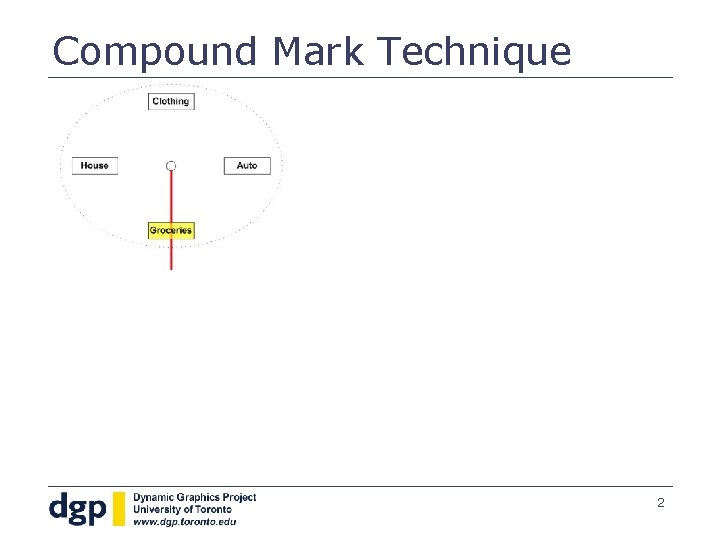
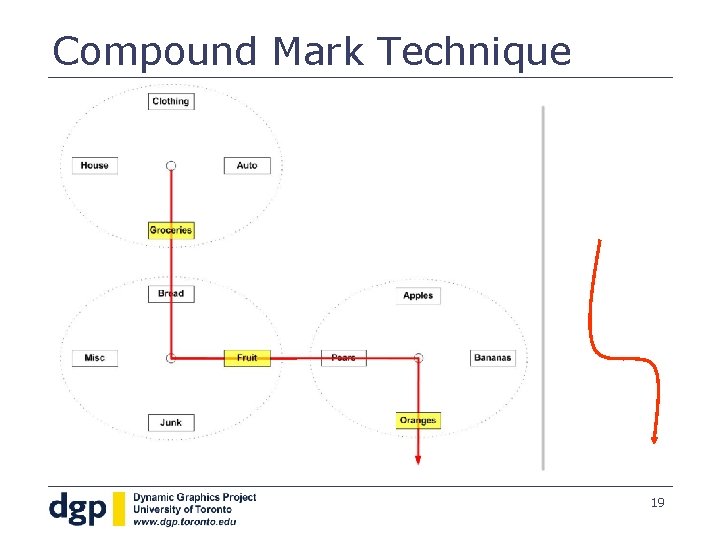
Compound Mark Technique 2
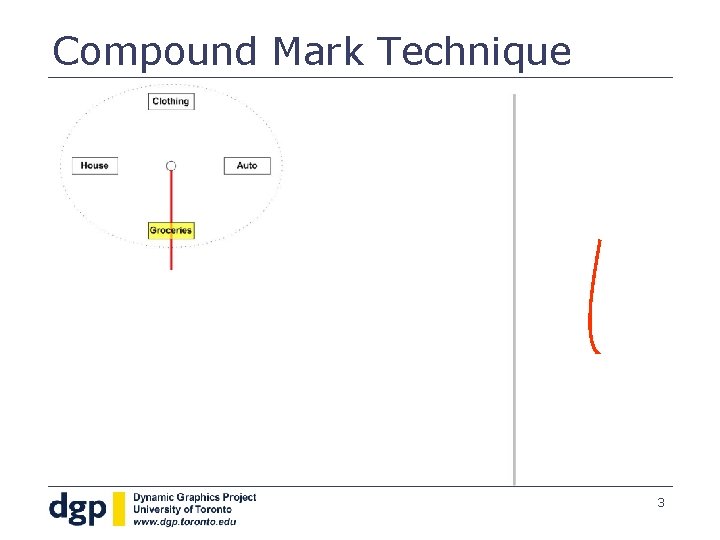
Compound Mark Technique 3
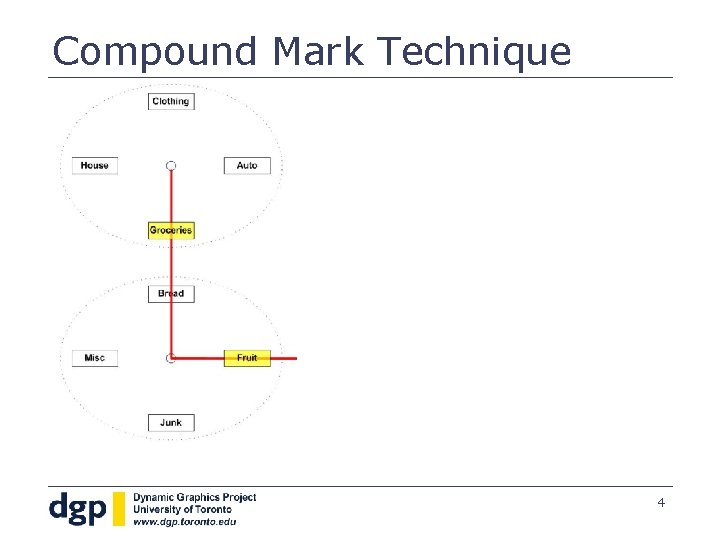
Compound Mark Technique 4
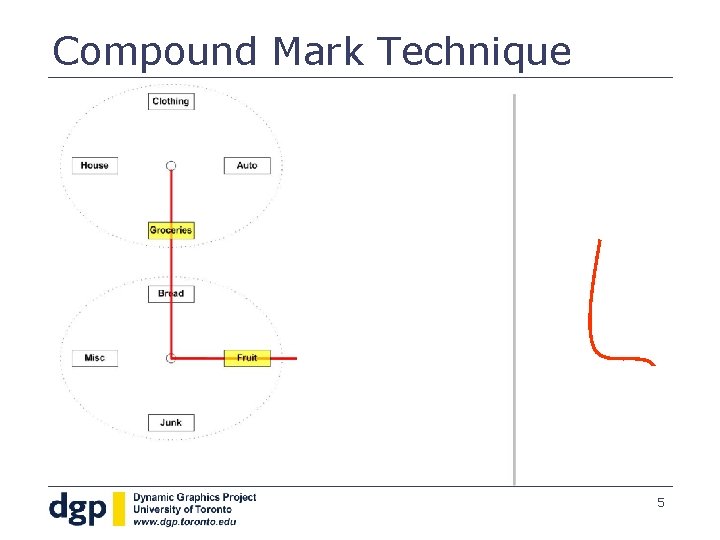
Compound Mark Technique 5
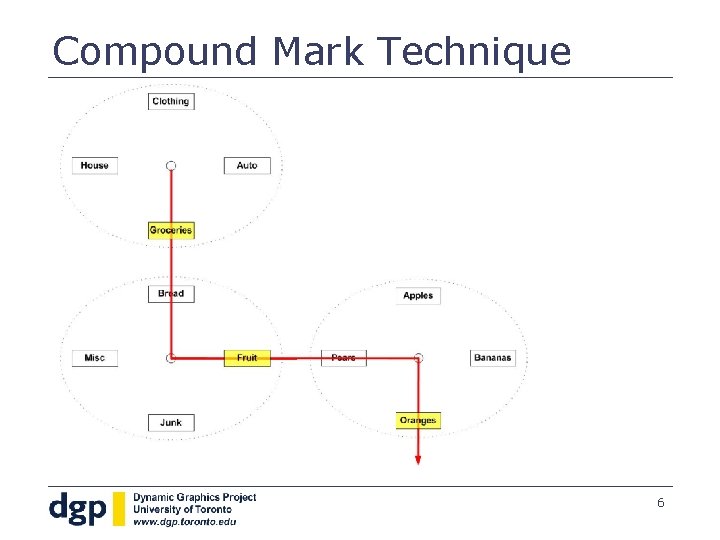
Compound Mark Technique 6
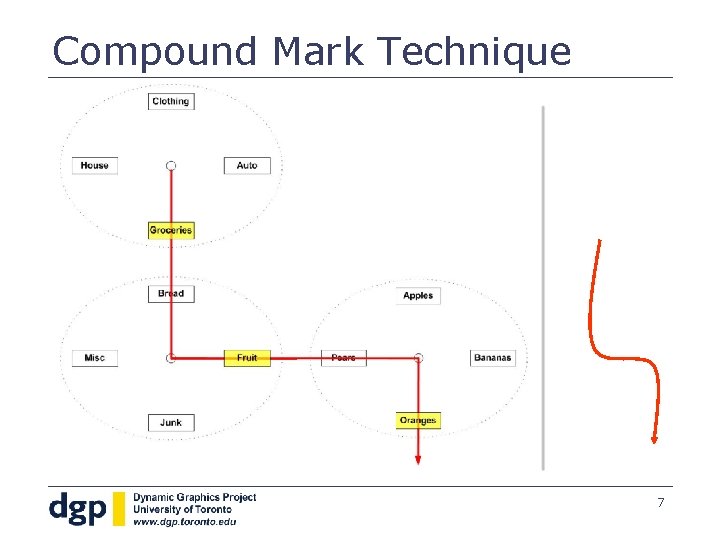
Compound Mark Technique 7
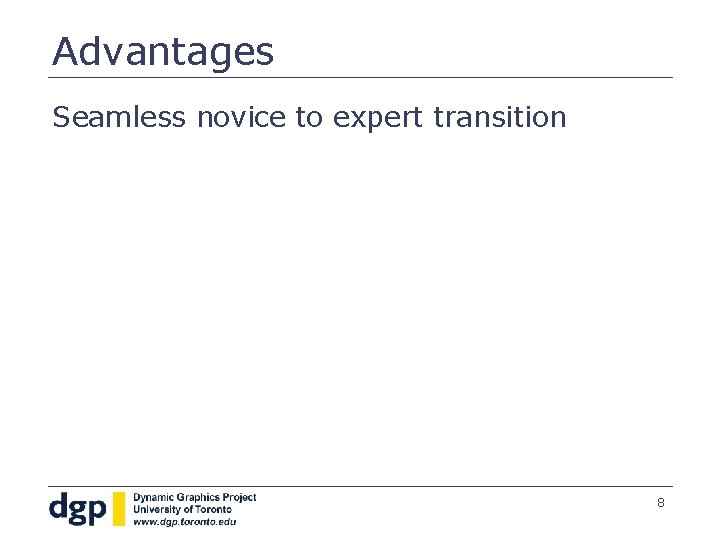
Advantages Seamless novice to expert transition 8
Advantages Seamless novice to expert transition 3. 5 x faster than linear menus 9
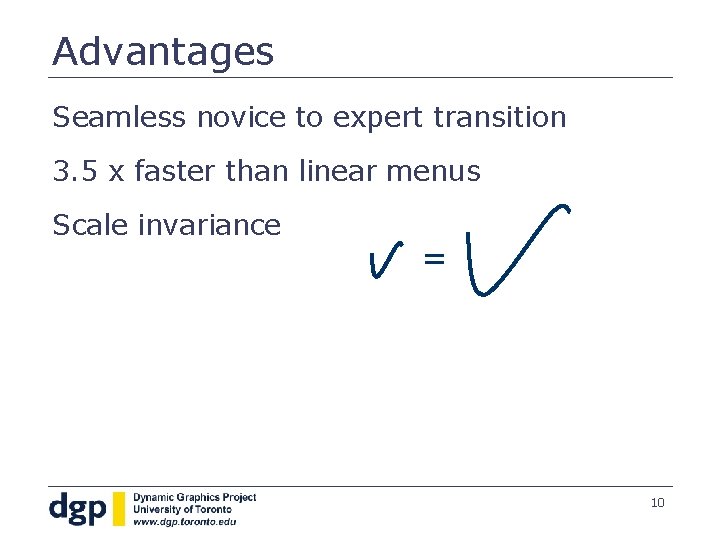
Advantages Seamless novice to expert transition 3. 5 x faster than linear menus Scale invariance = 10
Limitations – Error Rate Breadth/depth/speed/accuracy trade-off [Kurtenbach and Buxton, 1993] Compass 4 11
Limitations – Error Rate Breadth/depth/speed/accuracy trade-off [Kurtenbach and Buxton, 1993] Compass 4 -4 12
Limitations – Error Rate Breadth/depth/speed/accuracy trade-off [Kurtenbach and Buxton, 1993] Compass 8 13
Limitations – Error Rate Breadth/depth/speed/accuracy trade-off [Kurtenbach and Buxton, 1993] Compass 8 -2 14
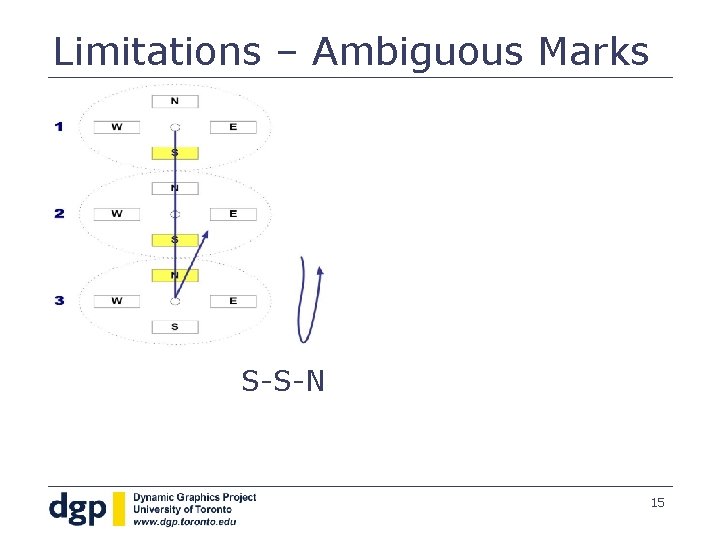
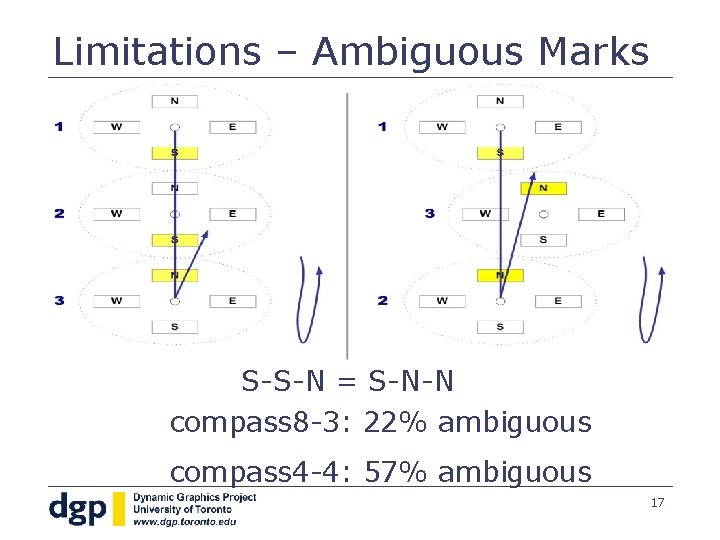
Limitations – Ambiguous Marks S-S-N 15
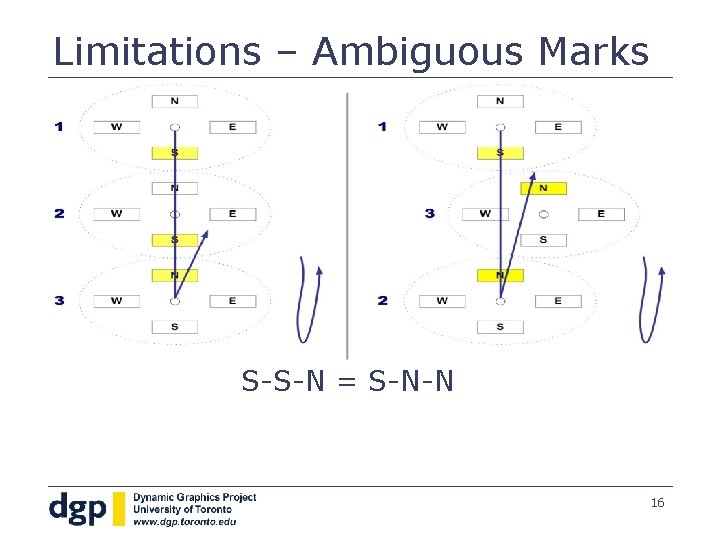
Limitations – Ambiguous Marks S-S-N = S-N-N 16
Limitations – Ambiguous Marks S-S-N = S-N-N compass 8 -3: 22% ambiguous compass 4 -4: 57% ambiguous 17
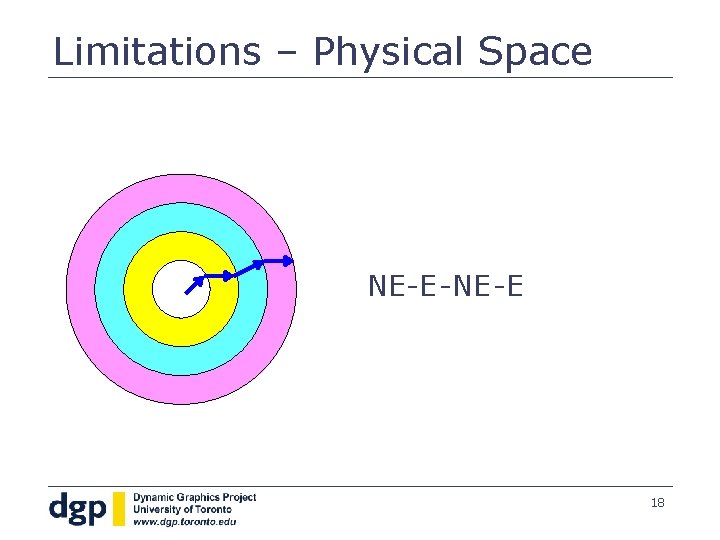
Limitations – Physical Space NE-E-NE-E 18
Compound Mark Technique 19
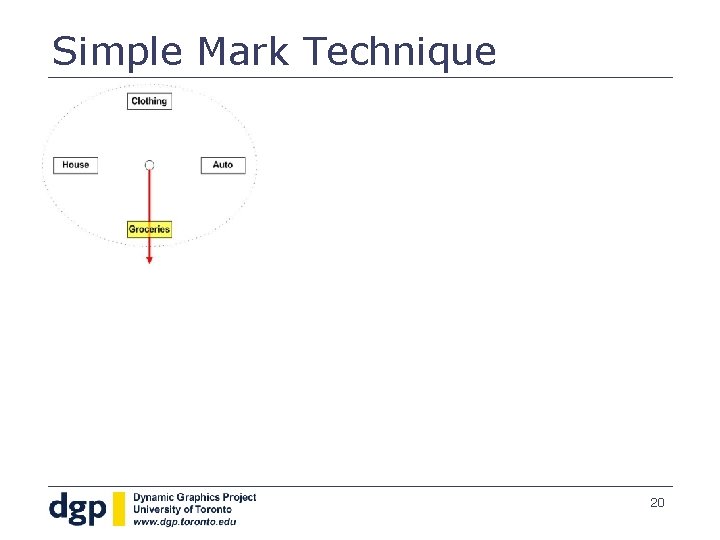
Simple Mark Technique 20
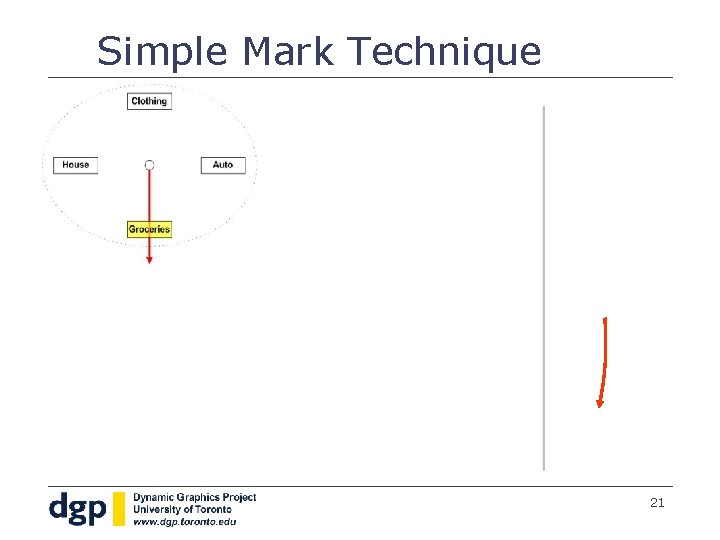
Simple Mark Technique 21
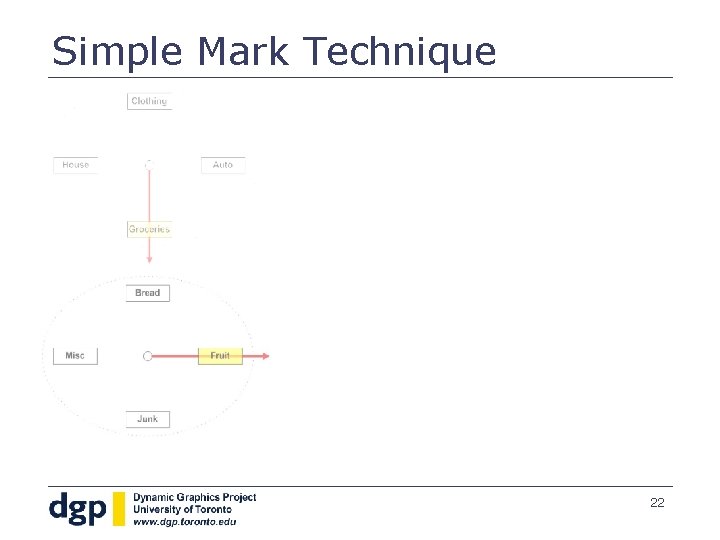
Simple Mark Technique 22
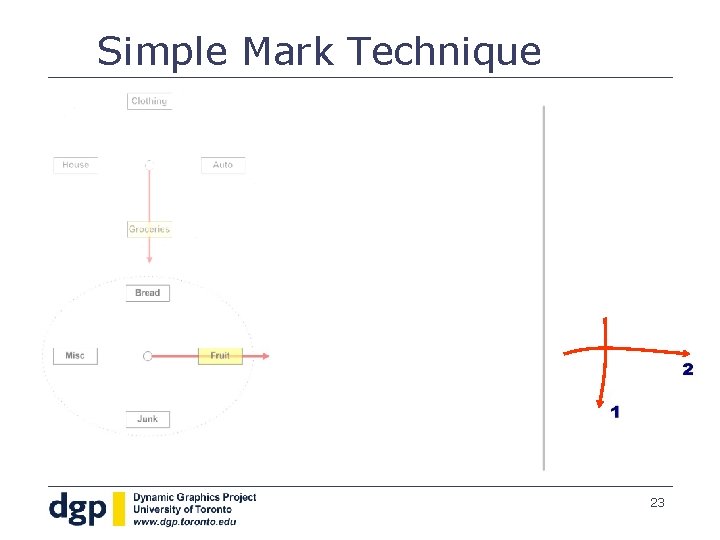
Simple Mark Technique 23
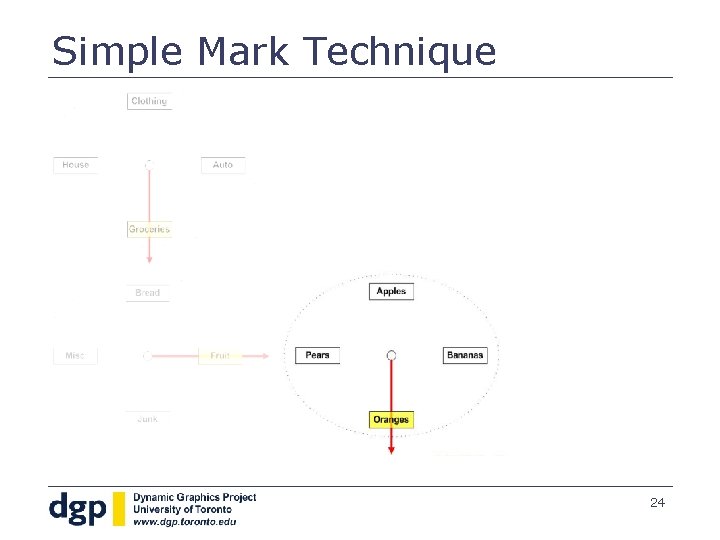
Simple Mark Technique 24
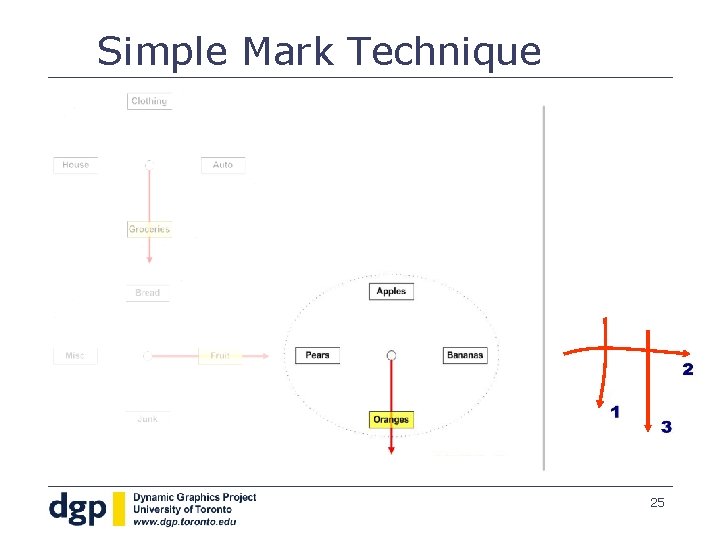
Simple Mark Technique 25
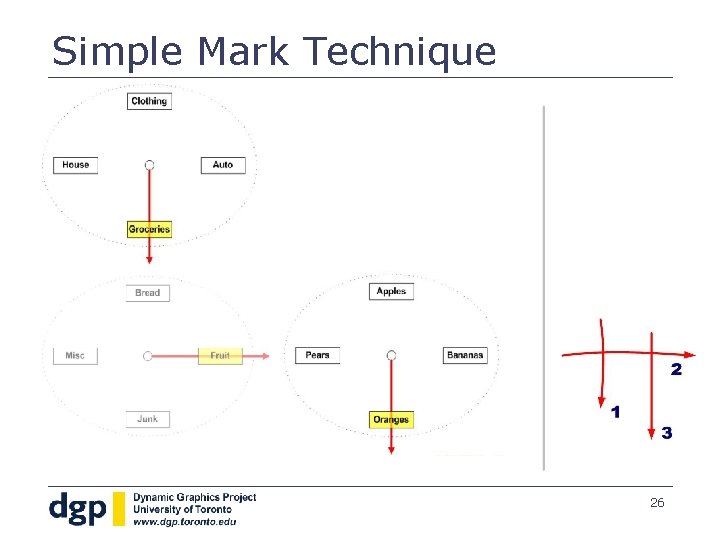
Simple Mark Technique 26
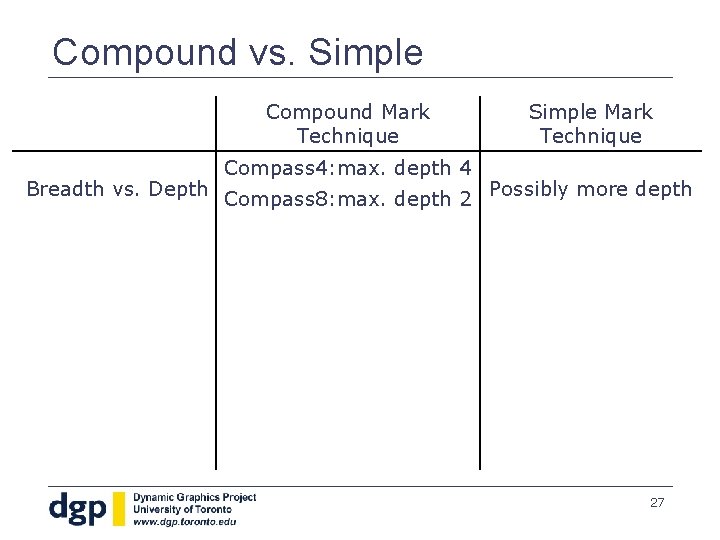
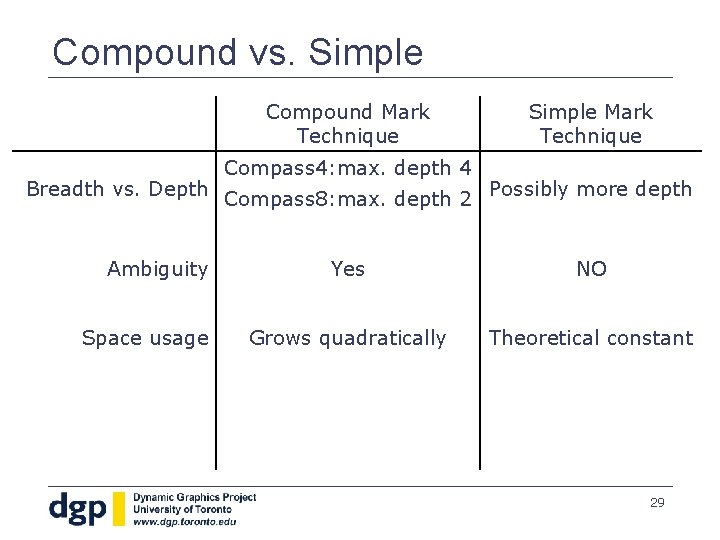
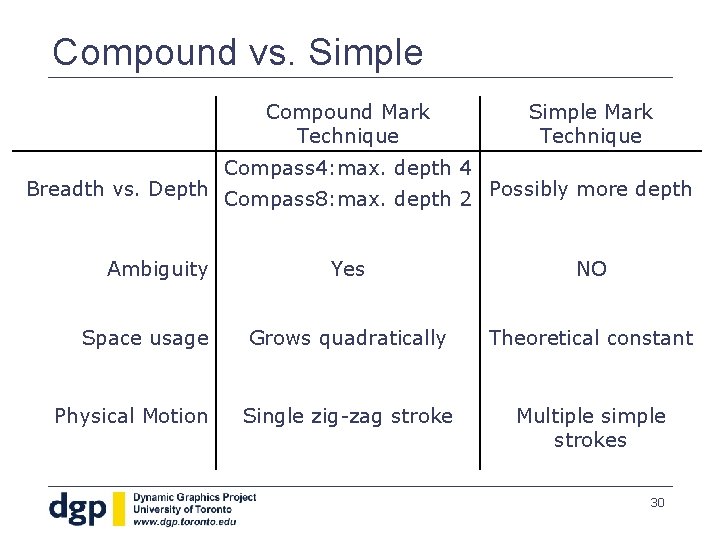
Compound vs. Simple Compound Mark Technique Simple Mark Technique Compass 4: max. depth 4 Breadth vs. Depth Compass 8: max. depth 2 Possibly more depth Ambiguity Space usage Physical Motion Yes NO Grows quadratically Theoretical constant Single zig-zag stroke Multiple simple strokes 27
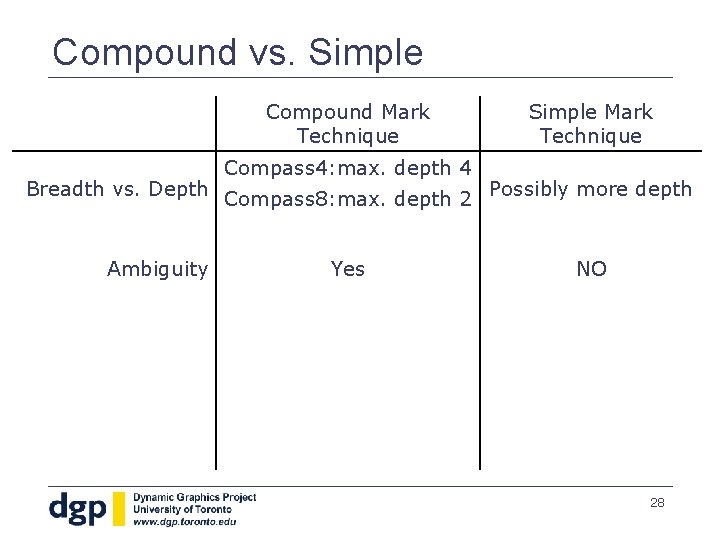
Compound vs. Simple Compound Mark Technique Simple Mark Technique Compass 4: max. depth 4 Breadth vs. Depth Compass 8: max. depth 2 Possibly more depth Ambiguity Space usage Physical Motion Yes NO Grows quadratically Theoretical constant Single zig-zag stroke Multiple simple strokes 28
Compound vs. Simple Compound Mark Technique Simple Mark Technique Compass 4: max. depth 4 Breadth vs. Depth Compass 8: max. depth 2 Possibly more depth Ambiguity Space usage Physical Motion Yes NO Grows quadratically Theoretical constant Single zig-zag stroke Multiple simple strokes 29
Compound vs. Simple Compound Mark Technique Simple Mark Technique Compass 4: max. depth 4 Breadth vs. Depth Compass 8: max. depth 2 Possibly more depth Ambiguity Space usage Physical Motion Yes NO Grows quadratically Theoretical constant Single zig-zag stroke Multiple simple strokes 30
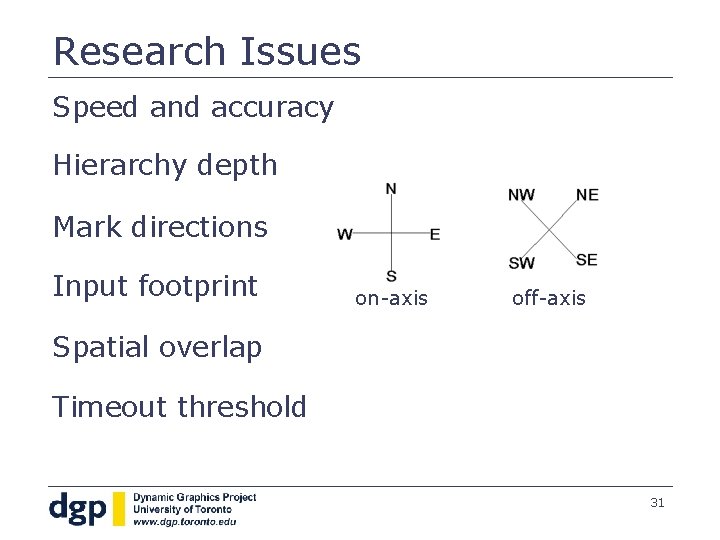
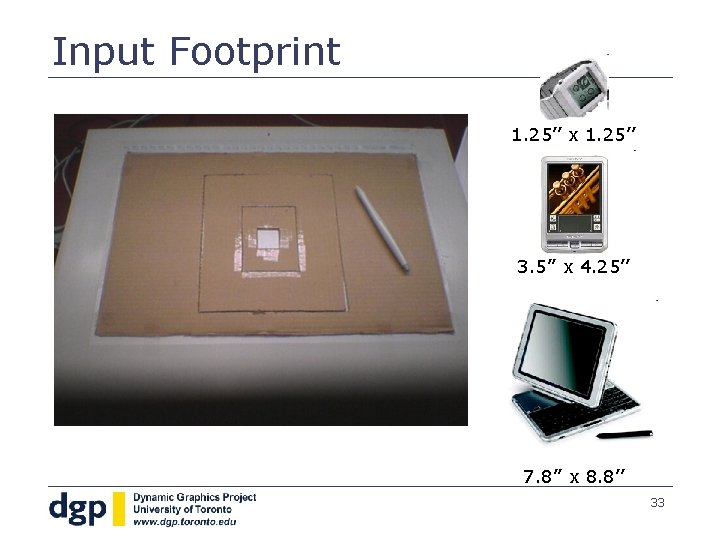
Research Issues Speed and accuracy Hierarchy depth Mark directions Input footprint on-axis off-axis Spatial overlap Timeout threshold 31
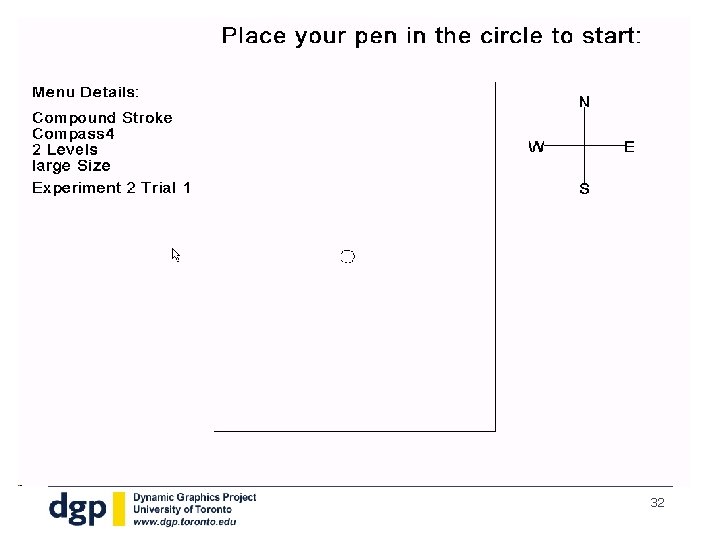
Experimental Setup 32
Input Footprint 1. 25’’ x 1. 25’’ 3. 5’’ x 4. 25’’ 7. 8’’ x 8. 8’’ 33
Experimental Design 34
Experimental Design 12 participants x 35
Experimental Design 12 participants x 2 techniques (compound, simple) x 36
Experimental Design 12 participants x 2 techniques (compound, simple) x 3 input footprint (small, medium, large) x 37
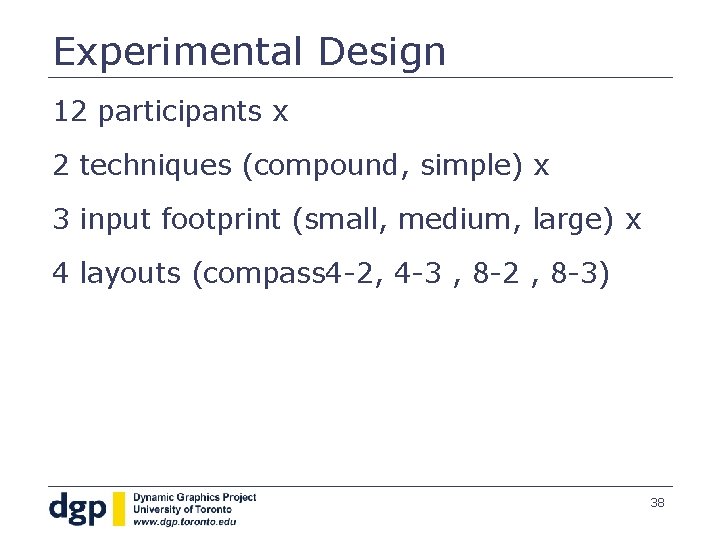
Experimental Design 12 participants x 2 techniques (compound, simple) x 3 input footprint (small, medium, large) x 4 layouts (compass 4 -2, 4 -3 , 8 -2 , 8 -3) 38
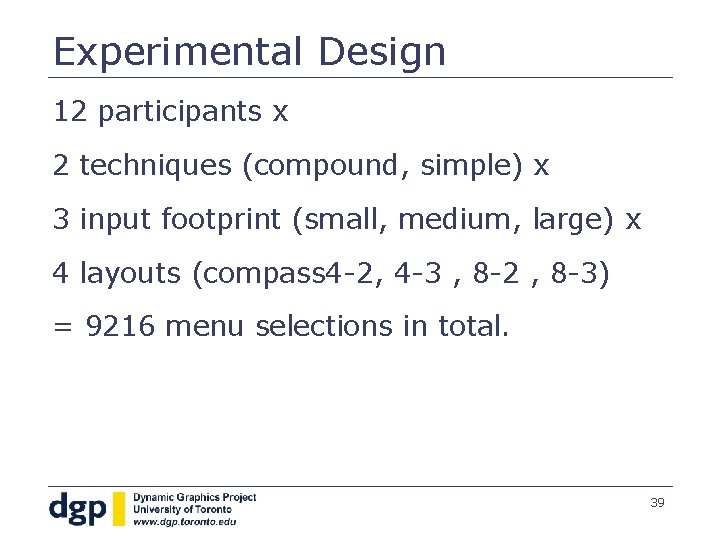
Experimental Design 12 participants x 2 techniques (compound, simple) x 3 input footprint (small, medium, large) x 4 layouts (compass 4 -2, 4 -3 , 8 -2 , 8 -3) = 9216 menu selections in total. 39
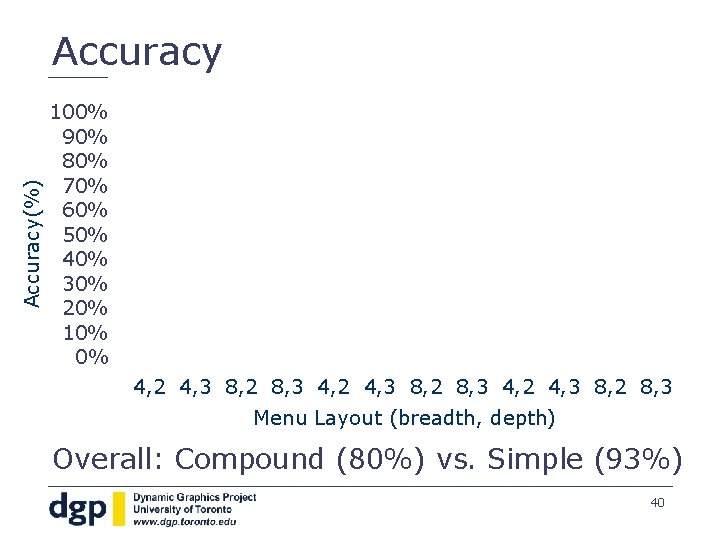
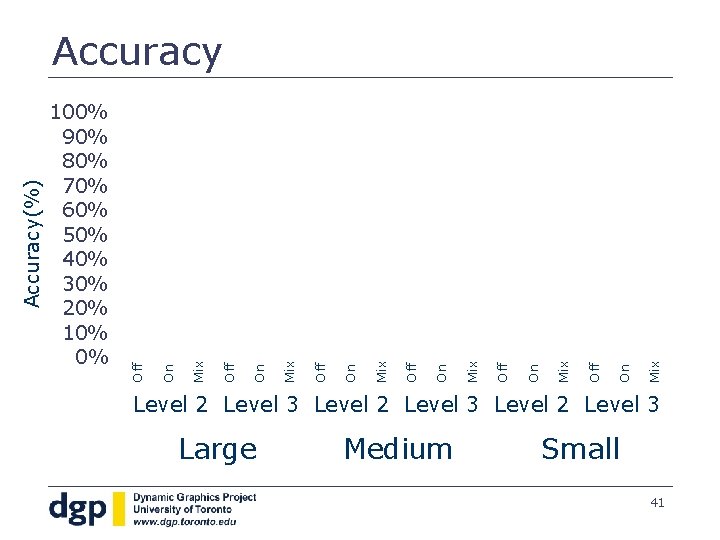
Accuracy(%) Accuracy 100% 90% 80% 70% 60% 50% 40% 30% 20% 10% 0% 4, 2 4, 3 8, 2 8, 3 Menu Layout (breadth, depth) Overall: Compound (80%) vs. Simple (93%) 40
Mix On Off Mix On Off Mix On 100% 90% 80% 70% 60% 50% 40% 30% 20% 10% 0% Off Accuracy(%) Accuracy Level 2 Level 3 Large Medium Small 41
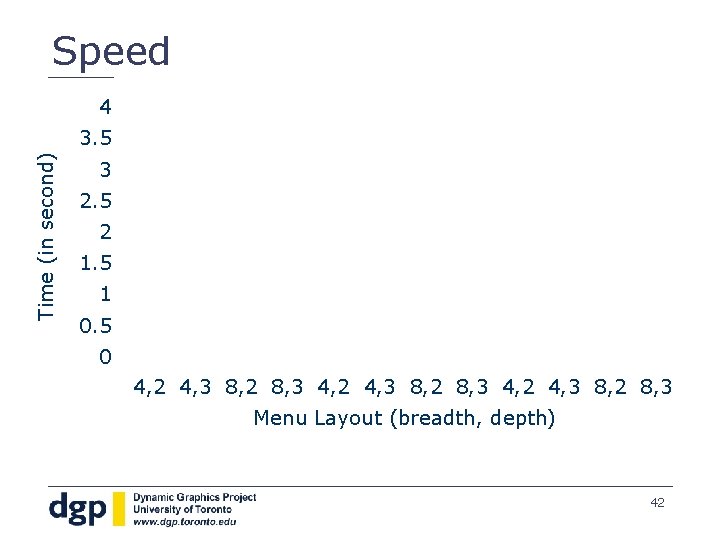
Speed 4 Time (in second) 3. 5 3 2. 5 2 1. 5 1 0. 5 0 4, 2 4, 3 8, 2 8, 3 Menu Layout (breadth, depth) 42
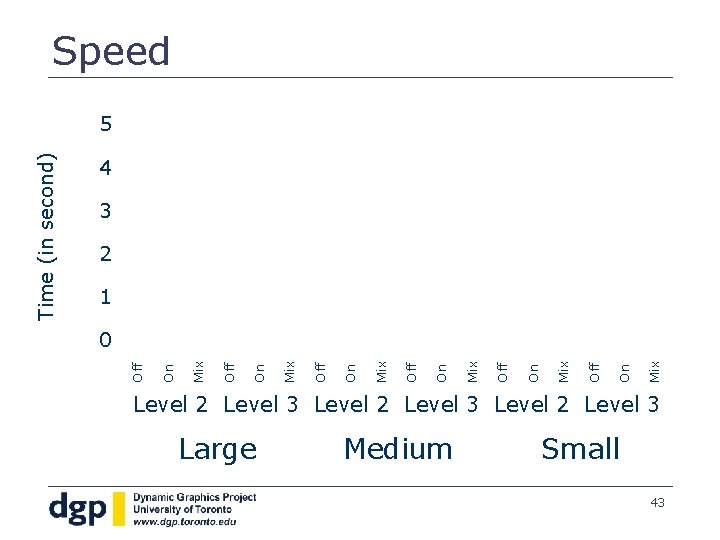
Speed 4 3 2 1 Mix On Off Mix On Off Mix On 0 Off Time (in second) 5 Level 2 Level 3 Large Medium Small 43
Input Space Usage 44
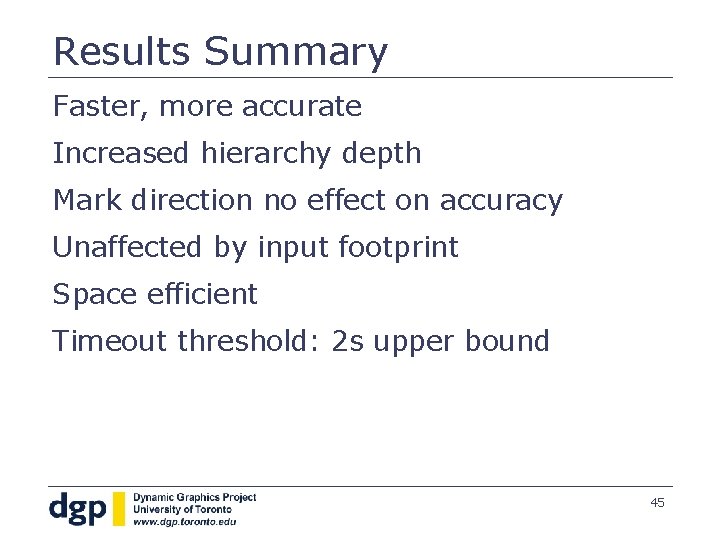
Results Summary Faster, more accurate Increased hierarchy depth Mark direction no effect on accuracy Unaffected by input footprint Space efficient Timeout threshold: 2 s upper bound 45
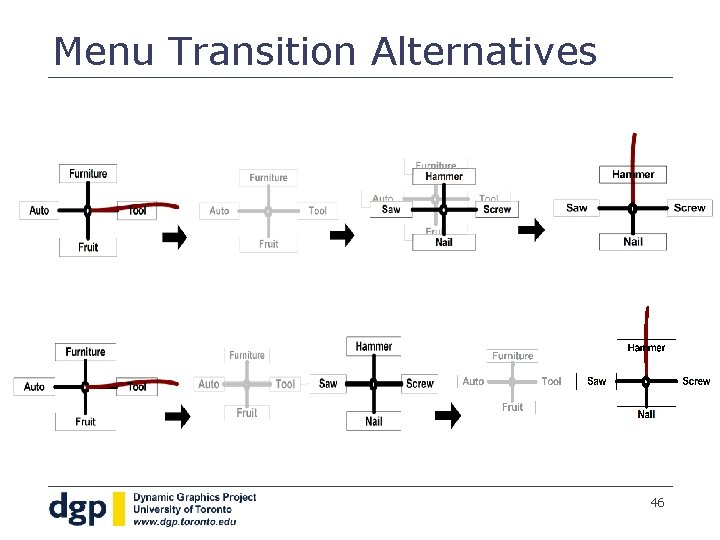
Menu Transition Alternatives 46
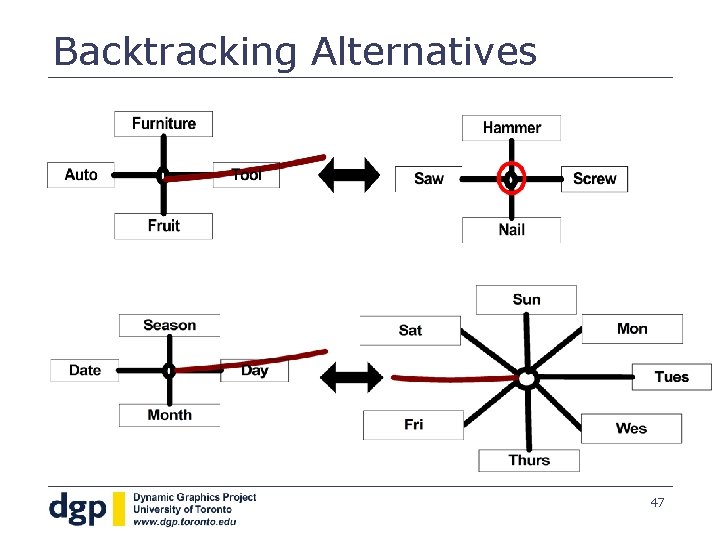
Backtracking Alternatives 47
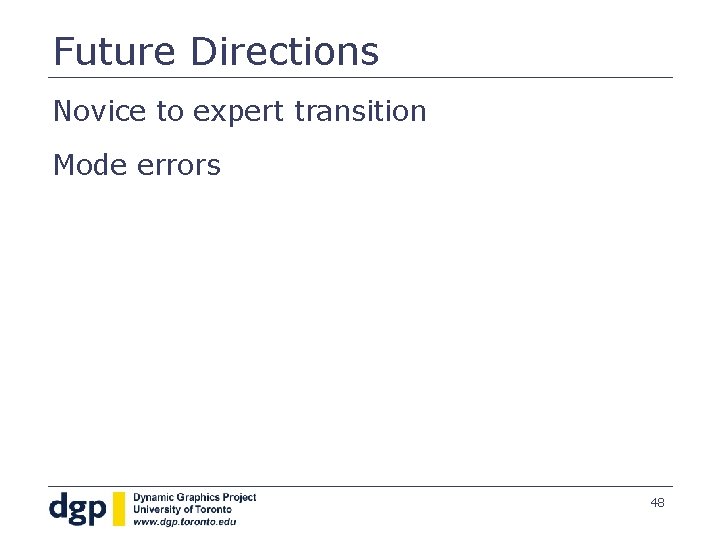
Future Directions Novice to expert transition Mode errors 48
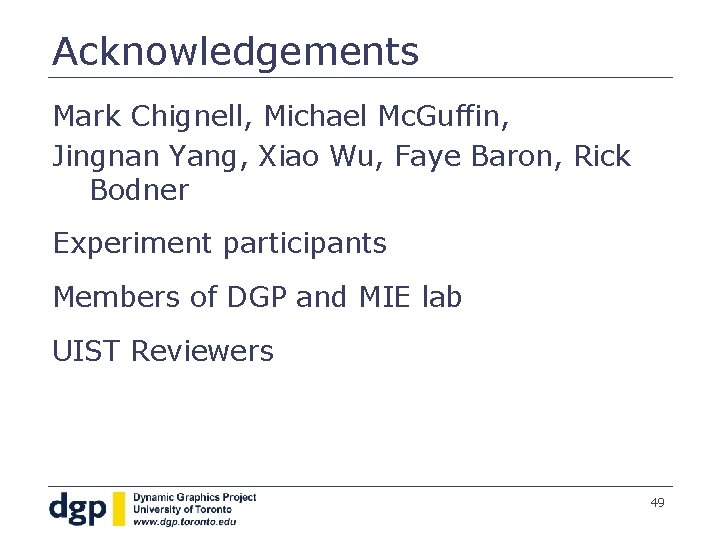
Acknowledgements Mark Chignell, Michael Mc. Guffin, Jingnan Yang, Xiao Wu, Faye Baron, Rick Bodner Experiment participants Members of DGP and MIE lab UIST Reviewers 49
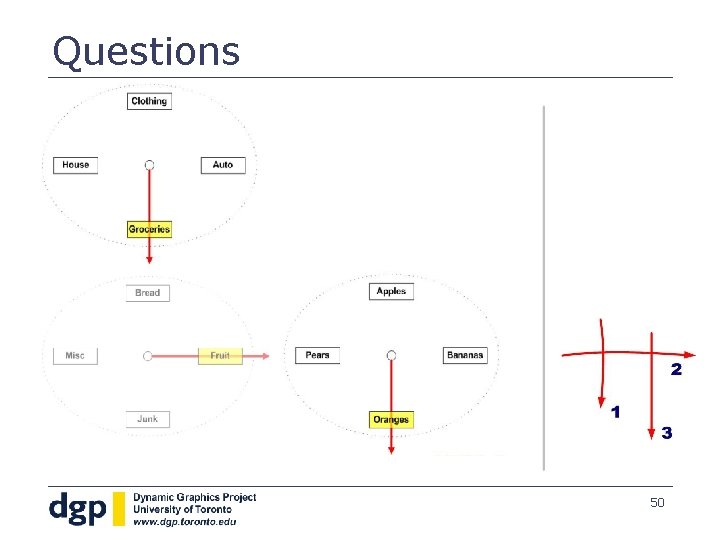
Questions 50
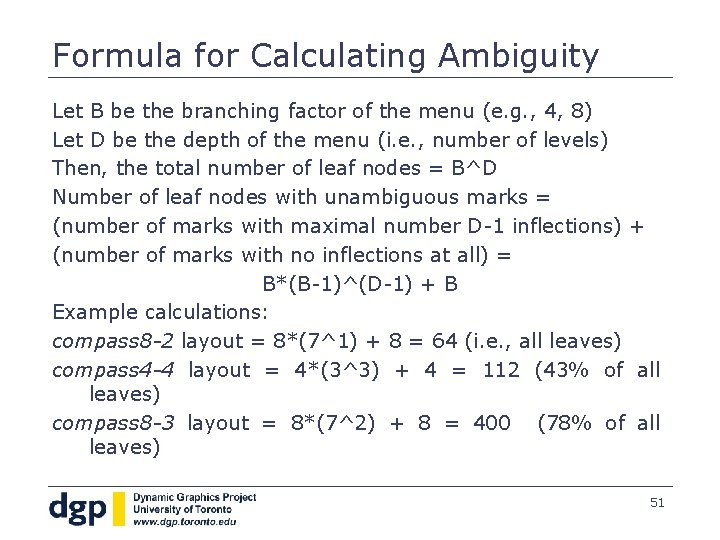
Formula for Calculating Ambiguity Let B be the branching factor of the menu (e. g. , 4, 8) Let D be the depth of the menu (i. e. , number of levels) Then, the total number of leaf nodes = B^D Number of leaf nodes with unambiguous marks = (number of marks with maximal number D-1 inflections) + (number of marks with no inflections at all) = B*(B-1)^(D-1) + B Example calculations: compass 8 -2 layout = 8*(7^1) + 8 = 64 (i. e. , all leaves) compass 4 -4 layout = 4*(3^3) + 4 = 112 (43% of all leaves) compass 8 -3 layout = 8*(7^2) + 8 = 400 (78% of all leaves) 51
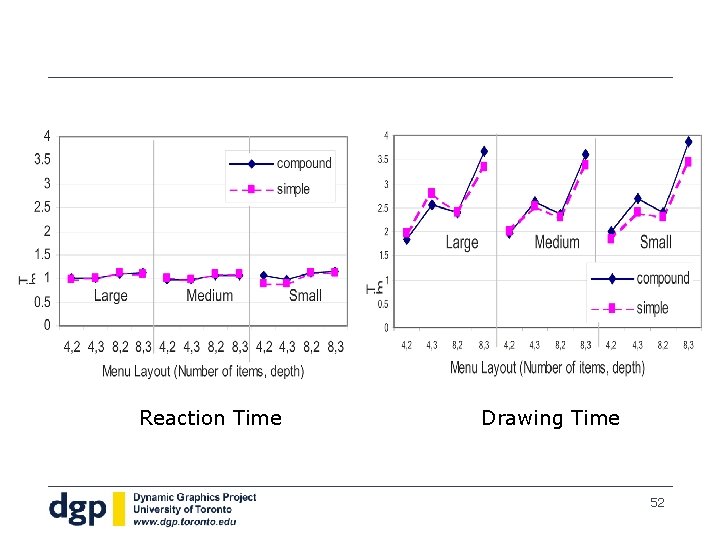
Reaction Time Drawing Time 52
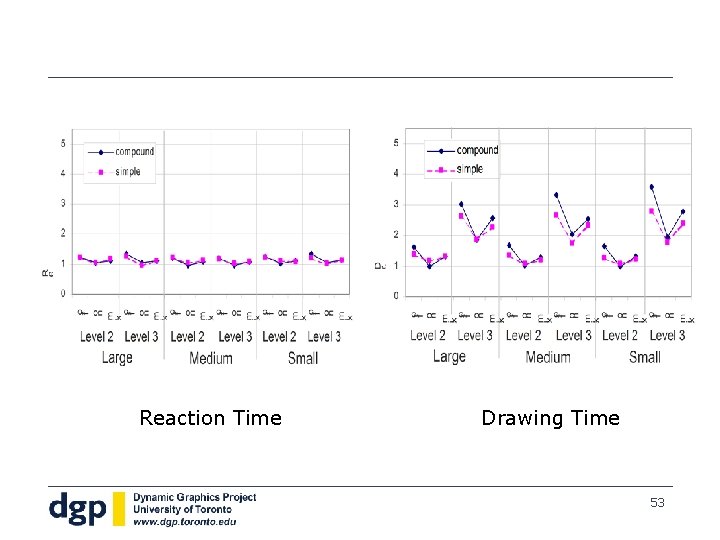
Reaction Time Drawing Time 53
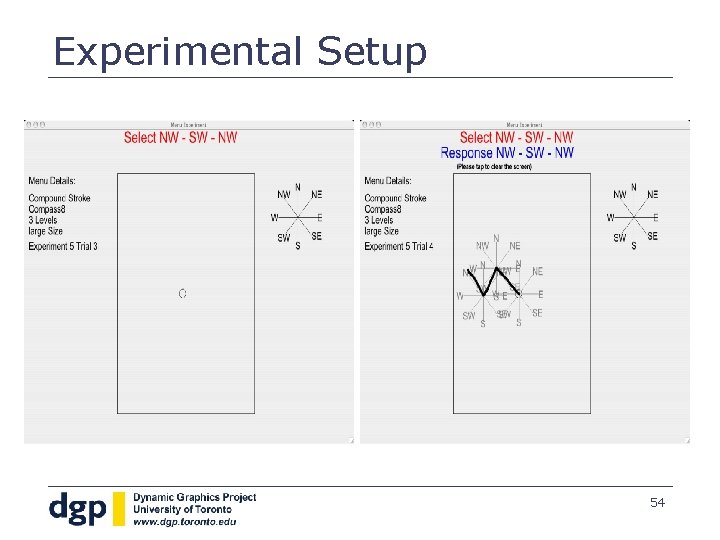
Experimental Setup 54