
Simple Twoway Active Measurement Protocol STAMP Extensions draftmirskyippmstampoptiontlv
- Slides: 8
Simple Two-way Active Measurement Protocol (STAMP) Extensions draft-mirsky-ippm-stamp-option-tlv Greg Mirsky gregimirsky@gmail. com Guo Jun guo. jun 2@zte. com. cn Henrik Nydell hnydell@accedian. com Richard Foote, footer. foote@nokia. com Xiao Min xiao. min 2@zte. com. cn IETF-104 March 2019, Prague
Updates to STAMP Extensions • • Originally, Section 5 TLV Extensions to STAMP of draft-ietf-ippm-stamp, spawned as separate draft Type values less than 32768 identify mandatory TLVs that MUST be supported by an implementation. Type values greater than or equal to 32768 identify optional TLVs that SHOULD be ignored if the implementation does not understand or support them. If a Type value for TLV or sub-TLV is in the range for Vendor Private Use, the Length MUST be at least 4, and the first four octets MUST be that vendor's the Structure of Management Information Private Enterprise Number, in network octet order. The rest of the Value field is private to the vendor. The use of extension TLVs is at the discretion of a Session-Sender. A Session-Sender may use some TLVs intermittently. For example, Timestamp TLV may be used at the start of the STAMP session or periodically, e. g. , once an hour, day or week. The same applies to Location TLV. On the other hand, Class of Service TLV may be present in every test packet either to monitor consistency of Co. S behavior along the path or to test the Co. S behavior. IANA Considerations
Extra Padding TLV • The Extra Padding TLV is similar to the Packet Padding field in TWAMP-Test packet [RFC 5357]. In STAMP the Packet Padding field is used to ensure symmetrical size between Session-Sender and Session-Reflector test packets. Extra Padding TLV MUST be used to create STAMP test packets of larger size.
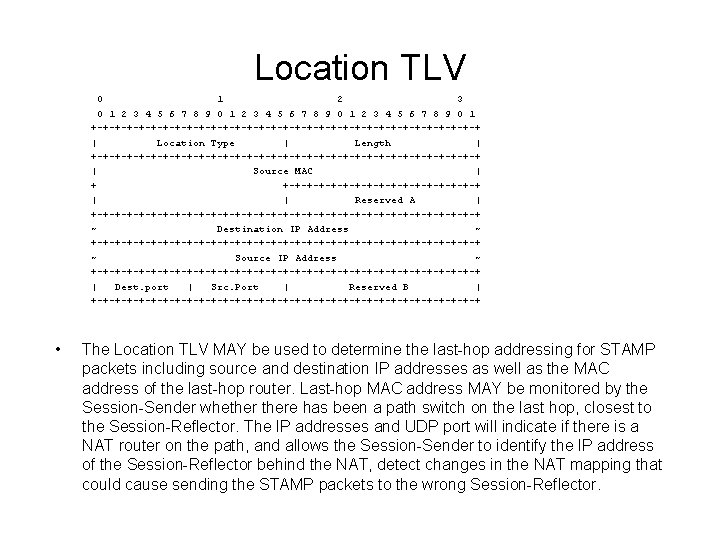
Location TLV 0 1 2 3 4 5 6 7 8 9 0 1 +-+-+-+-+-+-+-+-+-+-+-+-+-+-+-+-+ | Location Type | Length | +-+-+-+-+-+-+-+-+-+-+-+-+-+-+-+-+ | Source MAC | + +-+-+-+-+-+-+-+-+ | | Reserved A | +-+-+-+-+-+-+-+-+-+-+-+-+-+-+-+-+ ~ Destination IP Address ~ +-+-+-+-+-+-+-+-+-+-+-+-+-+-+-+-+ ~ Source IP Address ~ +-+-+-+-+-+-+-+-+-+-+-+-+-+-+-+-+ | Dest. port | Src. Port | Reserved B | +-+-+-+-+-+-+-+-+-+-+-+-+-+-+-+-+ • The Location TLV MAY be used to determine the last-hop addressing for STAMP packets including source and destination IP addresses as well as the MAC address of the last-hop router. Last-hop MAC address MAY be monitored by the Session-Sender whethere has been a path switch on the last hop, closest to the Session-Reflector. The IP addresses and UDP port will indicate if there is a NAT router on the path, and allows the Session-Sender to identify the IP address of the Session-Reflector behind the NAT, detect changes in the NAT mapping that could cause sending the STAMP packets to the wrong Session-Reflector.
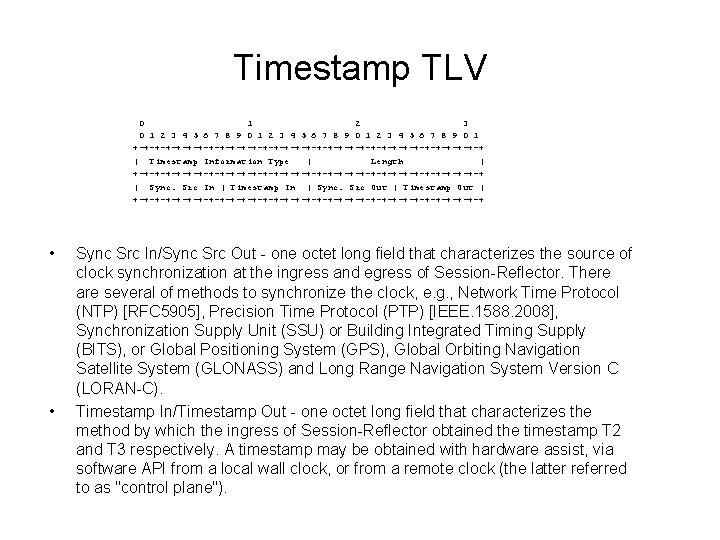
Timestamp TLV 0 1 2 3 4 5 6 7 8 9 0 1 +-+-+-+-+-+-+-+-+-+-+-+-+-+-+-+-+ | Timestamp Information Type | Length | +-+-+-+-+-+-+-+-+-+-+-+-+-+-+-+-+ | Sync. Src In | Timestamp In | Sync. Src Out | Timestamp Out | +-+-+-+-+-+-+-+-+-+-+-+-+-+-+-+-+ • • Sync Src In/Sync Src Out - one octet long field that characterizes the source of clock synchronization at the ingress and egress of Session-Reflector. There are several of methods to synchronize the clock, e. g. , Network Time Protocol (NTP) [RFC 5905], Precision Time Protocol (PTP) [IEEE. 1588. 2008], Synchronization Supply Unit (SSU) or Building Integrated Timing Supply (BITS), or Global Positioning System (GPS), Global Orbiting Navigation Satellite System (GLONASS) and Long Range Navigation System Version C (LORAN-C). Timestamp In/Timestamp Out - one octet long field that characterizes the method by which the ingress of Session-Reflector obtained the timestamp T 2 and T 3 respectively. A timestamp may be obtained with hardware assist, via software API from a local wall clock, or from a remote clock (the latter referred to as "control plane").
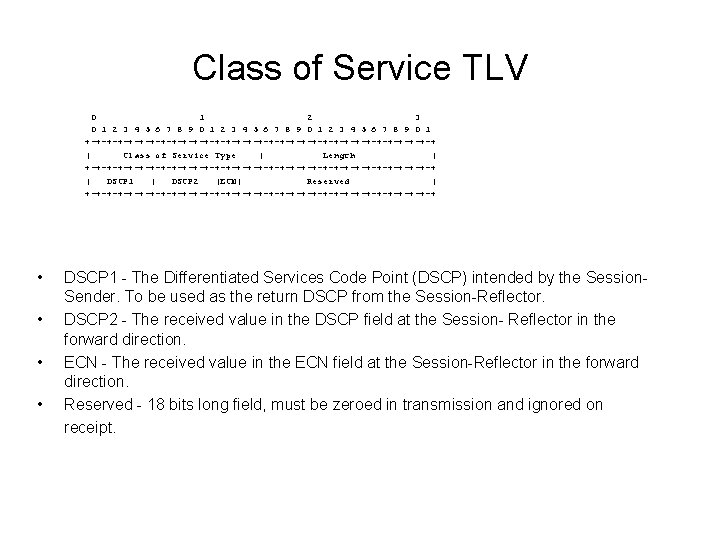
Class of Service TLV 0 1 2 3 4 5 6 7 8 9 0 1 +-+-+-+-+-+-+-+-+-+-+-+-+-+-+-+-+ | Class of Service Type | Length | +-+-+-+-+-+-+-+-+-+-+-+-+-+-+-+-+ | DSCP 1 | DSCP 2 |ECN| Reserved | +-+-+-+-+-+-+-+-+-+-+-+-+-+-+-+-+ • • DSCP 1 - The Differentiated Services Code Point (DSCP) intended by the Session. Sender. To be used as the return DSCP from the Session-Reflector. DSCP 2 - The received value in the DSCP field at the Session- Reflector in the forward direction. ECN - The received value in the ECN field at the Session-Reflector in the forward direction. Reserved - 18 bits long field, must be zeroed in transmission and ignored on receipt.
Next steps • Comments are welcome • Ask for WG adoption
Extending Active Measurement Protocol • RFC 8545 in Section 4 stated: – For avoidance of doubt, the implementation of both TWAMP-Control and TWAMP-Test is REQUIRED for Standards Track TWAMP as specified in [RFC 5357]. • STAMP: – use STAMP Extension TLVs; – augment STAMP YANG model.