
Simple Thoracostomy Kit Procedural Training Program Rev A
- Slides: 27
Simple Thoracostomy Kit Procedural Training Program Rev A 060519
The following materials were developed for the purpose of Simple Thoracostomy Kit orientation and training Warranty: The Simple Thoracostomy Kit contains medical equipment, which requires education and training for use. North American Rescue, LLC. warrants the Simple Thoracostomy Kit as merchantable expressly for the indication detailed. North American Rescue disclaims all other implied warranties relating to this kit and its contents, to include use beyond this kits identified purpose, and utilization by untrained personnel or legally unauthorized parties. Caution: Federal Law restricts the Simple Thoracostomy Kit to sale by, or on the order of, a licensed physician.
Objectives At the conclusion of didactic and hands-on training, you should be able to: 1. 2. 3. 4. 5. 6. Identify the simple thoracostomy kit components. List key terms, indications, contraindications, and expected therapeutic benefits of thoracic decompression (simple thoracostomy). Identify lateral landmarks for thoracostomy placement List the steps needed to perform and confirm a simple thoracostomy Define potential complications of improperly performed thoracic decompression procedures Discuss current scientific evidence as it relates to thoracic decompression
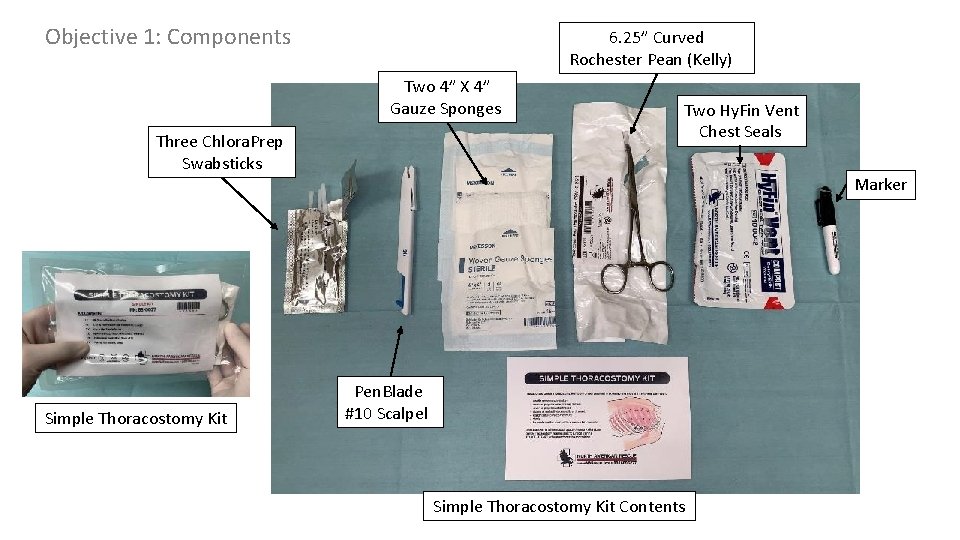
Objective 1: Components 6. 25” Curved Rochester Pean (Kelly) Two 4” X 4” Gauze Sponges Three Chlora. Prep Swabsticks Simple Thoracostomy Kit Two Hy. Fin Vent Chest Seals Marker Pen. Blade #10 Scalpel Simple Thoracostomy Kit Contents
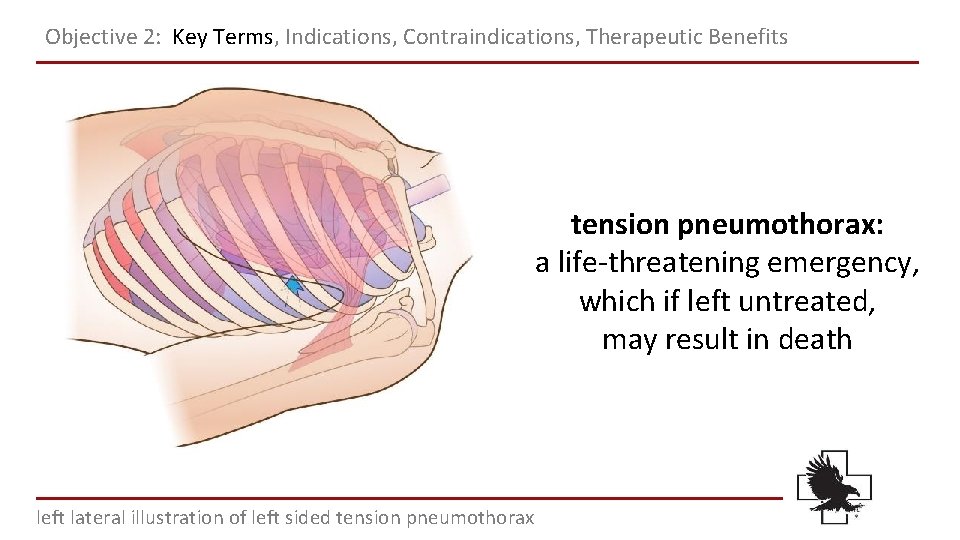
Objective 2: Key Terms, Indications, Contraindications, Therapeutic Benefits tension pneumothorax: a life-threatening emergency, which if left untreated, may result in death left lateral illustration of left sided tension pneumothorax
Objective 2: Key Terms, Indications, Contraindications, Therapeutic Benefits Indications: For relief of tension pneumothorax in the adult patient when one or more of the following are present: • Two needle decompression failures • Severe or progressive respiratory distress • Severe or progressive tachypnea • Absent or markedly decreased breath sounds • Oxygen saturations less than 90% • Traumatic cardiac arrest without obvious fatal wounds
Objective 2: Key Terms, Indications, Contraindications, Therapeutic Benefits Contraindications: Not intended for treatment of simple pneumothorax or hemothorax. Warning: Failure to utilize this kit properly may result in injury to cardiac, pulmonary, or vascular structures.
Objective 2: Key Terms, Indications, Contraindications, Therapeutic Benefits Thoracic decompression (simple thoracostomy) should improve one or more of the following: • respiratory distress • relief of restrictive pressure between the parietal and visceral pleura (secondary to injury or significant medical complication) • oxygen saturation (≥ 90% may be dependent on use of supplemental oxygen) • return of radial pulse or vital signs
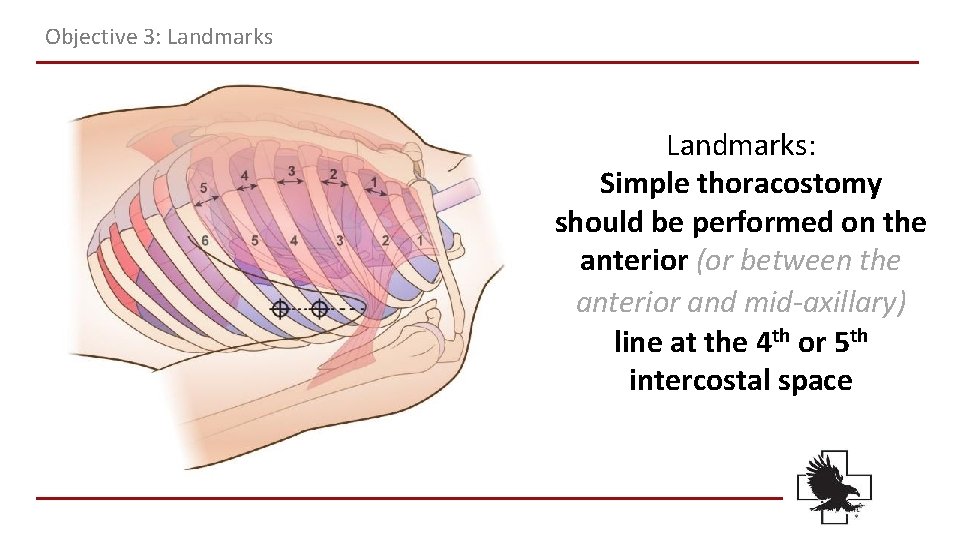
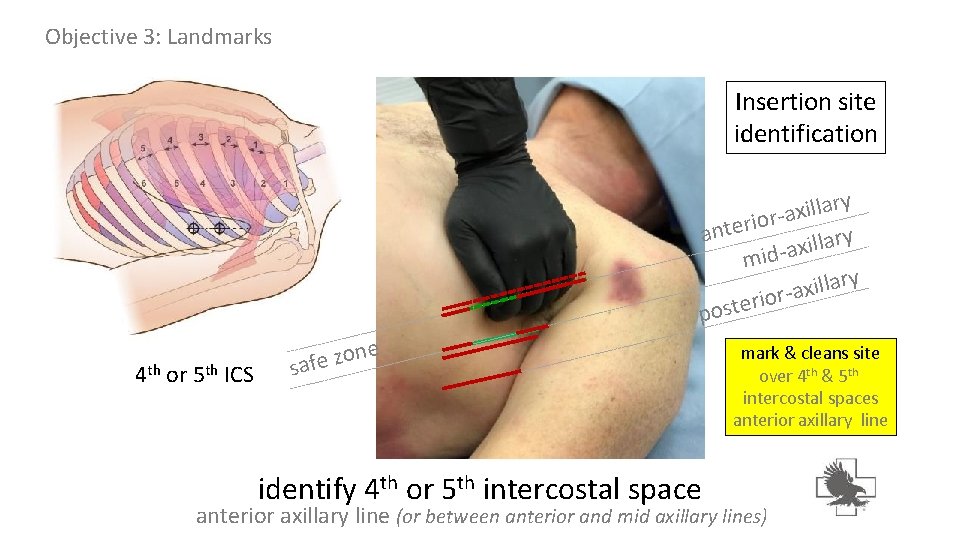
Objective 3: Landmarks: Simple thoracostomy should be performed on the anterior (or between the anterior and mid-axillary) line at the 4 th or 5 th intercostal space
Objective 3: Landmarks Insertion site identification y r a l l i x -a r o i r e ant y r a l l i x mid-a y r a l l i ax r o i r poste 4 th or 5 th ICS e n o z safe identify 4 th or 5 th intercostal space mark & cleans site over 4 th & 5 th intercostal spaces anterior axillary line (or between anterior and mid axillary lines)
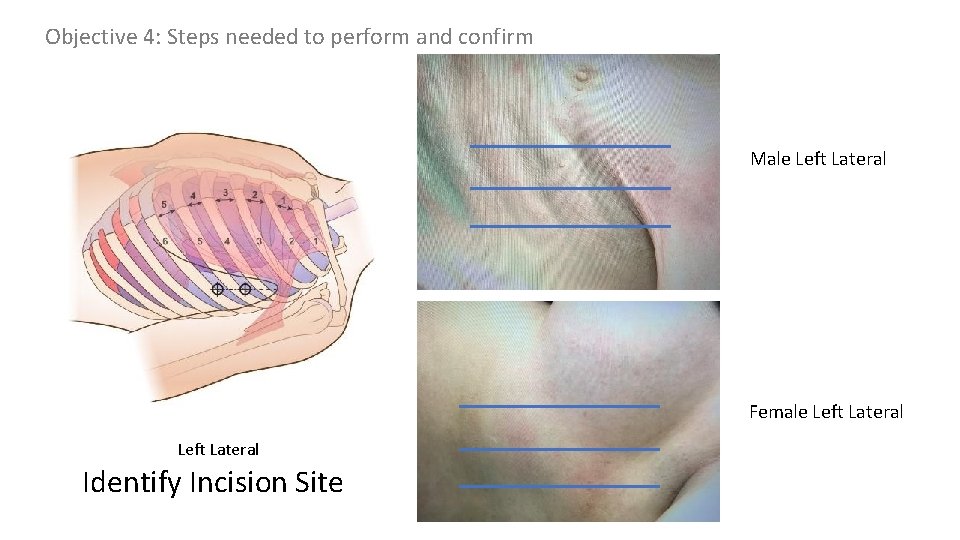
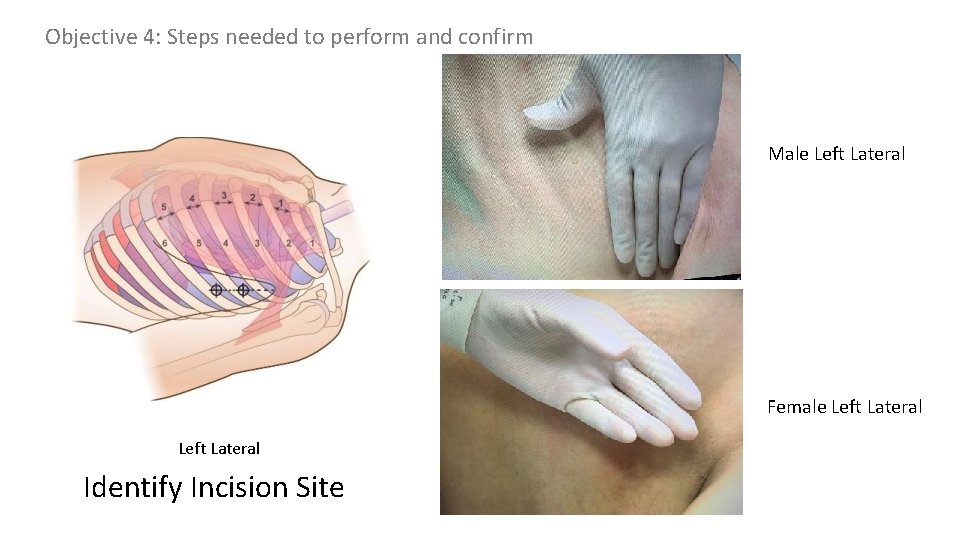
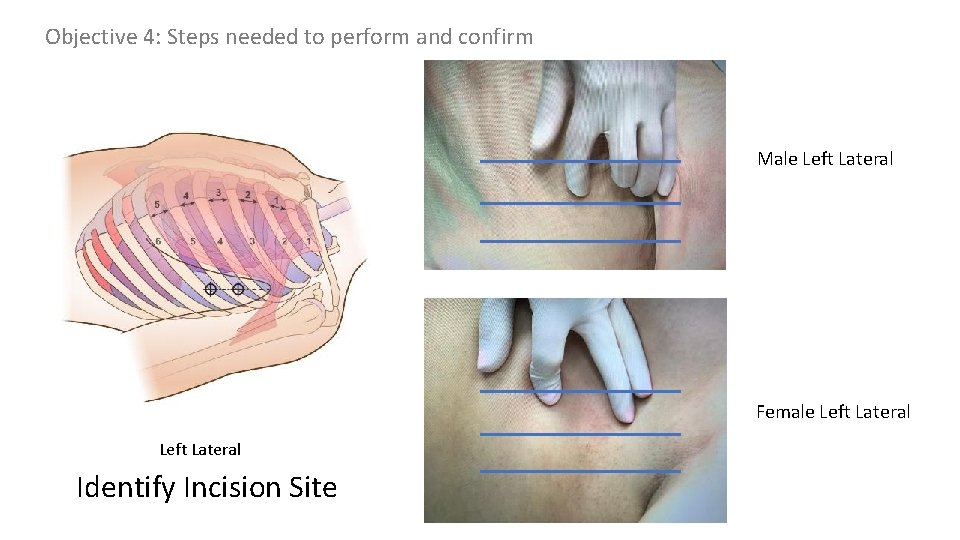
Objective 4: Steps needed to perform and confirm Male Left Lateral Female Left Lateral Identify Incision Site
Objective 4: Steps needed to perform and confirm Male Left Lateral Female Left Lateral Identify Incision Site
Objective 4: Steps needed to perform and confirm Male Left Lateral Female Left Lateral Identify Incision Site
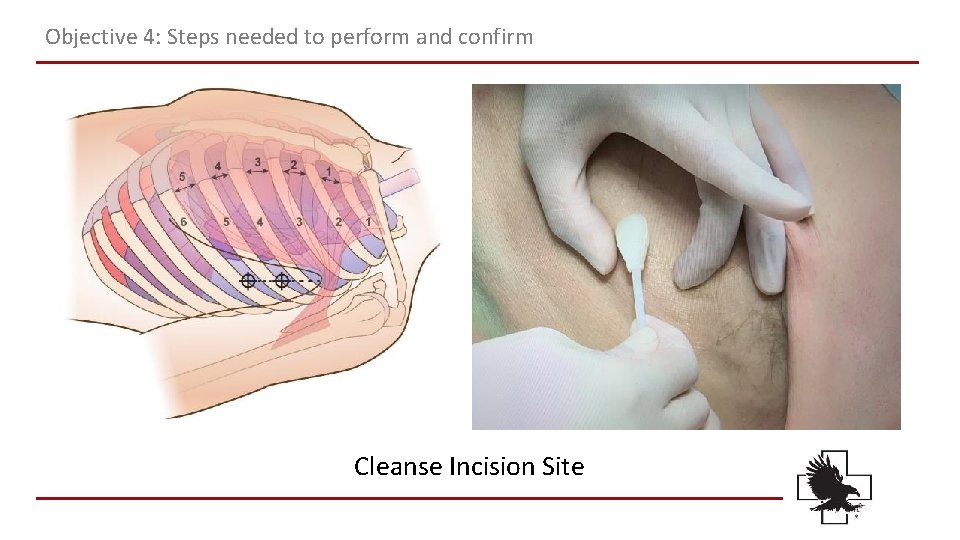
Objective 4: Steps needed to perform and confirm Cleanse Incision Site
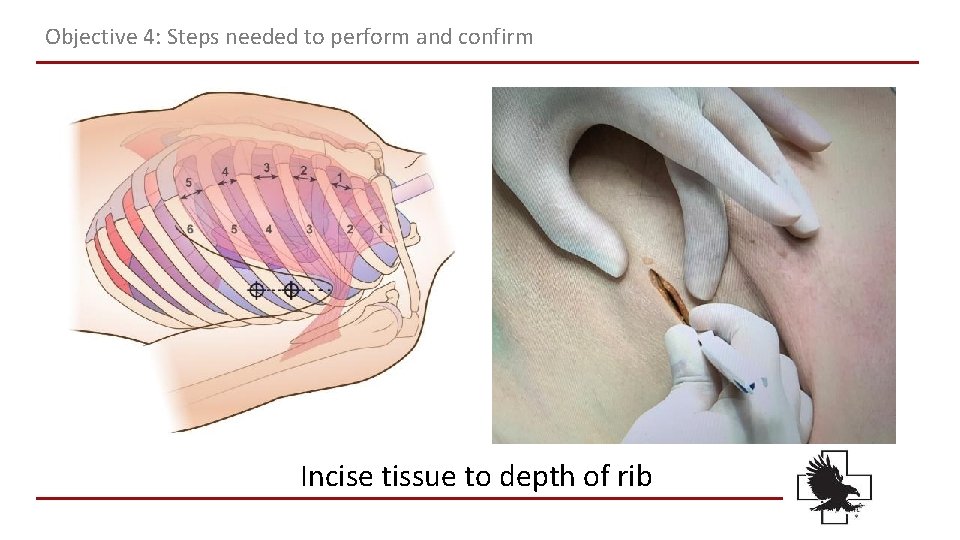
Objective 4: Steps needed to perform and confirm Incise tissue to depth of rib
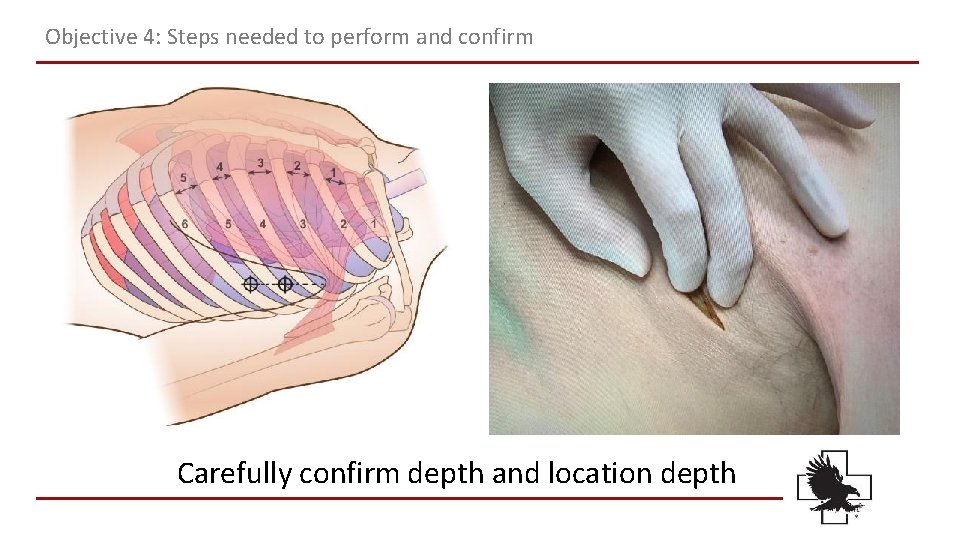
Objective 4: Steps needed to perform and confirm Carefully confirm depth and location depth
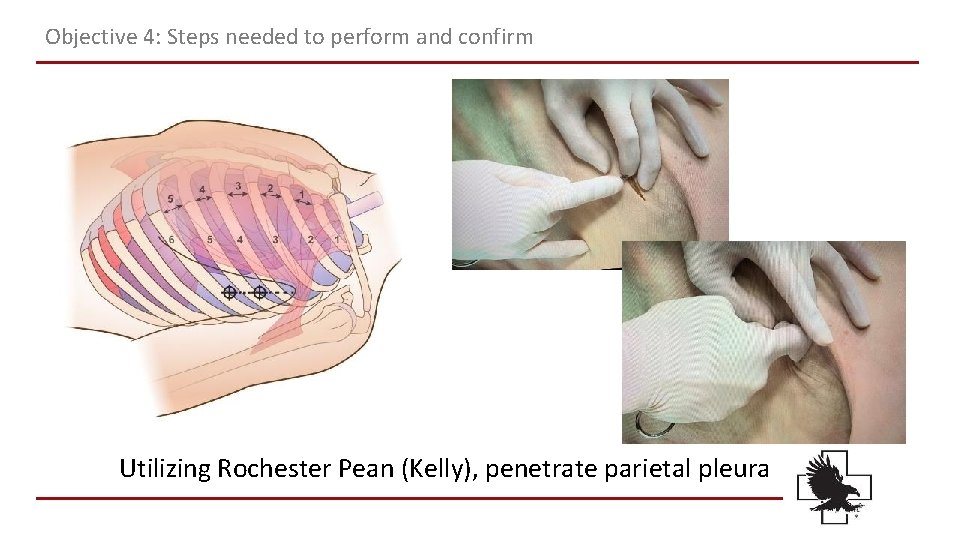
Objective 4: Steps needed to perform and confirm Utilizing Rochester Pean (Kelly), penetrate parietal pleura
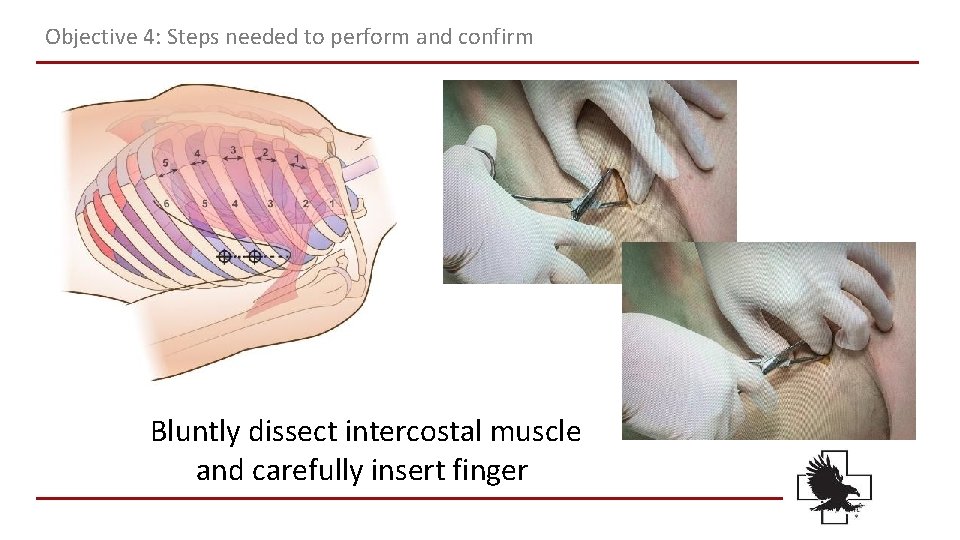
Objective 4: Steps needed to perform and confirm Bluntly dissect intercostal muscle and carefully insert finger
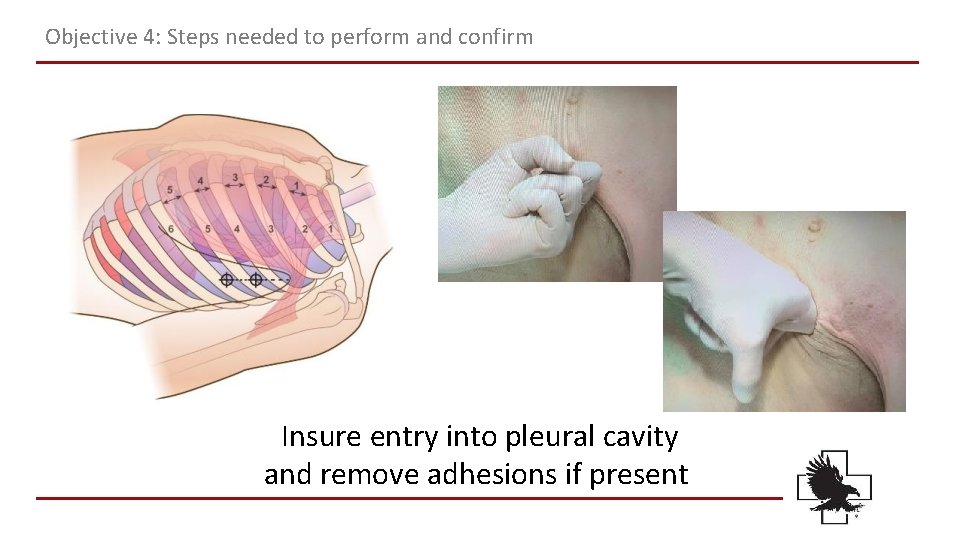
Objective 4: Steps needed to perform and confirm Insure entry into pleural cavity and remove adhesions if present
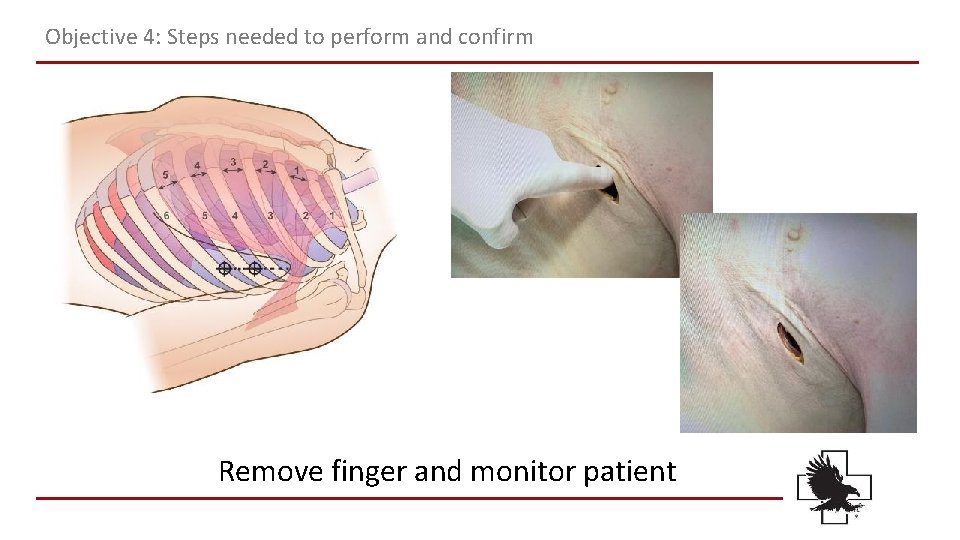
Objective 4: Steps needed to perform and confirm Remove finger and monitor patient
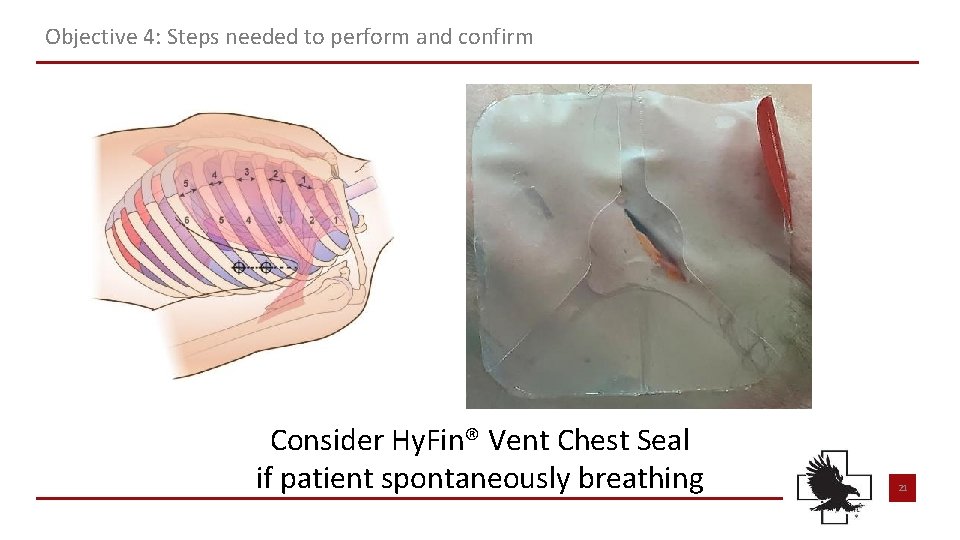
Objective 4: Steps needed to perform and confirm Consider Hy. Fin® Vent Chest Seal if patient spontaneously breathing 21
Objective 4: Steps needed to perform and confirm Successful thoracic decompression may have occurred if one or more of the following is observed: • improvement of respiratory distress • relief of air from catheter or one-way valve (valve may produce auditory signal) • improvement of oxygen saturation (≥ 90% may be dependent on use of supplemental oxygen) • return of radial pulse or vital signs
Objective 5: Complications Following a thoracic decompression procedure, continually assess patient for complications: • Hemodynamic instability If two needle decompression and • Respiratory distress simple thoracostomy fail • Unilateral chest expansion to relieve condition • Decreased oxygen saturation consider other causes and treatments IS THIS A CIRCULATORY PROBLEM? • Bleeding • Incision occlusion • Hematoma
Objective 5: Complications Potential adverse complications: of improper thoracic decompression • Death secondary to cardiac penetration • Lung injury • Vascular injury • Nerve damage • Pain • Numbness • Paralysis of intercostal muscle • Infection
Objective 6: Scientific Evidence The Simple Thoracostomy Kit, Thoracic decompression systems (ARS™ & SPEAR™) along with this presentation, were developed utilizing the latest published evidence, independent research, and the support of dedicated Military and Civilian medical professionals in Emergency Medicine, Trauma Surgery, Pulmonology, Radiology, and Pathology. Clinical providers, regardless of their position, must dedicate themselves to the unrelenting truth that critical care is an evolution on behalf of those in need. Butler F, Holcomb J, Shackelford S, et al. Management of the Suspected Tension Pneumothorax in Tactical Combat Care, TCCC Guidelines Change 17 -02. J Spe Op Med. 2018; 18: 19 -35. *The aforementioned publication references ninety-six additional papers worthy of careful review.
Objective 6: Scientific Evidence Nine Key Facets of Tactical Combat Care Guidelines Change 17 -02 1. 2. 3. 4. 5. 6. 7. 8. Continuation of aggressive approach to suspecting and treating tension pneumothorax Emphasis of bilateral decompression in traumatic arrest Addition of 10 Gauge catheter (length indicated in current guidelines differs from the S P E A R™) Designates either Lateral or Anterior sites as acceptable for thoracic decompression Addition of procedural elements (critical procedural differences are included within this material) Defines successful thoracic decompression Recommends ONLY two needle decompressions be attempted before moving on to circulation Addition of materials that recommend consideration of tension pneumothorax in presentations of shock 9. Addition of finger thoracostomy (if presentation warrants - following two unsuccessful needle decompression attempts - and provider is trained) Butler F, Holcomb J, Shackelford S, et al. Management of the Suspected Tension Pneumothorax in Tactical Combat Care, TCCC Guidelines Change 17 -02. J Spe Op Med. 2018; 18: 19 -35.
For additional information about the Simple Thoracostomy Kit email: info@NARescue. com Tel: 864. 675. 9800 Mail: 35 Tedwall Court Greer, SC 29650 -4791 Fax: 864. 675. 9880 Simple Thoracostomy Kit