
Simple rules for PID tuning Sigurd Skogestad NTNU
- Slides: 26
Simple rules for PID tuning Sigurd Skogestad NTNU, Trondheim, Norway April 4 -8, 2004 KFUPM-Distillation Control Course
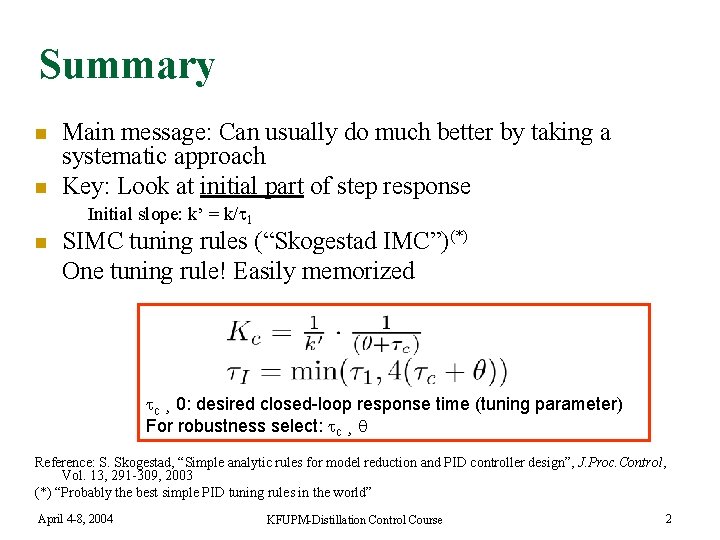
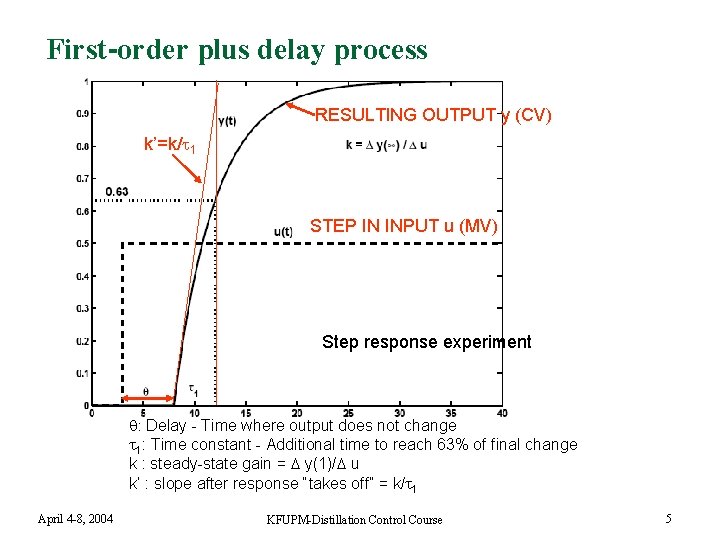
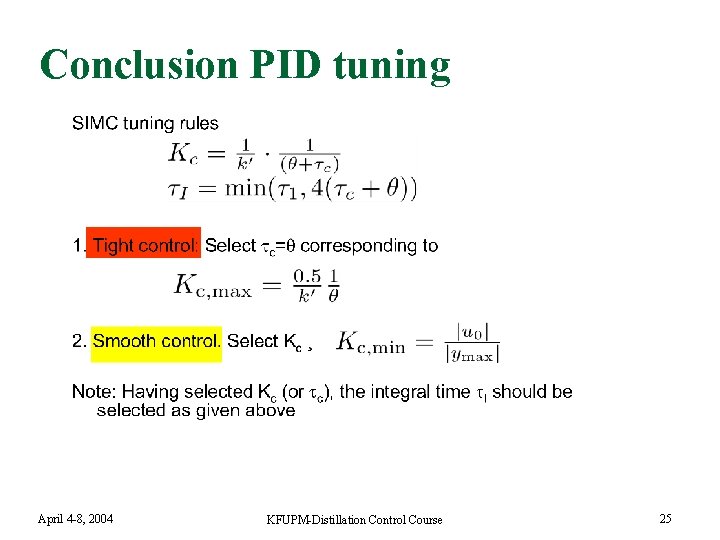
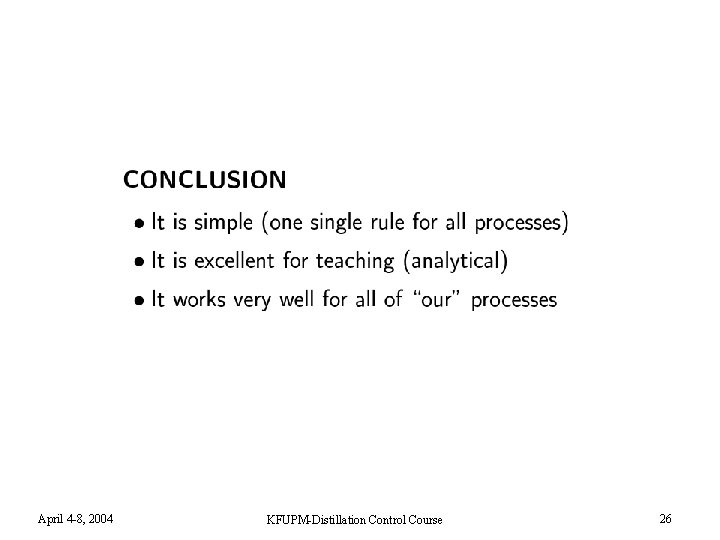
Summary n n Main message: Can usually do much better by taking a systematic approach Key: Look at initial part of step response Initial slope: k’ = k/ 1 n SIMC tuning rules (“Skogestad IMC”)(*) One tuning rule! Easily memorized c ¸ 0: desired closed-loop response time (tuning parameter) For robustness select: c ¸ Reference: S. Skogestad, “Simple analytic rules for model reduction and PID controller design”, J. Proc. Control, Vol. 13, 291 -309, 2003 (*) “Probably the best simple PID tuning rules in the world” April 4 -8, 2004 KFUPM-Distillation Control Course 2
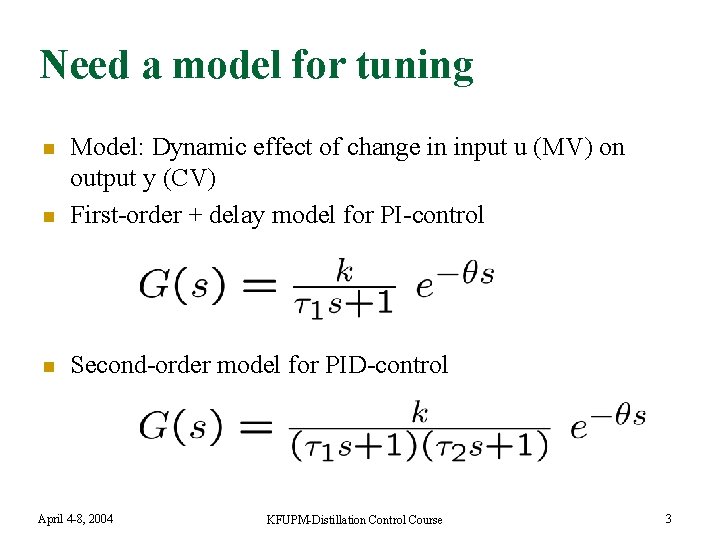
Need a model for tuning n Model: Dynamic effect of change in input u (MV) on output y (CV) First-order + delay model for PI-control n Second-order model for PID-control n April 4 -8, 2004 KFUPM-Distillation Control Course 3
Step response experiment n n Make step change in one u (MV) at a time Record the output (s) y (CV) April 4 -8, 2004 KFUPM-Distillation Control Course 4
First-order plus delay process RESULTING OUTPUT y (CV) k’=k/ 1 STEP IN INPUT u (MV) Step response experiment : Delay - Time where output does not change 1: Time constant - Additional time to reach 63% of final change k : steady-state gain = y(1)/ u k’ : slope after response “takes off” = k/ 1 April 4 -8, 2004 KFUPM-Distillation Control Course 5
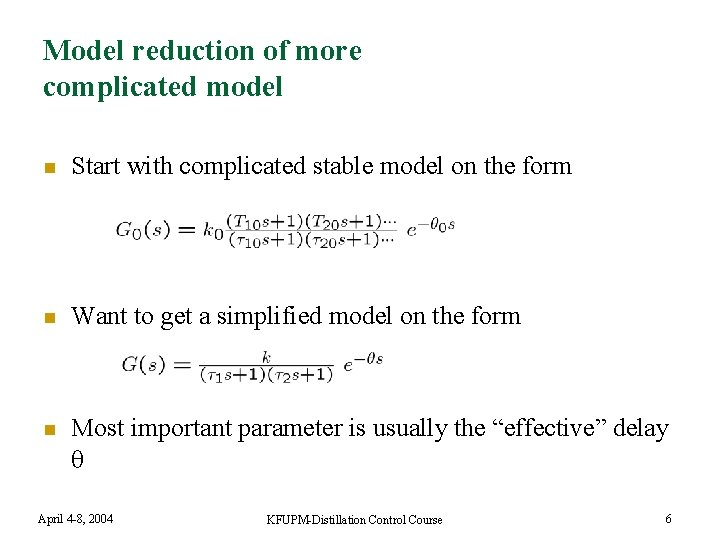
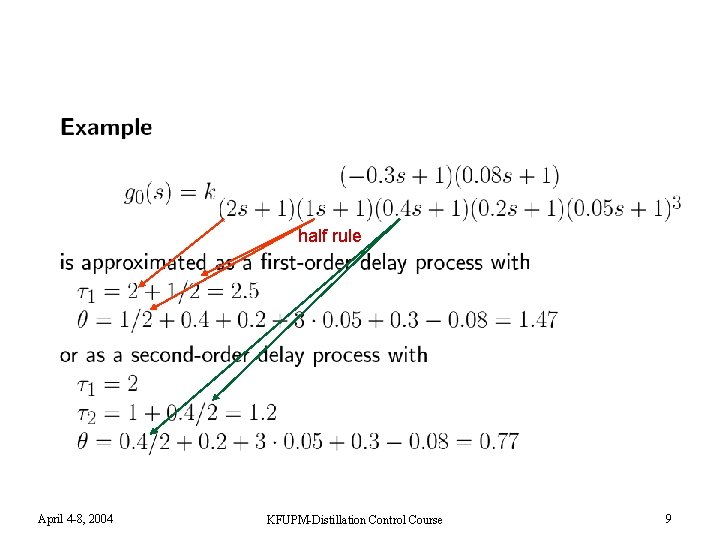
Model reduction of more complicated model n Start with complicated stable model on the form n Want to get a simplified model on the form n Most important parameter is usually the “effective” delay April 4 -8, 2004 KFUPM-Distillation Control Course 6
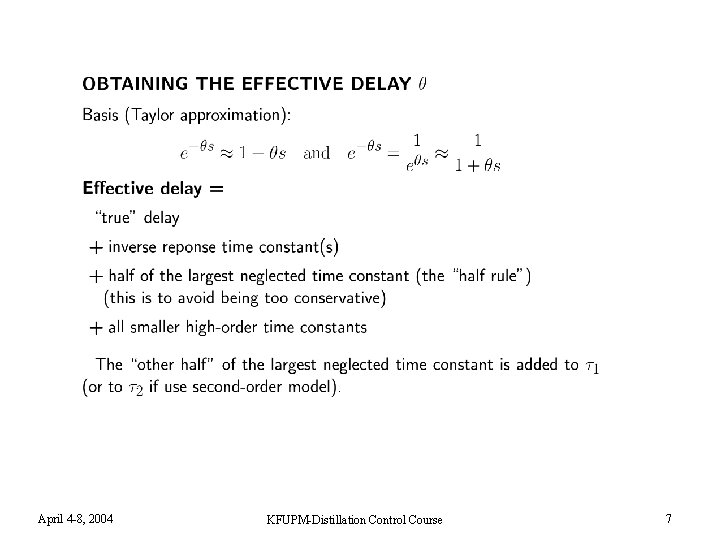
April 4 -8, 2004 KFUPM-Distillation Control Course 7
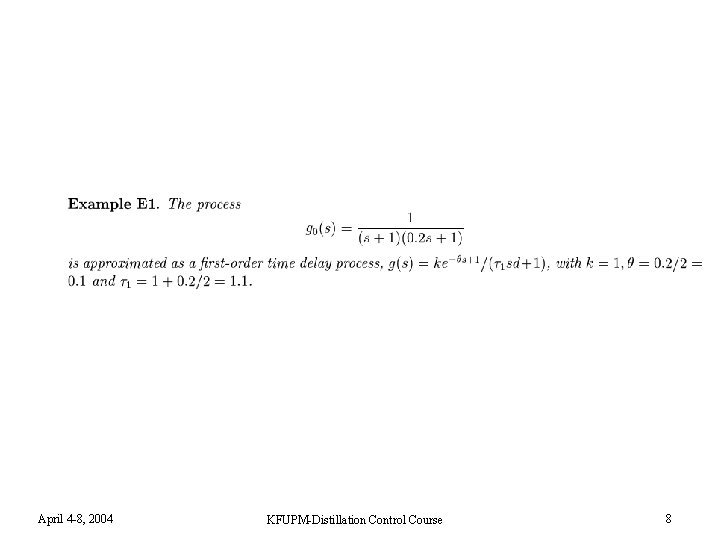
April 4 -8, 2004 KFUPM-Distillation Control Course 8
half rule April 4 -8, 2004 KFUPM-Distillation Control Course 9
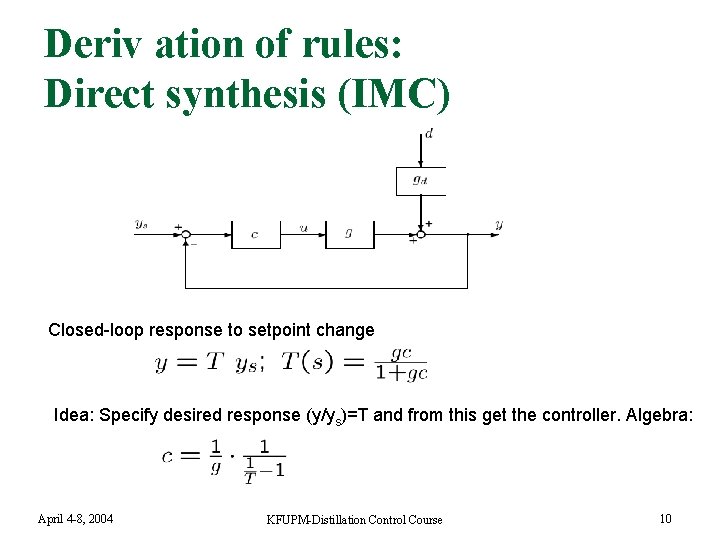
Deriv ation of rules: Direct synthesis (IMC) Closed-loop response to setpoint change Idea: Specify desired response (y/ys)=T and from this get the controller. Algebra: April 4 -8, 2004 KFUPM-Distillation Control Course 10
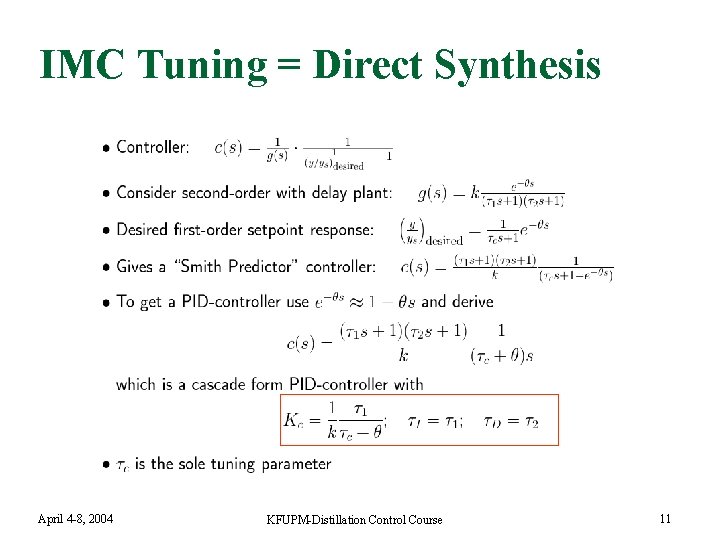
IMC Tuning = Direct Synthesis April 4 -8, 2004 KFUPM-Distillation Control Course 11
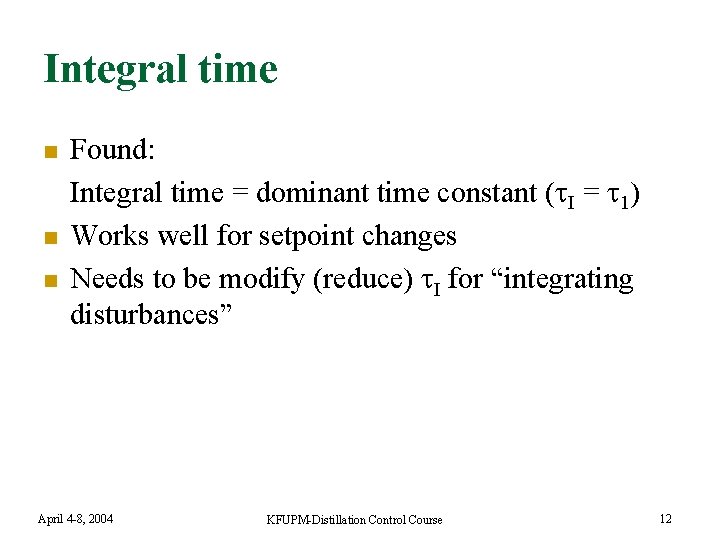
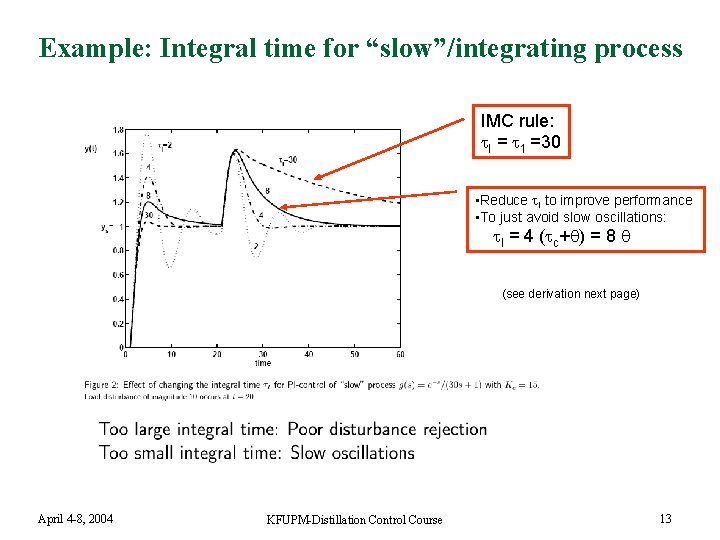
Integral time n n n Found: Integral time = dominant time constant ( I = 1) Works well for setpoint changes Needs to be modify (reduce) I for “integrating disturbances” April 4 -8, 2004 KFUPM-Distillation Control Course 12
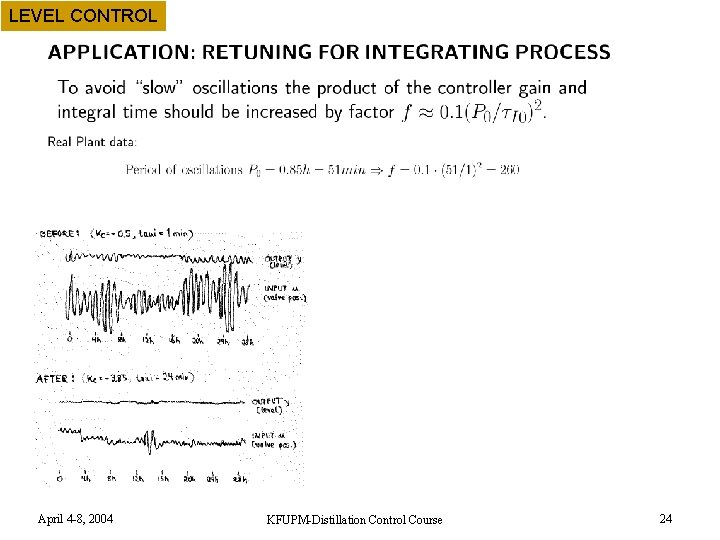
Example: Integral time for “slow”/integrating process IMC rule: I = 1 =30 • Reduce I to improve performance • To just avoid slow oscillations: I = 4 ( c+ ) = 8 (see derivation next page) April 4 -8, 2004 KFUPM-Distillation Control Course 13
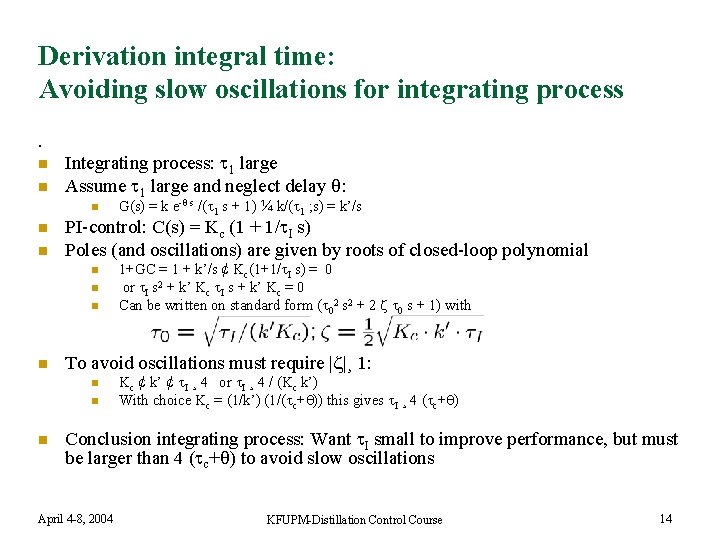
Derivation integral time: Avoiding slow oscillations for integrating process. n n Integrating process: 1 large Assume 1 large and neglect delay : n n n PI-control: C(s) = Kc (1 + 1/ I s) Poles (and oscillations) are given by roots of closed-loop polynomial n n 1+GC = 1 + k’/s ¢ Kc(1+1/ I s) = 0 or I s 2 + k’ Kc I s + k’ Kc = 0 Can be written on standard form ( 02 s 2 + 2 0 s + 1) with To avoid oscillations must require | |¸ 1: n n n G(s) = k e- s /( 1 s + 1) ¼ k/( 1 ; s) = k’/s Kc ¢ k’ ¢ I ¸ 4 or I ¸ 4 / (Kc k’) With choice Kc = (1/k’) (1/( c+ )) this gives I ¸ 4 ( c+ ) Conclusion integrating process: Want I small to improve performance, but must be larger than 4 ( c+ ) to avoid slow oscillations April 4 -8, 2004 KFUPM-Distillation Control Course 14
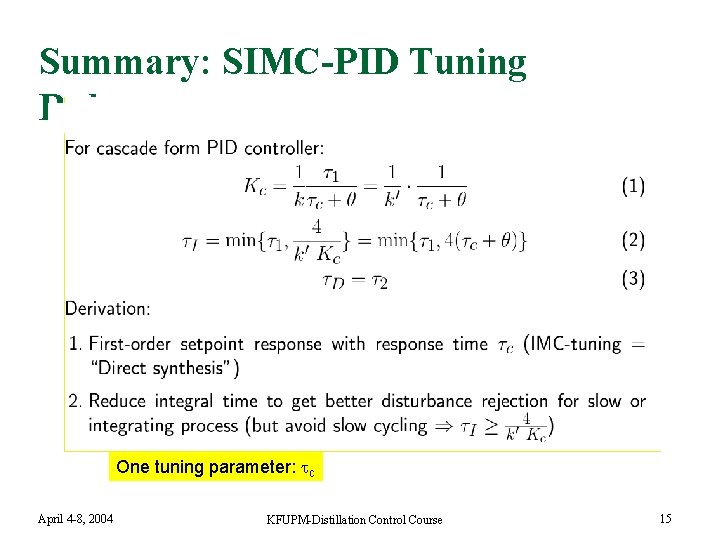
Summary: SIMC-PID Tuning Rules One tuning parameter: c April 4 -8, 2004 KFUPM-Distillation Control Course 15
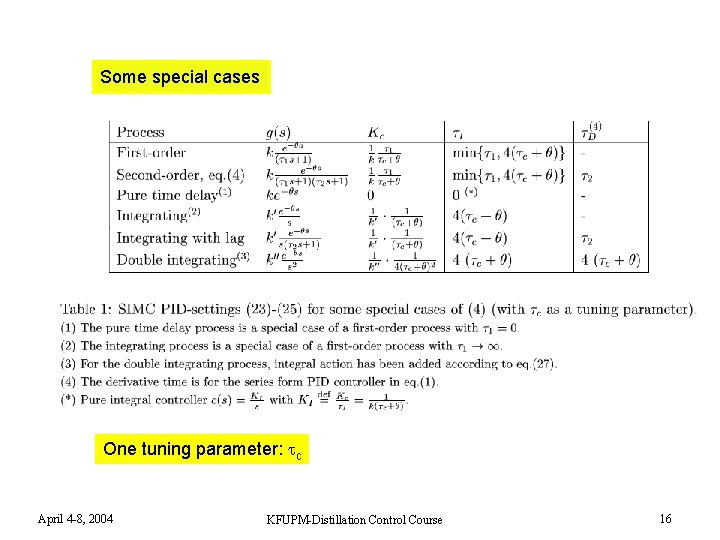
Some special cases One tuning parameter: c April 4 -8, 2004 KFUPM-Distillation Control Course 16
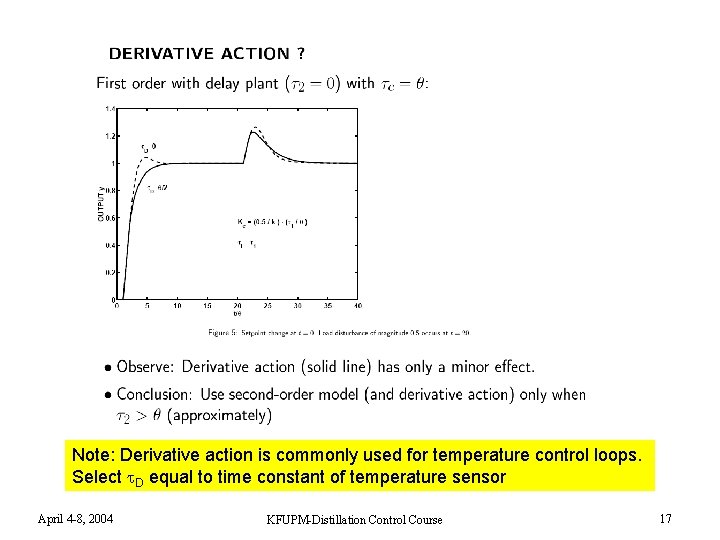
Note: Derivative action is commonly used for temperature control loops. Select D equal to time constant of temperature sensor April 4 -8, 2004 KFUPM-Distillation Control Course 17
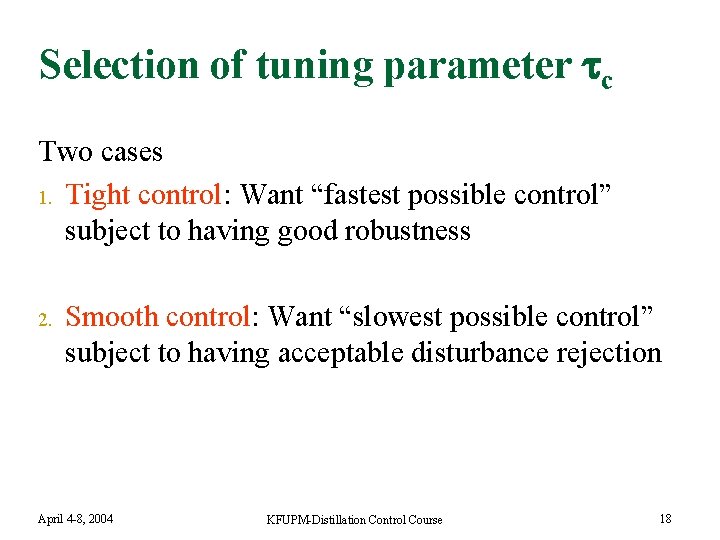
Selection of tuning parameter c Two cases 1. Tight control: Want “fastest possible control” subject to having good robustness 2. Smooth control: Want “slowest possible control” subject to having acceptable disturbance rejection April 4 -8, 2004 KFUPM-Distillation Control Course 18
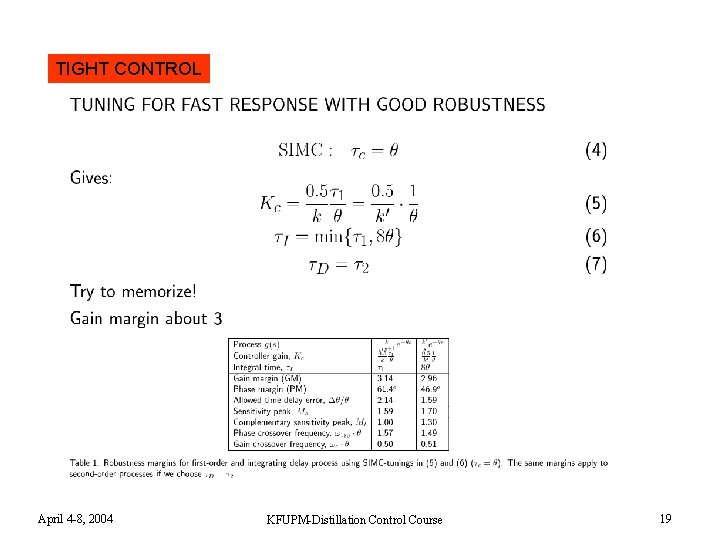
TIGHT CONTROL April 4 -8, 2004 KFUPM-Distillation Control Course 19
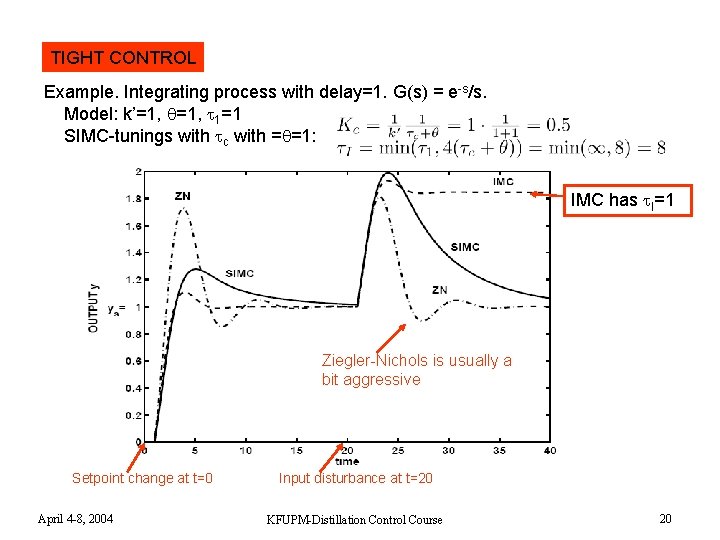
TIGHT CONTROL Example. Integrating process with delay=1. G(s) = e-s/s. Model: k’=1, 1=1 SIMC-tunings with c with = =1: IMC has I=1 Ziegler-Nichols is usually a bit aggressive Setpoint change at t=0 April 4 -8, 2004 Input disturbance at t=20 KFUPM-Distillation Control Course 20
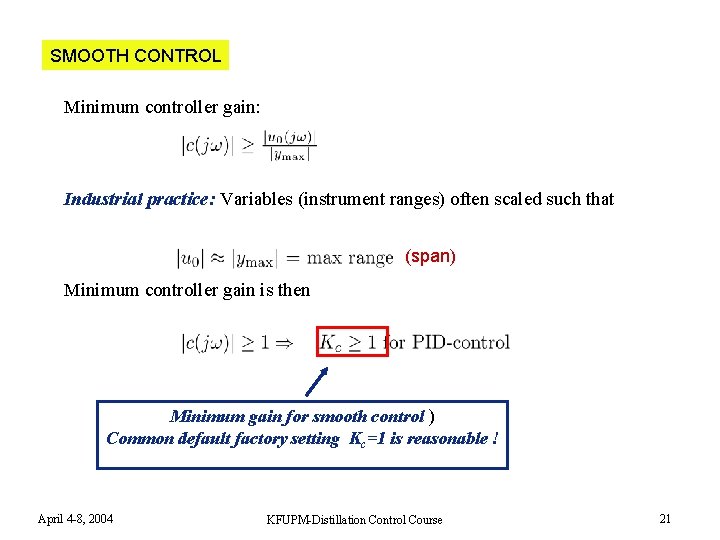
SMOOTH CONTROL Minimum controller gain: Industrial practice: Variables (instrument ranges) often scaled such that (span) Minimum controller gain is then Minimum gain for smooth control ) Common default factory setting Kc=1 is reasonable ! April 4 -8, 2004 KFUPM-Distillation Control Course 21
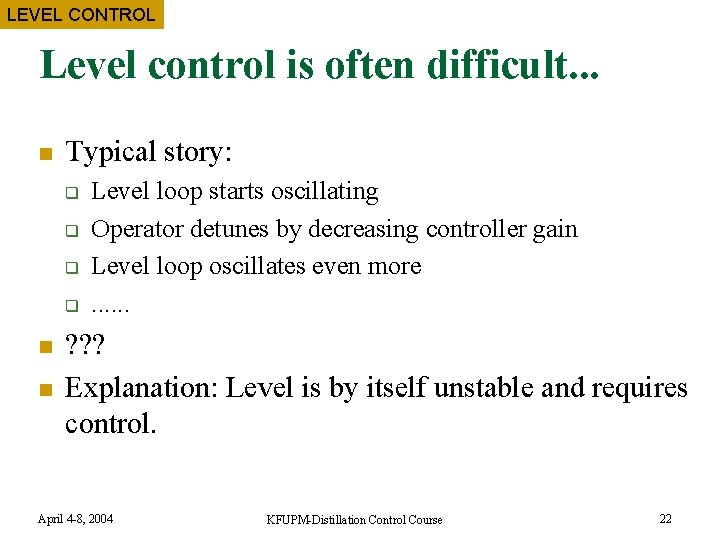
LEVEL CONTROL Level control is often difficult. . . n Typical story: q q n n Level loop starts oscillating Operator detunes by decreasing controller gain Level loop oscillates even more. . . ? ? ? Explanation: Level is by itself unstable and requires control. April 4 -8, 2004 KFUPM-Distillation Control Course 22
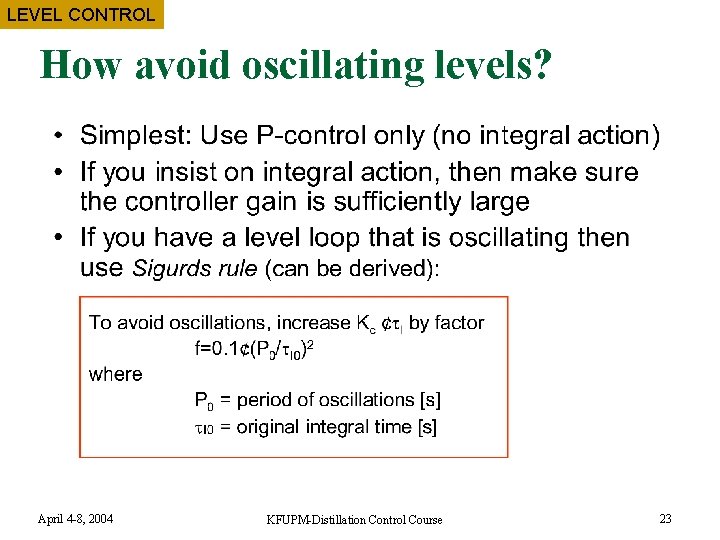
LEVEL CONTROL How avoid oscillating levels? April 4 -8, 2004 KFUPM-Distillation Control Course 23
LEVEL CONTROL April 4 -8, 2004 KFUPM-Distillation Control Course 24
Conclusion PID tuning April 4 -8, 2004 KFUPM-Distillation Control Course 25
April 4 -8, 2004 KFUPM-Distillation Control Course 26