
SIMPLE REGENERATIVE RECEIVER 80 and 40 with one
- Slides: 22
SIMPLE REGENERATIVE RECEIVER 80 and 40 with one FET and a low component count
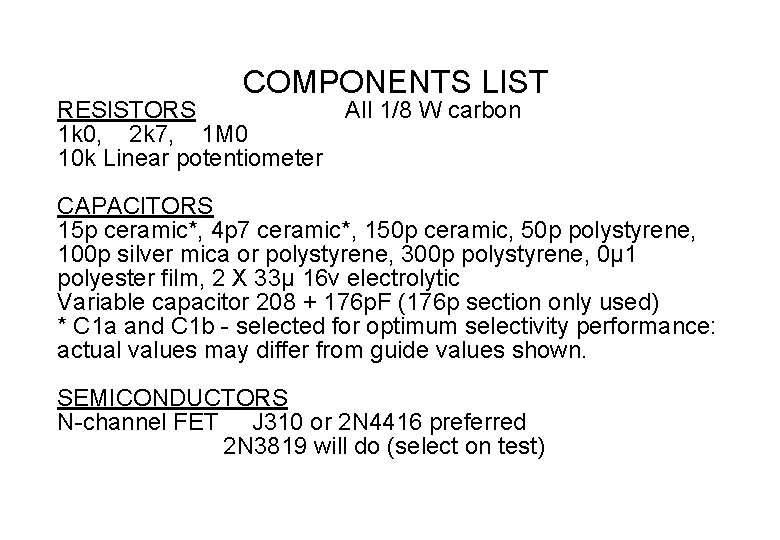
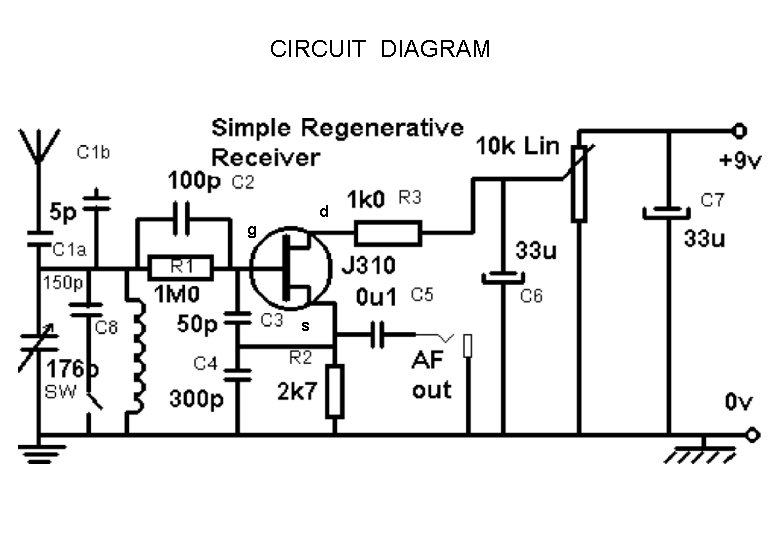
COMPONENTS LIST RESISTORS All 1/8 W carbon 1 k 0, 2 k 7, 1 M 0 10 k Linear potentiometer CAPACITORS 15 p ceramic*, 4 p 7 ceramic*, 150 p ceramic, 50 p polystyrene, 100 p silver mica or polystyrene, 300 p polystyrene, 0µ 1 polyester film, 2 X 33µ 16 v electrolytic Variable capacitor 208 + 176 p. F (176 p section only used) * C 1 a and C 1 b - selected for optimum selectivity performance: actual values may differ from guide values shown. SEMICONDUCTORS N-channel FET J 310 or 2 N 4416 preferred 2 N 3819 will do (select on test)
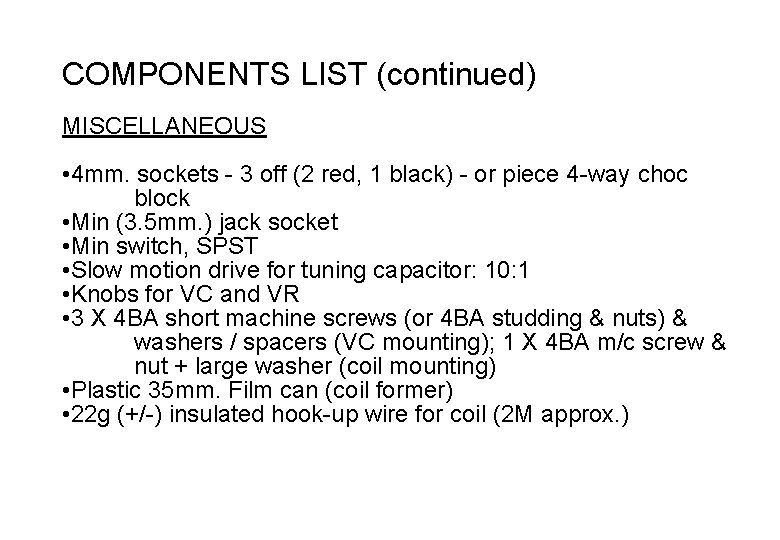
COMPONENTS LIST (continued) MISCELLANEOUS • 4 mm. sockets - 3 off (2 red, 1 black) - or piece 4 -way choc block • Min (3. 5 mm. ) jack socket • Min switch, SPST • Slow motion drive for tuning capacitor: 10: 1 • Knobs for VC and VR • 3 X 4 BA short machine screws (or 4 BA studding & nuts) & washers / spacers (VC mounting); 1 X 4 BA m/c screw & nut + large washer (coil mounting) • Plastic 35 mm. Film can (coil former) • 22 g (+/-) insulated hook-up wire for coil (2 M approx. )
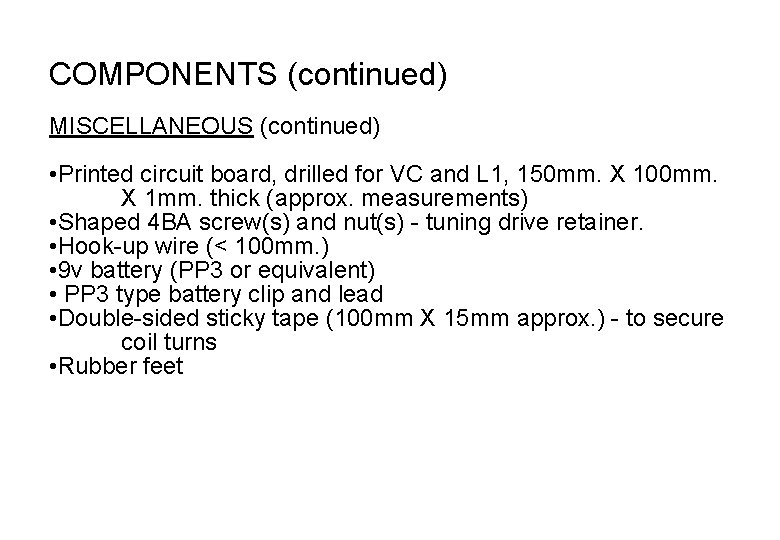
COMPONENTS (continued) MISCELLANEOUS (continued) • Printed circuit board, drilled for VC and L 1, 150 mm. X 100 mm. X 1 mm. thick (approx. measurements) • Shaped 4 BA screw(s) and nut(s) - tuning drive retainer. • Hook-up wire (< 100 mm. ) • 9 v battery (PP 3 or equivalent) • PP 3 type battery clip and lead • Double-sided sticky tape (100 mm X 15 mm approx. ) - to secure coil turns • Rubber feet
CIRCUIT DIAGRAM d g s
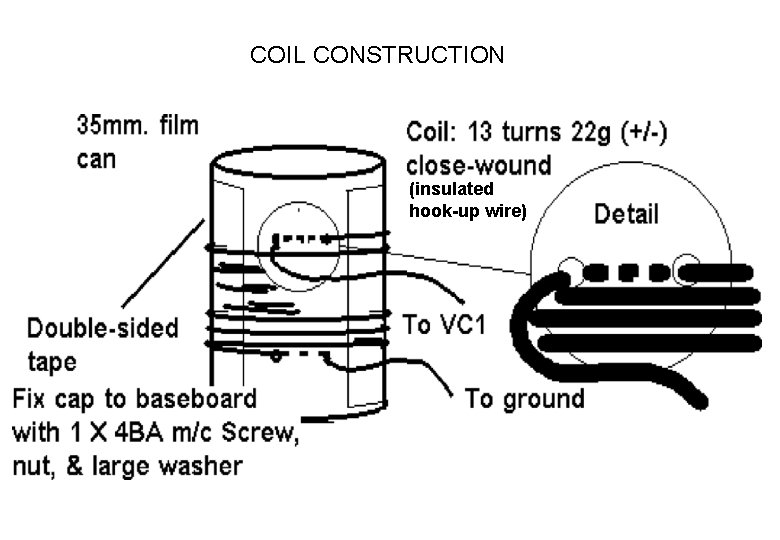
COIL CONSTRUCTION (insulated hook-up wire)
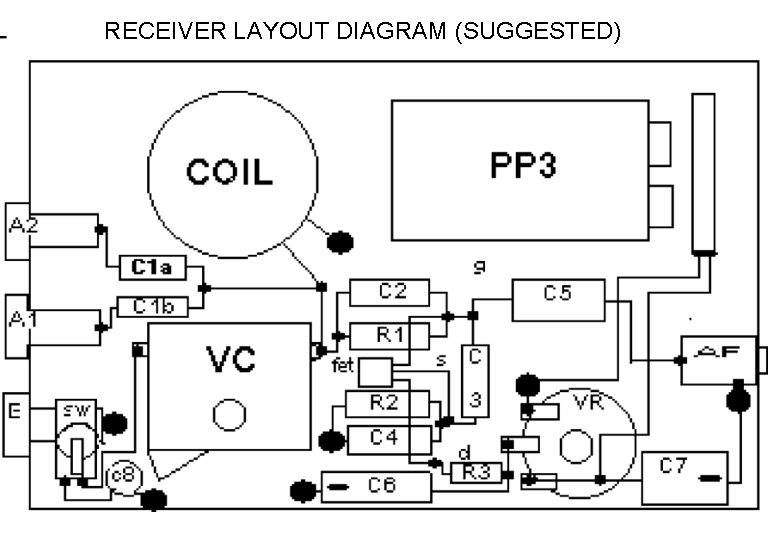
RECEIVER LAYOUT DIAGRAM (SUGGESTED)
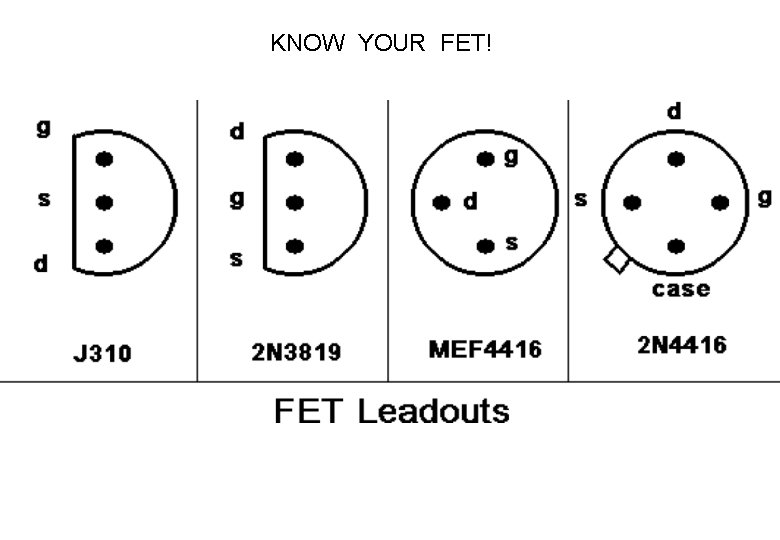
KNOW YOUR FET!
BEFORE YOU START! 1. Read through the instructions, referring to the circuit, layout and constructional diagrams. If there's anything that doesn't make sense, please ask. 2. When you start construction, keep the diagrams handy and check each stage as you go. 3. Tin all leads before you solder them - but watch out for the polystyrene capacitors: they melt easily. Use a heatsink if in doubt. more. . .
BEFORE YOU START! (continued) 4. When placing major components on the board leave plenty of room to get in and modify the circuit if necessary. 5. Keep the construction as rigid as possible the final receiver will be more stable that way.
INSTRUCTIONS 1. Wind the coil first, making sure that the coils are secure. Use double-sided tape to secure windings to the former - see the diagram. Anchor the winding ends by passing the wire through two holes pierced in the former. 2. Mount the tuning capacitor on its back, using 4 BA machine screws and spacers. Make sure that the screws do not foul the capacitor plates (use washers / spacers under the screw heads to adjust). Don't fit the reduction drive at this stage. more. .
INSTRUCTIONS (2) 3. Mount the coil base (film can cap) to the base-board using a 4 BA machine screw with a large washer and nut. 4. Mount Aerial and Earth Sockets to the board with hot-melt glue. 5. Solder a short length of wire (ca. 50 mm. or so) to one switch way terminal; solder one lead of the 150 p. F capacitor to the pole terminal. Keep the leads short. more. . .
INSTRUCTIONS (3) 6. Using hot-melt glue, mount the switch on top of the insulated body of the earth terminal, making sure that the free lead of the capacitor can be soldered to ground. Solder it. 7. Solder the free end of the switch wire to the VC rear section fixed plates terminal (LHS). 8. Solder R 1 and C 2 in parallel. Keep the leads short (< 10 mm. ). 9. Solder one end of R 1 / C 2 to the VC rear section fixed plates terminal (RHS). more. . .
INSTRUCTIONS (4) 10. Solder C 3 and C 4 together in series (short leads); solder the free lead of C 3 to the free end of R 1 / C 2. 11. Solder the free end of C 4 to ground (short lead). 12. Using hot melt glue, secure the regeneration potentiometer (VR) in position - make sure it's at least 10 mm. from the front edge of the board. 13. Solder to ground the rightmost of the three VR terminals. more. . .
INSTRUCTIONS (5) 14. Solder C 6 (-ve) and R 3 to the VR centre terminal. Solder the free lead (-ve) of C 6 to ground. 15. Solder C 7 (+ve) to the remaining (leftmost) VR terminal. Solder C 7 free lead (-ve) to ground. 16. Solder C 5 to the junction of C 3 / C 4 / R 2. It'll probably help rigidity if this component is stuck down to the board with hot melt glue. 17. Position the output socket on the right hand edge of the board. Secure in position with hot melt glue. more. . .
INSTRUCTIONS (6) 18. Solder the free lead of C 5 to the socket tip terminal. Solder the socket's other terminal to ground. 19. Solder the battery clip red lead to the junction of VR with C 7. Solder the black lead to ground. 20. Solder C 1 a and C 1 b to Aerial terminals A 1 and A 2 respectively. 21. Solder the free ends of C 1 a and C 1 b together, and connect (solder) to VC rear section fixed plates terminal. more…
INSTRUCTIONS (7) 22. Position the coil on its base. Solder the lower end of the winding to ground. 23. Solder the upper end of the coil winding to the VC rear section fixed plate terminal. 24. Solder the FET in place: ! (check the leadout diagram for your device) !
INSTRUCTIONS (8) 26. Check your wiring, paying special attention to electrolytic polarities and FET connections. 27. Fit the reduction drive to VC. Tighten the grub screws. 28. Secure the drive fixing lugs to the capacitor using 4 BA studding and lock nuts. !Make sure the stud ends don't foul the capacitor plates! Solder the lugs to the studs. 29. Fit knobs to VC drive and VR.
TESTING AND OPERATION 1. Connect an audio lead between the receiver output jack and audio amplifier. 2. Connect an aerial, preferably at least 10 M long, to the aerial terminal. 3. Connect an earth lead to the earth terminal. Connect the lead free end to a suitable earth. 4. Switch on the amplifier and turn up the volume control; connect the receiver battery clip to the battery. more. . .
TESTING & OPERATION (2) 5. Advance the regeneration control from the fully anticlockwise position: a point should be reached where either stations are heard, or a rushing sound. 6. If broadcast stations are heard, tune a station and continue to advance the regen. pot. until volume is maximum, without the set starting to howl: this is the point of maximum sensitivity and selectivity. more. . .
TESTING & OPERATION (3) 7. As the set is tuned across the band, small adjustments to VR will maintain the maximum selectivity / sensitivity point, and further broadcast stations will be heard. 8. Without C 8 switched in, the receiver should tune 4. 5 MHz to 8. 5 MHz approximately; with C 8 in circuit the range was 3. 4 MHz to 4. 6 MHz in the prototype. more. . .
TESTING & OPERATION (4) 9. To receive s. s. b. transmissions, advance the regen. pot. until the set just oscillates (rushing sound), tune for a station and adjust tuning / regeneration for best intelligible speech. 10. Each time you re-tune, you'll have to make adjustments to the regen. pot. . It takes practice, but the rewards are well worthwhile. Good Listening!