
Simple Receptors Unencapsulated Copyright 2006 Pearson Education Inc
- Slides: 24
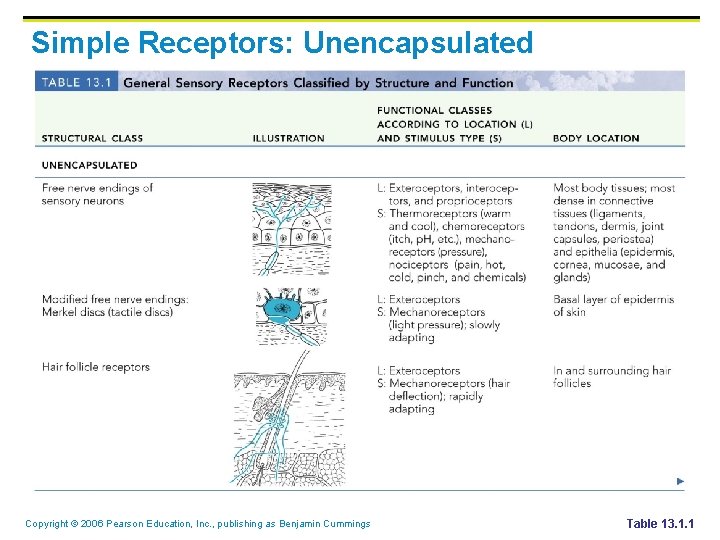
Simple Receptors: Unencapsulated Copyright © 2006 Pearson Education, Inc. , publishing as Benjamin Cummings Table 13. 1. 1
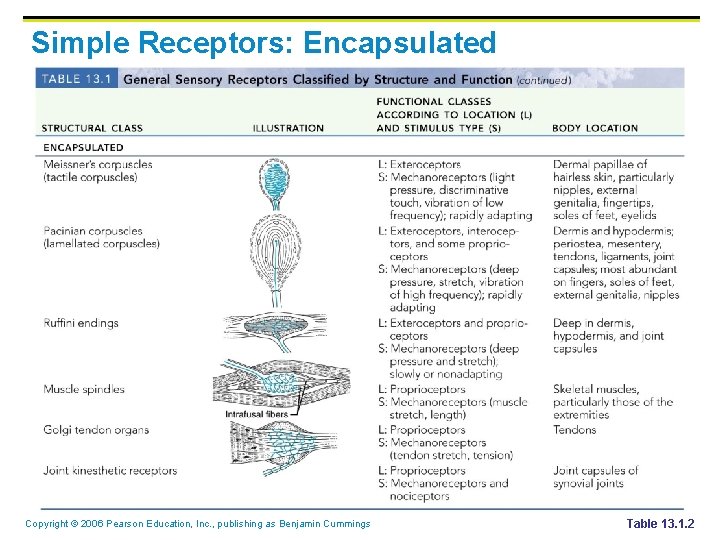
Simple Receptors: Encapsulated Copyright © 2006 Pearson Education, Inc. , publishing as Benjamin Cummings Table 13. 1. 2
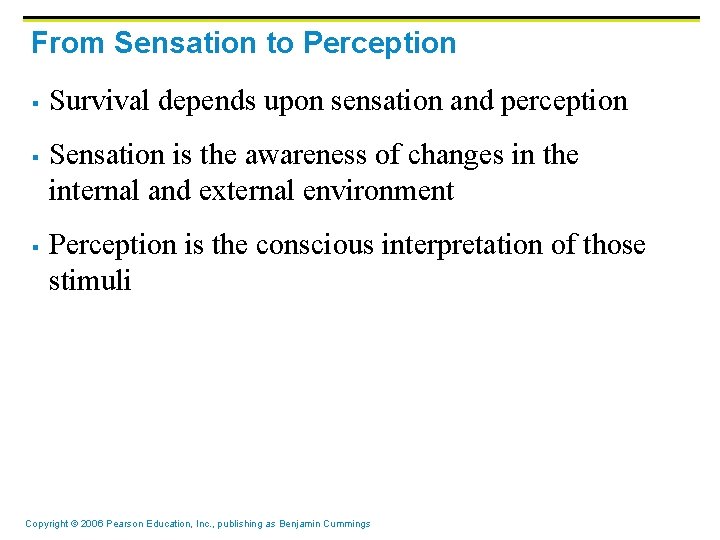
From Sensation to Perception § § § Survival depends upon sensation and perception Sensation is the awareness of changes in the internal and external environment Perception is the conscious interpretation of those stimuli Copyright © 2006 Pearson Education, Inc. , publishing as Benjamin Cummings
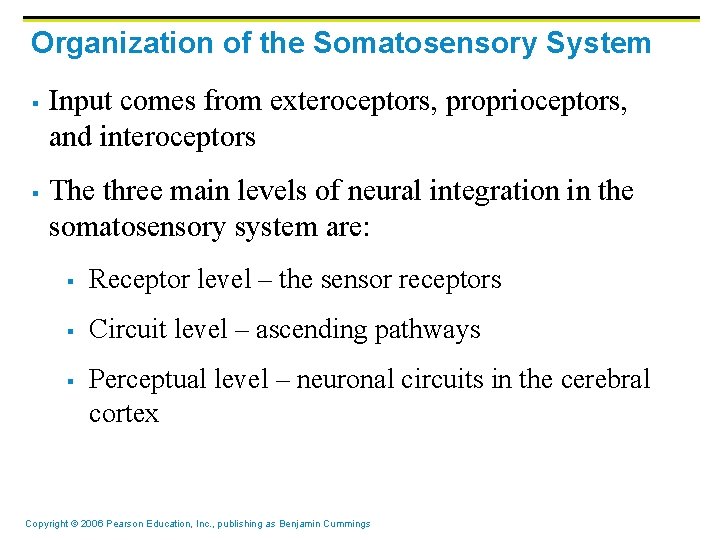
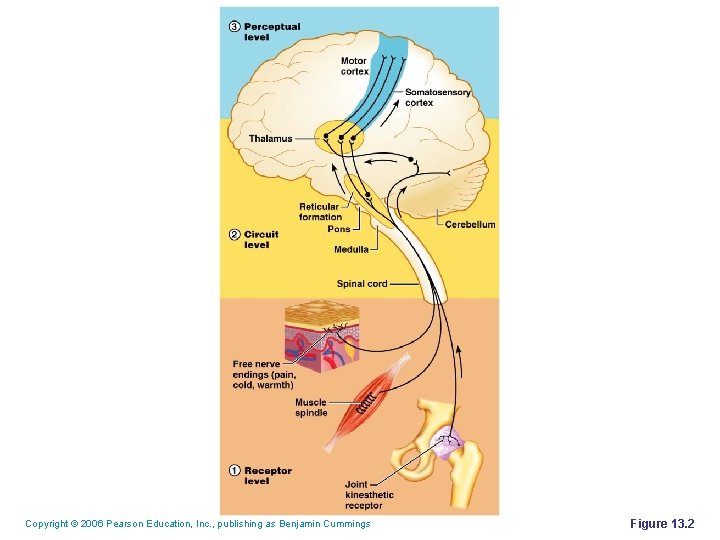
Organization of the Somatosensory System § § Input comes from exteroceptors, proprioceptors, and interoceptors The three main levels of neural integration in the somatosensory system are: § Receptor level – the sensor receptors § Circuit level – ascending pathways § Perceptual level – neuronal circuits in the cerebral cortex Copyright © 2006 Pearson Education, Inc. , publishing as Benjamin Cummings
Copyright © 2006 Pearson Education, Inc. , publishing as Benjamin Cummings Figure 13. 2
Processing at the Receptor Lever § § The receptor must have specificity for the stimulus energy The receptor’s receptive field must be stimulated Stimulus energy must be converted into a graded potential A generator potential in the associated sensory neuron must reach threshold Copyright © 2006 Pearson Education, Inc. , publishing as Benjamin Cummings
Adaptation of Sensory Receptors § Adaptation occurs when sensory receptors are subjected to an unchanging stimulus § Receptor membranes become less responsive § Receptor potentials decline in frequency or stop Copyright © 2006 Pearson Education, Inc. , publishing as Benjamin Cummings
Adaptation of Sensory Receptors § § § Receptors responding to pressure, touch, and smell adapt quickly Receptors responding slowly include Merkel’s discs, Ruffini’s corpuscles, and interoceptors that respond to chemical levels in the blood Pain receptors and proprioceptors do not exhibit adaptation Copyright © 2006 Pearson Education, Inc. , publishing as Benjamin Cummings
Processing at the Circuit Level § § Chains of three neurons conduct sensory impulses upward to the brain First-order neurons – soma reside in dorsal root or cranial ganglia, and conduct impulses from the skin to the spinal cord or brain stem Second-order neurons – soma reside in the dorsal horn of the spinal cord or medullary nuclei and transmit impulses to the thalamus or cerebellum Third-order neurons – located in the thalamus and conduct impulses to the somatosensory cortex of the cerebrum Copyright © 2006 Pearson Education, Inc. , publishing as Benjamin Cummings
Processing at the Perceptual Level § § § The thalamus projects fibers to: § The somatosensory cortex § Sensory association areas First one modality is sent, then those considering more than one The result is an internal, conscious image of the stimulus Copyright © 2006 Pearson Education, Inc. , publishing as Benjamin Cummings
Main Aspects of Sensory Perception § § § Perceptual detection – detecting that a stimulus has occurred and requires summation Magnitude estimation – how much of a stimulus is acting Spatial discrimination – identifying the site or pattern of the stimulus Copyright © 2006 Pearson Education, Inc. , publishing as Benjamin Cummings
Main Aspects of Sensory Perception § § § Feature abstraction – used to identify a substance that has specific texture or shape Quality discrimination – the ability to identify submodalities of a sensation (e. g. , sweet or sour tastes) Pattern recognition – ability to recognize patterns in stimuli (e. g. , melody, familiar face) Copyright © 2006 Pearson Education, Inc. , publishing as Benjamin Cummings
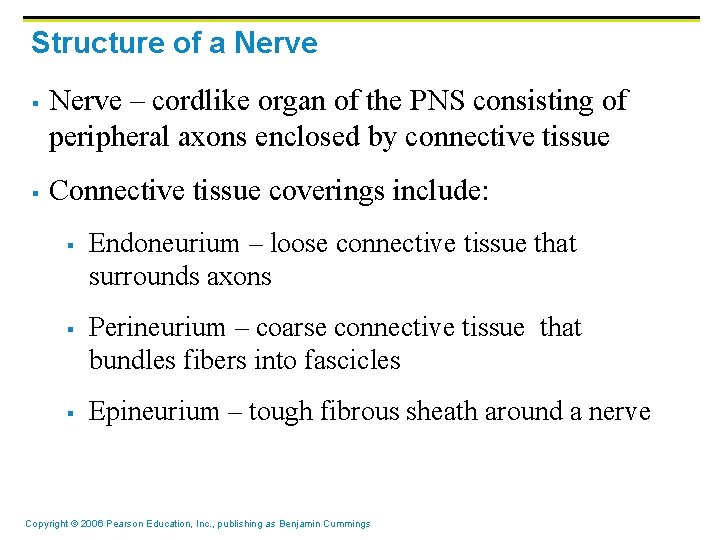
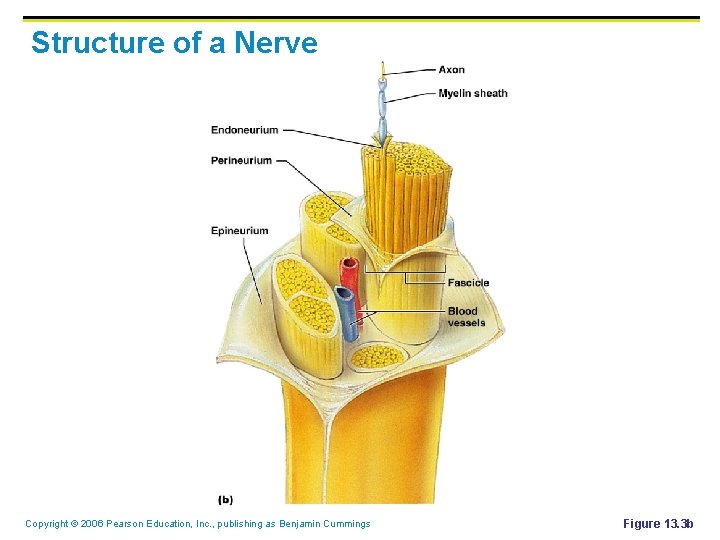
Structure of a Nerve § § Nerve – cordlike organ of the PNS consisting of peripheral axons enclosed by connective tissue Connective tissue coverings include: § § § Endoneurium – loose connective tissue that surrounds axons Perineurium – coarse connective tissue that bundles fibers into fascicles Epineurium – tough fibrous sheath around a nerve Copyright © 2006 Pearson Education, Inc. , publishing as Benjamin Cummings
Structure of a Nerve Copyright © 2006 Pearson Education, Inc. , publishing as Benjamin Cummings Figure 13. 3 b
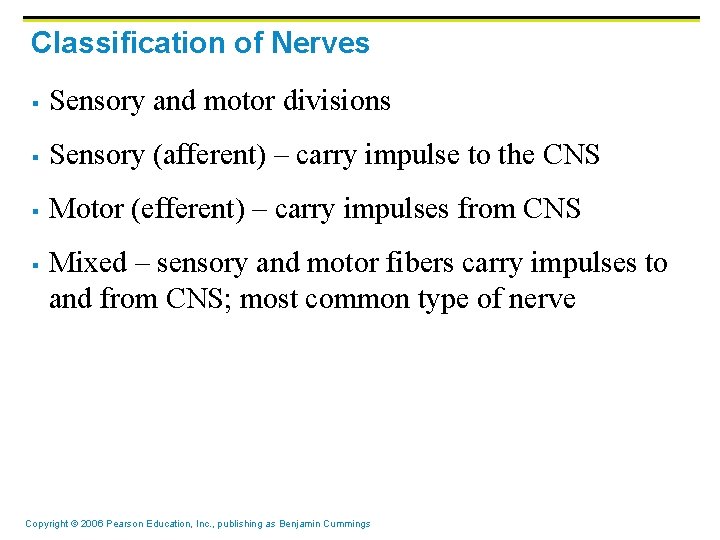
Classification of Nerves § Sensory and motor divisions § Sensory (afferent) – carry impulse to the CNS § Motor (efferent) – carry impulses from CNS § Mixed – sensory and motor fibers carry impulses to and from CNS; most common type of nerve Copyright © 2006 Pearson Education, Inc. , publishing as Benjamin Cummings
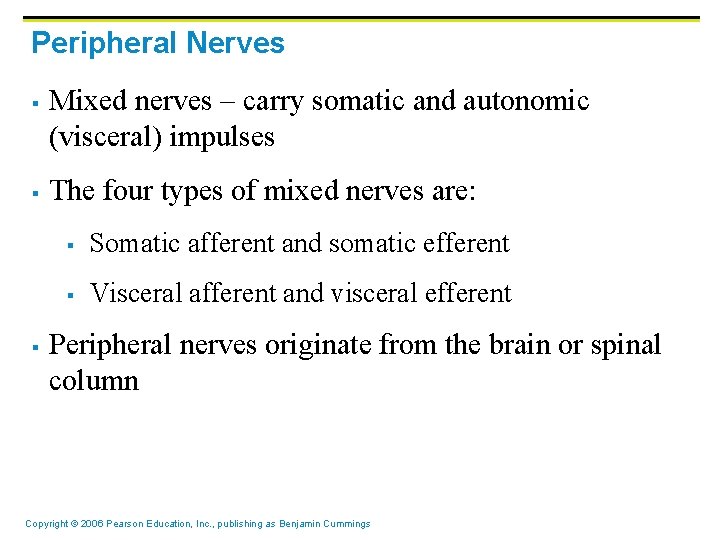
Peripheral Nerves § § § Mixed nerves – carry somatic and autonomic (visceral) impulses The four types of mixed nerves are: § Somatic afferent and somatic efferent § Visceral afferent and visceral efferent Peripheral nerves originate from the brain or spinal column Copyright © 2006 Pearson Education, Inc. , publishing as Benjamin Cummings
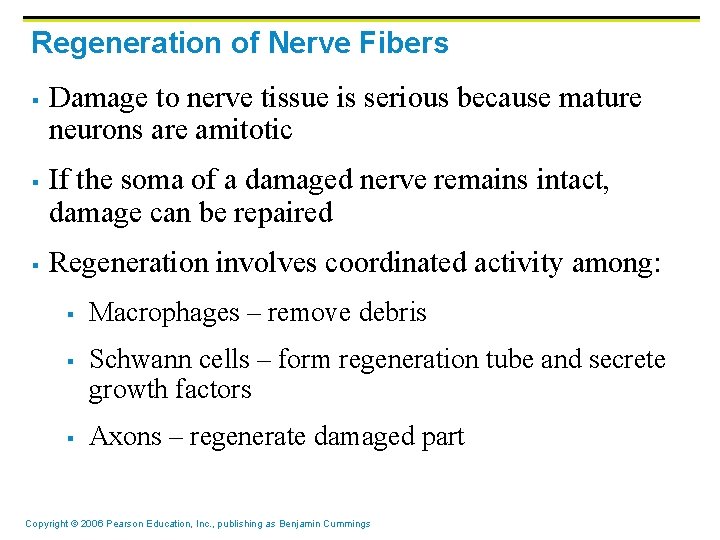
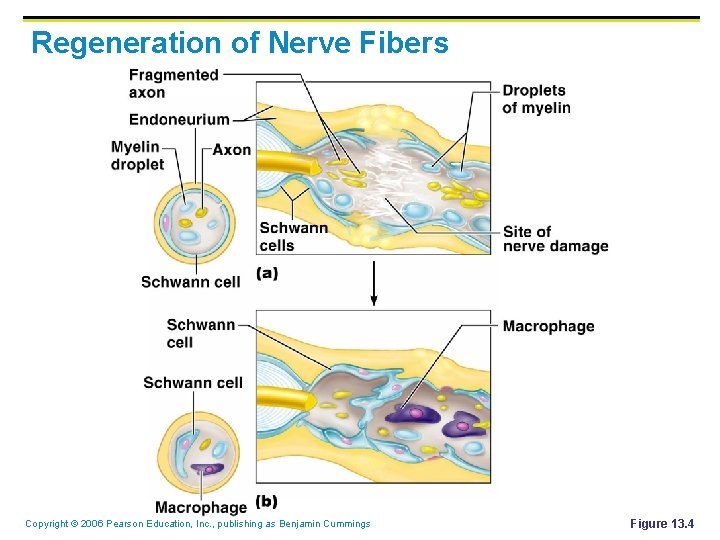
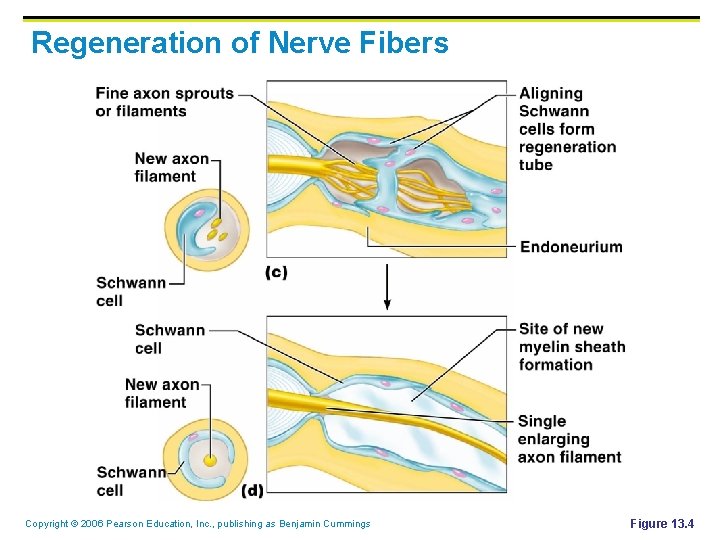
Regeneration of Nerve Fibers § § § Damage to nerve tissue is serious because mature neurons are amitotic If the soma of a damaged nerve remains intact, damage can be repaired Regeneration involves coordinated activity among: § § § Macrophages – remove debris Schwann cells – form regeneration tube and secrete growth factors Axons – regenerate damaged part Copyright © 2006 Pearson Education, Inc. , publishing as Benjamin Cummings
Regeneration of Nerve Fibers Copyright © 2006 Pearson Education, Inc. , publishing as Benjamin Cummings Figure 13. 4
Regeneration of Nerve Fibers Copyright © 2006 Pearson Education, Inc. , publishing as Benjamin Cummings Figure 13. 4
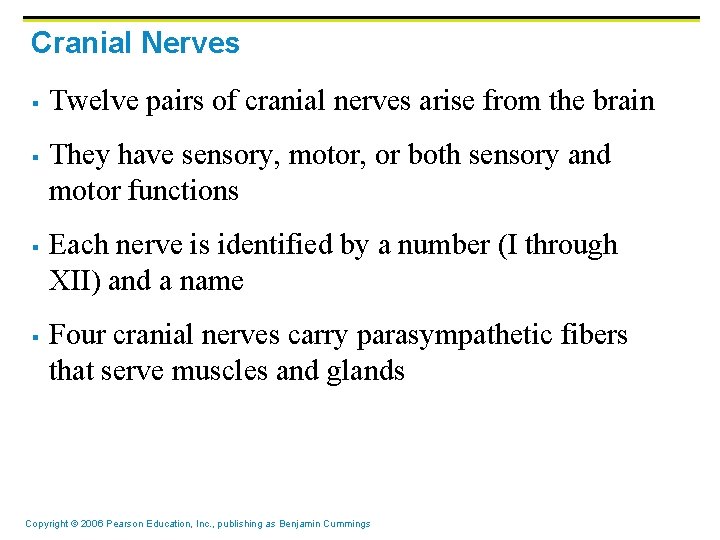
Cranial Nerves § § Twelve pairs of cranial nerves arise from the brain They have sensory, motor, or both sensory and motor functions Each nerve is identified by a number (I through XII) and a name Four cranial nerves carry parasympathetic fibers that serve muscles and glands Copyright © 2006 Pearson Education, Inc. , publishing as Benjamin Cummings
Cranial Nerve I: Olfactory § § Arises from the olfactory epithelium Passes through the cribriform plate of the ethmoid bone Fibers run through the olfactory bulb and terminate in the primary olfactory cortex Functions solely by carrying afferent impulses for the sense of smell Copyright © 2006 Pearson Education, Inc. , publishing as Benjamin Cummings
Cranial Nerve II: Optic § § § Arises from the retina of the eye Optic nerves pass through the optic canals and converge at the optic chiasm They continue to the thalamus where they synapse From there, the optic radiation fibers run to the visual cortex Functions solely by carrying afferent impulses for vision Copyright © 2006 Pearson Education, Inc. , publishing as Benjamin Cummings
Cranial Nerve III: Oculomotor § § § Fibers extend from the ventral midbrain, pass through the superior orbital fissure, and go to the extrinsic eye muscles Functions in raising the eyelid, directing the eyeball, constricting the iris, and controlling lens shape Parasympathetic cell bodies are in the ciliary ganglia Copyright © 2006 Pearson Education, Inc. , publishing as Benjamin Cummings
Cranial Nerve IV: Trochlear § § Fibers emerge from the dorsal midbrain and enter the orbits via the superior orbital fissures; innervate the superior oblique muscle Primarily a motor nerve that directs the eyeball Copyright © 2006 Pearson Education, Inc. , publishing as Benjamin Cummings