
Simple Procedure First Written Order Prep for The

- Slides: 21
Simple Procedure ‘First Written Order’ & Prep for “The Hearing” Andrew Heron
If the Respondent has issued a response… The Sheriff must, within 2 weeks of the response being received, issue the FIRST WRITTEN ORDER (from one of the following): 1. Refer the respondent and the claimant to alternative dispute resolution (ADR) 2. Arrange a case management discussion 3. Arrange a hearing 4. Indicate that the sheriff thinks that a decision could be made without a hearing, and that they are considering doing so. 5. Dismiss the claim or decide the claim.
1. ADR As previously discussed, the parties could be asked to use ‘Alternative Dispute Resolution’ to resolve the issue. If asked by the Sheriff, the parties must do this.
2. Case Management Discussion A case management discussion is an informal hearing the sheriff may arrange so they can: • Discuss the claim and response with both the claimant and respondent to clarify any concerns the sheriff may have. • Discuss negotiation and alternative dispute resolution with the claimant and respondent. • Give the claimant and respondent, in person, guidance and orders about witnesses, documents and other evidence which they need to bring to a hearing. • Give the claimant and respondent, in person, orders which arrange a hearing • Make a decision in the case. A case management discussion takes place in a courtroom or any other place decided by the sheriff. The sheriff will also decide how the discussion will take place, for example, by video conference, conference call or any other form that they decide.
3. A Hearing If the respondent disputes or defends the claim, the sheriff will want to find out about the facts that are not agreed on by asking questions of the claimant and respondent and any witnesses the sheriff thinks will help decide these facts. The purpose of a hearing is to help the sheriff make a decision in the case. The hearing will require the attendance of all parties involved in the case. The sheriff may also ask witnesses to attend the hearing, to help find out about the facts that are not agreed upon. You will be informed of the date, time and place of the hearing. It may be necessary for the court to inspect a document or item, or visit a place, to help decide the facts that are not agreed upon.
What if the claimant and or respondent do not come to the hearing? • If the claimant does not come to the hearing or is not represented at the hearing, the sheriff may dismiss the claim. • If the respondent does not come to the hearing or is not represented at the hearing, the sheriff may make a decision in the case at the hearing. • If neither party comes to or are represented at the hearing, the sheriff must dismiss the claim.
4 & 5 – Making a decision… What decisions can the sheriff make? . . . The sheriff may make any decision which resolves the dispute between the parties, including a decision which: • Orders the respondent to pay the claimant a sum of money. • Orders the respondent to deliver something to the claimant. • Orders the respondent to do something for the claimant. • Dismisses the claim or part of the claim made by the claimant. • Absolves the respondent of the claim or part of the claim made by the claimant. (A decision which absolves the respondent in a claim means that the claimant cannot make a claim about the same subject against the respondent again)
Making a decision… • At the end of the hearing, the sheriff may either make a decision there and then, or can take time to consider the facts that were disputed and the evidence that was heard, before making a decision. • If the sheriff makes a decision there and then, they must explain their reasons for that decision to the parties in person. • If the sheriff takes time to consider a decision, the decision must be made within 4 weeks from the date of the hearing. The sheriff must prepare a note of the reasons for the decision and the sheriff clerk will send a copy of that note to all of the parties. • Please note that the court will not issue a decision until a decision on the expenses of the case has been made.
Preparation for Hearing… • Lodge any Applications (see Rule 9) – quite simply an order to have something done, for e. g. – an order or a request to postpone the date of the Hearing…. Or ask to amend the terms of the claim or response.
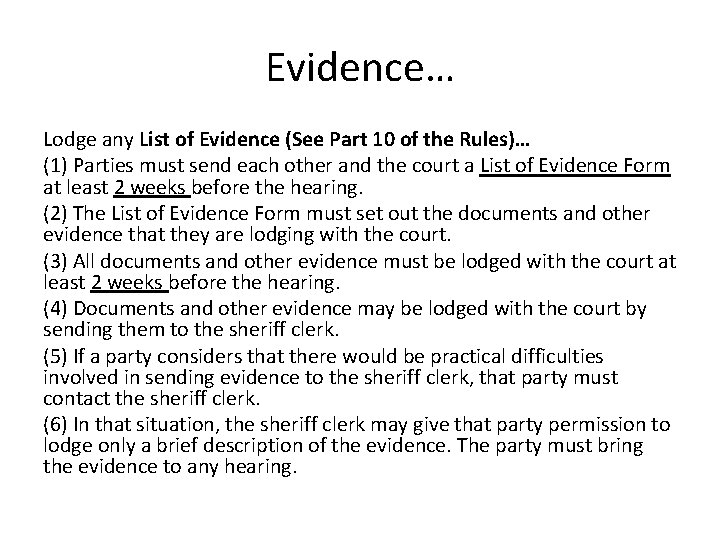
Evidence… Lodge any List of Evidence (See Part 10 of the Rules)… (1) Parties must send each other and the court a List of Evidence Form at least 2 weeks before the hearing. (2) The List of Evidence Form must set out the documents and other evidence that they are lodging with the court. (3) All documents and other evidence must be lodged with the court at least 2 weeks before the hearing. (4) Documents and other evidence may be lodged with the court by sending them to the sheriff clerk. (5) If a party considers that there would be practical difficulties involved in sending evidence to the sheriff clerk, that party must contact the sheriff clerk. (6) In that situation, the sheriff clerk may give that party permission to lodge only a brief description of the evidence. The party must bring the evidence to any hearing.
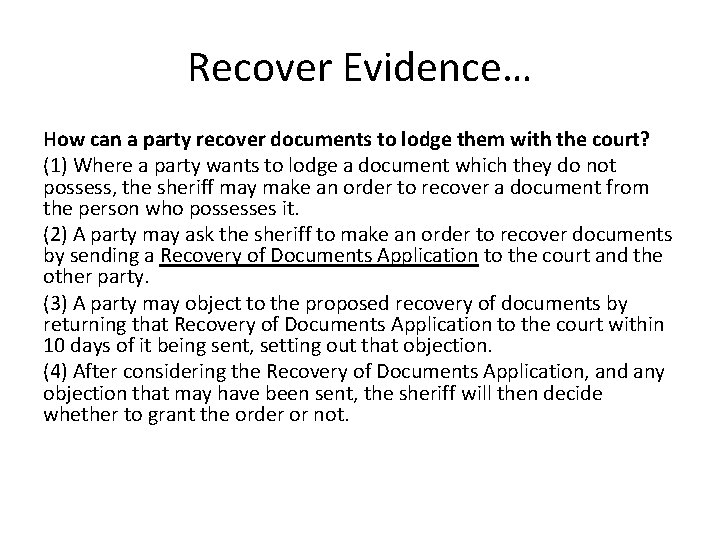
Recover Evidence… How can a party recover documents to lodge them with the court? (1) Where a party wants to lodge a document which they do not possess, the sheriff may make an order to recover a document from the person who possesses it. (2) A party may ask the sheriff to make an order to recover documents by sending a Recovery of Documents Application to the court and the other party. (3) A party may object to the proposed recovery of documents by returning that Recovery of Documents Application to the court within 10 days of it being sent, setting out that objection. (4) After considering the Recovery of Documents Application, and any objection that may have been sent, the sheriff will then decide whether to grant the order or not.
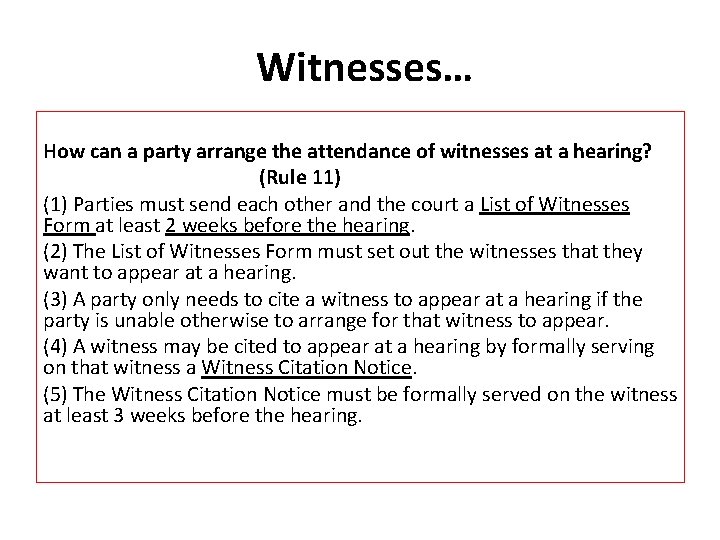
Witnesses… How can a party arrange the attendance of witnesses at a hearing? (Rule 11) (1) Parties must send each other and the court a List of Witnesses Form at least 2 weeks before the hearing. (2) The List of Witnesses Form must set out the witnesses that they want to appear at a hearing. (3) A party only needs to cite a witness to appear at a hearing if the party is unable otherwise to arrange for that witness to appear. (4) A witness may be cited to appear at a hearing by formally serving on that witness a Witness Citation Notice. (5) The Witness Citation Notice must be formally served on the witness at least 3 weeks before the hearing.
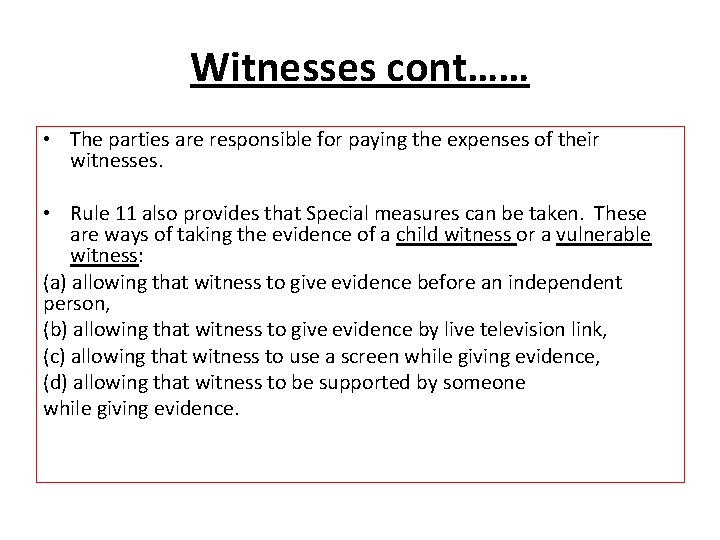
Witnesses cont…… • The parties are responsible for paying the expenses of their witnesses. • Rule 11 also provides that Special measures can be taken. These are ways of taking the evidence of a child witness or a vulnerable witness: (a) allowing that witness to give evidence before an independent person, (b) allowing that witness to give evidence by live television link, (c) allowing that witness to use a screen while giving evidence, (d) allowing that witness to be supported by someone while giving evidence.
Any other Preparations? . . . 1. 2. 3. 4. 5.
At the Continued Hearing… • Case starts when ‘called’ by the Clerk of Court. • Sheriff will confirm how the Hearing will be conducted. • Hearing is in public. • Claimant and their witnesses will go first. • Respondent will go next. • Witnesses sit in another room until they are ‘called’ to the court-room.
Hearing cont… • Each witness takes an ‘oath’ if asked by sheriff. • Each witness questioned - firstly by party who has called them, and then by the other party. Finally, the first party can ask further questions. • The sheriff may ask questions of the witnesses at any time. • Once all witnesses heard, Claimant and Respondent can address the sheriff to make final statements about their case.
Evidence in the court-room takes the form of: 1. 2. 3. 4. Witness statements. Productions (items/documents used in case). Inspections by court. Expert reports (e. g. by a surveyor). But remember, parties should only give evidence about facts which are not agreed.
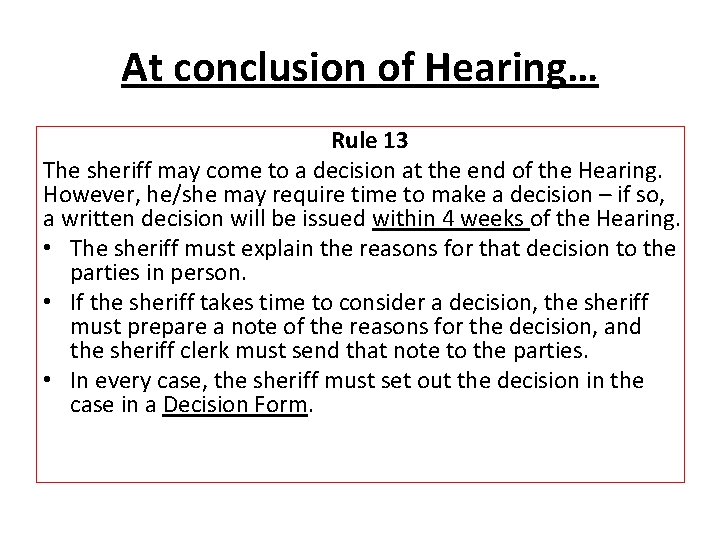
At conclusion of Hearing… Rule 13 The sheriff may come to a decision at the end of the Hearing. However, he/she may require time to make a decision – if so, a written decision will be issued within 4 weeks of the Hearing. • The sheriff must explain the reasons for that decision to the parties in person. • If the sheriff takes time to consider a decision, the sheriff must prepare a note of the reasons for the decision, and the sheriff clerk must send that note to the parties. • In every case, the sheriff must set out the decision in the case in a Decision Form.
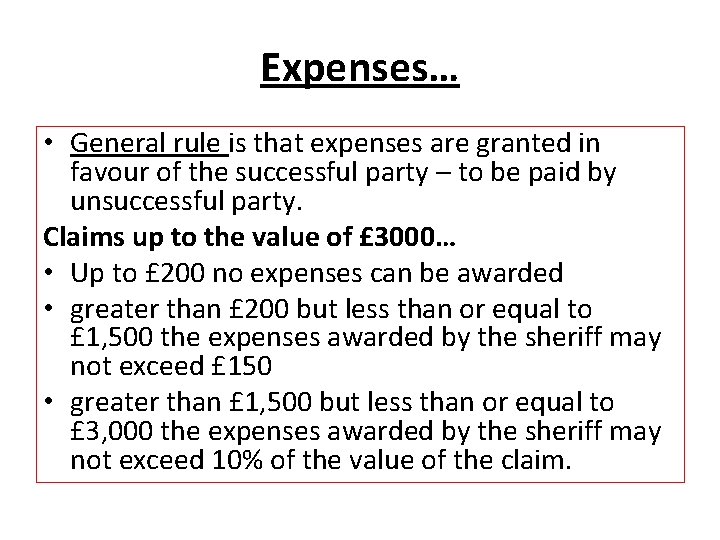
Expenses… • General rule is that expenses are granted in favour of the successful party – to be paid by unsuccessful party. Claims up to the value of £ 3000… • Up to £ 200 no expenses can be awarded • greater than £ 200 but less than or equal to £ 1, 500 the expenses awarded by the sheriff may not exceed £ 150 • greater than £ 1, 500 but less than or equal to £ 3, 000 the expenses awarded by the sheriff may not exceed 10% of the value of the claim.
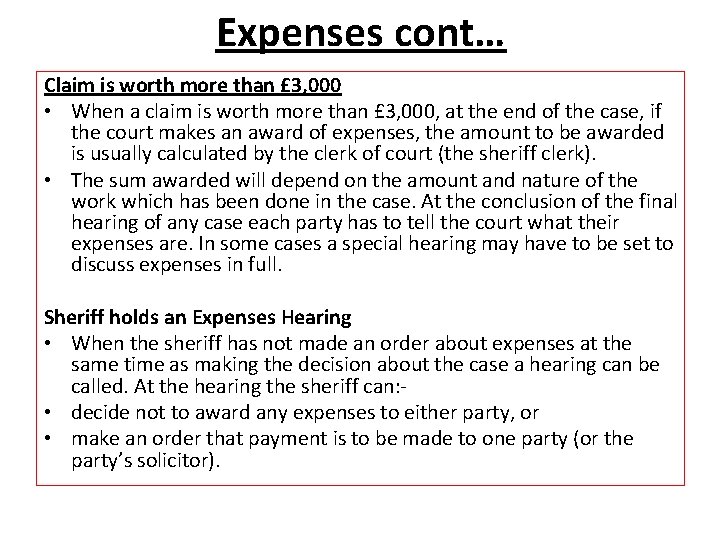
Expenses cont… Claim is worth more than £ 3, 000 • When a claim is worth more than £ 3, 000, at the end of the case, if the court makes an award of expenses, the amount to be awarded is usually calculated by the clerk of court (the sheriff clerk). • The sum awarded will depend on the amount and nature of the work which has been done in the case. At the conclusion of the final hearing of any case each party has to tell the court what their expenses are. In some cases a special hearing may have to be set to discuss expenses in full. Sheriff holds an Expenses Hearing • When the sheriff has not made an order about expenses at the same time as making the decision about the case a hearing can be called. At the hearing the sheriff can: • decide not to award any expenses to either party, or • make an order that payment is to be made to one party (or the party’s solicitor).
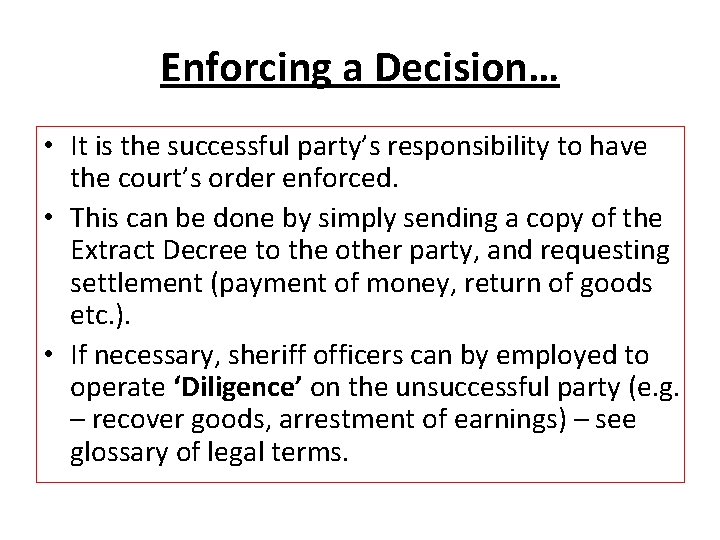
Enforcing a Decision… • It is the successful party’s responsibility to have the court’s order enforced. • This can be done by simply sending a copy of the Extract Decree to the other party, and requesting settlement (payment of money, return of goods etc. ). • If necessary, sheriff officers can by employed to operate ‘Diligence’ on the unsuccessful party (e. g. – recover goods, arrestment of earnings) – see glossary of legal terms.