
Simple Present Verb TO BE Past Participle of
Simple Present
�Verb TO BE �Past Participle of the main verb
Subject + verb to be (am/is/are) + past participle Example: Games are designed. A picture is drawn. A computer is sold.
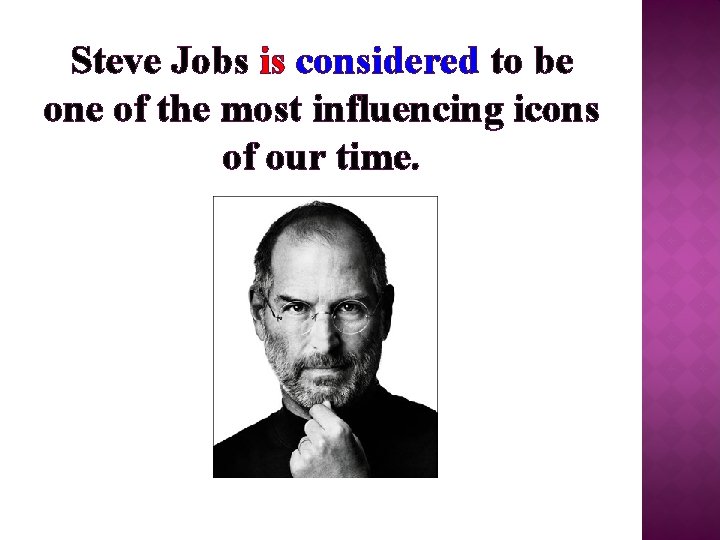
Steve Jobs is considered to be one of the most influencing icons of our time.

IPADS ARE SOLD TODAY ALMOST EVERYWHERE.
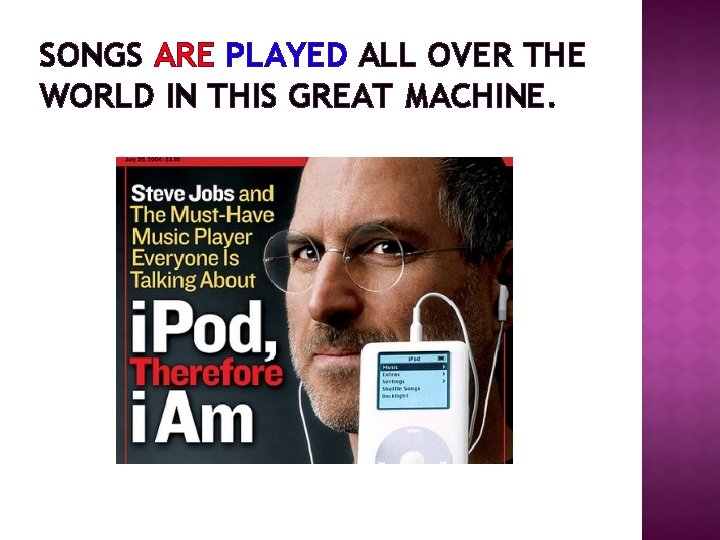
SONGS ARE PLAYED ALL OVER THE WORLD IN THIS GREAT MACHINE.
Subject + verb to be (was/ were) + past participle Example: The picture was painted. A photo was taken. Computers were sold.
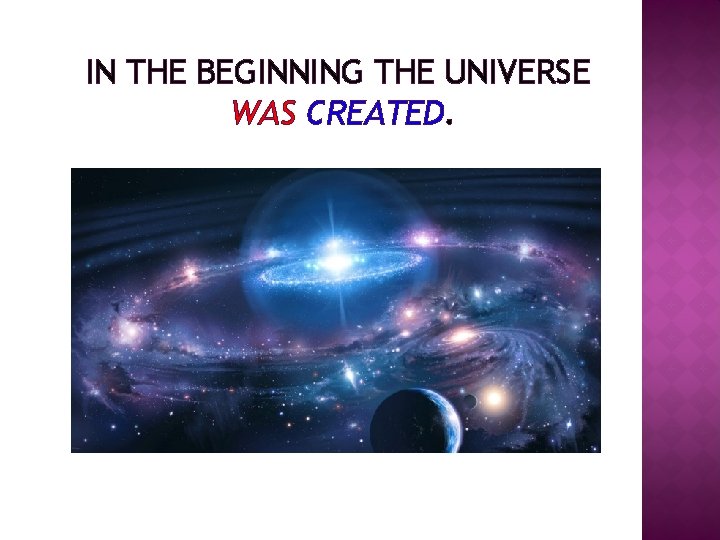
IN THE BEGINNING THE UNIVERSE WAS CREATED.
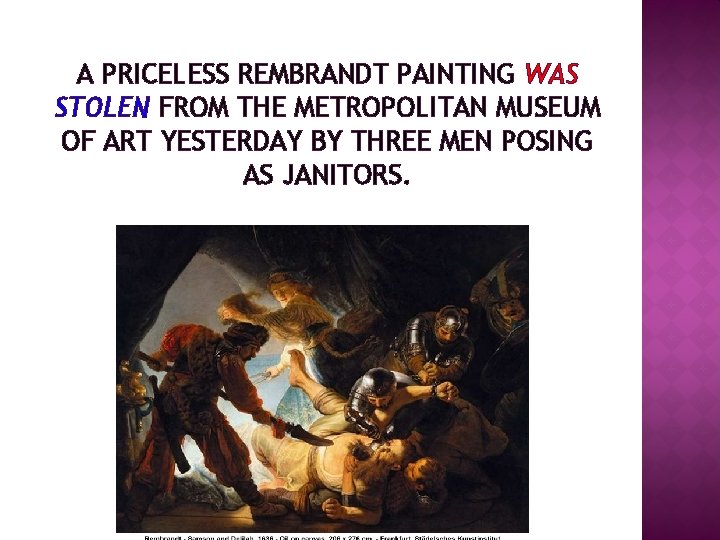
A PRICELESS REMBRANDT PAINTING WAS STOLEN FROM THE METROPOLITAN MUSEUM OF ART YESTERDAY BY THREE MEN POSING AS JANITORS.

THE CARGO WAS DAMAGED DURING THE TRANS-ATLANTIC FLIGHT.
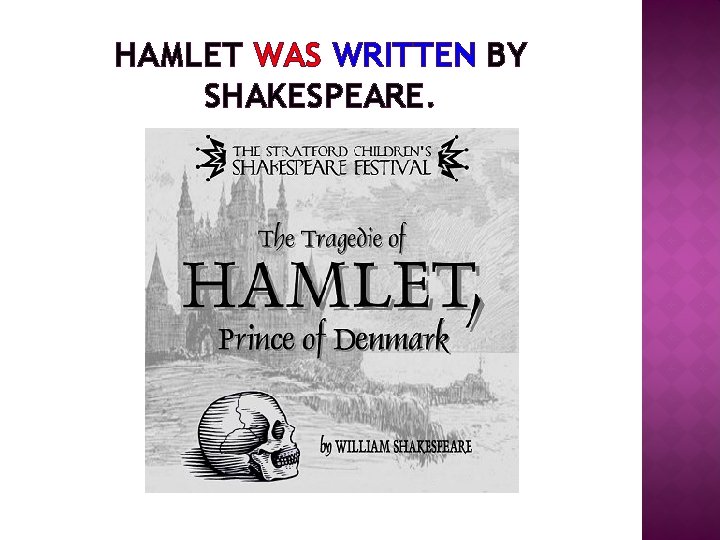
HAMLET WAS WRITTEN BY SHAKESPEARE.
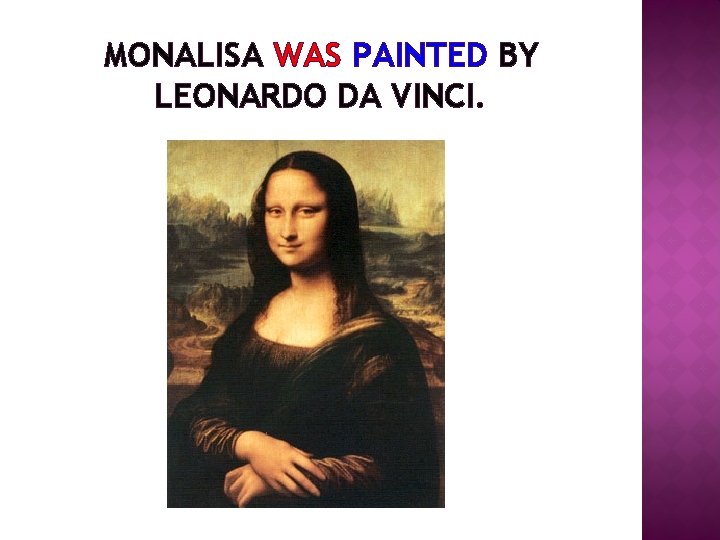
MONALISA WAS PAINTED BY LEONARDO DA VINCI.
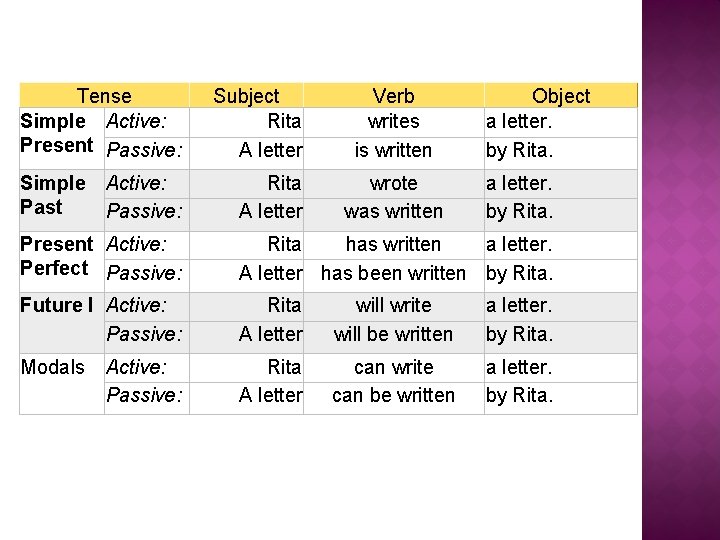
Tense Simple Active: Present Passive: Subject Rita A letter Simple Active: Past Passive: Rita A letter Present Active: Perfect Passive: Rita has written a letter. A letter has been written by Rita. Future I Active: Passive: Rita A letter will write will be written a letter. by Rita. Modals Rita A letter can write can be written a letter. by Rita. Active: Passive: Verb writes is written wrote was written Object a letter. by Rita.
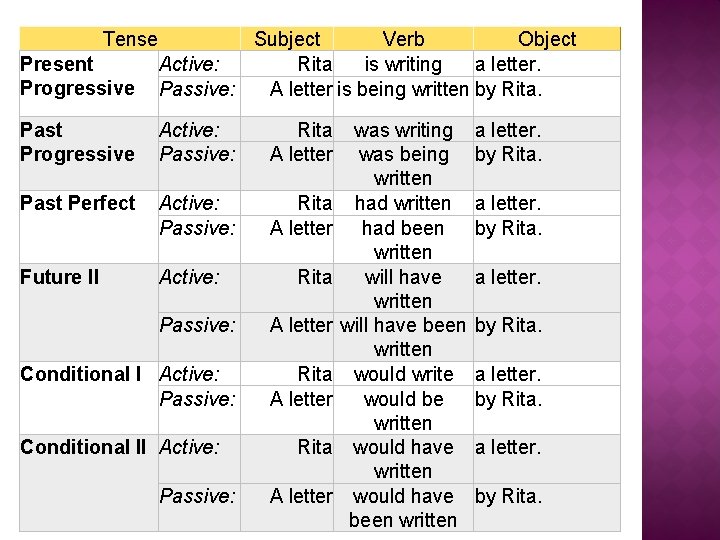
Tense Present Progressive Subject Verb Object Active: Rita is writing a letter. Passive: A letter is being written by Rita. Past Progressive Active: Passive: Rita A letter Past Perfect Active: Passive: Rita A letter Future II Active: Rita Passive: A letter Conditional I Active: Passive: Rita A letter Conditional II Active: Passive: Rita A letter was writing was being written had been written will have been written would write would be written would have been written a letter. by Rita.
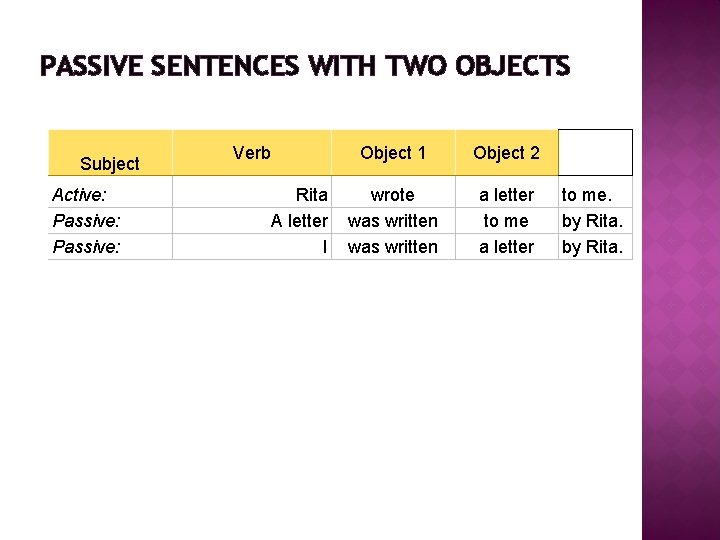
PASSIVE SENTENCES WITH TWO OBJECTS Subject Active: Passive: Verb Rita A letter I Object 1 Object 2 wrote was written a letter to me. by Rita.
� Personal Passive simply means that the object of the active sentence becomes the subject of the passive sentence. So every verb that needs an object (transitive verb) can form a personal passive. � Example: They build houses. – Houses are built.
� Verbs without an object (intransitive verb) normally cannot form a personal passive sentence (as there is no object that can become the subject of the passive sentence). If you want to use an intransitive verb in passive voice, you need an impersonal construction – therefore this passive is called Impersonal Passive. � Example: he says – it is said
� Impersonal Passive is not as common in English as in some other languages (e. g. German, Latin). In English, Impersonal Passive is only possible with verbs of perception (e. g. say, think, know). � Example: They say that women live longer than men. – It is said that women live longer than men.
� Although Impersonal Passive is possible here, Personal Passive is more common. � Example: They say that women live longer than men. – Women are said to live longer than men.
Complete the sentences (Active or Passive Voice). Use Simple Present. He (sell) _____ cars. � The blue car (sell) _____. � In summer, more ice-cream (eat) ____ than in winter. � She (call) ______ her grandparents every Friday. � The letters (type)____. � He (take) _______ his medicine every day. � Jane (take / not) _____ to school by her father. � We (go) ______ to school by bus. � She (work / not) ______ for a bank. � Milk (keep) ______ in the refrigerator. �
Complete the sentences (Active or Passive Voice). Use Simple Past. � They (visit) _______ their granny. � We (visit) _____ by our teacher. � My friend Paul (bear) _____ in Dallas. � She (go) ______ to school in Boston. � Antony (grow up) _____ in the country. � The new shopping centre (build) _____ last year. � The film (produce / not) ________ in Hollywood. � Barbara (know) ______ James very well. � The jewels (hide / not) ______ in the cellar. � We (spend / not) ______ all day on the beach.
� Summaries are usually written in present tense. Simple present is the most important tense in summaries. But other tenses are important, too. Decide whether to use simple present, simple past, present perfect, conjunctive or passive voice. Use the long forms. The Fellowship of the Ring (be) _____ the first book of J. R. R. Tolkien's The Lord of the Rings trilogy, which (set) _____ in a fictive world, Middle Earth. It(tell) _____ the story of Frodo, a hobbit, and a magic ring. As the story (begin) ______, Frodo (give) ____ a magic ring. The wizard Gandalf then (tell) _______ him of the Rings of Power and of Sauron, the Dark Lord, who (make) _____ the Master Ring to rule all other Rings. Gandalf (advise) ______ Frodo to leave home and keep the ring out of Sauron's hands who already (send) ______ his Black Riders in search for it. Frodo's ring (give) ______ Sauron the power to enslave Middle Earth.
- Slides: 22