
Simple Present Tense permanent situations She works in
- Slides: 46
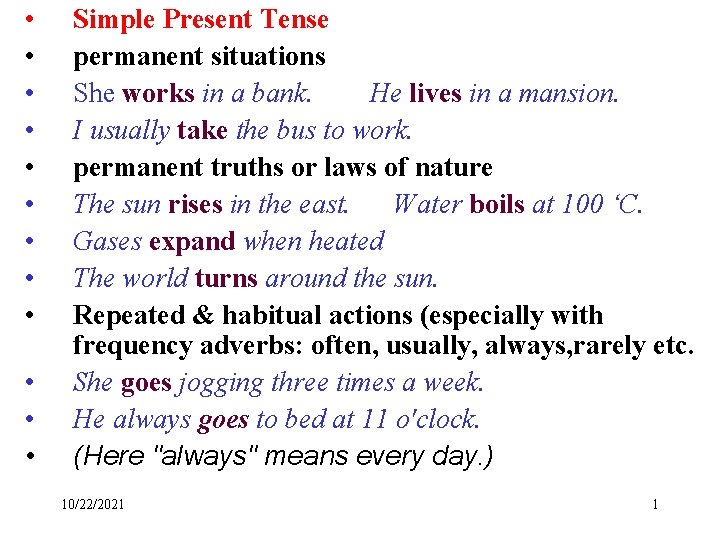
• • • Simple Present Tense permanent situations She works in a bank. He lives in a mansion. I usually take the bus to work. permanent truths or laws of nature The sun rises in the east. Water boils at 100 ‘C. Gases expand when heated The world turns around the sun. Repeated & habitual actions (especially with frequency adverbs: often, usually, always, rarely etc. She goes jogging three times a week. He always goes to bed at 11 o'clock. (Here "always" means every day. ) 10/22/2021 1
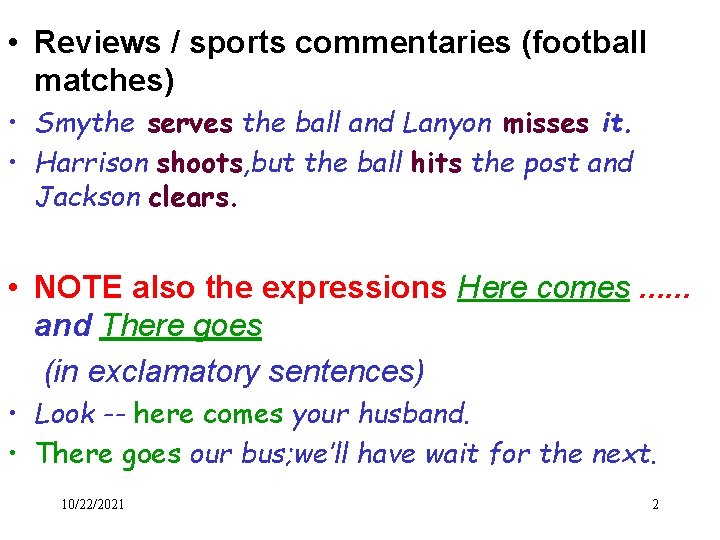
• Reviews / sports commentaries (football matches) • Smythe serves the ball and Lanyon misses it. • Harrison shoots, but the ball hits the post and Jackson clears. • NOTE also the expressions Here comes. . . and There goes (in exclamatory sentences) • Look -- here comes your husband. • There goes our bus; we’ll have wait for the next. 10/22/2021 2
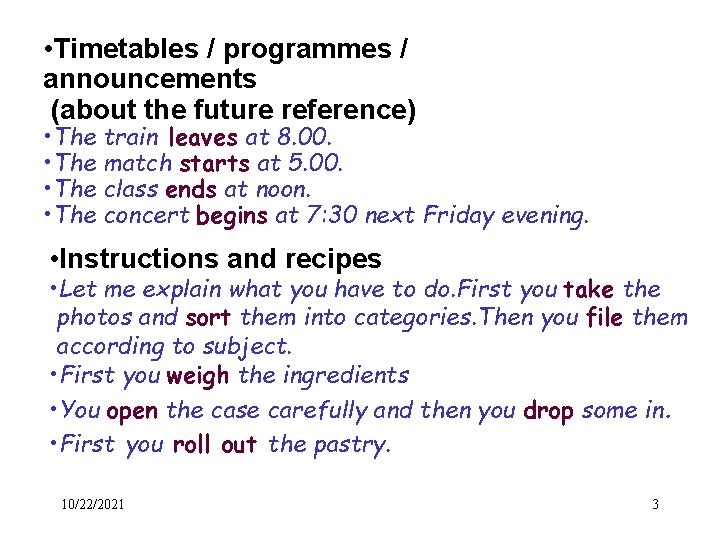
• Timetables / programmes / announcements (about the future reference) • The train leaves at 8. 00. • The match starts at 5. 00. • The class ends at noon. • The concert begins at 7: 30 next Friday evening. • Instructions and recipes • Let me explain what you have to do. First you take the photos and sort them into categories. Then you file them according to subject. • First you weigh the ingredients • You open the case carefully and then you drop some in. • First you roll out the pastry. 10/22/2021 3
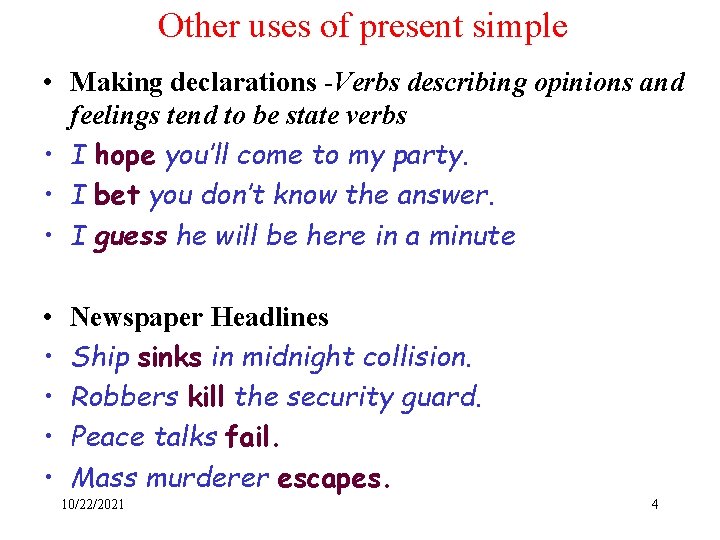
Other uses of present simple • Making declarations -Verbs describing opinions and feelings tend to be state verbs • I hope you’ll come to my party. • I bet you don’t know the answer. • I guess he will be here in a minute • • • Newspaper Headlines Ship sinks in midnight collision. Robbers kill the security guard. Peace talks fail. Mass murderer escapes. 10/22/2021 4
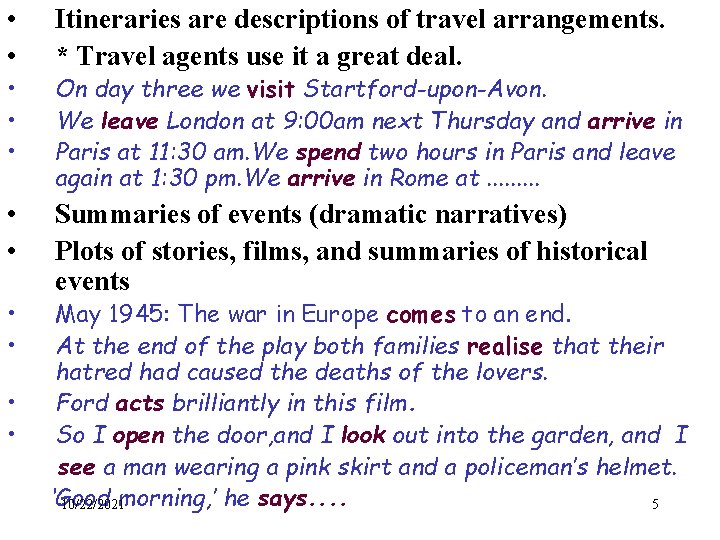
• • Itineraries are descriptions of travel arrangements. * Travel agents use it a great deal. • • Summaries of events (dramatic narratives) Plots of stories, films, and summaries of historical events • • On day three we visit Startford-upon-Avon. We leave London at 9: 00 am next Thursday and arrive in Paris at 11: 30 am. We spend two hours in Paris and leave again at 1: 30 pm. We arrive in Rome at. . May 1945: The war in Europe comes to an end. At the end of the play both families realise that their hatred had caused the deaths of the lovers. Ford acts brilliantly in this film. So I open the door, and I look out into the garden, and I see a man wearing a pink skirt and a policeman’s helmet. ‘Good morning, ’ he says. . 10/22/2021 5
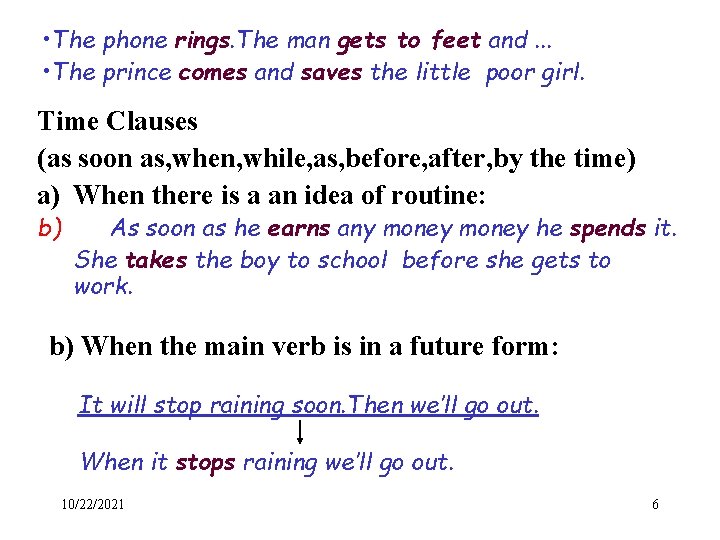
• The phone rings. The man gets to feet and. . . • The prince comes and saves the little poor girl. Time Clauses (as soon as, when, while, as, before, after, by the time) a) When there is a an idea of routine: b) As soon as he earns any money he spends it. She takes the boy to school before she gets to work. b) When the main verb is in a future form: It will stop raining soon. Then we’ll go out. When it stops raining we’ll go out. 10/22/2021 6
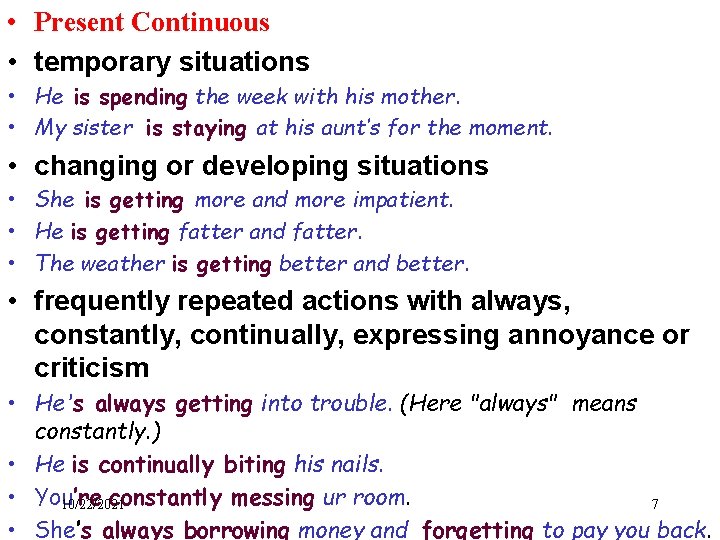
• Present Continuous • temporary situations • He is spending the week with his mother. • My sister is staying at his aunt’s for the moment. • changing or developing situations • She is getting more and more impatient. • He is getting fatter and fatter. • The weather is getting better and better. • frequently repeated actions with always, constantly, continually, expressing annoyance or criticism • He's always getting into trouble. (Here "always" means constantly. ) • He is continually biting his nails. • You’re constantly messing ur room. 10/22/2021 7 • She’s always borrowing money and forgetting to pay you back.
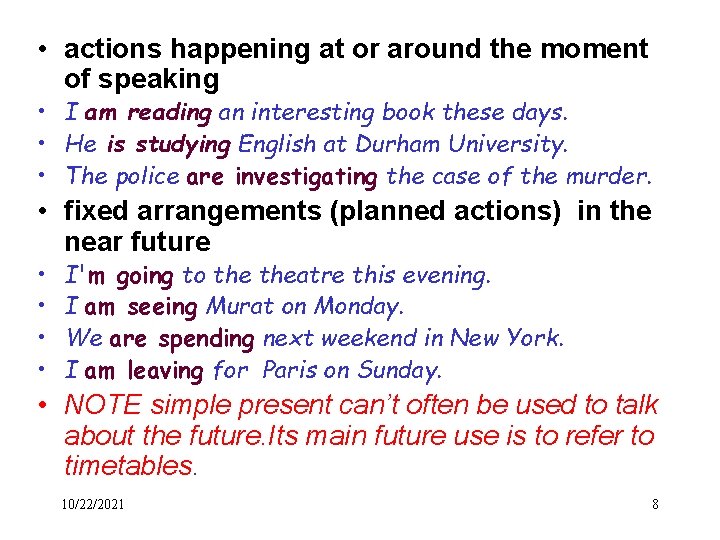
• actions happening at or around the moment of speaking • I am reading an interesting book these days. • He is studying English at Durham University. • The police are investigating the case of the murder. • fixed arrangements (planned actions) in the near future • • I'm going to theatre this evening. I am seeing Murat on Monday. We are spending next weekend in New York. I am leaving for Paris on Sunday. • NOTE simple present can’t often be used to talk about the future. Its main future use is to refer to timetables. 10/22/2021 8
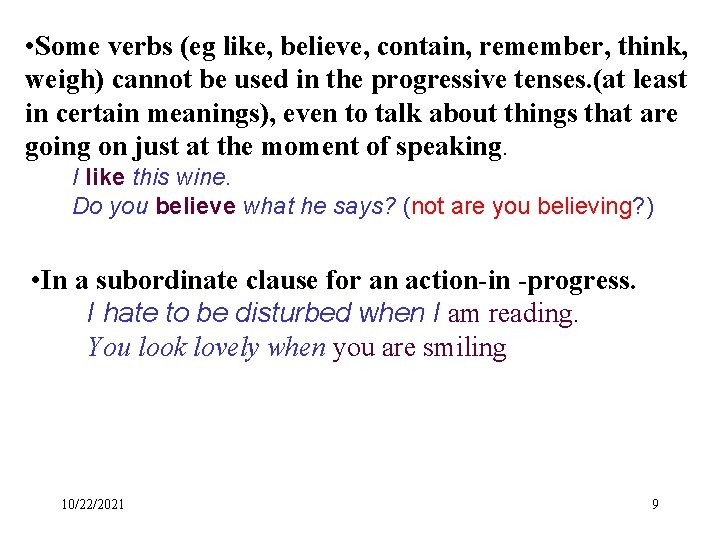
• Some verbs (eg like, believe, contain, remember, think, weigh) cannot be used in the progressive tenses. (at least in certain meanings), even to talk about things that are going on just at the moment of speaking. I like this wine. Do you believe what he says? (not are you believing? ) • In a subordinate clause for an action-in -progress. I hate to be disturbed when I am reading. You look lovely when you are smiling 10/22/2021 9
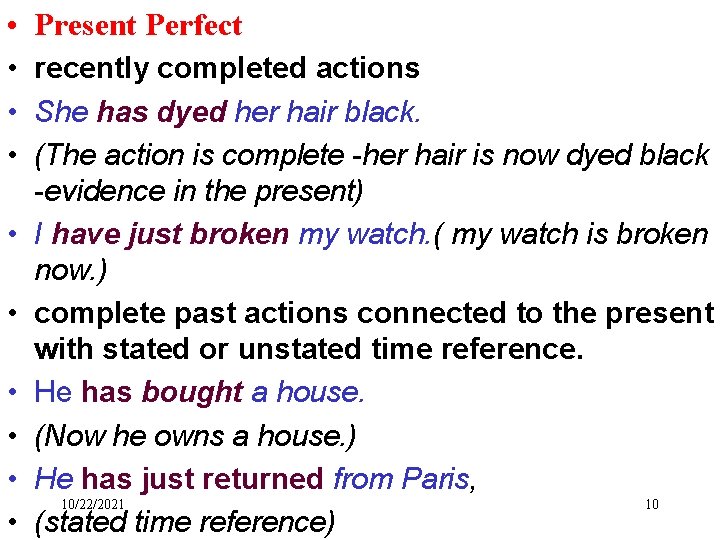
• Present Perfect • recently completed actions • She has dyed her hair black. • (The action is complete -her hair is now dyed black -evidence in the present) • I have just broken my watch. ( my watch is broken now. ) • complete past actions connected to the present with stated or unstated time reference. • He has bought a house. • (Now he owns a house. ) • He has just returned from Paris, 10/22/2021 10 • (stated time reference)
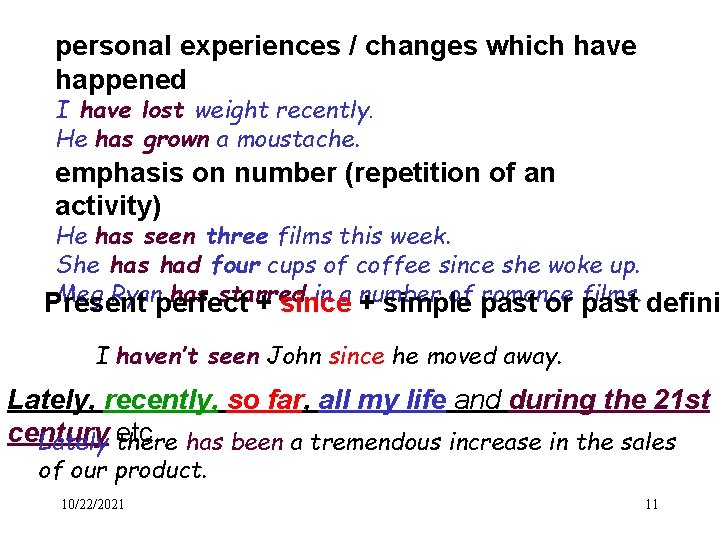
personal experiences / changes which have happened I have lost weight recently. He has grown a moustache. emphasis on number (repetition of an activity) He has seen three films this week. She has had four cups of coffee since she woke up. Meg Ryanperfect has starred in a number of past romance Present + since + simple or films. past defini I haven’t seen John since he moved away. Lately, recently, so far, all my life and during the 21 st century etc. . has been a tremendous increase in the sales Lately there of our product. 10/22/2021 11
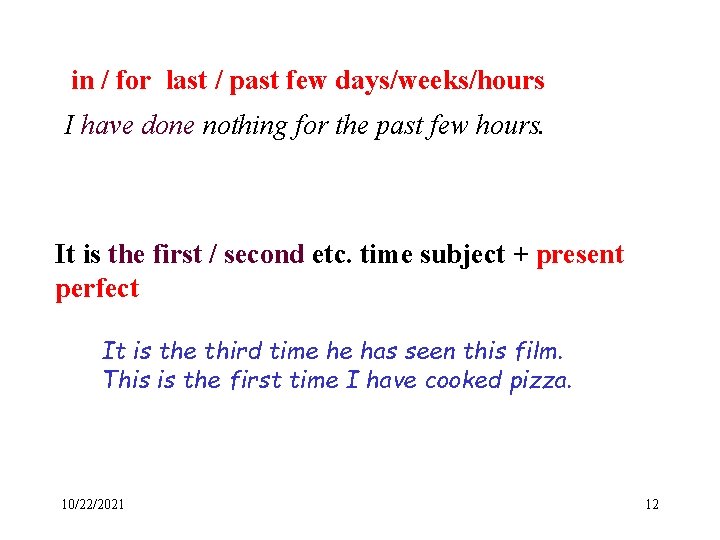
in / for last / past few days/weeks/hours I have done nothing for the past few hours. It is the first / second etc. time subject + present perfect It is the third time he has seen this film. This is the first time I have cooked pizza. 10/22/2021 12
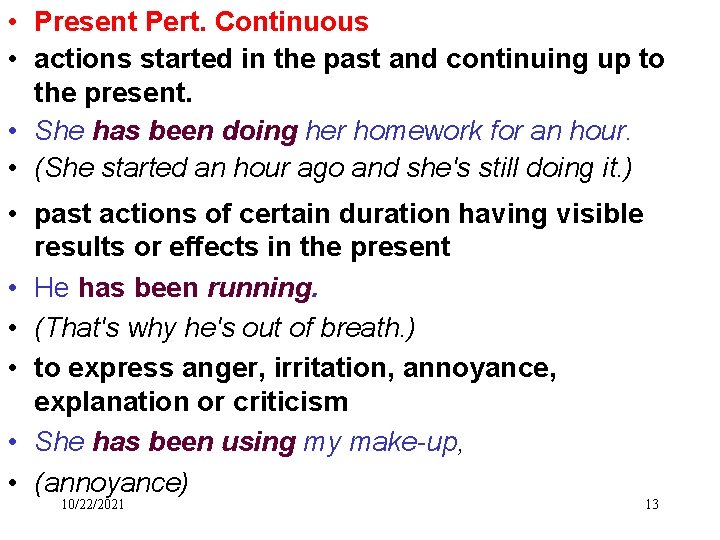
• Present Pert. Continuous • actions started in the past and continuing up to the present. • She has been doing her homework for an hour. • (She started an hour ago and she's still doing it. ) • past actions of certain duration having visible results or effects in the present • He has been running. • (That's why he's out of breath. ) • to express anger, irritation, annoyance, explanation or criticism • She has been using my make-up, • (annoyance) 10/22/2021 13
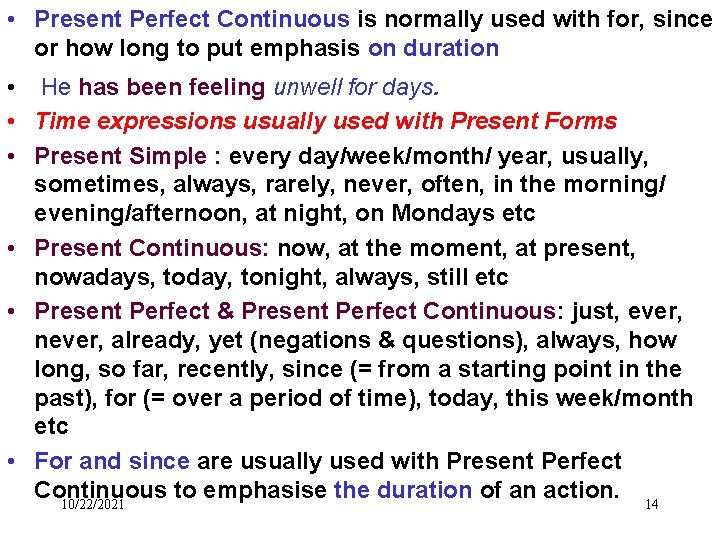
• Present Perfect Continuous is normally used with for, since or how long to put emphasis on duration • He has been feeling unwell for days. • Time expressions usually used with Present Forms • Present Simple : every day/week/month/ year, usually, sometimes, always, rarely, never, often, in the morning/ evening/afternoon, at night, on Mondays etc • Present Continuous: now, at the moment, at present, nowadays, today, tonight, always, still etc • Present Perfect & Present Perfect Continuous: just, ever, never, already, yet (negations & questions), always, how long, so far, recently, since (= from a starting point in the past), for (= over a period of time), today, this week/month etc • For and since are usually used with Present Perfect Continuous to emphasise the duration of an action. 14 10/22/2021
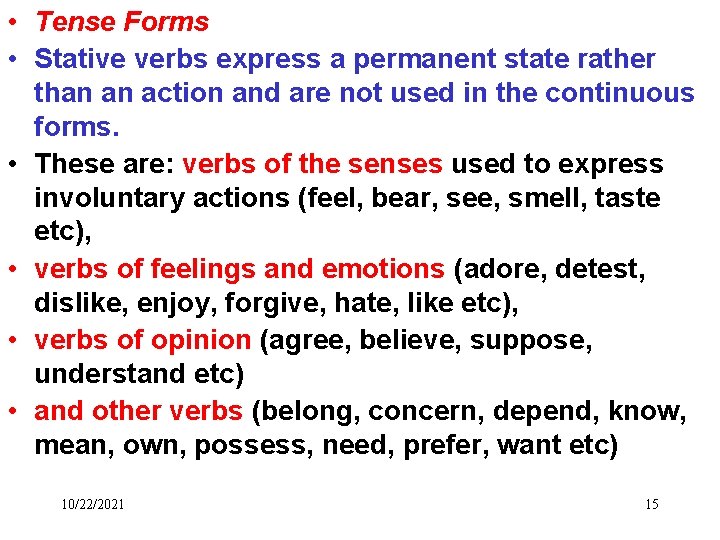
• Tense Forms • Stative verbs express a permanent state rather than an action and are not used in the continuous forms. • These are: verbs of the senses used to express involuntary actions (feel, bear, see, smell, taste etc), • verbs of feelings and emotions (adore, detest, dislike, enjoy, forgive, hate, like etc), • verbs of opinion (agree, believe, suppose, understand etc) • and other verbs (belong, concern, depend, know, mean, own, possess, need, prefer, want etc) 10/22/2021 15
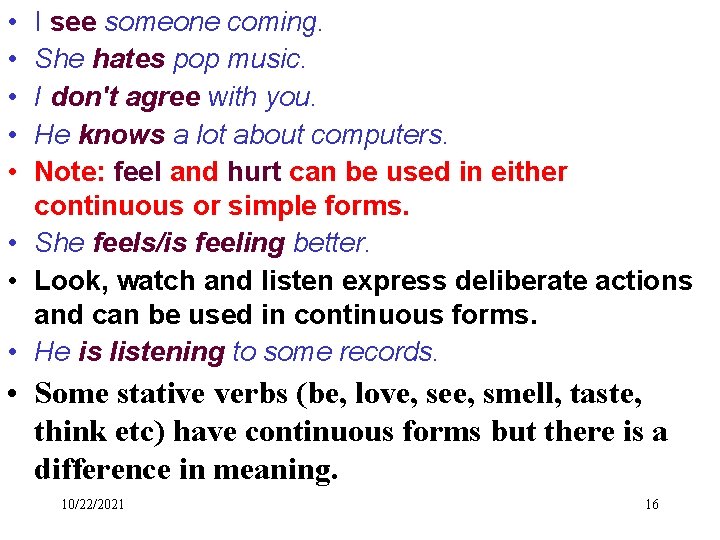
• • • I see someone coming. She hates pop music. I don't agree with you. He knows a lot about computers. Note: feel and hurt can be used in either continuous or simple forms. • She feels/is feeling better. • Look, watch and listen express deliberate actions and can be used in continuous forms. • He is listening to some records. • Some stative verbs (be, love, see, smell, taste, think etc) have continuous forms but there is a difference in meaning. 10/22/2021 16
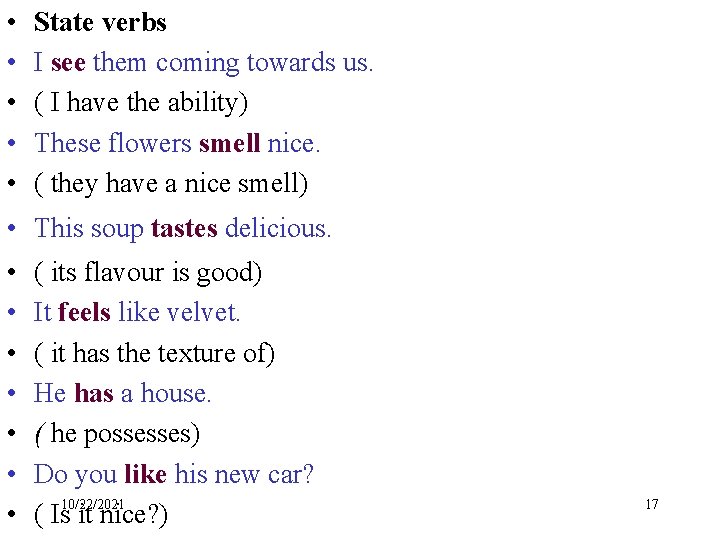
• • • State verbs I see them coming towards us. ( I have the ability) These flowers smell nice. ( they have a nice smell) • This soup tastes delicious. • • ( its flavour is good) It feels like velvet. ( it has the texture of) He has a house. ( he possesses) Do you like his new car? ( Is 10/22/2021 it nice? ) 17
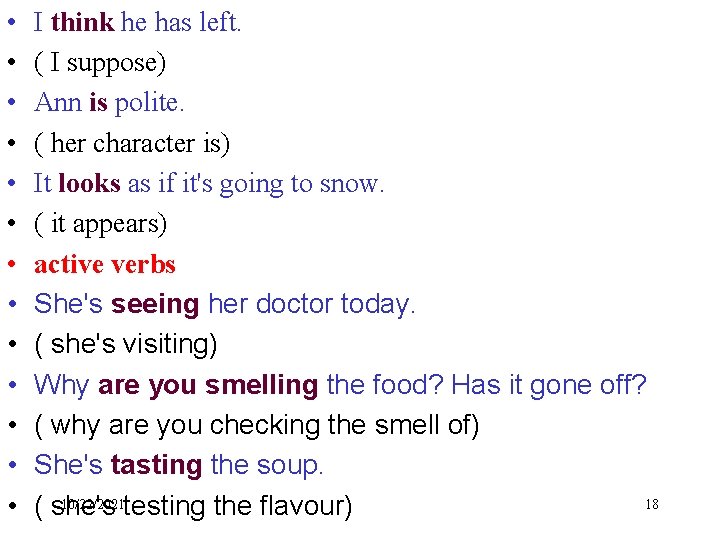
• • • • I think he has left. ( I suppose) Ann is polite. ( her character is) It looks as if it's going to snow. ( it appears) active verbs She's seeing her doctor today. ( she's visiting) Why are you smelling the food? Has it gone off? ( why are you checking the smell of) She's tasting the soup. 10/22/2021 testing the flavour) 18 ( she's
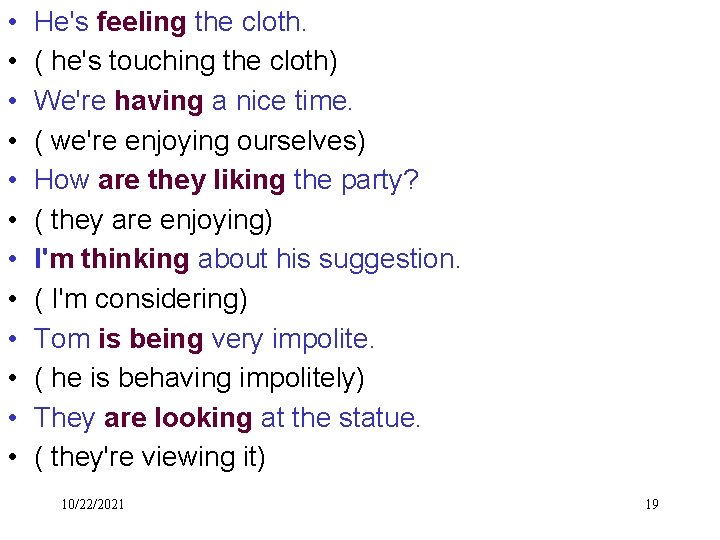
• • • He's feeling the cloth. ( he's touching the cloth) We're having a nice time. ( we're enjoying ourselves) How are they liking the party? ( they are enjoying) I'm thinking about his suggestion. ( I'm considering) Tom is being very impolite. ( he is behaving impolitely) They are looking at the statue. ( they're viewing it) 10/22/2021 19
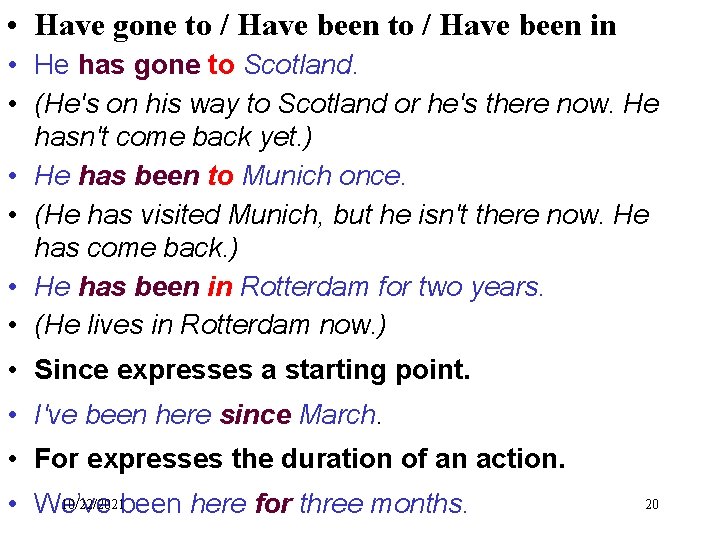
• Have gone to / Have been in • He has gone to Scotland. • (He's on his way to Scotland or he's there now. He hasn't come back yet. ) • He has been to Munich once. • (He has visited Munich, but he isn't there now. He has come back. ) • He has been in Rotterdam for two years. • (He lives in Rotterdam now. ) • Since expresses a starting point. • I've been here since March. • For expresses the duration of an action. 10/22/2021 been here for three months. • We’ve 20
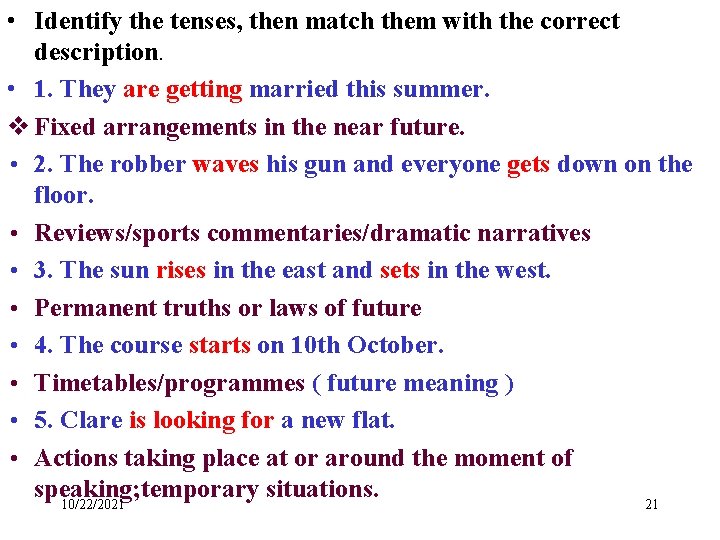
• Identify the tenses, then match them with the correct description. • 1. They are getting married this summer. v Fixed arrangements in the near future. • 2. The robber waves his gun and everyone gets down on the floor. • Reviews/sports commentaries/dramatic narratives • 3. The sun rises in the east and sets in the west. • Permanent truths or laws of future • 4. The course starts on 10 th October. • Timetables/programmes ( future meaning ) • 5. Clare is looking for a new flat. • Actions taking place at or around the moment of speaking; temporary situations. 10/22/2021 21
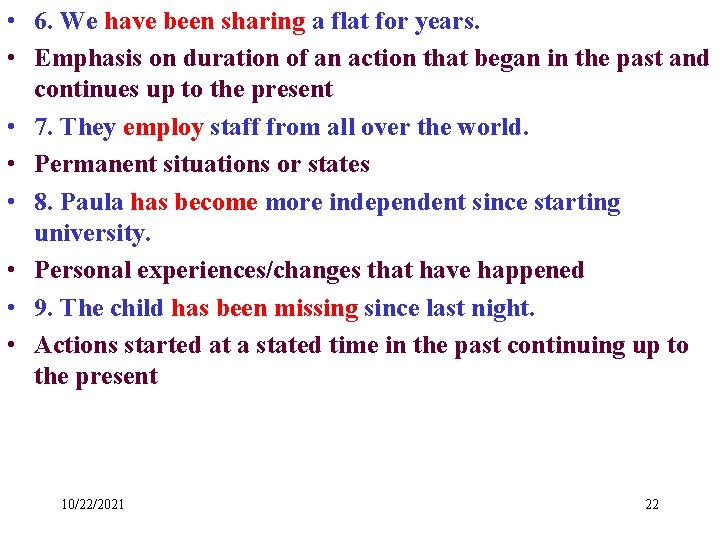
• 6. We have been sharing a flat for years. • Emphasis on duration of an action that began in the past and continues up to the present • 7. They employ staff from all over the world. • Permanent situations or states • 8. Paula has become more independent since starting university. • Personal experiences/changes that have happened • 9. The child has been missing since last night. • Actions started at a stated time in the past continuing up to the present 10/22/2021 22
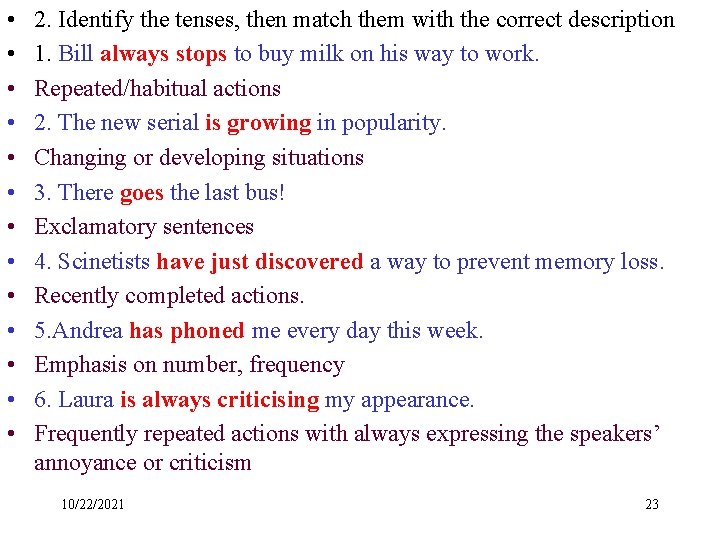
• • • • 2. Identify the tenses, then match them with the correct description 1. Bill always stops to buy milk on his way to work. Repeated/habitual actions 2. The new serial is growing in popularity. Changing or developing situations 3. There goes the last bus! Exclamatory sentences 4. Scinetists have just discovered a way to prevent memory loss. Recently completed actions. 5. Andrea has phoned me every day this week. Emphasis on number, frequency 6. Laura is always criticising my appearance. Frequently repeated actions with always expressing the speakers’ annoyance or criticism 10/22/2021 23
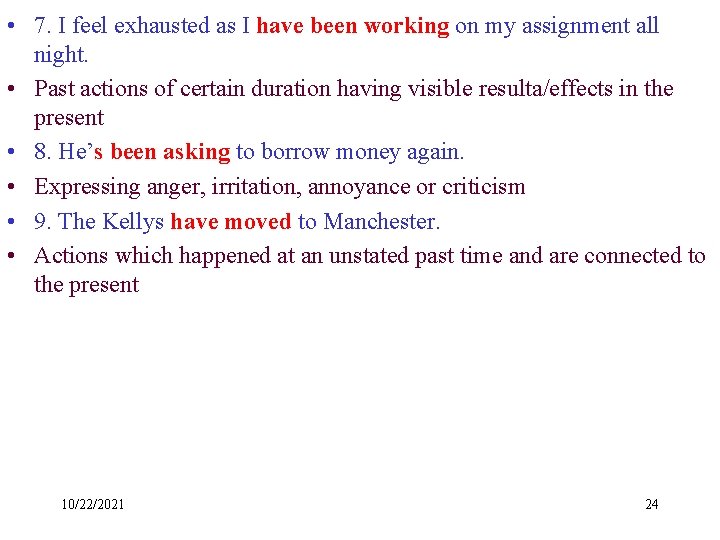
• 7. I feel exhausted as I have been working on my assignment all night. • Past actions of certain duration having visible resulta/effects in the present • 8. He’s been asking to borrow money again. • Expressing anger, irritation, annoyance or criticism • 9. The Kellys have moved to Manchester. • Actions which happened at an unstated past time and are connected to the present 10/22/2021 24
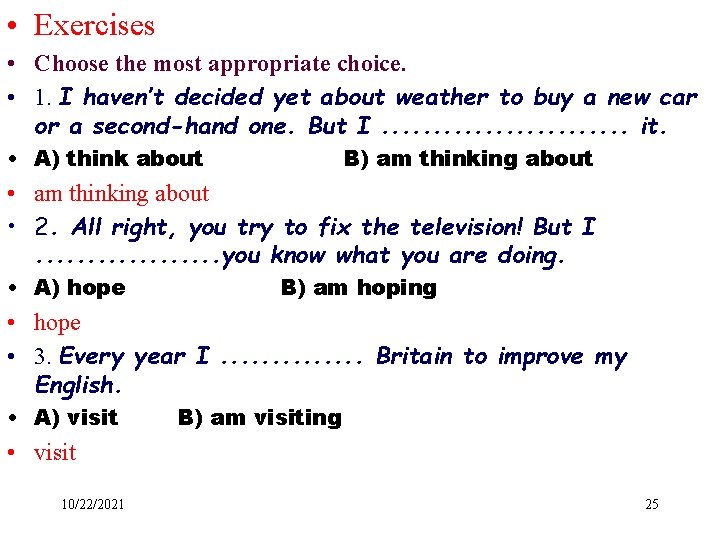
• Exercises • Choose the most appropriate choice. • 1. I haven’t decided yet about weather to buy a new car or a second-hand one. But I. . . it. • A) think about B) am thinking about • am thinking about • 2. All right, you try to fix the television! But I. . . . you know what you are doing. • A) hope B) am hoping • hope • 3. Every year I. . . Britain to improve my English. • A) visit B) am visiting • visit 10/22/2021 25
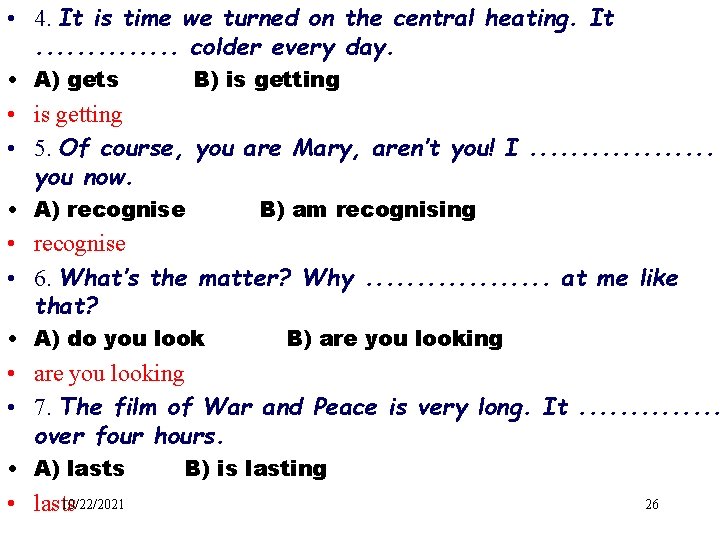
• 4. It is time we turned on the central heating. It. . . colder every day. • A) gets B) is getting • is getting • 5. Of course, you are Mary, aren’t you! I. . . . you now. • A) recognise B) am recognising • recognise • 6. What’s the matter? Why. . . . at me like that? • A) do you look B) are you looking • are you looking • 7. The film of War and Peace is very long. It. . . over four hours. • A) lasts 10/22/2021 • lasts B) is lasting 26
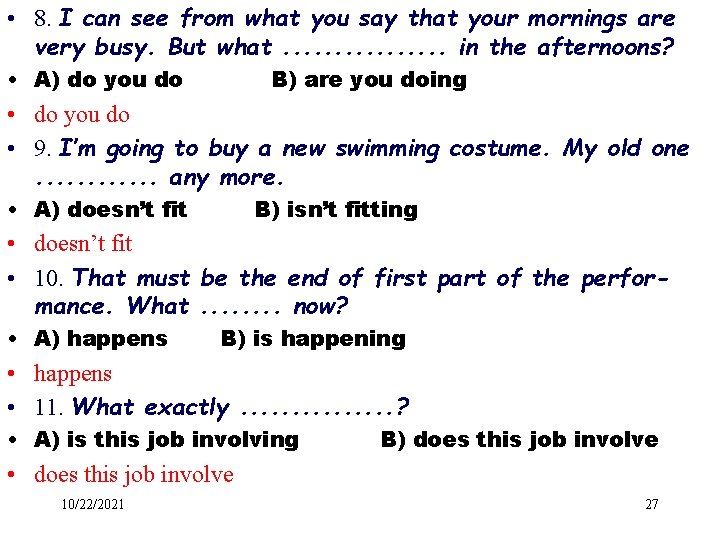
• 8. I can see from what you say that your mornings are very busy. But what. . . . in the afternoons? • A) do you do B) are you doing • do you do • 9. I’m going to buy a new swimming costume. My old one. . . any more. • A) doesn’t fit B) isn’t fitting • doesn’t fit • 10. That must be the end of first part of the performance. What. . . . now? • A) happens B) is happening • happens • 11. What exactly. . . . ? • A) is this job involving B) does this job involve • does this job involve 10/22/2021 27
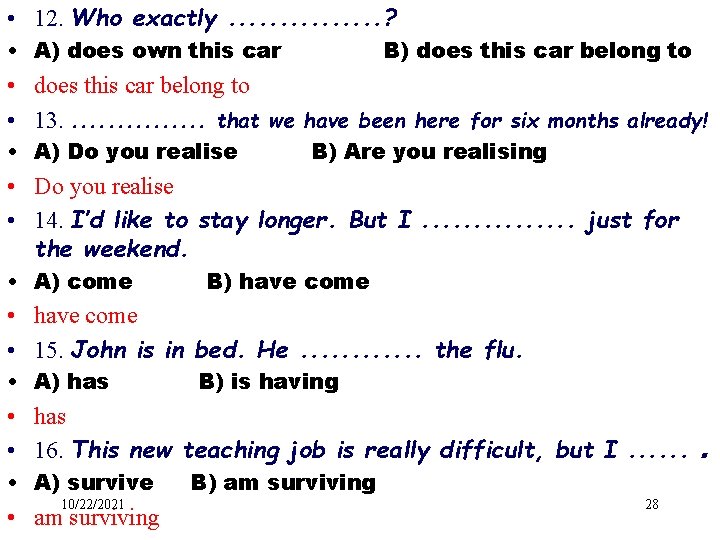
• 12. Who exactly. . . . ? • A) does own this car B) does this car belong to • does this car belong to • 13. . . . that we have been here for six months already! • A) Do you realise B) Are you realising • Do you realise • 14. I’d like to stay longer. But I. . . . just for the weekend. • A) come B) have come • have come • 15. John is in bed. He. . . the flu. • A) has B) is having • has • 16. This new teaching job is really difficult, but I. . . . • A) survive 10/22/2021 • am surviving B) am surviving 28
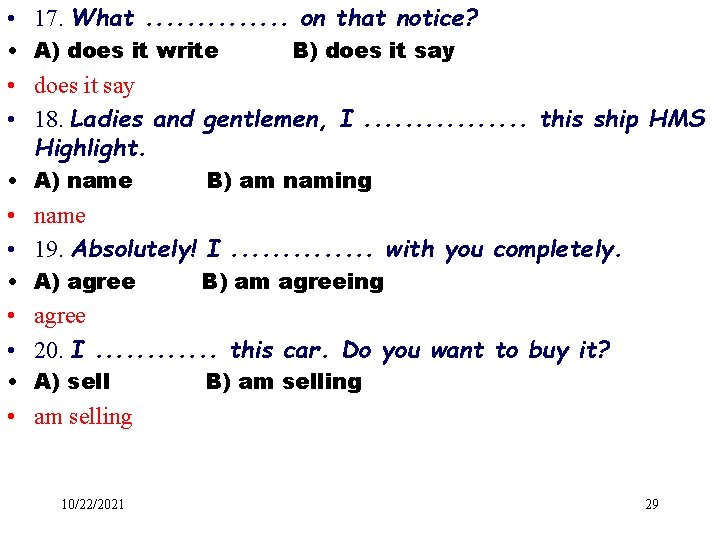
• 17. What. . . on that notice? • A) does it write B) does it say • does it say • 18. Ladies and gentlemen, I. . . . this ship HMS Highlight. • A) name B) am naming • name • 19. Absolutely! I. . . with you completely. • A) agree B) am agreeing • agree • 20. I. . . this car. Do you want to buy it? • A) sell B) am selling • am selling 10/22/2021 29
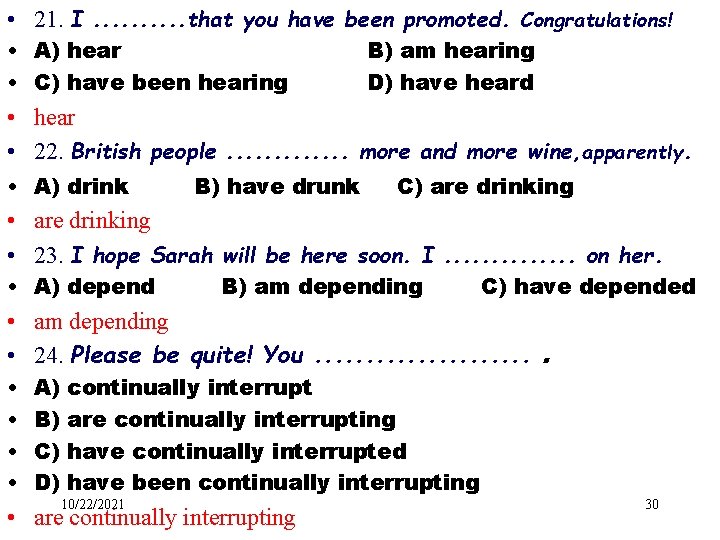
• 21. I. . that you have been promoted. Congratulations! • A) hear • C) have been hearing B) am hearing D) have heard • hear • 22. British people. . . more and more wine, apparently. • A) drink B) have drunk C) are drinking • are drinking • 23. I hope Sarah will be here soon. I. . . on her. • A) depend B) am depending C) have depended • am depending • 24. Please be quite! You. . . . . • • A) B) C) D) continually interrupt are continually interrupting have continually interrupted have been continually interrupting 10/22/2021 • are continually interrupting 30
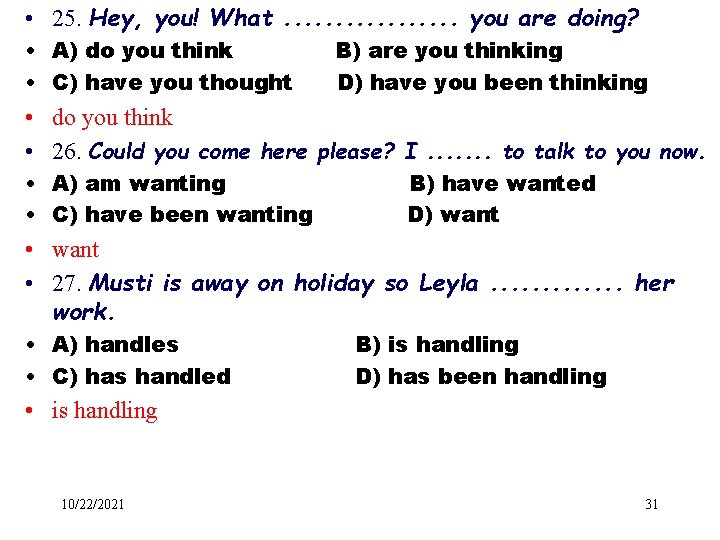
• 25. Hey, you! What. . . . you are doing? • A) do you think • C) have you thought B) are you thinking D) have you been thinking • do you think • 26. Could you come here please? I. . . . to talk to you now. • A) am wanting • C) have been wanting B) have wanted D) want • want • 27. Musti is away on holiday so Leyla. . . her work. • A) handles • C) has handled B) is handling D) has been handling • is handling 10/22/2021 31
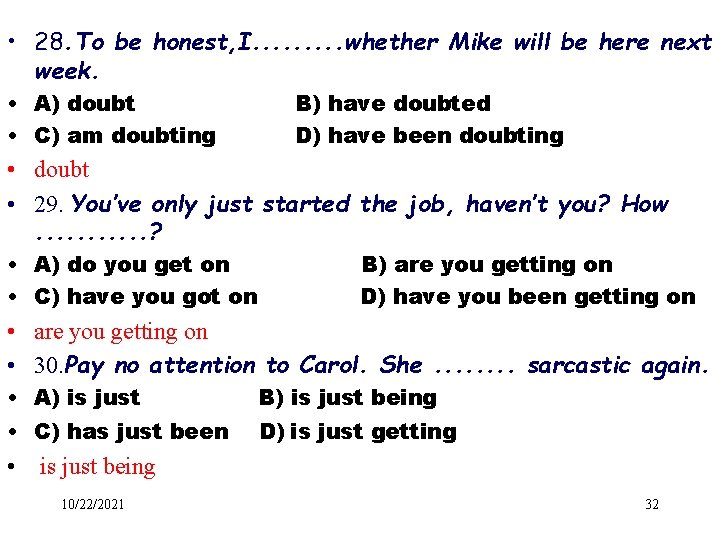
• 28. To be honest, I. . whether Mike will be here next week. • A) doubt • C) am doubting B) have doubted D) have been doubting • doubt • 29. You’ve only just started the job, haven’t you? How. . . ? • A) do you get on • C) have you got on B) are you getting on D) have you been getting on • are you getting on • 30. Pay no attention to Carol. She. . . . sarcastic again. • A) is just B) is just being • C) has just been D) is just getting • is just being 10/22/2021 32
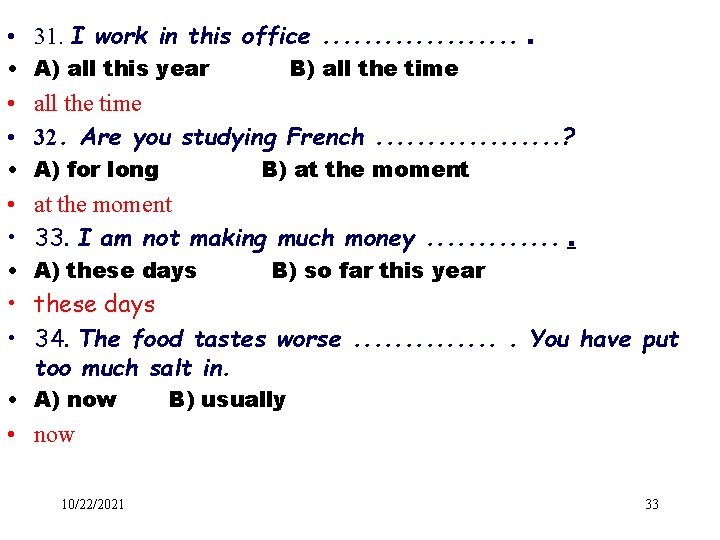
• 31. I work in this office. . . . . • A) all this year B) all the time • all the time • 32. Are you studying French. . . . ? • A) for long B) at the moment • at the moment • 33. I am not making much money. . . • A) these days B) so far this year • these days • 34. The food tastes worse. . . . You have put too much salt in. • A) now B) usually • now 10/22/2021 33
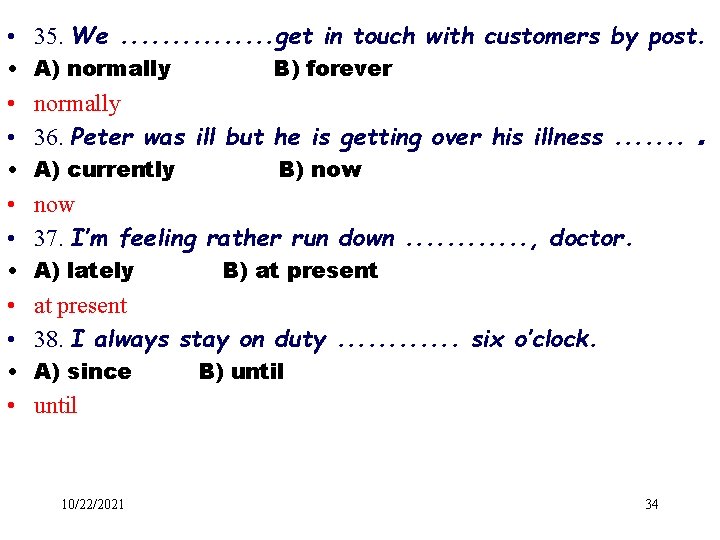
• 35. We. . . . get in touch with customers by post. • A) normally B) forever • normally • 36. Peter was ill but he is getting over his illness. . . . • A) currently B) now • now • 37. I’m feeling rather run down. . . , doctor. • A) lately B) at present • at present • 38. I always stay on duty. . . six o’clock. • A) since B) until • until 10/22/2021 34
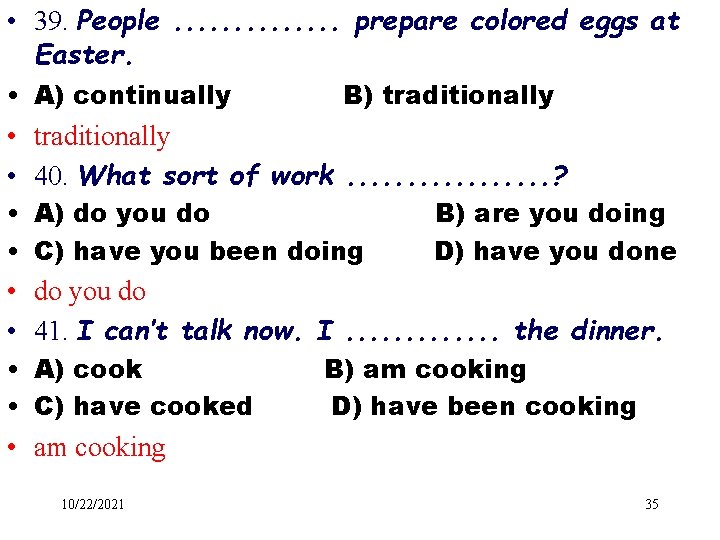
• 39. People. . . prepare colored eggs at Easter. • A) continually B) traditionally • traditionally • 40. What sort of work. . . . ? • A) do you do • C) have you been doing B) are you doing D) have you done • do you do • 41. I can’t talk now. I. . . the dinner. • A) cook • C) have cooked B) am cooking D) have been cooking • am cooking 10/22/2021 35
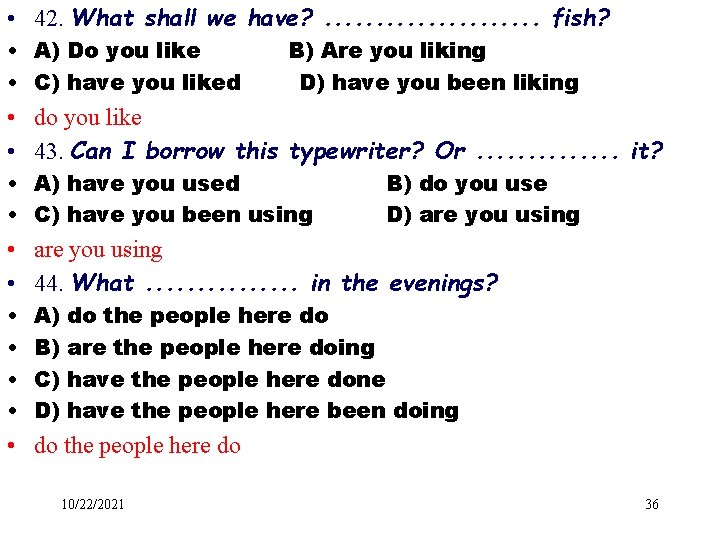
• 42. What shall we have? . . fish? • A) Do you like • C) have you liked B) Are you liking D) have you been liking • do you like • 43. Can I borrow this typewriter? Or. . . it? • A) have you used • C) have you been using B) do you use D) are you using • are you using • 44. What. . . . in the evenings? • • A) B) C) D) do the people here do are the people here doing have the people here done have the people here been doing • do the people here do 10/22/2021 36
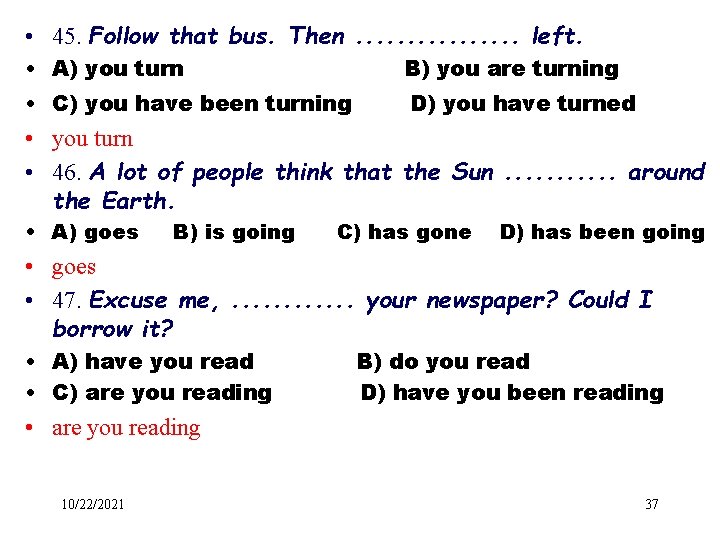
• 45. Follow that bus. Then. . . . left. • A) you turn B) you are turning • C) you have been turning D) you have turned • you turn • 46. A lot of people think that the Sun. . . around the Earth. • A) goes B) is going C) has gone D) has been going • goes • 47. Excuse me, . . . your newspaper? Could I borrow it? • A) have you read • C) are you reading B) do you read D) have you been reading • are you reading 10/22/2021 37
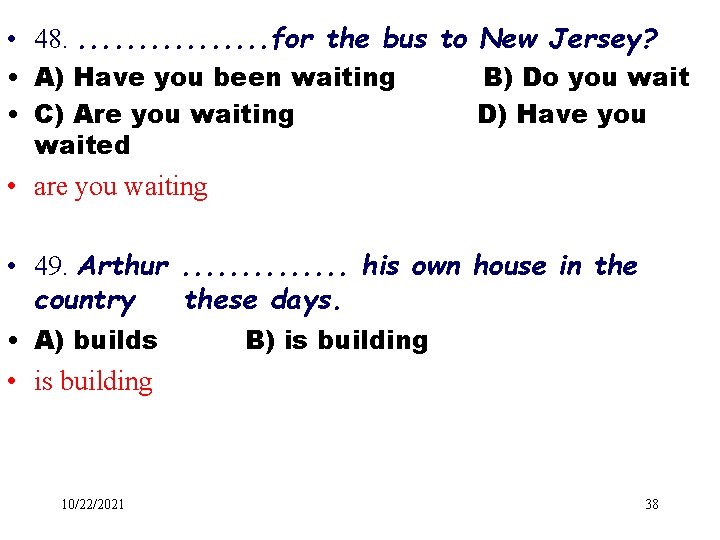
• 48. . . . for the bus to New Jersey? • A) Have you been waiting • C) Are you waiting waited B) Do you wait D) Have you • are you waiting • 49. Arthur. . . his own house in the country these days. • A) builds B) is building • is building 10/22/2021 38
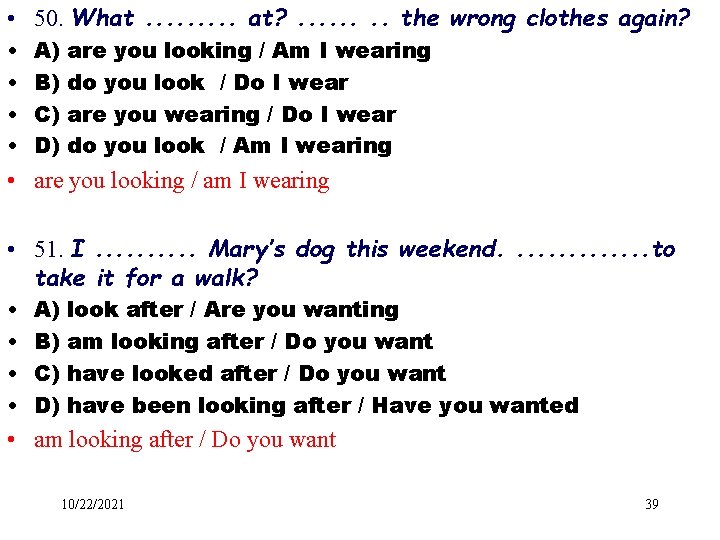
• 50. What. . at? . . . . the wrong clothes again? • • A) B) C) D) are you looking / Am I wearing do you look / Do I wear are you wearing / Do I wear do you look / Am I wearing • are you looking / am I wearing • 51. I. . Mary’s dog this weekend. . . to take it for a walk? • • A) B) C) D) look after / Are you wanting am looking after / Do you want have looked after / Do you want have been looking after / Have you wanted • am looking after / Do you want 10/22/2021 39
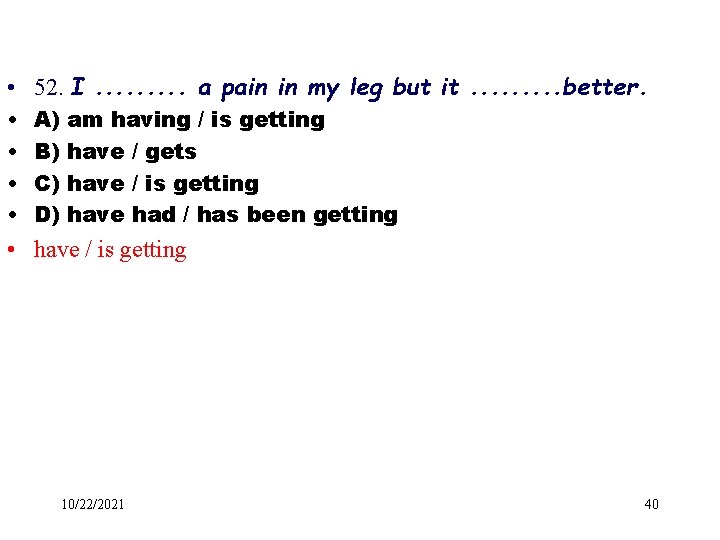
• 52. I. . a pain in my leg but it. . better. • • A) B) C) D) am having / is getting have / gets have / is getting have had / has been getting • have / is getting 10/22/2021 40
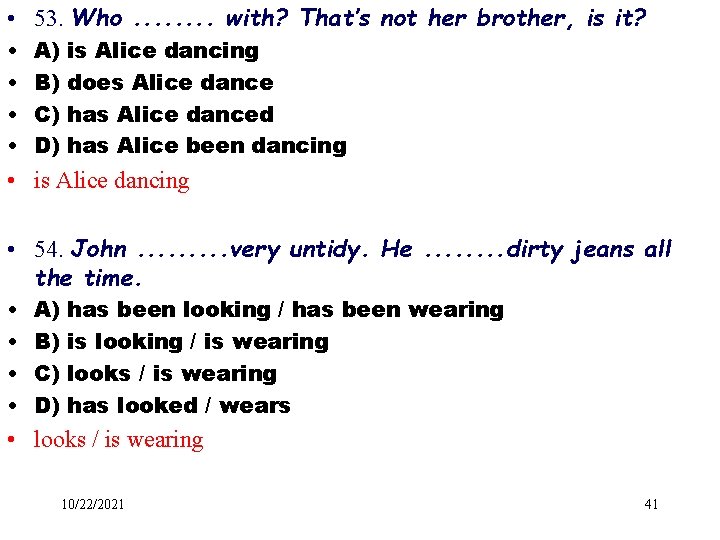
• 53. Who. . . . with? That’s not her brother, is it? • • A) B) C) D) is Alice dancing does Alice dance has Alice danced has Alice been dancing • is Alice dancing • 54. John. . very untidy. He. . . . dirty jeans all the time. • • A) B) C) D) has been looking / has been wearing is looking / is wearing looks / is wearing has looked / wears • looks / is wearing 10/22/2021 41
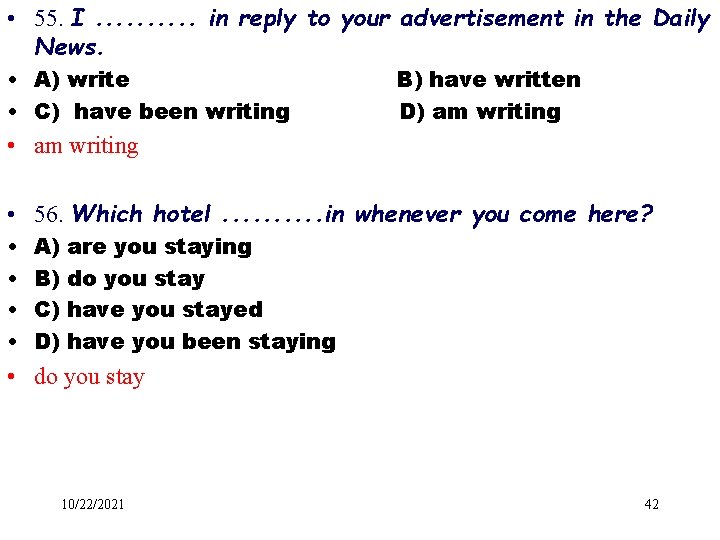
• 55. I. . in reply to your advertisement in the Daily News. • A) write • C) have been writing B) have written D) am writing • am writing • 56. Which hotel. . in whenever you come here? • • A) B) C) D) are you staying do you stay have you stayed have you been staying • do you stay 10/22/2021 42
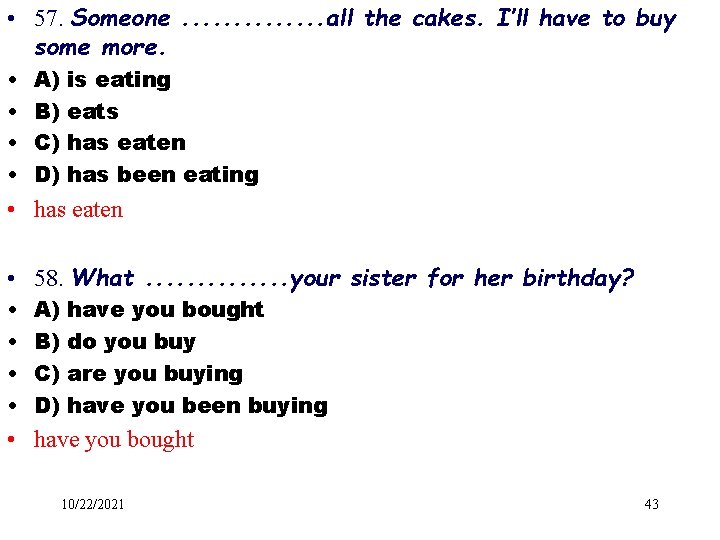
• 57. Someone. . . all the cakes. I’ll have to buy some more. • • A) B) C) D) is eating eats has eaten has been eating • has eaten • 58. What. . . your sister for her birthday? • • A) B) C) D) have you bought do you buy are you buying have you been buying • have you bought 10/22/2021 43
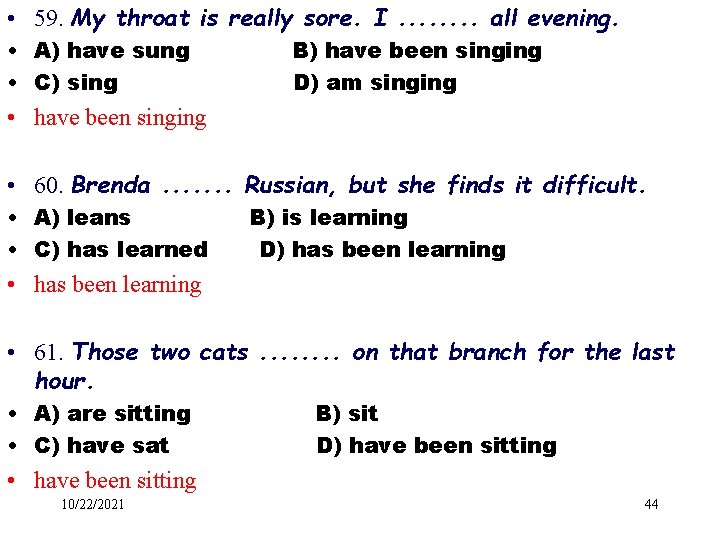
• 59. My throat is really sore. I. . . . all evening. • A) have sung • C) sing B) have been singing D) am singing • have been singing • 60. Brenda. . . . Russian, but she finds it difficult. • A) leans • C) has learned B) is learning D) has been learning • has been learning • 61. Those two cats. . . . on that branch for the last hour. • A) are sitting • C) have sat B) sit D) have been sitting • have been sitting 10/22/2021 44
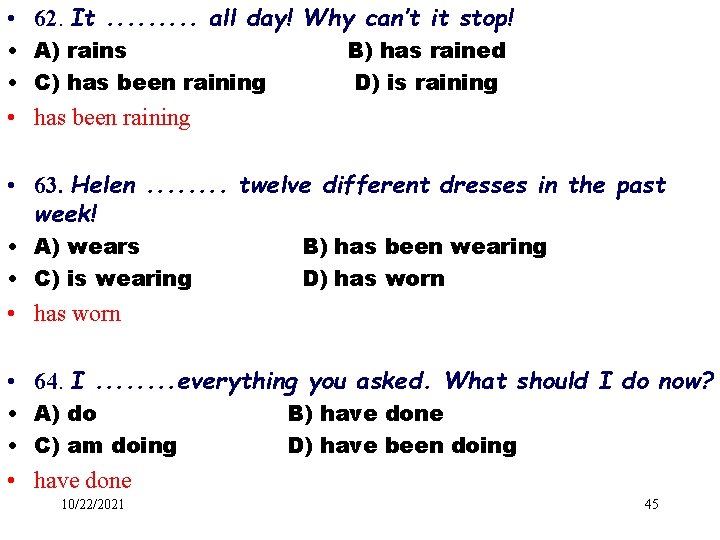
• 62. It. . all day! Why can’t it stop! • A) rains • C) has been raining B) has rained D) is raining • has been raining • 63. Helen. . . . twelve different dresses in the past week! • A) wears • C) is wearing B) has been wearing D) has worn • has worn • 64. I. . . . everything you asked. What should I do now? • A) do • C) am doing B) have done D) have been doing • have done 10/22/2021 45
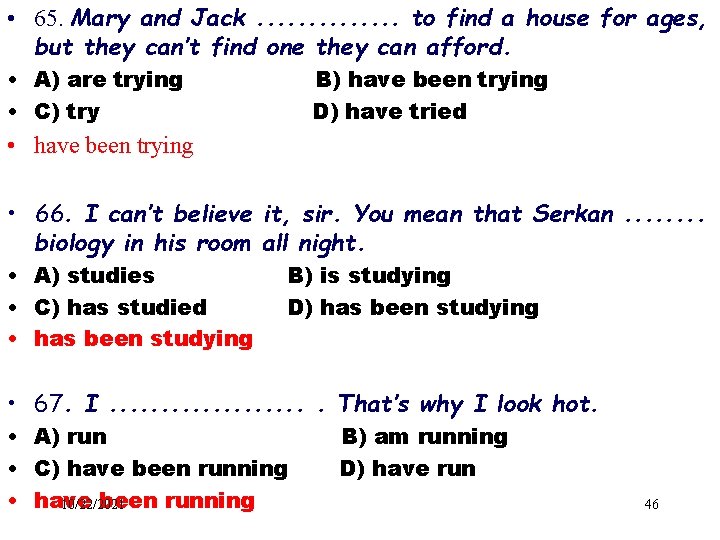
• 65. Mary and Jack. . . to find a house for ages, but they can’t find one they can afford. • A) are trying • C) try B) have been trying D) have tried • have been trying • 66. I can’t believe it, sir. You mean that Serkan. . . . biology in his room all night. • A) studies • C) has studied • has been studying B) is studying D) has been studying • 67. I. . . . . That’s why I look hot. • A) run • C) have been running • have been running 10/22/2021 B) am running D) have run 46