
SIMPLE NAME SERVICE Presented by Nisha U Rao
SIMPLE NAME SERVICE Presented by: Nisha U. Rao CS-S 8 Roll No: 36
SNS l l SNS is designed to store attributes of users computers & services. Computer-n/w address, details of computer types Services-Service address, version no The basic requirement for SNS are: 1) The objects named are users, services, computers & groups of these.
2) Other types of named objects maybe integrated. 3) The names are used only within the organisation. 4) Only authorised user may alter data. Name Server & Navigation >An organisation is highly unlikely to store all its naming information on a single server. >Such a server will end up in failure.
> All real name services employs the technique of replication to achieve high availability. Navigation: The process of locating naming data from among more than one name server inorder to resolve a name.
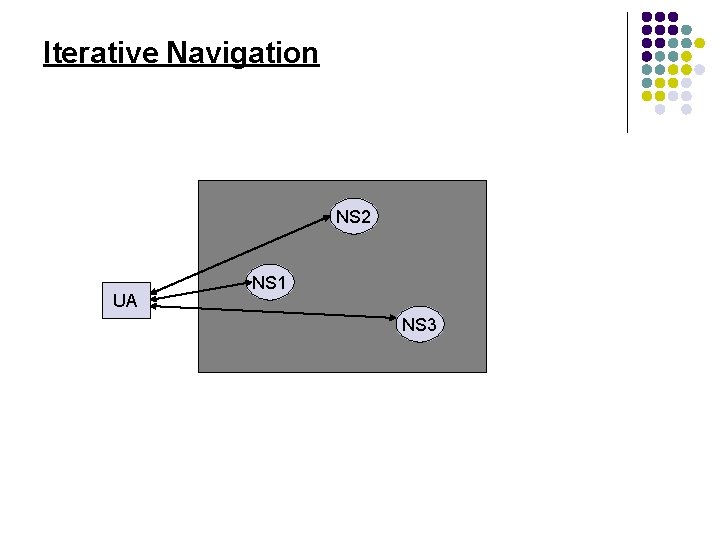
Iterative Navigation NS 2 UA NS 1 NS 3
l l In SNS , computers in the organisation runs a process called the User Agent(UA). UA carries out navigation on behalf of clients at that computer. It checks for names validity & communicates with servers to resolve a name. UA appears as user packages linked into individual clients.
Design Issues 1) Name Space: Collection of all valid names recognised by a name service such as the SNS. It has several limitations:
l l l Relative names - should be absolute. Merging Hetrogeneity Customization Restructuring
2)System that address name space issues: >GNS - is designed to allow the merging & reorganisation of name space on a global scale by manipulation of context. >UNS – allows users to maintain a private file , used to impose a private view of the name space.

3)Attribute-based naming: * They are also called Yellow Page Service. * Attributes are more powerful than names. * Attributes are suitable for selection of service. * They do not expose the structure of organisation to the outside world.
4)Replication : It is essential for name service that is to scale to very large number of objects & be highly available. 5)Alternative Navigation Models: The SNS navigation model in which the user agent contacts successive name servers to resolve a name is known as iterative navigation.
SNS navigation models: Multicast navigation – The UA multicasts the name to be resolved & the required object type to the group of name servers. Only the server that hold the named attribute responds to the request. If the name proved to be unbound, then the request is greeted with silence.
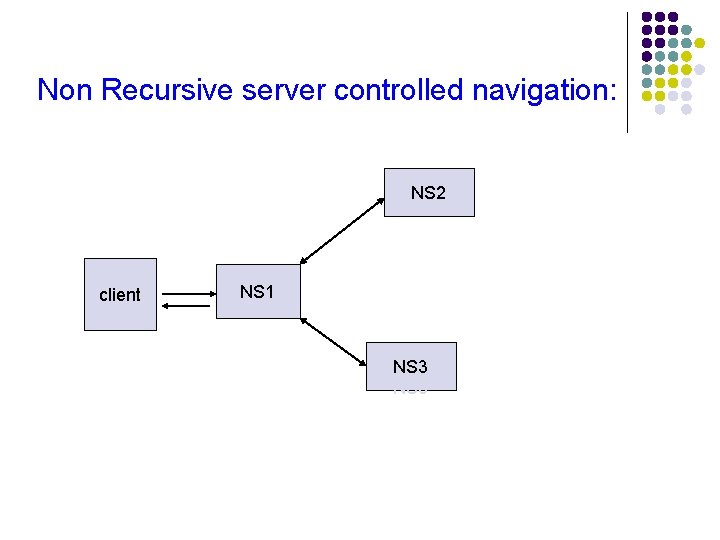
Non Recursive server controlled navigation: NS 2 client NS 1 NS 3
• • Any name server may be chosen by the user agent (UA). This server communicates by multicast or iteratively with its peers as though it were a user agent.
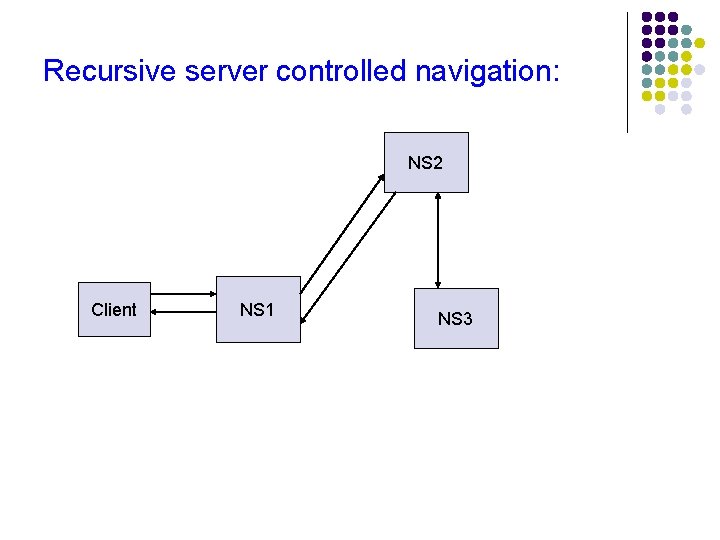
Recursive server controlled navigation: NS 2 Client NS 1 NS 3
l l l User agent contacts a single server. If this server does not store the name the server contacts a peer storing a (larger) prefix of the name, which in turn attempts to resolve it. This procedure continues recursively until the name is resolved.
6) Integrated name management: l l l Name serving is intergrated in the management of the objects named. This scheme uses multicast navigation Objects are managed by one of a collection of object managers organised as a multicast group.

- Slides: 18