
SIMPLE MIXTURES THERMODYNAMIC DESCRIPTION OF MIXTURES ARYO ABYOGA
SIMPLE MIXTURES THERMODYNAMIC DESCRIPTION OF MIXTURES ARYO ABYOGA A (080358395) GERALD MAYO L (0806472212) LEONARD AGUSTINUS J (0806472225)
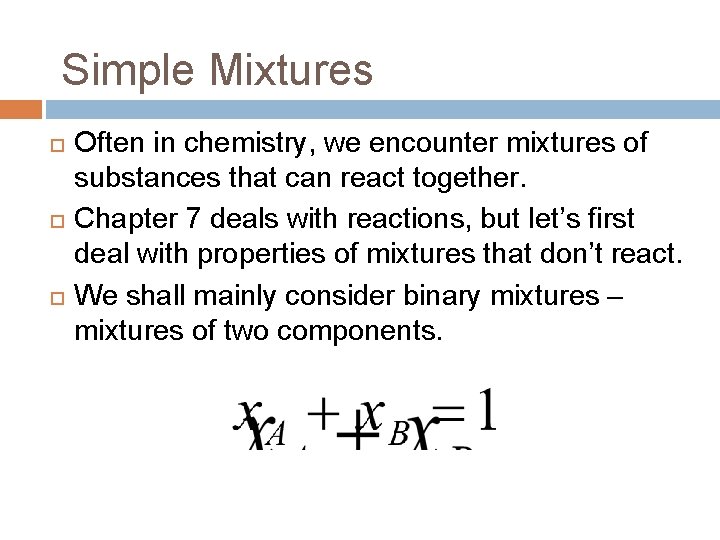
Simple Mixtures Often in chemistry, we encounter mixtures of substances that can react together. Chapter 7 deals with reactions, but let’s first deal with properties of mixtures that don’t react. We shall mainly consider binary mixtures – mixtures of two components.
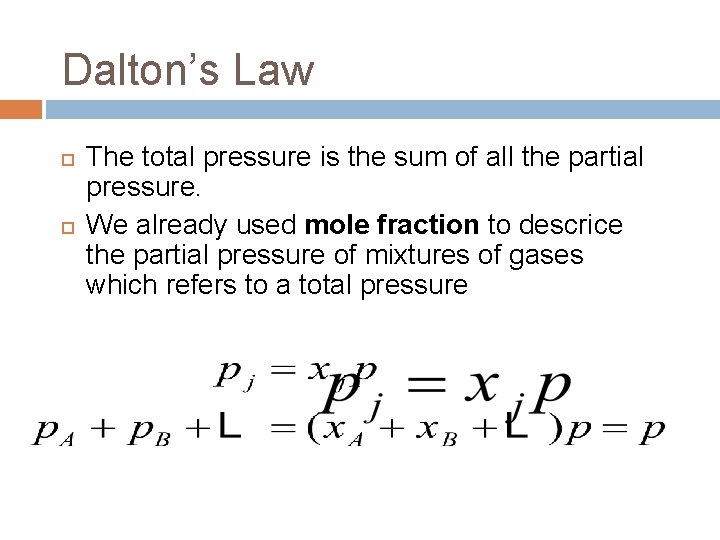
Dalton’s Law The total pressure is the sum of all the partial pressure. We already used mole fraction to descrice the partial pressure of mixtures of gases which refers to a total pressure
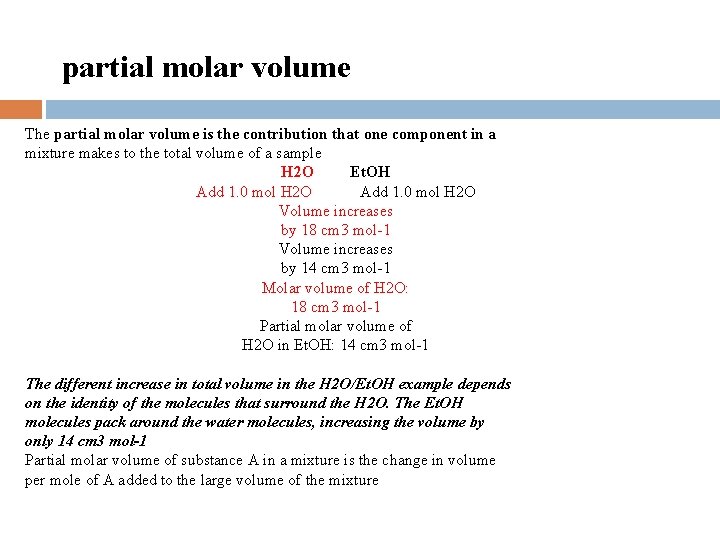
partial molar volume The partial molar volume is the contribution that one component in a mixture makes to the total volume of a sample H 2 O Et. OH Add 1. 0 mol H 2 O Volume increases by 18 cm 3 mol-1 Volume increases by 14 cm 3 mol-1 Molar volume of H 2 O: 18 cm 3 mol-1 Partial molar volume of H 2 O in Et. OH: 14 cm 3 mol-1 The different increase in total volume in the H 2 O/Et. OH example depends on the identity of the molecules that surround the H 2 O. The Et. OH molecules pack around the water molecules, increasing the volume by only 14 cm 3 mol-1 Partial molar volume of substance A in a mixture is the change in volume per mole of A added to the large volume of the mixture
Partial Molar Volumes Imagine a huge volume of pure water at 25 °C. If we add 1 mol H 2 O, the volume increases 18 cm 3 (or 18 m. L). So, 18 cm 3 mol-1 is the molar volume of pure water.
Partial Molar Volumes Now imagine a huge volume of pure ethanol and add 1 mol of pure H 2 O it. How much does the total volume increase by?
Partial Molar Volumes When 1 mol H 2 O is added to a large volume of pure ethanol, the total volume only increases by ~ 14 cm 3. The packing of water in pure water ethanol (i. e. the result of H-bonding interactions), results in only an increase of 14 cm 3.
Partial Molar Volumes The quantity 14 cm 3 mol-1 is the partial molar volume of water in pure ethanol. The partial molar volumes of the components of a mixture varies with composition as the molecular interactions varies as the composition changes from pure A to pure B.
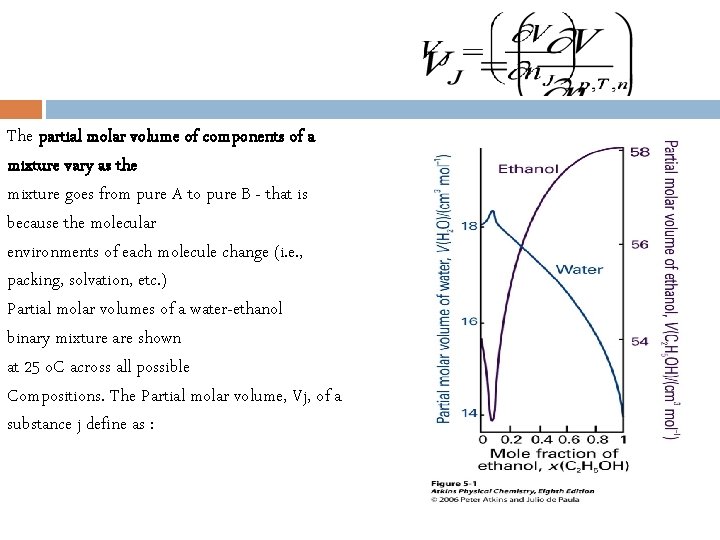
The partial molar volume of components of a mixture vary as the mixture goes from pure A to pure B - that is because the molecular environments of each molecule change (i. e. , packing, solvation, etc. ) Partial molar volumes of a water-ethanol binary mixture are shown at 25 o. C across all possible Compositions. The Partial molar volume, Vj, of a substance j define as :
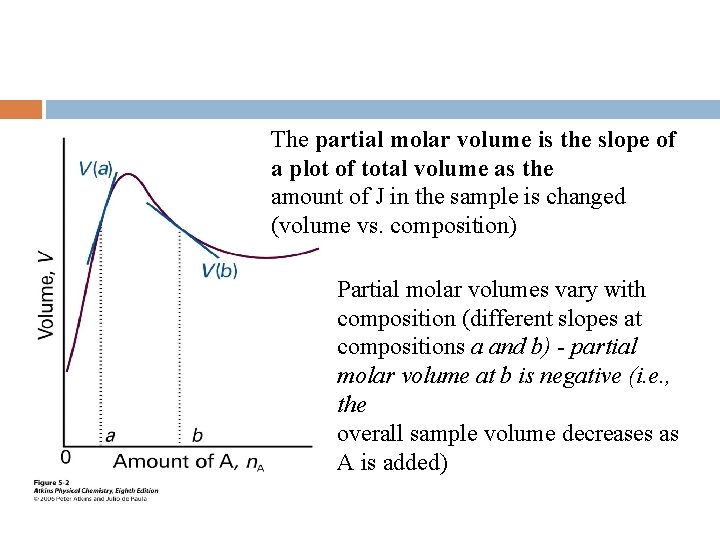
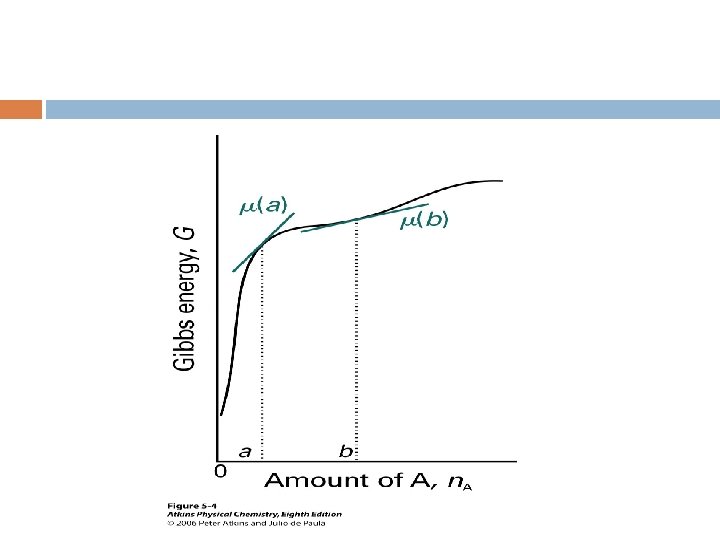
The partial molar volume is the slope of a plot of total volume as the amount of J in the sample is changed (volume vs. composition) Partial molar volumes vary with composition (different slopes at compositions a and b) - partial molar volume at b is negative (i. e. , the overall sample volume decreases as A is added)
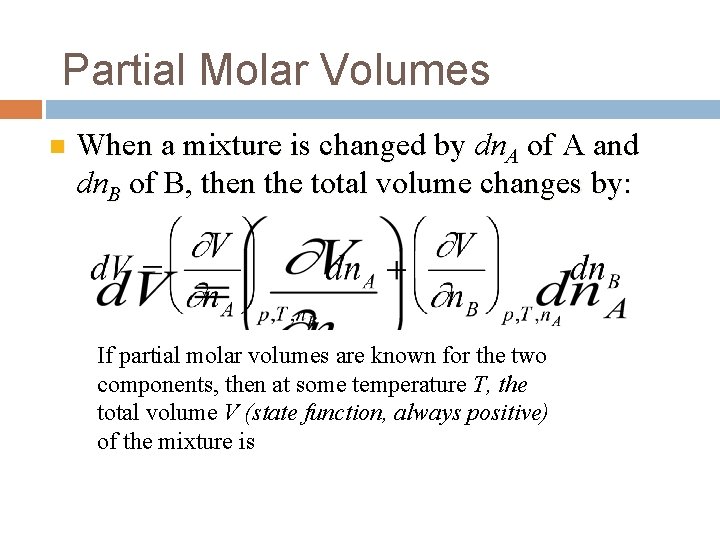
Partial Molar Volumes n When a mixture is changed by dn. A of A and dn. B of B, then the total volume changes by: If partial molar volumes are known for the two components, then at some temperature T, the total volume V (state function, always positive) of the mixture is

Partial Molar Volumes

Partial Molar Volumes
Partial Molar Volumes
Partial Molar Volumes How to measure partial molar volumes? Measure dependence of the volume on composition. Fit a function to data and determine the slope by differentiation.
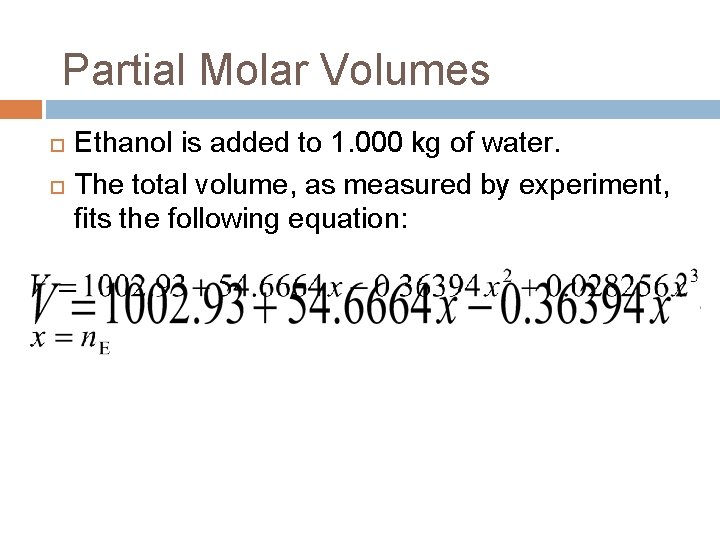
Partial Molar Volumes Ethanol is added to 1. 000 kg of water. The total volume, as measured by experiment, fits the following equation:
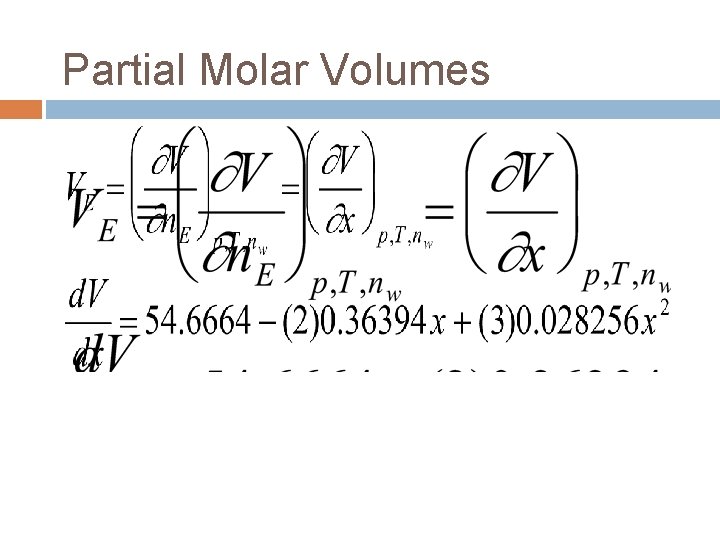
Partial Molar Volumes
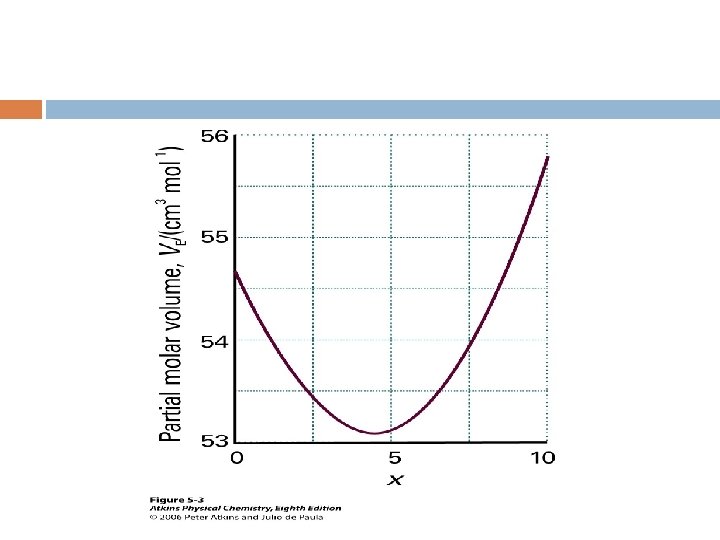
Partial Molar Volumes Molar volumes are always positive, but partial molar quantities need not be. The limiting partial molar volume of Mg. SO 4 in water is -1. 4 cm 3 mol-1, which means that the addition of 1 mol of Mg. SO 4 to a large volume of water results in a decrease in volume of 1. 4 cm 3.
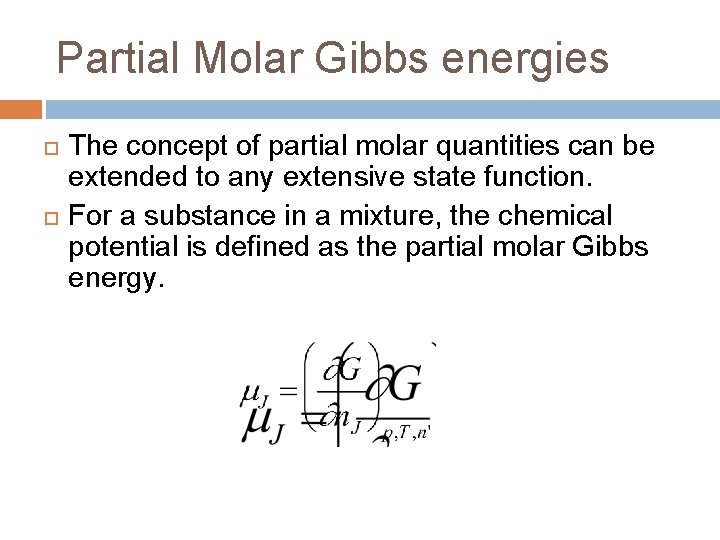
Partial Molar Gibbs energies The concept of partial molar quantities can be extended to any extensive state function. For a substance in a mixture, the chemical potential is defined as the partial molar Gibbs energy.
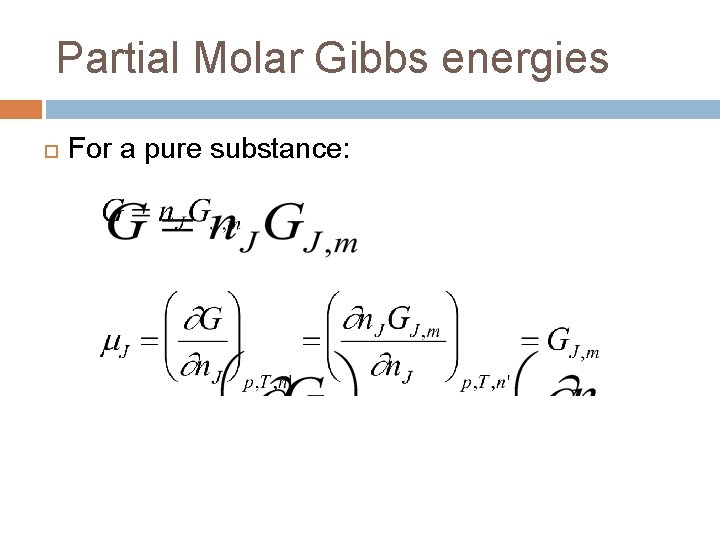
Partial Molar Gibbs energies For a pure substance:
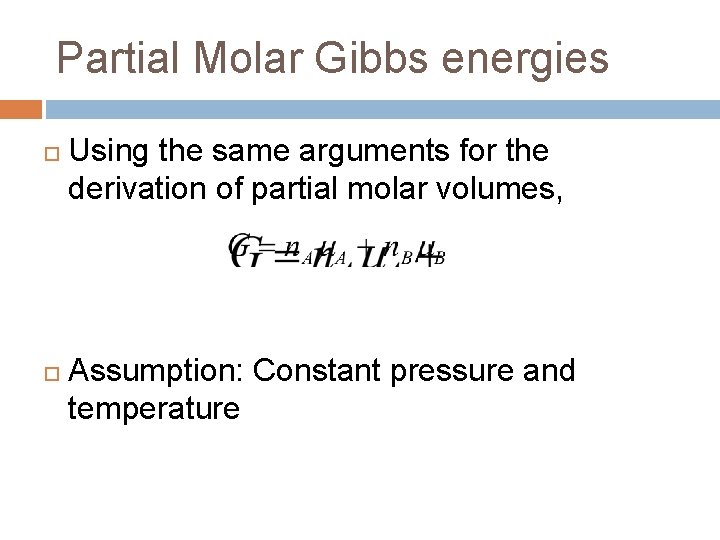
Partial Molar Gibbs energies Using the same arguments for the derivation of partial molar volumes, Assumption: Constant pressure and temperature
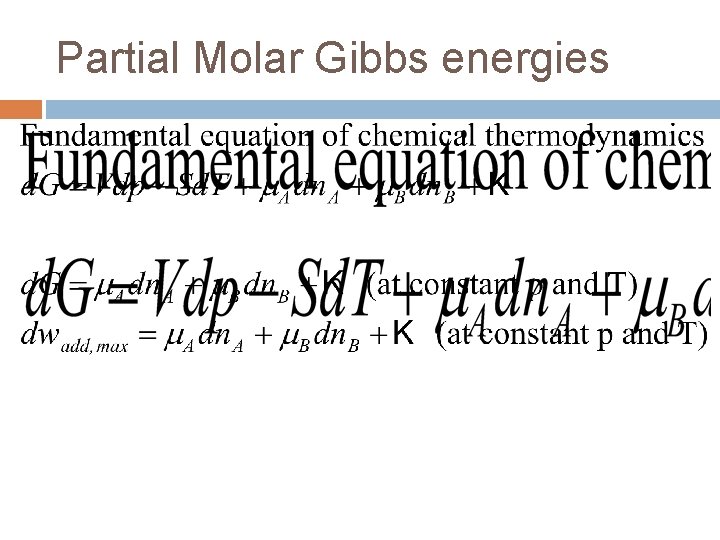
Partial Molar Gibbs energies
Chemical Potential
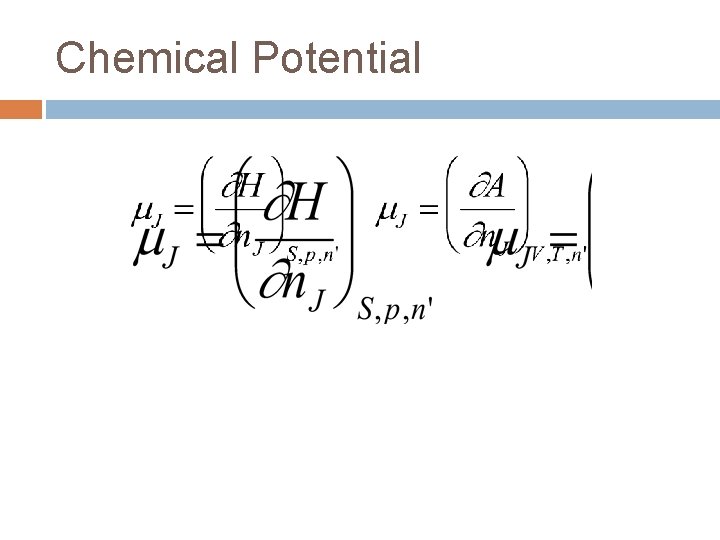
Chemical Potential
Gibbs-Duhem equation
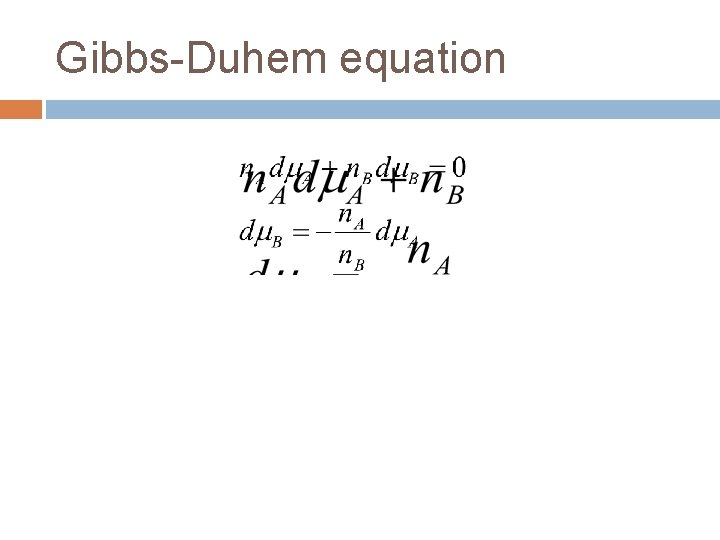
Gibbs-Duhem equation
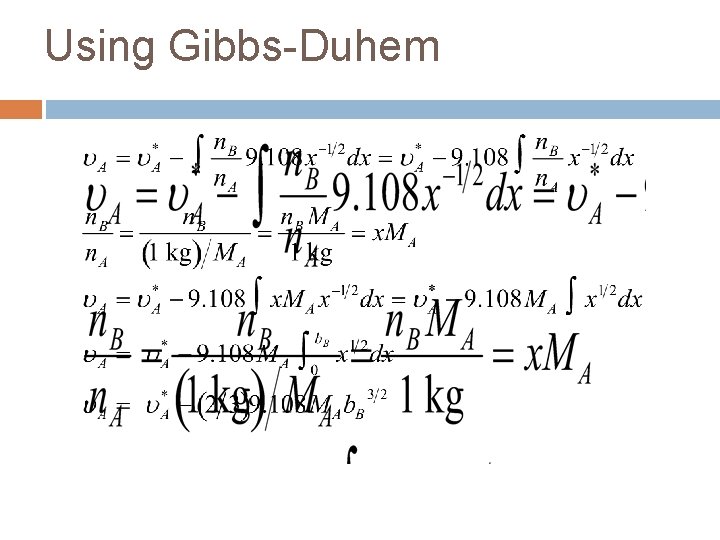
Molarity and Molality Molarity, c, is the amount of solute divided by the volume of solution. Units of mol dm-3 or mol L-1. Molality, b, is the amount of solute divided by the mass of solvent. Units of mol kg-1.
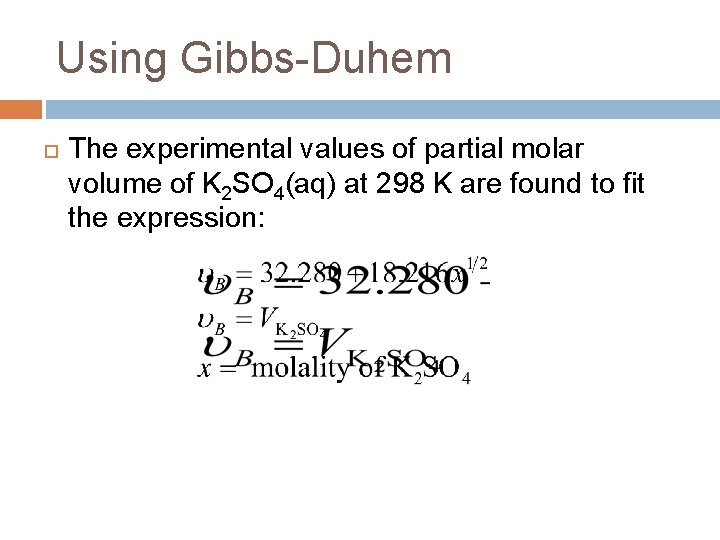
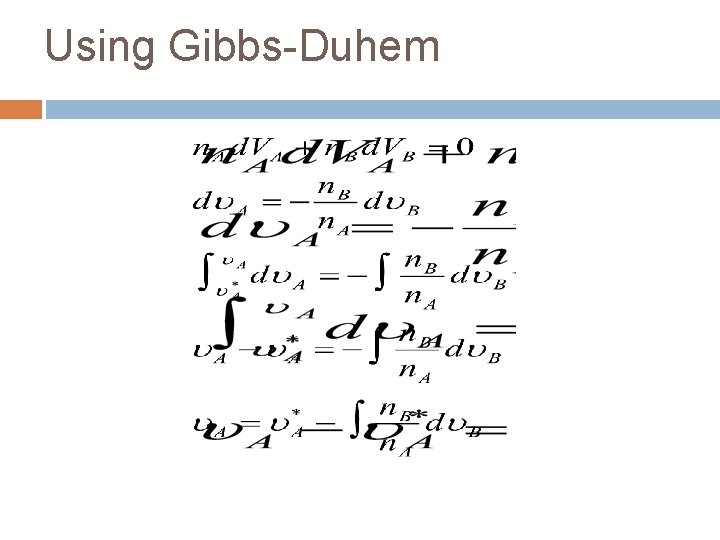
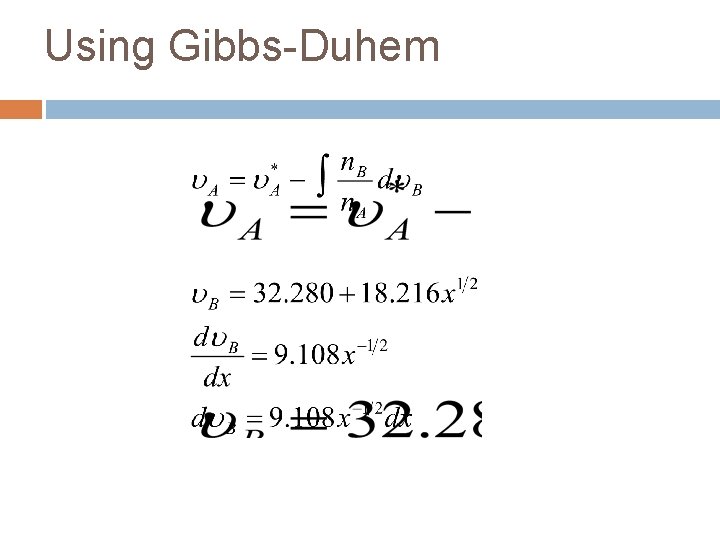
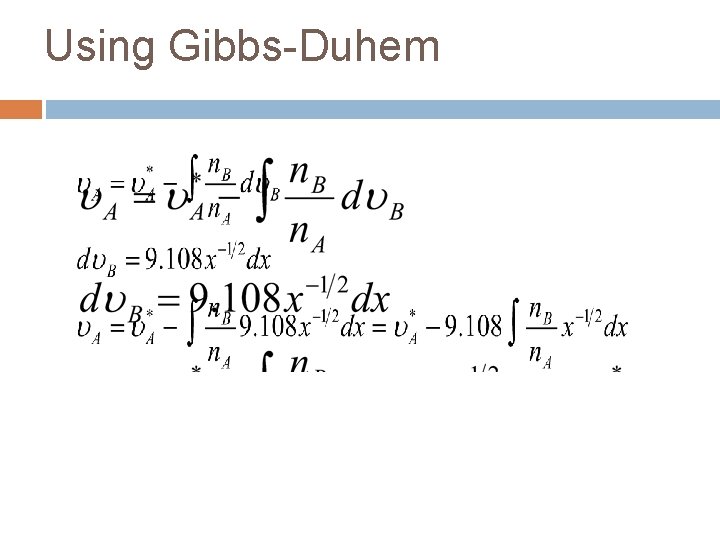
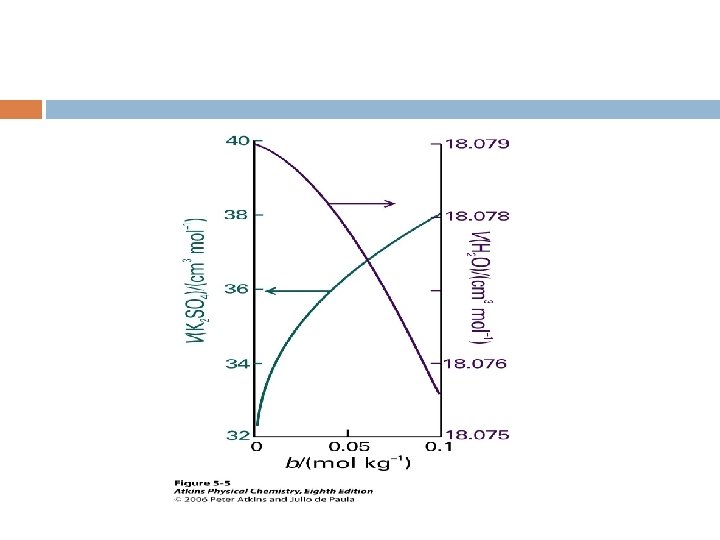
Using Gibbs-Duhem The experimental values of partial molar volume of K 2 SO 4(aq) at 298 K are found to fit the expression:
Using Gibbs-Duhem
Using Gibbs-Duhem
Using Gibbs-Duhem
Using Gibbs-Duhem
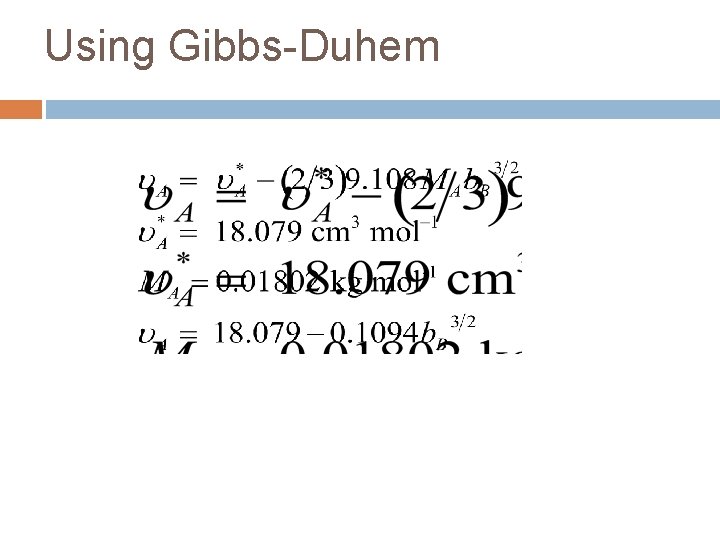
Using Gibbs-Duhem
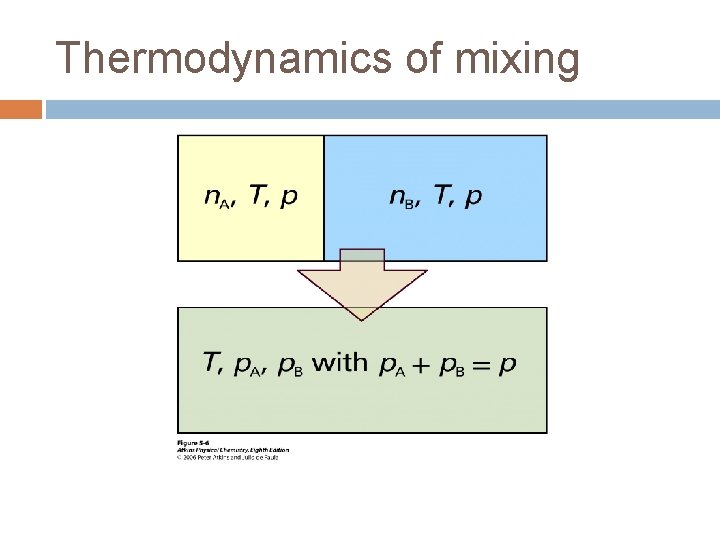
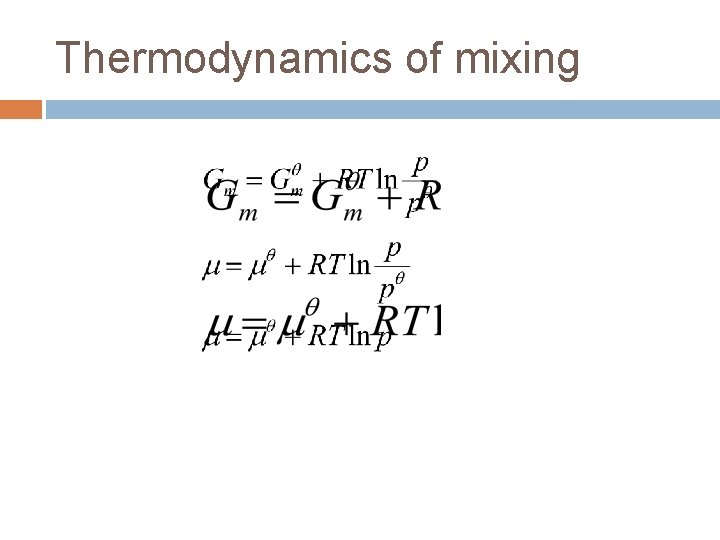
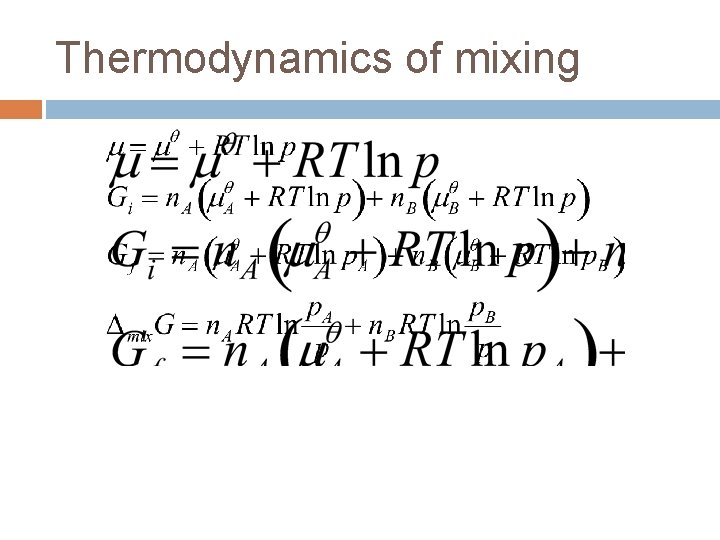
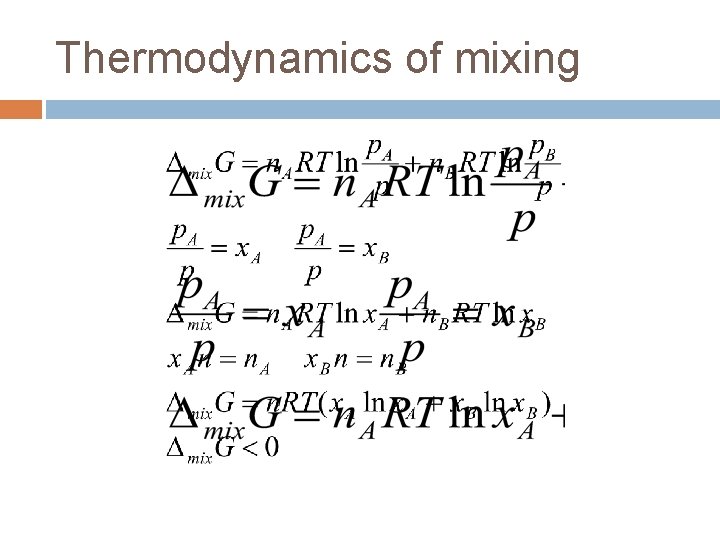
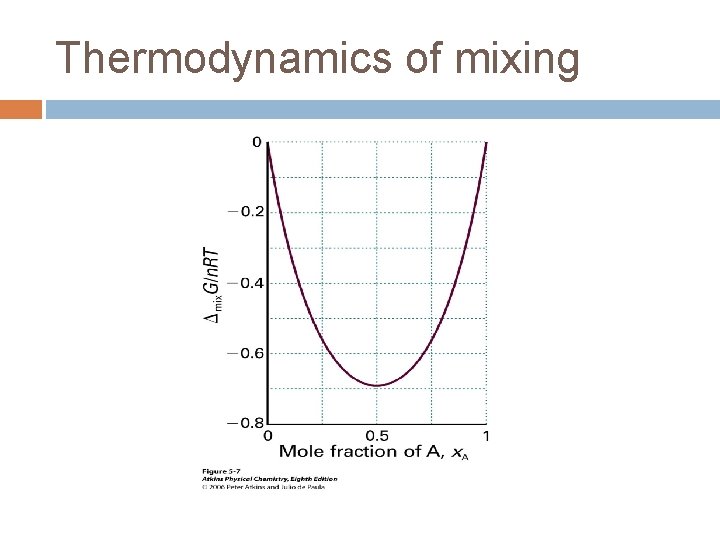
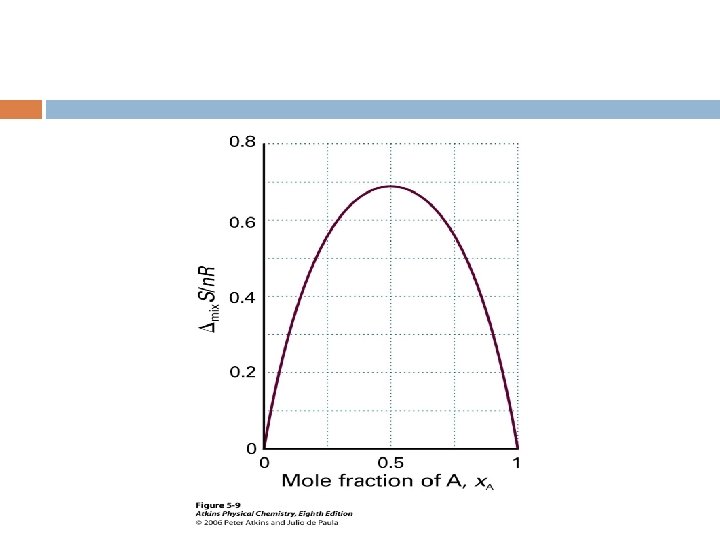
Thermodynamics of mixing So we’ve seen how Gibbs energy of a mixture depends on composition. We know at constant temperature and pressure systems tend towards lower Gibbs energy. When we combine two ideal gases they mix spontaneously, so it must correspond to a decrease in G.
Thermodynamics of mixing
Thermodynamics of mixing
Thermodynamics of mixing
Thermodynamics of mixing
Thermodynamics of mixing
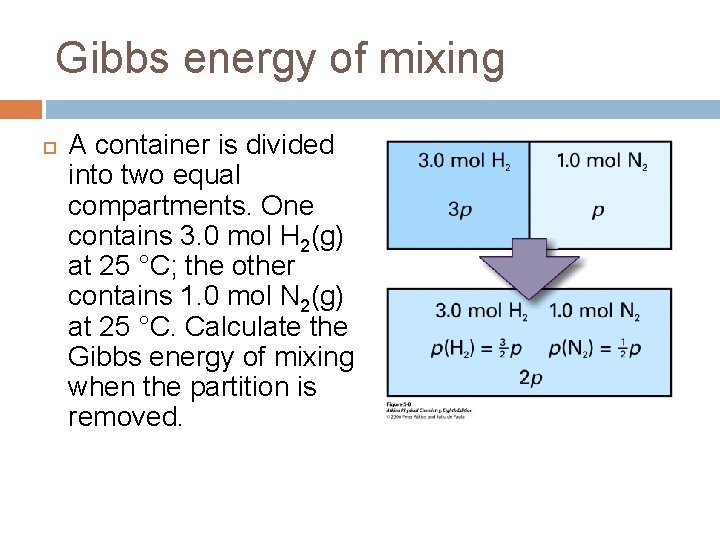
Gibbs energy of mixing A container is divided into two equal compartments. One contains 3. 0 mol H 2(g) at 25 °C; the other contains 1. 0 mol N 2(g) at 25 °C. Calculate the Gibbs energy of mixing when the partition is removed.
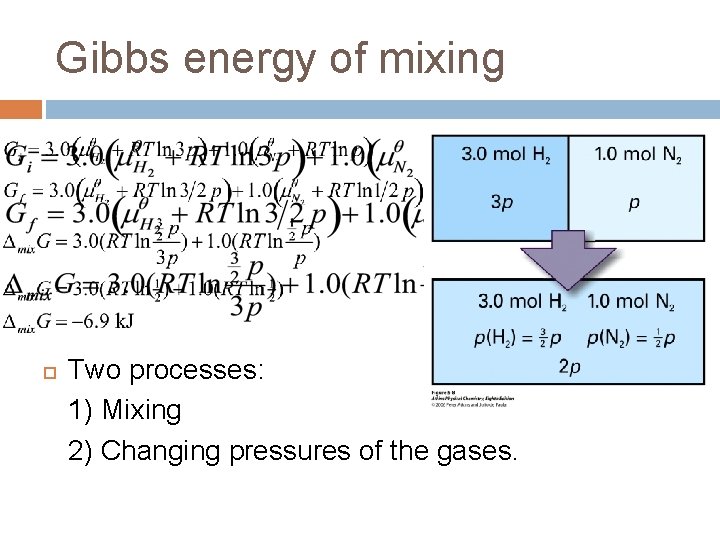
Gibbs energy of mixing Two processes: 1) Mixing 2) Changing pressures of the gases.
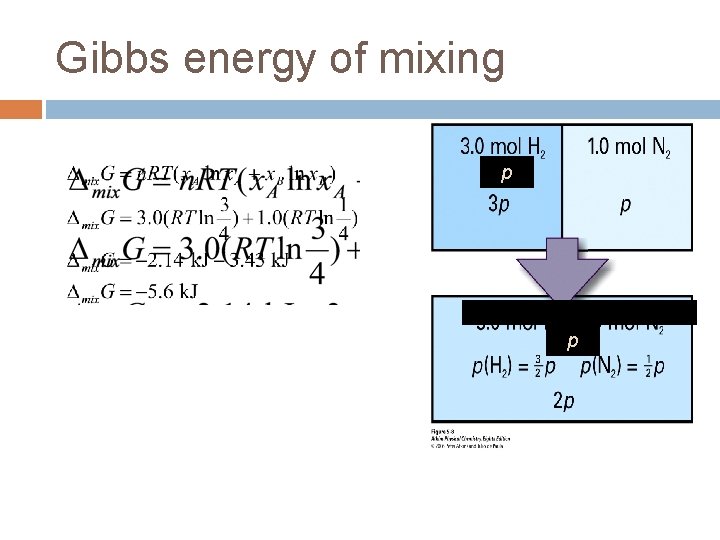
Gibbs energy of mixing p p
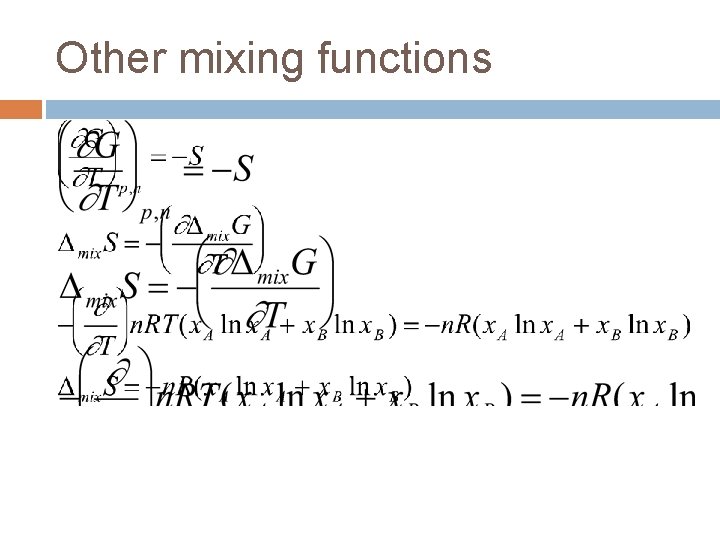
Other mixing functions
Other mixing functions
- Slides: 48