
Simple Machines Standard Identify simple machines and explain


- Slides: 16
Simple Machines Standard: Identify simple machines and explain their uses
What is a Simple Machine? ®A simple machine is a machine with few or no moving parts to which you apply just one force ® Simple machines change the way work is done and make work easier
Simple Machines ® Levers ® Pulleys ® Inclined planes ® Wedge ® Screw ® Wheel and axle
Simple Machines ® How did simple machines come about? ® Used to hunt, gather plants, make clothes, build shelter, protection, warfare, move things ® Copying nature such as: ® Beavers cutting logs ® Woodpeckers pecking on a tree trunk ® Moles clawing their way through the dirt
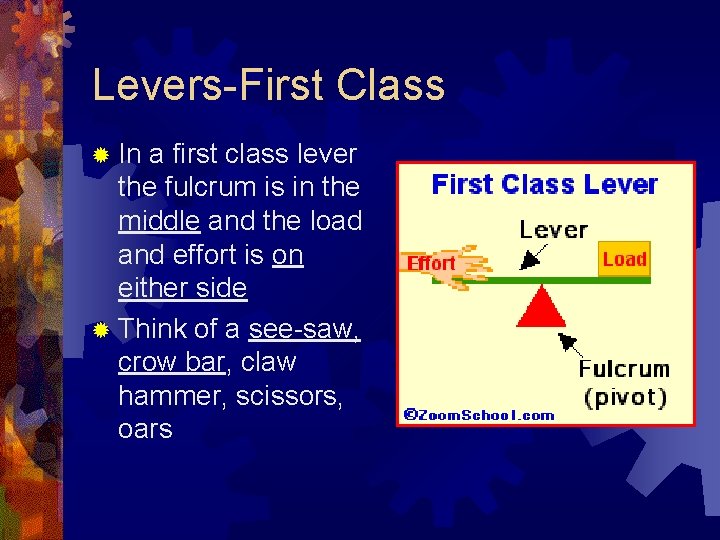
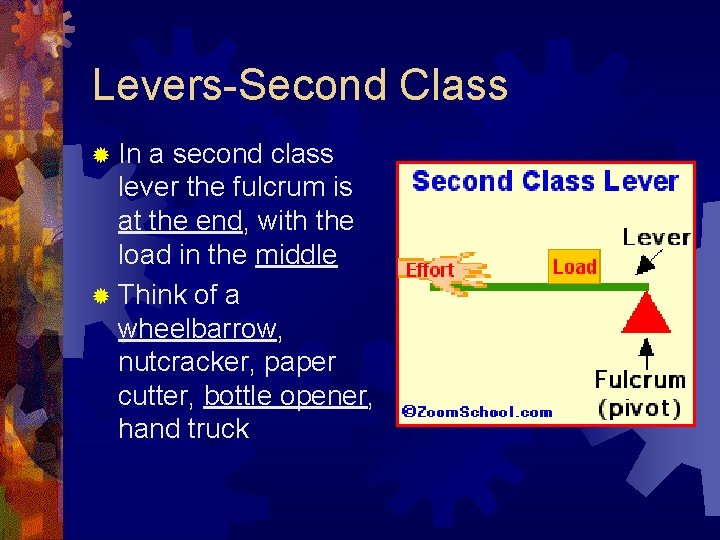
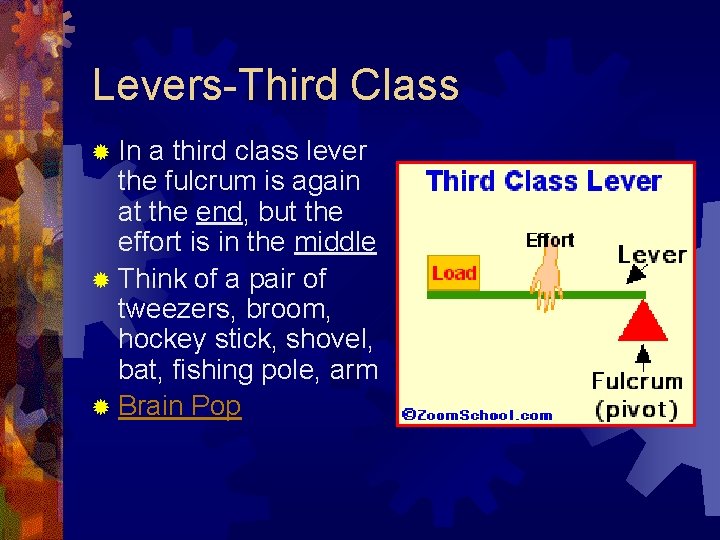
Levers ® ® ® ® Levers make it easier for people to lift heavy objects or open things. Levers date back to prehistoric times and were probably used by early humans to dig for small animals or pry under rocks. A lever is a bar that pivots on a fixed point. For any type of lever you can identify three parts or ELF – effort, load and fulcrum. The force that is exerted is the effort. The object being moved or opened is called the load. The fulcrum is the fixed point that allows a pivot to occur. The fulcrum does not move.
Levers-First Class ® In a first class lever the fulcrum is in the middle and the load and effort is on either side ® Think of a see-saw, crow bar, claw hammer, scissors, oars
Levers-Second Class ® In a second class lever the fulcrum is at the end, with the load in the middle ® Think of a wheelbarrow, nutcracker, paper cutter, bottle opener, hand truck
Levers-Third Class ® In a third class lever the fulcrum is again at the end, but the effort is in the middle ® Think of a pair of tweezers, broom, hockey stick, shovel, bat, fishing pole, arm ® Brain Pop
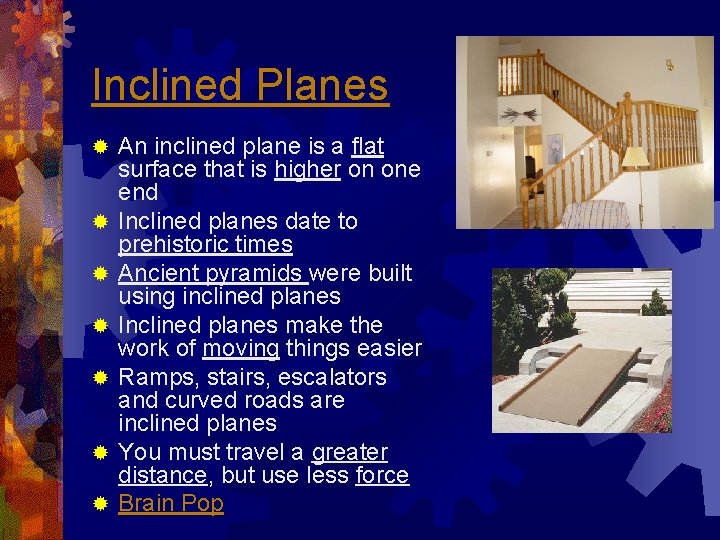
Inclined Planes ® ® ® ® An inclined plane is a flat surface that is higher on one end Inclined planes date to prehistoric times Ancient pyramids were built using inclined planes Inclined planes make the work of moving things easier Ramps, stairs, escalators and curved roads are inclined planes You must travel a greater distance, but use less force Brain Pop
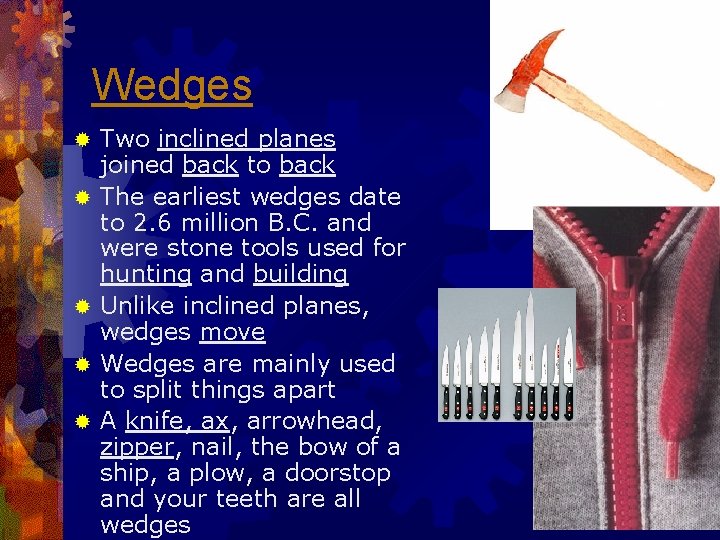
Wedges ® ® ® Two inclined planes joined back to back The earliest wedges date to 2. 6 million B. C. and were stone tools used for hunting and building Unlike inclined planes, wedges move Wedges are mainly used to split things apart A knife, ax, arrowhead, zipper, nail, the bow of a ship, a plow, a doorstop and your teeth are all wedges
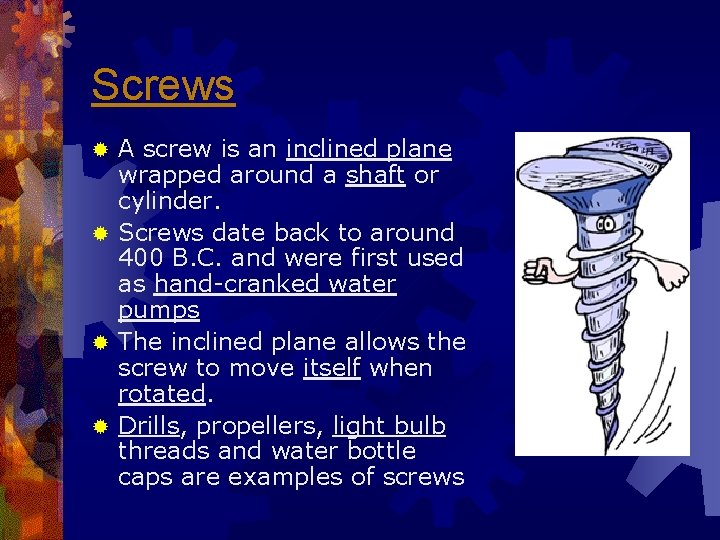
Screws A screw is an inclined plane wrapped around a shaft or cylinder. ® Screws date back to around 400 B. C. and were first used as hand-cranked water pumps ® The inclined plane allows the screw to move itself when rotated. ® Drills, propellers, light bulb threads and water bottle caps are examples of screws ®
Wheels and Axles ® ® ® The wheel and axle are a simple machine The wheel and axle dates back to around 4000 B. C. The axle is a rod that goes through the wheel which allows the wheel to turn Tires, a spinning wheel, faucets, doorknobs and windmills are examples of wheels and axles Brain Pop
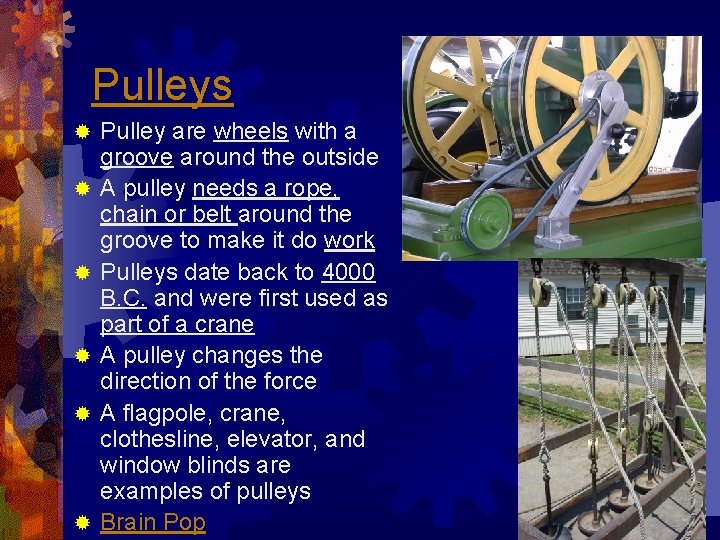
Pulleys ® ® ® Pulley are wheels with a groove around the outside A pulley needs a rope, chain or belt around the groove to make it do work Pulleys date back to 4000 B. C. and were first used as part of a crane A pulley changes the direction of the force A flagpole, crane, clothesline, elevator, and window blinds are examples of pulleys Brain Pop
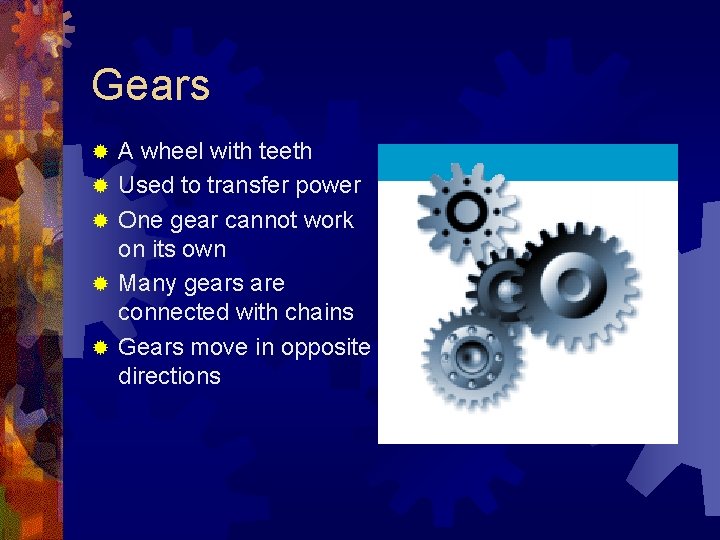
Gears ® ® ® A wheel with teeth Used to transfer power One gear cannot work on its own Many gears are connected with chains Gears move in opposite directions
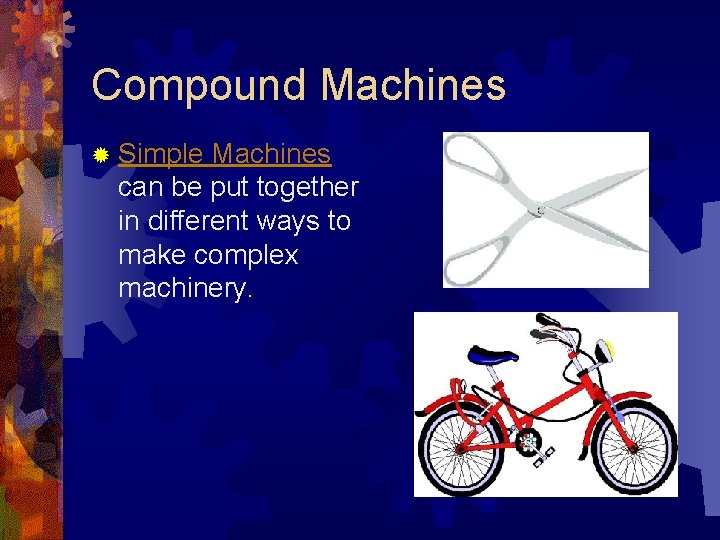
Compound Machines ® Simple Machines can be put together in different ways to make complex machinery.
Simple Machines Constructed Response: ® Draw pictures of two simple machines that you could use to help you lift a heavy box ® Label your drawings and include brief instructions on how to use the simple machine to lift the object.