
SIMPLE MACHINES Mechanical systems and machines What is
- Slides: 52
SIMPLE MACHINES
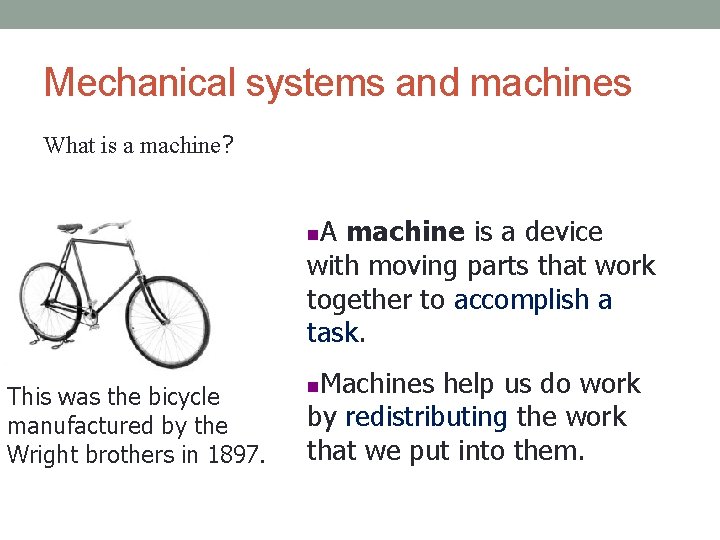
Mechanical systems and machines What is a machine? A machine is a device with moving parts that work together to accomplish a task. n This was the bicycle manufactured by the Wright brothers in 1897. Machines help us do work by redistributing the work that we put into them. n
Input & Output n A machine can’t do work without input. Input is what you do, or the energy you put into the machine to make it work. n The output is what the machine does for you, or the amount of work you get out of it. n Machines make our work easier by increasing output force. n
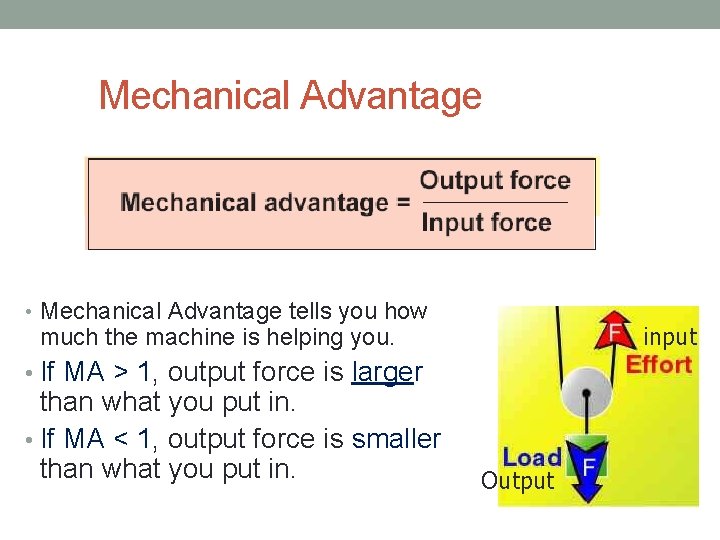
Mechanical Advantage • Mechanical Advantage tells you how input much the machine is helping you. • If MA > 1, output force is larger than what you put in. • If MA < 1, output force is smaller than what you put in. Output
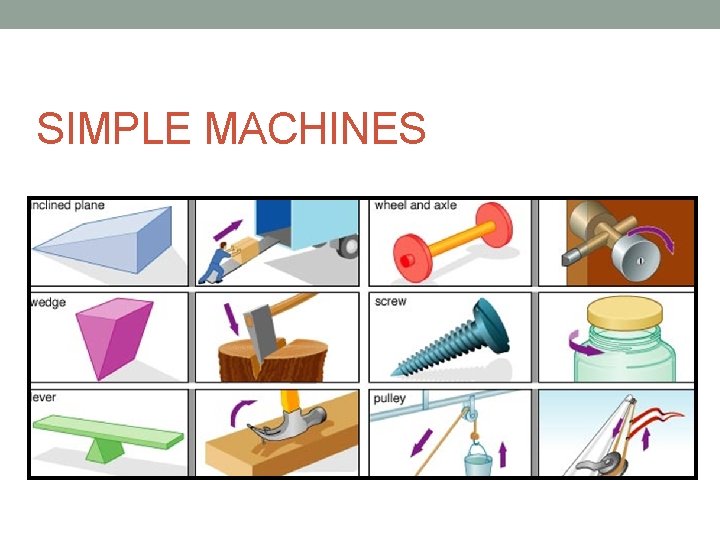
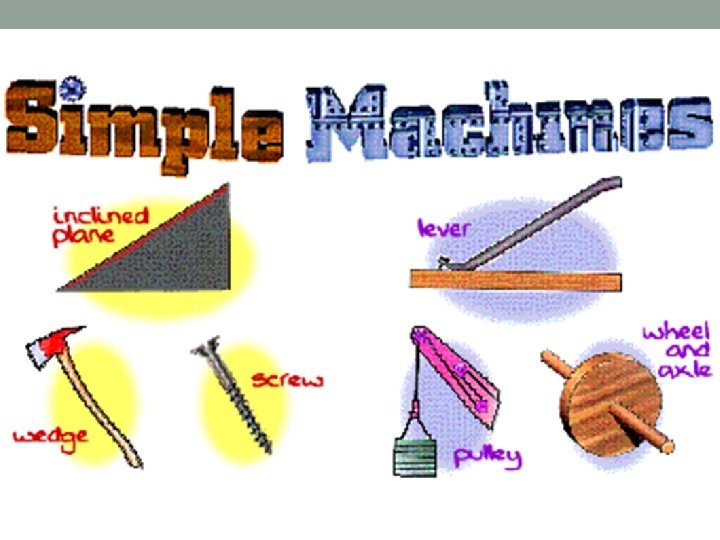
Simple Machines • Types of Simple Machines • Inclined Plane • Lever • Wedge • Screw • Pulley • Wheel and Axle
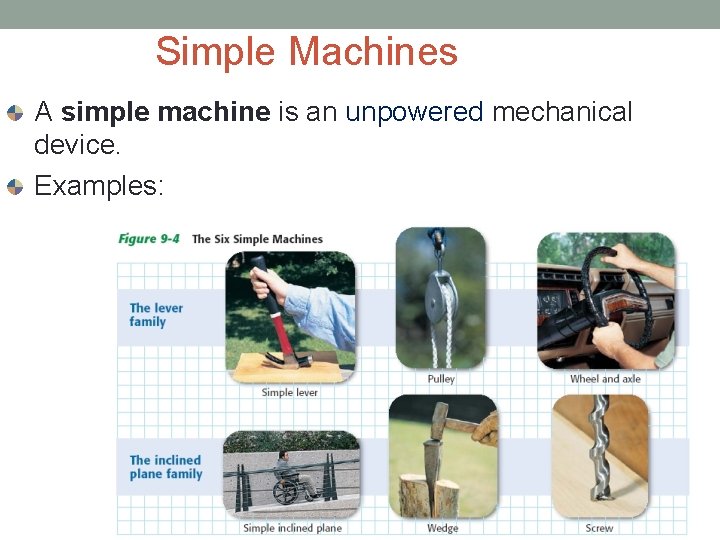
Simple Machines A simple machine is an unpowered mechanical device. Examples:
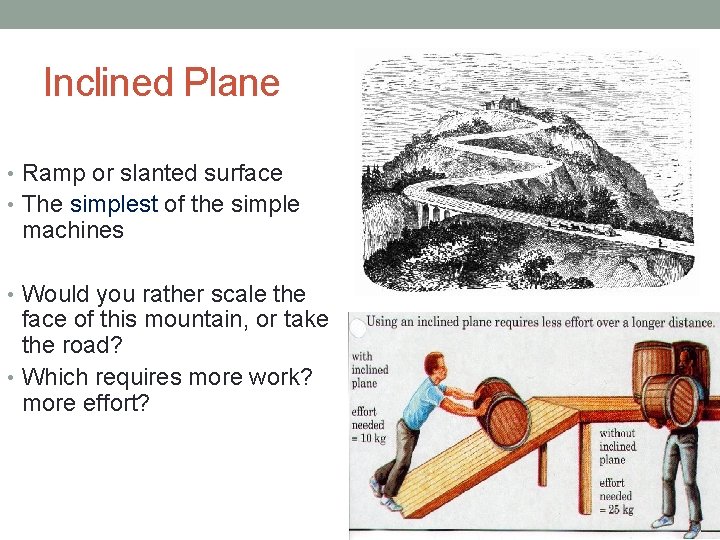
Inclined Plane • Ramp or slanted surface • The simplest of the simple machines • Would you rather scale the face of this mountain, or take the road? • Which requires more work? more effort?
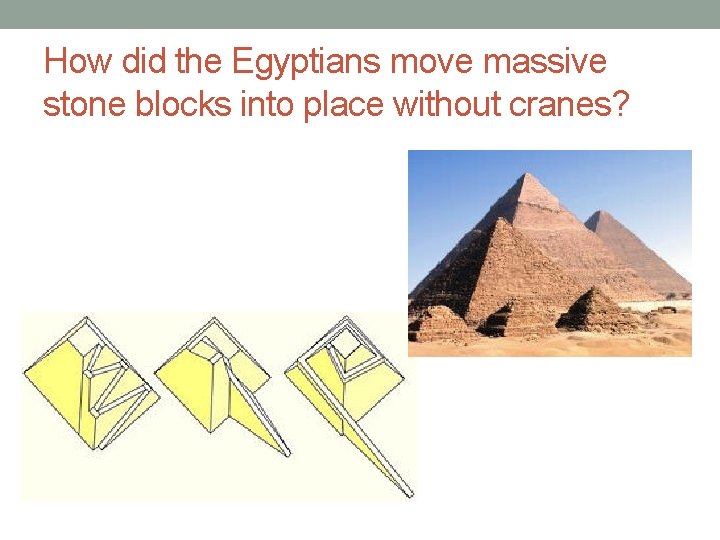
How did the Egyptians move massive stone blocks into place without cranes?
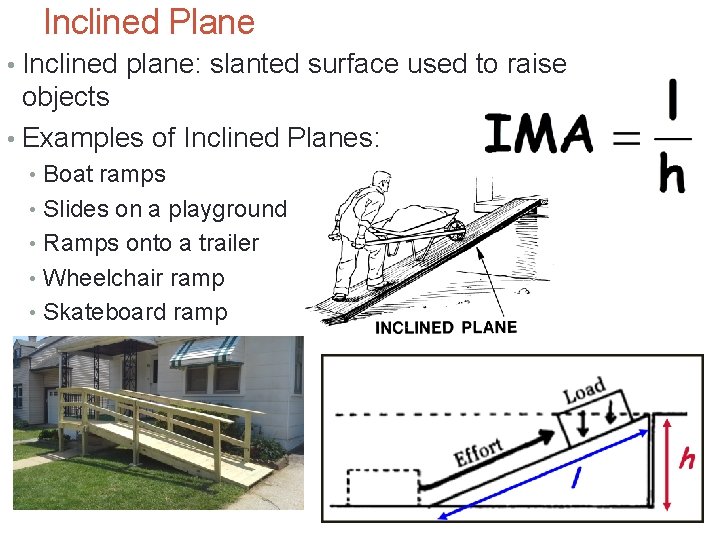
Inclined Plane • Inclined plane: slanted surface used to raise objects • Examples of Inclined Planes: • Boat ramps • Slides on a playground • Ramps onto a trailer • Wheelchair ramp • Skateboard ramp
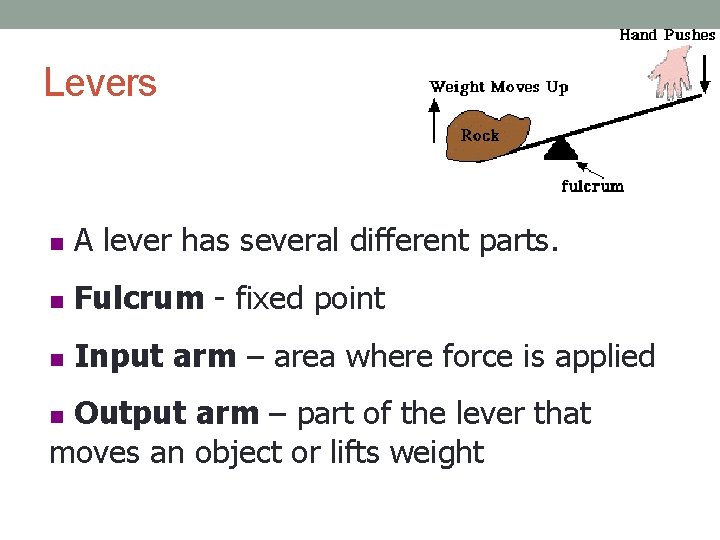
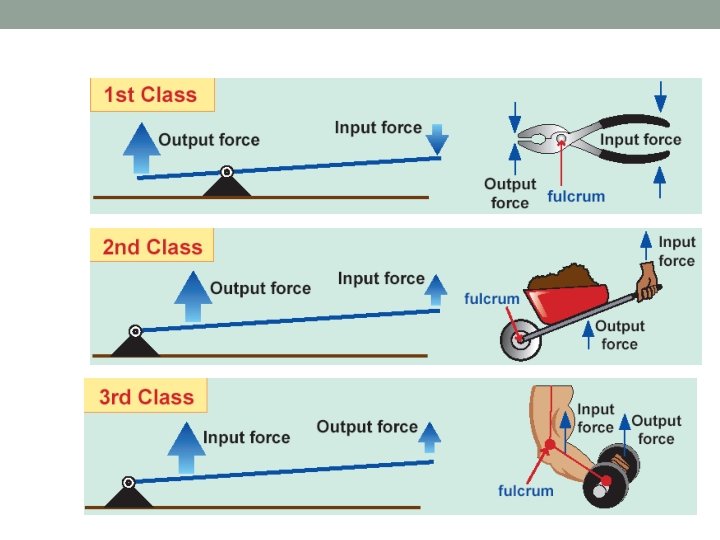
Levers n A lever has several different parts. n Fulcrum - fixed point n Input arm – area where force is applied Output arm – part of the lever that moves an object or lifts weight n
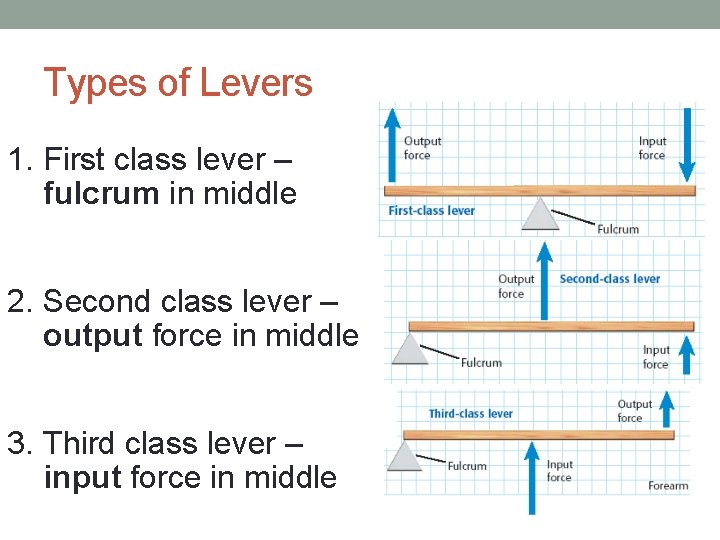
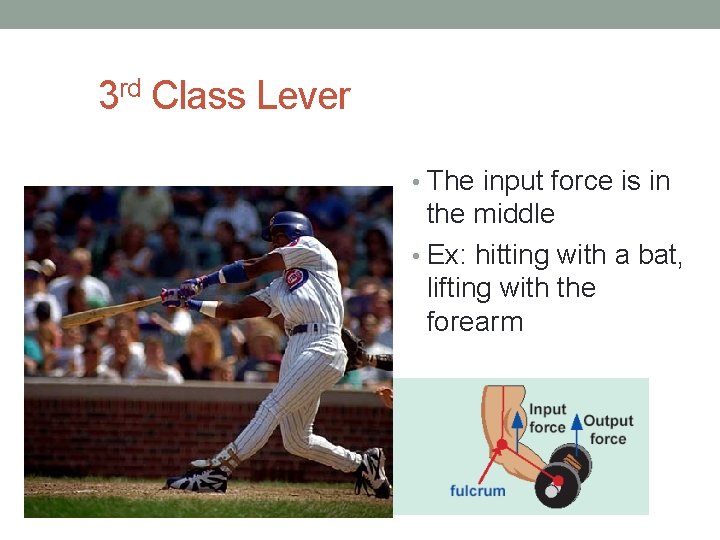
Types of Levers 1. First class lever – fulcrum in middle 2. Second class lever – output force in middle 3. Third class lever – input force in middle
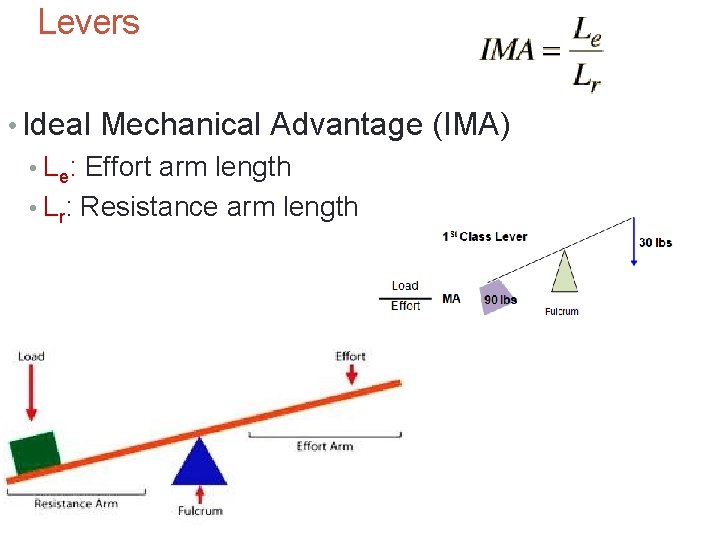
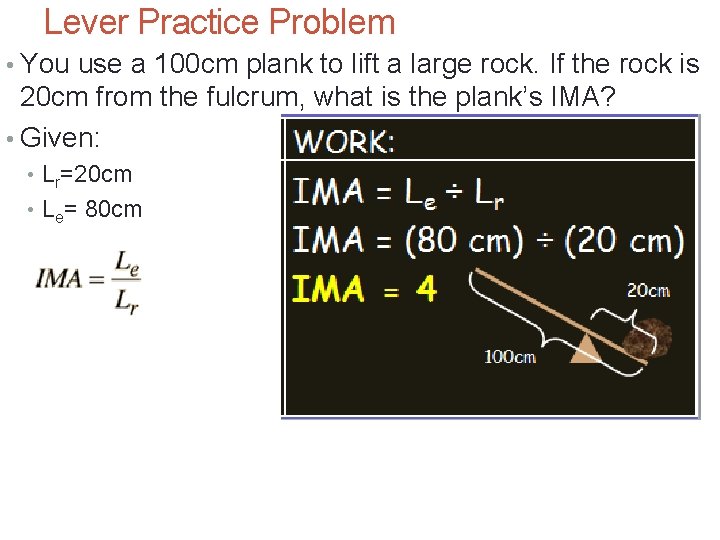
Levers • Ideal Mechanical Advantage (IMA) • Le: Effort arm length • Lr: Resistance arm length
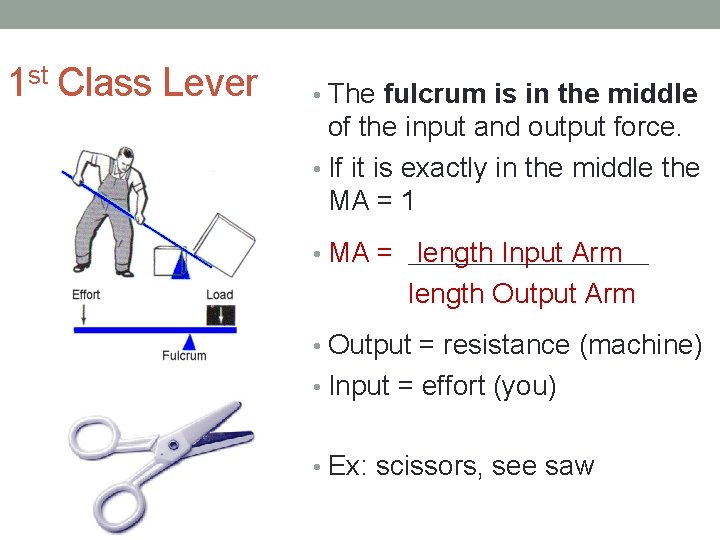
1 st Class Lever • The fulcrum is in the middle of the input and output force. • If it is exactly in the middle the MA = 1 • MA = length Input Arm length Output Arm • Output = resistance (machine) • Input = effort (you) • Ex: scissors, see saw
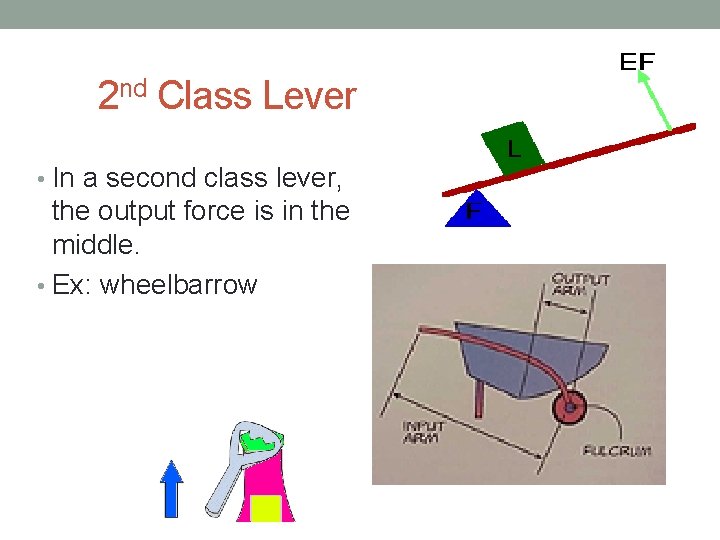
2 nd Class Lever • In a second class lever, the output force is in the middle. • Ex: wheelbarrow
3 rd Class Lever • The input force is in the middle • Ex: hitting with a bat, lifting with the forearm
Lever Practice Problem • You use a 100 cm plank to lift a large rock. If the rock is 20 cm from the fulcrum, what is the plank’s IMA? • Given: • Lr=20 cm • Le= 80 cm
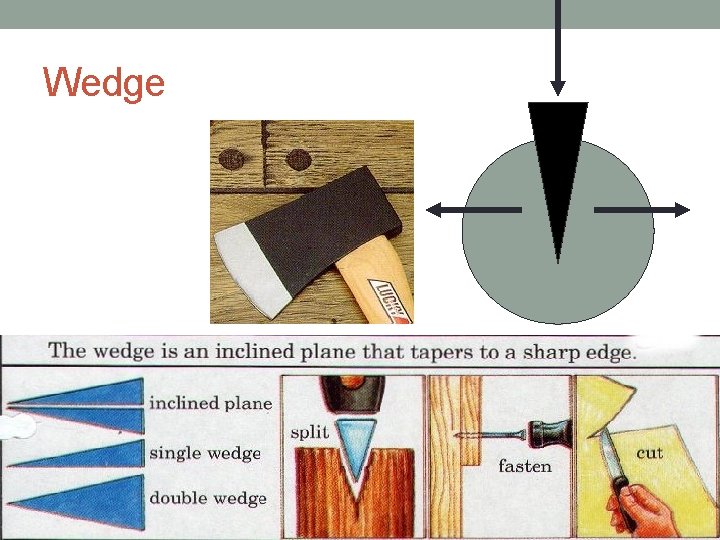
Wedge
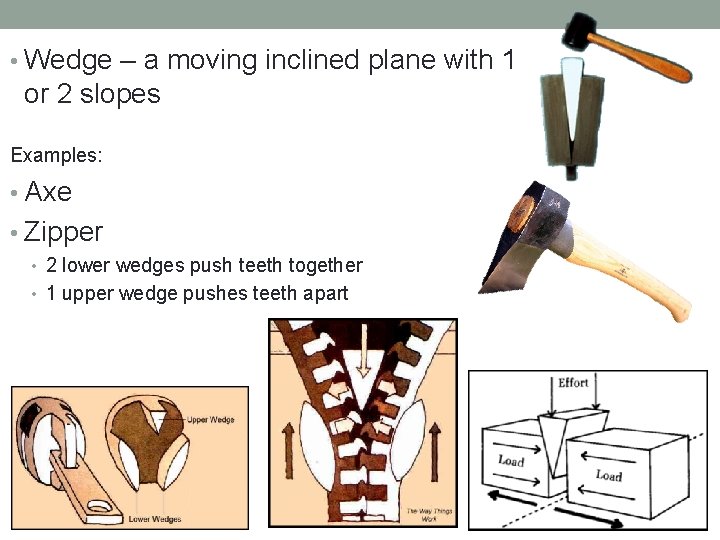
• Wedge – a moving inclined plane with 1 or 2 slopes Examples: • Axe • Zipper • 2 lower wedges push teeth together • 1 upper wedge pushes teeth apart
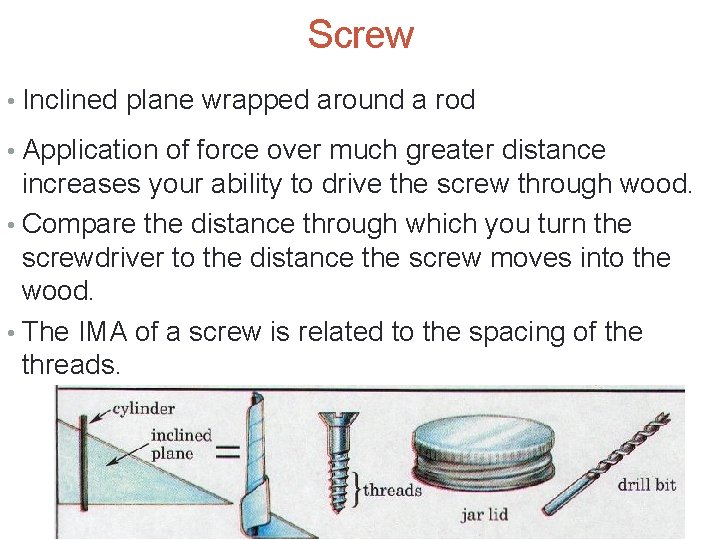
Screw • Inclined plane wrapped around a rod • Application of force over much greater distance increases your ability to drive the screw through wood. • Compare the distance through which you turn the screwdriver to the distance the screw moves into the wood. • The IMA of a screw is related to the spacing of the threads.
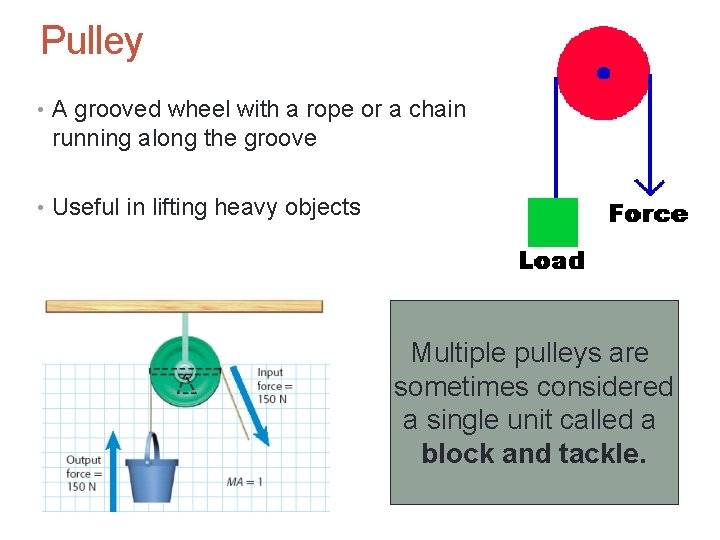
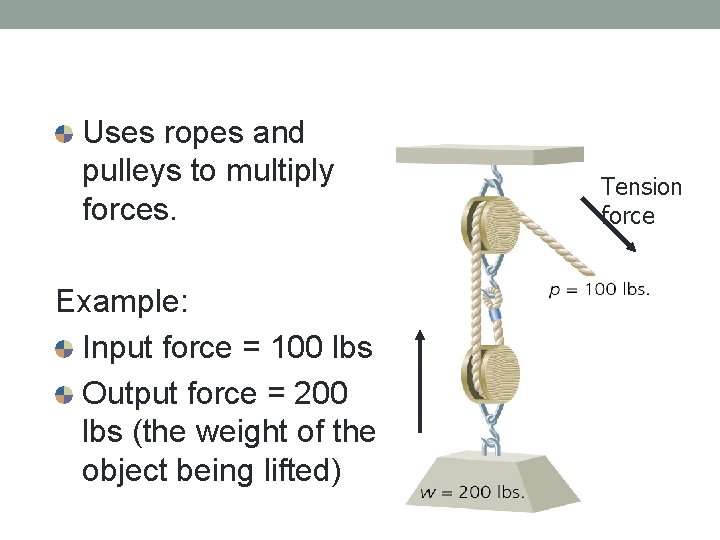
Pulley • A grooved wheel with a rope or a chain running along the groove • Useful in lifting heavy objects Multiple pulleys are sometimes considered a single unit called a block and tackle.
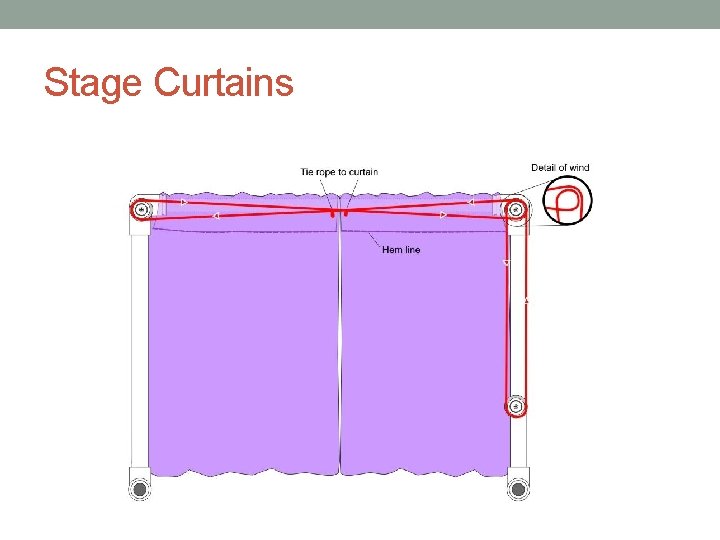
Stage Curtains
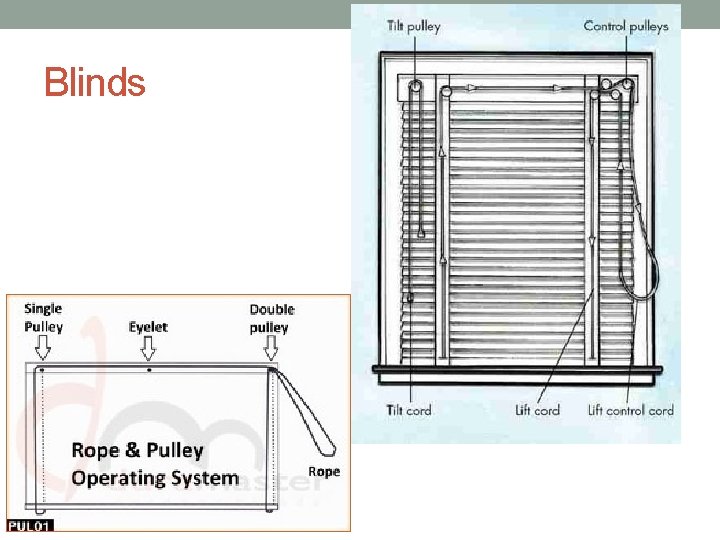
Blinds
Uses ropes and pulleys to multiply forces. Example: Input force = 100 lbs Output force = 200 lbs (the weight of the object being lifted) Tension force
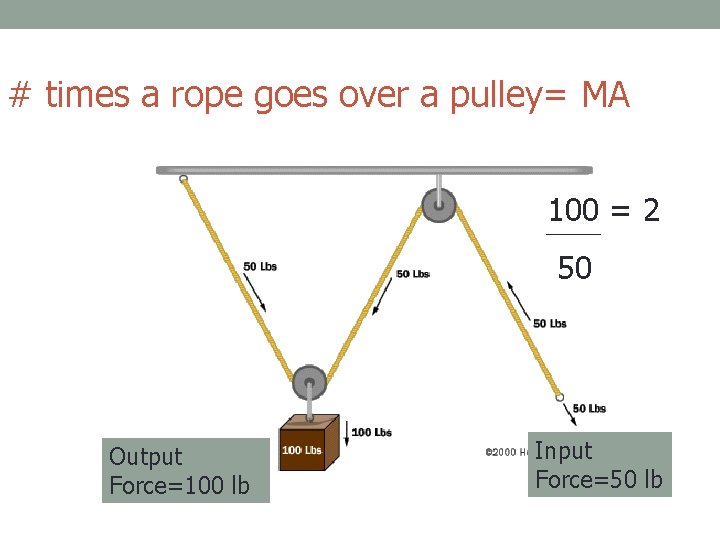
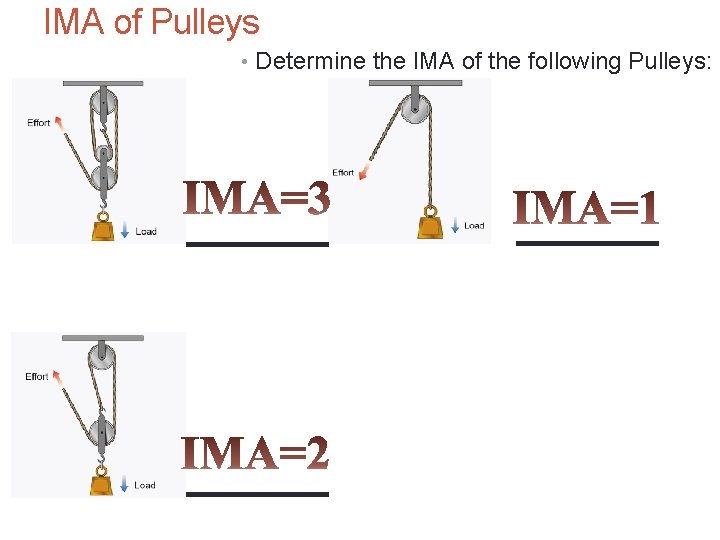
# times a rope goes over a pulley= MA 100 = 2 50 Output Force=100 lb Input Force=50 lb
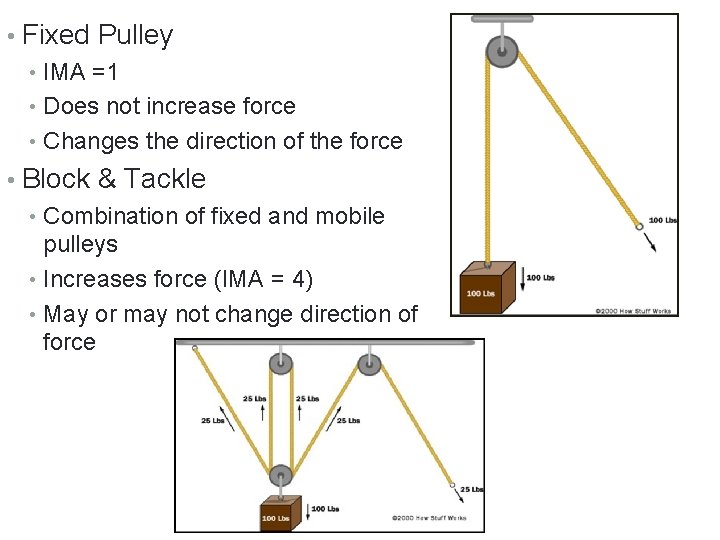
• Fixed Pulley • IMA =1 • Does not increase force • Changes the direction of the force • Block & Tackle • Combination of fixed and mobile pulleys • Increases force (IMA = 4) • May or may not change direction of force
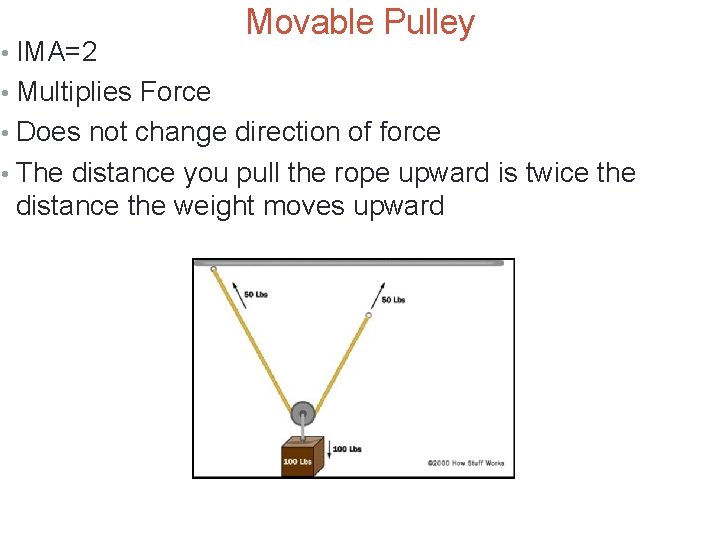
• IMA=2 Movable Pulley • Multiplies Force • Does not change direction of force • The distance you pull the rope upward is twice the distance the weight moves upward
IMA of Pulleys • Determine the IMA of the following Pulleys:
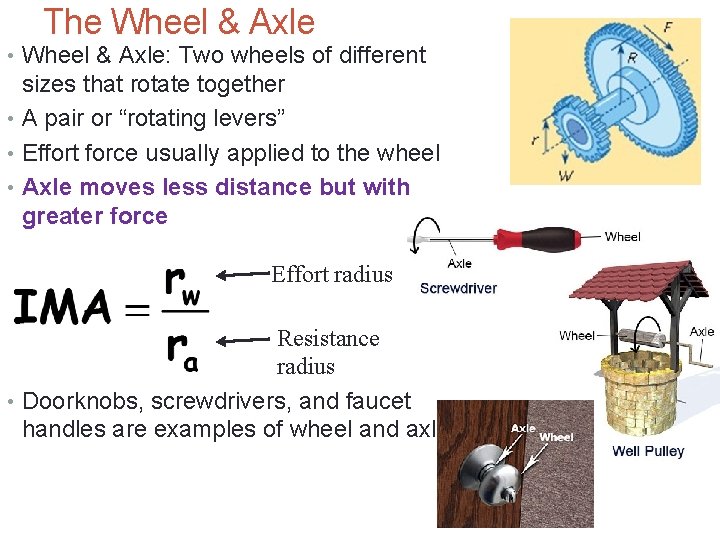
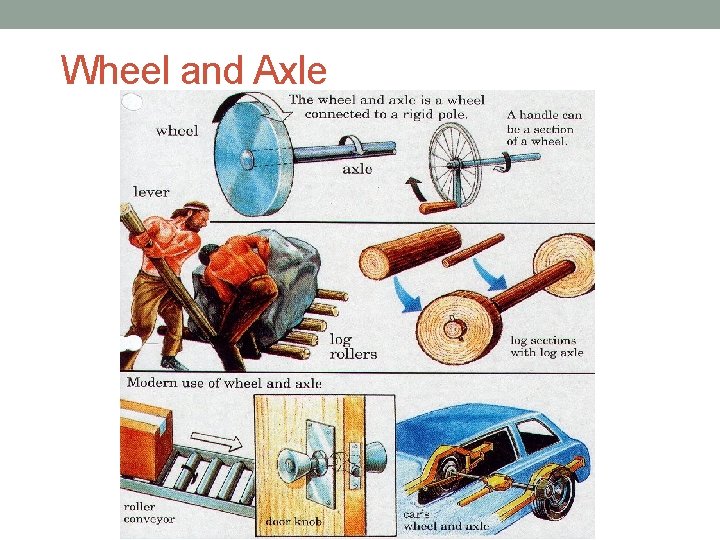
The Wheel & Axle • Wheel & Axle: Two wheels of different sizes that rotate together • A pair or “rotating levers” • Effort force usually applied to the wheel • Axle moves less distance but with greater force Effort radius Resistance radius • Doorknobs, screwdrivers, and faucet handles are examples of wheel and axles
Wheel and Axle
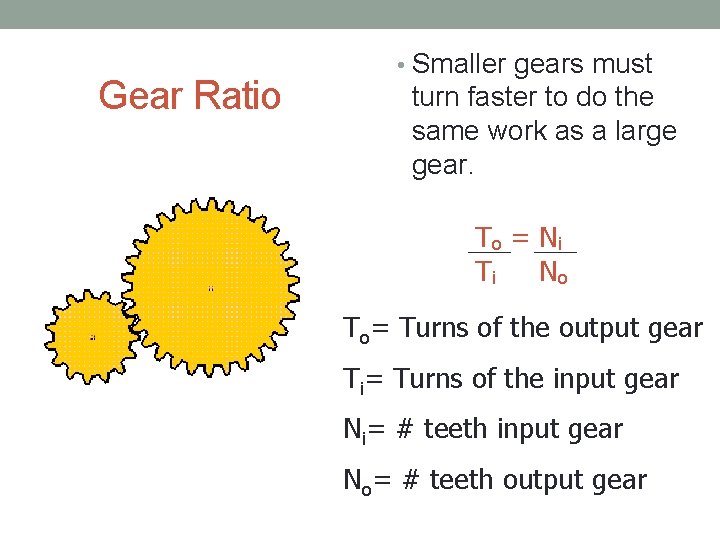
Gears and rotating machines • Rotating machines have gears and shafts. • If more than 1 shaft is involved, they can turn at different speeds. • They have teeth so they do not slip. • The input gear is what you turn • The output gear is connected to the output of the machine
Gear Ratio • Smaller gears must turn faster to do the same work as a large gear. To = N i Ti No To= Turns of the output gear Ti= Turns of the input gear Ni= # teeth input gear No= # teeth output gear
Simple Machines - Review • Device for multiplying force • May also change the direction of a force Machines do NOT create energy “Energy cannot be created or destroyed” A machine multiplies force at the expense of distance.
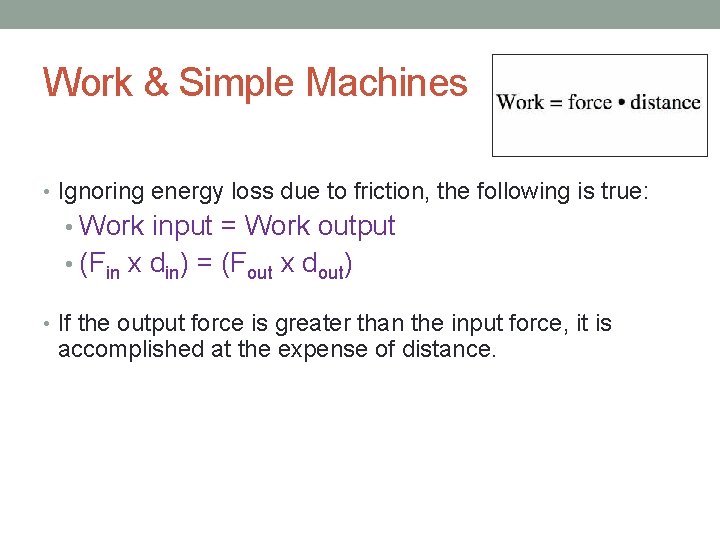
Work & Simple Machines • Ignoring energy loss due to friction, the following is true: • Work input = Work output • (Fin x din) = (Fout x dout) • If the output force is greater than the input force, it is accomplished at the expense of distance.
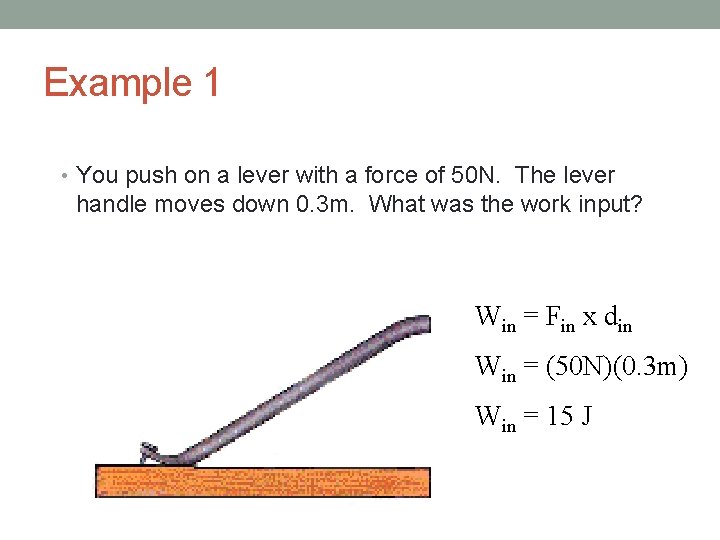
Example 1 • You push on a lever with a force of 50 N. The lever handle moves down 0. 3 m. What was the work input? Win = Fin x din Win = (50 N)(0. 3 m) Win = 15 J
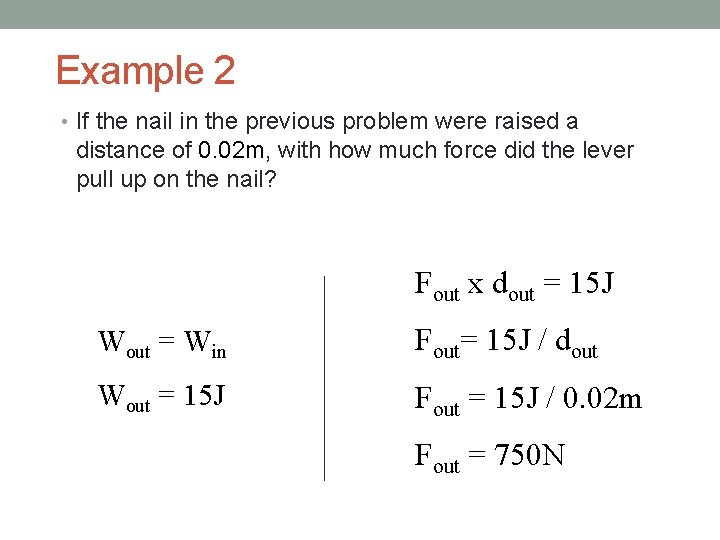
Example 2 • If the nail in the previous problem were raised a distance of 0. 02 m, with how much force did the lever pull up on the nail? Fout x dout = 15 J Wout = Win Fout= 15 J / dout Wout = 15 J Fout = 15 J / 0. 02 m Fout = 750 N
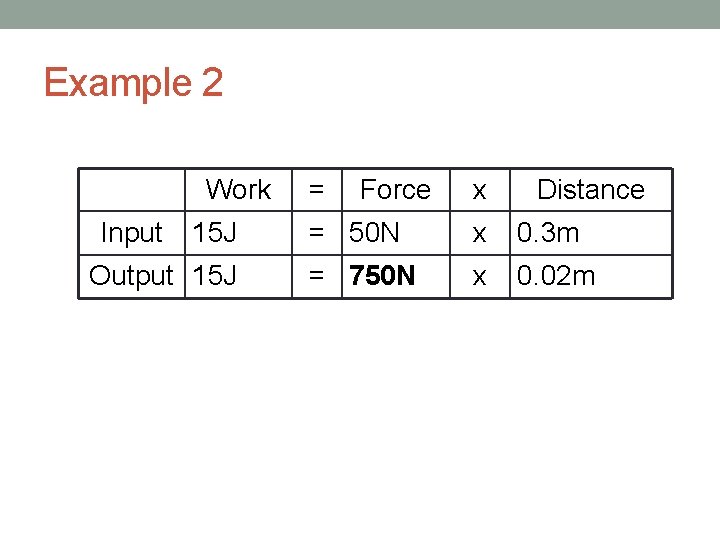
Example 2 Work Input 15 J Output 15 J = Force x Distance = 50 N x 0. 3 m = 750 N x 0. 02 m
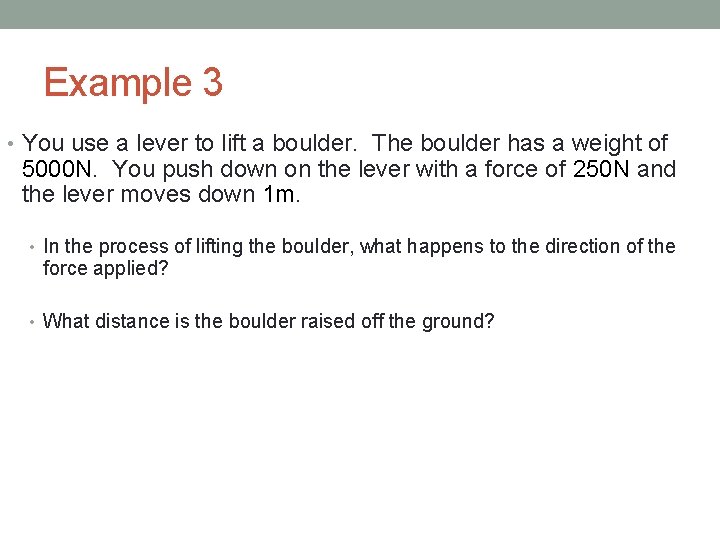
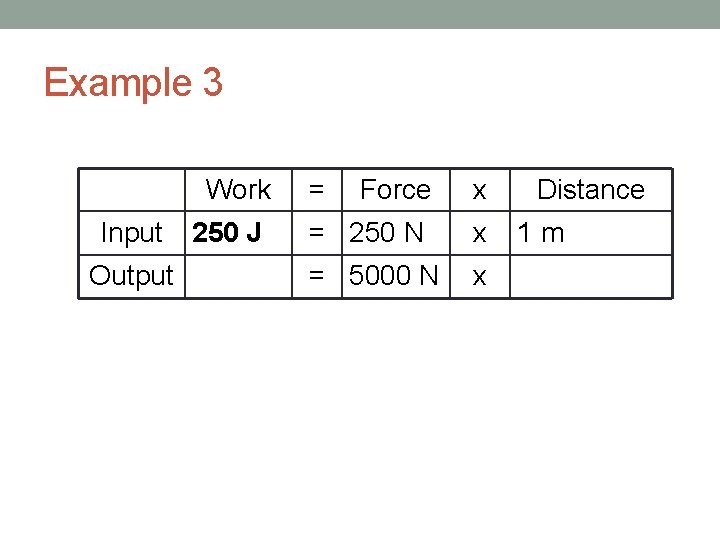
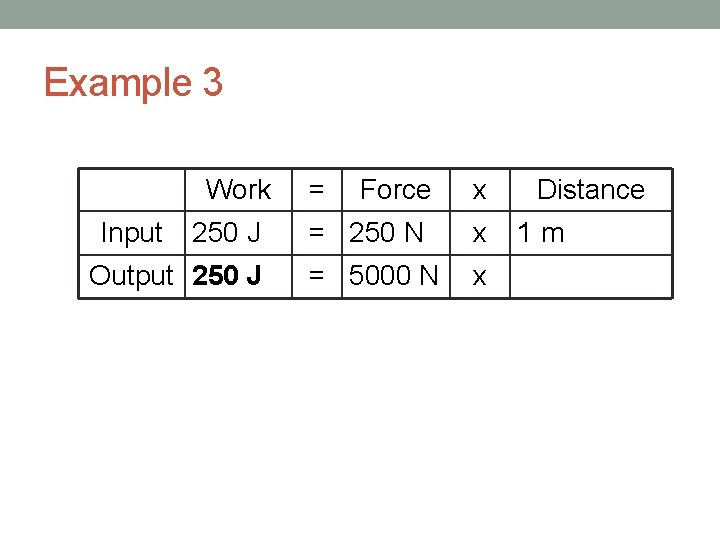
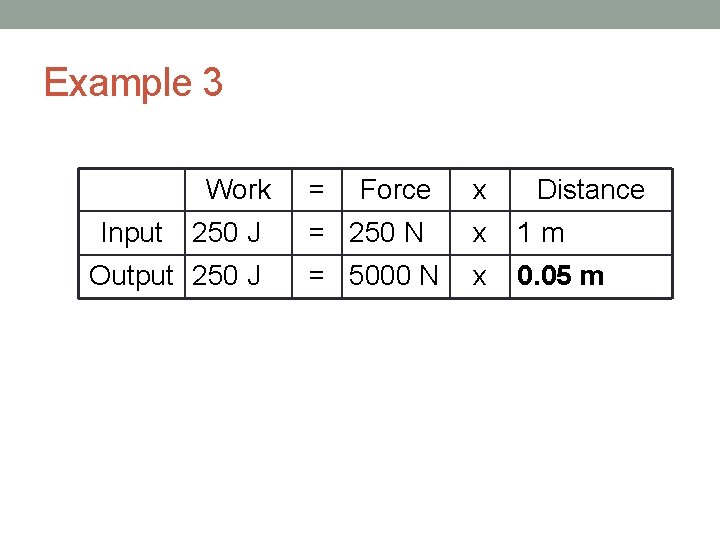
Example 3 • You use a lever to lift a boulder. The boulder has a weight of 5000 N. You push down on the lever with a force of 250 N and the lever moves down 1 m. • In the process of lifting the boulder, what happens to the direction of the force applied? • What distance is the boulder raised off the ground?
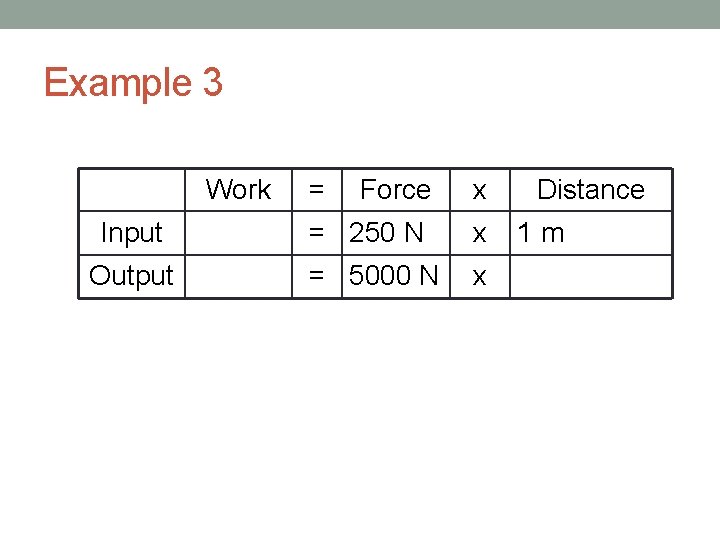
Example 3 Work = Force x Input = 250 N x Output = 5000 N x Distance 1 m
Example 3 Work Input Output 250 J = Force x = 250 N x = 5000 N x Distance 1 m
Example 3 Work Input 250 J Output 250 J = Force x = 250 N x = 5000 N x Distance 1 m
Example 3 Work Input 250 J Output 250 J = Force x Distance = 250 N x 1 m = 5000 N x 0. 05 m
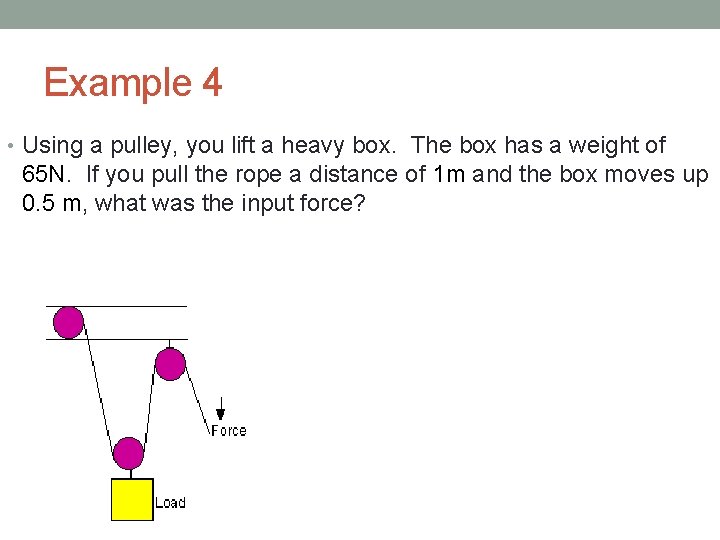
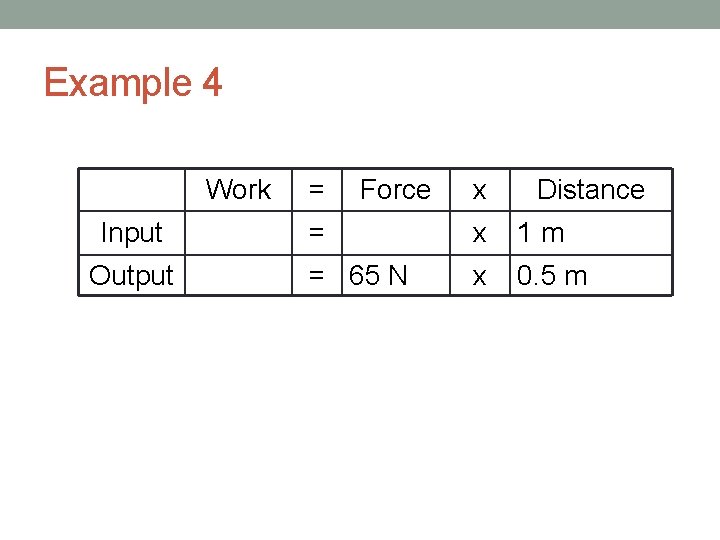
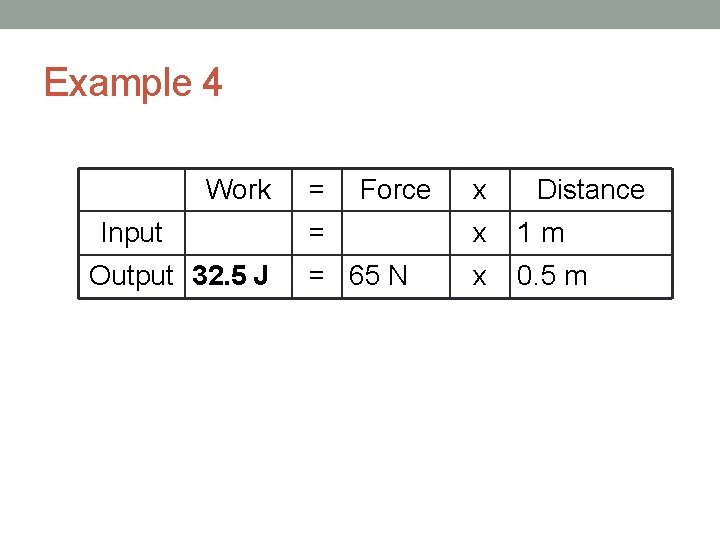
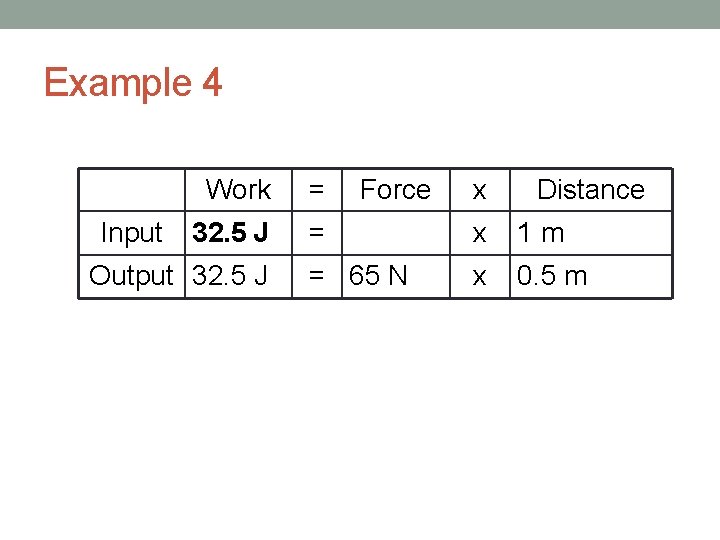
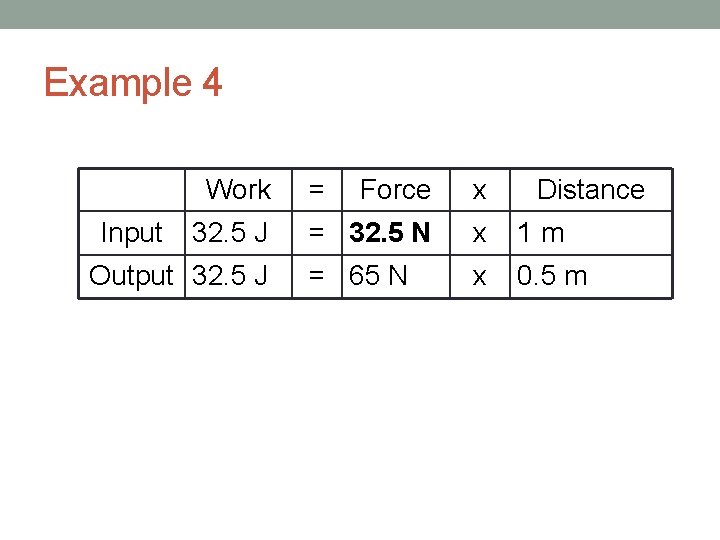
Example 4 • Using a pulley, you lift a heavy box. The box has a weight of 65 N. If you pull the rope a distance of 1 m and the box moves up 0. 5 m, what was the input force?
Example 4 Work Input Output = Force x Distance = x 1 m = 65 N x 0. 5 m
Example 4 Work Input Output 32. 5 J = Force x Distance = x 1 m = 65 N x 0. 5 m
Example 4 Input Work = 32. 5 J = x 1 m = 65 N x 0. 5 m Output 32. 5 J Force x Distance
Example 4 Work Input 32. 5 J Output 32. 5 J = Force x Distance = 32. 5 N x 1 m = 65 N x 0. 5 m
Simple Machines Review • Simple machines are helpful because they can increase the force you apply. • Can the force of your hand break the metal top off of a metal can? —a can opener can. • Can the force of your arms cut a large branch in two? A hedge clipper can.
Simple Machines Review • Simple machines DO NOT CREATE ENERGY. • Simple machines multiply force at the expense of distance. • Work input must always equal work output.
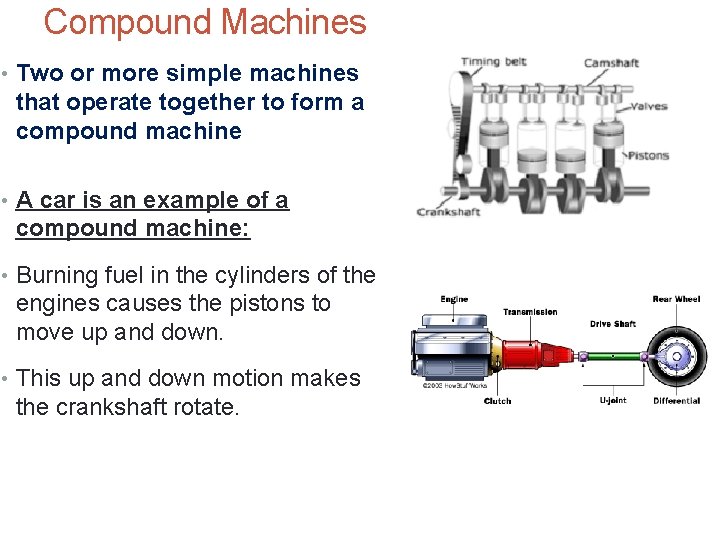
Compound Machines • Two or more simple machines that operate together to form a compound machine • A car is an example of a compound machine: • Burning fuel in the cylinders of the engines causes the pistons to move up and down. • This up and down motion makes the crankshaft rotate.
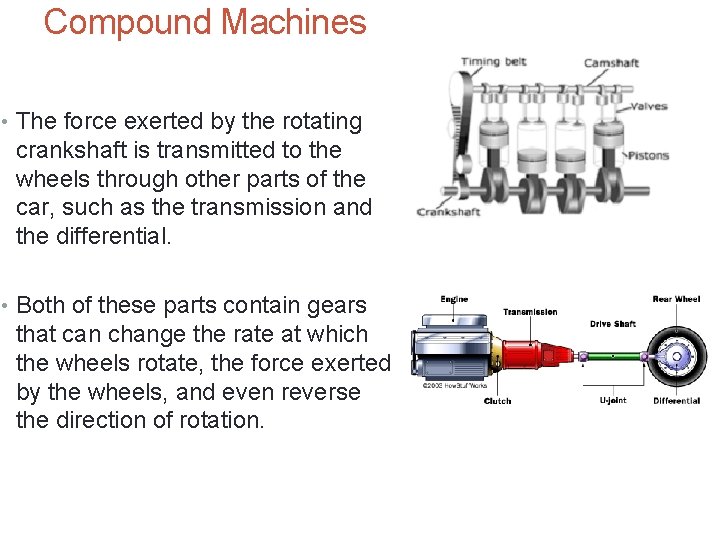
Compound Machines • The force exerted by the rotating crankshaft is transmitted to the wheels through other parts of the car, such as the transmission and the differential. • Both of these parts contain gears that can change the rate at which the wheels rotate, the force exerted by the wheels, and even reverse the direction of rotation.