
Simple Machines I What a machine can do
- Slides: 9
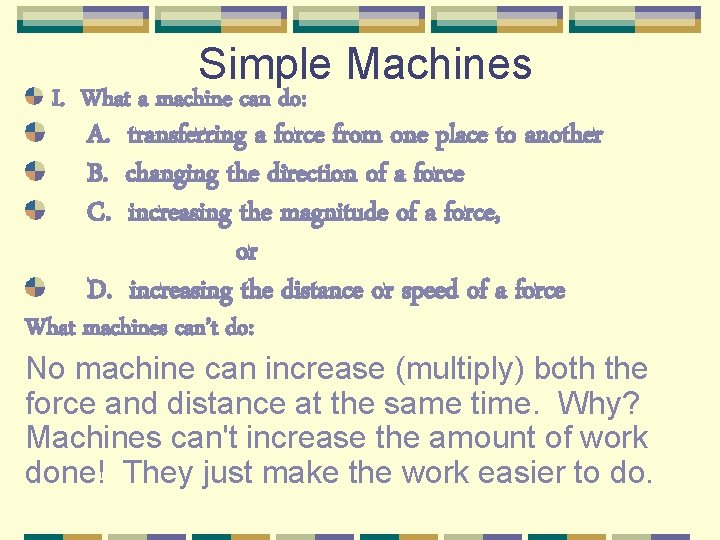
Simple Machines I. What a machine can do: A. transferring a force from one place to another B. changing the direction of a force C. increasing the magnitude of a force, or D. increasing the distance or speed of a force What machines can’t do: No machine can increase (multiply) both the force and distance at the same time. Why? Machines can't increase the amount of work done! They just make the work easier to do.
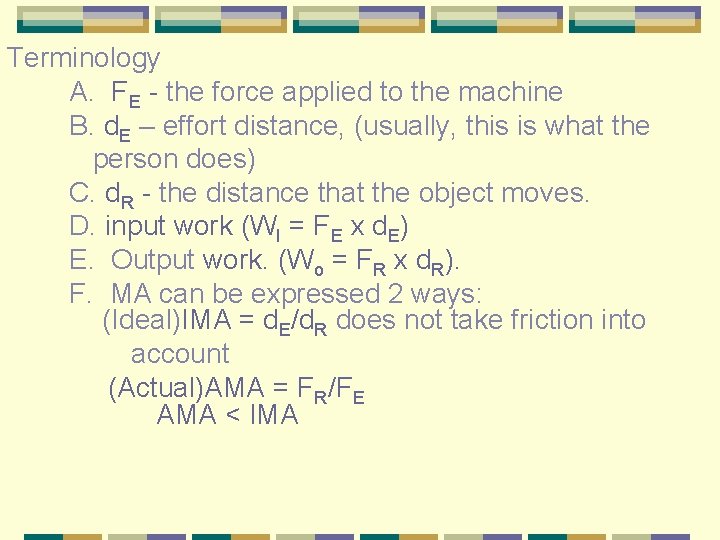
Terminology A. FE - the force applied to the machine B. d. E – effort distance, (usually, this is what the person does) C. d. R - the distance that the object moves. D. input work (WI = FE x d. E) E. Output work. (Wo = FR x d. R). F. MA can be expressed 2 ways: (Ideal)IMA = d. E/d. R does not take friction into account (Actual)AMA = FR/FE AMA < IMA
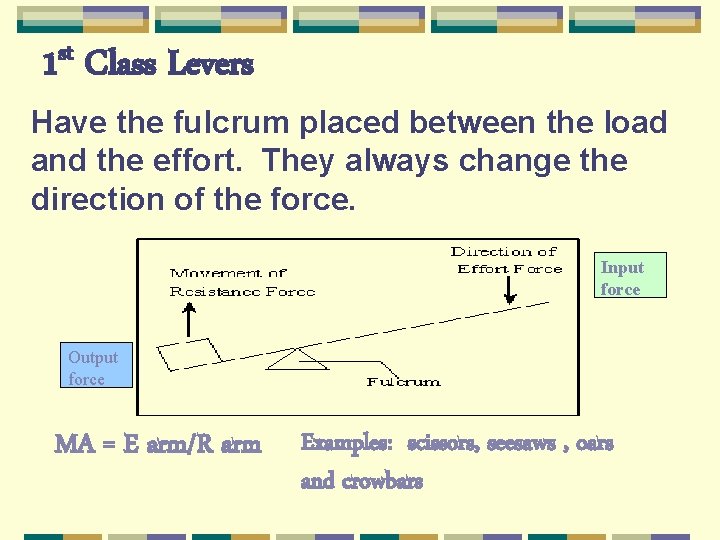
st 1 Class Levers Have the fulcrum placed between the load and the effort. They always change the direction of the force. Input force Output force MA = E arm/R arm Examples: scissors, seesaws , oars and crowbars
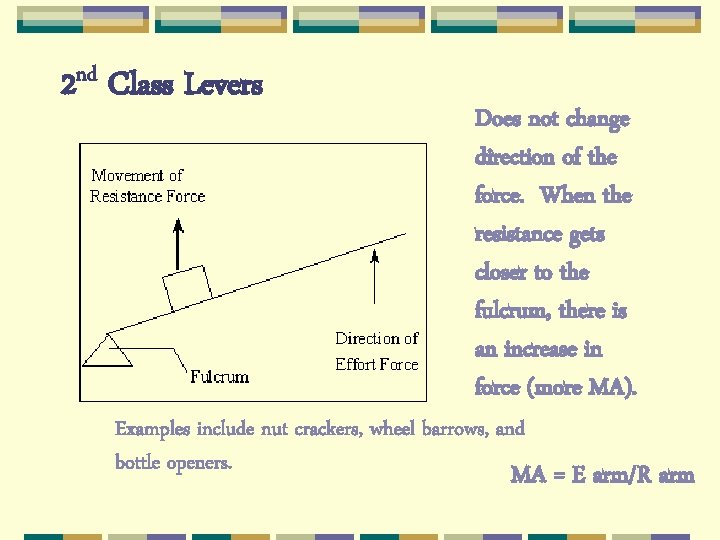
2 nd Class Levers Does not change direction of the force. When the resistance gets closer to the fulcrum, there is an increase in force (more MA). Examples include nut crackers, wheel barrows, and bottle openers. MA = E arm/R arm
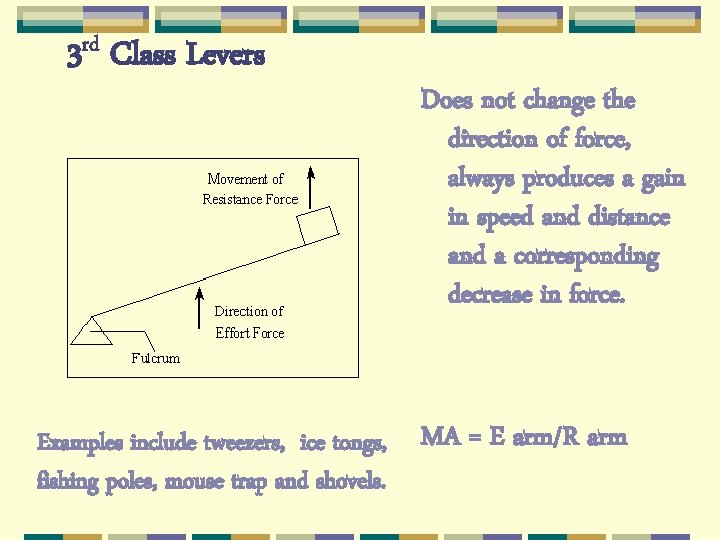
3 rd Class Levers Examples include tweezers, ice tongs, fishing poles, mouse trap and shovels. Does not change the direction of force, always produces a gain in speed and distance and a corresponding decrease in force. MA = E arm/R arm
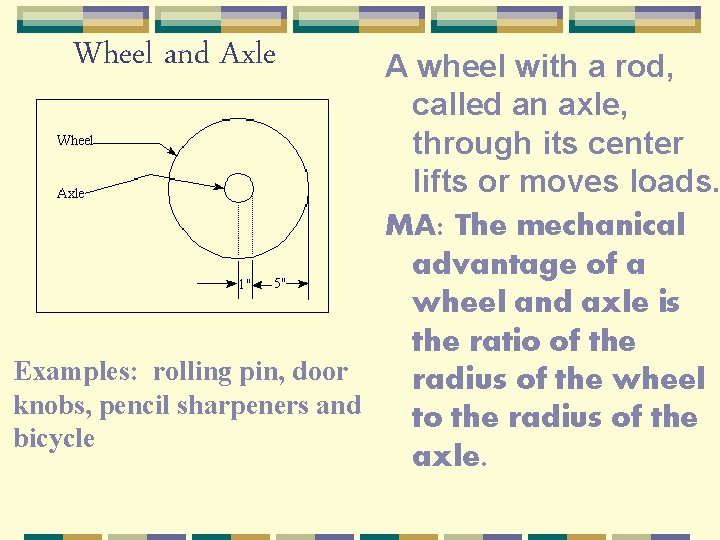
Wheel and Axle A wheel with a rod, called an axle, through its center lifts or moves loads. MA: The mechanical advantage of a wheel and axle is the ratio of the Examples: rolling pin, door radius of the wheel knobs, pencil sharpeners and to the radius of the bicycle axle.
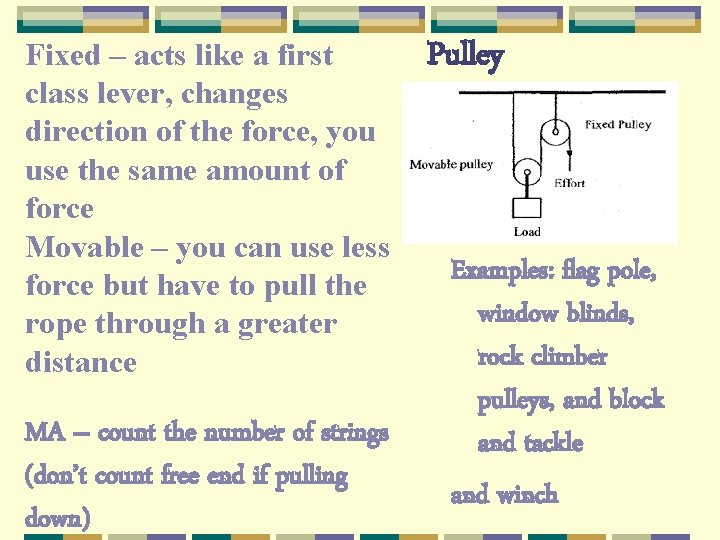
Fixed – acts like a first class lever, changes direction of the force, you use the same amount of force Movable – you can use less force but have to pull the rope through a greater distance MA – count the number of strings (don’t count free end if pulling down) Pulley Examples: flag pole, window blinds, rock climber pulleys, and block and tackle and winch
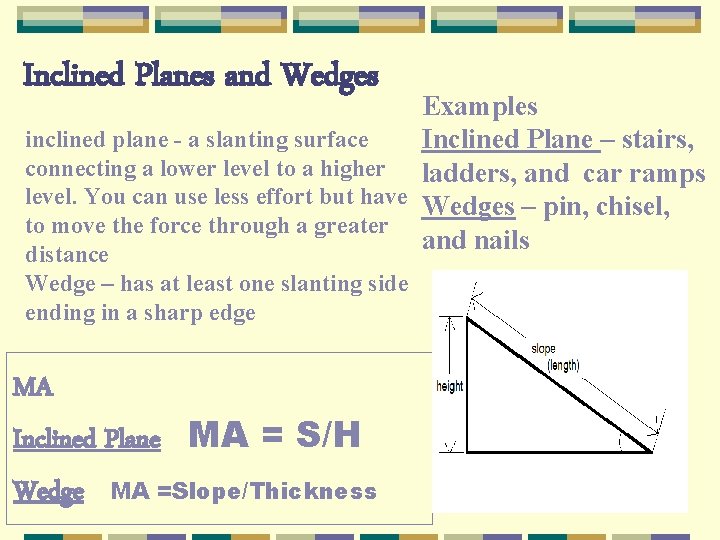
Inclined Planes and Wedges Examples inclined plane - a slanting surface Inclined Plane – stairs, connecting a lower level to a higher ladders, and car ramps level. You can use less effort but have Wedges – pin, chisel, to move the force through a greater and nails distance Wedge – has at least one slanting side ending in a sharp edge MA Inclined Plane MA = S/H Wedge MA =Slope/Thickness
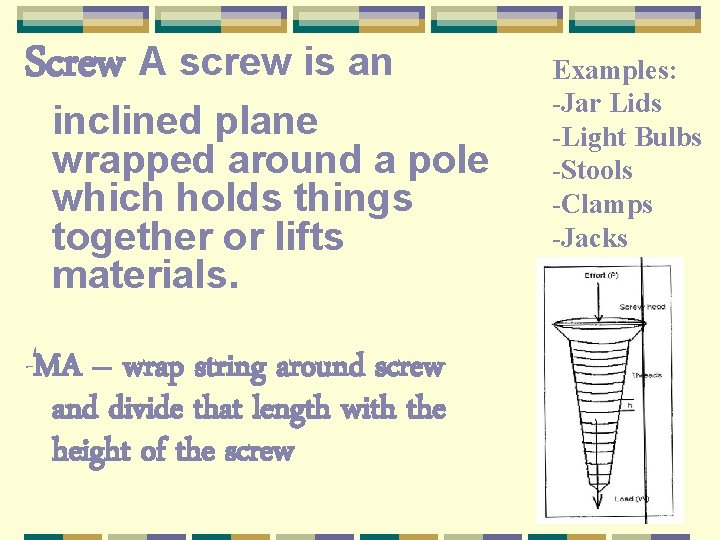
Screw A screw is an inclined plane wrapped around a pole which holds things together or lifts materials. -MA – wrap string around screw and divide that length with the height of the screw Examples: -Jar Lids -Light Bulbs -Stools -Clamps -Jacks -Wrenches