
SIMPLE MACHINES From Pyramids to Satellites I ancient

- Slides: 14
SIMPLE MACHINES From Pyramids to Satellites
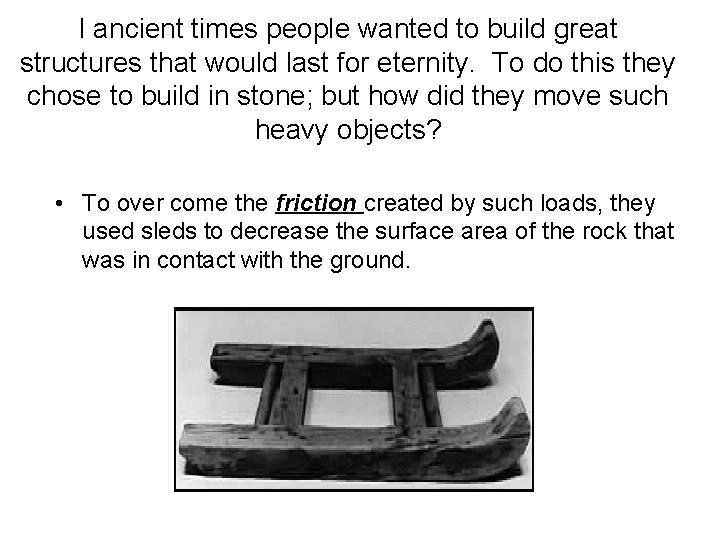
I ancient times people wanted to build great structures that would last for eternity. To do this they chose to build in stone; but how did they move such heavy objects? • To over come the friction created by such loads, they used sleds to decrease the surface area of the rock that was in contact with the ground.
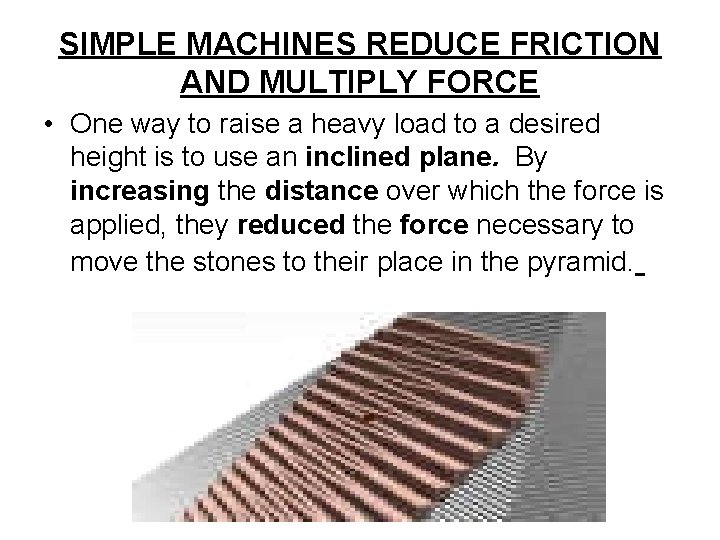
SIMPLE MACHINES REDUCE FRICTION AND MULTIPLY FORCE • One way to raise a heavy load to a desired height is to use an inclined plane. By increasing the distance over which the force is applied, they reduced the force necessary to move the stones to their place in the pyramid.
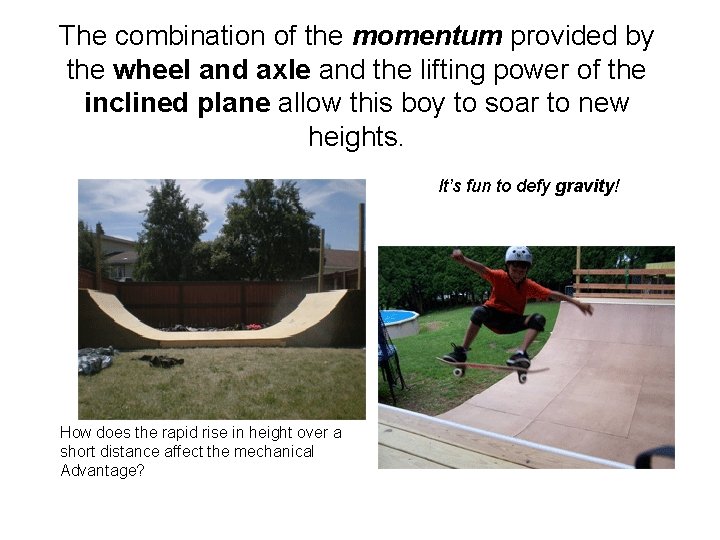
The combination of the momentum provided by the wheel and axle and the lifting power of the inclined plane allow this boy to soar to new heights. It’s fun to defy gravity! How does the rapid rise in height over a short distance affect the mechanical Advantage?
Simple Machines In Daily Life. • Since even before the Egyptians, men have developed simple machines to increase the efficiency of their work and quality of their lives. Most of the tools that we use today are either simple machines or some combination of simple machines.
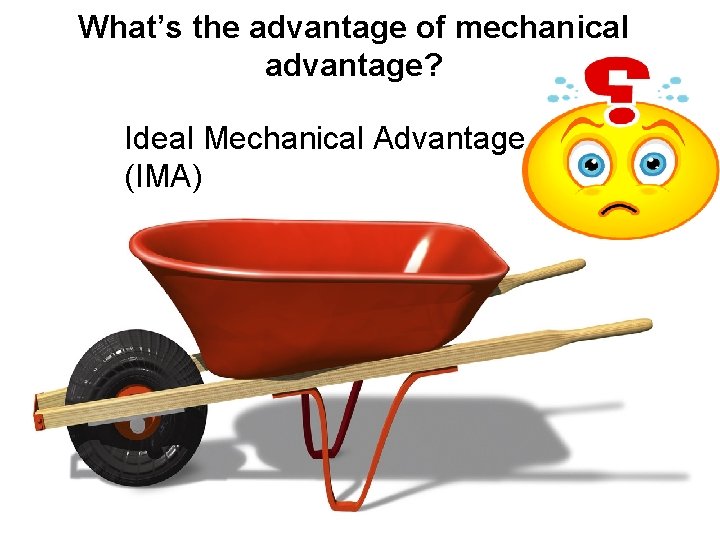
What’s the advantage of mechanical advantage? Ideal Mechanical Advantage (IMA)
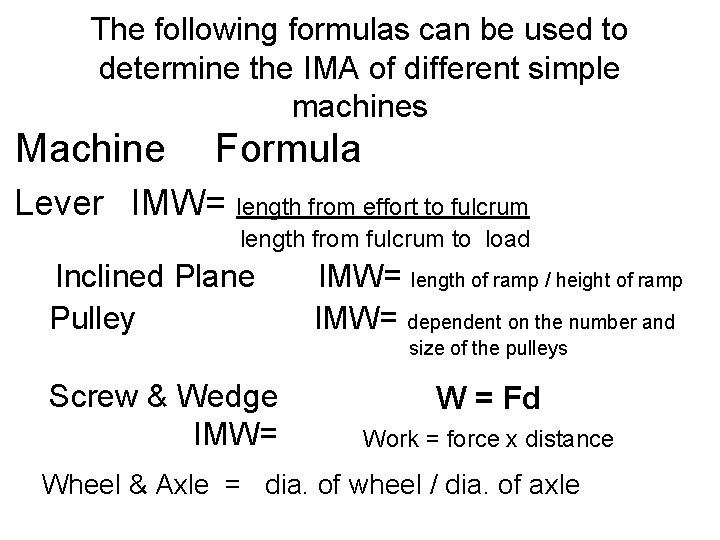
The following formulas can be used to determine the IMA of different simple machines Machine Formula Lever IMW= length from effort to fulcrum length from fulcrum to load Inclined Plane Pulley IMW= length of ramp / height of ramp IMW= dependent on the number and size of the pulleys Screw & Wedge IMW= W = Fd Work = force x distance Wheel & Axle = dia. of wheel / dia. of axle
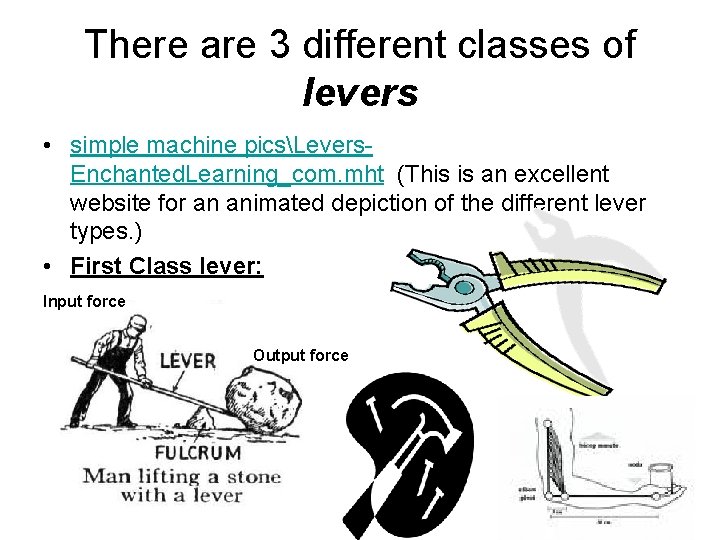
There are 3 different classes of levers • simple machine picsLevers. Enchanted. Learning_com. mht (This is an excellent website for an animated depiction of the different lever types. ) • First Class lever: Input force Output force
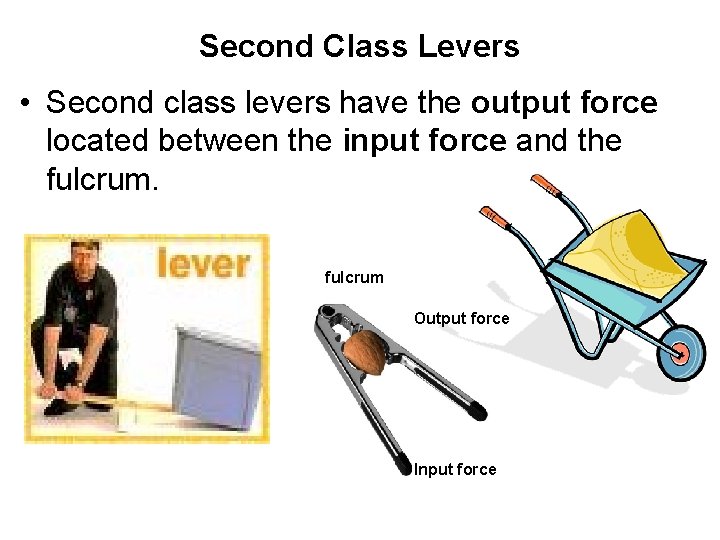
Second Class Levers • Second class levers have the output force located between the input force and the fulcrum Output force Input force
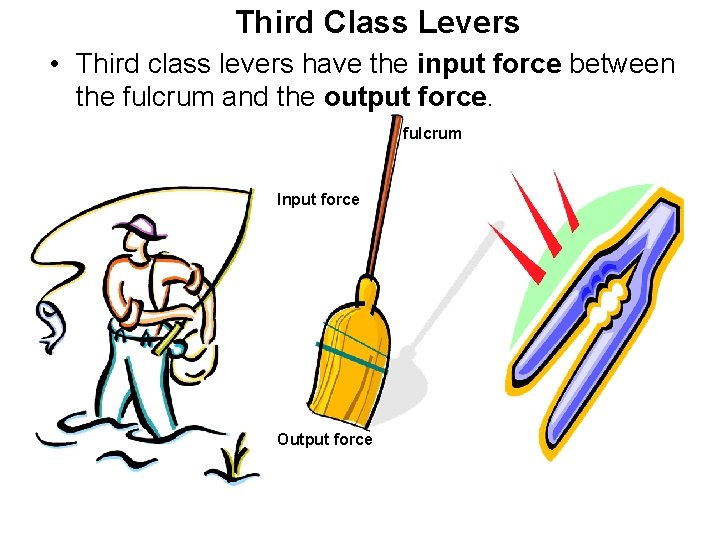
Third Class Levers • Third class levers have the input force between the fulcrum and the output force. fulcrum Input force Output force
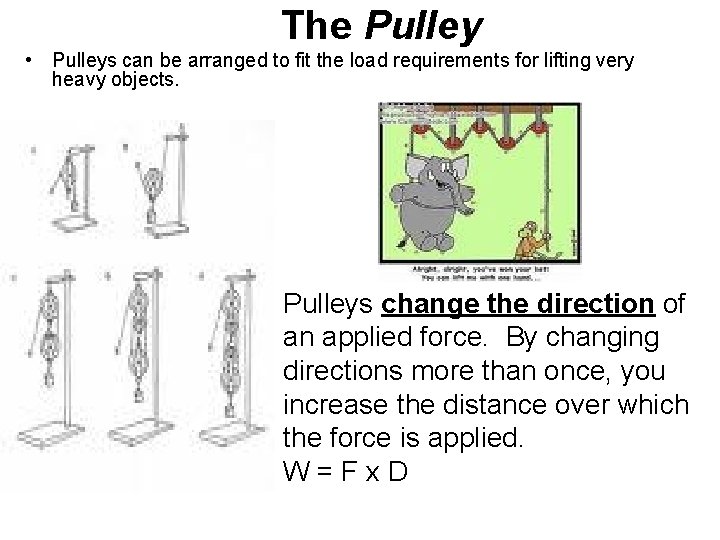
The Pulley • Pulleys can be arranged to fit the load requirements for lifting very heavy objects. Pulleys change the direction of an applied force. By changing directions more than once, you increase the distance over which the force is applied. W=Fx. D
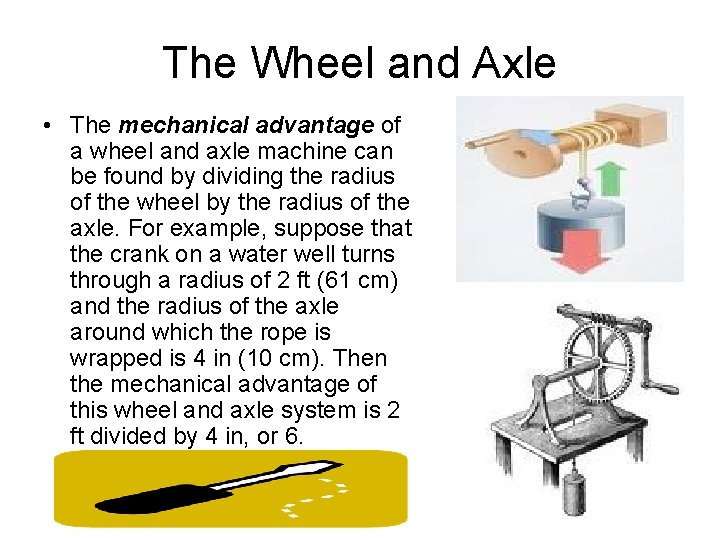
The Wheel and Axle • The mechanical advantage of a wheel and axle machine can be found by dividing the radius of the wheel by the radius of the axle. For example, suppose that the crank on a water well turns through a radius of 2 ft (61 cm) and the radius of the axle around which the rope is wrapped is 4 in (10 cm). Then the mechanical advantage of this wheel and axle system is 2 ft divided by 4 in, or 6.
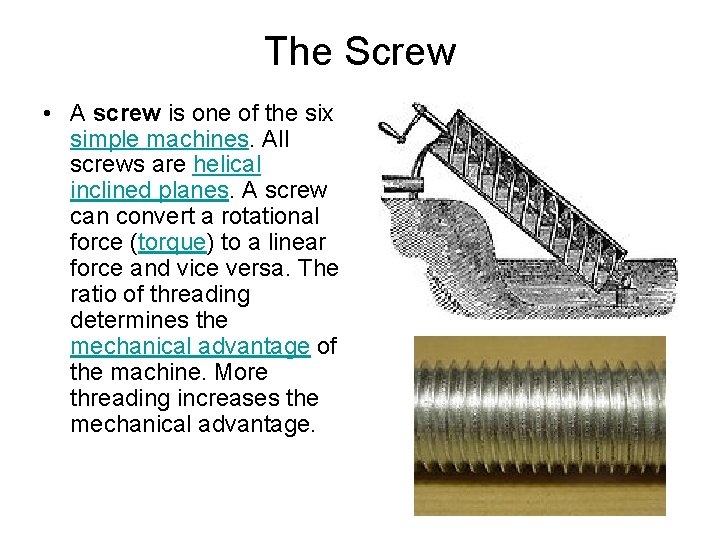
The Screw • A screw is one of the six simple machines. All screws are helical inclined planes. A screw can convert a rotational force (torque) to a linear force and vice versa. The ratio of threading determines the mechanical advantage of the machine. More threading increases the mechanical advantage.
The End