
Simple Machines Ag Mech and Metal Introduction to
- Slides: 43
Simple Machines Ag Mech and Metal
Introduction to Simple Machines
What are they? Simple machines are machines with few or no moving parts that are used to make work easier
Definitions: Energy: Ability to do work Work Force x Distance = Force: A Push or a Pull
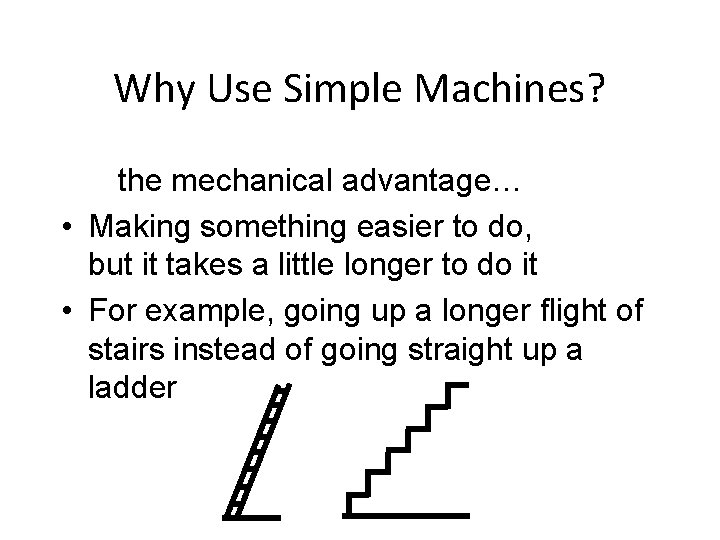
Why Use Simple Machines? For the mechanical advantage… • Making something easier to do, but it takes a little longer to do it • For example, going up a longer flight of stairs instead of going straight up a ladder
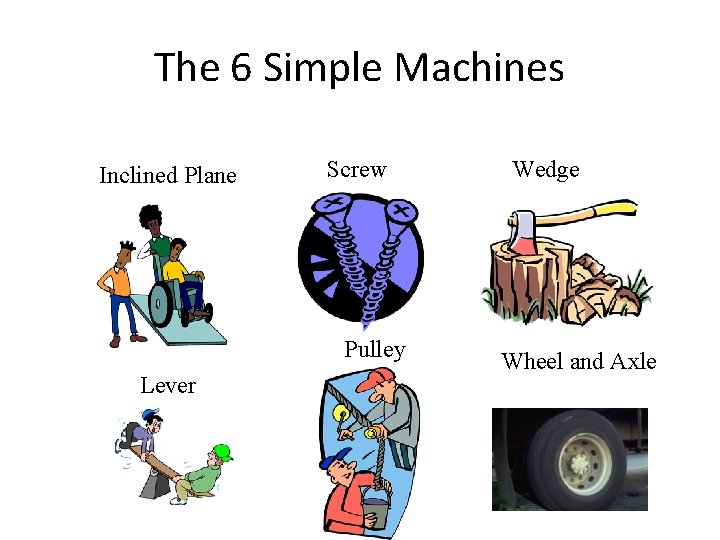
The 6 Simple Machines Inclined Plane Screw Pulley Lever Wedge Wheel and Axle
• The mechanical advantage of a lever is the ratio of the length of the lever on the applied force side of the fulcrum to the length of the lever on the resistance force side of the fulcrum.
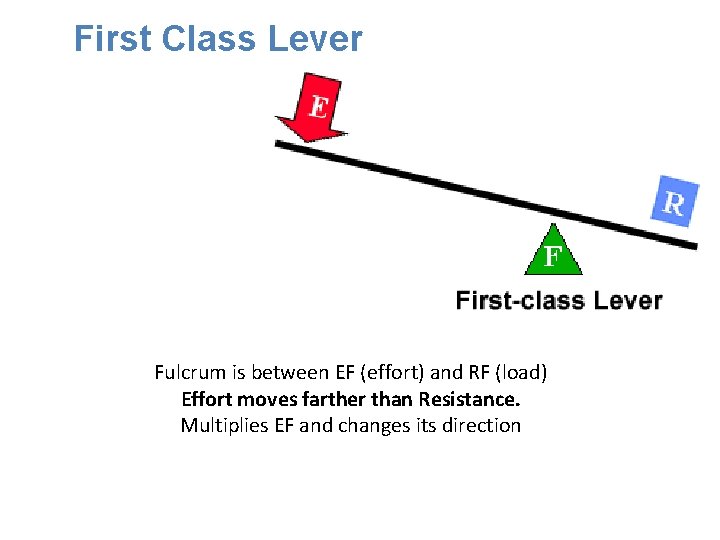
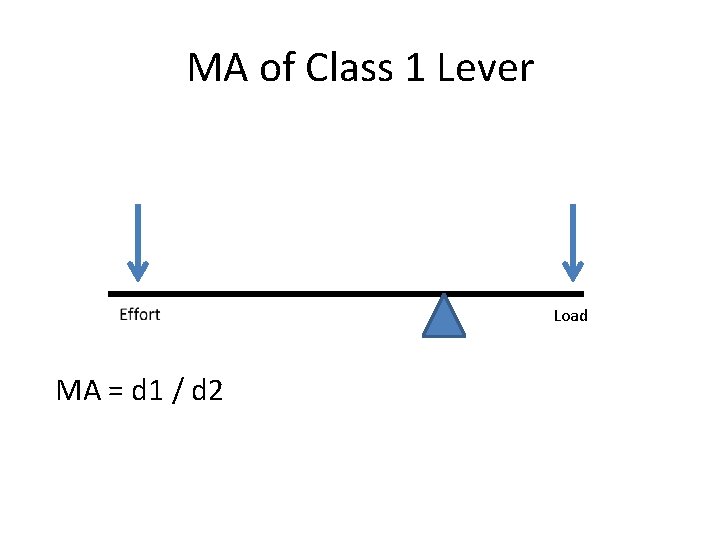
First Class Lever Fulcrum is between EF (effort) and RF (load) Effort moves farther than Resistance. Multiplies EF and changes its direction
MA of Class 1 Lever Load MA = d 1 / d 2
Group Discussion • What are 3 examples of first class levers?
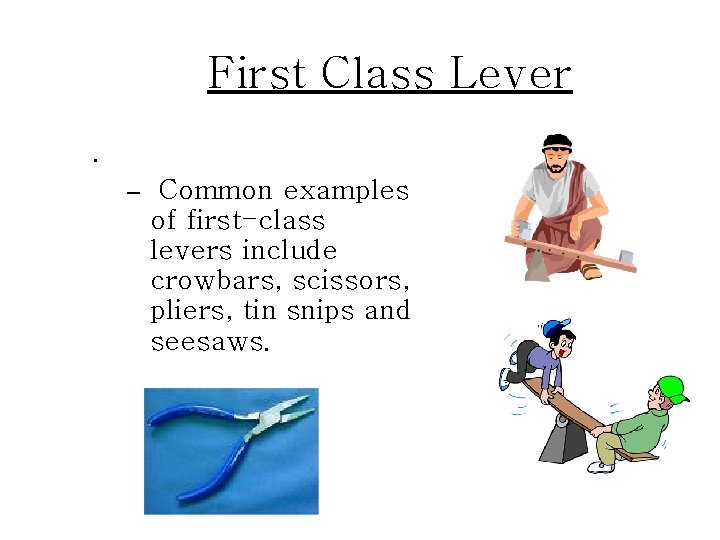
First Class Lever. – Common examples of first-class levers include crowbars, scissors, pliers, tin snips and seesaws.
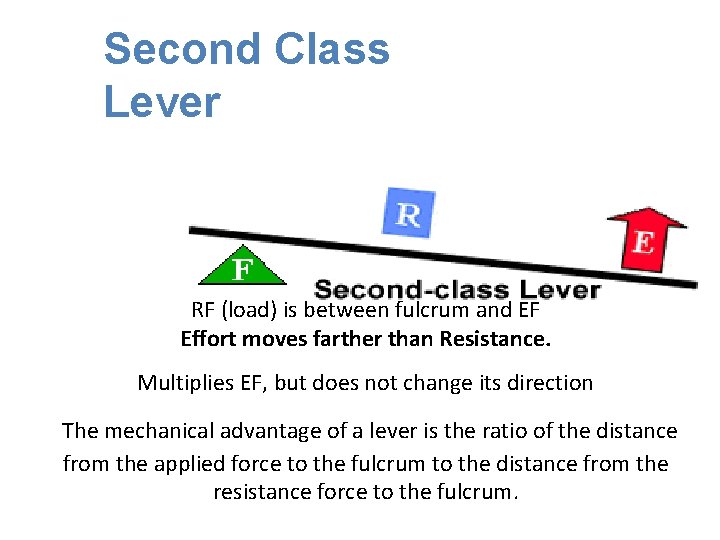
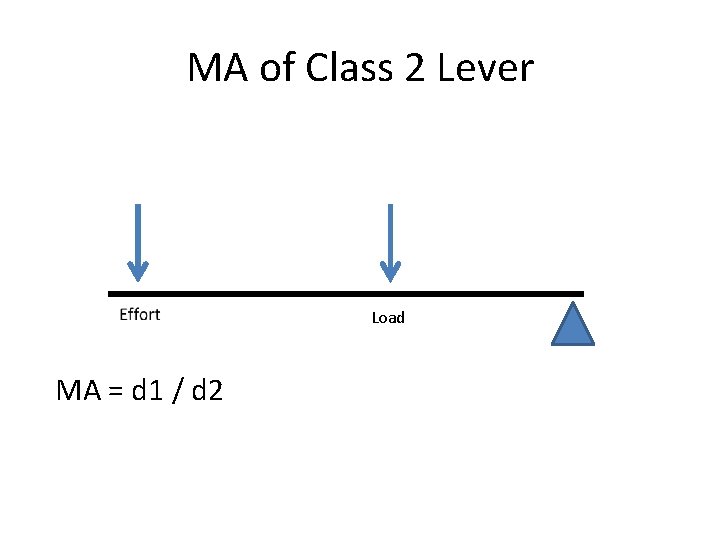
Second Class Lever RF (load) is between fulcrum and EF Effort moves farther than Resistance. Multiplies EF, but does not change its direction The mechanical advantage of a lever is the ratio of the distance from the applied force to the fulcrum to the distance from the resistance force to the fulcrum.
MA of Class 2 Lever Load MA = d 1 / d 2
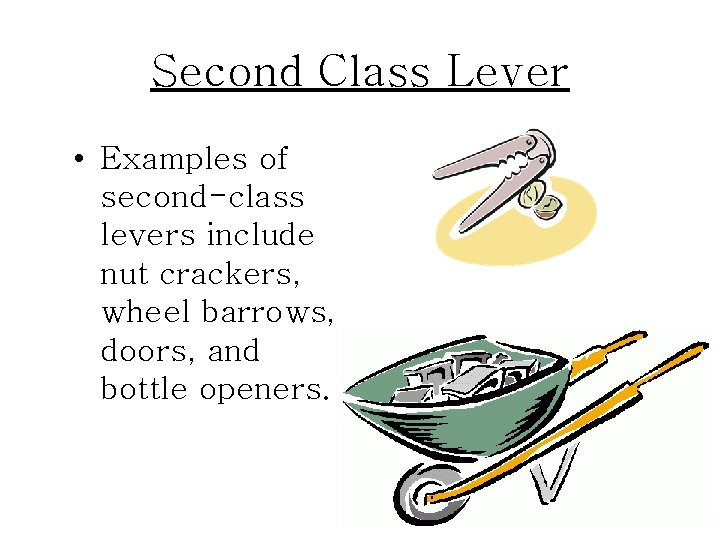
Second Class Lever • Examples of second-class levers include nut crackers, wheel barrows, doors, and bottle openers.
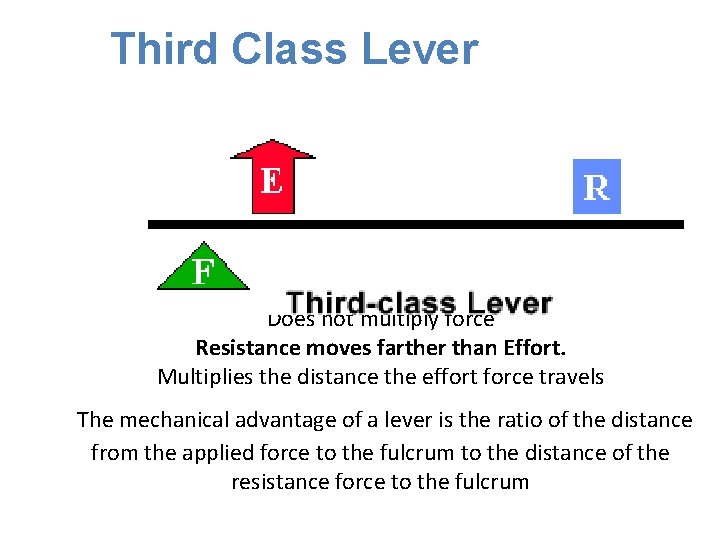
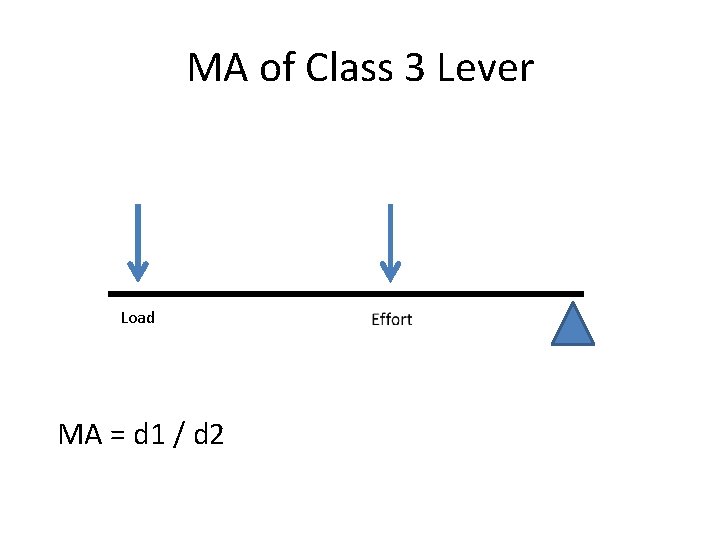
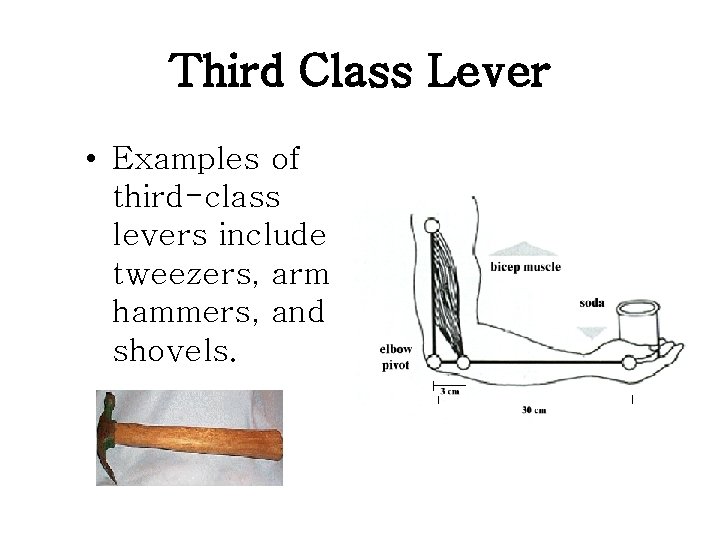
Third Class Lever EF is between fulcrum and RF (load) Does not multiply force Resistance moves farther than Effort. Multiplies the distance the effort force travels The mechanical advantage of a lever is the ratio of the distance from the applied force to the fulcrum to the distance of the resistance force to the fulcrum
MA of Class 3 Lever Load MA = d 1 / d 2
Third Class Lever • Examples of third-class levers include tweezers, arm hammers, and shovels.
Wheel and Axle • Group: What are 3 complex machines that use wheel and axles?
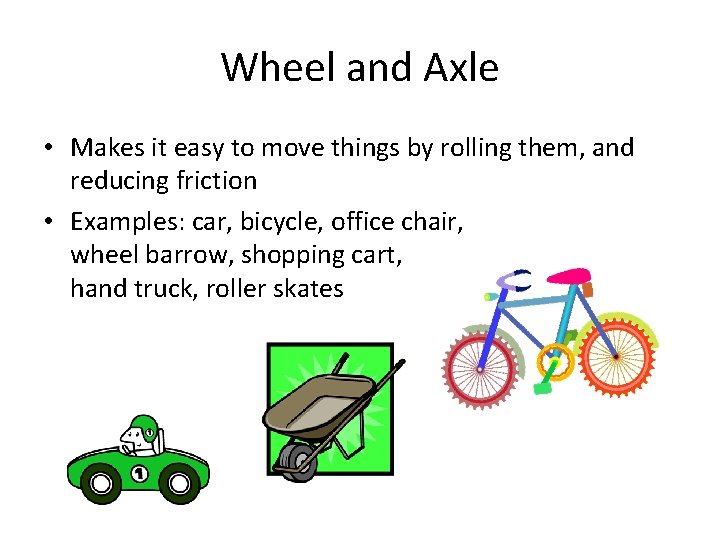
Wheel and Axle • Makes it easy to move things by rolling them, and reducing friction • Examples: car, bicycle, office chair, wheel barrow, shopping cart, hand truck, roller skates
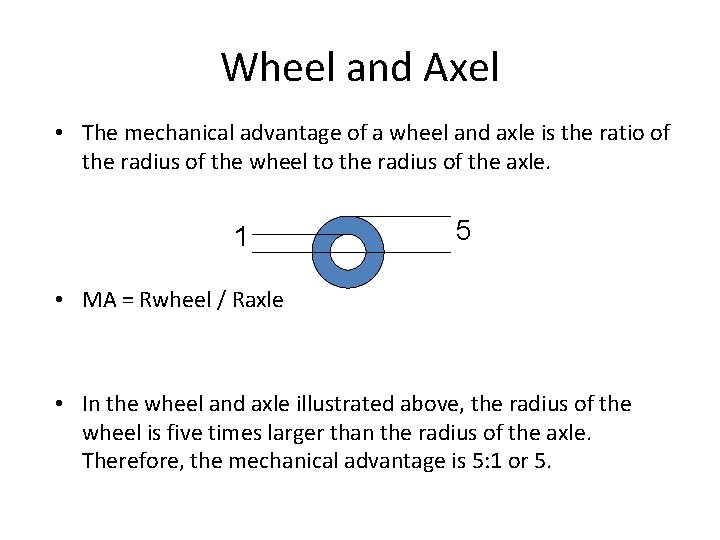
Wheel and Axel • The mechanical advantage of a wheel and axle is the ratio of the radius of the wheel to the radius of the axle. 1 5 • MA = Rwheel / Raxle • In the wheel and axle illustrated above, the radius of the wheel is five times larger than the radius of the axle. Therefore, the mechanical advantage is 5: 1 or 5.
• The wheel and axle can also increase speed by applying the input force to the axle rather than a wheel. This increase is computed like mechanical advantage. This combination would increase the speed 5 times.
Inclined Plane
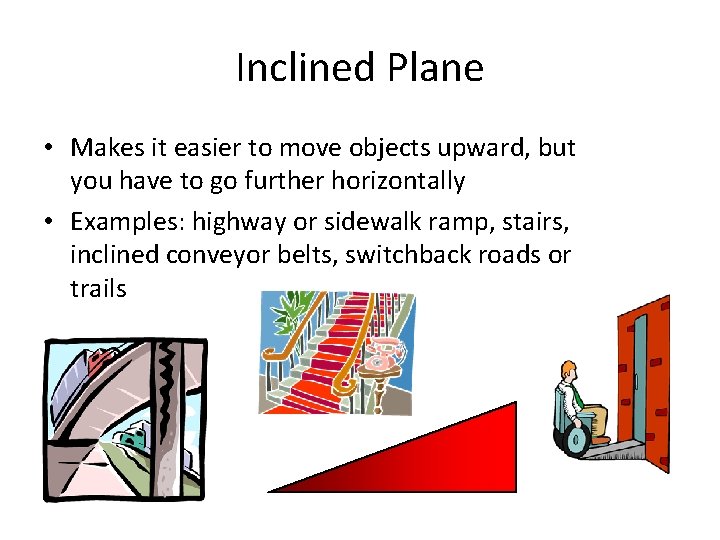
Inclined Plane • Makes it easier to move objects upward, but you have to go further horizontally • Examples: highway or sidewalk ramp, stairs, inclined conveyor belts, switchback roads or trails
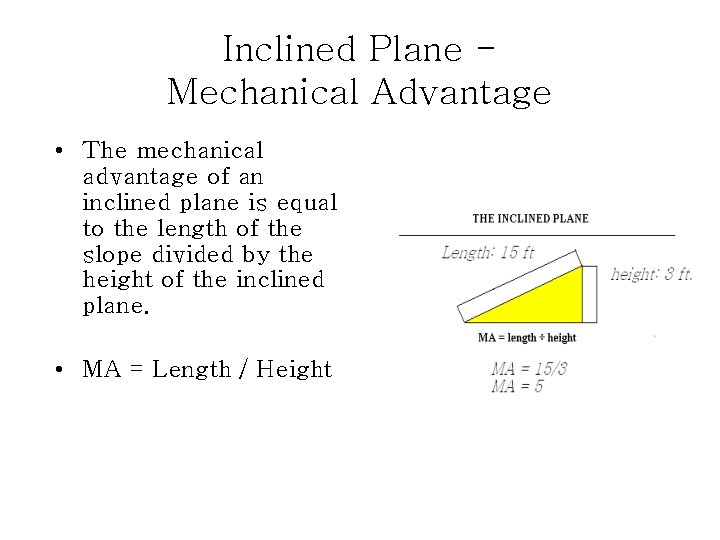
Inclined Plane Mechanical Advantage • The mechanical advantage of an inclined plane is equal to the length of the slope divided by the height of the inclined plane. • MA = Length / Height
• While the inclined plane produces a mechanical advantage, it does so by increasing the distance through which the force must move.
Pulleys
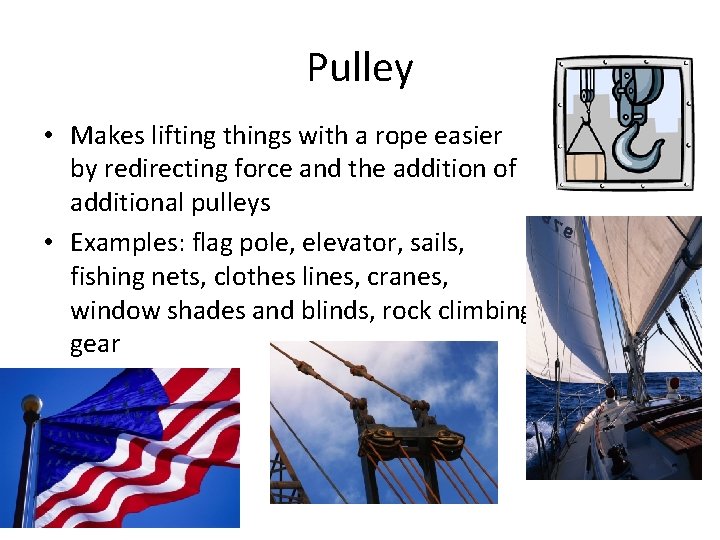
Pulley • Makes lifting things with a rope easier by redirecting force and the addition of additional pulleys • Examples: flag pole, elevator, sails, fishing nets, clothes lines, cranes, window shades and blinds, rock climbing gear
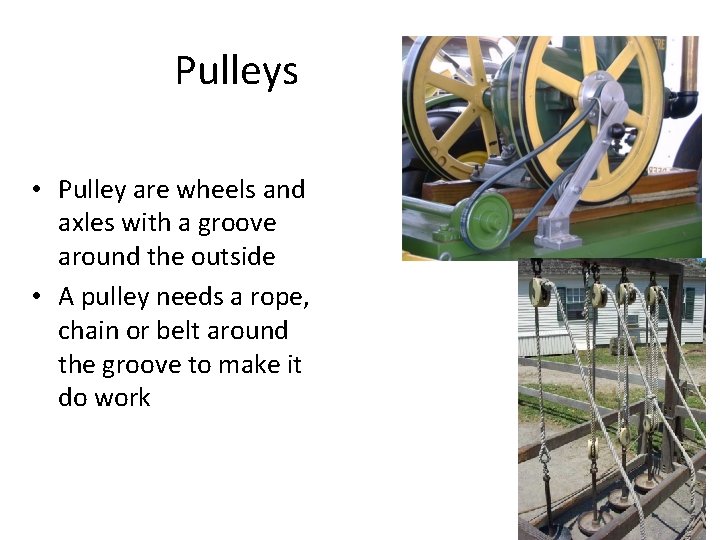
Pulleys • Pulley are wheels and axles with a groove around the outside • A pulley needs a rope, chain or belt around the groove to make it do work
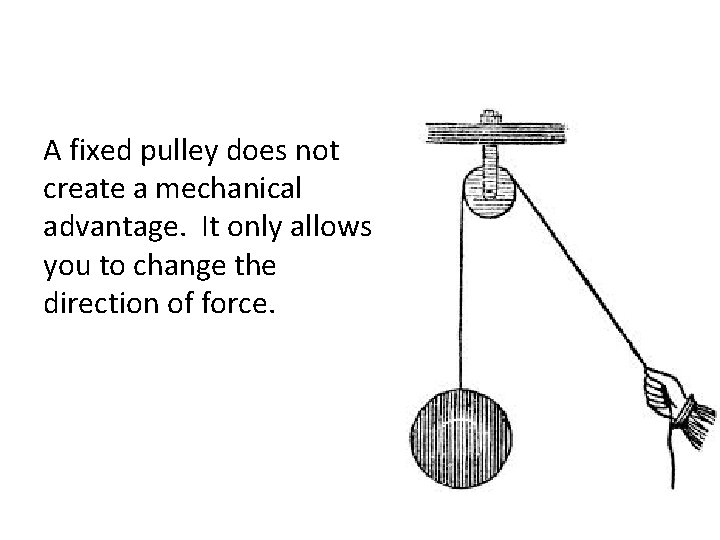
A fixed pulley does not create a mechanical advantage. It only allows you to change the direction of force.
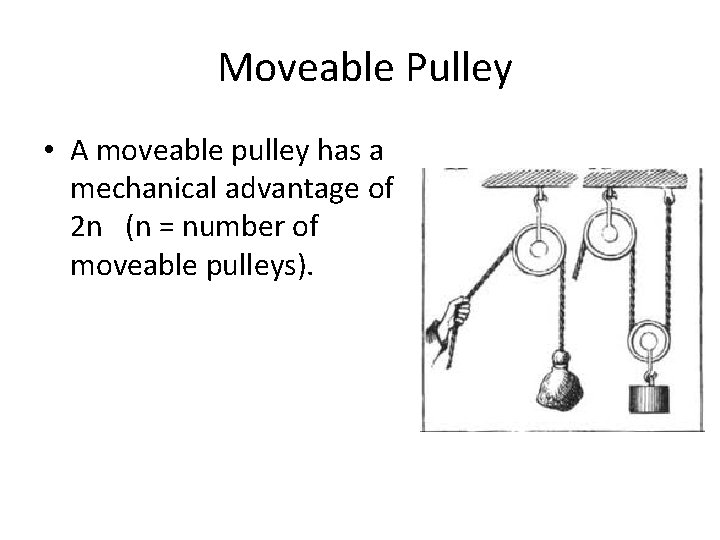
Moveable Pulley • A moveable pulley has a mechanical advantage of 2 n (n = number of moveable pulleys).
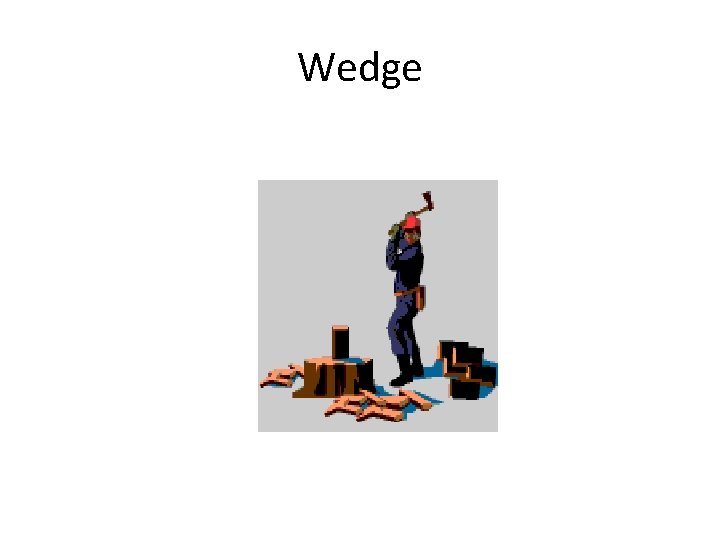
Wedge
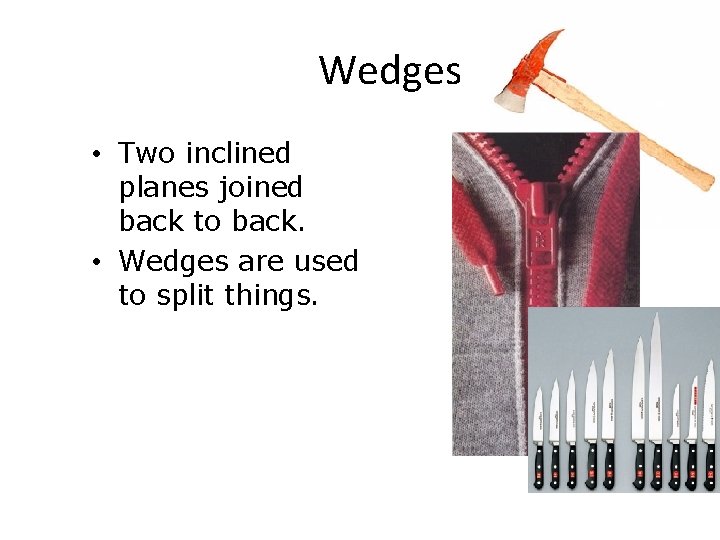
Wedges • Two inclined planes joined back to back. • Wedges are used to split things.
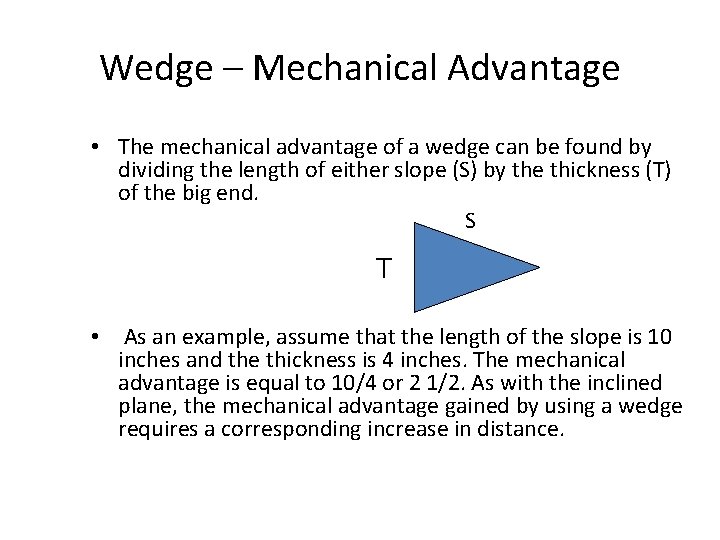
Wedge – Mechanical Advantage • The mechanical advantage of a wedge can be found by dividing the length of either slope (S) by the thickness (T) of the big end. S T • As an example, assume that the length of the slope is 10 inches and the thickness is 4 inches. The mechanical advantage is equal to 10/4 or 2 1/2. As with the inclined plane, the mechanical advantage gained by using a wedge requires a corresponding increase in distance.
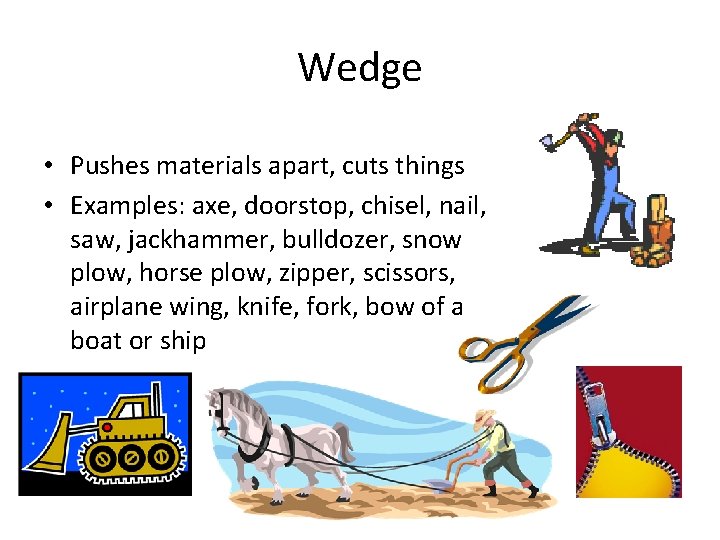
Wedge • Pushes materials apart, cuts things • Examples: axe, doorstop, chisel, nail, saw, jackhammer, bulldozer, snow plow, horse plow, zipper, scissors, airplane wing, knife, fork, bow of a boat or ship
The Screw
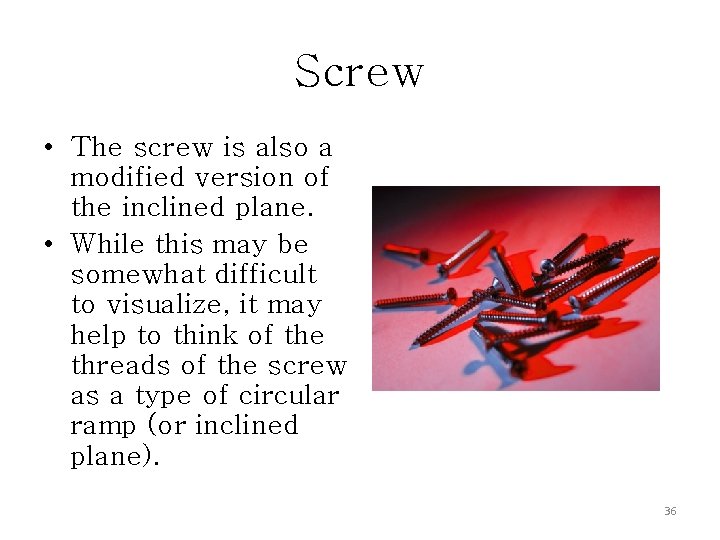
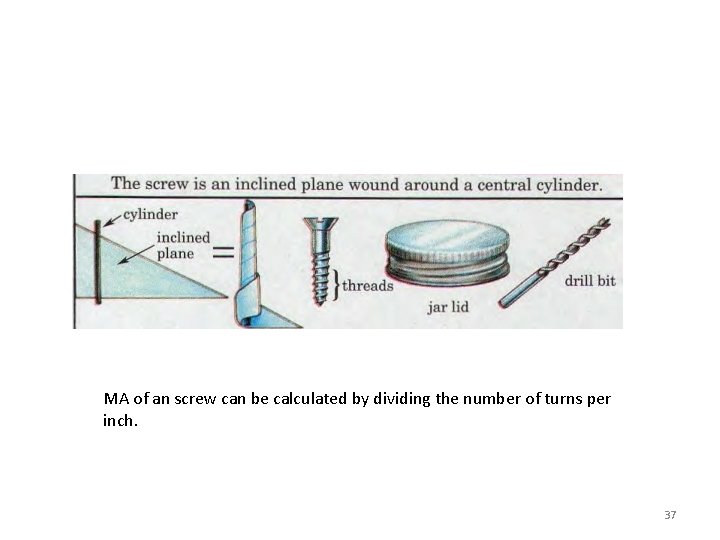
Screw • The screw is also a modified version of the inclined plane. • While this may be somewhat difficult to visualize, it may help to think of the threads of the screw as a type of circular ramp (or inclined plane). 36
MA of an screw can be calculated by dividing the number of turns per inch. 37
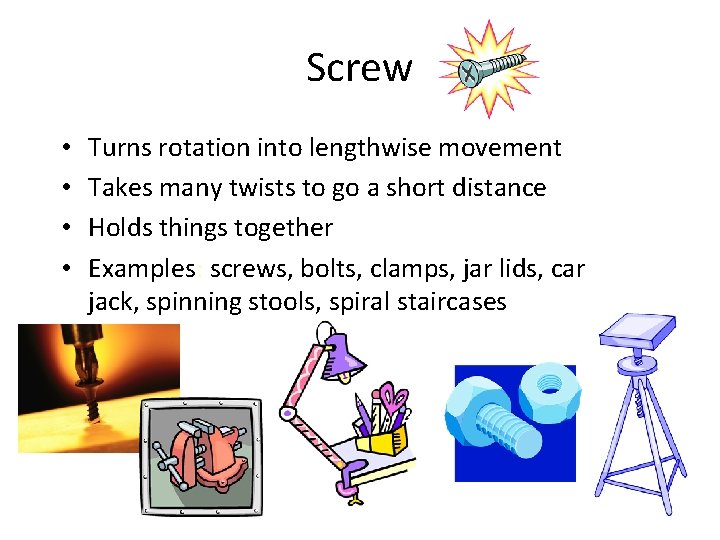
Screw • • Turns rotation into lengthwise movement Takes many twists to go a short distance Holds things together Examples: screws, bolts, clamps, jar lids, car jack, spinning stools, spiral staircases
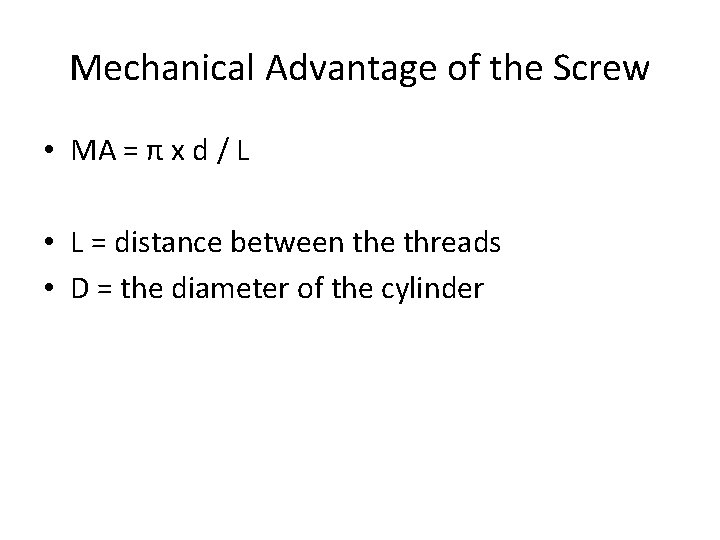
Mechanical Advantage of the Screw • MA = π x d / L • L = distance between the threads • D = the diameter of the cylinder
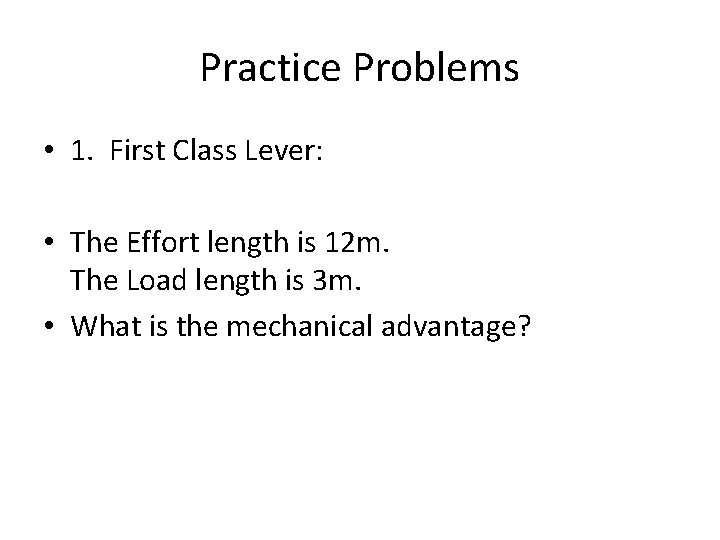
Practice Problems • 1. First Class Lever: • The Effort length is 12 m. The Load length is 3 m. • What is the mechanical advantage?
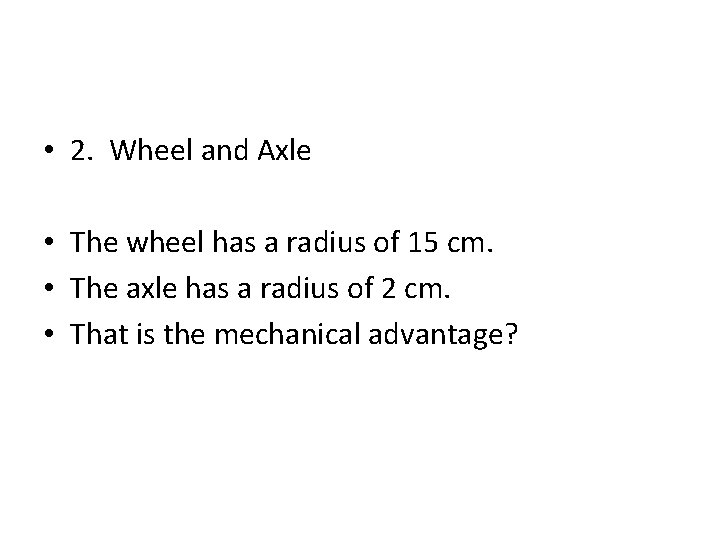
• 2. Wheel and Axle • The wheel has a radius of 15 cm. • The axle has a radius of 2 cm. • That is the mechanical advantage?
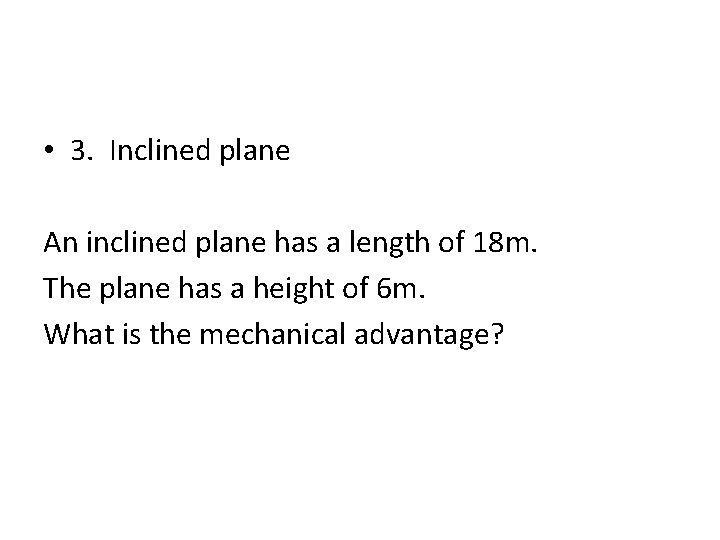
• 3. Inclined plane An inclined plane has a length of 18 m. The plane has a height of 6 m. What is the mechanical advantage?
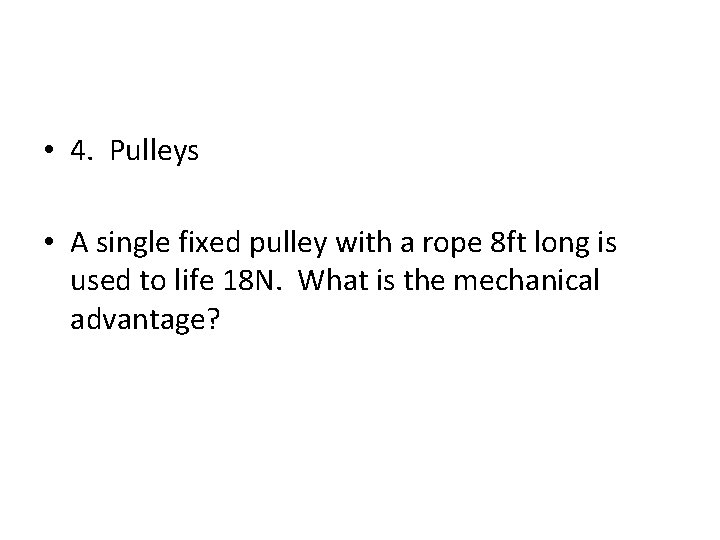
• 4. Pulleys • A single fixed pulley with a rope 8 ft long is used to life 18 N. What is the mechanical advantage?